 Slashdot Mirror
New Analysis Shows Lamar Smith's Accusations On Climate Data Are Wrong (arstechnica.com)
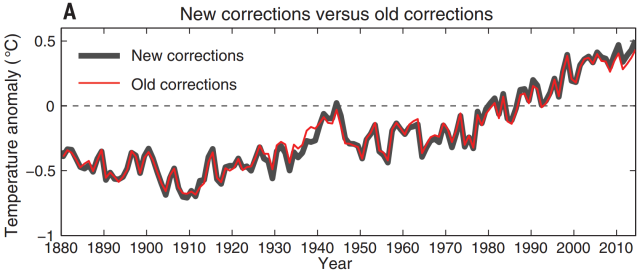
Layzej writes from a report via Ars Technica: In 2015, NOAA released version 4 of their marine temperature dataset called ERSST. The new dataset accounted for a known cooling bias introduced when ocean temperature measurements transitioned from being taken in ship engine intake valves to buoy-based measurements. The warming of the last couple decades increased ever so slightly in NOAA's new analysis. This was a red flag for U.S. House Science Committee Chair Lamar Smith (R-TX), who rejects the conclusions of climate science -- like the fact that the Earth's climate is warming. Suddenly he wanted to see the researchers' e-mails and echoed the accusations of contrarian blogs about scientists' supposedly nefarious adjustments to sea surface temperature measurements. Rather than invoking scientific conspiracies, issues like this should be settled by analyzing the data. A new study, led by University of California Berkeley's Zeke Hausfather, does just that -- and Rep. Smith won't like these results, either. To test the NOAA dataset, Zeke's team created instrumentally homogeneous temperature records from sensors available only over the last couple decades. As it happens, the Argo float data, the buoy data, and the satellite data each hew closer to the updated dataset that NOAA used. The older version (3b) gives a global average that is too cool in recent years, growing to an offset of about 0.06 degrees Celsius. The researchers repeat this same analysis for two more major sea surface datasets that are used by the UK Met Office and the Japanese Meteorological Agency for their global temperature records. Both of those datasets also drift cooler than the comparison data, but less so than NOAA's old dataset.
You're not going to convince an idiot by providing evidence that he doesn't understand.
Slashdot social media options: AIM, ICQ, Yahoo, Jabber and Mobile Text. Why no MySpace?
Bullshit.
It's the kind of obvious, blatant, easily disprovable but nonetheless convenient lie that leads to electing bullshit presidents.
http://ec.europa.eu/eurostat/w...
http://ec.europa.eu/eurostat/s...
Slashdot social media options: AIM, ICQ, Yahoo, Jabber and Mobile Text. Why no MySpace?
Suddenly he wanted to see the researchers' e-mails and echoed the accusations of contrarian blogs about scientists' supposedly nefarious adjustments to sea surface temperature measurements. Rather than invoking scientific conspiracies, issues like this should be settled by analyzing the data.
Most people wouldn't understand the data if you clubbed them over the head with it. Doubly so for politicians with no scientific training. The problem in the argument is that one side of this argument isn't arguing with facts and is actually incentivized to demonize any data that contradicts their pre-determined conclusions. They see the argument in one of two ways (sometimes both). A) They see climate change data as a threat to their personal interests - usually financial ones. If you are a politician sponsored by a fossil fuel company, this threatens your self interest. B) They see the climate change argument as something coming from the Other. It's a tribal thing - that Other group supports it ergo it must be bad. Often they frame it as a conspiracy despite the absurdity of that statement.
So in either case you have people who have no incentive whatsoever to acknowledge the data because it threatens what they hold dear. Rationality plays no role in it. The best way to combat this is to frame the argument in such a way as to align their incentives with the data. Point out how much money there is to be made/saved by working on the problem. Put it front and center as an economic issue. Figure out how to align solutions to the problem with economic and political self interest. Until you do that you're going to have this problem of certain politically powerful factions sticking their fingers in their ears and getting in the way.
Climate scientists haven't established Human caused global warming is real.
You are wrong. It's not even really a debate among climate scientists at this point. So far all the data seems to clearly show that humans are a key factor in recent climate change. And even just on the face of it the notion that we could be dumping so many billions of tons of CO2 and other pollutants into the atmosphere without any effect or consequence is just absurd. If you want to argue that we are still pinning down the exact extent of the effect of our activities then you might have an argument. But to pretend that our activities have had no effect on global climate is ridiculous.
That said, it doesn't really matter anyway. Even if hypothetically speaking humans weren't responsible at all for climate change we still would need to take action to deal with the reality of it. It's going to affect food supplies, energy resources, ecosystems, pollution, geopolitics, etc. The US Department of Defense (hardly a bastion of liberal thinking) considers it real and a significant threat to national security.
So far we just have a gently upward trend starting about 400 years ago, very similar to the previous upward trends that were entirely natural.
Yeah sorry but the data is just a tad more complicated than your little made up and cherry picked sound bite.
Right. During the late 20th century, ocean temperatures readings were primarily taken mechanically through an “engine-intake valve.” Ships pump water into their hull in order to cool the engine room, and a thermometer measures its temperature on the way. This can introduce bias to the numbers, though: Because engine rooms get hot, engine-intake-valve readings are skewed warmer than the actual ocean.
Whereas 95 percent of NOAA’s readings came from ship engine rooms in the early 1990s, 85 percent now come from buoys, which provide a more accurate reading. It turns out that if you don't account for that known bias you get a result that is less accurate.
No.
Over time the proportion of data contributed by taking measurements on ships has decreased.
NOAA said "hey guys, this has introduced a systematic error into the data and we need to adjust for it"
Other scientists were skeptical.
This group decided to test it. So they took several independent data sets that each used just one measurement so that each dataset is internally consistent.
They then discovered that all the data sets matched the NOAA adjusted combined data better than the previous unadjusted data.
What their work indicates is that the slow migration from ship thermometer to buoy, satellite etc has hidden an extra 0.06C/decade of warming - and that the warming rate over the last several decades is much closer to the rate over the previous decades than was thought.
(It should be pointed out that some statisticians don't accept that there was any statistically significant change in the warming rate over the last several decades even when using the pre NOAA (3b) data. My statistical knowledge isn't sufficient to be able to independently do the changepoint analysis necessary to confirm or refute this)
God said, "div D = rho, div B = 0, curl E = -@B/@t, curl H = J + @D/@t," and there was light.
Obligatory https://xkcd.com/1732/
On one hand the per capita CO2 emitted HAS increased from 4.3 tons per person in 1990 to 4.9 tons per person in 2014. This suggests that the world doesn't care.
On the other hand the world is far wealthier than it was twenty-five years ago. If you look at CO2 per dollar of purchasing power (PPP GDP), the world reduced it's CO2 emissions per dollar by fifty-six percent. The per dollar of GDP emissions have declined most markedly in ... Europe. The major industrial countries of Europe scored per dollar reductions on the order of 60% - 80%. (UK 600 g/$ --> 200; France 367 g/$ --> 129; Germany 560->208; Denmar 597->148; UK 557->182). Most European countries emit less CO2 per person, in the cases of the largest industrialized countries (UK, France, Germany) dramatically so. Italy is the only industrialized country to score large increases in C02 over that period.
SO here's the TL;DR: the world has tried and succeeded at becoming dramatically more carbon efficient -- about 2x as efficient on a dollar basis. That efficiency gain have not kept up with a Gross World Product that has more than doubled, and a population increase of over 1/3.
There's a world of difference between doing nothing and not doing quite enough to solve the problem. What we have done is push a number of climate change consequences further into the future, and that makes a big difference. For many of us it means not living to see those changes.
Post may contain irony: discontinue use if experiencing mood swings, nausea or elevated blood pressure.