 Slashdot Mirror
Japanese Company Develops a Solar Cell With Record-Breaking 26%+ Efficiency (arstechnica.com)
An anonymous reader quotes a report from Ars Technica: The silicon-based cells that make up a solar panel have a theoretical efficiency limit of 29 percent, but so far that number has proven elusive. Practical efficiency rates in the low-20-percent range have been considered very good for commercial solar panels. But researchers with Japanese chemical manufacturer Kaneka Corporation have built a solar cell with a photo conversion rate of 26.3 percent, breaking the previous record of 25.6 percent. Although it's just a 2.7 percent increase in efficiency, improvements in commercially viable solar cell technology are increasingly hard-won. Not only that, but the researchers noted in their paper that after they submitted their article to Nature Energy, they were able to further optimize their solar cell to achieve 26.6 percent efficiency. That result has been recognized by the National Renewable Energy Lab (NREL). In the Nature Energy paper, the researchers described building a 180.4 cm2 cell using high-quality thin-film heterojunction (HJ) -- that is, layering silicon within the cell to minimize band gaps where electron states can't exist. Controlling heterojunctions is a known technique among solar cell builders -- Panasonic uses it and will likely incorporate it into cells built for Tesla at the Solar City plant in Buffalo, and Kaneka has its own proprietary heterojunction techniques. For this record-breaking solar cell, the Kaneka researchers also placed low-resistance electrodes toward the rear of the cell, which maximized the number of photons that collected inside the cell from the front. And, as is common on many solar cells, they coated the front of the cell with a layer of amorphous silicon and an anti-reflective layer to protect the cell's components and collect photons more efficiently.
"26.3 percent, breaking the previous record of 25.6 percent. Although it's just a 2.7 percent increase"
Uh, what? Someone flunked elementary school math.
25.6 * 1.027 = 26.29
Lots of people flunk elementary maths... apparently.
If God forks the Universe every time you roll a die, he'd better have a damned good memory.
Cost is not everything, that is pretty dumb economic thinking. Cost efficiency is everything, the return on capital investment. With branded solar energy systems, retained capital investment is as important as energy generated. Want it the price of a home with a top quality solar energy system versus a home without one. What premium can you start to charge on a home where the supply charge for electricity is higher than the cost of actual supply of electricity, a house that is basically black out proof. Where energy running cost for a car heads to zero.
So in mid level housing density, how close to an effective solar energy system for a two story town house, where a premium is paid, due to limited are for panels. It makes no sense with solar panels to have them anywhere else but as close as practicable to the point of demand, screw the insensate greed of the energy companies. Doing away with the electrical grid all together in suburban low density housing would be a major victory for the majority, screw the energy companies, they can pretty much choke on their own gas (tee hee).
Chaos - everything, everywhere, everywhen
Over time, though, the cost almost always comes down unless there's a reliance on highly valuable raw materials (such as gold).
This sig has been enciphered with a one-time pad. It could say almost anything.
26.29 rounds to 26, not 27.
Nobody mentioned 27 though. 2.7 isn't 27.
And, although the wording clearly implies an absolute relationship, the correct relative formula would be 26.3/25.6=1.03 when significant digits are accommodated (which would be a 3% relative increase).
You're making the assumption that 26.3 and 25.6 are given with the full number of significant digits (which may not be the case), or that significant digits actually matter in a percentage figure (not an actual measurement) in popular scientific journalism. Get over yourself.
Well, at least you're in good company.
Someone's really salty to be shown wrong, eh?
26.29 rounds to 26, not 27. And, although the wording clearly implies an absolute relationship, the correct relative formula would be 26.3/25.6=1.03 when significant digits are accommodated (which would be a 3% relative increase).
26.3 (the previous record), multiplied by 1.027 (or 102.7%, or increasing by 2.7%) equals 26.29, which rounds to 26.3 (the new record).
That's not elementary maths, I grant you, but I'm sure you would have spotted it if you weren't so eager for the FP.
If God forks the Universe every time you roll a die, he'd better have a damned good memory.
...but solar cell efficiency only really matters when space is limited.
Nobody said there would be math in this comments section.
Next time, could we get some kind of warning?
You are welcome on my lawn.
"26.3 percent, breaking the previous record of 25.6 percent. Although it's just a 2.7 percent increase" Uh, what? Someone flunked elementary school math.
25.6 * 1.027 = 26.29
Lots of people flunk elementary maths... apparently.
It's from Japan; their numbers are in metric - duh.
It must have been something you assimilated. . . .
Modern consumer solar is breathtakingly amazing.
We forget how bad things were just 15-20 years ago.
Earlier today, I set up a folding panel with sunpower cells; it was literally vertical, in a window, facing South. Total surface area.. maybe 3sqft, weighing 1lb. It was making ~20W for 4 hours, and managed to completely recharge my 130Wh battery pack in 8. Through a window. In the winter, in Canada.
The thing cost $120.
It's easy to get lost in the constant claims of breakthroughs while forgetting what an amazing time we live in. 20 years ago, this panel would have blocked out the sun and cost a months' salary.
A government is a body of people notably ungoverned - AC
and I have all of my roof covered that gets direct sunlight, and they still aren't powerful enough to produce enough power even in the summer to overcome the self-discharge of my SLA batteries. Here in Seattle in the winter, I might as well not even have the panels. 26% efficient would be strong enough to keep me from having to plug a charger into the wall to charge my batteries for maybe six months a year. Hopefully this will reach consumers soon.
The state of WA is almost entirely powered by hydro-electric. We already have reasonably cheap, green power right off the grid here. And you weren't satisfied with buying solar panels just once, but are interested in purchasing a second set because the first ones were so worthless.
I'm apparently missing something.
Irony: Agile development has too much intertia to be abandoned now.
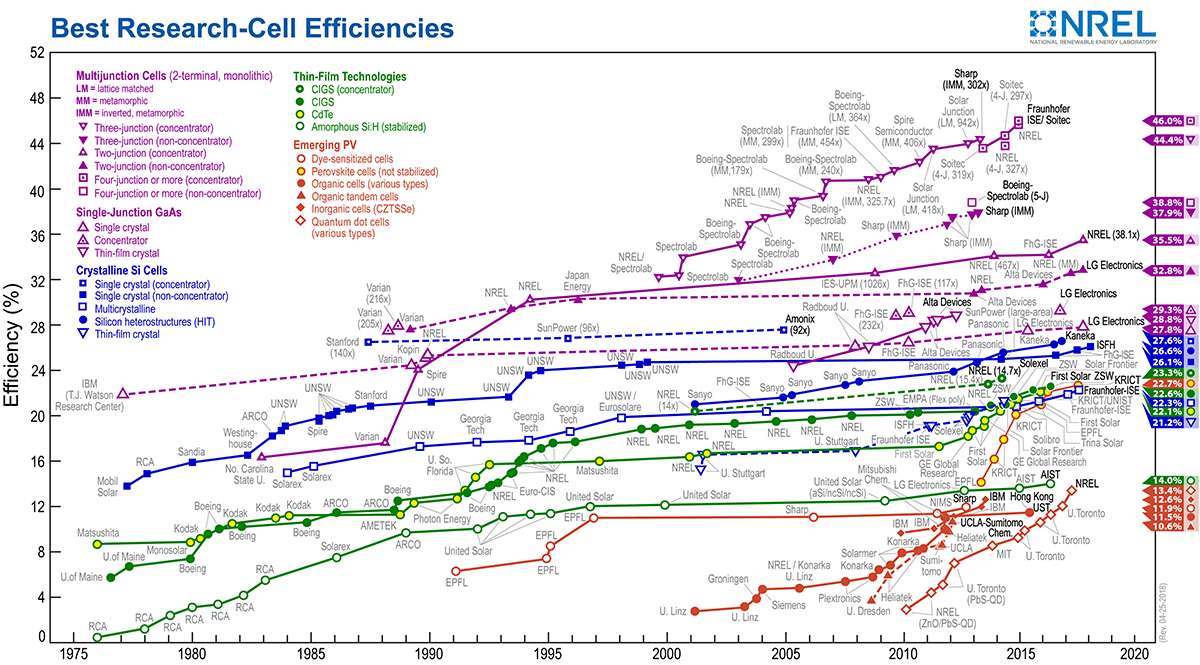
There is a good graph on Wikipedia regarding research cell efficiency over time, and comparing all of the technologies at https://en.wikipedia.org/wiki/...
It can legitimately be read as
25.6%+2.7%=28.3% (huh?).
No, what you have just described is a 2.7 percentage point increase. The language is not ambiguous.
have solar cells without making ridiculous amounts of toxic waste. ... no idea where this myth is coming from.
Production of solar cells does not produce "ridiculous amounts of toxic waste"
BTW: traditional PV cells are produced in the same way as computer chips, CPUs, memory, and SSDs.
Cost free eBook I read (by iBook/Kobo/Amazon/ObookO/Gutenberg etc.): "The Green Odyssey" by Philip Jose Farmer.
What's wrong with you ?
There's a new better photovoltaic cell, that is actually produced by an actual manufacturer (Kaneka) and could soon be matched by other actual manufacturer making real cells in the real world (Panasonic and Tesla mentioned), and not simply one of those "small research team in some university lab make a small breakthrough that could increase cell effenciency. In theory. Probably within 25 years when the discovery finally reach actual production at a real-world manufacturer".
And all you people bicker about how the numbers are presented in the summary ?
What's next ? Going ape-shit crazy about some shirt that a scientist is wearing, instead of paying attention that he's announcing that they managed to land a probe on...
oh, wait!
"Sufficiently advanced satire is indistinguishable from reality." - [Tips: 1DrYakQDKCQ6y52z6QbnkxHXAocMZJE61o ]