 Slashdot Mirror
Japanese Company Develops a Solar Cell With Record-Breaking 26%+ Efficiency (arstechnica.com)
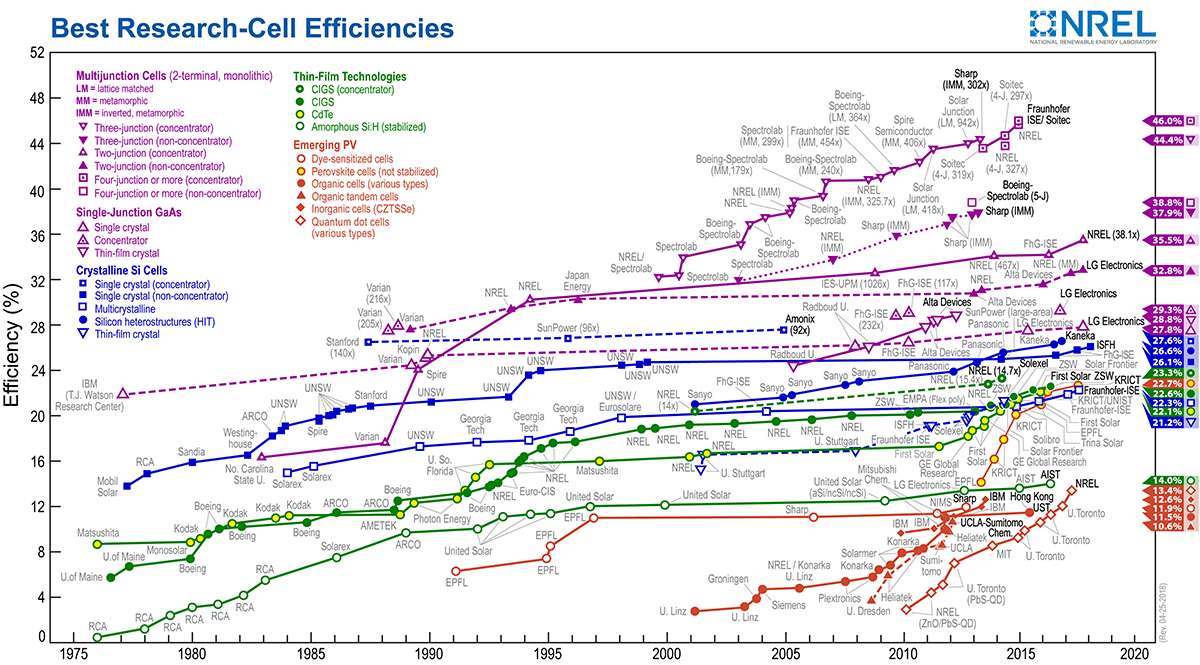
An anonymous reader quotes a report from Ars Technica: The silicon-based cells that make up a solar panel have a theoretical efficiency limit of 29 percent, but so far that number has proven elusive. Practical efficiency rates in the low-20-percent range have been considered very good for commercial solar panels. But researchers with Japanese chemical manufacturer Kaneka Corporation have built a solar cell with a photo conversion rate of 26.3 percent, breaking the previous record of 25.6 percent. Although it's just a 2.7 percent increase in efficiency, improvements in commercially viable solar cell technology are increasingly hard-won. Not only that, but the researchers noted in their paper that after they submitted their article to Nature Energy, they were able to further optimize their solar cell to achieve 26.6 percent efficiency. That result has been recognized by the National Renewable Energy Lab (NREL). In the Nature Energy paper, the researchers described building a 180.4 cm2 cell using high-quality thin-film heterojunction (HJ) -- that is, layering silicon within the cell to minimize band gaps where electron states can't exist. Controlling heterojunctions is a known technique among solar cell builders -- Panasonic uses it and will likely incorporate it into cells built for Tesla at the Solar City plant in Buffalo, and Kaneka has its own proprietary heterojunction techniques. For this record-breaking solar cell, the Kaneka researchers also placed low-resistance electrodes toward the rear of the cell, which maximized the number of photons that collected inside the cell from the front. And, as is common on many solar cells, they coated the front of the cell with a layer of amorphous silicon and an anti-reflective layer to protect the cell's components and collect photons more efficiently.
"26.3 percent, breaking the previous record of 25.6 percent. Although it's just a 2.7 percent increase"
Uh, what? Someone flunked elementary school math.
25.6 * 1.027 = 26.29
Lots of people flunk elementary maths... apparently.
If God forks the Universe every time you roll a die, he'd better have a damned good memory.
First they tried thin-film homojunction, but they couldn't get it to replicate.
Cost is not everything, that is pretty dumb economic thinking. Cost efficiency is everything, the return on capital investment. With branded solar energy systems, retained capital investment is as important as energy generated. Want it the price of a home with a top quality solar energy system versus a home without one. What premium can you start to charge on a home where the supply charge for electricity is higher than the cost of actual supply of electricity, a house that is basically black out proof. Where energy running cost for a car heads to zero.
So in mid level housing density, how close to an effective solar energy system for a two story town house, where a premium is paid, due to limited are for panels. It makes no sense with solar panels to have them anywhere else but as close as practicable to the point of demand, screw the insensate greed of the energy companies. Doing away with the electrical grid all together in suburban low density housing would be a major victory for the majority, screw the energy companies, they can pretty much choke on their own gas (tee hee).
Chaos - everything, everywhere, everywhen
Over time, though, the cost almost always comes down unless there's a reliance on highly valuable raw materials (such as gold).
This sig has been enciphered with a one-time pad. It could say almost anything.
Keeping the same number of significant digits in the lower and higher efficiencies, a 3 percent increase from 25.6 would round to 26.4, and a 2 percent increase from 25.6 would round to 26.1.
This means that to describe a percentage increase that properly rounds to 26.3, you need one more digit, and once you decide to add the extra digit, you want to make it as accurate as possible. The 2.7 percent given in the article rounds to 26.3, as accurately as possible.
26.29 rounds to 26, not 27.
Nobody mentioned 27 though. 2.7 isn't 27.
And, although the wording clearly implies an absolute relationship, the correct relative formula would be 26.3/25.6=1.03 when significant digits are accommodated (which would be a 3% relative increase).
You're making the assumption that 26.3 and 25.6 are given with the full number of significant digits (which may not be the case), or that significant digits actually matter in a percentage figure (not an actual measurement) in popular scientific journalism. Get over yourself.
Well, at least you're in good company.
Someone's really salty to be shown wrong, eh?
This is only single cell solar cells, multi-junction cells have breached 46%. https://www.ise.fraunhofer.de/... At this point increases in efficiency are mostly masturbation, relying on complex materials/techniques that aren't worth the cost. The big transformation will occur when they get thin film solar cells that are more efficient so you can have solar cells without making ridiculous amounts of toxic waste.
26.29 rounds to 26, not 27. And, although the wording clearly implies an absolute relationship, the correct relative formula would be 26.3/25.6=1.03 when significant digits are accommodated (which would be a 3% relative increase).
26.3 (the previous record), multiplied by 1.027 (or 102.7%, or increasing by 2.7%) equals 26.29, which rounds to 26.3 (the new record).
That's not elementary maths, I grant you, but I'm sure you would have spotted it if you weren't so eager for the FP.
If God forks the Universe every time you roll a die, he'd better have a damned good memory.
...but solar cell efficiency only really matters when space is limited.
Nobody said there would be math in this comments section.
Next time, could we get some kind of warning?
You are welcome on my lawn.
Don't you worry folks... we got your coal jobs right here!!! that thar sciency mumbo jumbo is fer them Hollywood E-leetists... you won't catch me usin' no soLAR sells.... commie contraptions iffn' ya ask me!!!!
"26.3 percent, breaking the previous record of 25.6 percent. Although it's just a 2.7 percent increase" Uh, what? Someone flunked elementary school math.
25.6 * 1.027 = 26.29
Lots of people flunk elementary maths... apparently.
It's from Japan; their numbers are in metric - duh.
It must have been something you assimilated. . . .
The only reasonable improvements are in reducing the cost of manufacturing and reducing the amazingly toxic byproducts of solar cell production.
And, of course, making them Godzilla proof.
It must have been something you assimilated. . . .
My solar panels are 14% efficient and cost 11 cents per watt.
Modern consumer solar is breathtakingly amazing.
We forget how bad things were just 15-20 years ago.
Earlier today, I set up a folding panel with sunpower cells; it was literally vertical, in a window, facing South. Total surface area.. maybe 3sqft, weighing 1lb. It was making ~20W for 4 hours, and managed to completely recharge my 130Wh battery pack in 8. Through a window. In the winter, in Canada.
The thing cost $120.
It's easy to get lost in the constant claims of breakthroughs while forgetting what an amazing time we live in. 20 years ago, this panel would have blocked out the sun and cost a months' salary.
A government is a body of people notably ungoverned - AC
Seattle gets about 3.7 hours per day average insolation. It doesn't make sense to put them there until you run out of space in AZ and California. Your roi is 2x higher in those places. Worse than that, it doesn't provide energy in the winter when it's needed most. I have a house there and my summer electric bill is next to nothing.
http://rredc.nrel.gov/solar/ol...
"26.3 percent, breaking the previous record of 25.6 percent. Although it's just a 2.7 percent increase" Uh, what? Someone flunked elementary school math.
26.29/25.6=1.026953125 ,rounded to 3 decimals 1.027 , which makes it a 2.7 percent increase. How man decimals do they need to use not to flunk math would you say?
If my comment didn't sound as good in your head as it did in mine, then I guess we all know who's to blame
The language is actually ambiguous.
It can legitimately be read as
25.6%+2.7%=28.3% (huh?).
or
25.6%+ (25.6%*2.7%)=26.29% (hooray)
or even
25.6%*1.027=26.29% (hooray)
She was like chocolate when she drank... semi-sweet at first and then increasingly bitter.
and I have all of my roof covered that gets direct sunlight, and they still aren't powerful enough to produce enough power even in the summer to overcome the self-discharge of my SLA batteries. Here in Seattle in the winter, I might as well not even have the panels. 26% efficient would be strong enough to keep me from having to plug a charger into the wall to charge my batteries for maybe six months a year. Hopefully this will reach consumers soon.
The state of WA is almost entirely powered by hydro-electric. We already have reasonably cheap, green power right off the grid here. And you weren't satisfied with buying solar panels just once, but are interested in purchasing a second set because the first ones were so worthless.
I'm apparently missing something.
Irony: Agile development has too much intertia to be abandoned now.
It can legitimately be read as
25.6%+2.7%=28.3% (huh?).
No, what you have just described is a 2.7 percentage point increase. The language is not ambiguous.
Sometimes there is an energy cost to making the material/molecular structure.
Why is this rated -1? Cost is a damn strong motivator to general adoption, and the absolute first thing that comes to mind as a barricade to entry in the current energy market.
Cost might not be the only thing that matters, but any energy source today must fulfill one of two criteria -
1. Cheap. For personal use (such as solar panels on the roof of a house) the barrier to entry is price. Your standard homeowner only has $X saved up, so even a super-efficient solar panel for $250,000 will remain out of reach. A cheap-ass solar panel of low efficiency for $1,000 though? That is what makes the energy companies complain (and lobby for bans).
2. A high power to cost ratio. The west is starting to drown in wind-parks. The energy is there, but building a wind-turbine out in nowhere is expensive, and the energy output is damn low. Coupled with the erratic performance of wind ( and solar to a lesser extent), and you will need a(n expensive) backup source to meet demand. Don't expect to get your money back quickly. And that's not even counting the protesting or zoning laws you will face before construction can begin.
And because of those, the parent asked a very pertinent quetion - What does it cost? Because that determines what, if any, role can the panel fulfill in our current energy market.
Eh? Well, the way I was taught to calculate a percentage increase was:
(a) 26.3 - 25.6 = 0.7
(b) 0.7/25.6 = 0.02734
So 2.7% increase....
(c) Check your result 25.6 * 1.02734 = 26.2999 or round up to 26.3
At least these guys agree with me anyway...
https://www.skillsyouneed.com/...
You are so stupid it's truly a shame your parents were not tortured for bringing you into this world. Even the Republicans support abortion for things as stupid as you.
Can you actually share this links? Or you are not allowed by the rules of the website ? that would be a pity. Your comment actually seems quite good compared to alll the terrible stuff that is above
Oh I like how this is going!
Maybe the word 'ambiguous' is too ambiguous for you?
And don't forget , 26.29% is just 2.7% away from that theoretical limit!
We need Gunpistolman on here.
What's wrong with you ?
There's a new better photovoltaic cell, that is actually produced by an actual manufacturer (Kaneka) and could soon be matched by other actual manufacturer making real cells in the real world (Panasonic and Tesla mentioned), and not simply one of those "small research team in some university lab make a small breakthrough that could increase cell effenciency. In theory. Probably within 25 years when the discovery finally reach actual production at a real-world manufacturer".
And all you people bicker about how the numbers are presented in the summary ?
What's next ? Going ape-shit crazy about some shirt that a scientist is wearing, instead of paying attention that he's announcing that they managed to land a probe on...
oh, wait!
"Sufficiently advanced satire is indistinguishable from reality." - [Tips: 1DrYakQDKCQ6y52z6QbnkxHXAocMZJE61o ]
The key word is 'buffering' , the ability to absorb excess energy. Solar and wind energy are very variable. You can store a bit of excess energy locally in your own home, but a smart grid allows you to pass it on to others who need it. Excess energy production on a larger scale becomes problematic. If you can adjust fossil energy production quickly to match so you can compensate this way, but the possibilities for storing renewable energy are minimal. They're also rather lowtech so they won't get much attention(except when Tesla comes up with household battery storage).
One reason why the German 'energiewende' is fairly successful is because they're the first to do large scale conversion to renewables, so they can make use of the European buffering capacity of the network. But the next one does not have that benefit.
Cost is not everything, that is pretty dumb economic thinking. Cost efficiency is everything, the return on capital investment.
With solar panels, it turns out that these two correlate quite nicely. With the exception of potential panel area limitation, cheaper panels are also more cost efficient. Although the US is also an outlier with fixed non-hardware costs (permits, labor etc.), so your experience may be somewhat different than in other parts of the world, where the cost efficiency of ordinary panels is much more obvious.
Ezekiel 23:20
Eh? Well, the way I was taught to calculate a percentage increase was:
(a) 26.3 - 25.6 = 0.7 (b) 0.7/25.6 = 0.02734
It's not a percentage increase in the first place. When the power of the incident light was 100W the old solar cells would produce 25.6W of electrical power. In the same conditions the new cells provide 26.3W. So that's an increase in the delivered power of (26.3 - 25.6) / 25.6 = 2.7%. See none of the numbers being compared are percentages.
I just do 1 - old/new.
A notable example of that is silicon wafer manufacturing.
Well, kind of. The cost for wafers keeps staying about the same but the transistor-density goes up. So if you were to measure cost/transistor, the prices are sinking like a rock.
We need both:
Panels that are cheap for areas such as building roofs where grabbing every last watt isn't such a big deal, due to the availability of space. It is just getting the solar cells on the area that is the main thing.
Panels where surface area is hard to obtain (satellites is one example.) where every watt is precious. A more realistic example are solar panels on class "B" motorhomes (campervans.) There isn't much in the way of square footage, so the trick is to maximize what can be gotten.
Similar argument can be made regarding PWM versus MPPT controllers. You can buy a PWM controller for $8 which "lops off" excess voltage and passes the batteries what it needs. MPPT controllers require an inductor and coil to change volts into amps and vice versa, so are usually an order of magnitude more expensive... but for areas where space is precious, they allow more energy to hit the batteries.
I've found that the charger you are using makes a difference. If it is a PWM charger that cuts the voltage down to whatever the batteries take, you can lose 25-50% of the incoming wattage. For example (and note, these figures vary widely in real life since batteries require different voltages in different charging stages), a 24 volt panel feeding a PWM charger that is using a 12 volt battery, the PWM charger will not use 12 volts of the 24 coming in. However, a MPPT controller will reduce the voltage and double the amperage.
The difference is quite noticeable when it comes to smaller applications.
"you will need a(n expensive) backup source to meet demand"
If you can use LFTR (when they're ready) it's likely to prove so cheap that solar and wind installations will be abandoned.
"the European buffering capacity of the network"
AKA "The very large French nuclear reactor fleet in the country next door (which happens to be France)", which has some load-following ability.
"Renewables" in northern europe have the potential to replace all current carbon emitting sources - if the entire european countryside is carpetted in turbines and glazed with solar panels, at a cost several tens of times higher than the carbon-emitting sources (and the fuel) they replace.
Eliminating OTHER sources of carbon (heating, transportation, industrial processes) will require an increase in electrical generation by a factor of _AT LEAST_ 6 if not more. The only way forward is massive investment into nuclear sources and nuclear research. We _need_ LFTR technology and we need it deployed at least 10 years ago. The ironic thing is that LFTR's inherent ability to load-follow without penalty means that whilst it's an ideal backing source for "renewables" the overall lower cost of operation (an removal of the need to subsidise, as LTFRs are carbon-neutral) means that the deployed renewables fleet would become white elephants overnight.
When you factor in the requirements for increased energy availability in developing countries, the need for nuclear sources is clear. Even in equatorial areas the investment required to ramp up production of "renewable" energy dwarfs the cost of a few nuclear plants (conventional or LFTR) and without low-cost reliable energy, we cannot continue to both pull people out of poverty AND reduce the population (well-off people have fewer kids. Making people better off is the only _proven_ way of curbing population growth. Wars, Famine and Malthus effects have _all_ resulted in population bounces which more than made up the losses within 2 generations.)
Those nuclear plants are likely to be chinese, and the LFTR plants will almost definitely be chinese - they're the biggest player in R&D into making LFTRs viable. It'll be interesting to see how fast chinese industry hoovers up both Thorium and "nuclear waste" to feed their plants in the next 20 years.