 Slashdot Mirror
NASA Images of Puerto Rico Reveal How Maria Wiped Out Power On the Island (jalopnik.com)
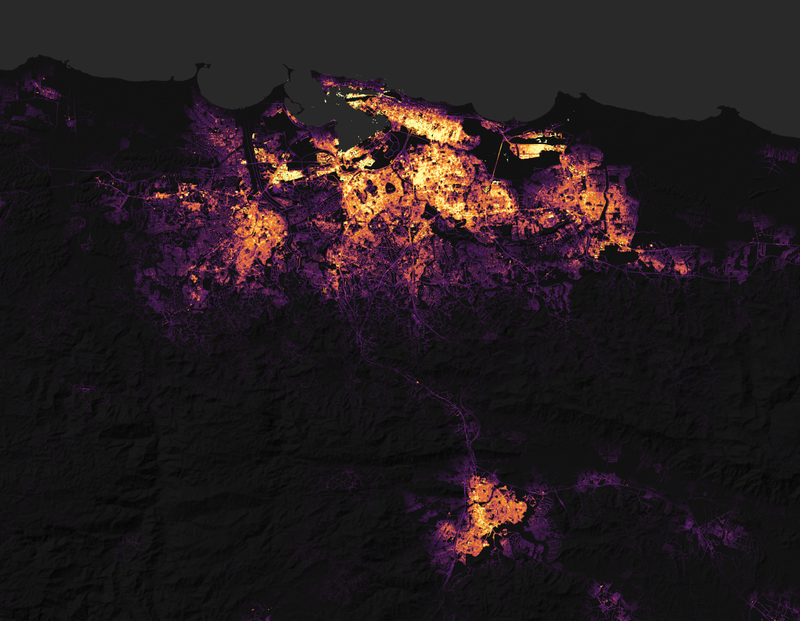
An anonymous reader quotes a report from Jalopnik: Hurricane Maria was the most devastating hurricane to make land in Puerto Rico in nearly 100 years and the country is still reeling in its wake. Much of the island still doesn't have running water, reliable communication or electricity. Recently, NASA published a set of date-processed photos that show the island's nighttime lights both before and after the storm. Here, you can see images of the country's capital, San Juan, on a typical night before Maria. It's based on cloud-free and low moonlight conditions. Conversely, the following composite image is of data taken on the nights of Sept. 27 and 28 -- nearly a week after the storm hit -- by the Visible Infrared Imaging Radiometer Suite, a scanning radiometer that collects visible and infrared imagery of land, atmosphere, cryosphere and oceans, according to NASA's website.

Obviously, however the reason why they put them on poles in the first place is because it's considerably cheaper than run them underground and if you've paid any attention to what's been going on there for the last few years you'll know they don't exactly have the money for this just lying around.
To put the cost into perspective, here in Finland, where we don't have the same debt and budgetary problems, they only relatively recently started mandating companies put a significant effort into moving the above-ground powerline infrastructure under ground and the current plan is to have 65% of the low voltage and 47% of the medium voltage infrastructure moved to underground cables by 2029.
"Why should I want to make anything up? Life's bad enough as it is without wanting to invent any more of it."
These photographs don't shed any light on how the grid was wiped out. It just shows how much. Which we already know. Just a little bit more graphic. That is all.
sed -e 's/Chuck Norris/Rajnikant/g' joke > fact
While other states have representatives to bring home pork spending, Puerto Rico does not. In addition, the median household income is $18K compared to Mississippi, where where the per capita income is $40K. How much can you really tax a household that only makes $18K? No companies will target Puerto Rico as a market. It's expensive to ship food there from the COTUS. In addition, if the island was already in debt, a substantial portion of the revenues are going to pay off the debug.
So it's easy to say the government "drove the island to bankruptcy" implying that funds are being mismanaged. Even a new government would not be able to change the status quo because they are starting from such a deep hole. When the federal government needs to get out of a recession, they use deficit spending, and the closest thing a state can do to do that (which is not really ethical but there are no other options) is to issue bonds, and then default on them (bankruptcy).
A large part of the challenges that Peurto Rico faces is that it is not in fact a country, but rather it is an "unincorporated territory of the United States located in the northeast Caribbean Sea".
https://en.wikipedia.org/wiki/...
https://www.thoughtco.com/puer...
Peraps if Peurto Rico was a country (or a "state" within the United States), they might have been better able to respond to the types of problems that this storm has caused.
WIth a population of a bit more than 3.4 million, the territory seems to have more people than twenty-two other US states:
http://worldpopulationreview.c...
The design and construction of underground transmission lines differ from overhead lines because of two significant technical challenges that need to be overcome. These are: 1) providing sufficient insulation so that cables can be within inches of grounded material; and 2) dissipating the heat produced during the operation of the electrical cables. Overhead lines are separated from each other and surrounded by air. Open air circulating between and around the conductors cools the wires and dissipates heat very effectively. Air also provides insulation that can recover if there is a flashover.
Happiness in intelligent people is the rarest thing I know.
Ernest Hemingway
To further support your point, National Electric Code requires a much thicker wire gauge for buried/raceway applications. Or rather, for any given wire gauge the allowable amperage is much lower if buried, so I suppose it doesn't matter if you're already going to massive overspec your run.
Take 4/0 copper and 75C rated wire. In free air it's legally rated to 360 amps. Buried, it's legal up to 230 amps.
Failure rates for underground cables are higher in normal operation, and are more sudden and difficult to repair compared to overhead. You might get it for a residential subdivision, but not for the distribution network.
The real problem is that the poles are too far apart resulting in dramatically higher wind loading in a direction they have little capability to resist. Coupling that with the complete lack of maintenance, poor quality repairs, extremely high centralization of substation infrastructure, and transmission towers that are likely as under-designed as the island's cell towers, it is pretty easy to see why we are here.
We were trying to get a redundant feeder to a site there, and it was essentially impossible. Their grid was bare bones to say the least.
If you don't know anything about high voltage and power distribution you probably shouldn't be commenting like this.
Underground wires fail all the time, I have had six power outages this summer in Arizona due to exactly that. As cables heat up their insulator breaks down and becomes brittle and then dust. When the wire is exposed it is now very close to the ground where it will bleed current. Worse yet, if both + and - lines lose their insulation they could short, typically they are run in separate conduit though so it is more of an issue where the wire surfaces.
If you have ever loaded an extension cord with too much current you'll see what I mean. I used to work in tents with temporary power all the time. Extension cords for lighting were always so hot you couldn't touch them. You solve that problem by using a thicker gauge which also allows you to go further. I had a hell of a time getting 208 power 500 feet from the generator. It takes real thick wire if you're going to actually power a server rack or two. 20 amp 208 for 500' ends up being 10 gauge preferably but you can probably get away with 12. Either way that is some THICK wire and is very hard to work with. Now imagine doing that with transmission lines while are way higher voltage and pulling waaay more current.