 Slashdot Mirror
Researchers Want To Turn Your Entire House Into a Co-Processor Using the Local Wi-Fi Signal (arstechnica.com)
An anonymous reader shares an excerpt from a report via Ars Technica: Researchers are proposing an idea to make your computer bigger. They are suggesting an extreme and awesome form of co-processing. They want to turn your entire house into a co-processor using the local Wi-Fi signal. Why, you may be asking, do we even want to do this in the first place? The real answer is to see if we can. But the answer given to funding agencies is thermal management. In a modern processor, if all the transistors were working all the time, it would be impossible to keep the chip cool. Instead, portions of the chip are put to sleep, even if that might mean slowing up a computation. But if, like we do with video cards, we farm out a large portion of certain calculations to a separate device, we might be able to make better use of the available silicon.
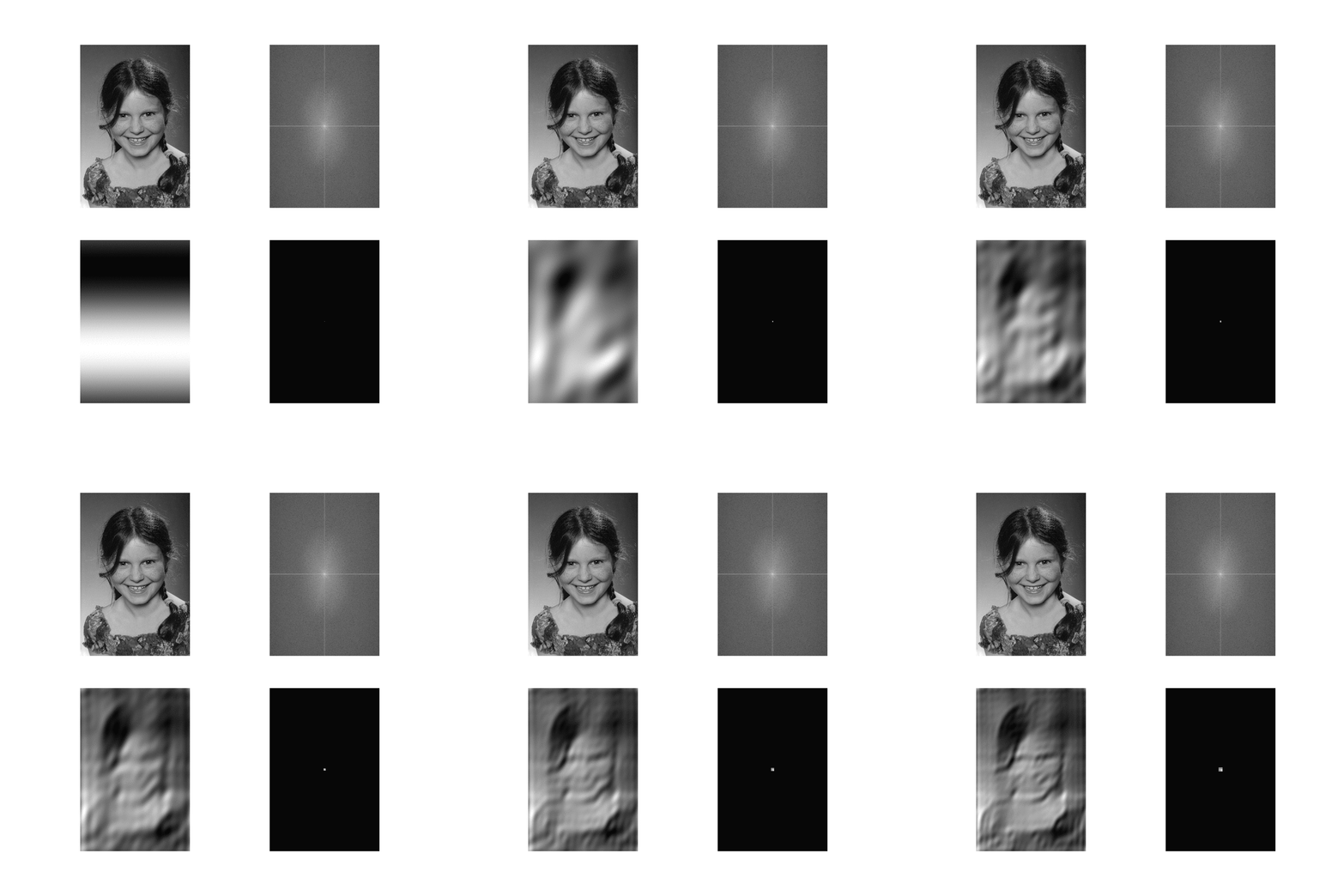
So, how do you compute with Wi-Fi in your bedroom? The basic premise is that waves already perform computations as they mix with each other, it's just that those computations are random unless we make some effort to control them. When two waves overlap, we measure the combination of the two: the amplitude of one wave is added to the amplitude of the other. Depending on the history of the two waves, one may have a negative amplitude, while the other may have a positive amplitude, allowing for simple computation. The idea here is to control the path that each wave takes so that, when they're added together, they perform the exact computation that we want them to. The classic example is the Fourier transform. A Fourier transform takes an object and breaks it down into a set of waves. If these waves are added together, the object is rebuilt. You can see an example of this in the animation here.
So, how do you compute with Wi-Fi in your bedroom? The basic premise is that waves already perform computations as they mix with each other, it's just that those computations are random unless we make some effort to control them. When two waves overlap, we measure the combination of the two: the amplitude of one wave is added to the amplitude of the other. Depending on the history of the two waves, one may have a negative amplitude, while the other may have a positive amplitude, allowing for simple computation. The idea here is to control the path that each wave takes so that, when they're added together, they perform the exact computation that we want them to. The classic example is the Fourier transform. A Fourier transform takes an object and breaks it down into a set of waves. If these waves are added together, the object is rebuilt. You can see an example of this in the animation here.
And just like all other science which sounds like a bullshit waste of time when it is done it may also yield some new understandings of how interacting radio signals can be used for practical purposes.
Sidenote: Does anyone know of a news for nerds site? I'm looking for a site which specialises in technology and has an interested readership. All I can seem to find is a bunch of negative luddites who are more interested in blaming the entire world on governments.
Let me know if you find such a site.
I COULD extend my old Tampermonkey script to hide all of thr annoying people, or only show comments from people in my whitelist.
I made it years ago to make that ADP or whatever guy disappear from my browser. That guy who could never understand why in 1982 the world switched from hosts files to DNS. Seen that dude lately? I vanished him with Tampermonkey about three or four years ago.
People have been farting around with optical processing ever since the laser was invented. In the 1980 JPL used optical correlators for image processing. Faster than any computer back in the 1980s.
These days it's used routinely to have wave pattern defined sub-cells on cellular towers. That's not the same thing as beam steering because it's relying on reflections.
Apple's homepod sounds better than one can imagine because that's what it is doing too.
And of course seeing around corners with scattered light is still an active area.
This particular application is utterly moronic for the simple reason that to do any of the above you need a lot of antennas, There just are not a lot of antennas in a house
Some drink at the fountain of knowledge. Others just gargle.