 Slashdot Mirror
Domain: achtungpanzer.com
Stories and comments across the archive that link to achtungpanzer.com.
Comments · 12
-
Re:Read a map
Take a look. There is even a story where Guderian came across a Char B and none of his anti tank guns could take it out. The worst failing of the French doctrine was to parcel tanks out as infantry support. If you were a tank commander would you rather fight five separate battle against four tanks each or one battle against twenty tanks. The Germans had the twenty tanks while the French had the formations of four tanks.
-
In a perfect world, this happens:
Uber die Schelde die Maas und den Rhein,
stiessen die Panzer nach Frankreich hinein,
Husaren des Fuhrers im schwarzen Gewand
so haben sie Frankreich im Sturm überrannt
Es rasseln die Ketten, es drÃhnt der Motor
Panzer rollen in Afrika Korps,
Panzer rollen in Afrika vor!
Heiss uber Afrikas Boden die Sonne glüht
Unsere Panzermotoren singen ihr Lied
Deutsche Panzer im Sonnenbrand
stehen im Kampf gegen Engeland
Es rasseln die Ketten, es drÃhnt der Motor
Panzer rollen in Afrika vor
Panzer des Führers ihr Britten habt acht
Die sind zu eurer Vernichtung erdacht
Sie furchten vor Tod und
vor Teufel sich nicht
an ihnen der britische Hochmut zerbricht
Es rasseln die Ketten, es drohnt der Motor
Panzer rollen in Afrika korps,
Panzer rollen in Afrika vor!
-
More 'defense dividends'...
Mod parent up.
I'll add to that list; the automotive industry is full of them. First of all there's the night-vision cameras (arguably invented by the Germans pre WWII), radar parking aids, and heads-up displays.
At home you can cook using a microwave oven (invented by a researcher at Raytheon), which probably itself uses a Liquid Crystal Display (much of the development of which was done at the UK Radar Research Establishment at Malvern, formerly the Army Radar Establishment). Or maybe you'd like to listen to some music on a set of flat-panel loudspeakers (offshoot of research done by the British DERA into quiet 'stealth' helicopters).
A list like this could go on practically forever; in fact it's hard to find a product -- any product -- which hasn't been touched by military R&D at some point in its history. To be honest, dollar for dollar, I think it is quite possible that the American public (and other countries too, but particularly the U.S. because we consume so much technology) gets as much if not more out of the money spent on military research by contractors, than we do out of pure research at universities. Not to say that pure research doesn't have it's place, and is almost always inventive in nature, military research is usually directed and innovative, and produces useful devices in relatively short timescales.
Take a look around your home, unless you live on an Amish farm, you're probably surrounded by things, the initial development of which were paid for with defense dollars.
References:
http://www.achtungpanzer.com/ir.htm Infrared and Night Vision Scopes
http://en.wikipedia.org/wiki/Liquid_crystal_displa y#Brief_history LCDs
http://www.mod.uk/issues/diversification/diversifi cation_gp.htm#The%20Defence%20Industry Flat Panel Loudspeakers (and many others) -
Ob. Link
-
Re:Hey, Wait...I'm not normally one to nitpick, and this will probably go down as "offtopic", but the misconceptions behind this post crop up far too often to stand uncorrected.
1. I'm sure you're speaking figuratively, but for those who don't know, the Polish Cavalry didn't declare war, they were defending their country against invasion. "Going up against" might have been a better phrase.
2. Cavalry wasn't in fact obsolete in 1939 as is often made out. In fact, if you watch the newsreels of German troops entering Czechoslovakia in 1938 many are on horseback, with horse-drawn carts. The Polish cavalry of the time was similar, the units fought as dragoons, using the horses for transport (which was actually advantageous, as many of the roads in all of Eastern Europe were just unsurfaced mud tracks at the time, and vehicles would often get bogged down) and dismounting for battle. They used rifles, machine-guns and horse-drawn artillery. In fact the Polish cavalry had a particularly effective anti-tank gun.
3. The Panzers actually suffered considerable losses in the '39 campaign, the tanks were not the Tigers or Panthers of later years, but light tanks, and in the woods and fields of Poland often suffered at the hands of infantry and cavalry antitank weapons.
You might like to have a look at (for example, just a quick trawl through Google) this page or this one or this one or this one.
-
Re:Missile Defense
This is so utterly wrong. Here is a list of all tanks used by the Germans in the initial attacks on Poland. Please compare this with the tank specs and images here, think about it for a moment and then tell me if these vehicles could ever be stopped by soldiers on horses. I'm eager to hear your excuses then.
BTW Germany had 1 cavalry division vs. 30 on the Polish side if you believe the web. Some more facts on that. Just look at the picture of the Polish cavalry for a moment. They must've been incredibly brave and/or stupid to even think about attacking more than 1500 German tanks like that.
Even extensive searching didn't bring up a mentioning of German cavalry units and I couldn't even find anything about the one from the SS. But I'm glad to read more about German cavalry being used in WW2, but I'd like to see some links. -
Re:Missile Defense
This is so utterly wrong. Here is a list of all tanks used by the Germans in the initial attacks on Poland. Please compare this with the tank specs and images here, think about it for a moment and then tell me if these vehicles could ever be stopped by soldiers on horses. I'm eager to hear your excuses then.
BTW Germany had 1 cavalry division vs. 30 on the Polish side if you believe the web. Some more facts on that. Just look at the picture of the Polish cavalry for a moment. They must've been incredibly brave and/or stupid to even think about attacking more than 1500 German tanks like that.
Even extensive searching didn't bring up a mentioning of German cavalry units and I couldn't even find anything about the one from the SS. But I'm glad to read more about German cavalry being used in WW2, but I'd like to see some links. -
German tanks?
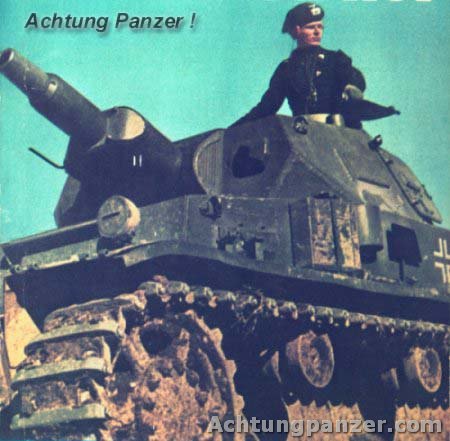
What's up with apple and German tanks? First the Panther (http://www.achtungpanzer.com/pz4.htm#panther) and now the Tiger (http://www.achtungpanzer.com/tigerp.htm). What's next, the Leopard? When apple releases Mac OS 1x.x Leopard II, then I'm buying a Macintosh!
-
German tanks?
What's up with apple and German tanks? First the Panther (http://www.achtungpanzer.com/pz4.htm#panther) and now the Tiger (http://www.achtungpanzer.com/tigerp.htm). What's next, the Leopard? When apple releases Mac OS 1x.x Leopard II, then I'm buying a Macintosh!
-
Re:This is no different
Ford = Mercury = Lincoln
= Mazda = Volvo = Aston Martin = Jaguar
Chevy = GM
= Pontiac = Oldsmobile (dead now) = Cadillac = Saab
Chrysler = Dodge
= Mitsubishi = Mercedes-Benz
Toyota = Lexus = Scion
= Chevy = GM (well, not quite -- Toyota rebrands the Cavalier in Japan, but otherwise there's little sharing between the two companies)
Volkswagen = Audi = Porsche
And this one is wrong. Volkswagen = Audi, but not Porsche. While it's true that Dr. Ferdinand Porsche started Volkswagen, and the Pieche and Porsche families have controlling interests in both the VAG (Volkswagen Automotive Group, including Audi, Bentley, and Lamborghini) and the PAG (Porsche Automotive Group, which is just Porsche), the Porsche car company is independently owned and is not part of Volkswagen. Parts and platforms are shared (the original 356 engine was a VW, as was the engine for the 914; the Boxster and 996 share relays and other mechanical parts with VW and Audi models; the Cayenne and the Touareg are built on the same platform; etc), but the companies are not the same. In all of your other examples, the companies are partially or fully owned.
The automobile family tree runs back over itself in so many different ways. Ford owns part of Mazda, and they both produce an identical SUV... with different name badging.
And it's only getting smaller. Gone are the days of many different manufacturers (for example, the single company Audi, which is now only a part of a larger company, started life as four independent companies -- thus the four interlocked circles of the Audi badge), but even back in the early days of automotive development there was a lot of "cross-polination". For example, Dr. Ferdinand Porsche helped built a number of early cars long before he built the first Volkswagen (and even longer before the first 356). Among others, he did plenty of work for Mercedes-Benz and the German military (the Panzer Tiger was designed by Porsche). Porsche still does non-Porsche design work today, such as the engine on the Harley-Davidson V-Rod (this by the Porsche car company, and not the independent Porsche industrial design company).
That's not to say that the different badges don't bring something more to the table. I doubt you'd object that a Lexus ES500 is more luxurious than a corresponding Toyota Camry, or an Acura TSX compared to a Honda Acura. The platforms may be shared, but in many cases the "up-market" brand model will have a larger engine, better suspension (either tigher or softer, depending on the goal -- sports car or luxury car), fancier interiors (leather, woods, metals instead of plastics and vinyls), more options (navigation, sound options), etc. That's not always the case, since many Chevy and Pontiac cars are exact matches minus body cladding (Grand Prix and Monte Carlo, especially before the late-90s/early-00s body redesigns of the cars; Camaro and Firebird prior to the cancellation of the F-body line; Cavalier and Sunfire; etc), but Cadillac is GM's upscale brand, and it shows. The Cadillac CTS (not CTS-V) may be nearly identical to a Chevy Impala, but the CTS is going to be more luxuriously appointed. Perhaps not enough to justify the $10,000+ price difference, but enough to justify some increase in price.
-
Re:Add-ons...
I'd prefer a different kind of Porsche design
-
Where have I heard that before?"Our industries need to work together for the consumer to benefit and for our respective businesses to grow." -Hilary Rosen.
Oh yeah, that's it, Poland 1939, the Ribbentrop-Molotov pact signed on August 23rd of 1939.

_1234327361566.png)