Slashdot Mirror
Domain: alienryderflex.com
Stories and comments across the archive that link to alienryderflex.com.
Comments · 6
-
Re:Quantum Physics @ Home
I'm not sure if slashdotters is just slow today or what. Each filter changes the angle of reference of each subsequent filter. E.g. Filter 2 sees 45 degree removal of polarization. Filter 3 sees 45 degree removal of polarization from Filter 2. This isn't that weird. You know what, http://alienryderflex.com/polarizer/
-
Re:Sunglasses
Part where your hypothesis falls apart is where you assume that losing one dimension of the wave of light from the Sun reduces the amount of luminance carried by the wave of light from the Sun. This is false.
It's not false. It does, and necessarily so. It's the same reason which allows LCD displays to vary between completely dark and completely light. As the angle between the polarization of the light varies with the angle of the filter, the intensity will be reduced by the cosine of that angle.
If you put two polarizing filters in line (with their polarizations aligned to each other), the second filter will not significantly diminish the intensity of the light passing through the first. However, if you rotate the 2nd filter 45 degrees in relation to the first, then it will block about 50% of the light passing through the first filter - even though all of that light was of the "wrong" polarization to this filter (wrong by 45 degrees, to be specific). It is reduced to the cosine of 45 degrees, which is 50%.
As a matter of fact, if the 2nd filter is rotated 90 degrees in relation to the first filter, it will block all of the light (nearly, since it's not a perfect filter) - but if you place a 3rd filter between them, rotated 45 degrees in relation to both of them, you get more light through the 3 filters than you did through the original 2.
If you want to test this, just take two pairs of polarizing sunglasses (or pop the 2 lenses out of one pair of polarizing sunglasses) and use an LCD computer monitor (there's a polarizing filter in the monitor already - if you were counting, you knew we need 3 filters to do this). Rotate one pair of sunglasses until the LCD looks completely dark; that's 90 degrees to the polarizing filter in the monitor. Then put the 2nd pair of sunglasses between the LCD and the 1st pair of glasses, tilted at a 45 degree angle... you'll discover that some light gets through, even though the first filter is still at 90 degrees to the filter in the LCD.
-
Re:HA!
And I'm pretty sure you're wrong. Sorry. You might choose to measure font rendering that way--fidelity at any cost, even if it means reducing text to illegible blobs
Illegible blobs are produced on no modern system. You are attacking a straw man.
In such cases, making "click here" distinguishable from "dick here" is more important than preserving the font designer's artistic vision.
And because of the TrueType alignment and kerning liberties, you're more likely to end up with "dick here" when the design of the typeface is compromised.
Again, this is only true if you ignore what happens at small sizes.
And again, this is only true if you apply subpixel rendering at these small sizes. Both Apple and Microsoft systems do not.
Nope, you've got it backwards: Microsoft's approach involves more fine-tuning. Apple's approach is easier to implement: just scale the outline to the appropriate size and fill it in.
A puzzling and inaccurate description that describes both the Microsoft and Apple approaches. The question is method of scaling. Apple's methodology looks at pixel boundaries and typeface parameters. Link.
Nonsense. A font that looks fine when rendered in a 15-pixel-high line (on a 300 DPI printer) may look illegible when rendered unchanged in a 5-pixel-high line (on screen). That doesn't mean the typeface is poor, it just means it's too intricate for such a low resolution.
In other words, as I said the first time, it's a poor typeface selection.
You seem to be confused about how that renderer works. It's far from "simplistic snap-to-grid": simply snapping the font's vertices to a pixel grid would produce garbage. What it actually does is apply the TrueType hints found in the font file.
No, I'm afraid that's exactly backwards. TrueType, including its hinting, was in fact developed by Apple. Hinting was unique to Apple systems long before subpixel rendering. Microsoft eventually began using the hints, but this information isn't about subpixel rendering. It's about pixel-level placement.
No, not in every way; only in the particular way you've chosen to focus on. Your personal, subjective preference is showing.
My personal, subjective preference was never hidden.
But that has no bearing on what is objectively true: the typeface is better preserved on Apple systems. There's no objective analysis that makes Microsoft's system better in any way. That's simple fact.
The two systems are a wash in legibility. Apple's maintains the technical fidelity that is critical. It's not controversial in the least among anyone actually versed in the field.
You, however, are not. Based on your comment history, you have a habit of getting into arguments here and presenting yourself as an authority, and yet never provide any substantive support.
-
LCD sub-pixel layouts, RGBW
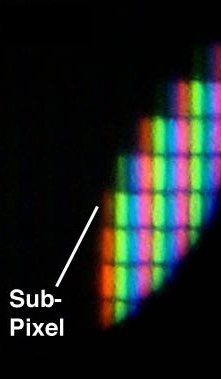
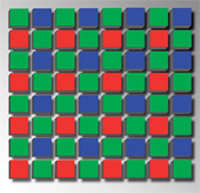
I was recently looking into LCD sub-pixel layouts, and found that there are more than just RGB columns. For one, there's the same arrangement, but with every other row shifted horizontally by 1.5 sub-pixels. This improves things because the spacing between like-colored sub-pixels is similar, no matter what direction; with columns, vertically they are right next to each other, while horizontally they're 3 sub-pixels apart. Others put twice as many greens. There's even RGBW, that adds white into the mix, to increase brightness and efficiency.
But the problem with all the alternate geometries is that you don't have pixels in a normal grid, so it seems that most computers will always be stuck with the sub-optimal grid arrangement. But for custom devices where there isn't lots of legacy software, they can use new arrangements. Things like cell phones and portable games fall into this category. It's very similar to the processor architecture issue, where personal computers are mostly stuck with x86, while others can use things like ARM, MIPS, PowerPC, etc.
Maybe this isn't exactly the "inventor's dilemma", but it reminded me of it.
-
Re:dv editing and Gutenburgs press
Someone recently pointed me to this web page:
http://www.alienryderflex.com/rotoscope/
There are some *astonishing* StarWars fanfic films on this web page, esp. the first one.
(Unfortunately, most of the links are dead.) -
Re: Millons?Although on second glance it doesn't appear that he's quite so "converted" as I may have been led to believe.
I think this deserves more research by me in the future, because a biologist who is convinced there are massive problems with evolution and then changes his mind would be significant indeed - and so would understanding his reasons why.
Especially considering this review:
At least one pro-evolution writer, Gert Korthof, has seized with delight Denton's apparent flip-flop on evolution. In Part 2 of Nature's Destiny that appearance is quickly dispelled, but Denton still deserves some of the blame for the confusion. Virtually every reference to evolution in Part 1 could be replaced with a reference to the survival of species, and the argument concerning the laws of physics would not be diminished. By using the word "evolution" as he does, Denton seems to be contributing to the obfuscation of that word, rather than clarifying it as Phillip Johnson seeks to do.When we begin reading Part 2, it immediately becomes apparent that Denton is talking about something very different from Darwin's concept of natural selection acting on random changes. Denton proposes that evolution is true in a sense, but that it is not driven by random changes, but rather by intelligently directed leaps which involve significant changes in complexity. Further, he proposes that these directed leaps are not performed by supernatural acts of interference with the laws of physics, but instead were elaborately planned into the laws of physics from the beginning. Thus, Denton finds a point of common ground between pure naturalism and the intelligent design of higher organisms -- a remarkable feat.
Anyway, I'm off to bed.