Slashdot Mirror
Domain: anandtech.com
Stories and comments across the archive that link to anandtech.com.
Comments · 3,318
-
Re:What phone-centered software runs on x86?
Correct me if I'm wrong (and I could be), but AFAIK there is no strong ecosystem for x86 software that is geared toward usage on a touch-screen phone. Granted, Win8 will run X86 and will probably garner some touch-oriented software for the small screen, but it doesn't exist yet. So if I get one of these phones which 'apps' will I run? I suppose there is the Android x86 port, but I would imagine that most of the existing Android apps would fail in that environment.
From Anand:
"By default all Android apps run in a VM and are thus processor architecture agnostic. As long as the apps are calling Android libraries that aren't native ARM there, once again, shouldn't be a problem. Where Intel will have a problem is with apps that do call native libraries or apps that are ARM native (e.g. virtually anything CPU intensive like a 3D game).
Intel believes that roughly 75% of all Android apps in the Market don't feature any native ARM code. The remaining 25% are the issue. The presumption is that eventually this will be a non-issue (described above), but what do users of the first x86 Android phones do? Two words: binary translation.
Intel isn't disclosing much about the solution, but by intercepting ARM binaries and translating ARM code to x86 code on the fly during execution Intel is hoping to achieve ~90% app compatibility at launch. Binary translation is typically noticeably slower than running native code, although Intel is unsurprisingly optimistic about the experience on Android. I'm still very skeptical about the overall experience but we'll have to wait and see for ourselves."
http://www.anandtech.com/show/5365/intels-medfield-atom-z2460-arrive-for-smartphones
-
Re:what kind of power draw?
Sorry for replying to my own comment, but I just realized that my link to the Anandtech article got stripped out.
Here's the link: http://www.anandtech.com/show/5365/intels-medfield-atom-z2460-arrive-for-smartphones -
Re:Dull Specs, but battery life?
720p video encoding, 1080p video decoding and 1080p via HDMI are considered stunning features?
Heck, Apple's been conservative, and the iPhone 4s has got 1080p video encoding, 1080p video decode and 1080p via HDMI. Androids have had it in 2010-2011 (and were mocking Apple the whole time).
So... the bigger question is - what's the battery life? The performance looks spectacular, but x86 is a notable power hog. And more worringly, I see nothing in the articles about battery life, power consumption, or battery size.
Less power draw than ARM for most tasks, more performance: http://www.anandtech.com/show/5365/intels-medfield-atom-z2460-arrive-for-smartphones
-
Re:what kind of power draw?
The phones in the article are HTC Sensation, Motorola Droid 3, iPhone 4S, LG Optimus 2X and Samsung Galaxy S 2.
http://www.anandtech.com/show/5365/intels-medfield-atom-z2460-arrive-for-smartphones
x86 is offering more performance per watt than ARM, though by no more than a factor of 2.
-
Anandtech has the numbers
Here.. Looks quite competitive to me.
-
Re:what kind of power draw?
I read on Anandtech that the power draw is comparable to ARM-based devices. http://www.anandtech.com/show/5365/intels-medfield-atom-z2460-arrive-for-smartphones
-
That may be changing...
It looks like Intel's new Atom SoC is going to be given a shot in the smartphone space: http://www.anandtech.com/show/5365/intels-medfield-atom-z2460-arrive-for-smartphones.
-
The ARMy of fanboys is getting repetitive.
Before I being, bear in mind, the whole annoying mantra that x86 will NEVER compete with ARM in low-power applications has just been shot out of the water: http://www.anandtech.com/show/5365/intels-medfield-atom-z2460-arrive-for-smartphones
I've been hearing ad-nauseum about how all ARM has to do to destroy x86 in the desktop market is to flip a couple of bits and they'll have "good enough" performance while using zero-point energy that produces free power and unicorns since about 2006. In the meantime, the exact same people who say that ARM is "good enough" rip dual-core Atoms for being too slow (while the single-core Medefield I just linked to is faster than dual--core A9's in the Iphone 4S and Galaxy Nexus, while using less power).
I've also heard about how the A15 will completely blow Intel away when it finally shows up blah blah blah (I heard the exact same story about the A9 cores btw, and Intel is still in business).
What I have yet to see is ARM *really* ratchet up performance... and no, I'm not saying that they need to beat Ivy Bridge... I'm saying they need to *approximate* a mobile 1.8Ghz Core 2 from about 2006 to get that "good enough" performance. I have yet to see that chip, and for all you fanboys out there, the A15 is *not* that chip (it'll likely finally beat a single-core Atom from 2008... but remember the single-core Atom was never good enough to begin with!). Intel has closed the gap for x86... it's a done deal, and no amount of "ARM is magical" will change the laws of physics.
ARM has *NOT* closed the performance gap with x86, and when you add in all the cache, real memory controllers (not those jokes used in current ARM designs) and I/O controllers needed to do real work, your ARM chip will end up using just as much power as a competitive x86, no matter how many forums you go on to brag about the superioirity of the ARM instruction set that doesn't even do 64 bit, and which you never even write assembler for anyway.
-
Re:RedundantTV
I think the PVR as a device is going to disappear entirely by 2015. If the "RokuStick" they're announcing (HDMI dongle for your TV) is any indication, especially at the sub-$100 launch price, there won't be any profit margin left in HDMI dongles in a few years. You will get a Netflix dongle free with your subscription, along with one for your Hulu Plus subscription; cable TV and satellite boxes will disappear completely and you'll get an HDMI dongle in a bubble pack mailer instead of a VCR-looking device.
Much like how calculators were $500 items that took up a permanent spot on your desk and are now given away as promotional items, HTPC/Media Centers are going the same way. I would be shocked if the next AppleTV is bigger than a book of matches.
More info, or more importantly, a visual of exactly what an HDMI dongle may look like: http://www.anandtech.com/show/5305/roku-streaming-stick-brings-smarts-to-mhl-equipped-tvs -
Re:Nonesense
I'm sorry, but it's not nonsense. The article is spot on.
WebOS as a GUI design absolutely has its merits (the cards really are fantastic) - but then that's not what the article is claiming. The article's claim is that WebOS was immature and slow and that's absolutely the case.
Just booting the damn thing takes 77 seconds (versus 31s on a Galaxy Tab). Never mind the anemic performance of their WebKit implementation - which carries right on over to application performance since most applications are written against WebKit - which is why at best it's less than half as fast as an iPad 2 with similar performing hardware and still spends most of the time trailing the now-ancient iPad 1.
The 3.0.4 update fixed this somewhat, but not a ton. It's still slow and it still chugs, it just does so somewhat less often than with the shipping software. The poor thing can't even play YouTube videos above 480p most of the time.
Though you're not entirely off base; you are absolutely right about the applications also being a problem. The IM client is probably the best part and it only gets worse from there. The PDF reader is especially atrocious as you noted, and a big part of that is because they're rendering everything in WebKit, saving the result to an image file, and then displaying that to the end user.
Anyhow, no, WeOS is not a fine OS. It's yet another collection of interesting concepts that weren't executed on correctly and require a level of performance today's hardware can't provide. Relying on WebKit for so much of the OS - and thereby a combination of interpretation and JIT compiling - was a stupid idea. These are still fundamentally embedded systems, and with embedded systems the closer you can be to the metal the better off you're going to be. Of course in Palm/HP's case all of this was punctuated by particularly inane decisions like logging every last thing to MLC Flash memory that doesn't like small writes.
As a TouchPad owner I'm doing little at the moment besides waiting for someone to port Ice Cream Sandwich to it. It may not have the slick multitasking of WebOS, but at least Android has the performance to actually handle multitasking along with everything else a tablet should be able to do smoothly. WebOS is crap.
I'm sorry, but it's not nonsense. The article is spot on.
WebOS as a GUI design absolutely has its merits (the cards really are fantastic) - but then that's not what the article is claiming. The article's claim is that WebOS was immature and slow and that's absolutely the case.
Just booting the damn thing takes 77 seconds (versus 31s on a Galaxy Tab). Never mind the anemic performance of their WebKit implementation - which carries right on over to application performance since most applications are written against WebKit - which is why at best it's less than half as fast as an iPad 2 with similar performing hardware and still spends most of the time trailing the now-ancient iPad 1.
The 3.0.4 update fixed this somewhat, but not a ton. It's still slow and it still chugs, it just does so somewhat less often than with the shipping software. The poor thing can't even play YouTube videos above 480p most of the time.
Though you're not entirely off base; you are absolutely right about the applications also being a problem. The IM client is probably the best part and it only gets worse from there. The PDF reader is especially atrocious as you noted, and a big part of that is because they're rendering everything in WebKit, saving the result to an image file, and then displaying that to the end user.
Anyhow, no, WeOS is not a fine OS. It's yet another collection of interesting concepts that weren't executed on correctly a
-
Re:Nonesense
I'm sorry, but it's not nonsense. The article is spot on.
WebOS as a GUI design absolutely has its merits (the cards really are fantastic) - but then that's not what the article is claiming. The article's claim is that WebOS was immature and slow and that's absolutely the case.
Just booting the damn thing takes 77 seconds (versus 31s on a Galaxy Tab). Never mind the anemic performance of their WebKit implementation - which carries right on over to application performance since most applications are written against WebKit - which is why at best it's less than half as fast as an iPad 2 with similar performing hardware and still spends most of the time trailing the now-ancient iPad 1.
The 3.0.4 update fixed this somewhat, but not a ton. It's still slow and it still chugs, it just does so somewhat less often than with the shipping software. The poor thing can't even play YouTube videos above 480p most of the time.
Though you're not entirely off base; you are absolutely right about the applications also being a problem. The IM client is probably the best part and it only gets worse from there. The PDF reader is especially atrocious as you noted, and a big part of that is because they're rendering everything in WebKit, saving the result to an image file, and then displaying that to the end user.
Anyhow, no, WeOS is not a fine OS. It's yet another collection of interesting concepts that weren't executed on correctly and require a level of performance today's hardware can't provide. Relying on WebKit for so much of the OS - and thereby a combination of interpretation and JIT compiling - was a stupid idea. These are still fundamentally embedded systems, and with embedded systems the closer you can be to the metal the better off you're going to be. Of course in Palm/HP's case all of this was punctuated by particularly inane decisions like logging every last thing to MLC Flash memory that doesn't like small writes.
As a TouchPad owner I'm doing little at the moment besides waiting for someone to port Ice Cream Sandwich to it. It may not have the slick multitasking of WebOS, but at least Android has the performance to actually handle multitasking along with everything else a tablet should be able to do smoothly. WebOS is crap.
I'm sorry, but it's not nonsense. The article is spot on.
WebOS as a GUI design absolutely has its merits (the cards really are fantastic) - but then that's not what the article is claiming. The article's claim is that WebOS was immature and slow and that's absolutely the case.
Just booting the damn thing takes 77 seconds (versus 31s on a Galaxy Tab). Never mind the anemic performance of their WebKit implementation - which carries right on over to application performance since most applications are written against WebKit - which is why at best it's less than half as fast as an iPad 2 with similar performing hardware and still spends most of the time trailing the now-ancient iPad 1.
The 3.0.4 update fixed this somewhat, but not a ton. It's still slow and it still chugs, it just does so somewhat less often than with the shipping software. The poor thing can't even play YouTube videos above 480p most of the time.
Though you're not entirely off base; you are absolutely right about the applications also being a problem. The IM client is probably the best part and it only gets worse from there. The PDF reader is especially atrocious as you noted, and a big part of that is because they're rendering everything in WebKit, saving the result to an image file, and then displaying that to the end user.
Anyhow, no, WeOS is not a fine OS. It's yet another collection of interesting concepts that weren't executed on correctly a
-
Re:Nonesense
I'm sorry, but it's not nonsense. The article is spot on.
WebOS as a GUI design absolutely has its merits (the cards really are fantastic) - but then that's not what the article is claiming. The article's claim is that WebOS was immature and slow and that's absolutely the case.
Just booting the damn thing takes 77 seconds (versus 31s on a Galaxy Tab). Never mind the anemic performance of their WebKit implementation - which carries right on over to application performance since most applications are written against WebKit - which is why at best it's less than half as fast as an iPad 2 with similar performing hardware and still spends most of the time trailing the now-ancient iPad 1.
The 3.0.4 update fixed this somewhat, but not a ton. It's still slow and it still chugs, it just does so somewhat less often than with the shipping software. The poor thing can't even play YouTube videos above 480p most of the time.
Though you're not entirely off base; you are absolutely right about the applications also being a problem. The IM client is probably the best part and it only gets worse from there. The PDF reader is especially atrocious as you noted, and a big part of that is because they're rendering everything in WebKit, saving the result to an image file, and then displaying that to the end user.
Anyhow, no, WeOS is not a fine OS. It's yet another collection of interesting concepts that weren't executed on correctly and require a level of performance today's hardware can't provide. Relying on WebKit for so much of the OS - and thereby a combination of interpretation and JIT compiling - was a stupid idea. These are still fundamentally embedded systems, and with embedded systems the closer you can be to the metal the better off you're going to be. Of course in Palm/HP's case all of this was punctuated by particularly inane decisions like logging every last thing to MLC Flash memory that doesn't like small writes.
As a TouchPad owner I'm doing little at the moment besides waiting for someone to port Ice Cream Sandwich to it. It may not have the slick multitasking of WebOS, but at least Android has the performance to actually handle multitasking along with everything else a tablet should be able to do smoothly. WebOS is crap.
I'm sorry, but it's not nonsense. The article is spot on.
WebOS as a GUI design absolutely has its merits (the cards really are fantastic) - but then that's not what the article is claiming. The article's claim is that WebOS was immature and slow and that's absolutely the case.
Just booting the damn thing takes 77 seconds (versus 31s on a Galaxy Tab). Never mind the anemic performance of their WebKit implementation - which carries right on over to application performance since most applications are written against WebKit - which is why at best it's less than half as fast as an iPad 2 with similar performing hardware and still spends most of the time trailing the now-ancient iPad 1.
The 3.0.4 update fixed this somewhat, but not a ton. It's still slow and it still chugs, it just does so somewhat less often than with the shipping software. The poor thing can't even play YouTube videos above 480p most of the time.
Though you're not entirely off base; you are absolutely right about the applications also being a problem. The IM client is probably the best part and it only gets worse from there. The PDF reader is especially atrocious as you noted, and a big part of that is because they're rendering everything in WebKit, saving the result to an image file, and then displaying that to the end user.
Anyhow, no, WeOS is not a fine OS. It's yet another collection of interesting concepts that weren't executed on correctly a
-
Re:Nonesense
I'm sorry, but it's not nonsense. The article is spot on.
WebOS as a GUI design absolutely has its merits (the cards really are fantastic) - but then that's not what the article is claiming. The article's claim is that WebOS was immature and slow and that's absolutely the case.
Just booting the damn thing takes 77 seconds (versus 31s on a Galaxy Tab). Never mind the anemic performance of their WebKit implementation - which carries right on over to application performance since most applications are written against WebKit - which is why at best it's less than half as fast as an iPad 2 with similar performing hardware and still spends most of the time trailing the now-ancient iPad 1.
The 3.0.4 update fixed this somewhat, but not a ton. It's still slow and it still chugs, it just does so somewhat less often than with the shipping software. The poor thing can't even play YouTube videos above 480p most of the time.
Though you're not entirely off base; you are absolutely right about the applications also being a problem. The IM client is probably the best part and it only gets worse from there. The PDF reader is especially atrocious as you noted, and a big part of that is because they're rendering everything in WebKit, saving the result to an image file, and then displaying that to the end user.
Anyhow, no, WeOS is not a fine OS. It's yet another collection of interesting concepts that weren't executed on correctly and require a level of performance today's hardware can't provide. Relying on WebKit for so much of the OS - and thereby a combination of interpretation and JIT compiling - was a stupid idea. These are still fundamentally embedded systems, and with embedded systems the closer you can be to the metal the better off you're going to be. Of course in Palm/HP's case all of this was punctuated by particularly inane decisions like logging every last thing to MLC Flash memory that doesn't like small writes.
As a TouchPad owner I'm doing little at the moment besides waiting for someone to port Ice Cream Sandwich to it. It may not have the slick multitasking of WebOS, but at least Android has the performance to actually handle multitasking along with everything else a tablet should be able to do smoothly. WebOS is crap.
I'm sorry, but it's not nonsense. The article is spot on.
WebOS as a GUI design absolutely has its merits (the cards really are fantastic) - but then that's not what the article is claiming. The article's claim is that WebOS was immature and slow and that's absolutely the case.
Just booting the damn thing takes 77 seconds (versus 31s on a Galaxy Tab). Never mind the anemic performance of their WebKit implementation - which carries right on over to application performance since most applications are written against WebKit - which is why at best it's less than half as fast as an iPad 2 with similar performing hardware and still spends most of the time trailing the now-ancient iPad 1.
The 3.0.4 update fixed this somewhat, but not a ton. It's still slow and it still chugs, it just does so somewhat less often than with the shipping software. The poor thing can't even play YouTube videos above 480p most of the time.
Though you're not entirely off base; you are absolutely right about the applications also being a problem. The IM client is probably the best part and it only gets worse from there. The PDF reader is especially atrocious as you noted, and a big part of that is because they're rendering everything in WebKit, saving the result to an image file, and then displaying that to the end user.
Anyhow, no, WeOS is not a fine OS. It's yet another collection of interesting concepts that weren't executed on correctly a
-
Re:Nonesense
I'm sorry, but it's not nonsense. The article is spot on.
WebOS as a GUI design absolutely has its merits (the cards really are fantastic) - but then that's not what the article is claiming. The article's claim is that WebOS was immature and slow and that's absolutely the case.
Just booting the damn thing takes 77 seconds (versus 31s on a Galaxy Tab). Never mind the anemic performance of their WebKit implementation - which carries right on over to application performance since most applications are written against WebKit - which is why at best it's less than half as fast as an iPad 2 with similar performing hardware and still spends most of the time trailing the now-ancient iPad 1.
The 3.0.4 update fixed this somewhat, but not a ton. It's still slow and it still chugs, it just does so somewhat less often than with the shipping software. The poor thing can't even play YouTube videos above 480p most of the time.
Though you're not entirely off base; you are absolutely right about the applications also being a problem. The IM client is probably the best part and it only gets worse from there. The PDF reader is especially atrocious as you noted, and a big part of that is because they're rendering everything in WebKit, saving the result to an image file, and then displaying that to the end user.
Anyhow, no, WeOS is not a fine OS. It's yet another collection of interesting concepts that weren't executed on correctly and require a level of performance today's hardware can't provide. Relying on WebKit for so much of the OS - and thereby a combination of interpretation and JIT compiling - was a stupid idea. These are still fundamentally embedded systems, and with embedded systems the closer you can be to the metal the better off you're going to be. Of course in Palm/HP's case all of this was punctuated by particularly inane decisions like logging every last thing to MLC Flash memory that doesn't like small writes.
As a TouchPad owner I'm doing little at the moment besides waiting for someone to port Ice Cream Sandwich to it. It may not have the slick multitasking of WebOS, but at least Android has the performance to actually handle multitasking along with everything else a tablet should be able to do smoothly. WebOS is crap.
-
Re:Nonesense
I'm sorry, but it's not nonsense. The article is spot on.
WebOS as a GUI design absolutely has its merits (the cards really are fantastic) - but then that's not what the article is claiming. The article's claim is that WebOS was immature and slow and that's absolutely the case.
Just booting the damn thing takes 77 seconds (versus 31s on a Galaxy Tab). Never mind the anemic performance of their WebKit implementation - which carries right on over to application performance since most applications are written against WebKit - which is why at best it's less than half as fast as an iPad 2 with similar performing hardware and still spends most of the time trailing the now-ancient iPad 1.
The 3.0.4 update fixed this somewhat, but not a ton. It's still slow and it still chugs, it just does so somewhat less often than with the shipping software. The poor thing can't even play YouTube videos above 480p most of the time.
Though you're not entirely off base; you are absolutely right about the applications also being a problem. The IM client is probably the best part and it only gets worse from there. The PDF reader is especially atrocious as you noted, and a big part of that is because they're rendering everything in WebKit, saving the result to an image file, and then displaying that to the end user.
Anyhow, no, WeOS is not a fine OS. It's yet another collection of interesting concepts that weren't executed on correctly and require a level of performance today's hardware can't provide. Relying on WebKit for so much of the OS - and thereby a combination of interpretation and JIT compiling - was a stupid idea. These are still fundamentally embedded systems, and with embedded systems the closer you can be to the metal the better off you're going to be. Of course in Palm/HP's case all of this was punctuated by particularly inane decisions like logging every last thing to MLC Flash memory that doesn't like small writes.
As a TouchPad owner I'm doing little at the moment besides waiting for someone to port Ice Cream Sandwich to it. It may not have the slick multitasking of WebOS, but at least Android has the performance to actually handle multitasking along with everything else a tablet should be able to do smoothly. WebOS is crap.
-
Re:Will it a be world 4g / 3g phone with GSM / CDM
There is no longer separate GSM and CDMA models, there is only on global model. You can have both Source from anandtech
-
Re:Anonymous Threatened Sony
There's also the other form where the links are spread over the words such as "There is many tech web sites".
Not a big deal, but people could give it just a little thought in general. It forces you to hover over all the links and makes the page harder to read if it's printed. A good rule of thumb could be that the same text should also work completely without the links around the words.
-
Re:That's a big reason why I don't buy Android
This alpha 7 build of CM9 reveals lag on Nexus S: http://www.youtube.com/watch?v=fQmaCKbpwxE
>Also my girlfriend's Galaxy S II gets put on a charger about every 2 days, and the dual core makes it incredibly snappy.
Great, the GS2 is a good phone, but actual reviews show the SII's battery life still pales in comparison to the iPhone's:
http://www.anandtech.com/show/4971/apple-iphone-4s-review-att-verizon/15It's a lot like how OSX will get 6 hours on a particular laptop, but Windows on that same exact device will get 4 hours. There's nothing Samsung can do about Android's inefficiency.
-
Re:No *official* port.
hah, I've had many people and a few ROM/CM developers say Galaxy S was a paid beta for Galaxy S II
The shocking thing is that even though it was a beta, Galaxy S was arguably the best android phone on the market for at least 6 months. It did many things right: Decent internal memory size, Best in class GPU, proper multi-touch touchscreen (no bs dual-touch like Nexus One/Desire/Incredible/Droid), ~1.8GB for app installs (150ish MB was the norm back then). Brilliant video playback and codec support.
But 1GB RAM, dual core 1.2ghz A9, 8MP camera with 1080p and flash, flawless high profile 1080p playback and even 1080p flash playback (youtube). Like anandtech said: The Best, Redefined.. and that review was 5 months after the phone launched!
-
Re:How well does that perform?
And most modern drives deliver nowhere near a gigabit of streaming performance anyway.
Well, almost all SSDs do. (1Gb/s is about 125 MB/s).
-
Re:Um
Doesn't really matter.
My personal desktop sees about 7GB of writes per day. That can be pretty typical for a power user and a bit high for a mainstream user but it's nothing insane.
If I never install another application and just go about my business, my drive has 203.4GB of space to spread out those 7GB of writes per day. That means in roughly 29 days my SSD, if it wear levels perfectly, I will have written to every single available flash block on my drive. Tack on another 7 days if the drive is smart enough to move my static data around to wear level even more properly. So we're at approximately 36 days before I exhaust one out of my ~10,000 write cycles. Multiply that out and it would take 360,000 days of using my machine for all of my NAND to wear out; once again, assuming perfect wear leveling. That's 986 years. Your NAND flash cells will actually lose their charge well before that time comes, in about 10 years. -
Re:Hybrid can actually be sometimes faster
The core problem with SSD's is write speed on workloads that have a large number of small updates. My testing on the older 500GB Momentus XT showed that in general it had better write speed doing, e.g., a Fedora install, than the 80GB Intel SSD that I benchmarked it against (same generations of product here, about a year ago), due to the large number of small updates that the non-SSD-aware EXT3/4 filesystems do during the course of installing oodles of RPM's.
Uhh...you have that totally backwards. A large number of small updates is NOT a weakness of SSD...it's where they excel. For lots of random reads and write, SSDs absolutely crush HDDs. We're talking something like a couple orders of magnitude faster. The only SSDs that were worse than HDDs on that were some early models that used really crappy controllers. The only place where HDDs have ever been able to outperform SSDs are on large sequential reads/writes, and I believe even this advantage has been lost with pretty much all the newer model SSDs. Pretty much HDDs only saving grace anymore is cost. Well, maybe that and the fact that SSDs still have more compatability issues than HDDs, and HDD data recovery is much more mature process. Even endurance isn't much of a big deal anymore, as almost any workload that requires
Your results also do not agree with reviews of the Momentus XT. Anand did extensive benchmarks, and the Intel 40GB SSD (which is actually one of the lower performers) tied or crushed the Momentus XT in every test except sequential writes:
http://www.anandtech.com/show/3734/seagates-momentus-xt-review-finally-a-good-hybrid-hdd/3So sorry if I don't believe that your anecdotal experience is not a flawed comparison. For another anecdotal experience, I recently did an install of linux onto my old Intel 80GB G1 drive (the one that doesn't even have trim support) and found it much faster than my previous installs onto HDDs using the same hardware.
-
Re:Is this significantly different from SRT?
I don't imagine it is. Anandtech found it wasn't that difficult to evict stuff from the cache you actually wanted. Not to mention that if you start copying anything especially large (your MP3 collection, or installing a couple games from a Steam sale, say) you nuke the cache and are back to mechanical HD performance.
Personally, I prefer to do it manually. Stuff I want to load fast (Windows, applications, games, my profile folder) sit on an SSD. Bulk data sits on a mechanical drive.
Personally I'd prefer that the file system does it, a la ZFS.
Configure a pool for your hard drive/s, and then attach SSD/ss as read (MLC) and/or write (preferably SLC) cache/s. Just like the OS manages the buffer in RAM, it will manage the SSDs with hot data and, potentially more importantly, metadata. Writes will be sync'd to SSD first to make sure they're on stable storage, but will also go to (hopefully redundant) disks for safety.
The performance boost can be quite remarkable:
http://dtrace.org/blogs/brendan/2009/01/30/l2arc-screenshots/ (read cache SSD)
http://dtrace.org/blogs/brendan/2009/06/26/slog-screenshots/ (write cache SSD) -
Is this significantly different from SRT?
I don't imagine it is. Anandtech found it wasn't that difficult to evict stuff from the cache you actually wanted. Not to mention that if you start copying anything especially large (your MP3 collection, or installing a couple games from a Steam sale, say) you nuke the cache and are back to mechanical HD performance.
Personally, I prefer to do it manually. Stuff I want to load fast (Windows, applications, games, my profile folder) sit on an SSD. Bulk data sits on a mechanical drive.
-
Re:AMD needs its swagger back
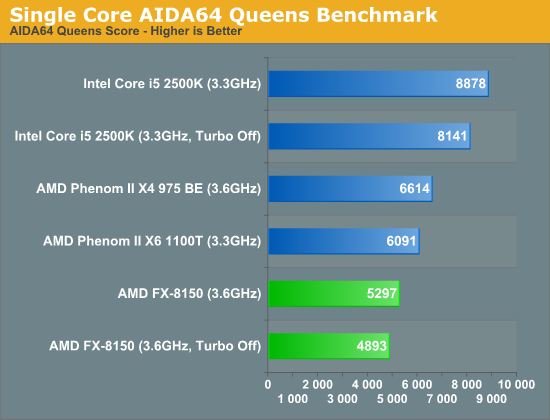
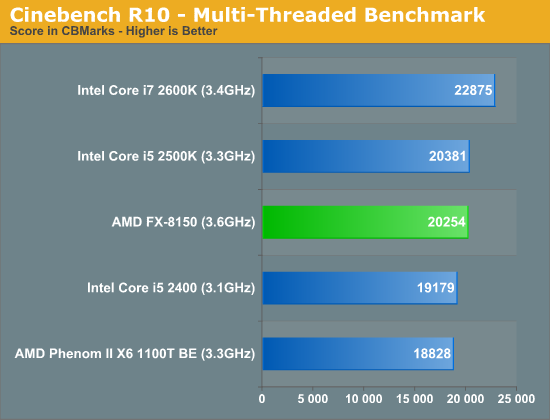
On the desktop, it is different. More of the benchmarks show that the core i5 is faster than the Phenom2 x6 and 8150. But some benchmarks show that the AMD showings can be considerably faster. The choice is really simple. If your workload is dominated by the kind of things that Intel do well, then buy intel, otherwise buy AMD.
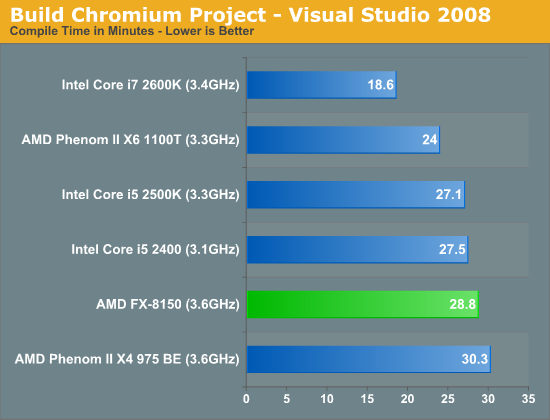
The question is, what are they? Take a look at the bench scores at Anandtech. Note that it switches between "higher is better" and "lower is better", a bit annoying. Significant wins (>10%) that I see:
x264 HD encode test - 2nd pass (listed twice)
- though it loses the first pass by 20-25% and the DivX test
3dsmax9 - SPECapc - SinglePipe2
- though it loses the composite CPU test
POV-ray 3.7
Par2 - multithreaded
Cinebench 11.5 multitheaded
- but it lost Cinebench 10 multithreaded
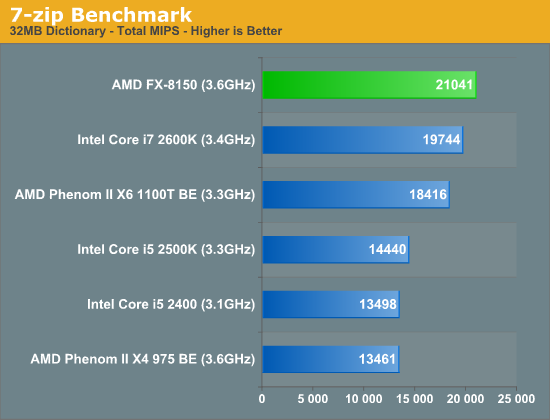
7zip - benchmark
AES-128 Performance -Truecrypt 7.1And that was it, against the i5. If you go to the 2600K the results are:
(this space intentionally left blank)
That's right, there's not a single benchmark where the FX-8150 outperforms the 2600K by more than 10%, the closest is 6-7% in the 7zip test. Some of the big wins over the 2500K like Cinebench 11.5 is now lost by 14% because of hyperthreading. And both of these absolutely spank the FX-8150 at anything single/few-threaded and use a lot less power. Yes you could find a few niches where the $245 FX-8150 beats the $216 2500K and the $317 2600K isn't worth it, but that it's "too close to call"... heh, it hasn't been this clear to call in years. And I pity AMD when they're fighting Ivy Bridge in a few month's time, Intel has said they started volume production in Q3 so I think March next year is a too kind estimate. My guess is January, just like Sandy Bridge - hopefully with no mobo screwups this time.
-
Re:AMD needs its swagger back
On the desktop, it is different. More of the benchmarks show that the core i5 is faster than the Phenom2 x6 and 8150. But some benchmarks show that the AMD showings can be considerably faster. The choice is really simple. If your workload is dominated by the kind of things that Intel do well, then buy intel, otherwise buy AMD.
The question is, what are they? Take a look at the bench scores at Anandtech. Note that it switches between "higher is better" and "lower is better", a bit annoying. Significant wins (>10%) that I see:
x264 HD encode test - 2nd pass (listed twice)
- though it loses the first pass by 20-25% and the DivX test
3dsmax9 - SPECapc - SinglePipe2
- though it loses the composite CPU test
POV-ray 3.7
Par2 - multithreaded
Cinebench 11.5 multitheaded
- but it lost Cinebench 10 multithreaded
7zip - benchmark
AES-128 Performance -Truecrypt 7.1And that was it, against the i5. If you go to the 2600K the results are:
(this space intentionally left blank)
That's right, there's not a single benchmark where the FX-8150 outperforms the 2600K by more than 10%, the closest is 6-7% in the 7zip test. Some of the big wins over the 2500K like Cinebench 11.5 is now lost by 14% because of hyperthreading. And both of these absolutely spank the FX-8150 at anything single/few-threaded and use a lot less power. Yes you could find a few niches where the $245 FX-8150 beats the $216 2500K and the $317 2600K isn't worth it, but that it's "too close to call"... heh, it hasn't been this clear to call in years. And I pity AMD when they're fighting Ivy Bridge in a few month's time, Intel has said they started volume production in Q3 so I think March next year is a too kind estimate. My guess is January, just like Sandy Bridge - hopefully with no mobo screwups this time.
-
Re:AMD needs its swagger back
On the desktop, it is different. More of the benchmarks show that the core i5 is faster than the Phenom2 x6 and 8150. But some benchmarks show that the AMD showings can be considerably faster. The choice is really simple. If your workload is dominated by the kind of things that Intel do well, then buy intel, otherwise buy AMD.
The question is, what are they? Take a look at the bench scores at Anandtech. Note that it switches between "higher is better" and "lower is better", a bit annoying. Significant wins (>10%) that I see:
x264 HD encode test - 2nd pass (listed twice)
- though it loses the first pass by 20-25% and the DivX test
3dsmax9 - SPECapc - SinglePipe2
- though it loses the composite CPU test
POV-ray 3.7
Par2 - multithreaded
Cinebench 11.5 multitheaded
- but it lost Cinebench 10 multithreaded
7zip - benchmark
AES-128 Performance -Truecrypt 7.1And that was it, against the i5. If you go to the 2600K the results are:
(this space intentionally left blank)
That's right, there's not a single benchmark where the FX-8150 outperforms the 2600K by more than 10%, the closest is 6-7% in the 7zip test. Some of the big wins over the 2500K like Cinebench 11.5 is now lost by 14% because of hyperthreading. And both of these absolutely spank the FX-8150 at anything single/few-threaded and use a lot less power. Yes you could find a few niches where the $245 FX-8150 beats the $216 2500K and the $317 2600K isn't worth it, but that it's "too close to call"... heh, it hasn't been this clear to call in years. And I pity AMD when they're fighting Ivy Bridge in a few month's time, Intel has said they started volume production in Q3 so I think March next year is a too kind estimate. My guess is January, just like Sandy Bridge - hopefully with no mobo screwups this time.
-
Re:Virtualization
-
Re:Ars Troll Articles Are Arse
I posted this bellow but realized it should go here.
Anandtech.com provides much more knowledgeable and professional reviews. They had this to about AMD's new chip,
"Unfortunately, with the current power management in ESXi, we are not satisfied with the Performance/watt ratio of the Opteron 6276. The Xeon needs up to 25% less energy and performs slightly better. So if performance/watt is your first priority, we think the current Xeons are your best option. The Opteron 6276 offers a better performance per dollar ratio. It delivers the performance of $1000 Xeon (X5650) at $800. Add to this that the G34 based servers are typically less expensive than their Intel LGA 1366 counterparts and the price bonus for the new Opteron grows. If performance/dollar is your first priority, we think the Opteron 6276 is an attractive alternative." http://www.anandtech.com/show/5058/amds-opteron-interlagos-6200/1
I don't understand why other sites are more popular. -
A much better source for this kind of information.
Anandtech.com provides much more knowledgeable and professional reviews. They had this to about AMD's new chip, "Unfortunately, with the current power management in ESXi, we are not satisfied with the Performance/watt ratio of the Opteron 6276. The Xeon needs up to 25% less energy and performs slightly better. So if performance/watt is your first priority, we think the current Xeons are your best option. The Opteron 6276 offers a better performance per dollar ratio. It delivers the performance of $1000 Xeon (X5650) at $800. Add to this that the G34 based servers are typically less expensive than their Intel LGA 1366 counterparts and the price bonus for the new Opteron grows. If performance/dollar is your first priority, we think the Opteron 6276 is an attractive alternative." http://www.anandtech.com/show/5058/amds-opteron-interlagos-6200/14
-
Good question
The Tegra 3 chip that's showing up in phones this spring and Transformer Prime tablet now is about 7.2 GFLOPs. That's more than enough to be top 10 in 1993. Current ARM architectures might go all the way up to fast enough to take that number one spot in reference sample designs now but they consume too much power to go in your pocket on retail shelves as yet. Maybe in a year or two.
Mali T658 and PowerVR are two to watch here. Mali is supposed to go up to 350 GFLOPs. It still amazes me that in 1993 that machine cost about $70 million in today's money and you can almost match it today for under $500.
-
More photos?
Some more photos would have been good...you go all the way to New Jersey and you only took three pictures? That Pick to Light system sounded interesting, but a photo would have made it all clearer.
I thought that this story had already been done, and sure enough, it has. Of course I'm sure Newegg is happy to give a warehouse tour to any blogger who wants one. I'm not even sure the story I linked is the one I've seen before. Wait, maybe that was this one! Anyway, both of those had more photos.
-
More photos?
Some more photos would have been good...you go all the way to New Jersey and you only took three pictures? That Pick to Light system sounded interesting, but a photo would have made it all clearer.
I thought that this story had already been done, and sure enough, it has. Of course I'm sure Newegg is happy to give a warehouse tour to any blogger who wants one. I'm not even sure the story I linked is the one I've seen before. Wait, maybe that was this one! Anyway, both of those had more photos.
-
Re:Clueless guy visits a fulfillment center
Agree. For much better articles about NewEgg's distribution centers, see AnandTech. The first one is a very old article in fact.
-
Re:Clueless guy visits a fulfillment center
Agree. For much better articles about NewEgg's distribution centers, see AnandTech. The first one is a very old article in fact.
-
Re:I'm more interested in their California locatio
Those guys are slower than snails.
Hope they treat their employees better than Amazon, though!
A bit out of date now, but Anandtech did a similar warehouse tour at the California location back in 2006. And one at the New Jersey location back in 2008.
-
Re:I'm more interested in their California locatio
Those guys are slower than snails.
Hope they treat their employees better than Amazon, though!
A bit out of date now, but Anandtech did a similar warehouse tour at the California location back in 2006. And one at the New Jersey location back in 2008.
-
Re:Little Intel has growed up
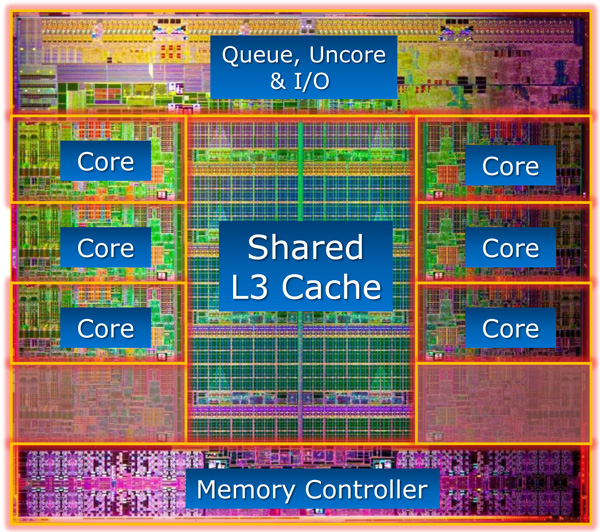
I'm guessing 5x10, if you look at their Intel Core i7 3960X the cores are about twice as wide as they are high.
-
Re:ION (not ION2)
Get a zotac zbox with nvidia onboard card.
Yawn... yeah, wake me up when someone finally starts selling the pico-ITX nVidia ION reference design
http://www.anandtech.com/print/2688I did replace my tower Linux server with one of those Zotac mini-ITX IONs in a shoebox PC last year. Thanks to the GPU, I can even use it to do some light web browsing, and view videos like you say.
Too bad Intel dorked up ION2, with the 1x PCIe GPU bottleneck.
I've played with the fit-PC too, but with the crap Intel GPU with proprietary driver binary blobs, it's pretty useless. Other parts of the chipset (like the sata controller) is also problematic on older linux distros.
http://www.fit-pc.com/web/ -
Re:how do they compare ?
-
Re:how do they compare ?
-
Re:how do they compare ?
-
Re:how do they compare ?
-
Re:how do they compare ?
and many, many, moooreeee
-mainconcept http://www.lostcircuits.com/mambo//i...&limitstart=17
-mediashow http://www.guru3d.com/article/amd-fx...ssor-review/14
-h.264 http://www.guru3d.com/article/amd-fx...ssor-review/14
-vp8 http://www.guru3d.com/article/amd-fx...ssor-review/17
-sha1 http://www.guru3d.com/article/amd-fx...ssor-review/17
-photoshop cs5 http://www.lostcircuits.com/mambo//i...&limitstart=14
-photoshop cs5 http://www.tomshardware.com/reviews/...x,3043-15.html
-winrar, faster than 2600k http://www.techspot.com/review/452-a...pus/page7.html
-winrar, improves over x6 http://www.tomshardware.com/reviews/...x,3043-16.html
-7-zip better than 2600k here: http://images.anandtech.com/graphs/graph4955/41698.png http://www.anandtech.com/show/4955/t...x8150-tested/7
-7-zip same perf as 2600k http://www.tomshardware.com/reviews/...x,3043-16.html
-POV-ray, faster than 2600k http://www.legitreviews.com/article/1741/10/
-POV-ray http://www.nordichardware.se/test-la...art=15#content
-x264(2nd pass AVX enabled) http://www.anandtech.com/show/4955/t...x8150-tested/7
-x264 (2nd pass, better overall than 2600k) http://www.bjorn3d.com/read.php?cID=2125&pageID=11108
-x264 (2nd pass +.3 than SB2600k) http://www.legitreviews.com/article/1741/7/
-handbrake; http://www.legitreviews.com/article/1741/9/
-truecrypt; http://www.bjorn3d.com/read.php?cID=2125&pageID=11111
-solidworks; faster than 2600k http://www.techspot.com/review/452-a...pus/page7.html
-abbyy filereader http://www.tomshardware.com/reviews/...x,3043-16.html
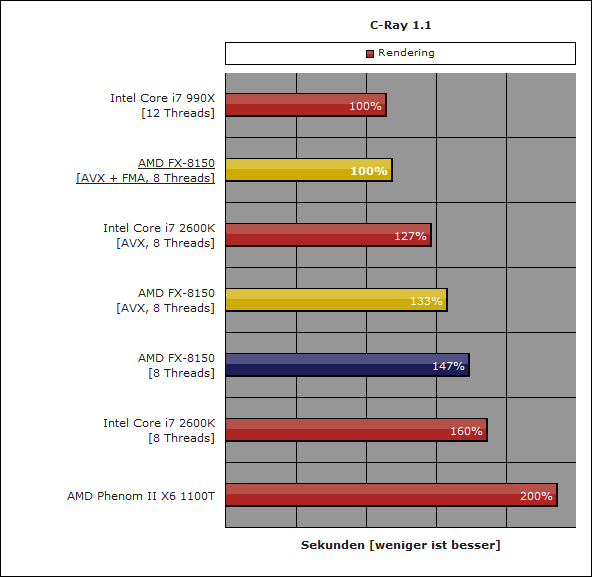
-C-Ray, as fast as $1k i7-990X, http://i664.photobucket.com/albums/v.../c-rayir38.png -
Re:how do they compare ?
and many, many, moooreeee
-mainconcept http://www.lostcircuits.com/mambo//i...&limitstart=17
-mediashow http://www.guru3d.com/article/amd-fx...ssor-review/14
-h.264 http://www.guru3d.com/article/amd-fx...ssor-review/14
-vp8 http://www.guru3d.com/article/amd-fx...ssor-review/17
-sha1 http://www.guru3d.com/article/amd-fx...ssor-review/17
-photoshop cs5 http://www.lostcircuits.com/mambo//i...&limitstart=14
-photoshop cs5 http://www.tomshardware.com/reviews/...x,3043-15.html
-winrar, faster than 2600k http://www.techspot.com/review/452-a...pus/page7.html
-winrar, improves over x6 http://www.tomshardware.com/reviews/...x,3043-16.html
-7-zip better than 2600k here: http://images.anandtech.com/graphs/graph4955/41698.png http://www.anandtech.com/show/4955/t...x8150-tested/7
-7-zip same perf as 2600k http://www.tomshardware.com/reviews/...x,3043-16.html
-POV-ray, faster than 2600k http://www.legitreviews.com/article/1741/10/
-POV-ray http://www.nordichardware.se/test-la...art=15#content
-x264(2nd pass AVX enabled) http://www.anandtech.com/show/4955/t...x8150-tested/7
-x264 (2nd pass, better overall than 2600k) http://www.bjorn3d.com/read.php?cID=2125&pageID=11108
-x264 (2nd pass +.3 than SB2600k) http://www.legitreviews.com/article/1741/7/
-handbrake; http://www.legitreviews.com/article/1741/9/
-truecrypt; http://www.bjorn3d.com/read.php?cID=2125&pageID=11111
-solidworks; faster than 2600k http://www.techspot.com/review/452-a...pus/page7.html
-abbyy filereader http://www.tomshardware.com/reviews/...x,3043-16.html
-C-Ray, as fast as $1k i7-990X, http://i664.photobucket.com/albums/v.../c-rayir38.png -
Re:how do they compare ?
and many, many, moooreeee
-mainconcept http://www.lostcircuits.com/mambo//i...&limitstart=17
-mediashow http://www.guru3d.com/article/amd-fx...ssor-review/14
-h.264 http://www.guru3d.com/article/amd-fx...ssor-review/14
-vp8 http://www.guru3d.com/article/amd-fx...ssor-review/17
-sha1 http://www.guru3d.com/article/amd-fx...ssor-review/17
-photoshop cs5 http://www.lostcircuits.com/mambo//i...&limitstart=14
-photoshop cs5 http://www.tomshardware.com/reviews/...x,3043-15.html
-winrar, faster than 2600k http://www.techspot.com/review/452-a...pus/page7.html
-winrar, improves over x6 http://www.tomshardware.com/reviews/...x,3043-16.html
-7-zip better than 2600k here: http://images.anandtech.com/graphs/graph4955/41698.png http://www.anandtech.com/show/4955/t...x8150-tested/7
-7-zip same perf as 2600k http://www.tomshardware.com/reviews/...x,3043-16.html
-POV-ray, faster than 2600k http://www.legitreviews.com/article/1741/10/
-POV-ray http://www.nordichardware.se/test-la...art=15#content
-x264(2nd pass AVX enabled) http://www.anandtech.com/show/4955/t...x8150-tested/7
-x264 (2nd pass, better overall than 2600k) http://www.bjorn3d.com/read.php?cID=2125&pageID=11108
-x264 (2nd pass +.3 than SB2600k) http://www.legitreviews.com/article/1741/7/
-handbrake; http://www.legitreviews.com/article/1741/9/
-truecrypt; http://www.bjorn3d.com/read.php?cID=2125&pageID=11111
-solidworks; faster than 2600k http://www.techspot.com/review/452-a...pus/page7.html
-abbyy filereader http://www.tomshardware.com/reviews/...x,3043-16.html
-C-Ray, as fast as $1k i7-990X, http://i664.photobucket.com/albums/v.../c-rayir38.png -
Re:how do they compare ?
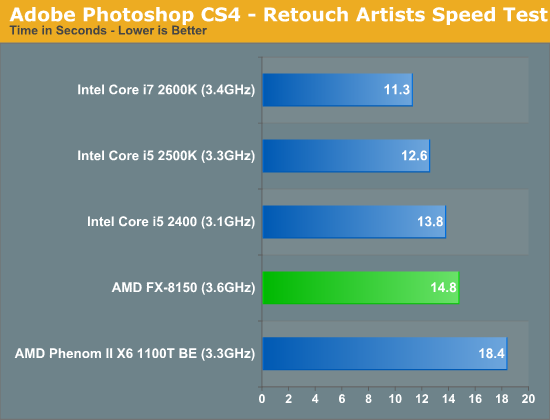
Really? Because this looks like the FX-8150 getting beaten 3 ways silly by even an i5-2500 at photoshop:
http://images.anandtech.com/graphs/graph4955/41688.png -
Other Reviews
http://www.pcper.com/reviews/Processors/Intel-Sandy-Bridge-E-Review-Core-i7-3960X-and-X79-Chipset-Tested
http://www.hardocp.com/article/2011/11/14/intel_core_i73960x_sandy_bridge_e_processor_review
http://www.legitreviews.com/article/1773/1/
http://www.anandtech.com/show/5091/intel-core-i7-3960x-sandy-bridge-e-review-keeping-the-high-end-alive -
More information here...
A lot more information here: http://www.anandtech.com/show/5077/arms-malit658-gpu-in-2013-up-to-10x-faster-than-mali400
-
Re:What are the range of failures?
i don't feel like this is a super valid comparison, unless you mention that the iPhone ran like horseshit on iOS 2 onward, and the iPhone 3G always ran poorly. now my wife's 3GS runs like butt on iOS 5. the original iPhone used the current OS until it didn't get iOS 4, so from 2007-06 to 2010-06, three years, half of which it ran poorly. you have no options for upgrading for new features even if you wanted to. the iPhone 3G used the current OS until it didn't get iOS 5, so from 2008-06 to 2011-10, three years and some change, all of which it ran poorly. you have no options for upgrading for new features even if you wanted to.
This is nonsense. The 3GS runs just fine on iOS 5. Significantly faster, in fact, in some areas than iOS 4 - such as web browsing (particularly a HUGE improvement on Javascript scores thanks to the Nitro javascript engine), and loading time for the camera app.
You can see the iOS 5 on 3GS benchmarks for yourself at: http://www.anandtech.com/show/4956/apple-ios-5-review/15
Secondly, the only iPhone which ever had serious performance problems with an upgrade was the 3G running on iOS 4. 1st gen and 3G iPhones all run just fine with iOS 3.x. The issue (which is admittedly very bad and a huge fuck up by Apple) with the 3G on iOS 4 is mostly due to a serious bug in Location Services which causes memory consumption to increase (and thus, performance decrease) over time. So a fresh iOS 4 install on a 3G starts out pretty decent but after a few weeks it gets slower and slower until, eventually, it becomes unusable.