Slashdot Mirror
Domain: anandtech.com
Stories and comments across the archive that link to anandtech.com.
Comments · 3,318
-
Re:Wut?
1. Actually the current claim is that FPGA is mostly for DRM, as it's basically a DRM wrapper around activesync, which is what G-sync appears to be. According to the guy behind this discovery at least.
2. Factually incorrect. G-sync is in fact inferior to Adaptivesync in refresh rate range in the current implementation. G-sync range is 30-144Hz, where Adaptivesync can handle (depending on the scaler) 36-240Hz, 21-144Hz, 17-120Hz and 9-60Hz.
Source: http://www.geforce.com/hardwar...
http://www.anandtech.com/show/...
3. In general, when someone uses a word "experience" to describe something as simple as syncing refresh rate, you know you're about to read some marketing bullshit. You certainly delivered, by arguing that alpha leaked driver delivering worse results than finished product is evidence of superiority of finished product.
5. Correct. However this is not about the driver, but what finding the fact that G-sync "mobile" is actually Activesync in a wrapper means for previous statements of Nvidia on the topic. Specifically that it means that a lot of those statements have been lies.
And then there's the issue of the claim that G-sync is actually activesync in a DRM wrapper, presented by the original source that got its hands on the driver. -
Better article
As usual, AnandTech's article is generally the best technical reporting on the matter
Key takeaways (aka tl;dr version):
* Nvidia's initial announcement of the specs was wrong, but only because the technical marketing team wasn't notified that you could partially disable a ROP unit with the new architecture. They overstated the number of ROPs by 8 (was 64, actually 56) and the amount of L2 cache by 256KB (was 2MB, actually 1.75MB). This was quite unlikely to be a deliberate deception, and was most likely an honest mistake.
* The card effectively has two performance cliffs for exceeding memory usage. Go over 3.5GB, and it drops from 196GB/s to 28GB/s; go over 4GB and it drops from 28GB/s to 16GB/s as it goes out to main memory. This makes it act more like a 3.5GB card in many ways, but the performance penalty isn't quite as steep, and it intelligently prioritizes which data to put in the slower segment.
* The segmented memory is not new; Nvidia previously used it with the 660 and 660 Ti, although for a different reason.
* Because, even with the reduced bandwidth, the card is bottlenecked elsewhere, this is unlikely to cause actual performance issues in real-world cases. The only things that currently show it are artificial benchmarks that specifically test memory bandwidth, and most of those were written specifically to test this card.
* As always, the only numbers that matter for buying a video card are benchmarks and prices. I'm a bigger specs nerd than most, but even I recognize that the thing that matters is application performance, not theoretical. And the application performance is good enough for the price that I'd still buy one, if I were in the market for a high-end but not top-end card.Not a shill or fanboy for Nvidia - I use and recommend both companies' cards, depending on the situation.
-
Re: You're not going very far with nVidia
Sadly that's a stellar example of the *ahem* limited utility of phoronix benchmarks. Look at all those pretty barplots and tell me, how does the GTX 980 fare in double precision OpenCL? (hint: poorly, the SP:DP ratio seems to be about 32:1, anandtech's benchmark shows even a Radeon HD 7970 destroying it on FP64). So if I wanted to know whether the GTX 980 is a good investment for integer, single or double precision OpenCL number crunching, phoronix is the wrong place to look for relevant information. The problem is, different problems require different types of operations, so if you're heavy on linear algebra chances are FP64 is a must and the GTX 980 is a poor choice, whereas if you're crunching integers for crypto, or doing accelerated image processing it's probably great (but check your memory bandwith constraints just in case).
-
Re:Yes, but
it's useless because it doesn't use a processor that hasn't even launched?
It's useless for me. What am I supposed to do with a friggin Iris? Fuck that, I want a real numbercruncher, even if I have to wait.
So, I'm not complaining, they've got a great lappy, just not quite what I imagined for myself, so I'll hold out.I can't find the link, but there was something about TB2 not being connected directly to the CP lanes.
Ah, there it is:Intel has never allowed motherboard vendors to hang the Thunderbolt silicon / add-in card off the CPU's PCIe lanes. [...] It would have been great to have a new version of Thunderbolt with PCIe 3.0 along with the X99 launch. But, we already know it is not going to be the case till Skylake launches.
From: http://www.anandtech.com/show/...
So that seems the single most important update we've had in years, IMHO.Hopefully I'll be able to get myself something like a WS 60, but with proper TB support that will be able to run OS X. I.e. metal case, two drive bays, lots of RAM, TB2-3, USB 3(.1), and a quadra or the like.
I'm willing to accept binary blobs on my 'puter for such specs, since I have a Free router that does the network filtering anyway.In any case, they got pretty close to what I want except for the TB and the GPU. I might get one of these for my wife in order to support them.
-
Re:Maybe
I'd have to call bullshit on the "most give you either SMART warning or "delayed write failure" errors long before they die" part. I've had many a drive that was working fine one day, monitoring software showed no signs of pending drive failure, and then... dead the next day. *click* *click* *click* *click* *cry*
You say the problem with SSDs is when wafer shrink, well... it seems that manufacturers have thought about that and have gone back to larger lithograph processes. In fact, Samsung has done just that with their 850 Series SSDs by going to 40nm and 3D-NAND. Not only has Samsung done this but Intel has also been considering SSDs of their own to have 3D-NAND. -
Re:It's still Integrated graphics
and it still gets rings run around it by an 830M
Wow, a 15W iGPU gets beaten by a 33W dGPU what a shocker.
Heck, the AMD stuff out performs it.
An A8-6410 which is AMDs best 15W part scores 2010 in futuremark, you can find the i7-4200 under chips with similar performance at 2310.
It just seems silly to have that much processor and an integrated graphics chip...
Today that's a misnomer, Intel's laptop chips are mainly a GPU with a small sideorder of CPU, just like AMD.
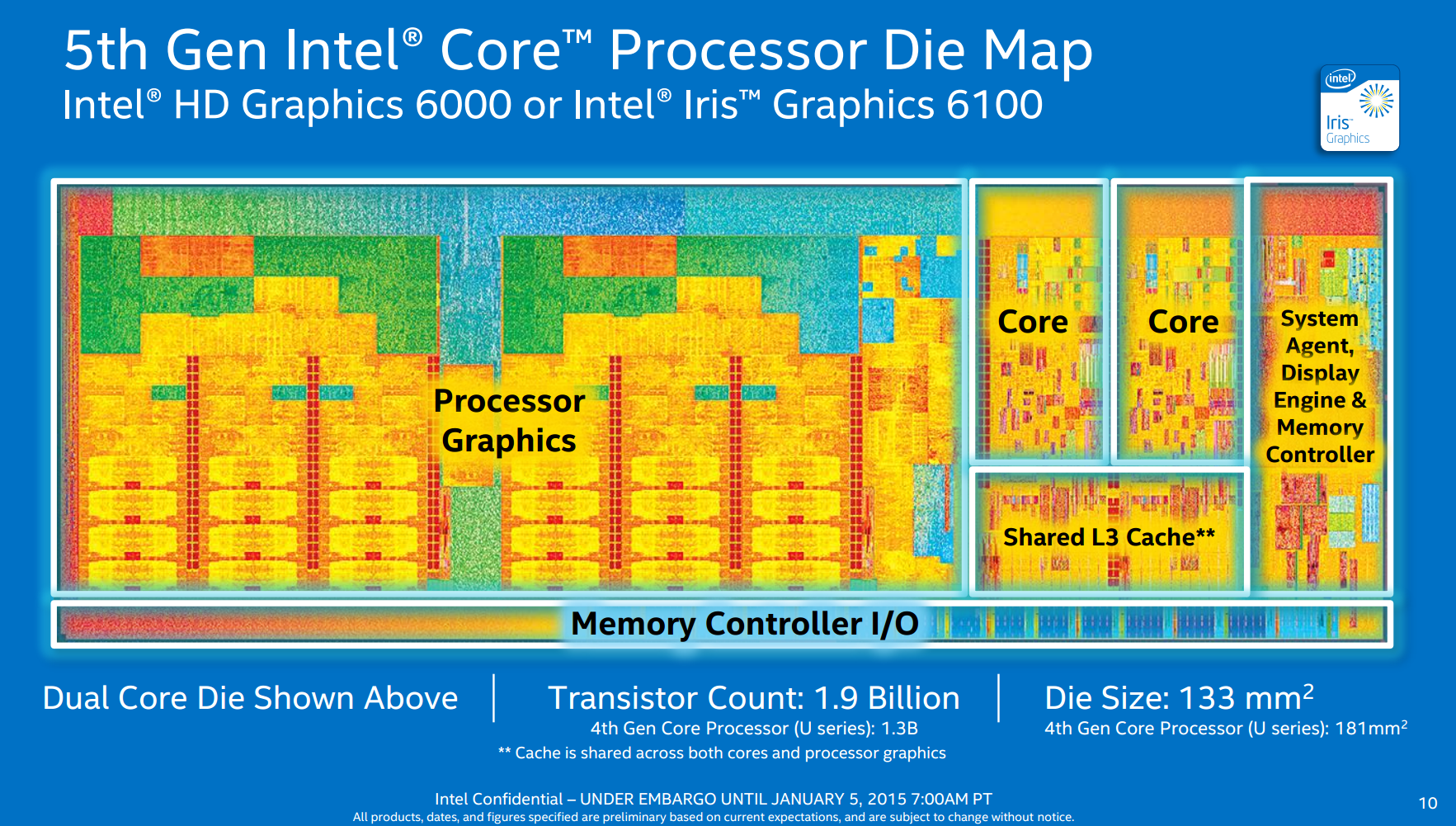
The top of the line chip i7-5557 will have 3.1 vs 2.2 GHz base frequency for the i7-5200 currently under review, 48 EUs vs 24 EUs and they'll run at 1100 vs 900 MHz at 28W vs 15W TDP. You can expect it to be at least 50%+ faster. And this is still Intel's mid range laptop chips (Broadwell-U), we're still waiting for their high end laptop chips (Broadwell-H) with 37/47W configurations. Clearly Intel isn't feeling much pressure there, since they seem to be in no big hurry to get those out.
-
Re:If you don't want to upgrade your box
No they don't, they ship with AHCI drives. There is no support for NVME in OS X. You do understand that NVME is not the form factor right? Just because they have PCIe drives (basically a Samsung XP941 with a proprietary connector, which is an AHCI drive) does not mean they use NVME
https://discussions.apple.com/...
and just so you can learn the difference
http://www.anandtech.com/show/...
http://en.wikipedia.org/wiki/N... -
Getting ready to buy again here... apk
Per my subject: I hear you. I recall, for instance/example, how HDD's going from SATA I to II didn't really "saturate" (or rather take FULL advantage of the theoretical value often extolled) the bus, & only used a FRACTION of what was being said WAS possible... that sticks out in my mind here.
Still - I am looking to buy to replace this current system of mine:
Intel Core I7 920 CPU
4gb DDR3 RAM
WD Velociraptor 10k rpm SATA II HDD
Gigabyte IRAM 4gb DDR3 "True SSD" (not flash-based & I use this for temp ops, print spooling, browser caches, pagefile location, + more)
NVidia GeForce 470 vidcard* Reasons being what I am seeing from sites I respect's benchmarks:
Video -> http://www.techspot.com/articl...
CPU -> http://anandtech.com/bench/pro...
Disk (articles like this one - Flash based SSD tech seems to be truly "getting there" - especially on Samsung's end from what I've read, as well as early controller firmware issues being solved along with "trim" tech, etc-et al)
Still tough to decide WHEN is the "right time" to buy, due to the points you've made & that yes, I have seen myself... I don't know WHAT or WHO to fully trust (like a lot of things nowadays what-with what I call "spinmaster technology" out there that's been raised to a 'fine art', imo...)
APK
P.S.=> I've learned, the hard way perhaps (seeing what you're noting, lots of hype, no real-world practical gains) by buying every 6 months etc. upgrading components (for no REAL gains, not really, & certainly NOT for the monetary outlay) - however, *IF* those links I put up above are ANY valid indicator (this is the tough part - who can you really trust etc. as to data being put out), then, it's time to buy for me (since I am seeing TRIPLING of results in many tests on CPU, Video, & Disk especially)... apk
-
All the Cherry info you'd ever want...
I forget the brand name of my keyboard, but I sprang for a cheap one with Cherry MX Black switches.
The mechanical keyboard I bought almost ten years ago has Cherry MX Black switches apparently. It's certainly lasted, but although I'm still using it to type this message on, I've always felt that the spring resistance was just a *little* too stiff to be truly pleasurable to touch-type on. (Something I've since read elsewhere).
The Cherry MX Red has the same "linear" key action I bought the Black-based keyboard for, but with less resistance, and having used a Red-based keyboard, it's closer to what I had in mind when I bought the Black one (mail order). Mind you, the Red switches apparently weren't around back then anyway.
Cherry MX Reds are supposedly too sensitive for touch-typing, and intended for gaming keyboards, but I (as a non-gamer) am still considering buying one.
Of course, all the above is a matter of personal preference; if possible, you should always try out a mechanical keyboard- or at least one based on the same technology- if the feel of it is important. (And you probably wouldn't be bothering to buy a mechanical one if it wasn't!)
FWIW, while I was researching new keyboards a couple of months back, I came across these, both of which are useful in explaining the different types of Cherry switch:-
An introduction to Cherry MX mechanical switches
Cherry MX overview
Note that these colour codings only apply to official Cherry switches, not unofficial clones derived from their patent-expired design. For example, Razer commissioned a custom "green" switch from another manufacturer, which is apparently similar to the official Cherry MX Blue (rather than the Cherry MX Green). -
It's about Intel not Nokia
What has flown over everyone's head, and it's really disheartening to see this, is this tablet product is likely much more about Intel than Nokia. Intel wants to keep some presence in tablets while it transitions from 22nm to 14nm at which point its products would be much more competitive. Furthermore Intel does not currently even fab its own wireless modems. Fortunately a tablet does not even need an LTE modem, has larger room for batteries, and fortunately Google has recently released Android 5.0 Lollipop with 64-bit support, great for the Atom Intel is using as a transitional product.
-
Re:Long story short (ad-less)
- Energy Use â" The Seagate drives were 7200 rpm and used slightly more electricity than the Western Digital drives which were 5400 rpm. This small difference adds up when you place 45 drives in a Storage Pod and then stack 10 Storage Pods in a cabinet.
- Loading speed â" Edge to Western Digital, by a little over 1 TB per day on average.That didn't really make sense to me that the 5400 RPM drive beat out the 7200 RPM drive, so I did a bit of research.
The WD drives were the WD60EFRX. It's a 5-platter 6TB drive, or 1.2 TB/platter. It has 64MB cache.
The Seagate drives were the STBD6000100. It's a 6-platter drive, or 1 TB/platter. It has 128MB cache. Googling for it brings up contradictory information, listing it as both 7200 RPM and 5900 RPM. (Note: It's pathetic that Seagate doesn't list basic information like RPM on their website.)
So apparently the higher areal density on the WD (meaning more data can be written per rotation, and shorter r/w head strokes to move to a given number of cylinder tracks) is enough to overcome its RPM disadvantage. Given the results, it's likely the Seagate STBD6000100 is 5900 RPM drive, as 7200/5400 = 1.33 which would've exceeded the WD's higher areal density.
I'd caution though that Backblaze's application seems to be a highly sequential task. Peak transfer rates were over 7 TB/day, which is more than 80 MB/s. Given the larger cache and higher RPM (whether 5900 or 7200), I'd expect the Seagate drive to perform better under random read/writes. -
Re:"Content" is an obnoxious red herring..
"Display Stream Compression" (deemed a "visually lossless" algorithm) should be or was to be an alternative to 4:2:0
I just learned that it did not make the cut to be included in the DP 1.3 spec sadly (maybe in a DP 1.3) -
Why is 3D NAND better?
TFA says:
The move to 32-layer 3D VNAND 3-bit MLC flash brings pricing down to the
which didn't make sense to me. Luckily Anandtech has a non-gibberish explanation:
Rather than increasing density by shrinking cell size, Samsung's V-NAND takes a few steps back in process technology and instead stacks multiple layers of NAND cells on top of one another.
With V-NAND, Samsung abandons the floating gate MOSFET and instead turns to its own Charge Trap Flash (CTF) design. An individual cell looks quite similar, but charge is stored on an insulating layer instead of a conductor. This seemingly small change comes with a bunch of benefits, including higher endurance and a reduction in overall cell size. That's just part of the story though.
V-NAND takes this CTF architecture, and reorganizes it into a non-planar design. The insulator surrounds the channel, and the control gate surrounds it. The 3D/non-planar design increases the physical area that can hold a charge, which in turn improves performance and endurance.
The final piece of the V-NAND puzzle is to stack multiple layers of these 3D CTF NAND cells. Since Samsung is building density vertically, there's not as much pressure to shrink transistor sizes. With relaxed planar space constraints, Samsung turned to an older manufacturing process (30nm class, so somewhere between 30 and 39nm) as the basis of V-NAND.
By going with an older process, Samsung inherently benefits from higher endurance and interference between cells is less of an issue. Combine those benefits with the inherent endurance advantages of CTF and you end up with a very reliable solution. Whereas present day 19/20nm 2-bit-per-cell MLC NAND is good for around 3000 program/erase cycles, Samsung's 30nm-class V-NAND could withstand over 10x that (35K p/e cycles).
-
Re:Why no 2tb model?
With increased density from 32 layers (despite larger feature size) why don't they have a 2tb (or 1920gb) model yet?
Anandtech wrote:
Initially I was told that the 850 EVO would come in 2TB capacity as well, but later on Samsung opted against it due to the limited demand.
Most likely because there's no savings whatsoever, if a 1TB drive is $500 then 2TB is probably like $980. They scale almost perfectly, all you need is an extra SATA port and you'd get a lot better performance with two in RAID0.
-
Re:clock speeds yes
Don't underestimate the power difference from top to bottom. Anandtech's CPU bench doesn't go all the way back to 2002, so the closest I got to the Pentium 4 HT 3.06 launched back then is a Pentium 4 660 from Q1 2005 vs AMD Sempron 2650 launched in april 2014. Hey, you said weakest AMD processor. Results
Cinebench R10 - Single Threaded Benchmark:
P4 660: 2245
Sempron 2650: 1384Subtract 15% from the P4's score to match a 3.06 GHz P4 and you're down to 1908. Then you have the arch differences from Northwood to Prescott 2M, but they weren't very impressive as this is when the P4 was running out of steam so let's subtract another 15% to be kind, that brings us down to 1621. Nope, that power guzzler from 2002 probably beats the worst of the worst of 2014. Of course it runs at less than half the frequency, sips a quarter the power and it's dual core so it only loses the single thread benchmark at effectively one eight the power but still, it's a loss.
-
Re:When we give money to the schools ...
Are you able to provide some examples of the devices that you refer to as being the same as iPads at lower cost?
When I look at major benchmarks such as Geekbench (where iPad Air gets more than twice as high score as fastest Galaxy Tab), or sophisticated reviews of tablets that contain rich varieties of performance assessments (e.g. Anandtech 1 or 2 where gets similar margin greatest performance than competitors in both general and graphics performance measures), I see iPads generally showing greater performance for the money than any of its major competitors (e.g., Samsung, Google Nexus, Asus, etc).
-
Re:When we give money to the schools ...
Are you able to provide some examples of the devices that you refer to as being the same as iPads at lower cost?
When I look at major benchmarks such as Geekbench (where iPad Air gets more than twice as high score as fastest Galaxy Tab), or sophisticated reviews of tablets that contain rich varieties of performance assessments (e.g. Anandtech 1 or 2 where gets similar margin greatest performance than competitors in both general and graphics performance measures), I see iPads generally showing greater performance for the money than any of its major competitors (e.g., Samsung, Google Nexus, Asus, etc).
-
Re:Any AMD equivalents out there?
AMD theoretically has parts that target reasonably similar power envelopes (lower-powered 'Kabini' APUs, 'Temash' APUs, and 'Mullins' APUs, go here and play with the wattage filter if you want the actual model-number-soup); but design wins appear to be..sparse...at best.
Zotac put an A6-1450 into a little fanless desktop/HTPC thing; but AMD parts seem to be damn rare outside cheap desktops and the churn of big-n'-awful 15ish inch Best Buy shelfwarmer laptops.
I'm not familiar enough with the benchmarks, and definitely not familiar enough with what OEMs actually pay, to say how much of this is due to objective inferiority, and how much is due to Intel's rather 'generous' pricing of their low-end, low-TDP parts to break into the tablet game.
Compared with something like the J1900 ('Bay Trail' celeron ~10w) the A6-1450 can hold its own, and likely has a punchier GPU; but reports are that Intel is practically giving Bay Trails away, while AMD just doesn't have anything that matches Haswell parts. -
Re:Seems obvious
Well, there may be good news for you: http://www.anandtech.com/show/...
A 26.5" tallscreen 1920x1920 monitor sounds like just what you're wishing for
-
Re:Generic SATA storage devices don't support TRIM
I'm wondering about that myself. Early benchmarks showed that the 840 EVO benefits from TRIM, but that drive also had wonky firmware that was causing read degradation. Could the old firmware have accounted for some of the benchmark problems?
Side note: I applied the firmware upgrade myself last week and it went through without a hitch. YMMV, but I had an easy time of it.
-
Re:Compared to Facebook
I believe these are the boxes that are being used.
-
Re:Can you break it in half?
I found "GTX 970’s TDP meanwhile is lower than GTX 980’s thanks to the reduced clockspeeds and SMM count. The stock GTX 970 will be shipping with a TDP of just 145W" on Anandtech and figured that they are usually reasonably accurate. The 770 and 780 were seriously thirsty; but allegedly the 9-series is better. I apologize if I am in error.
-
Classic Samsung...
Couldn't write a proper wear levelling algorithm if their life depended on it.
First the MAG4FA/KYL00M/VYL00M data corruption bug that affected the Galaxy Nexus - https://android.googlesource.c...
Then (actually BEFORE it, Google found it during Galaxy Nexus development but Samsung kept it hush-hush - but it became a public issue much later) - the infamous Samsung Superbrick fiasco (If you fired a secure erase command at the chip, it had a chance of permanently corrupting the wear leveller data to the point where the chip's onboard controller would crash until you power cycled it any time you accessed that region of flash). - https://git.kernel.org/cgit/li...
Then pre-release 840 PRO devices suffer from the SAME DAMN BUG SAMSUNG HAD BEEN AWARE OF FOR OVER A YEAR - http://www.anandtech.com/show/... - While this only affected review devices, the fact that this was a known bug since before the release of the Galaxy Nexus (a year earlier) is inexcusable.
Then there was the Galaxy S3 "Sudden Death Syndrome" issue in late 2013... - https://github.com/omnirom/and...
Then there were a few other issues - http://wiki.cyanogenmod.org/w/...
Now this...
-
Anandtech had a WAY better article
More technical detail as to what is going on.
-
Re:5K display (and computer) for $2500
The feature is called Target Display Mode and it is not available in the 5K iMac. It may return when it gains Skylake CPUs with Thunderbolt 3.0, because there is no DisplayPort currently capable of sending 5K data.
-
Re:Power VR sucks
Heh...if it were trash, you'd not see it being one of the primary GPUs for mobile devices.
The problem isn't PowerVR itself. It's proprietary drivers on their stuff not being available that's always been the problem. Else you'd probably be singing their praises like most do NVidia for the problem space.
Mods, lay down the damn crack pipe...this one's not "informative", nor is it even accurate. Proof:
Rockchip RX3168 uses SGX GPU
Apple uses SGX in their iPads...
Ingenic uses it with their MIPS Android SOC
MediaTek uses itAnd the list goes on and on. Unless this one uses AMD (well and now NVidia with Kepler...) or can convince Broadcom to make their top-end Videocore IV stuff available to use, they're talking out their backside out of box. It's crap because you can't easily get drivers for it and it's closed- and the only difference between them and NVidia on X86 is that NVidia makes closed drivers available, ImgTec doesn't. The same can be said for Adreno, Mali, and a few others. Now, if ImgTech could ass themselves to make available their drivers for X86 Atom boards, things would be better there.
-
Re:Samsung Already works with Apple, what changes?
Yes, they'll probably look for alternatives (the same way they are looking for an alternative to the Samsung chip fabrication).
I thought they already signed on with TSMC for this. Yes some could look at it as Apple looking to smite Samsung but also remember that TSMC currently is ahead of Samsung when it comes to feature size. TSMC will be producing 16nm chips in 2015 and 10mn after that while Samsung has only recently made 20nm ones. Only Intel is ahead of them but Intel is not yet producing ARM chips in this size. They seem to be reserving these fabs for their own x86 chips.
-
Re:Depends on the specs.
if history has taught us anything about processors it's that generic always seems to win.
That argument ends when you realize that the special blocks are being put onto the same die as the CPU. If anything, mobile SOCs are gaining MORE specialized circuitry. All of your counterexamples are referring to separate cards.
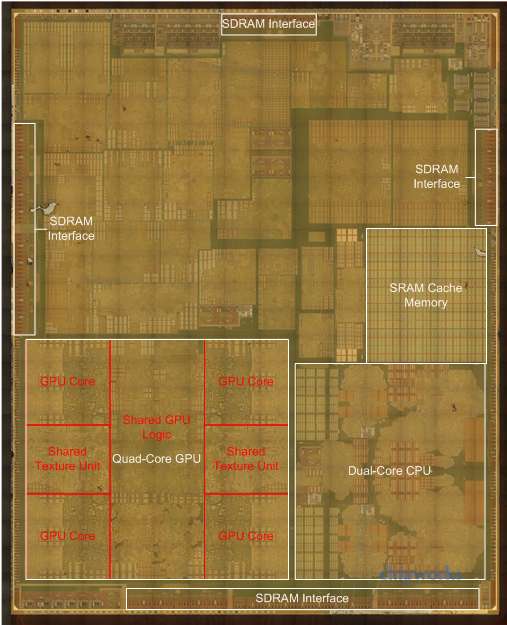
Take a look at this picture of the A8 from chipworks. Only around 1/3 of the die area is used for the CPU and GPU. The rest is SRAM, various interfaces, special blocks (ex. DSPs), etc. There's a reason a modern phone processor is referred to as a system on a chip. There's tons more stuff on them than just a generic CPU/GPU.
Further, even CPUs are specializing further. Take big/LITTLE for example; they're effectively doubling the amount of circuitry for a more favorable performance/power ratio.
-
This is something I've been noticing for a while
Android handsets are in a numbers race as far as specs go, going so far as to push beyond what anyone would appreciably notice. Case in point: The LG G3 with its 1440p, making for 534 PPI. What, exactly, is the point of this ridiculous PPI? You certainly aren't going to notice a difference between a 1080p screen and that one at these screen sizes unless you're used to using your phone under a magnifying glass or an inch away from your face. And yet it's a big feature, proudly displayed as the first bullet point on the website. It's a numbers game.
Then there's the dual core vs quad core (and beyond) and maximum clock speed bit, which is absurd when you consider that different implementations (Qualcomm vs Apple for instance) even within the same architecture will have different levels of efficiency. In the PC world, for instance, Intel's processors absolutely dominate AMD's per-core and per-clock, and both are x86-64. For some perspective on that, Anandtech wrote that a single Haswell core has double the floating point performance of two AMD modules - four "cores". For Android's part, the trend seems to be, similarly to AMD, pushing for higher and higher clocks (Snapdragon 80x), and not efficiency. This can be seen in the preliminary benchmark results that show Apple's supposedly underpowered CPU topping the charts.
And then, coming back to the story's example of the Nexus 5 vs the iPhone 6, comparing Android to iOS as far as RAM requirements go couldn't possibly be more misguided. iOS is far more restrictive as to what an app can do in the background than Android is, and much more aggressive with reclaiming memory for the app in the foreground. Android keeps apps running for as long as possible (until memory is needed, basically), and apps can do essentially whatever they want to do in the background. This also factors in to battery life, where power consumption on Android is likely to be much higher and therefore much larger batteries are being used there for what is basically similar battery life.
It's for those reasons that it's tough to actually compare the two ecosystems, and it's tough to say whether the specs really make that much of a difference to the overall experience. I think the ultimate answer is that regardless of performance numbers on paper, we've hit the wall for what we're expecting our devices to do. For my part, I say that, for now at least, specs are irrelevant. As long as the device is able to handle the tasks thrown at it without choking and has the features I'm looking for, it's a device worth considering. I think the Nexus series in particular has always embodied that point of view.
-
This is something I've been noticing for a while
Android handsets are in a numbers race as far as specs go, going so far as to push beyond what anyone would appreciably notice. Case in point: The LG G3 with its 1440p, making for 534 PPI. What, exactly, is the point of this ridiculous PPI? You certainly aren't going to notice a difference between a 1080p screen and that one at these screen sizes unless you're used to using your phone under a magnifying glass or an inch away from your face. And yet it's a big feature, proudly displayed as the first bullet point on the website. It's a numbers game.
Then there's the dual core vs quad core (and beyond) and maximum clock speed bit, which is absurd when you consider that different implementations (Qualcomm vs Apple for instance) even within the same architecture will have different levels of efficiency. In the PC world, for instance, Intel's processors absolutely dominate AMD's per-core and per-clock, and both are x86-64. For some perspective on that, Anandtech wrote that a single Haswell core has double the floating point performance of two AMD modules - four "cores". For Android's part, the trend seems to be, similarly to AMD, pushing for higher and higher clocks (Snapdragon 80x), and not efficiency. This can be seen in the preliminary benchmark results that show Apple's supposedly underpowered CPU topping the charts.
And then, coming back to the story's example of the Nexus 5 vs the iPhone 6, comparing Android to iOS as far as RAM requirements go couldn't possibly be more misguided. iOS is far more restrictive as to what an app can do in the background than Android is, and much more aggressive with reclaiming memory for the app in the foreground. Android keeps apps running for as long as possible (until memory is needed, basically), and apps can do essentially whatever they want to do in the background. This also factors in to battery life, where power consumption on Android is likely to be much higher and therefore much larger batteries are being used there for what is basically similar battery life.
It's for those reasons that it's tough to actually compare the two ecosystems, and it's tough to say whether the specs really make that much of a difference to the overall experience. I think the ultimate answer is that regardless of performance numbers on paper, we've hit the wall for what we're expecting our devices to do. For my part, I say that, for now at least, specs are irrelevant. As long as the device is able to handle the tasks thrown at it without choking and has the features I'm looking for, it's a device worth considering. I think the Nexus series in particular has always embodied that point of view.
-
Re:Sales figures are news now?
Except for:
- the iPhone 6 is, well the S3 is so old its not even in the comparative benchmarks published today by anandtech.... http://www.anandtech.com/show/..., but since the iPhone 6, 6+ and 5s are all faster than the Galaxy S5 we can assume that they are also faster than the S3
- the iPhone doesn't run Andoid
- the iPhone is not build by Sammy.. more nuff said
-
Re:I said it was BS
I guess you now realize that's wrong. The main purpose of trim is to avoid reading and writing pages that are unused anyway. The SSD doesn't need to reallocate trimmed blocks, because the OS isn't using that data anyway. Less physical reading and writing == more endurance.
Its not wrong.
1) TRIM simply alerts the drive when a block is ready for erasure; its right there in the article I linked. Its primary purpose is not reallocation or anything else; its just garbage collection for performance reasons.
2) The endurance thing is ONLY if the firmware being used is using a hack to implement their own garbage collection which could induce write amplification. It does not, in itself, reduce endurance if the SSD isnt doing anything fancy / out-of-spec.
3) Reads have no impact whatsoever on endurance. Only write / erase cycles do-- hence why they quote 1000 P/E cycles (where P= program and E= erase)Now that you've agreed with what I said (trim affects endurance, but in an application dependent way), are you ready to admit YOU had forgotten exactly what the tech does?
From the wikipedia article's opening paragraph:
A Trim command (commonly typeset as TRIM) allows an operating system to inform a solid-state drive (SSD) which blocks of data are no longer considered in use and can be wiped internally.From Anandtech
The purpose of TRIM is performance-- NOT ENDURANCE. It has NOTHING TO DO WITH ENDURANCE except insofar as it replaces a manufacturer's proprietary and amplification-causing garbage collection. Older drives dont HAVE garbage collection, and TRIM does NOTHING for their endurance; all it does is eliminate the eventual performance crash.
You REALLY need to read up on TRIM, as you seem to not understand what it is that it does. To repeat: It does not have any effect on reallocations. It does scheduled erasures. If an erasure would cause a reallocation, that would happen regardless of whether it was during a scheduled TRIM, or during a "on-the-fly erase/write".
-
Re:Lifetime at 16nm?
Anandtech disagrees. Techreport. So, in fact, do huge numbers of user reports which suggest that SSDs really do last a long time.
Further, multiplying this problem manyfold, is that when an SSD fails, it tends to fail totally.
I have seen this happen, but its not due to endurance of the flash cells but on the quality of the firmware / controller. The actual cell failures apparently cause reallocations (according to techreport's tests, and to common sense). And you create an interesting dichotomy; what does it look like for an SSD or HDD or CPU or RAM to fail "not totally"? You get most of your bits back? All tech generally tends to fail catastrophically.
-
Re: [s]Parallax.[/s] Perspective
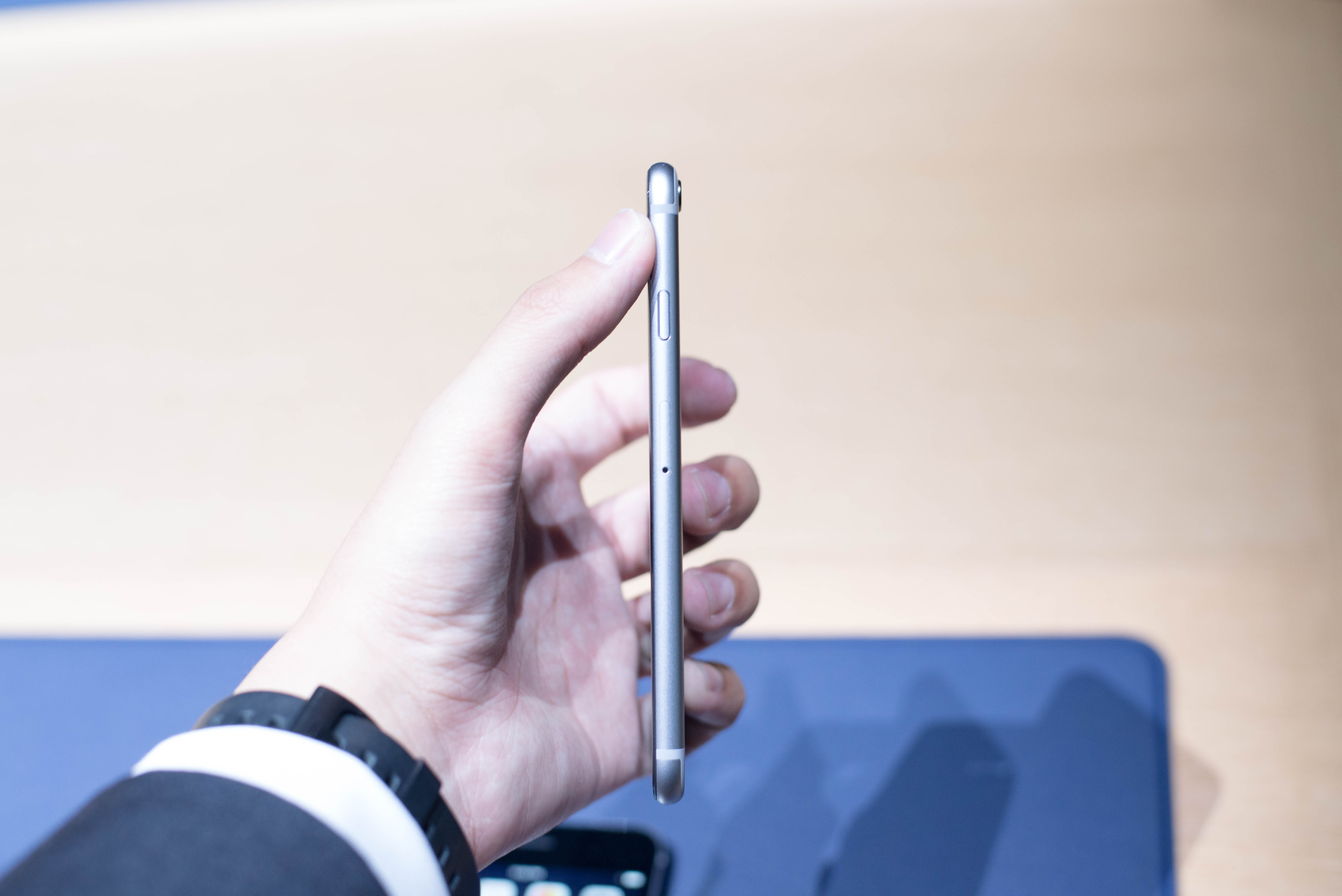
Ok then, try this image where the camera is clearly visible from a straight on side shot.
http://images.anandtech.com/do...
The excuses and outright lies that you Apple shills come up with are absolutely hilarious.
-
Re:Something tells me they have had this for a whi
I don't believe so. Just look at the picture in this article. That's some extreme stacking going on. There's a degree of competition and collusion in all of the tech markets. But at the end of the day, you are still going to get a space age product that is improving and becoming cheaper over time.
32 GB get as low as $11-14. 64 GB is $20-30. 128 GB is more like $70-80. It's not a stretch to say that it is harder to fit more in a smaller area, the resulting product is more valuable, and some customers will gladly pay more $/GB for density. For everyone else, there's the 32-64 GB cards.
-
Re:Pricing?
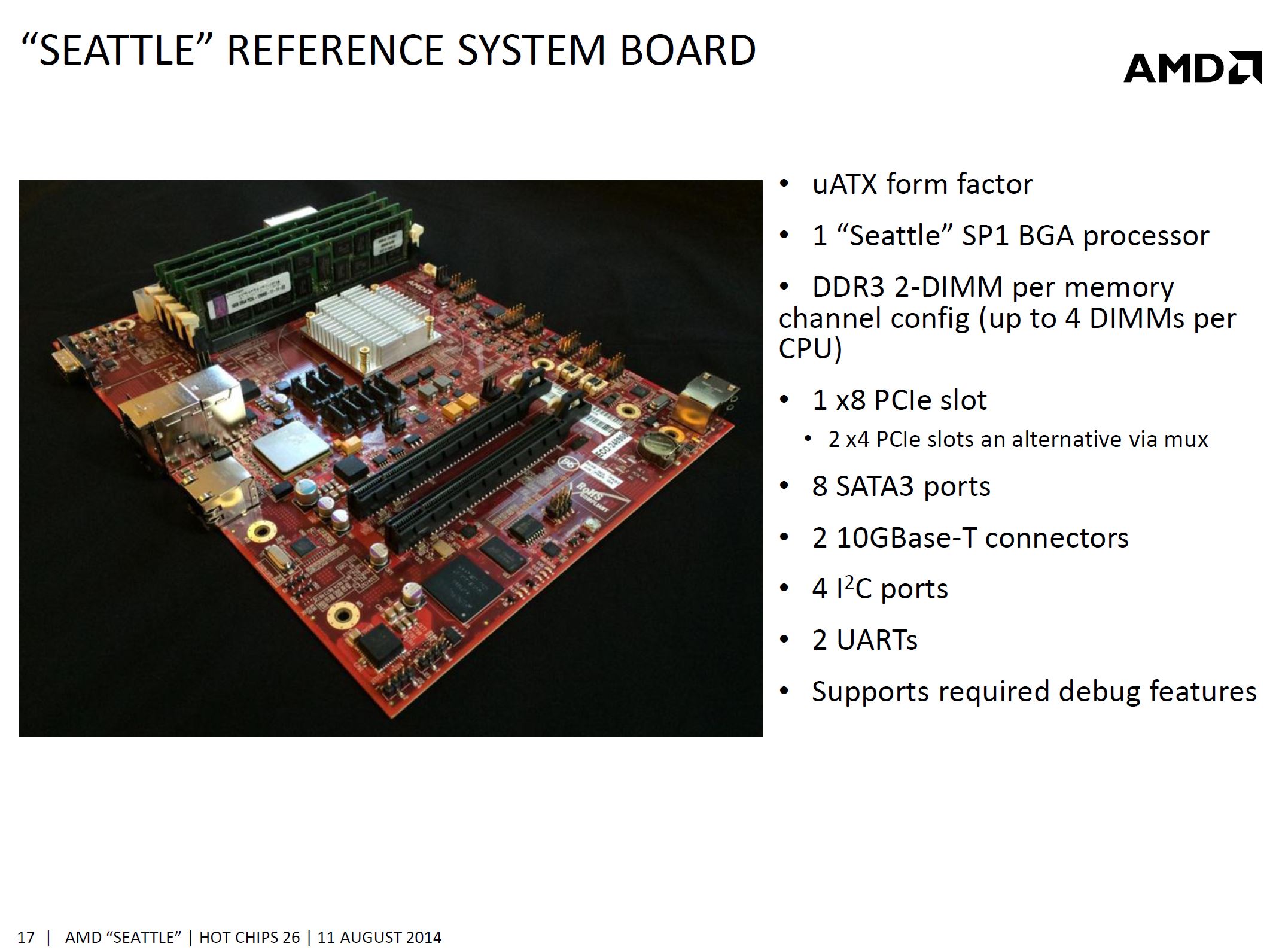
$6,000? AMD's 64-bit-ARM Opteron A1100 reference board is half as much and (while obviously not very 'embedded') is a rather bigger piece of gear...
-
Re:What happened to the core-wars?
I've been stuck with my 4 core cpu for the last 6-7 years now and the only thing that has improved my rendering is the NVIDIA GPUs
6-7 years ago, that's like a Q6600 or so? Have you actually looked at benchmarks like Q6600 vs 4790K because current top of the line quad-cores are 3-4 times faster than that.
I remember 8-16 cores being announced YEARS ago, but they never ever appeared in regular desktop computers
No, because of a couple things:
1) Single-threaded performance is still huge and often the bottleneck in interactive work - big multithreaded jobs just decide how long a coffee break you get.
2) Lots of cores means big die means big costs and poor yields meaning they aren't really interested in selling it at consumer prices.
3) Companies would no doubt try to use these as cheap servers or whatever and they don't want enterprise users buying anything but Xeon.
4) You can now get i7-5960x in an "enthusiast" system with 8 cores at least, though it'll cost you $1000. Or you can buy AMDs marketing and get an "8-core" FX processor... -
Re:Trying to get bought out?
You mean aside from the fact Intel has patent agreements with Nvidia? It's pretty clear to me that Nvidia's trying very hard to increase their share in the mobile market and one way to do it is to get some cash from competitors through licensing agreements. Or maybe they want some of Qualcomm's patents for their own products?
As per usual, -
Re: Not really 8 cores...
Somewhat analogous to P4 but not quite in that Bulldozer IPC is about at Phenom II levels. See here: fully loaded, IPC is equivalent to Sandy Bridge/Ivy Bridge but single-threaded it's about at Phenom II IPC.
AMD's original goal was to get Bulldozer to have similar IPC as Phenom II. Basically, Piledriver is what Bulldozer should have been.
-
Re:Really hope the spirit lives on
From AnandTech, 2001:
AMD's Athlon XP: Great performance, poor marketingTotally shilling, right? Heres the sad truth: Since the Core 2 Duo hit in ~2006, AMD has been getting its rear handed to it. It had a small advantage in memory benchmarks for several years after that due to its integrated memory controller, but after Intel jumped on board with those, the only reasons youd buy AMD these days are core count or cost (you get a lot more CPU features at the low end with AMD).
Performance-wise, and often even on a budget, Intel is simply better. You dont have to like it (and I dont, because Intel's customer service sucks while AMDs is great), but its the reality.
-
Re:I bought one of these for Litecoin mining
Indeed, this is nothing new. It takes all of 10 seconds to find fake video cards being sold on eBay.
http://www.ebay.com/itm/OEM-GT...
The sellers will simultaneously lie and tell the truth to skirt the rules and not get banned. Not that eBay actually cares about counterfeit goods.
Right now it's rebadging Fermi (400/500 series) generation parts as modern Kepler (600/700 series) parts. However it's an old scam, and if you go back a few years you can find G7x (7xxx series) cards that were being rebadged and sold as GT2xx cards.
The method of the scam hasn't changed: flash a hacked vBIOS to change the device ID so that it shows up as the desired card. And as long as sellers aren't prosecuted it will keep happening. There's just not much risk in this kind of fraud on the individual level. Though the scam in TFA is large enough that it's certainly going to attract more attention than the perps would like.
-
Re:lets talk about endurance
They are targetting gamers, not servers. Do gamers really use 30GB/day? Other than maybe the first day, when installing Steam and a bunch of content on a brand-new system.
http://images.anandtech.com/do...
I didn't find very good stats on average daily pagefile / hiberfile use for gamers.
-
Re:Misleading Labeling
It's not the first time they are using the "Radeon" brand for non-GPU hardware; for over a year now they have RAM also.
-
False.
The Nexus 10 I purchased on launch day had a working OpenCL implementation. I ran some kernels on it and it was definitely GPU accelerated. A software update actually removed the CL driver later on as Google backtracked on CL support and began promoting their Renderscript instead.
http://www.anandtech.com/show/...
Also, the nVidia jetson-tk1 that I purchased does NOT have a working OpenCL implementation.
Look at the comments from the nvidia employee: http://devblogs.nvidia.com/par...
This article is just free advertising for nVidia, and its false information too!
They make great hardware, why do they have to be so damn dishonest all the time?
-
Re:Updated?
The "new" news is the release on the A8-7600; and only about 7 months late. Most of the reviews for that processor were published in January, which is shameful really.
http://www.anandtech.com/show/...But now that it is out, it is at a good price, decent computationally, very good power envelope. It's a good option for productivity-only desktops, at a fraction of the price of a 7850K or an i3-4330.
-
Not a high-end machine
It's using a Core i7-4785T, an "ultra-low power" processor (shown by the T suffix - S indicates a "low-power" part, and K indicating an overclockable part). This particular one is a 35W part running at only 2.2GHz, while the regular i7-4790 runs at 3.6GHz (and 84W)[citation]. Turbo boost can bring that up to 3.2GHz on a single core (on the regular chip, 4.0GHz). So the CPU is not a regular desktop chip at all, let alone a "high-end" one.
The Nvidia GeForce 760 is a bit of an interesting choice. It's not powerful enough to be called "high-end" (I would apply that label only to the 780 and 780 Ti of that series), but it doesn't fit with the ultra-low power CPU. If they were thermally constrained (as their CPU choice indicates), I would have expected to see the 750 Ti - not too much weaker (~30% [citation]), but with a far lower power draw (it's the most powerful card to be powered only by PCIe, no extra power connections needed). Seriously, the 760 is a 170W card, and the 750 Ti is a 60W card. Seeing how they handicapped the CPU to shave off 50W, I don't see their logic for not shaving 110W for a similar performance penalty.
Because of their choice of CPU, I can't really support their claim of being a high-end desktop with passive cooling. They are much more powerful than most fanless PCs, but most fanless PCs are also designed for industrial use, not for regular office/home environment. So it's an improvement, but not a revolutionary one.
-
Re:My SSD already encrpyts its contents
Exactly. Mainstream PC SSDs have been self-encrypting for a couple of years now; in Intel's case they've supported full disk encryption since the SSD 320 released in 2011. This is both to allow the easy use of encryption on the end-user side (ATA password), but it also makes it easy to wipe the drive without immediately zeroing out pages, as you have noted.
-
cherry-picked benchmarks
If you do a broader range of benchmarks you'll see the 290x beats the Titan on most compute benchmarks:
http://www.anandtech.com/show/... -
Wrong tests
The Titan shouldn't be considered a top-end gaming card. It should be treated as a budget Tesla card - even at $3k, it's the cheapest card in Nvidia's lineup with full double-precision floating point performance (which no game uses, but is common for scientific computing, Tesla's market). And on tests using that, the single-gpu Titan and Titan Black outperform the 295X2 by a large amount. AT hasn't gotten to test a Titan Z yet, but you can tell it's going to wipe the floor with the 295X2.
Yes, Nvidia advertised the original Titan as a super-gaming card, and to be fair it was their top-performing gaming card for a while. But once the 780 Ti came out, that was over, and since everyone expects a 790 dual-GPU gaming card to be announced soon, buying any Titan for gaming is a fool's choice.
Nvidia seems to still be advertising it as a top-end gaming card, presumably trying to prove the old adage about fools and their money. It just comes off as a scam to me, but anyone willing to spend over a grand without doing some proper research probably deserves to be ripped off.
-
Re:4 GHz
"they managed to break the 4GHz barrier"
Dell sold a Presler-based system at 4.25 GHz in 2006: http://anandtech.com/show/1916...