Slashdot Mirror
Domain: anandtech.com
Stories and comments across the archive that link to anandtech.com.
Comments · 3,318
-
Re:Really?
In the case of most drives, the key they ship with is randomly generated at the factory, unless you enable ATA passwords in your BIOS, which will prompt a new key to be generated, secured by that password. This is the typical behaviour; encrypt everything by default using the built-in key, and most support various external interfaces for securing that. Some even support eDrive, which integrates with BitLocker. Anandtech has a nice article about that:
-
Re:Not going back
http://www.anandtech.com/show/4329/intel-z68-chipset-smart-response-technology-ssd-caching-review/2
Intel SRT tech seem to bring a good compromise. Best of both worlds sort of.
-
Re:Now..
haswell makes full windows with 100% backwards compatibility in a tablet device a desirable thing
Actually, if I'm not mistaken, the Atom line has been the one championing x86 tablets. Also, it is the line Intel feels is their best bet for entry into the tablet and phone market: http://www.anandtech.com/show/7263/intel-teases-baytrail-performance-with-atom-z3770-cinebench-score
The end result is the same, though:
RT is destined for the bin.
ARM SoCs are getting competition from SoCs made by a very potent behemoth.
x86 will rise in the mobile market.To further support the latter I'd like to note that Intel is also putting effort into getting Android x86 working on the Atom, with success:
http://reviews.cnet.com/tablets/asus-transformer-book-trio/4505-3126_7-35827211.htmlAlso:
http://www.pcworld.com/article/2044617/new-intel-chief-sees-150-atom-tablets-this-year.html
http://www.intel.com/content/www/us/en/tablets/tablets-atom.html -
Re:Apple press release
Yes, it was in snow leopard. It is still cutting edge, as no other OS has anything similar throughout the OS.
GCD might be cutting-edge, but it does not itself make Mavericks a cutting-edge version of OS X, given that it dates back to Snow Leopard, and it doesn't belong in a list whose other members are features new in Mavericks. In the list "interrupt coalescing, memory compression, grand central dispatch, app nap.", at least one of these things is not like the others, as the saying goes, and, if by "interrupt coalescing" you mean "timer coalescing", exactly one of those things is not like the others.
(As for "interrupt coalescing", I have no reason to believe that, for example, jerbun's comment in this Gizmodo story:
My best guess is that they are essentially doing this:
Interrupt Coalescing
This taken from the "Time Coalescing" statement from which I am making the assumption that they really mean "Interrupt Coalescing."
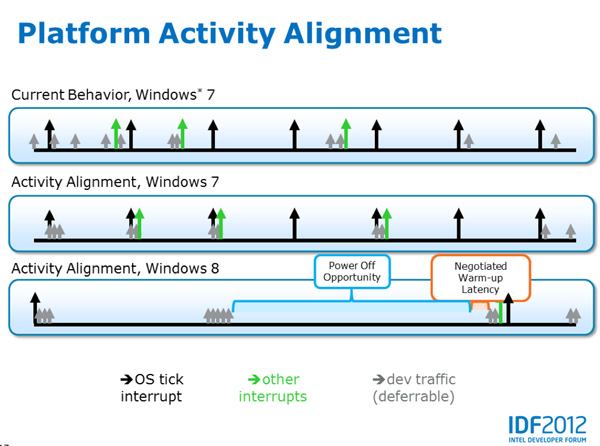
The basic idea is that instead of waking up the processor every single time some sort of I/O needs to be done by a peripheral, they let some of them wait a little longer. Not all I/O is latency dependent, and as such the wake-up time can be postponed. This means that a series of interrupts can be handled all at once, and then the processor can go back to sleep.More in depth explanation:
Anandtech on Haswell 6/10/13 5:21pmis a good guess.
I'm more inclined to go with Apple's own description of it in their "OS X Mavericks Core Technologies Overview" document, which indicates that it shifts the times of events scheduled to happen sufficiently close together in time so that, instead of happening at a time as close as possible to the scheduled time, they happen at times further from their scheduled time in a fashion that allows more of them to be handled within one timer-based wakeup. One consequence of this might be that fewer timer interrupts occur (as I remember, XNU was made tickless at least as far back as Lion, so there aren't periodic timer interrupts), but that particular bit of interrupt coalescing - it only concerns timer interrupts - isn't the main goal, and is arguably not a goal at all, just a side-effect of reducing the number of timer-based wakeups from sleep.)
-
Re:Apple press release
Yes, it was in snow leopard. It is still cutting edge, as no other OS has anything similar throughout the OS.
GCD might be cutting-edge, but it does not itself make Mavericks a cutting-edge version of OS X, given that it dates back to Snow Leopard, and it doesn't belong in a list whose other members are features new in Mavericks. In the list "interrupt coalescing, memory compression, grand central dispatch, app nap.", at least one of these things is not like the others, as the saying goes, and, if by "interrupt coalescing" you mean "timer coalescing", exactly one of those things is not like the others.
(As for "interrupt coalescing", I have no reason to believe that, for example, jerbun's comment in this Gizmodo story:
My best guess is that they are essentially doing this:
Interrupt Coalescing
This taken from the "Time Coalescing" statement from which I am making the assumption that they really mean "Interrupt Coalescing."
The basic idea is that instead of waking up the processor every single time some sort of I/O needs to be done by a peripheral, they let some of them wait a little longer. Not all I/O is latency dependent, and as such the wake-up time can be postponed. This means that a series of interrupts can be handled all at once, and then the processor can go back to sleep.More in depth explanation:
Anandtech on Haswell 6/10/13 5:21pmis a good guess.
I'm more inclined to go with Apple's own description of it in their "OS X Mavericks Core Technologies Overview" document, which indicates that it shifts the times of events scheduled to happen sufficiently close together in time so that, instead of happening at a time as close as possible to the scheduled time, they happen at times further from their scheduled time in a fashion that allows more of them to be handled within one timer-based wakeup. One consequence of this might be that fewer timer interrupts occur (as I remember, XNU was made tickless at least as far back as Lion, so there aren't periodic timer interrupts), but that particular bit of interrupt coalescing - it only concerns timer interrupts - isn't the main goal, and is arguably not a goal at all, just a side-effect of reducing the number of timer-based wakeups from sleep.)
-
Re:CSS
Absolutely. Just browse http://userstyles.org/.
If you insist on a specific example, try http://userstyles.org/styles/22529/anandtech-forums-fusetalk-look for http://forums.anandtech.com/
Although maybe your definition of "completely redesigns" is more extreme than mine?
-
Re:Call me old fashion
So you mean on this page where they estimate a life span of a perfectly empty 128GiB drive using TLC nand at 2.5 years... but if it was 75% full then it would be a quarter of that, which is pretty close to what I estimated before of likely to fail between 0.85 and 2.55 years?
-
Re:Was the RAPID sw used throughout the test
I would want to see its performance without drivers installed and used as a plain SATA drive. And I would like to see with and without RAPID numbers.
Is RAPID a sophisticated buffer cache that is doing lazy writes to the SSD?
There you go: http://www.anandtech.com/show/7173/samsung-ssd-840-evo-review-120gb-250gb-500gb-750gb-1tb-models-tested/5
I wonder if RAPID could bring such huge performance improvements on Linux too, or if this just means the Windows cache sucks. Because from the article I still don't see eactly what RAPID does that the OS's cache shouldn't do already.
-
Re:Call me old fashion
No, I mean this, which has a detailed explanation of what's going on, and why you shouldn't care.
-
Re:Damn
Even Western Digital bit the bullet and started working on pure SSDs.
Uh, what? (Please be sure to look at the date on that article, and I also recommend reading the article as well)
But I'm still waiting for said drives. I want nothing to do with Seagate's hybrids, given that the MHDD portion of the drive still behaves like their vanilla MHDDs -- inappropriate firmware features like excessive head parking is still present on their hybrids, and their choice of NAND capacity is utter nonsense for multiple reasons (wear levelling: even if the drive reserved 50% of the 8GB for wear levelling it wouldn't last long. I don't understand how Seagate can't understand more NAND capacity = more NAND pages available to use for wear levelling = those NAND pages last longer; overall capacity: most games today will exceed 8GB in capacity so you can "destroy" (lack of better term) the caching benefits by loading that game -- 32GB would get you much more comfort room).
It's like Seagate based their entire study on laptop drives being used by sales execs who do nothing but run Outlook, Powerpoint, and Excel all day long. Sometimes I really do think this is what these "justification white papers" use as their demographic, and it's a completely unrealistic group to use as a data point. (Please also remember this is Slashdot, we're all technical nerds and use computers for technical things, not clicking "Print" all day).
In short, Western Digital has the right idea.
As for hybrids being pointless, "just go to SSDs" -- sure, I agree, that would be ideal. However the capacity of SSDs vs. the price point is still no where near that of a hybrid drive. A hybrid drive (assuming its designed correctly) will give you fantastic performance for reads and could give you better performance for writes too (if not, then they'll at least be on-par with that of the MHDD, which is acceptable), while giving you the capacity (500GB+) for a much lower overall cost.
-
Re:Why does this compare to the iPad 3?
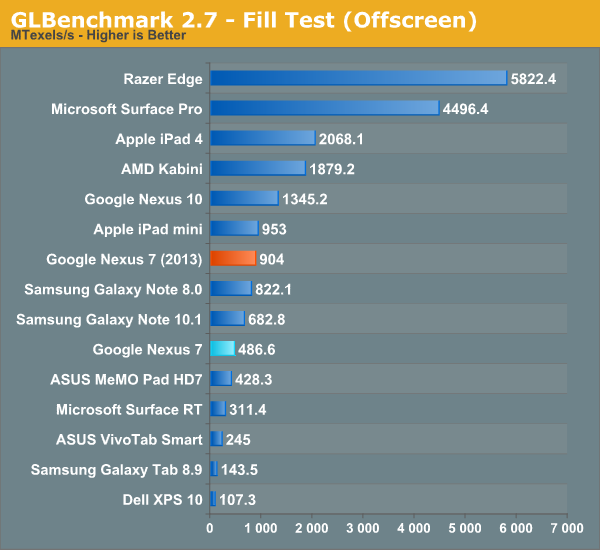
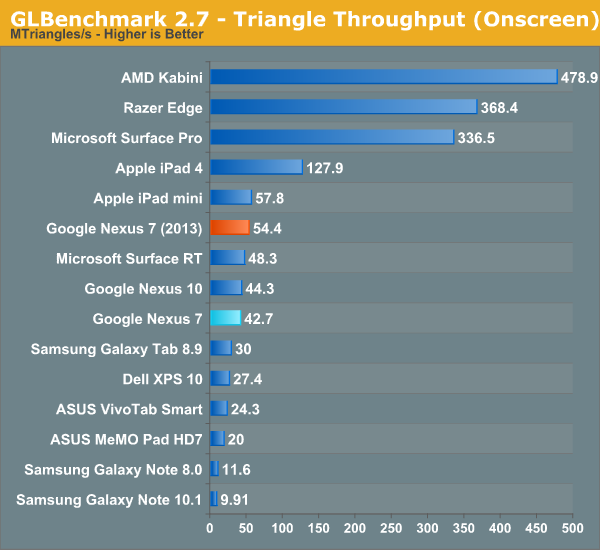
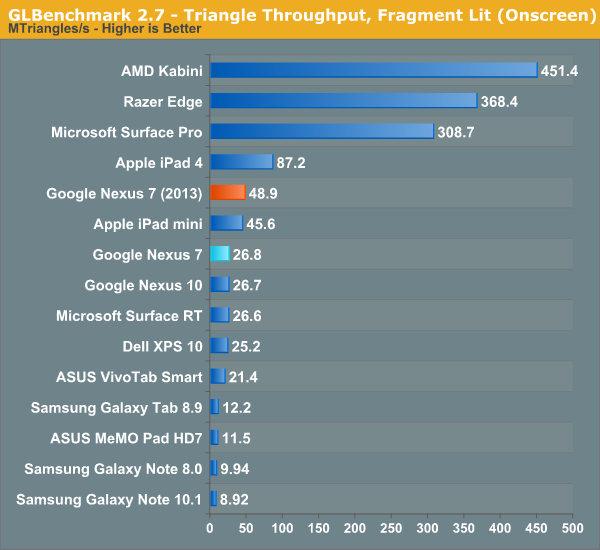
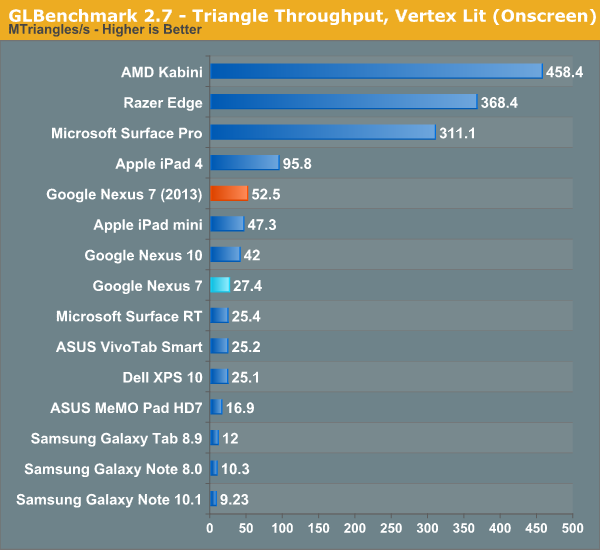
Two years? The iPad 3 was released March 2012. That's not even a year and a half ago. In any case what they should be comparing it to for an apples to apples (no pun intended) comparison is the iPad Mini, which has a similar form factor.
I agree, and the benchmarks show that the nearly year-old iPad mini does darn well in comparison. The new Nexus 7 isn't a benchmark horse by any means.
http://images.anandtech.com/graphs/graph7176/56538.png
http://images.anandtech.com/graphs/graph7176/56539.png
http://images.anandtech.com/graphs/graph7176/56541.png
http://images.anandtech.com/graphs/graph7176/56543.png -
Re:Why does this compare to the iPad 3?
Two years? The iPad 3 was released March 2012. That's not even a year and a half ago. In any case what they should be comparing it to for an apples to apples (no pun intended) comparison is the iPad Mini, which has a similar form factor.
I agree, and the benchmarks show that the nearly year-old iPad mini does darn well in comparison. The new Nexus 7 isn't a benchmark horse by any means.
http://images.anandtech.com/graphs/graph7176/56538.png
http://images.anandtech.com/graphs/graph7176/56539.png
http://images.anandtech.com/graphs/graph7176/56541.png
http://images.anandtech.com/graphs/graph7176/56543.png -
Re:Why does this compare to the iPad 3?
Two years? The iPad 3 was released March 2012. That's not even a year and a half ago. In any case what they should be comparing it to for an apples to apples (no pun intended) comparison is the iPad Mini, which has a similar form factor.
I agree, and the benchmarks show that the nearly year-old iPad mini does darn well in comparison. The new Nexus 7 isn't a benchmark horse by any means.
http://images.anandtech.com/graphs/graph7176/56538.png
http://images.anandtech.com/graphs/graph7176/56539.png
http://images.anandtech.com/graphs/graph7176/56541.png
http://images.anandtech.com/graphs/graph7176/56543.png -
Re:Why does this compare to the iPad 3?
Two years? The iPad 3 was released March 2012. That's not even a year and a half ago. In any case what they should be comparing it to for an apples to apples (no pun intended) comparison is the iPad Mini, which has a similar form factor.
I agree, and the benchmarks show that the nearly year-old iPad mini does darn well in comparison. The new Nexus 7 isn't a benchmark horse by any means.
http://images.anandtech.com/graphs/graph7176/56538.png
http://images.anandtech.com/graphs/graph7176/56539.png
http://images.anandtech.com/graphs/graph7176/56541.png
http://images.anandtech.com/graphs/graph7176/56543.png -
Re:Still way behind even after stacking the deck
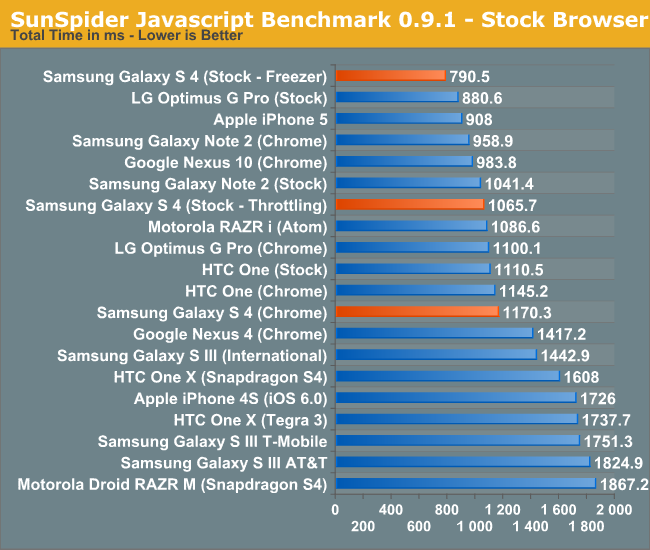
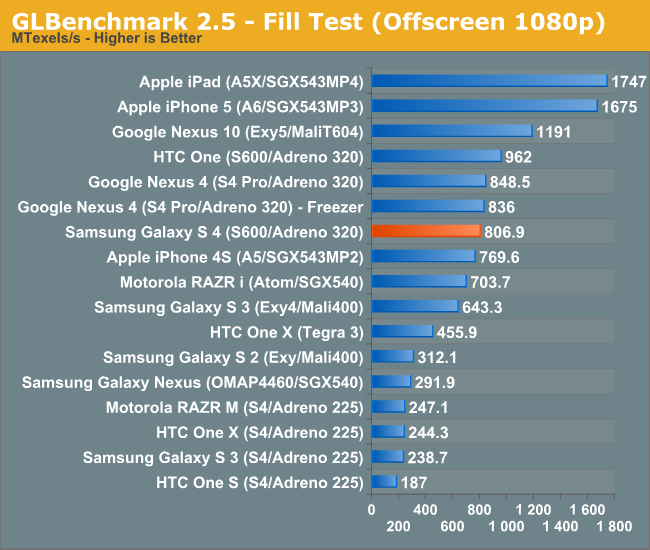
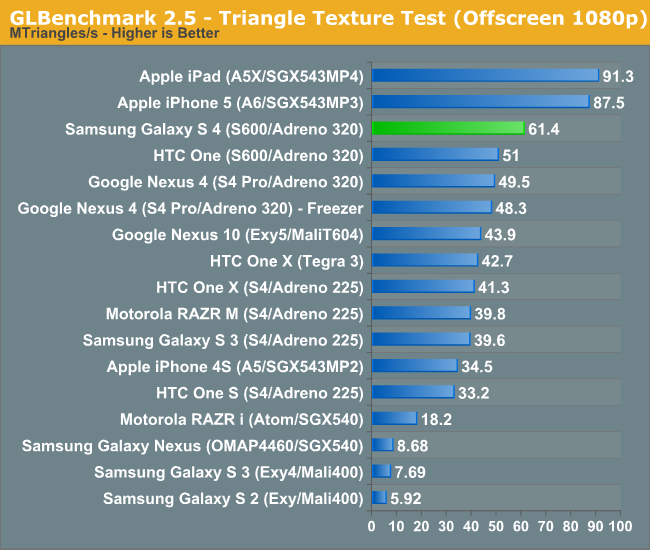
Shows how far behind Samsung is in terms of hardware engineering. They stack the deck and still can't touch a 9 month old phone. Both browser performance and gaming performance, the 2 most stressful use cases on a smartphone, are way behind Apple.
http://images.anandtech.com/graphs/graph6914/54305.pngLook at your link. It shows the S4 beating the iP5.
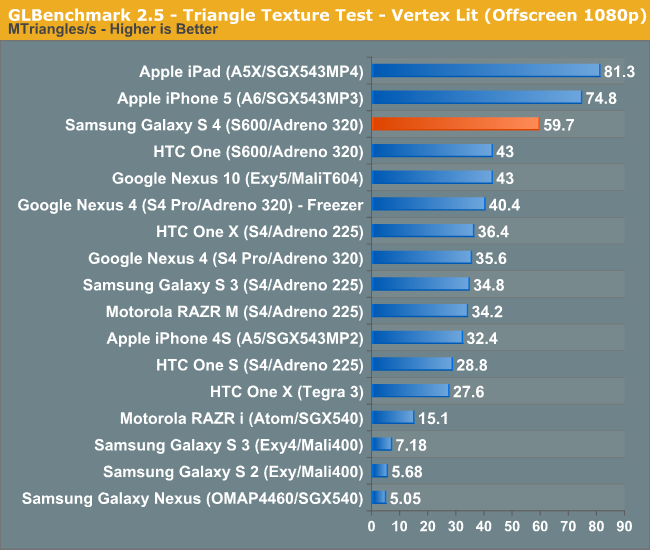
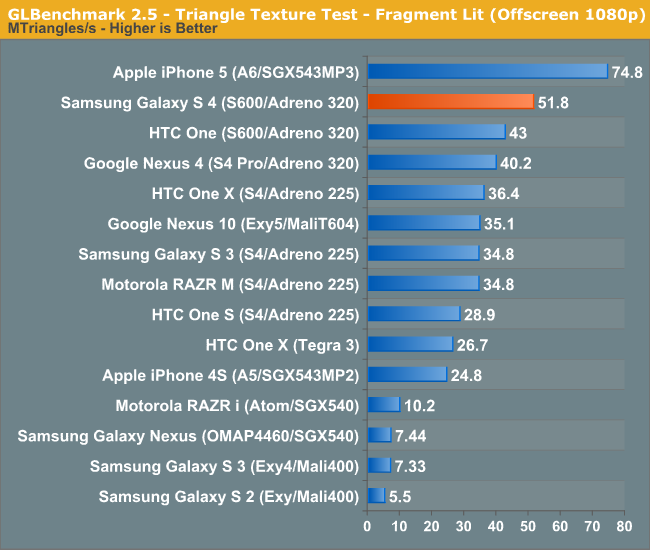
No. The S4 only beat the iPhone 5 when they tested it inside a freezer to prevent thermal throttling. It says so in the article from which the chart was taken.
-
Re:Still way behind even after stacking the deck
Shows how far behind Samsung is in terms of hardware engineering. They stack the deck and still can't touch a 9 month old phone. Both browser performance and gaming performance, the 2 most stressful use cases on a smartphone, are way behind Apple.
http://images.anandtech.com/graphs/graph6914/54305.pngLook at your link. It shows the S4 beating the iP5.
No. The S4 only beat the iPhone 5 when they tested it inside a freezer to prevent thermal throttling. It says so in the article from which the chart was taken.
-
Re:Still way behind even after stacking the deck
Shows how far behind Samsung is in terms of hardware engineering. They stack the deck and still can't touch a 9 month old phone. Both browser performance and gaming performance, the 2 most stressful use cases on a smartphone, are way behind Apple. http://images.anandtech.com/graphs/graph6914/54305.png
Look at your link. It shows the S4 beating the iP5. Also Sunspider is kind of weird. I think that current Windows Phones with underpowered SoCs post the best scores in more recent comparisons, and that doesn't make a lot of sense.
Regarding your other links, yes, the iP5 has oddly good GPU performance.
The S4 beats the iPhone 5 while in a freezer. It has heat dissipation issues due to poor built quality.
-
Re:Not that fast at all
According to Anandtech benchmarks it easily beats the iPad 4: http://www.anandtech.com/show/7190/nvidia-shield-review-tegra-4-crossroads-pc-mobile-gaming/4
It also beats Snapdragon 800 in CPU (but not GPU). In fairness, it has to be said that Tegra 4 needs to be actively colled, while Snapdragon 800 does not. -
Not that fast at all
According to Anandtech only 74.8 GFLOPS - comparable to an iPad 4. Other sources say 96 GFLOPS, but only when in power-hungry overclock mode: image. The real winner for Q4 2013 will be the Qualcomm Snapdragon 800 - 129 GFLOPS. That leaves Tegra 4 completely in the dust.
The main reason the Tegra 4 is in no tablet/phone, is because Tegra 3 real performance and power usage was worse than advertised/marketed, and therefore the tablet/phone makers did not trust Tegra 4 would be a good bet. Another (smaller) reason was that NVIDIA is quite pushing their own agenda and brand, whereas other vendors do not meddle with their customer's business so much. Unluckily they did not learn from their experience and suggest in their latest video (the face-demo) that Tegra 5 uses 2 to 3 Watts when under full load - truth is that the load was not given. NVIDIA knows a little too much about marketing... -
Re:Still way behind even after stacking the deck
Shows how far behind Samsung is in terms of hardware engineering. They stack the deck and still can't touch a 9 month old phone. Both browser performance and gaming performance, the 2 most stressful use cases on a smartphone, are way behind Apple.
http://images.anandtech.com/graphs/graph6914/54305.pngLook at your link. It shows the S4 beating the iP5. Also Sunspider is kind of weird. I think that current Windows Phones with underpowered SoCs post the best scores in more recent comparisons, and that doesn't make a lot of sense.
Regarding your other links, yes, the iP5 has oddly good GPU performance.
-
Re:Official answer from Samsung
How much does Samsung pay you to spread this misinformation?
This thread is littered with multiple posts from you spreading the same misinformation that is clearly wrong to anyone who's read the article - the 533MHZ speed is ONLY available to benchmark apps (the code it triggers is even called BenchmarkBooster). Other apps and games cannot access that speed and are limited to 480MHz.
http://www.anandtech.com/show/7187/looking-at-cpugpu-benchmark-optimizations-galaxy-s-4
...all other apps/games were limited to 480MHz.
Given how many times you've posted misinformation to this discussion, I'm forced to assume you're either a complete moron or you're on Samsung's payroll. I'm guessing the later so I'm curious, how much does Samsung pay? What is the going rate for spreading misinformation in a Slashdot discussion?
-
Re:And you think they're the only one why?
It doesn't. Other applications can run at 533mhz...
No. They can't. Please try reading the article.
http://www.anandtech.com/show/7187/looking-at-cpugpu-benchmark-optimizations-galaxy-s-4
...all other apps/games were limited to 480MHz.
Other applications can NOT run at 533. The only applications that have access to that speed boost are benchmark apps.
The ONLY apps.
Please read the article before you continue spreading your misinformation.
-
Still way behind even after stacking the deck
Shows how far behind Samsung is in terms of hardware engineering. They stack the deck and still can't touch a 9 month old phone. Both browser performance and gaming performance, the 2 most stressful use cases on a smartphone, are way behind Apple.
http://images.anandtech.com/graphs/graph6914/54294.png
http://images.anandtech.com/graphs/graph6914/54296.png
http://images.anandtech.com/graphs/graph6914/54300.png
http://images.anandtech.com/graphs/graph6914/54298.png
http://images.anandtech.com/graphs/graph6914/54305.png -
Still way behind even after stacking the deck
Shows how far behind Samsung is in terms of hardware engineering. They stack the deck and still can't touch a 9 month old phone. Both browser performance and gaming performance, the 2 most stressful use cases on a smartphone, are way behind Apple.
http://images.anandtech.com/graphs/graph6914/54294.png
http://images.anandtech.com/graphs/graph6914/54296.png
http://images.anandtech.com/graphs/graph6914/54300.png
http://images.anandtech.com/graphs/graph6914/54298.png
http://images.anandtech.com/graphs/graph6914/54305.png -
Still way behind even after stacking the deck
Shows how far behind Samsung is in terms of hardware engineering. They stack the deck and still can't touch a 9 month old phone. Both browser performance and gaming performance, the 2 most stressful use cases on a smartphone, are way behind Apple.
http://images.anandtech.com/graphs/graph6914/54294.png
http://images.anandtech.com/graphs/graph6914/54296.png
http://images.anandtech.com/graphs/graph6914/54300.png
http://images.anandtech.com/graphs/graph6914/54298.png
http://images.anandtech.com/graphs/graph6914/54305.png -
Still way behind even after stacking the deck
Shows how far behind Samsung is in terms of hardware engineering. They stack the deck and still can't touch a 9 month old phone. Both browser performance and gaming performance, the 2 most stressful use cases on a smartphone, are way behind Apple.
http://images.anandtech.com/graphs/graph6914/54294.png
http://images.anandtech.com/graphs/graph6914/54296.png
http://images.anandtech.com/graphs/graph6914/54300.png
http://images.anandtech.com/graphs/graph6914/54298.png
http://images.anandtech.com/graphs/graph6914/54305.png -
Still way behind even after stacking the deck
Shows how far behind Samsung is in terms of hardware engineering. They stack the deck and still can't touch a 9 month old phone. Both browser performance and gaming performance, the 2 most stressful use cases on a smartphone, are way behind Apple.
http://images.anandtech.com/graphs/graph6914/54294.png
http://images.anandtech.com/graphs/graph6914/54296.png
http://images.anandtech.com/graphs/graph6914/54300.png
http://images.anandtech.com/graphs/graph6914/54298.png
http://images.anandtech.com/graphs/graph6914/54305.png -
Re:Meh
You do realize that the size of the pixels on the 1020 are about the same as those on the iPhone5 and the Galaxy S4?
http://www.anandtech.com/show/7142/some-thoughts-about-the-lumia-1020-camera-system
Sort of invalidates your entire rant.
-
Better Article
There's a better article here:
http://www.anandtech.com/show/7161/khronos-siggraph-2013-opengl-44-opencl-20-opencl-12-spir-announced -
Re:What's the reason to buy one?
Wow I hadn't bother to check. Your instincts were right it doesn't have that. http://www.anandtech.com/show/6695/microsoft-surface-pro-review/4
OK so scratch that reason to buy the RT.
-
Re:Price Adjustment
The
That being said to your point about the media panning the thing? I do not remember that. I remember a LOT of fawning (and what clearly was some paid for shilling) over the non-RT unit. And then very little about the RT from the bit names, often those who were very often shilling for the non-RT, or something very non-committal as to not anger the MS cash to shill flow.
My take on that was that with the way the units were named, planned this way I'm sure, is that there would be this hype about the awsome!!!!!one!@##$!@ Surface unit. But damn it did cost a lot so you could just buy the RT version for the cheap! It is almost the same right, RIGHT!? Anand said how great our Surface unit was and he never is biased for Intel or MS platforms! Buy the RT!!!!
-
Better link
The actual forum post by Exophase.
It's a good analysis. The code in question looks really synthetic (set or clear a large range of bits one bit a time?), so even claims that this compiler efficiency will carry on to real-world performance fall flat on their face. Disregarding that most Android developers will use the GCC compiler provided with the NDK.
-
Re:Clearly this can't be true
Supposedly, benchmarks are written to simulate real workloads. It seems to me that tweaking processor designs to run benchmarks faster is a good idea.
That may be true, *if* you don't break the benchmark in the process. This link, shared by another posted further down the
http://forums.anandtech.com/showthread.php?t=2330027
In summary, while the compiled ARM code performed a series of bitwise operations as written in order to excercise the CPU instructions, the Intel compiler seems to have applied some compile-time smarts to effectively bypass a lot of the work but achieve the same end result. In a real-world program that's good, because you speed the program up by cutting down on the work the processor has to do, but in a benchmark that's supposed to make the processor perform all those individual operations it's bad and gives misleading results your readers end up unwittingly comparing apples to oranges but assuming that they're comparing apples to apples.
Essentially, "Which CPU is faster and/or more efficient? Who knows, they were asked to do different work."
-
AnTuTu assembly code analysed
Some guy on the Anandtech forums analysed the AnTuTu code and found that it indeed had been tweeked to favor x86 processors:
http://forums.anandtech.com/showthread.php?t=2330027 -
Re:This is not a tech issue
Intel supplies most of Apple's CPUs, yes?
Intel supplies all of the CPUs used in Apple's desktop and laptop computers, yes.
Personally, I think Apple should take their cash and make their own processors
Is that "Apple should take their cash and build their own foundries" or "Apple should take their cash and buy an existing foundry"? In either case, it's "Apple should continue to invest in foundries to update to new processes", and, in either case, I'm not sure how easy that would be.
Or is that "Apple should do their own chip designs"? Anandtech suspects they're already doing that.
allowing for their OS to have a firmware component
If by "firmware component" you mean on-chip firmware, how is owning your own foundry, rather than having another foundry fab your design, a requirement for that? Or does this mean that "Apple should take their cash and build their own foundries" means "Apple should do their own chip designs" rather than "Apple should do their own chip fabrication"?
and thereby boosting performance and security.
What sort of firmware customization are you talking about here?
-
Re:It's because of Steve
-
Re:AMD Financials Summary
What product did Intel have to compete with AMD's Jaguar + 7xxx APU? Let alone with CPU alone:
"In its cost and power band, Jaguar is presently without competition. Intel’s current 32nm Saltwell Atom core is outdated, and nothing from ARM is quick enough. It’s no wonder that both Microsoft and Sony elected to use Jaguar as the base for their next-generation console SoCs, there simply isn’t a better option today. As Intel transitions to its 22nm Silvermont architecture however Jaguar will finally get some competition. For the next few months though, AMD will enjoy a position it hasn’t had in years: a CPU performance advantage."
http://www.anandtech.com/show/6976/amds-jaguar-architecture-the-cpu-powering-xbox-one-playstation-4-kabini-temash/5 -
Re:Was performance the problem?Tegra 3 wasn't bad. But on Surface RT there were also times where it was clearly not up to the task of running Windows software.
Simply typing quickly in Microsoft Word maxes the single threaded performance of Tegra 3's ARM Cortex A9 cores. I've seen CPU usage a high as 50% when typing very quickly, but mostly it tends to sit between 20 - 40%. Switch to notepad and max CPU utilization drops to sub 10%. This says more about Office 2013 than the performance of NVIDIA's Tegra 3, but there are not a whole lot of spare CPU cycles to go around with Surface.
-
Re:Whoosh
Same(ish) CPU
More modern GPU of same brand with more cores
Same amount of RAM, more bandwidth from GDDR5, but no SRAM on-dieIn other words, PS4=more graphical power, less effective memory management overall. So PS4 is at best slightly superior to XB1, not "vastly."
And of course, one other thing to consider is that the power and heat management of the XB1 is better than the PS4 - which no one will care about until they remember RRoD and YLoD issues stemming directly from heat in almost all cases.
http://www.anandtech.com/show/6972/xbox-one-hardware-compared-to-playstation-4
Now if by "vastly" better you meant in terms of the original DRM scheme implementations, then no disagreement here.
-
Sales Pitch
Obvious sales pitch is obvious:
AMD also has overclocking-friendly K-series parts, but it offers more models at lower prices, and it doesn't remove features available on standard CPUs."
Feature #1 TSE: http://en.wikipedia.org/wiki/Transactional_Synchronization_Extensions I'd imagine nobody codes for this.
It can still do virtualizion just fine: http://forums.anandtech.com/archive/index.php/t-2133898.html
Not an Intel fanboy or anything, but they're not as arrogant as people are making them sound.
-
enterprise class SSDs not the same
The enterprise class SSDs are not the same as the "consumer" ones: http://www.anandtech.com/print/6433/intel-ssd-dc-s3700-200gb-review
Don't be surprised if you stick a "consumer" grade one to a heavily loaded DB server and it dies a few months later.
Fine for random read-only loads.
And some consumer grade SSDs aren't even consumer grade (I'm looking at you OCZ: http://www.behardware.com/articles/881-7/components-returns-rates-7.html ).
-
Anandtech has more reliable servers/info
-
Re:Awesome
Yeah it would look different...PCs would be the size of fridges to hold the giant AC unit needed to cool that sucker! And nothing in your argument changes the fact that if you take the most powerful P4 and then increase its marks just as if you had increased it to 10Ghz you would still be scoring LOWER than 35w chips do today.
When you are scoring a shitastic 440 marks at 3.6Ghz magically cranking that chip to 10Ghz isn't gonna give it 10,000 marks, its gonna give it 4 times what it is now which would be around 1350 marks. You are falling for the old MHz myth that raw GHz means shit when it don't, if you managed to get a Pentium 1 up to 20Ghz that wouldn't magically make it do more useful work than a C2Q even though the C2Q would only be running at 1/4th the speed because the C2Q would do more work per cycle than that hyper pumped P2 could EVER do. Again look at the links yourself, look up the Pentium EE chips, those were "golden chips" that were hand picked to be the absolute cream of the crop, the absolute best the P4 had to offer. How did they score? Worse than the chip in my netbook, and that is while belching out over 150w of heat.
Your argument basically boils down to "if you put a big enough motor in it a Pinto could outpull a pickup" while ignoring that there is a lot more to pulling than the motor. The insanely long pipeline made stalls a nightmare for the P4, it cranked out waste heat like you wouldn't believe, and the IPC on it was truly pathetic. You say it isn't fair to compare it to a modern chip? fine compare it to a chip from its time, the Athlon 3800 X2 on this chart. Notice how the P4 based chips are using damned near more power idling than the X2 did under full load? The IPC on those chips are just fricking terrible, I should know as I have one at the shop and its sooo damned sluggish and hot that I'm seriously thinking about replacing this Pentium D with a circa 2004 Sempron single core until I can get another Bobcat board in because the Sempron? actually more snappy than the Pentium D.
So I'm sorry friend but unless you think Intel could come up with some pixie dust to sprinkle on each P4 the extra GHz would have translated into a shitload of heat, useful work? Not so much. BTW just running that Pentium D running ONLY a browser for a couple of hours, even with flash blocked? Its at 143f and as i said it struggles with page loads worse than that old Sempron, its just not a good chip, the whole line just sucked.
-
Re:Awesome
I starting to fell like a broken record here but seriously Slashdot, I would have thought that this Myth that x86 ISA somehow makes it impossible to build a low power part would be dead by now. ARM is a rather complex instruction set now that they have added SIMD and floating point support. If you look at the number of op-codes it has versus x86 they are roughly equal. Both ISAs have variable length instructions (all recent ARM designs support THUMB) so the decode logic complexity is actually pretty comparable. Also much of the decode logic is implemented in software via microcode on both ISAs.
There is nothing magical about ARM that makes it lower power. The real reason why x86 implementations are so much hotter is because designers of x86 processors have been targeting high compute performance for decades, whereas ARM has been targeting low power for decades. A quick look at Medfield benchmarks show that it is comparable in performance to ARM processors that were current when it was released. Medfield is ~4W active TDP... same as a Exynos 5 Dual ARM CPU. From what we have seen from Merrifield/Bay Trail/Haswell the next gen x86 parts are continuing along this trend.
-
Re:Awesome
The low-powered, RISC space is where AMD needs to go. It doesn't necessarily have to be ARM. Instead, there's a market for low-powered x86, which is where Intel is going with Haswell. AMD needs to get ahead of the game and create something that is capable of power sipping (which obviously won't be x86)
Actually Intel has already shown they can make x86 phones on par with existing ARM phones, not market leading or anything but middle of the road. You want AMD to out-do ARM and Intel, push a new instruction set, create the compiler support and the industry momentum behind it? With a single, financially troubled company who I wouldn't bet is there five years from now? Yes, Itanic was a huge failure but Intel still makes Itaniums for anyone foolish enough to bet on that horse, AMD couldn't make any such promises. To compare it to US politics x86 and ARM are the republicrats and anything AMD would come up with a third party. They get support on Slashdot but go nowhere in the real world.
but is also capable of running legacy x86 code at reasonable speeds.
If you want a past example that tried just this, see Transmeta with their VLIW design. It did not end well, the x86 code didn't perform and nobody made native VLIW binaries. Besides, AMD has already split their efforts two-way on ARM and x86 which I suspect was a mistake. If you're losing the battle against Intel picking a new one against Samsung, Qualcomm, nVidia, Apple and everyone else making ARM chips still doesn't seem like a good idea. As an x86 supplier they'd have value as an alternative to Intel, in the ARM market they're entirely expendable.
-
Re:Yes
Even high IOPS is starting to become meaningless. Here's an Anandtech comparison of top SSDs from two years ago of typical tasks which stressed IOPS. He played it straight for this one page and showed benchmarks in units that matter to people's perception of speed - seconds to complete a task. The result is utterly uninteresting. The HDD is substantially slower. The SSDs are for all practical purposes identical.
But boring graphs are bad for review sites. If the reviews are boring, people won't read them, and the sites lose out on ad revenue. So they invert the metric to make smaller differences appear bigger. Instead of the practical sec/MB, they use the more ephemeral MB/sec. That makes the graphs more interesting and gets people coming back to the sites before buying, instead of just buying some random cheap SSD without really caring about the max speed.
"But sec/MB and MB/sec are the same number! Why should inverting it make a difference?" Because when you invert a metric, the big numbers become small numbers, and the small numbers become big numbers. e.g. Say you have a HDD which can read 100 MB/s, a cheap SSD which can read 200 MB/s, and an expensive SSD which can read 500 MB/s. So in 1 second, the HDD reads 100 MB, the cSSD 200 MB, and eSSD 500 MB. Expressed in MB/s you gain 100 MB/s switching from HDD->cSSD, and a whopping 300 MB/s switching from cSSD->eSSD. Switching from cSSD->eSSD gives you 3x the benefit of switching from HDD->cSSD! So the extra money for the expensive SSD is definitely worth it! Right?
Hold on. Invert to s/MB and say you need to read 1 GB. The HDD takes 10 sec, the cSSD 4 sec, and the eSSD 2 sec. Switching from HDD->cSSD saves you 6 seconds. Switching from cSSD->eSSD only saves you 2 sec. So in terms of time you spend waiting, the HDD->cSSD switch saves you 3x as much time as the cSSD->eSSD switch. The vast majority of your time saved can actually be obtained from the switch to the cheaper SSD. The next step switching to the expensive SSD only gives you a marginal improvement. (Even if you insist on using relative measures of time, the cheap SSD still wins. 10 sec to 4 sec is a 60% reduction in time. 4 sec to 2 sec is only a 50% reduction in time. Or if you want to be a purist, of the 8 sec saved going from 10 sec to 2 sec, the cheap SSD gets you 75% of that speedup, the expensive SSD gives only the remaining 25%)
Unless you're regularly doing tasks where you find yourself twiddling your thumbs for several seconds or minutes waiting for the SSD to finish reading/writing several GB of data, the difference between 600 MB/s and 1.25 GB/s is imperceptible despite being a 2x speedup. Twice as fast as the blink of an eye is still as fast as a blink of an eye to our perception. -
Re:I do have a question about this .....
You are right. From the article : "Update: It's a custom Apple design, not M.2. Since there's no PCIe routed off of the CPU in Haswell ULT, these 2 lanes come from the on-package PCH." http://www.anandtech.com/show/7058/2013-macbook-air-pcie-ssd-and-haswell-ult-inside Look under the disk benchmarks.
-
Re:Poor AMD...
yeah, this article is guessing at about 125w....
-
Re:The TB bus does not have a lot of bandwidth
missing the point how are the TB chips linked to the chip set? and does each controller have it's own X4 link?
The TB 2.0 chipsets use a x4 PCIe 2.0 link per controller. Guess that means that each pair of two TB ports shares the bandwidth of a controller (6 ports / 3 controllers / 12 PCIe 2.0 lanes total.
Probably not fast enough for external graphics that would outperform the (extremely fast) internal graphics solution but still orders of magnitude more bandwidth than any current external consumer or prosumer storage solution. -
Re:Short run versus long run
All modern PCs are more powerful than modern tablets, unless you're looking at netbooks. i7 series processors are in the 10 IPC range, compared to tablet ~3 IPC. For GPUs, there are sites that have already done that testing, such as this: http://www.anandtech.com/show/6877/the-great-equalizer-part-3 Tablets are just an order of magnitude slower than PCs in CPU, and two orders of magnitude slower in terms of GPU.