Slashdot Mirror
Domain: archive.org
Stories and comments across the archive that link to archive.org.
Stories · 353
-
Fixing a 7,000-Ton Drill
An anonymous reader writes: At the end of last year, we discussed Bertha, the world's largest tunnel boring machine. During an effort to drill a viaduct beneath downtown Seattle, the machine — clocking in at 7,000 tons, 57.5 feet in diameter, and 326 feet long — got hamstrung by an 8-inch-diameter steel pipe. The complexity and scope of the repair plan rivals that of the project itself. "The rescue operation (workers call it "the intervention") began in late spring with construction on the shaft to reach Bertha. Workers have been sinking pilings in a ring to prevent the shaft from collapsing, using 24,000 cubic yards of concrete — enough for a medium-size office building. Once that ring is complete, digging on the shaft will start. When the shaft is ready, Bertha, which is damaged but still operational, will be turned back on so she can chew through the concrete pilings to reach the center of the shaft. There, the machine will rest on a cradle where workers can detach the front end and hoist it out." That detachable front end? It weighs about 2,000 tons by itself. The repair bill is estimated at about $125 million. -
Intuit Beats SSL Patent Troll That Defeated Newegg
Last fall, Newegg lost a case against patent troll TQP for using SSL with RC4, despite arguments from Diffie of Diffie-Hellman key exchange. Intuit was also targeted by a lawsuit for infringing the same patent, and they were found not to be infringing. mpicpp (3454017) sends this excerpt from Ars: U.S. Circuit Judge William Bryson, sitting "by designation" in the Eastern District of Texas, has found in a summary judgment ruling (PDF) that the patent, owned by TQP Development, is not infringed by the two defendants remaining in the case, Intuit Corp. and Hertz Corp. In a separate ruling (PDF), Bryson rejected Intuit's arguments that the patent was invalid. Not a complete victory (a clearly bogus patent is still not invalidated), but it's a start. -
Intuit Beats SSL Patent Troll That Defeated Newegg
Last fall, Newegg lost a case against patent troll TQP for using SSL with RC4, despite arguments from Diffie of Diffie-Hellman key exchange. Intuit was also targeted by a lawsuit for infringing the same patent, and they were found not to be infringing. mpicpp (3454017) sends this excerpt from Ars: U.S. Circuit Judge William Bryson, sitting "by designation" in the Eastern District of Texas, has found in a summary judgment ruling (PDF) that the patent, owned by TQP Development, is not infringed by the two defendants remaining in the case, Intuit Corp. and Hertz Corp. In a separate ruling (PDF), Bryson rejected Intuit's arguments that the patent was invalid. Not a complete victory (a clearly bogus patent is still not invalidated), but it's a start. -
Interviews: Bruce Perens Answers Your Questions
A while ago you had the chance to ask programmer and open source advocate Bruce Perens about the future of open source, its role in government, and a number of other questions. Below you'll find his answers and an update on what he's doing now. Er...what's left in "open source" to talk about?
by xxxJonBoyxxx
Having lived through the entire lifecycle of "open source," it seems like its place in development communities and businesses is well-established, with a mix of different licensing and deployment models for whatever anyone wants to do. So...is there really anything interesting left in "open source" to talk about? (Software patents, maybe, but even that's picked up some case law.)
Perens: There's a lot to talk about, if you consider that “Open Source” is a way of introducing people to the ethos of Free Software as much as it is an economic and technical paradigm for software development. The ethos part of the job is hardly done.
There is always going to be a conflict of interest between a company's needs and your needs as a user or customer. Who has control? It should be you, rather than the company that made the software or a government that tells them what to put in it as the U.S. Government did with RSA Security.
Imagine the billions of dollars paid by companies that thought they were buying security while RSA had a clear conflict between the government's needs and those of the customer. Now, Heartbleed has shown us that there are some problems that don't have enough eyes, but I still can't think of any way to resolve the conflict-of-interest issue without giving everyone the right to read, modify, use, and redistribute software. A third-party can then audit and repair government-inserted security issues as Red Hat did by auditing GNU TLS and making their results and a patch public. If that same problem exists in proprietary systems – and I assure you it does – you can't see it, you can't fix it, you can't help yourself or others, and if others know something they can't help you. But we've not made much progress in selling that idea to the end-user.
State of the Union address / 16 this year
by Martin S.
The OSI is 16 this year and in many ways has experienced a difficult childhood but has grown stronger as a result. What challenges do you foresee for the future?
Perens: Please forgive me for interpolating your question a bit: the Open Source and Free Software movement are important to talk about, OSI the organization isn't. And of course Free Software is older than 16 years, it goes back to the genesis of software. We're still not where we need to be: to the point where everyone can run Free Software for every task, without the threat of litigation over patents, and without being locked in by digital rights management. Regarding Software Patents, we've backslid from the time that we were able to derail a thrust for a Pan-European unified software patent system. That's essentially happening without our objection now. Why? Because we're no longer seen as a movement for helping people and giving them control, we've positioned ourselves as merely an economic and software development paradigm. That was a bad move. Folks, pump up the philanthropic and helping-others aspects of what you do! You dis-empower yourselves and our movement when you fail to do so.
I think we've also backslid regarding DRM, as shown by the W3C accepting a DRM API into their standards process. Indeed, we've not made much progress regarding viewers and reader's rights to use any device, and to have a durable copy of their media that works today and forever because it isn't in some black-box format. A lot of us convert those Kindle books to open formats on the sly, just to preserve them for the future. We should be able to do that in the bright light of day without fear. Or we should not have to do it.
I have been encouraged by the Science Fiction writers. Very many of them refrain from use of DRM these days. Their revenues don't suffer. Neither did the revenues of my own book series. Unfortunately, readers other than the Sci-Fi market don't know what to ask for. Can we tell them convincingly?
I think we all need to think about what we're doing with our lives and how we can help improve electronic freedom for everyone. Together we have the power, we're just not using it.
Automation Technology Displacing Tomorrows Worker
by SethJohnson
I'd like to know your perspective on the future need for programmers while automation technology continues to displace workers in many industries.
Perens: I don't oppose automation displacing people from their jobs, but for a reason you might not expect. Human beings are demeaned when they perform “mechanical” tasks for their employment. They are not machines! Whether picking fruit or stock in a warehouse, People are not enriched by doing it and it does not exercise their unique capabilities as thinking entities. So, I'll ask a different question: When we can automate so much, why is it still necessary for so many to do the most demeaning sort of work just to feed, shelter, and clothe their families? Our society needs to move those people into rewarding work instead of the demeaning mechanical sort. We do a very good job at generating obscene amounts of wealth for a few while too many suffer. What are you doing about that?
Regarding whether programmers will be automated out of a job:
Once “computer” was a job title for people who did math all day, and the automation that so completely replaced them in that job was called an “electronic computer”. Those people moved on to other jobs, often as programmers.
What about the future need for programmers? There was a big, government-funded scientific research project to develop “automatic programming”. It produced what we today call the “compiler”. It reduced the price of programming, but that actually increased the demand for programmers.
The job market for programmers will dry up when all of the programs that a mass of people would ever desire have been written and perfected, regardless of how automated our tools become and how powerful future computers may be. I'm not sure that such an end of need is a possible condition. It's sort of like saying that there will be no further need for horse coach designers once the coach is perfected. We stopped needing what we could imagine in the 1830's, and went on to something else.
If we ever arrive at artificial general intelligence, we may obsolete human beings as no more than an evolutionary step on the way to something else. But that is only one of many possible futures, and not an impending one.
Obamacare
by MouseTheLuckyDog
Should the software used for Obamacare be open source. I don't just mean the website, but also things like the software controlling pharmaceuticals, X-rays, MRI, maintaining health records etc. ?
Perens: Allow me a slight diversion to talk about Obamacare. My wife, son, and I have each individually been denied private health insurance although we're healthy, for what is essentially medical trivia. One insurance company rejected us on the grounds of my son having a certain medical test, even though he passed it. I own my one-man company, and until this year had no way to provide my family with insurance. Fortunately for us my wife was able to get it through her employer, but we would have been sunk if she had lost her job.
I think Obamacare will do one really big thing that truly scares the Republican Party. It will free up millions of smart people to be self-employed, who formerly stayed in the corporate world. These folks are in their 40's and 50's, have families to take care of, but previously could not reliably get insurance on their own. The small-business revolution will come not because these people actually buy care through an exchange rather than getting it through a spouse's employer, but because they know that they can get it when they need it.
The small business revolution that Obamacare drives will create disruptive technology and thus economic churn as income moves from older established companies to more new ones. This shift from mega-business to smaller business erodes the Republican money base, and that's why the Republican Party must kill Obamacare at all costs, regardless of the damage to their own people.
Now, what about the software that is used for “safety of life and property” applications? This isn't just health systems under Obamacare, it's the stuff that operates elevators, aircraft and air traffic control, your automobile, anything where a failure can hurt people.
Karen Sandler does a great talk about this called “Unchain my Heart”. She has an implanted pacemaker due to cardiomyopathy (enlarged heart), and was justifiably reluctant to have one with proprietary software implanted.
There is no question that software failures have killed people going back to Therac-25 and probably earlier, and will continue to do so.
Software that is in life-and-property-critical applications should be disclosed. It can have all of the power of copyright protection, but it should be possible to audit it. Everyone should be able to discuss its issues, with quotes of the applicable source code as needed, on-line and under public view. If the security of your Bluetooth-enabled pacemaker is a crock (as embedded software so often is), we should be able to tell you about it, and get something done.
My experience is that people code better when the whole world is looking over their shoulder.
Credit for the OSS movement
by Anonymous Coward
Some years ago, around 2006, I attended a talk from Eric S. Raymond at a venue large enough to accommodate his massive ego and still leave room for attendees. He informed that he had essentially given HP their Open Source strategy. Your name was not mentioned once. I am curious what were your discussions like at HP during your time there, specifically in regards to the ideals of Free Software versus Open Source. My question specifically: What legal and financial hurdles and impacts, if any, did HP (and other companies) face when deciding between Open Source and Free Software models? I.e., what proprietary assets/IP could not be completely "freed"? What were the savings/costs associated with the decisions?
Perens: At some point I accumulated enough credit for achievements that it became unnecessary to fight over it :-) . But I am hardly without flaws. Most visible might be that I want to get things done and don't mind trampling others if that's what it takes. I try to keep my ego down enough so that I get through those narrow doors.
The worst problems I saw at HP had little to do with Open Source. What I remember most was the sadness. There were and are many smart people there, and so many of us were conscious that the company was in a sort of death spiral and that we couldn't do anything about it. The “pretexting” scandal was to the discredit of the board, the general counsel actually took the 5th in front of Congress on national television! Carly (the CEO) asked all of the employees to take a voluntary pay cut in the same month that she and other Board officers sold tens of Millions of dollars of HP stock. I remember my boss (a Section Manager, now the CTO) announcing at a meeting that an employee had gotten a “Reinvention Memo”. That meant lay-off, a sarcastic re-framing of HP's “Reinvent” motto that showed how even upper managers like him were in despair. There was a series of ill-advised acquisitions of second-best or declining companies that HP failed to turn around, and then sold for cents on the dollar two years after acquiring them. The Compaq merger put the company at the very top of a business with vanishingly-small margins.
There was one really bad day that I guess is safe to talk about now, more than 10 years later, because the information is already in the public and thus no longer subject to NDA: Microsoft showed HP their plans to sue the Open Source projects for the Linux Kernel, Samba, Sendmail, and a list of other projects. Someone immediately shot me an HP VP's memo recounting that meeting and concluding that we should back off of Open Source before the lawsuits started. When I passed it to my boss, I was told to keep it quiet. But I was hired to be an Open Source community leader first, and an HP officer second, and keeping quiet about that meant betraying the Open Source developer community. I just hated that and it poisoned my involvement with HP.
Microsoft eventually used SCO as a proxy to achieve what it disclosed to HP that day. I'd been warned long before that happened, and could do nothing until SCO announced their damaging but ultimately unsuccessful jihad against Linux.
What I think is worth remembering about HP is that it was once the great tech company that people wanted to work for, as Apple or Google might be for many today. I think a lot of what made it great left with Agilent. The Test and Measurement business was a low-volume, high-margin business that required lots of too-highly-paid old smart people who worked in expensive labs in Palo Alto, California. That became the most costly place to do anything largely due to HP's own success. But Test and Measurement was also the brain-trust of the company, and lent its creativity to all of HP's other aspects. So we lost a lot, I think, when Agilent was spun off of HP.
HP's problem regarding Open Source and Linux was that systems running Linux competed with other HP lines running HP-UX or Microsoft, and HP was structured as Organizational Silos. Each line had its own sales-people, and different lines competed with each other for the same customer. HP-9000 folks were always complaining because Linux undercut HP-UX and thus HP-9000, as were folks who sold Microsoft Windows systems based on x86. If I said anything in the press about Open Source or Linux, a customer would ask one of those single-line sales-people about it, and it would come back to my boss as a complaint rather than a sales opportunity.
HP was always to some extent in Microsoft's pocket, although they were also aware that Microsoft had screwed them and would continue to do so. HP de-emphasized further development of the HP 9000 hardware because Microsoft had told them in the late 80's that they were soon to have an enterprise-quality NT. HP believed it, but MS failed to deliver for a decade. That lost HP Billions while Sun Microsystems took the engineering workstation market from HP. The HP officer who made that decision of course went on to be a Microsoft executive.
What we did achieve at HP was a good process for deciding what to do with Open Source when individual opportunities came up. If you wanted to incorporate Open Source in a product, or you had a business reason to Open Source something, we resolved the legal issues, the community issues, we even handled some security aspects and achieved a reasonable level of reuse. That could all be achieved by middle managers. So, everybody in the company knew that it was OK to use Open Source, but there was a process you had to go through. It wasn't particularly expensive, it did sometimes sink multiple days of some engineer in doing paperwork, but that's just due diligence and we ended up on a better legal footing when we used Open Source than otherwise.
There were things we decided not to Open Source because there was no good business reason for doing so. We weren't UNICEF, so there had to be a business reason for everything. There were times when legacy customers would have gained benefit if we brought one of HP's nine legacy operating systems to Open Source, but untangling the proprietary software that originated with third parties from the rest was too difficult. There were a few times when it was decided not to Open Source a legacy product because we were afraid that IBM might use it to sell their hardware against ours. Once that happened with a system that had only 5000 existing customers, and it would have been better for the customers for HP to open it but the decision – not mine – was not to do so.
I've since helped other companies start their own internal Open Source Process, and still do so today.
What we never achieved within HP, what I never had the power to do, was: to get HP to completely stand behind any innovative product regardless of what that meant for old-line products, to make innovation the #1 job of the company, and to grow a brand-new company from the old one every year that they were in business. They needed to embrace disruptive technologies as a pioneer rather than have the disruption done to HP by competitors. I think they tried to kill the Silo organizational structure after I left, I don't know how successful that was.
Q3 for BP
by postbigbang
What are your five biggest fears for safety on the Internet today, and where do you believe responsible admins should put their efforts for those five?
Perens: Centralization: too much depends on too few companies. It's not entirely a matter of architecture, it's a matter of getting customers to distribute themselves. So maybe it's a social engineering problem to a great extent.
Conflict of interest: Back to those companies again. They are operating your internet infrastructure, and their interest isn't yours. I found out today that my kid's school is using Turnitin. The problems with that are well covered at Wikipedia. We need a way to provide sustainable infrastructure that works for the customer, instead of exploits them. I'm for non-profit common carriers and services, using Open Source.
Politics: we still don't have much of a footing, despite our numbers, and even our wealth! We need to get more of the people we listen to and admire into elected offices, and in communications regulators like ITU and FCC. Way too much of the leadership there is from the exploitation side.
Privacy: I am afraid we're going to shoot ourselves in the foot pursuing it. We're rapidly heading for a locked-down Internet as IETF pushes for an HTTPS-only web. From there it's only a very short step to certified browsers, user digital signature requirements, Open Source and anonymity both locked out of the system. Yes, the metadata thing is unsettling, but we also have to be clear that we employ spies to work for our country and to help protect us, and they have an important job to do. We need to work on the politics of regulation and oversight of our nation's espionage rather than the nerd approach, which is to attempt to treat a social problem as a bug in the network software.
Economics: If OpenSSL had been dual-licensed AGPL3 and commercial, we would probably not have Heartbleed. There would have been money from its commercial users. Imagine companies like Intuit using OpenSSL and not giving much back to its maintenance at all! That was a mistake. IMO dual-licensing has a bad reputation because of MySQL, and also because some folks at Red Hat have promoted against it. We need to revisit it.
Moderation
by symbolset
Do you find your views on blended/mixed license models evolving over time? Is it time to lay down the pitchforks some of the time?
Perens: PR isn't really a pitchfork. It's always been about people who are calling something Open Source when it is not. Not against mixed models. If you want to have something that has some community participation and doesn't meet the Open Source Definition, don't call it Open Source or Free Software and nobody will pursue you with pitchforks. We may continue to say our way is better, but that's fair.
In that vein, keep in mind that Creative Commons is not Open Source. A few, actually a minority, of creative commons licenses are. About the only right that all Creative Commons licenses have in common is the right to read.
Open source HARDWARE
by unixisc
What are your views on Open source hardware? Is it as important as open source software, or less important, or not important at all?
Perens: Let's please call it Open Hardware, in the interest of simplicity and good marketing. Unless you are interested in calling it Free-Libre Open Source Hardware or FLOSSHW. I bet there's somebody that silly.
I think it's important. But there's an important thing we should be aware of about Open Hardware. It's backwards in a way. Richard Stallman's Free Software movement opposed software being copyrighted. Copyright does not, for the most part, apply to hardware designs because they are functional (read about CAI v. Altai to understand this). Patents apply to hardware designs, but most Open Hardware designers never pursue a patent on their designs. What then do they license to others?
It turns out that we have a group of people at CERN, and one of my favorite lawyers and Yahoo, and even me, trying to add restrictions to something that is, for the most part, already in the public domain. And it came to me that this was backwards, and that we could be working against our own interest that way.
We all get to use the vast body of electronic designs that we've read about in magazines since the dawn of ham radio. Now, imagine if those were suddenly copyrighted and under enforceable licenses.
The problem is that when we start licensing things that are actually in the public domain, we create norms that the courts take seriously. And they start enforcing licenses on things that could not be licensed before. We really can write new law when what we do gets to a court case, and we want to be careful what law that is. If we were responsible for taking hardware designs from public domain to copyrighted status, we'd be shooting ourselves in the foot.
So, for a while I was uncomfortable with my own Open Hardware evangelism. Was I doing the right thing? I think I've worked out the right path now and will be warning the community about this issue.
There's also a lot of confusion about how effective Open Hardware licenses are. If you make a 3D printer and you think your license keeps other people from manufacturing copies, sorry! It does not protect your design unless you have filed patents. Copyright won't do it. It might keep people from selling the plans, but not the devices.
We also have a bunch of people who use “CC BY-NC” licenses on their designs and then call it Open Source Hardware! Funny how eager they are to call it “Open Source” and then they don't even follow the rules of Open Source. Open Source includes the right to use in any way. If it's “no commercial use allowed” like CC BY-NC, it's not Open Source.
So, there's room for a lot of education there.
Re:How do we address the weaknesses of Open Source
by Tiger4
More to the point, how do you reply to the criticism and practice that Open Source is worthless because there is no company to back it? I run into this all the time. First, no one stop shop to get tech support from if we have trouble. Second, No company to go after for liability. Third, no company to maintain regular bugfixes and general currency and freshness. We don't have a policy against Open Source, we just have a standard the vast majority of (perfectly adequate) software can never meet.
Perens: Well, I bet your employer doesn't do as well as Google. Or any number of companies that make money hand over fist while using an Open Source infrastructure. So, I thought I could stop evangelizing on this issue. But maybe not.
Having a shop to get tech support from is important. But you guys are kidding yourselves if you think there isn't one. Even IBM will do that. Indeed, they make a great deal of money implementing and maintaining solutions that are glued-together Open Source programs for the most part.
Or is it that you want a different company for every different program, like in the proprietary world. That's not so nice when you have to use them, is it? You spend the day trying to convince them that their product is broken and having to deal with them pointing fingers at each other rather than fixing your problem. Sometimes it's nicer when one contractor really can fix all of the pieces. How do you do that without Open Source?
The liability issue is a red herring. How often have you actually sued a software provider and collected all of your damages and court costs? Many of them would go bankrupt first. I am an expert witness on some of those cases, and they cost so much to fight that you lose even if you win.
But there are the big vendors like Microsoft, you're safe with them because they have the cash, right? How often do you hear of a customer actually collecting court costs and damages from them? Go read your EULA.
If you actually want liability that works, you need the vendor to provide insurance-backed support for your individual account. That means the insurance policy covers your account, not their other 10,000 customers, and it persists with you as the beneficiary if the vendor goes away. Most companies aren't willing to pay for that.
Regarding regular bug-fixes and freshness, this is another thing that it's difficult to get for proprietary software. Do you really know what the bugs are and if they are being fixed? I bet that information is a trade secret. This is an area in which it's easier to work with Open Source.
Again, I didn't think I still had to make this sale. Usually, the companies that think they don't use Open Source these days really do, it's just that engineering hasn't told management. I get called in to help the managers make policy when they find out.
Gun Ownership
by Tenebrousedge
You are on record as being rather firmly against private ownership of firearms. Frankly, I thought this extremity of anti-gun zealotry was a Republican myth, a straw man used to rile the rabble. I understand that people in less civilized territories will on rare occasion use guns for murder and atrocity, I am not aware of this impulse being a general hazard of gun ownership.
I'm from Alaska. All the people that I know who have guns have only ever used them for hunting. I'm less sympathetic to those who can acquire an alternate hobby besides shooting, but there are yet many places where hunting is a means of subsistence. I've known many people to bow-hunt, but I suspect if your dinner depended on your marksmanship you might prefer the more effective instrument. Does your plan involve screwing hunters as well as the millions of other lawful citizens?
Originally we are a revolutionary state, and I believe the People yet preserve the right to revolution. Furthermore, Mao was right about the origins of political power: violence is the defining characteristic of government. Do you believe that the 'tree of liberty' is no longer hematophagic? Else, by what means are we intended to obtain and keep self-governance?
Perens: I'll start by calling B.S. on your dialogue above. The existence of disapproval of the private ownership of firearms isn't a “Republican myth” unless you have never heard of the United Kingdom, where – the horrors! - private ownership of handguns and the like is not allowed. You should get out of the county sometime. Indeed, you'd have to be living in Plato's cave to be ignorant of Lincoln, the Kennedys, Martin Luther King and his mom, poor congressperson Giffords deprived of part of her brain and the power of speech, and 11,000 firearm murders in the U.S. every year. So thanks for taking advantage of my interview to give a little deceptive speech rather than just ask a question.
The last time I was in Denali, where 1000 pound grizzly bears would walk right in front of me down the main shopping street in town, I felt the urge to carry some large-bore repeating rifle. Not that it's easy to stop a grizzly. But I understand that out in the boonies, it's different than it is in Oakland.
There's a crime scene with some teenager shot dead a short drive from where I live, almost any evening. And unfortunately there is no shortage of people who decide to find a dozen innocent folks, often kids, to snuff before they take their own lives or persuade a cop to do it for them.
What of my right to life, liberty, and the pursuit of happiness when every nut-case seems to have been issued sufficient automatic weaponry to cut all that I love right out of this world?
I don't have firearms in my home, and my kid doesn't get more than a BB-gun to plink targets with, because I don't trust myself to be 100% sane for every moment of the rest of my life. People aren't built that way.
I learned that from my dad. He killed some Nazi soldiers and brought home a Luger, with the firing pin carefully removed and destroyed. So we had an authentic human trophy in the house, but not one that would fire. Dad was a reserve and was activated for both WWII and Korea. He had a Purple Heart, a bravery medal, and a panel chock full of campaign ribbons. But he wouldn't trust himself to be 100% sane for the rest of his days and keep a functional firearm at home.
Each society decides on the balance between liberty and protecting the weak from the strong. My problem with firearms is that they make you too strong for the safety of the people around you, and you are not capable of rationally wielding that strength throughout every moment of your life. People do break, and when they do, things happen for which every one of us should be sorry. So yes, I do believe the balance as it exists in the United States today is wrong. If you are not a subsistence hunter and you don't face ursus arctos and maritimus when you take out the garbage, I would indeed have you disable your weapons by leading the barrel, which is a more permanent means of disabling a firearm than just removing the firing pin.
In Jefferson's time, when individuals working together could fight off a regiment, individual ownership of firearms was an implicit limit on the power of the state. No longer can any number of people weigh their armor against that of a modern military, rather than pick at its edges dishonorably with IEDs. The Tree of Liberty today is renewed by the blood of journalists, not marksmen.
I grew up reading Heinlein, like so many of us, and was captured by the romantic image of the armed freeholder. R.A.H. didn't bother to preface his stories with any mention that he was a failure as a miner and too sickly for most of his life to survive without society's protection. For him, those stories were wish-fulfillment. Heinlein invented some aspects of modern warfare (his contribution to the Operations Room or CIC is most cited), further arming society against the individual and killing his own dream for good if it wasn't dead already.
Perhaps there are real freeholders protecting their rights with their guns somewhere, but mostly there are fat old guys with a 300-channel cable TV package and some freeholder fantasy going. Kids don't have to die for the sake of some old fart's toys.
It's damn past time that the anti-firearm folks got as much lobbying power as the NRA. There are enough of us. Count me in if you can make that work.
Thanks for the interview, folks!
Perens: I'd like to tell people what I'm up to this year.
At the moment, I'm CEO of a startup called Algoram. We make a power-efficient mobile software-defined-radio transceiver, which is to dual-licensed Open Hardware and commercial with some tricks that let us both be Open and preserve our revenue, and we're building dual-licensed Open Source and commercial software for digital radio communications. The radio can use any modulation on frequencies of 50 to 1000 MHz, although it's not made for spread-spectrum. Its major market will be commercial and municipal two-way radio, where they don't particularly want Open Source, but hams are experimenters and their Open Source development helps us.
A partner and I have funded the company out-of-pocket through getting our first product working. It's better to ask for venture funding when you already have something to sell.
I'm also operating my consulting firm to pay the bills. I work with law firms and companies that need help with Open Source. Sometimes they need policy and processes, some have been GPL violators who need a path to compliance. I am the bridge between law and engineering, explaining each side to the other, training engineers to identify legal problems in software and work with attorneys effectively, rewriting part of a customer's product to cure an infringement. I get to do good (by helping companies to comply with Free Software licenses) and pay the bills too.
I'm not doing the Free Software Evangelist job very much this year. Taking a break after working on this since about 1991 feels good. I haven't changed what I believe, but I won't be traveling much for Free Software conferences in 2014 and I've turned off a lot of writing and mailing-list participation. I will be back to that, but right now I'm focused on running a company and making something new. -
Wikia and Sony Playing Licensing Mind Tricks
TuringTest (533084) writes "Popular culture website Wikia originally hosted its user-contributed content under a free, sharealike Commercial Commons license (CC-BY-SA). At least as soon as 2003, some specific wikis decided to use the non-commercial CC-BY-NC license instead: hey, this license supposedly protects the authors, and anyone is free to choose how they want to license their work anyway, right? However, in late 2012 Wikia added to its License terms of service a retroactive clause for all its non-commercial content, granting Wikia an exclusive right to use this content in commercial contexts, effectively making all CC-BY-NC content dual-licensed. And today, Wikia is publicizing a partnership with Sony to display Wikia content on Smart TVs, a clear commercial use. A similar event happened at TV Tropes when the site owners single-handedly changed the site's copyright notice from ShareAlike to the incompatible NonCommercial, without notifying nor requesting consent from its contributors. Is this the ultimate fate of all wikis? Do Creative Commons licenses hold any weight for community websites?" -
GNU Mailman 3 Enters Beta
GNU Mailman, likely the most popular mailing list manager in use today, has finally announced the release of a beta for version 3. GNU Mailman 3.0 is a major rewrite, features include a central server with a REST API replacing the dozen or two programs that manipulated Mailman data directly, a shiny new web fron end (Postorius), and a new archiver (HyperKitty). Fedora is already using the new archiver and interface, which is quite a bit more modern looking than Mailman 2.x's interface (wayback machine link for posterity). Individual message thread views are greatly improved, and you can even reply from the web by logging in with your list credentials. If you'd like to try it out, see the announcement message. -
Gary Kildall, Father of the PC OS, Finally Gets His Due
theodp writes: "GeekWire reports that Gary Kildall, the creator of the landmark personal computer operating system CP/M, will be recognized posthumously by the IEEE for that contribution, in addition to his invention of BIOS, with a rare IEEE Milestone plaque. Kildall, who passed away in 1994 at the age of 52, has been called the man who could have been Bill Gates. But according to Kildall's son, his dad wasn't actually interested in being what Bill Gates became: 'He was a real inventor,' said Scott Kildall. 'He was much more interested in creating new ideas and bringing them to the world, rather than being the one that was bringing them to market and leveraging a huge amount of profits. He was such a kind human being. He was always sharing his ideas, and would sit down with people and show flowcharts of what he was thinking. I think if he were around for the open-source movement, he would be such a huge proponent of it.' Techies of a certain age will also remember Gary's work as a co-host of Computer Chronicles." -
This 1981 BYTE Magazine Cover Explains Why We're So Bad At Tech Predictions
harrymcc (1641347) writes "If you remember the golden age of BYTE magazine, you remember Robert Tinney's wonderful cover paintings. BYTE's April 1981 cover featured an amazing Tinney image of a smartwatch with a tiny text-oriented interface, QWERTY keyboard, and floppy drive. It's hilarious — but 33 years later, it's also a smart visual explanation of why the future of technology so often bears so little resemblance to anyone's predictions. I wrote about this over at TIME.com. 'Back then, a pundit who started talking about gigabytes of storage or high-resolution color screens or instant access to computers around the world or built-in cameras and music players would have been accused of indulging in science fiction.'" -
Some Sites That Blue Coat Blocks Under "Pornography"
Bennett Haselton writes this week with a dissection of the effects of one well-known, long-known problem with so-called Internet filters. "The New Braunfels Republican Women, the Weston Community Children's Association, and the Rotary Club of Midland, Ontario are among the sites categorized as 'pornography' by Blue Coat, a California-based Internet blocking software company. While the product may not be much worse than other Internet filtering programs in that regard, it reinforces the point that miscategorization of sites as 'pornographic' is a routine occurrence in the industry, and not just limited to a handful of broken products." Read on below for the rest.On Monday I released a blog post through the Citizen Lab at the University of Toronto, listing some of the sites that we had found to be blocked by Blue Coat's Internet filtering program. Previously we had released a similar report on sites that were miscategorized as "pornography" by Smartfilter. We ran some of the same URL lists through both programs, and found that some unfortunate sites were even blocked as "pornography" by both products, including Barenboim-Said (a youth orchestra featuring musicians from Israel, Palestine, and different Arab nations), and the aforementioned New Braunfels Republican Women.
The full list of sites we said were "miscategorized" is at the end of the Citizen Lab blog post. As far as I know we didn't miss any porn hidden on any of the sites that were in the list. The closest we came was a photo on performancespace.org/ showing what appears to be a model taking one for the team by lying on the floor of a grungy art exhibit. There was also the other borderline case of http://safe-sex.org/, which does include articles on topics like "Safe Sex with Expensive London Escorts." But Blue Coat's own working definition of 'pornography' defines it as "Sites that contain sexually explicit material for the purpose of arousing a sexual or prurient interest," and the articles on Safe-Sex.org do not appear intended to arouse ("The heartwarming fact about having safe sex with expensive London escorts is that they usually present a clean bill of health to clients."), so it gets counted as a miscategorization. The overwhelming majority of miscategorized sites were completely G-rated fare like the Kiddie Kollege Nursery School (which, by the way, would probably have grounds for a lawsuit against Blue Coat, if parents trying to access their website were greeted with a message that it had been blocked for containing "pornography").
Anyone can play the parlor game of examining blocked websites looking for signs of what caused them to be blocked. Is the website of the New Braunfels Republican Women blocked by both Blue Coat and Smartfilter because it has the word "women" in the title? (Tempting to thing so, but unlikely, since there are so many other sites with "women" in the name which were not blocked by either product.) One of the blocked websites, http://www.foundations4betterliving.org/, until recently contained statistics such as "A growing variety of sexual behaviour is being practiced by teens 15- to 19-year-old... 53% admit to masturbating; 49% have participated in oral sex; 11% have had anal sex," all of which you could read on their front page while Bette Midler's 'From A Distance' auto-played in the background. (I was hoping to introduce you to that sublime experience, but unfortunately the domain apparently expired right after the report was published. When you list 150 domain names in a report, that's bound to happen with some of them.) And there's neobit.org/, the homepage of a manufacturer of emulators for dongles. While many Americans probably heard the term for the first time when Amy Poehler asked the Best Buy salesman "Can I use a dongle with this? Does it make you uncomfortable when I use the word 'dongle'?", the eggheads at Blue Coat should know what a dongle actually is. 'Dongle' has never been generally accepted anatomical slang, one rogue entry at the Urban Dictionary notwithstanding.
On the other hand, most websites in the report are not only not pornographic, they don't even seem to contain any content that could have triggered an accidental block. So it's quite possible that Blue Coat simply blocks a certain number of sites as a result of some pseudo-random process, and just by chance, some of those sites happen to contain content which looks like it might have caused the block, but the content actually had nothing to do with it.
Still, that leaves open the question of why so many sites turned up blocked by both Blue Coat and Smartfilter. Out of about 150 sites miscategorized by Smartfilter and about 150 sites miscategorized by Blue Coat, 8 sites showed up on both lists, or about 6%. (That group of 8 is listed in the middle of the blog post, beginning with balticsail.org.) Now if either Smartfilter or Blue Coat were blocking non-pornographic sites completely at random, then the percentage of overlap should be about the same as the percentage of non-pornographic sites that the product blocks generally. (For example: Suppose Blue Coat blocked 1% of non-pornographic sites completely at random. Out of 150 non-pornographic sites blocked by Smartfilter, we would therefore expect 1% of them -- about 1 or 2 sites -- to also be blocked by Blue Coat.) But despite the huge number of errors made by both products, neither of them comes close to blocking 6% of all non-pornographic websites as "pornography"; the percentage of overlap is much higher than we would expect if the blocking were random.
So this suggests that some factor is at work that caused the 8 sites in that list to be more likely than average to be blocked, such that they ended up blocked by both products. Did any of the domain names used to be registered to a porn site? It seems hard to imagine that balticsail.org or barenboimsaidusa.org/ could have ever been in demand as domain names used to advertise porn. moriah.org/ sounds like it possibly could have been (many domain names consisting solely of female first names are registered to porn sites), but according to the Wayback Machine, the a previous owner was a Christian band, before the domain expired and was bought by its present-day owner, a Jewish boarding school. Perhaps the IP addresses of these sites used to be held by porn companies, but then why would the products block the sites by their domain name as well? So I really don't know.
The good news is that, unlike Smartfilter, at least Blue Coat's blacklist doesn't appear to be used by any countries for nationwide Internet censorship. Citizen Lab had previously discovered installations of Blue Coat Internet blocking software in 19 "countries of interest" with poor human rights records, but none of them appeared to be set up to filter Internet traffic in and out of the country. In the one country where the product was being used for statewide Internet filtering, the United Arab Emirates, the Blue Coat software was being used in conjunction with Smartfilter's blacklist, so the sites that are mis-blocked by Blue Coat are not blocked in that country (unless of course they also happen to be mis-blocked by Smartfilter).
For the time being, it is not against U.S. law for a company to sell Internet censoring software to foreign governments, even with the knowledge that the tools are being used to restrict freedom of speech in a manner that would be considered a human rights violation by international standards, so both companies have made it a core part of their business.
What a bunch of dongles.
-
Some Sites That Blue Coat Blocks Under "Pornography"
Bennett Haselton writes this week with a dissection of the effects of one well-known, long-known problem with so-called Internet filters. "The New Braunfels Republican Women, the Weston Community Children's Association, and the Rotary Club of Midland, Ontario are among the sites categorized as 'pornography' by Blue Coat, a California-based Internet blocking software company. While the product may not be much worse than other Internet filtering programs in that regard, it reinforces the point that miscategorization of sites as 'pornographic' is a routine occurrence in the industry, and not just limited to a handful of broken products." Read on below for the rest.On Monday I released a blog post through the Citizen Lab at the University of Toronto, listing some of the sites that we had found to be blocked by Blue Coat's Internet filtering program. Previously we had released a similar report on sites that were miscategorized as "pornography" by Smartfilter. We ran some of the same URL lists through both programs, and found that some unfortunate sites were even blocked as "pornography" by both products, including Barenboim-Said (a youth orchestra featuring musicians from Israel, Palestine, and different Arab nations), and the aforementioned New Braunfels Republican Women.
The full list of sites we said were "miscategorized" is at the end of the Citizen Lab blog post. As far as I know we didn't miss any porn hidden on any of the sites that were in the list. The closest we came was a photo on performancespace.org/ showing what appears to be a model taking one for the team by lying on the floor of a grungy art exhibit. There was also the other borderline case of http://safe-sex.org/, which does include articles on topics like "Safe Sex with Expensive London Escorts." But Blue Coat's own working definition of 'pornography' defines it as "Sites that contain sexually explicit material for the purpose of arousing a sexual or prurient interest," and the articles on Safe-Sex.org do not appear intended to arouse ("The heartwarming fact about having safe sex with expensive London escorts is that they usually present a clean bill of health to clients."), so it gets counted as a miscategorization. The overwhelming majority of miscategorized sites were completely G-rated fare like the Kiddie Kollege Nursery School (which, by the way, would probably have grounds for a lawsuit against Blue Coat, if parents trying to access their website were greeted with a message that it had been blocked for containing "pornography").
Anyone can play the parlor game of examining blocked websites looking for signs of what caused them to be blocked. Is the website of the New Braunfels Republican Women blocked by both Blue Coat and Smartfilter because it has the word "women" in the title? (Tempting to thing so, but unlikely, since there are so many other sites with "women" in the name which were not blocked by either product.) One of the blocked websites, http://www.foundations4betterliving.org/, until recently contained statistics such as "A growing variety of sexual behaviour is being practiced by teens 15- to 19-year-old... 53% admit to masturbating; 49% have participated in oral sex; 11% have had anal sex," all of which you could read on their front page while Bette Midler's 'From A Distance' auto-played in the background. (I was hoping to introduce you to that sublime experience, but unfortunately the domain apparently expired right after the report was published. When you list 150 domain names in a report, that's bound to happen with some of them.) And there's neobit.org/, the homepage of a manufacturer of emulators for dongles. While many Americans probably heard the term for the first time when Amy Poehler asked the Best Buy salesman "Can I use a dongle with this? Does it make you uncomfortable when I use the word 'dongle'?", the eggheads at Blue Coat should know what a dongle actually is. 'Dongle' has never been generally accepted anatomical slang, one rogue entry at the Urban Dictionary notwithstanding.
On the other hand, most websites in the report are not only not pornographic, they don't even seem to contain any content that could have triggered an accidental block. So it's quite possible that Blue Coat simply blocks a certain number of sites as a result of some pseudo-random process, and just by chance, some of those sites happen to contain content which looks like it might have caused the block, but the content actually had nothing to do with it.
Still, that leaves open the question of why so many sites turned up blocked by both Blue Coat and Smartfilter. Out of about 150 sites miscategorized by Smartfilter and about 150 sites miscategorized by Blue Coat, 8 sites showed up on both lists, or about 6%. (That group of 8 is listed in the middle of the blog post, beginning with balticsail.org.) Now if either Smartfilter or Blue Coat were blocking non-pornographic sites completely at random, then the percentage of overlap should be about the same as the percentage of non-pornographic sites that the product blocks generally. (For example: Suppose Blue Coat blocked 1% of non-pornographic sites completely at random. Out of 150 non-pornographic sites blocked by Smartfilter, we would therefore expect 1% of them -- about 1 or 2 sites -- to also be blocked by Blue Coat.) But despite the huge number of errors made by both products, neither of them comes close to blocking 6% of all non-pornographic websites as "pornography"; the percentage of overlap is much higher than we would expect if the blocking were random.
So this suggests that some factor is at work that caused the 8 sites in that list to be more likely than average to be blocked, such that they ended up blocked by both products. Did any of the domain names used to be registered to a porn site? It seems hard to imagine that balticsail.org or barenboimsaidusa.org/ could have ever been in demand as domain names used to advertise porn. moriah.org/ sounds like it possibly could have been (many domain names consisting solely of female first names are registered to porn sites), but according to the Wayback Machine, the a previous owner was a Christian band, before the domain expired and was bought by its present-day owner, a Jewish boarding school. Perhaps the IP addresses of these sites used to be held by porn companies, but then why would the products block the sites by their domain name as well? So I really don't know.
The good news is that, unlike Smartfilter, at least Blue Coat's blacklist doesn't appear to be used by any countries for nationwide Internet censorship. Citizen Lab had previously discovered installations of Blue Coat Internet blocking software in 19 "countries of interest" with poor human rights records, but none of them appeared to be set up to filter Internet traffic in and out of the country. In the one country where the product was being used for statewide Internet filtering, the United Arab Emirates, the Blue Coat software was being used in conjunction with Smartfilter's blacklist, so the sites that are mis-blocked by Blue Coat are not blocked in that country (unless of course they also happen to be mis-blocked by Smartfilter).
For the time being, it is not against U.S. law for a company to sell Internet censoring software to foreign governments, even with the knowledge that the tools are being used to restrict freedom of speech in a manner that would be considered a human rights violation by international standards, so both companies have made it a core part of their business.
What a bunch of dongles.
-
TrustyCon Session Videos Now Online
The RSA conference counter-conference TrustyCon livestreamed its videos and made the seven hour video available. Al Billings wasn't happy with that, and split the videos into segments for easy viewing. Quoting: "I don't know about you but I like my viewing in smaller chunks. I also tend to listen to talks and presentations, especially when there is no strong visual component, by saving the audio portion of it to my huffduffer account and listening to the resulting feed as a podcast. I took it on myself to do a quick and dirty slice and dice on the seven plus hour video. It isn't perfect (I'm a program manager, not a video editor!) but it works. ... Additionally, I extracted the audio from each of these files and put an audio collection up on the Internet Archive, for people like me who just want to listen to them." The videos are collected into a Youtube playlist. -
The Other Oscars: White House Hi-Tech Ed Film Winners
theodp writes "Last December, the White House called on kids to film high-tech education. Three months later, the winners of the White House Student Film Festival are in. "They tell the story of exactly why it's so important that we make sure more classrooms have the kind of cutting-edge technology they promote," the White House said. The film festival, NBC reports, showcases the administration's ConnectED campaign to bring next-generation broadband and wireless to 99% of students within 5 years. Since the White House left things at 16 finalists, how about the Slashdot People's Choice Awards — which of the videos selected by the White House do you feel best "highlight the power of technology in schools"? The slickest, no doubt, is Technology in Education: A Future Classroom by young Daniel Nemroff, who gives those Microsoft 'Future Vision' video folks a run for their money." -
Fixing Broken Links With the Internet Archive
eggboard writes "The Internet Archive has copies of Web pages corresponding to 378 billion URLs. It's working on several efforts, some of them quite recent, to help deter or assist with link rot, when links go bad. Through an API for developers, WordPress integration, a Chrome plug-in, and a JavaScript lookup, the Archive hopes to help people find at least the most recent copy of a missing or deleted page. More ambitiously, they instantly cache any link added to Wikipedia, and want to become integrated into browsers as a fallback rather than showing a 404 page." -
Fixing Broken Links With the Internet Archive
eggboard writes "The Internet Archive has copies of Web pages corresponding to 378 billion URLs. It's working on several efforts, some of them quite recent, to help deter or assist with link rot, when links go bad. Through an API for developers, WordPress integration, a Chrome plug-in, and a JavaScript lookup, the Archive hopes to help people find at least the most recent copy of a missing or deleted page. More ambitiously, they instantly cache any link added to Wikipedia, and want to become integrated into browsers as a fallback rather than showing a 404 page." -
Sites Blocked By Smartfilter, Censored in Saudi Arabia
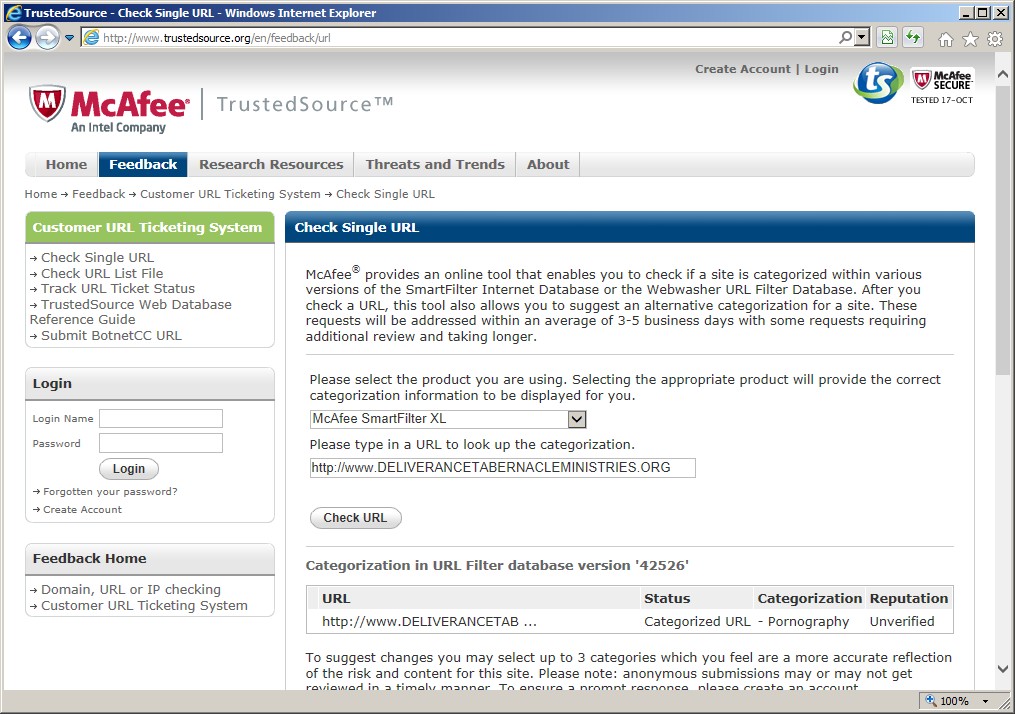
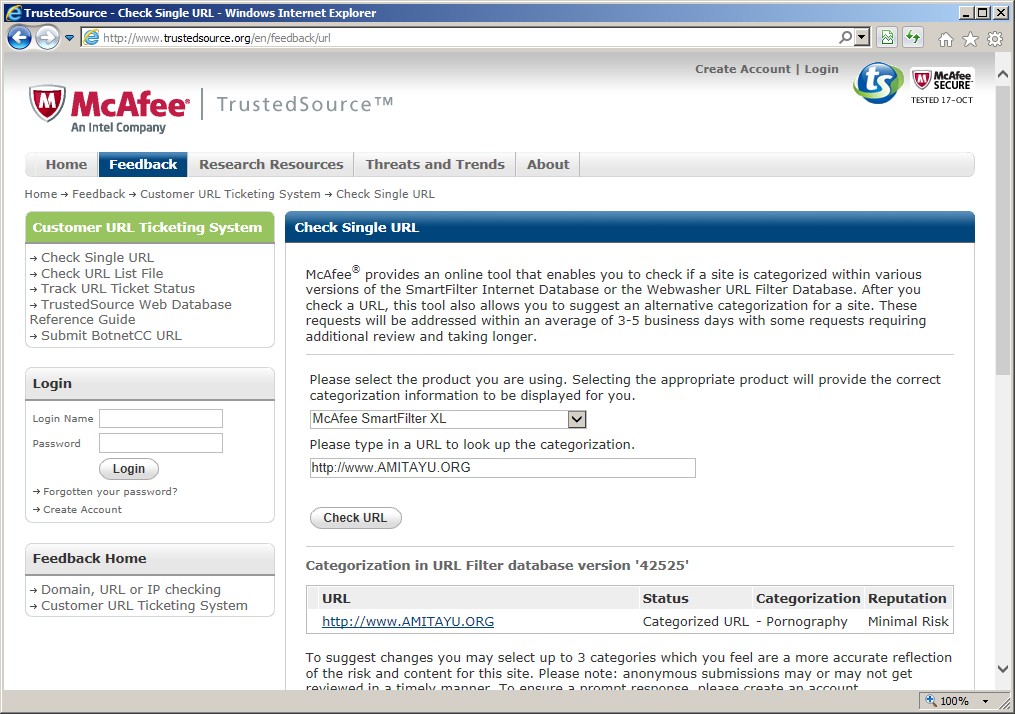
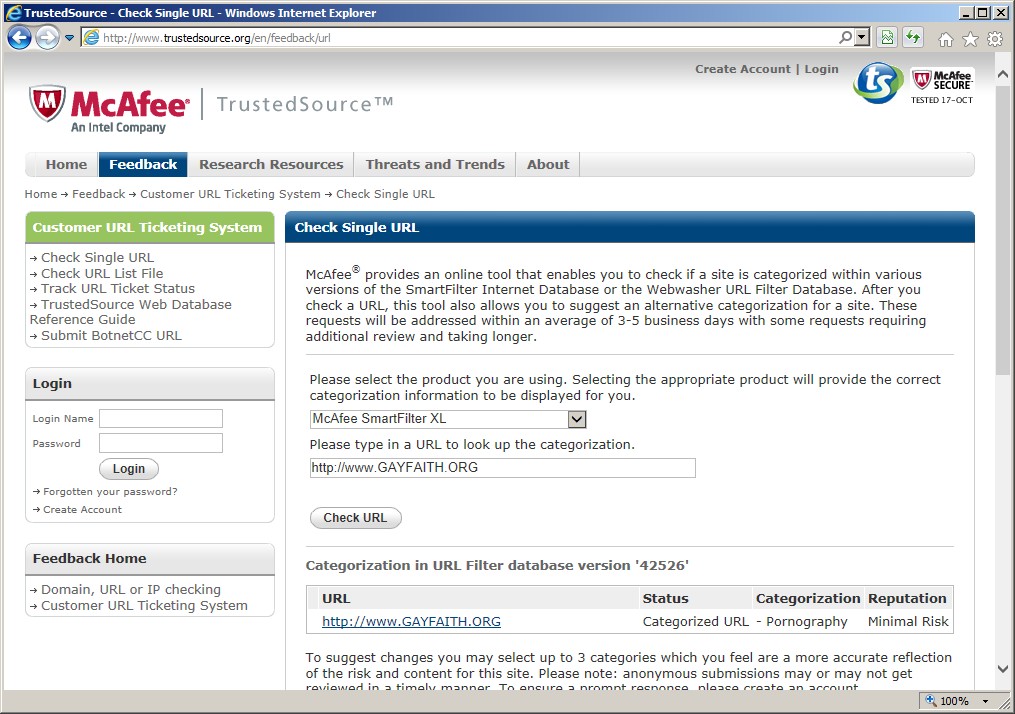
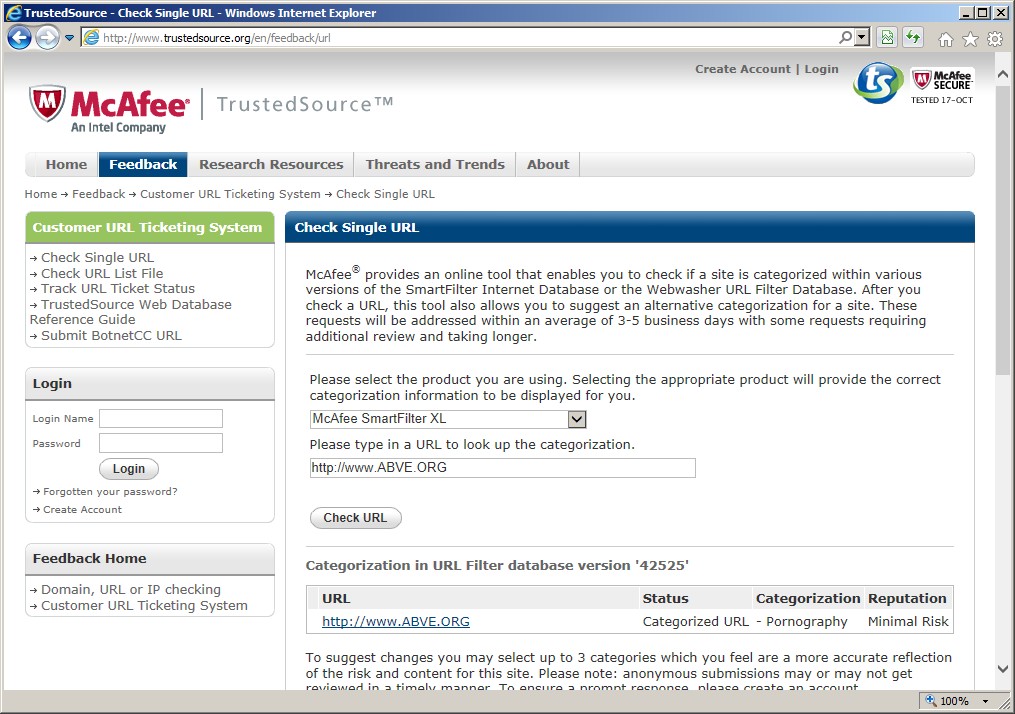
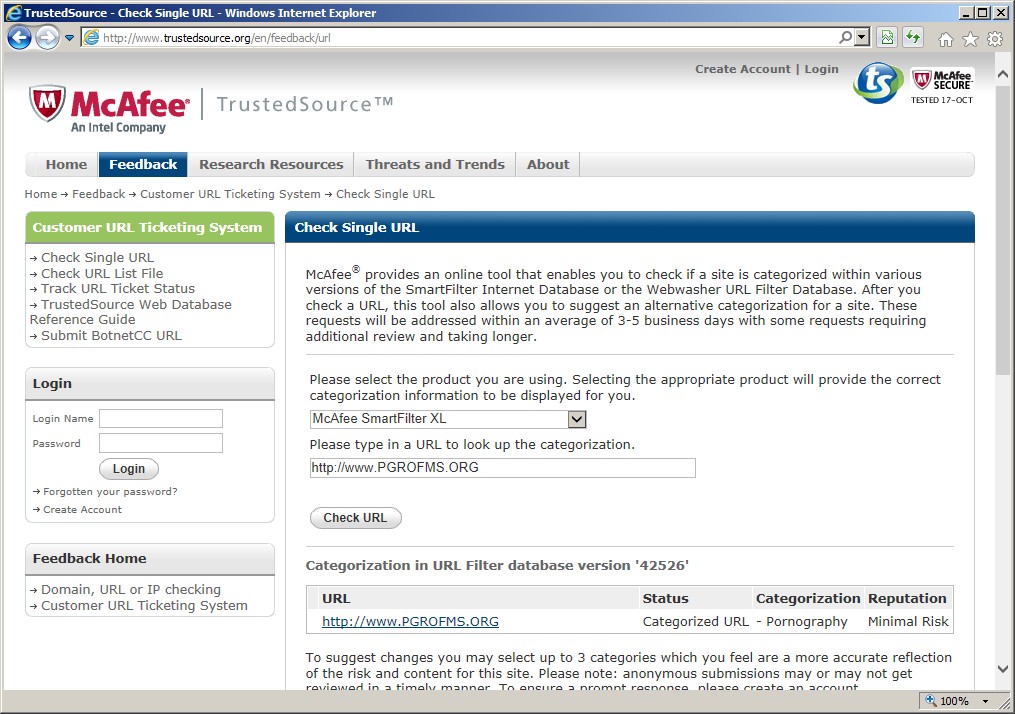
Slashdot contributor Bennett Haselton writes: "Internet users in Saudi Arabia, along with most users in the United Arab Emirates, are blocked by their respective government censors from accessing the websites of the Trinity Davison Lutheran Church, Deliverance Tabernacle Ministries in Pittsburgh, the Amitayu Buddhist Society of Taiwan, and GayFaith.org. An attempt to access any of those websites yields an error page like this one. However, the sites are not blocked because they conflict with the religions beliefs of those countries' governments. Rather, they are blocked because Smartfilter -- the American-made blocking program sold by McAfee, and used for state-mandated Internet censorship in those countries -- classifies those sites as "pornography". You can see the screen shots here, here, here and here." Read on for the rest of Bennett's thoughts.I found these blocked sites by starting with a combination of URL lists and ad hoc spidering, and running as many sites as possible through the Saudi filters to catch the ones that were blocked. Some of the sites were blocked for reasons that were easy to guess -- for example, http://www.bighornbasinsfw.org/, the home page of the Big Horn Basin, Wyoming chapter of Sportsmen for Fish & Wildlife, was almost certainly blocked because of the slang term "nsfw" in their URL. http://www.AgainstPornography.org and http://www.SearchingForMySpermDonorFather.org were presumably blocked because of the presence of the words "porn" and "sperm".
On the other hand, there appears to be no rational reason why the Filipino American Women's Network, the Tuscon Jazz Institute, or the Sacramento Police Activities League would have been blocked by Smartfilter, even by accident. A partial list of the blocked sites that I found is in the blog post I wrote for Citizen Lab, an Internet censorship research center at the University of Toronto.
Articles about sites that are erroneously blocked by Internet censorship software, have a storied history. The first widely read piece was the article "Keys to the Kingdom" written by Brock Meeks and Declan McCullagh in 1996, calling out Cyber Patrol for blocking EnviroLink.org and the University of Newcastle Computer Science Department, and CYBERsitter for blocking the National Organization for Women. I made a minor name for myself and the Peacefire.org site in the late 1990's by writing more pages about sites blocked by other products, including some (like X-Stop and SurfWatch) which no longer exist, and others that are still around, including Smartfilter. I was also one of six people comprising the Censorware Project, a loosely organized group of volunteers that published a few more reports.
By the early 2000's, however, it became clear that anyone whose mind was likely to be changed by information about what kinds of sites were blocked by blocking software, would have changed their mind already (or would, if they came across the research that had already been done up to that point). So the further reports on Internet blocking software errors, by me and other people, slowed to a trickle. I wrote a report in January 2002 on the latest list of sites blocked by Cyber Patrol, a product that most people today have forgotten. In 2006 I worked with the ACLU of Washington to publish a report on sites erroneously blocked by FortiGuard, a program used on computers in some libraries in central Washington, as part of the ACLU's suit to challenge the constitutionality of the program's use on public library terminals. (The Washington State Supreme Court rejected the lawsuit on the grounds that, regardless of what sites were blocked on the computers, it didn't matter because an adult library patron could request for the filter to be turned off.) In 2007 I wrote an article for Slashdot titled "From Bess to Worse" listing some sites that were blocked by an Internet filtering program called Bess (which was later bought out by Smartfilter and discontinued).
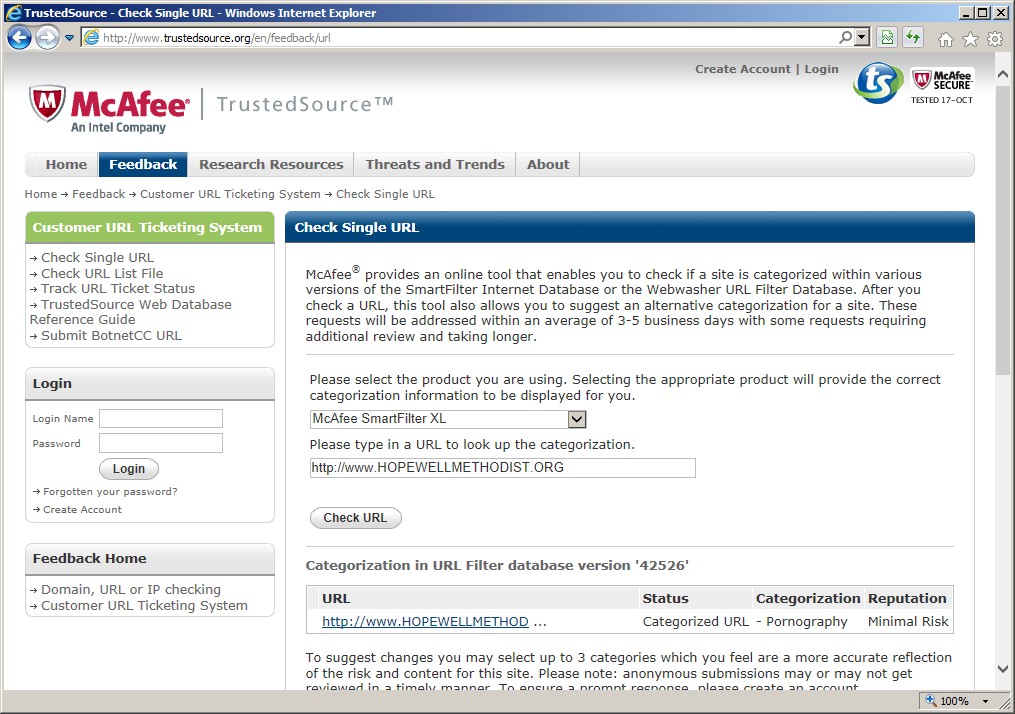
Most people's awareness of this debate, if they had heard about it at all, was limited to the perception that "breast cancer sites" and sites about "chicken breast recipes" were sometimes filtered by Internet blocking programs. Or they heard that "Beaver College" actually had to change its name to avoid being censored by web filters. As I tried to explain in a FAQ (written, according to the Wayback Machine, in 1999, but which still broadly holds true today), these examples are true, but they miss the point. These examples make it sound as if blocking software companies are doing the best job they can under the circumstances, and that the errors are unavoidable due to limitations on machine intelligence. In reality, any software algorithm that blocks the American Board of Vocational Experts, the Hopewell United Methodist Church, and the Patriot Guard Riders of Mississippi, as "pornography" (as Smartfilter currently does), is probably not the best algorithm the company could have come up with -- but there's no incentive for them to try harder, because few people will ever look that deep.
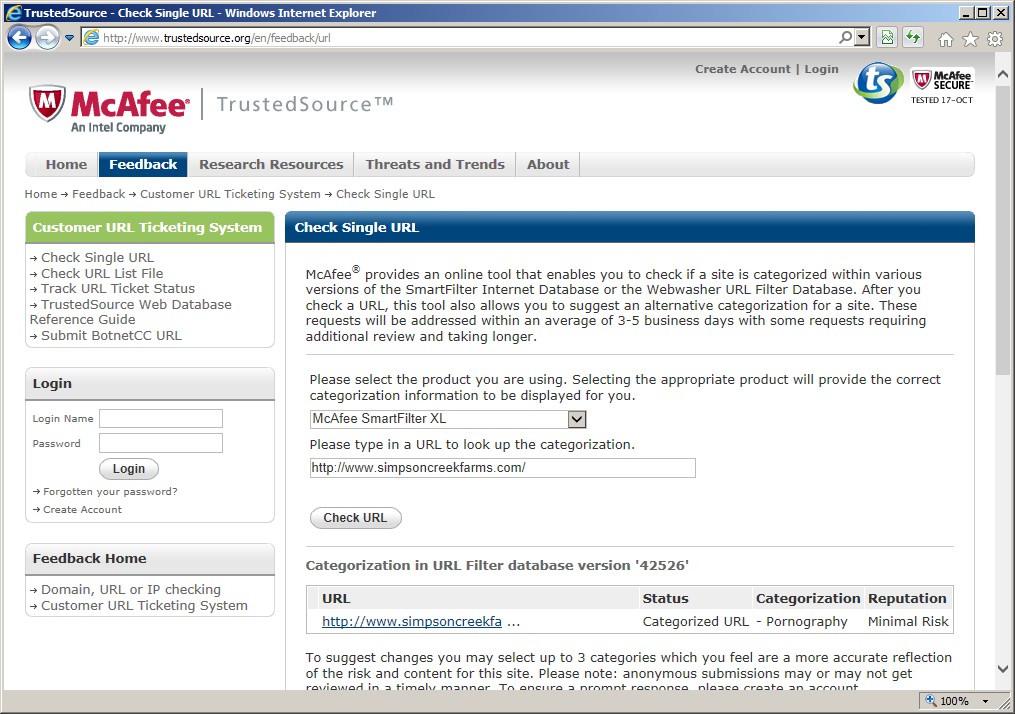
And yet, people continue to remember the "breast cancer site" examples. This sounds to me like an example of the narrative fallacy -- people remember that breast cancer sites were blocked, because there's a tidy explanation. There is no tidy explanation for most other examples of blocked sites, so the meme never spreads very far. Conveniently for the blocking companies, the blocked-site errors which make the company look most sloppy (the Kennels at Simpson Creek Farms, the St. Francis Institute of Milwaukee, etc.) are precisely the ones that, due to the narrative fallacy, most people won't remember or hear about.
One company, CYBERsitter, did manage to make a few blocking decisions in the 1990s that were egregious enough that their antics did make the news, and did finally raise some people's awareness that the controversy over private Internet filtering extended beyond "breast cancer sites". After TIME Magazine's website published an article (no longer online) that criticized CYBERsitter's blocking policies, CYBERsitter responded by blocking TIME Magazine's pathfinder.com domain. A few months earlier, CYBERsitter had blacklisted the monthly e-Zine "The Ethical Spectacle, after the Spectacle's founder, Jonathan Wallace, published an article criticizing CYBERsitter for blocking my own Peacefire.org website. And Peacefire.org had been blocked, in turn, because of a page I wrote (now very much out of date) listing some of the sites that CYBERsitter blocked, including the International Gay and Lesbian Human Rights Commission and Mother Jones. (Nowadays, of course, nobody would be surprised that filtering companies block Peacefire.org, since the site publishes ample instructions on how to get around Internet blockers. But at the time, the site's first and only article was the list of sites blocked by CYBERsitter, which is why CYBERsitter received so much criticism for blocking the domain in retaliation.) CYBERsitter also threatened to have Meeks and McCullagh criminally prosecuted for writing "Keys to the Kingdom" and threatened to sue me over the page that I had made.)
The moral, it seems, is that if you want an example of a censored web site to stick in people's minds, it either has to be a forgivable error, or an insane vindictive dick move -- because in either of those cases, people will understand why it happened. The vast swaths of censored websites on the spectrum in between, the ones for which there is no rational explanation for the blocking, go ignored.
These days, though, American and Canadian "censorware" makers have also come under fire for selling censoring software to foreign governments which use them for country-wide censorship. Most of the criticism focuses, naturally, not on the kinds of sites that are accidentally blocked by the blocking software, but on the immorality of these companies enabling statewide foreign censorship in the first place. Netsweeper, Blue Coat, and McAfee have all made the claim that "Once we sell their product to them, we have no control over what they do with it" -- which, as I wrote previously in Slashdot, is nonsense, because for the product to be effective, it has to rely on updates to the blocked-site list, which are provided at regular intervals by the manufacturer. Cut off the updates, and the product will not work, at least not as well.
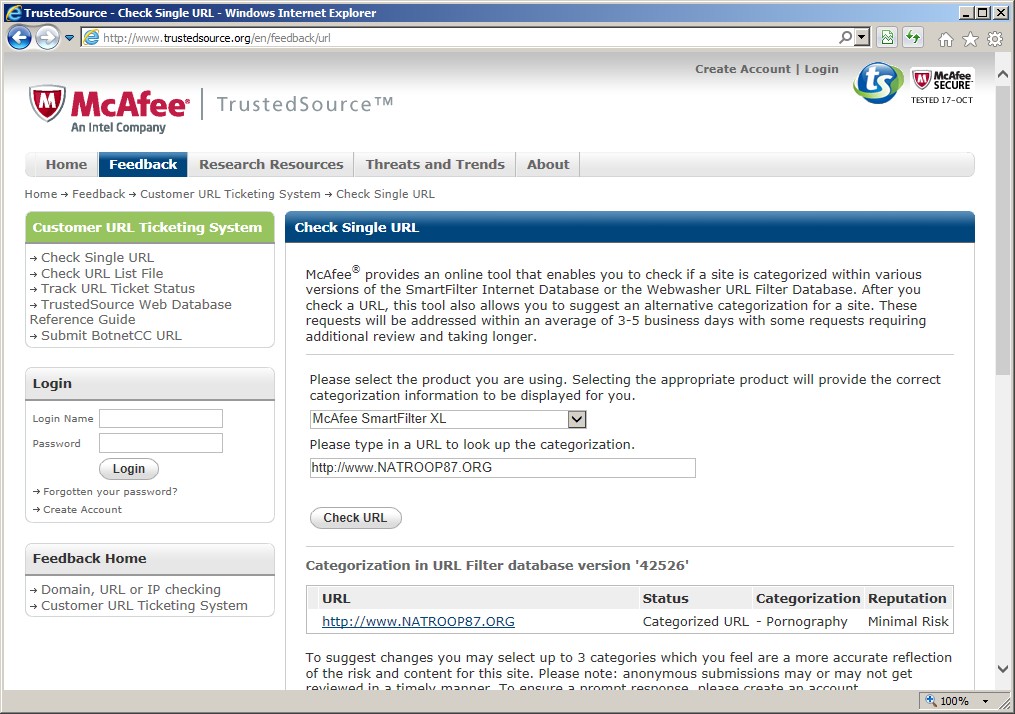
So the fact that McAfee has classified the Boy Scout Troop 87 of North Andover, the Pan-Iranist Party of Iran, and Reptile Conservation International as "Pornography" is (rightly) overshadowed by the fact that McAfee is selling to government censors in Saudi Arabia and the UAE in the first place. However, as long as the filters are installed, these blocked sites are at least part of the problem for users in those countries, just as much as they are for students or cubicle workers in the U.S. whose network administrators happen to use Smartfilter. And, of course, I sampled only a miniscule fraction of the Web to find these examples of blocked sites, so the true number of stupid blocks affecting Saudi and UAE users is likely to be much larger. For each individual example, you might reasonably ask, "Is it really a big deal if Saudis are blocked from accessing Boy Scout Troop 87 of North Andover?" But it adds up.
-
Sites Blocked By Smartfilter, Censored in Saudi Arabia
Slashdot contributor Bennett Haselton writes: "Internet users in Saudi Arabia, along with most users in the United Arab Emirates, are blocked by their respective government censors from accessing the websites of the Trinity Davison Lutheran Church, Deliverance Tabernacle Ministries in Pittsburgh, the Amitayu Buddhist Society of Taiwan, and GayFaith.org. An attempt to access any of those websites yields an error page like this one. However, the sites are not blocked because they conflict with the religions beliefs of those countries' governments. Rather, they are blocked because Smartfilter -- the American-made blocking program sold by McAfee, and used for state-mandated Internet censorship in those countries -- classifies those sites as "pornography". You can see the screen shots here, here, here and here." Read on for the rest of Bennett's thoughts.I found these blocked sites by starting with a combination of URL lists and ad hoc spidering, and running as many sites as possible through the Saudi filters to catch the ones that were blocked. Some of the sites were blocked for reasons that were easy to guess -- for example, http://www.bighornbasinsfw.org/, the home page of the Big Horn Basin, Wyoming chapter of Sportsmen for Fish & Wildlife, was almost certainly blocked because of the slang term "nsfw" in their URL. http://www.AgainstPornography.org and http://www.SearchingForMySpermDonorFather.org were presumably blocked because of the presence of the words "porn" and "sperm".
On the other hand, there appears to be no rational reason why the Filipino American Women's Network, the Tuscon Jazz Institute, or the Sacramento Police Activities League would have been blocked by Smartfilter, even by accident. A partial list of the blocked sites that I found is in the blog post I wrote for Citizen Lab, an Internet censorship research center at the University of Toronto.
Articles about sites that are erroneously blocked by Internet censorship software, have a storied history. The first widely read piece was the article "Keys to the Kingdom" written by Brock Meeks and Declan McCullagh in 1996, calling out Cyber Patrol for blocking EnviroLink.org and the University of Newcastle Computer Science Department, and CYBERsitter for blocking the National Organization for Women. I made a minor name for myself and the Peacefire.org site in the late 1990's by writing more pages about sites blocked by other products, including some (like X-Stop and SurfWatch) which no longer exist, and others that are still around, including Smartfilter. I was also one of six people comprising the Censorware Project, a loosely organized group of volunteers that published a few more reports.
By the early 2000's, however, it became clear that anyone whose mind was likely to be changed by information about what kinds of sites were blocked by blocking software, would have changed their mind already (or would, if they came across the research that had already been done up to that point). So the further reports on Internet blocking software errors, by me and other people, slowed to a trickle. I wrote a report in January 2002 on the latest list of sites blocked by Cyber Patrol, a product that most people today have forgotten. In 2006 I worked with the ACLU of Washington to publish a report on sites erroneously blocked by FortiGuard, a program used on computers in some libraries in central Washington, as part of the ACLU's suit to challenge the constitutionality of the program's use on public library terminals. (The Washington State Supreme Court rejected the lawsuit on the grounds that, regardless of what sites were blocked on the computers, it didn't matter because an adult library patron could request for the filter to be turned off.) In 2007 I wrote an article for Slashdot titled "From Bess to Worse" listing some sites that were blocked by an Internet filtering program called Bess (which was later bought out by Smartfilter and discontinued).
Most people's awareness of this debate, if they had heard about it at all, was limited to the perception that "breast cancer sites" and sites about "chicken breast recipes" were sometimes filtered by Internet blocking programs. Or they heard that "Beaver College" actually had to change its name to avoid being censored by web filters. As I tried to explain in a FAQ (written, according to the Wayback Machine, in 1999, but which still broadly holds true today), these examples are true, but they miss the point. These examples make it sound as if blocking software companies are doing the best job they can under the circumstances, and that the errors are unavoidable due to limitations on machine intelligence. In reality, any software algorithm that blocks the American Board of Vocational Experts, the Hopewell United Methodist Church, and the Patriot Guard Riders of Mississippi, as "pornography" (as Smartfilter currently does), is probably not the best algorithm the company could have come up with -- but there's no incentive for them to try harder, because few people will ever look that deep.
And yet, people continue to remember the "breast cancer site" examples. This sounds to me like an example of the narrative fallacy -- people remember that breast cancer sites were blocked, because there's a tidy explanation. There is no tidy explanation for most other examples of blocked sites, so the meme never spreads very far. Conveniently for the blocking companies, the blocked-site errors which make the company look most sloppy (the Kennels at Simpson Creek Farms, the St. Francis Institute of Milwaukee, etc.) are precisely the ones that, due to the narrative fallacy, most people won't remember or hear about.
One company, CYBERsitter, did manage to make a few blocking decisions in the 1990s that were egregious enough that their antics did make the news, and did finally raise some people's awareness that the controversy over private Internet filtering extended beyond "breast cancer sites". After TIME Magazine's website published an article (no longer online) that criticized CYBERsitter's blocking policies, CYBERsitter responded by blocking TIME Magazine's pathfinder.com domain. A few months earlier, CYBERsitter had blacklisted the monthly e-Zine "The Ethical Spectacle, after the Spectacle's founder, Jonathan Wallace, published an article criticizing CYBERsitter for blocking my own Peacefire.org website. And Peacefire.org had been blocked, in turn, because of a page I wrote (now very much out of date) listing some of the sites that CYBERsitter blocked, including the International Gay and Lesbian Human Rights Commission and Mother Jones. (Nowadays, of course, nobody would be surprised that filtering companies block Peacefire.org, since the site publishes ample instructions on how to get around Internet blockers. But at the time, the site's first and only article was the list of sites blocked by CYBERsitter, which is why CYBERsitter received so much criticism for blocking the domain in retaliation.) CYBERsitter also threatened to have Meeks and McCullagh criminally prosecuted for writing "Keys to the Kingdom" and threatened to sue me over the page that I had made.)
The moral, it seems, is that if you want an example of a censored web site to stick in people's minds, it either has to be a forgivable error, or an insane vindictive dick move -- because in either of those cases, people will understand why it happened. The vast swaths of censored websites on the spectrum in between, the ones for which there is no rational explanation for the blocking, go ignored.
These days, though, American and Canadian "censorware" makers have also come under fire for selling censoring software to foreign governments which use them for country-wide censorship. Most of the criticism focuses, naturally, not on the kinds of sites that are accidentally blocked by the blocking software, but on the immorality of these companies enabling statewide foreign censorship in the first place. Netsweeper, Blue Coat, and McAfee have all made the claim that "Once we sell their product to them, we have no control over what they do with it" -- which, as I wrote previously in Slashdot, is nonsense, because for the product to be effective, it has to rely on updates to the blocked-site list, which are provided at regular intervals by the manufacturer. Cut off the updates, and the product will not work, at least not as well.
So the fact that McAfee has classified the Boy Scout Troop 87 of North Andover, the Pan-Iranist Party of Iran, and Reptile Conservation International as "Pornography" is (rightly) overshadowed by the fact that McAfee is selling to government censors in Saudi Arabia and the UAE in the first place. However, as long as the filters are installed, these blocked sites are at least part of the problem for users in those countries, just as much as they are for students or cubicle workers in the U.S. whose network administrators happen to use Smartfilter. And, of course, I sampled only a miniscule fraction of the Web to find these examples of blocked sites, so the true number of stupid blocks affecting Saudi and UAE users is likely to be much larger. For each individual example, you might reasonably ask, "Is it really a big deal if Saudis are blocked from accessing Boy Scout Troop 87 of North Andover?" But it adds up.
-
Notorious Patent Troll Sues Federal Trade Commission
Fnord666 writes with news that the notorious scanner patent troll MPHJ Technology caught the eye of the FTC, and decided to file a preemptive lawsuit (PDF) against the Federal government. From the article: As the debate over so-called "patent trolls" has flared up in Congress, MPHJ became the go-to example for politicians and attorneys general trying to show that patent abuse has spun out of control. ... The FTC was going to sue under Section 5 of the FTC Act, which bars deceptive trade practices. MPHJ says that the FTC is greatly overstepping its bounds. The patent-licensing behavior doesn't even amount to 'commerce' by the standards of the FTC Act, because the letters are not 'the offer of a good or sale for service,' argues MPHJ. Furthermore, MPHJ has a First Amendment right to notify companies that it believes its patents are being infringed." -
Archive.org Hosts Massive Collection of MAME ROMs
An anonymous reader writes to point out a giant gift to the world from the Internet Archive: a massive collection of MAME ROMs, playable in your browser using Javascript Mess. From the blog post announcing this extension of the already mind-blowing Internet Archive: "Like the Historical Software collection, the Console Living Room is in beta – the ability to interact with software in near-instantaneous real-time comes with the occasional bumps and bruises. An army of volunteer elves are updating information about each of the hundreds of game cartridges now available, and will be improving them across the next few days. Sound is still not enabled, but is coming soon. Faster, more modern machines and up-to-date browsers work best with the JSMESS emulator." -
Archive.org Hosts Massive Collection of MAME ROMs
An anonymous reader writes to point out a giant gift to the world from the Internet Archive: a massive collection of MAME ROMs, playable in your browser using Javascript Mess. From the blog post announcing this extension of the already mind-blowing Internet Archive: "Like the Historical Software collection, the Console Living Room is in beta – the ability to interact with software in near-instantaneous real-time comes with the occasional bumps and bruises. An army of volunteer elves are updating information about each of the hundreds of game cartridges now available, and will be improving them across the next few days. Sound is still not enabled, but is coming soon. Faster, more modern machines and up-to-date browsers work best with the JSMESS emulator." -
Is Computer Science Education Racist and Sexist?
theodp writes "What's wrong with this picture?" asked Code.org at its launch earlier this year, lamenting the lack of Computer Science students in a race and gender reference-free infographic. But as the organization has grown via public/private partnerships and inked agreements to drive the CS curriculum for the Chicago and NYC school systems, the same stats webpage has adopted a new gender and racial equity focus, positioning Computer Science education as "a chance to level the playing field" for women, Hispanic and African American students. The new message is consistent with the recently-forged Code.org partnership with the NSF-funded Exploring Computer Science (ECS, "a K-12/university partnership committed to democratizing computer science") and Computer Science Principles (CSP, "a new course under development that seeks to broaden participation in computing and computer science"). According to The Research Behind ECS, an "insidious 'virtual segregation' that maintains inequality" is to blame for keeping the number of African Americans and Latino/as CS students disproportionately low. So, what might the future of Code.org's proposed equity-based U.S. K-12 CS education look like? "Including culturally relevant instructional materials represented a driving focus of our course development," explained ECS Team members who now advise Code.org. "Cultural design tools encourage students to artistically express computing design concepts from Latino/a, African American, or Native American history as well as cultural activities in dance, skateboarding, graffiti art, and more. These types of lessons are important for students to build personal relationships with computer science concepts and applications – an important process for discovering the relevance of computer science for their own life." And — ironically for Code.org — it could mean less coding." -
Britain's Conservatives Scrub Speeches from the Internet
An anonymous reader writes news of an attempt to erase a bit of history. From the article: "The Conservative Party have attempted to delete all their speeches and press releases online from the past 10 years, including one in which David Cameron promises to use the Internet to make politicians 'more accountable'. The Tory party have deleted the backlog of speeches from the main website and the Internet Archive — which aims to make a permanent record of websites and their content — between 2000 and May 2010." -
Internet Archive's San Francisco Home Badly Damaged By Fire
Rambo Tribble writes "The San Francisco building housing the Internet Archive, and its popular Wayback Machine, has suffered a serious fire. While no archived data was destroyed, materials awaiting archival were. Rebuilding will be a major undertaking, and the group is soliciting donations." -
Microsoft, Apple and Others Launch Huge Patent Strike at Android
New submitter GODISNOWHERE writes "Nortel went bankrupt in 2009. In 2011, it held an auction for its massive patent portfolio. The winners of the auction were Apple, Microsoft, Sony, RIM, and others, who bought the patents for $4.5 billion as a consortium named Rockstar Bidco. At the time, many people speculated those patents would be used against Google, who bid separately but lost. It turns out they were right. Rockstar has filed eight lawsuits in federal court targeting Google and Android device manufacturers. 'The complaint (PDF) against Google involves six patents, all from the same patent "family." They're all titled "associative search engine," and list Richard Skillen and Prescott Livermore as inventors. The patents describe "an advertisement machine which provides advertisements to a user searching for desired information within a data network. The oldest patent in the case is US Patent No. 6,098,065, with a filing date of 1997, one year before Google was founded. The newest patent in the suit was filed in 2007 and granted in 2011. The complaint tries to use the fact that Google bid for the patents as an extra point against the search giant.'" -
New Musopen Campaign Wants To "Set Chopin Free"
Eloquence writes "Three years ago, Musopen raised nearly $70,000 to create public domain recordings of works by Beethoven, Brahms, Mozart, Schubert, and others. Now they're running a new campaign with a simple but ambitious objective: 'To preserve indefinitely and without question everything Chopin created. To release his music for free, both in 1080p video and 24 bit 192kHz audio. This is roughly 245 pieces.'" Adds project organizer aarondunn: "His music will be made available via an API powered by Musopen so anyone can come up with ways to explore and present Chopin's life." -
Yahoo! Sports Redesign Sparks Controversy, Disdain From Users
coastal984 writes "Yahoo! launched their latest redesign over the past couple of weeks, revamping their utilitarian Yahoo! Sports section with a new-age, modernized look, which features a much darker, graphical background, and light, larger text. Only problem is, the sports buffs that frequented Yahoo! Sports loved the basic, easy to read and comprehend presentation that the old site used (Which was a predominately plain white background, and smaller, dark text. Thousands of users took to Yahoo's uservoice page to express their discontent, begging for the old design back." -
Internet.org's Slave and Helicopter-Powered Internet
theodp writes "As reported earlier on Slashdot, Mark Zuckerberg on Wednesday announced the launch of Internet.org, 'a global partnership with the goal of making internet access available to the next 5 billion people,' including 'those who cannot currently afford it.' So it's especially bizarre that just a few days ago, Internet.org carried a FAQ which joked that slaves were used to create an Internet for the Pharaohs. And until recently, Internet.org's home page sported a photo purporting to show that freighters are used to rush Internet porn to affluent residents of the 16th arrondissement of Paris, and an illustration showing how helicopters deliver Internet data to actor George Clooney's magnificent Lake Como Villa. So keep an eye on how your domain is used, kids, especially if you plan to use it soon to position yourself and your partners as saints who champion the right of the world's poor to Internet access." -
Internet.org's Slave and Helicopter-Powered Internet
theodp writes "As reported earlier on Slashdot, Mark Zuckerberg on Wednesday announced the launch of Internet.org, 'a global partnership with the goal of making internet access available to the next 5 billion people,' including 'those who cannot currently afford it.' So it's especially bizarre that just a few days ago, Internet.org carried a FAQ which joked that slaves were used to create an Internet for the Pharaohs. And until recently, Internet.org's home page sported a photo purporting to show that freighters are used to rush Internet porn to affluent residents of the 16th arrondissement of Paris, and an illustration showing how helicopters deliver Internet data to actor George Clooney's magnificent Lake Como Villa. So keep an eye on how your domain is used, kids, especially if you plan to use it soon to position yourself and your partners as saints who champion the right of the world's poor to Internet access." -
Internet.org's Slave and Helicopter-Powered Internet
theodp writes "As reported earlier on Slashdot, Mark Zuckerberg on Wednesday announced the launch of Internet.org, 'a global partnership with the goal of making internet access available to the next 5 billion people,' including 'those who cannot currently afford it.' So it's especially bizarre that just a few days ago, Internet.org carried a FAQ which joked that slaves were used to create an Internet for the Pharaohs. And until recently, Internet.org's home page sported a photo purporting to show that freighters are used to rush Internet porn to affluent residents of the 16th arrondissement of Paris, and an illustration showing how helicopters deliver Internet data to actor George Clooney's magnificent Lake Como Villa. So keep an eye on how your domain is used, kids, especially if you plan to use it soon to position yourself and your partners as saints who champion the right of the world's poor to Internet access." -
First Portions of Aaron Swartz's Secret Service File Released
Despite attempts by MIT and JSTOR to block the release of files pertaining the Aaron Swartz investigation, the court has ordered the release of documents not referencing MIT or JSTOR. There are approximately 14,500 pages of documents that will be released over the coming six months, after having information that could lead to harm against MIT or JSTOR employees redacted. Wired has the full story, and the author uploaded the first hundred pages of files. The first batch reveals that the Feds had indeed been looking into Swartz since the publication of his 2008 'Guerilla Open Access Manifesto,' several years before being indicted for copying documents from JSTOR. -
Omni Magazine To Reboot
Hugh Pickens DOT Com writes "Adi Robertson reports in The Verge that classic science fiction magazine Omni, created in 1978 by Penthouse mogul Bob Guccione and partner Kathy Keeton, is coming back — and with it, questions about how our vision of science and science fiction has changed since Omni closed up shop in 1996. 'There's a heavy dose of nostalgia in the proceedings, and it's not just about bringing back an old name,' writes Robertson. 'Longtime editor Ben Bova has described Omni as "a magazine about the future," but since his time as editor, our vision of the future has been tarnished — or, at the very least, we've started looking at the predictions of the past with rose-tinted glasses.' Omni's resurrection comes courtesy of Jeremy Frommer, a collector and businessman who acquired Guccione's archives earlier this year. Like the original magazine, now available at the internet archive, the new Omni will publish a mixture of new fiction and nonfiction publishing the old illustrations that helped define Omni alongside the stories. Longtime science writer Claire Evans will edit the new online project described as an 'Omni reboot' but plans to jettison one of the magazine's most dated elements — a fondness for extraterrestrials and conspiracy theories. 'Omni always had a distressing new agey tinge to it,' says Bruce Sterling. 'There was a lot of "aircraft of the pharaohs'"rubbish going on, which I didn't have very much tolerance for.'" -
Federal Judge Declares Bitcoin a Currency
tlhIngan writes "An East Texas federal judge has concluded that Bitcoin is a currency that can be regulated under American Law. The conclusion came during the trial of Trendon Shavers, who is accused of running the Bitcoin Savings and Trust (BTCST) as a Ponzi scheme. Shavers had argued that since the transactions were all done in Bitcoins, no money changed hands and thus the SEC has no jurisdiction. The judge found that since Bitcoins may be used to purchase goods and services, and more importantly, can be converted to conventional currencies, it is a form of currency (PDF) and investors wishing to invest in the BTCST provided an investment of money, and thus the SEC may regulate such business." -
Judge Denies Administration Request To Delay ACLU Metadata Lawsuit
sl4shd0rk writes "Federal Judge William Pauley has dismissed an Obama Administration request to delay a hearing on Verizon/NSA data sifting. The ACLU has argued that the sifting is not authorized by statute and even if it were it would still be unconstitutional. The Obama Administration requested the delay on the grounds it needed more time to search through its classified material to determine what was suitable for disclosure." See also the case docket. Motions must be filed by August 26th, and oral arguments begin on November 1st. -
Snowden NSA Claims Partially Confirmed, Says Rep. Jerrold Nadler
bill_mcgonigle writes with this news from from CNET: "Rep. Jerrold Nadler (D NY) disclosed that NSA analysts eavesdrop on Americans' domestic telephone calls without court orders during a House Judiciary hearing. After clearing with FBI director Robert Mueller that the information was not classified, Nadler revealed that during a closed-door briefing to Congress, the Legislature was informed that the spying organization had implemented and uses this capability. This appears to confirm Edward Snowden's claim that he could, in his position at the NSA, 'wiretap anyone from you or your accountant to a federal judge to even the president.' Declan McCullagh writes, 'Because the same legal standards that apply to phone calls also apply to e-mail messages, text messages, and instant messages, Nadler's disclosure indicates the NSA analysts could also access the contents of Internet communications without going before a court and seeking approval.' The executive branch has defended its general warrants, claiming that 'the president had the constitutional authority, no matter what the law actually says, to order domestic spying without [constitutional] warrants,' while Kurt Opsahl, senior staff attorney at EFF claims such government activity 'epitomizes the problem of secret laws.'" Note that "listening in" versus "collecting metadata" is a distinction that defenders of government phone spying have been emphasizing. Tracking whom you called and when, goes the story, doesn't impinge on expectations of privacy. Speaking of the metadata collection, though, reader Bruce66423 writes "According to the Washington Post, the Bush administration took 'bulk metadata' from the phone companies under voluntary agreements for more than four years after 9/11 until a court agreed they could have it compulsorily." Related: First time accepted submitter fsagx writes that Brewster Kahle of the Internet Archive has calculated the cost to store every phone call made in the U.S. over the course of a year: "It's surprisingly inexpensive. It puts the recent NSA stories (and reports from the Boston bombings about the FBI's ability to listen to past phone conversions) into perspective." -
Ortiz-Heymann: the Prior Generation
theodp writes "Two decades before the White House was petitioned to remove U.S. Attorney Carmen Ortiz and her Assistant U.S. Attorney Stephen Heymann from their jobs for the allegedly overzealous prosecution of Aaron Swartz, the Boston Globe reported on allegations of 'sometimes heavy-handed tactics and inaccuracies' of an NFL investigation into sexual harassment charges made by a sportswriter against the New England Patriots that was led by Watergate prosecutor Philip Heymann (Stephen's father) and included Ortiz. 'From the day Philip Heymann and his colleagues walked into Foxboro Stadium to investigate Lisa Olson's charges of sexual harassment,' the Globe reported, 'the New England Patriots were on the defensive, and apparently, they stayed there to the end. One day after conducting a preliminary six-hour interview with Olson, Heymann introduced each investigator to the Patriots and outlined their backgrounds at a meeting he later called benign. Yet he also said two weeks ago, "They were frightened from the beginning by the way I introduced people. I said that Jerry O'Sullivan had been US Attorney. I said Jim Ring had been FBI special agent in charge of organized crime."'
Regarding Ortiz, the Globe reported, 'Heymann investigator Carmen Ortiz wrote in a memo of her Oct. 18, 1990, interview with [Lisa Olson] that she took no notes and did not tape-record the conversation. Yet she used direct quotes when writing up her 15-page report on the session. When asked to explain, she referred the Globe to Heymann.' Aside from transcripts of two interviews (the tapes of which were destroyed), the Globe reported the NFL kept no notes on its interviews with 89 other people. '"It was contemplated that there would be a motion such as this [a lawsuit by Olson] and we did not want to create that type of document," an NFL attorney explained. According to the Globe, an attorney representing the Patriots said that 'one reason the tapes were destroyed may be that the NFL did not want anyone to hear raised voices or pounding of tables. He said some of those interviewed were not allowed to leave the room and had their livelihoods threatened if they did not cooperate.' Curiously, the elder Heymann featured prominently in a recently-upheld DOJ motion to keep the names of key people involved in the Aaron Swartz case secret — a postcard threat received by Philip Heymann was cited by Ortiz's office as evidence of why such secrecy was necessary." -
Ortiz-Heymann: the Prior Generation
theodp writes "Two decades before the White House was petitioned to remove U.S. Attorney Carmen Ortiz and her Assistant U.S. Attorney Stephen Heymann from their jobs for the allegedly overzealous prosecution of Aaron Swartz, the Boston Globe reported on allegations of 'sometimes heavy-handed tactics and inaccuracies' of an NFL investigation into sexual harassment charges made by a sportswriter against the New England Patriots that was led by Watergate prosecutor Philip Heymann (Stephen's father) and included Ortiz. 'From the day Philip Heymann and his colleagues walked into Foxboro Stadium to investigate Lisa Olson's charges of sexual harassment,' the Globe reported, 'the New England Patriots were on the defensive, and apparently, they stayed there to the end. One day after conducting a preliminary six-hour interview with Olson, Heymann introduced each investigator to the Patriots and outlined their backgrounds at a meeting he later called benign. Yet he also said two weeks ago, "They were frightened from the beginning by the way I introduced people. I said that Jerry O'Sullivan had been US Attorney. I said Jim Ring had been FBI special agent in charge of organized crime."'
Regarding Ortiz, the Globe reported, 'Heymann investigator Carmen Ortiz wrote in a memo of her Oct. 18, 1990, interview with [Lisa Olson] that she took no notes and did not tape-record the conversation. Yet she used direct quotes when writing up her 15-page report on the session. When asked to explain, she referred the Globe to Heymann.' Aside from transcripts of two interviews (the tapes of which were destroyed), the Globe reported the NFL kept no notes on its interviews with 89 other people. '"It was contemplated that there would be a motion such as this [a lawsuit by Olson] and we did not want to create that type of document," an NFL attorney explained. According to the Globe, an attorney representing the Patriots said that 'one reason the tapes were destroyed may be that the NFL did not want anyone to hear raised voices or pounding of tables. He said some of those interviewed were not allowed to leave the room and had their livelihoods threatened if they did not cooperate.' Curiously, the elder Heymann featured prominently in a recently-upheld DOJ motion to keep the names of key people involved in the Aaron Swartz case secret — a postcard threat received by Philip Heymann was cited by Ortiz's office as evidence of why such secrecy was necessary." -
Judge Orders Child Porn Suspect To Decrypt His Hard Drives
An anonymous reader writes "After having first decided against forcing a suspect to decrypt a number of hard drives that were believed to be his and to contain child pornography, a U.S. judge has changed his mind and has now ordered the suspect to provide law enforcement agents heading the investigation with a decrypted version of the contents of his encrypted data storage system, or the passwords needed to decrypt forensic copies of those storage devices. Jeffrey Feldman, a software developer at Rockwell Automation, has still not been charged with any crime, and the prosecution initially couldn't prove conclusively that the encrypted hard drives contained child pornography or were actually Feldman's, which led U.S. Magistrate Judge William Callahan to decide that forcing him to decrypt them would violate his Fifth Amendment right against self-incrimination. But new evidence has made the judge reverse his first decision (PDF): the FBI has continued to try to crack the encryption on the discs, and has recently managed to decrypt and access one of the suspect's hard drives... The storage device was found to contain 'an intricate electronic folder structure comprised of approximately 6,712 folders and subfolders,' approximately 707,307 files (among them numerous files which constitute child pornography), detailed personal financial records and documents belonging to the suspect, as well as dozens of his personal photographs." -
How Did You Learn How To Program?
theodp writes "'Every programmer likely remembers how they learned to code,' writes GeekWire's Taylor Soper. 'For guys like Bill Gates and Paul Allen, the magic began on the Teletype Model 33 (pic). For others, it may have been a few days at a coding workshop like the one I attended for journalists.' If you're in the mood to share how and in what ways your own developer days began, Soper adds, 'cyborg anthropologist' Amber Case is collecting stories to help people understand what it takes to learn how to code. Any fond computer camp stories, kids?" -
LinuxDevices.com Vanishes From the Web
DeviceGuru writes "Embedded Linux pioneer LinuxDevices.com departed from the web earlier this week. The site became a collateral casualty of the aquisition of eWEEK by Quinstreet in February 2012, as part of a bundle of Ziff Davis Enterprise assets. Quinstreet immediately fired all the LinuxDevices staffers and ceased maintaining the site. A few days ago, the site's plug was finally pulled and it is now gone from the Web, save for a few pages on the WayBack Machine. For more than a decade, LinuxDevices played a pivotal role in serving and fostering an emerging embedded Linux ecosystem, and it was well respected by the embedded Linux community at the time it was acquired by QuinStreet. Unfortunately, the site did not mesh well with QuinStreet's B2B market focus. Fortunately, its spirit remains alive and well at LinuxGizmos.com, a site recently launched by LinuxDevices founder Rick Lehrbaum." -
LinuxDevices.com Vanishes From the Web
DeviceGuru writes "Embedded Linux pioneer LinuxDevices.com departed from the web earlier this week. The site became a collateral casualty of the aquisition of eWEEK by Quinstreet in February 2012, as part of a bundle of Ziff Davis Enterprise assets. Quinstreet immediately fired all the LinuxDevices staffers and ceased maintaining the site. A few days ago, the site's plug was finally pulled and it is now gone from the Web, save for a few pages on the WayBack Machine. For more than a decade, LinuxDevices played a pivotal role in serving and fostering an emerging embedded Linux ecosystem, and it was well respected by the embedded Linux community at the time it was acquired by QuinStreet. Unfortunately, the site did not mesh well with QuinStreet's B2B market focus. Fortunately, its spirit remains alive and well at LinuxGizmos.com, a site recently launched by LinuxDevices founder Rick Lehrbaum." -
The Internet Archive Is Now the Largest Collection of Historical Software Online
hypnosec writes "The Internet Archive has a great collection of books, music, visual items and websites but, it had one thing lacking up until now – software. This has changed recently as The Internet Archive now claims to hold the largest collection of software in the world. The expansion at the Internet Archive has come through collaboration with other independent archives like the Disk Drives collection, the FTP site boneyard, Shareware CD Archive, and the TOSEC archive. The archive doesn't hold just the software – it also holds documentation as well." -
The Internet Archive Is Now the Largest Collection of Historical Software Online
hypnosec writes "The Internet Archive has a great collection of books, music, visual items and websites but, it had one thing lacking up until now – software. This has changed recently as The Internet Archive now claims to hold the largest collection of software in the world. The expansion at the Internet Archive has come through collaboration with other independent archives like the Disk Drives collection, the FTP site boneyard, Shareware CD Archive, and the TOSEC archive. The archive doesn't hold just the software – it also holds documentation as well." -
The Internet Archive Is Now the Largest Collection of Historical Software Online
hypnosec writes "The Internet Archive has a great collection of books, music, visual items and websites but, it had one thing lacking up until now – software. This has changed recently as The Internet Archive now claims to hold the largest collection of software in the world. The expansion at the Internet Archive has come through collaboration with other independent archives like the Disk Drives collection, the FTP site boneyard, Shareware CD Archive, and the TOSEC archive. The archive doesn't hold just the software – it also holds documentation as well." -
The Internet Archive Is Now the Largest Collection of Historical Software Online
hypnosec writes "The Internet Archive has a great collection of books, music, visual items and websites but, it had one thing lacking up until now – software. This has changed recently as The Internet Archive now claims to hold the largest collection of software in the world. The expansion at the Internet Archive has come through collaboration with other independent archives like the Disk Drives collection, the FTP site boneyard, Shareware CD Archive, and the TOSEC archive. The archive doesn't hold just the software – it also holds documentation as well." -
DOJ, MIT, JSTOR Seek Anonymity In Swartz Case
theodp writes "Responding to an earlier request by the estate of Aaron Swartz to disclose the names of those involved in the events leading to Aaron's suicide, counsel for MIT snippily told the Court, "The Swartz Estate was not a party to the criminal case, and therefore it is unclear how it has standing, or any legally cognizable interest, to petition for the modification of the Protective Order concerning others' documents." In motions filed on slow-news-day Good Friday (MIT's on spring break), the DOJ, MIT, and JSTOR all insisted on anonymity for those involved in the Swartz case, arguing that redacting of names was a must, citing threats posed by Anonymous and LulzSec, a badly-photoshopped postcard sent to Assistant U.S. Attorney Stephen Heymann and another sent to his Harvard Prof father, cake frosting, a gun hoax, and e-mail sent to MIT. From the DOJ filing: 'I also informed him [Swartz estate lawyer] that whatever additional public benefit might exist by disclosing certain names was, in this case, outweighed by the risk to those individuals of becoming targets of threats, harassment and abuse.' From the MIT filing: 'The publication of MIT's documents in unredacted form could lead to further, more targeted, and more dangerous threats and attacks...The death of Mr. Swartz has created a very volatile atmosphere.' From the JSTOR filing: 'The supercharged nature of the public debate about this case, including hacking incidents, gun hoaxes and threatening messages, gives JSTOR and its employees legitimate concern for their safety and privacy.'" -
DOJ, MIT, JSTOR Seek Anonymity In Swartz Case
theodp writes "Responding to an earlier request by the estate of Aaron Swartz to disclose the names of those involved in the events leading to Aaron's suicide, counsel for MIT snippily told the Court, "The Swartz Estate was not a party to the criminal case, and therefore it is unclear how it has standing, or any legally cognizable interest, to petition for the modification of the Protective Order concerning others' documents." In motions filed on slow-news-day Good Friday (MIT's on spring break), the DOJ, MIT, and JSTOR all insisted on anonymity for those involved in the Swartz case, arguing that redacting of names was a must, citing threats posed by Anonymous and LulzSec, a badly-photoshopped postcard sent to Assistant U.S. Attorney Stephen Heymann and another sent to his Harvard Prof father, cake frosting, a gun hoax, and e-mail sent to MIT. From the DOJ filing: 'I also informed him [Swartz estate lawyer] that whatever additional public benefit might exist by disclosing certain names was, in this case, outweighed by the risk to those individuals of becoming targets of threats, harassment and abuse.' From the MIT filing: 'The publication of MIT's documents in unredacted form could lead to further, more targeted, and more dangerous threats and attacks...The death of Mr. Swartz has created a very volatile atmosphere.' From the JSTOR filing: 'The supercharged nature of the public debate about this case, including hacking incidents, gun hoaxes and threatening messages, gives JSTOR and its employees legitimate concern for their safety and privacy.'" -
DOJ, MIT, JSTOR Seek Anonymity In Swartz Case
theodp writes "Responding to an earlier request by the estate of Aaron Swartz to disclose the names of those involved in the events leading to Aaron's suicide, counsel for MIT snippily told the Court, "The Swartz Estate was not a party to the criminal case, and therefore it is unclear how it has standing, or any legally cognizable interest, to petition for the modification of the Protective Order concerning others' documents." In motions filed on slow-news-day Good Friday (MIT's on spring break), the DOJ, MIT, and JSTOR all insisted on anonymity for those involved in the Swartz case, arguing that redacting of names was a must, citing threats posed by Anonymous and LulzSec, a badly-photoshopped postcard sent to Assistant U.S. Attorney Stephen Heymann and another sent to his Harvard Prof father, cake frosting, a gun hoax, and e-mail sent to MIT. From the DOJ filing: 'I also informed him [Swartz estate lawyer] that whatever additional public benefit might exist by disclosing certain names was, in this case, outweighed by the risk to those individuals of becoming targets of threats, harassment and abuse.' From the MIT filing: 'The publication of MIT's documents in unredacted form could lead to further, more targeted, and more dangerous threats and attacks...The death of Mr. Swartz has created a very volatile atmosphere.' From the JSTOR filing: 'The supercharged nature of the public debate about this case, including hacking incidents, gun hoaxes and threatening messages, gives JSTOR and its employees legitimate concern for their safety and privacy.'" -
DOJ, MIT, JSTOR Seek Anonymity In Swartz Case
theodp writes "Responding to an earlier request by the estate of Aaron Swartz to disclose the names of those involved in the events leading to Aaron's suicide, counsel for MIT snippily told the Court, "The Swartz Estate was not a party to the criminal case, and therefore it is unclear how it has standing, or any legally cognizable interest, to petition for the modification of the Protective Order concerning others' documents." In motions filed on slow-news-day Good Friday (MIT's on spring break), the DOJ, MIT, and JSTOR all insisted on anonymity for those involved in the Swartz case, arguing that redacting of names was a must, citing threats posed by Anonymous and LulzSec, a badly-photoshopped postcard sent to Assistant U.S. Attorney Stephen Heymann and another sent to his Harvard Prof father, cake frosting, a gun hoax, and e-mail sent to MIT. From the DOJ filing: 'I also informed him [Swartz estate lawyer] that whatever additional public benefit might exist by disclosing certain names was, in this case, outweighed by the risk to those individuals of becoming targets of threats, harassment and abuse.' From the MIT filing: 'The publication of MIT's documents in unredacted form could lead to further, more targeted, and more dangerous threats and attacks...The death of Mr. Swartz has created a very volatile atmosphere.' From the JSTOR filing: 'The supercharged nature of the public debate about this case, including hacking incidents, gun hoaxes and threatening messages, gives JSTOR and its employees legitimate concern for their safety and privacy.'" -
DOJ, MIT, JSTOR Seek Anonymity In Swartz Case
theodp writes "Responding to an earlier request by the estate of Aaron Swartz to disclose the names of those involved in the events leading to Aaron's suicide, counsel for MIT snippily told the Court, "The Swartz Estate was not a party to the criminal case, and therefore it is unclear how it has standing, or any legally cognizable interest, to petition for the modification of the Protective Order concerning others' documents." In motions filed on slow-news-day Good Friday (MIT's on spring break), the DOJ, MIT, and JSTOR all insisted on anonymity for those involved in the Swartz case, arguing that redacting of names was a must, citing threats posed by Anonymous and LulzSec, a badly-photoshopped postcard sent to Assistant U.S. Attorney Stephen Heymann and another sent to his Harvard Prof father, cake frosting, a gun hoax, and e-mail sent to MIT. From the DOJ filing: 'I also informed him [Swartz estate lawyer] that whatever additional public benefit might exist by disclosing certain names was, in this case, outweighed by the risk to those individuals of becoming targets of threats, harassment and abuse.' From the MIT filing: 'The publication of MIT's documents in unredacted form could lead to further, more targeted, and more dangerous threats and attacks...The death of Mr. Swartz has created a very volatile atmosphere.' From the JSTOR filing: 'The supercharged nature of the public debate about this case, including hacking incidents, gun hoaxes and threatening messages, gives JSTOR and its employees legitimate concern for their safety and privacy.'" -
DOJ, MIT, JSTOR Seek Anonymity In Swartz Case
theodp writes "Responding to an earlier request by the estate of Aaron Swartz to disclose the names of those involved in the events leading to Aaron's suicide, counsel for MIT snippily told the Court, "The Swartz Estate was not a party to the criminal case, and therefore it is unclear how it has standing, or any legally cognizable interest, to petition for the modification of the Protective Order concerning others' documents." In motions filed on slow-news-day Good Friday (MIT's on spring break), the DOJ, MIT, and JSTOR all insisted on anonymity for those involved in the Swartz case, arguing that redacting of names was a must, citing threats posed by Anonymous and LulzSec, a badly-photoshopped postcard sent to Assistant U.S. Attorney Stephen Heymann and another sent to his Harvard Prof father, cake frosting, a gun hoax, and e-mail sent to MIT. From the DOJ filing: 'I also informed him [Swartz estate lawyer] that whatever additional public benefit might exist by disclosing certain names was, in this case, outweighed by the risk to those individuals of becoming targets of threats, harassment and abuse.' From the MIT filing: 'The publication of MIT's documents in unredacted form could lead to further, more targeted, and more dangerous threats and attacks...The death of Mr. Swartz has created a very volatile atmosphere.' From the JSTOR filing: 'The supercharged nature of the public debate about this case, including hacking incidents, gun hoaxes and threatening messages, gives JSTOR and its employees legitimate concern for their safety and privacy.'" -
DOJ, MIT, JSTOR Seek Anonymity In Swartz Case
theodp writes "Responding to an earlier request by the estate of Aaron Swartz to disclose the names of those involved in the events leading to Aaron's suicide, counsel for MIT snippily told the Court, "The Swartz Estate was not a party to the criminal case, and therefore it is unclear how it has standing, or any legally cognizable interest, to petition for the modification of the Protective Order concerning others' documents." In motions filed on slow-news-day Good Friday (MIT's on spring break), the DOJ, MIT, and JSTOR all insisted on anonymity for those involved in the Swartz case, arguing that redacting of names was a must, citing threats posed by Anonymous and LulzSec, a badly-photoshopped postcard sent to Assistant U.S. Attorney Stephen Heymann and another sent to his Harvard Prof father, cake frosting, a gun hoax, and e-mail sent to MIT. From the DOJ filing: 'I also informed him [Swartz estate lawyer] that whatever additional public benefit might exist by disclosing certain names was, in this case, outweighed by the risk to those individuals of becoming targets of threats, harassment and abuse.' From the MIT filing: 'The publication of MIT's documents in unredacted form could lead to further, more targeted, and more dangerous threats and attacks...The death of Mr. Swartz has created a very volatile atmosphere.' From the JSTOR filing: 'The supercharged nature of the public debate about this case, including hacking incidents, gun hoaxes and threatening messages, gives JSTOR and its employees legitimate concern for their safety and privacy.'"