Slashdot Mirror
Domain: arizona.edu
Stories and comments across the archive that link to arizona.edu.
Comments · 896
-
Except that....
...in NASA's case that's way much more than 3 filters. They are using about a dozen to by able to study other wavelenght too. linky
-
Re:idiot.
its easy to disassemble the program and remove the offending instructions
http://www.cs.arizona.edu/~debray/Publications/obf-signal.pdf
Encryption is overkill. This is much easier to do.
-
Re:did anyone else notice the logo?This quote from a press release released yesterday helps to explain one of the reasons why it's appropriately titled "Phoenix"... It rose from the ashes of a previous project!: Phoenix uses hardware from a spacecraft built for a 2001 launch that was canceled in response to the loss of a similar Mars spacecraft during a 1999 landing attempt. Researchers who proposed the Phoenix mission in 2002 saw the unused spacecraft as a resource for pursuing a new science opportunity. A few months earlier, NASA's Mars Odyssey orbiter discovered that plentiful water ice lies just beneath the surface throughout much of high-latitude Mars. NASA chose the Phoenix proposal over 24 other proposals to become the first endeavor in the Mars Scout program of competitively selected missions. That press release is here with the main press release page here.
-
Re:did anyone else notice the logo?This quote from a press release released yesterday helps to explain one of the reasons why it's appropriately titled "Phoenix"... It rose from the ashes of a previous project!: Phoenix uses hardware from a spacecraft built for a 2001 launch that was canceled in response to the loss of a similar Mars spacecraft during a 1999 landing attempt. Researchers who proposed the Phoenix mission in 2002 saw the unused spacecraft as a resource for pursuing a new science opportunity. A few months earlier, NASA's Mars Odyssey orbiter discovered that plentiful water ice lies just beneath the surface throughout much of high-latitude Mars. NASA chose the Phoenix proposal over 24 other proposals to become the first endeavor in the Mars Scout program of competitively selected missions. That press release is here with the main press release page here.
-
Re:did anyone else notice the logo?This quote from a press release released yesterday helps to explain one of the reasons why it's appropriately titled "Phoenix"... It rose from the ashes of a previous project!: Phoenix uses hardware from a spacecraft built for a 2001 launch that was canceled in response to the loss of a similar Mars spacecraft during a 1999 landing attempt. Researchers who proposed the Phoenix mission in 2002 saw the unused spacecraft as a resource for pursuing a new science opportunity. A few months earlier, NASA's Mars Odyssey orbiter discovered that plentiful water ice lies just beneath the surface throughout much of high-latitude Mars. NASA chose the Phoenix proposal over 24 other proposals to become the first endeavor in the Mars Scout program of competitively selected missions. That press release is here with the main press release page here.
-
Re:Interesting Object?
I noticed the same thing in http://fawkes4.lpl.arizona.edu/images/gallery/lg_440.jpg (same image, it seems), and posted to the first slashdot article about it: http://science.slashdot.org/comments.pl?sid=563849&cid=23542289 So far only one funny comment, nothing much to go on. But it sure looks interesting. My bet is still a rock, but if it has moved when they take the next picture... -H
-
Strange image
If you look at this hi-res image http://fawkes4.lpl.arizona.edu/images/gallery/lg_440.jpg you see a white object in the distance. Although it is out of focus, it seems rather tall and narrow, you can even see its shadow. Probably not a live Martian, but something interesting anyway. I hope they take a better picture of it, when time allows.
-
Hey! An obelisk! Or monolith!
http://fawkes4.lpl.arizona.edu/images/gallery/md_440.jpg
look to the right far side - there is something
like a pyramid. Or can it be a white monolith? -
Why a lander?The short answer, to keep inside the weight budget.
Not really. The reason it is not a rover is that it doesn't need to be. From the FAQ:Unlike the rovers, which were hunting for evidence of water at points along the Martian surface, the Phoenix lander knows exactly where to go to find water. To reach it, however, the spacecraft must dig down below the surface. The Phoenix lander is going to an area of Mars where water is believed to exist in the form of ice just below the surface. This water ice is probably spread fairly uniformly throughout the northern plains so the lander should be able to uncover ice wherever it lands.
While mass guidelines may be tight, they're decided upon *AFTER* they decide if they need a rover or a lander. If they needed a rover with the same science packages, they would put one together. -
Neat Pictures
Particularly this one. I can make out the flag on the next green, just below the horizon. It looks like a PAR 3 with a 7-iron.
-
Re:Pictures
This link shows clickable thumbnails of all the post-landing images.
They're cool. Like a sand and gravel version of the Viking and Pathfinder landing sites (i.e. finer-grained with few boulders), and with obvious furrows in a polygonal geometry -- i.e. small "high centre" permafrost polygons. Quite a lot of sand and gravel was kicked up by the landing engines close to the lander. It is possible to see where some of the pebbles were rolled, leaving small indentations in the sandier sediment, and implying that some of the surface material isn't well cemented together (i.e. by ice).
Solar arrays look good.
The images are surprisingly high resolution for the first pass. When the first color images are available tomorrow it will be awesome. -
Re:Pictures Already
Wow. I can see a Martian in this one.
We can clearly see that Martians are skinny, white (not green) and look like an imaging artifact. -
Re:Pictures Already
Like many scientific imagers, the camera on phoenix (called the surface stereo imager http://fawkes3.lpl.arizona.edu/science_ssi.php ) uses a filter wheel in front of a CCD. They have 12 filters picked specifically for geological and atmospheric interest. Presumably three of the filters roughly correspond to red, green and blue, so they can take an image through each filter and then composite them into a single color image. I assume they've just been posting the raw images taken through a given filter first and will composite them once they've got a set in. Note that your digital camera works in a similar way (takes images through three filters and composites them, it may place a permanent color filter array in front of the CCD, or use three separate CCDs and a beam splitter rather than using a spinning filter wheel), except it does the compositing automatically. Since the imager on phoenix will not be used exclusively for making RGB color images, there's no reason to have the camera automatically take images through those three filters and do the compositing. Also, it looks like many of the images they've taken first are of the solar arrays - I imagine they wanted to take quick single filter images of each array and send them back first over their limited bandwidth to see that they really deployed, before taking and transmitting a color panorama.
-
Re:geeky video here
Cool! Aliens on mars!:
What's this strangely bipedal alien looking white speck?...has it been photoshopped out of the original? from here. -
Re:Pictures
Good question. However, according to the University of Arizona's Phoenix Lander site, "The Robotic Arm Camera, built by the UA and Max Planck Institute,
-
Re:first set of images 2200 EDT
Check out http://phoenix.lpl.arizona.edu/images/gallery/lg_334.jpg
Upper right by the horizon, you can clearly see a white, bipedal alien looking at the lander. Zoomed image at www.nearlydeaf.com -
Re:did anyone else notice the logo?
But that is the logo for the lander though...
-
Pictures Already
-
Pictures Already
-
Pictures Already
-
Pictures
Here are the photos it has taken so far.
http://fawkes1.lpl.arizona.edu/images.php?gID=0&cID=7 -
Re:Macs
-
first images 2200 EDT
-
first set of images 2200 EDT
-
Very Cool.
Very Cool Indeed.
Lets hope the Phoenix Lander finds something too -
What, me read?
http://uniset.ca/terr/news/lat_fbibreakin.html
http://en.wikipedia.org/wiki/Weatherman_(organization)
http://en.wikipedia.org/wiki/United_States_v._Microsoft
http://en.wikipedia.org/wiki/Sedition_Act_of_1918
http://en.wikipedia.org/wiki/Alien_and_Sedition_Acts
http://en.wikipedia.org/wiki/SLAPP
http://www.amazon.com/Bowling-Alone-Collapse-American-Community/dp/0743203046/sr=8-1/qid=1172469926/ref=pd_bbs_sr_1/105-3962904-3664448?ie=UTF8&s=books
http://code.google.com/p/torchat/
http://en.wikipedia.org/wiki/All_the_Shah's_Men
http://en.wikipedia.org/wiki/CIA_and_Contras_cocaine_trafficking_in_the_US
http://en.wikipedia.org/wiki/CIA_drug_trafficking
http://en.wikipedia.org/wiki/Operation_Paperclip
http://en.wikipedia.org/wiki/Project_MKULTRA
http://en.wikipedia.org/wiki/Reichstag_Fire_Decree
http://web.mit.edu/gtmarx/www/iron.html
http://en.wikipedia.org/wiki/Jury_nullification
http://en.wikipedia.org/wiki/Citizens_Rule_Book
http://en.wikipedia.org/wiki/Repeal_of_prohibition
http://en.wikipedia.org/wiki/Writeprint
http://en.wikipedia.org/wiki/Van_Eck_phreaking
http://en.wikipedia.org/wiki/Sousveillance
http://www.cgsecurity.org/wiki/PhotoRec
http://www.eff.org/testyourisp/pcapdiff/
http://en.wikipedia.org/wiki/Panopticon
http://ai.bpa.arizona.edu/COPLINK/
http://ai.bpa.arizona.edu/research/coplink/authorship.htm
http://www.coplink.com/
http://en.wikipedia.org/wiki/COINTELPRO
http://www.zurich.ibm.com/security/idemix/
http://packetstormsecurity.nl/filedesc/Practical_Onion_Hacking.pdf.html
http://www.williamson-labs.com/laser-mic.htm
http://www-users.cs.umn.edu/~dfrankow/files/privacy-sigir2006.pdf
http://freehaven.net/anonbib/topic.html#Anonymous_20communication
http://www.wiley.com/legacy/compbooks/mcnamara/links.html -
What, me read?
http://uniset.ca/terr/news/lat_fbibreakin.html
http://en.wikipedia.org/wiki/Weatherman_(organization)
http://en.wikipedia.org/wiki/United_States_v._Microsoft
http://en.wikipedia.org/wiki/Sedition_Act_of_1918
http://en.wikipedia.org/wiki/Alien_and_Sedition_Acts
http://en.wikipedia.org/wiki/SLAPP
http://www.amazon.com/Bowling-Alone-Collapse-American-Community/dp/0743203046/sr=8-1/qid=1172469926/ref=pd_bbs_sr_1/105-3962904-3664448?ie=UTF8&s=books
http://code.google.com/p/torchat/
http://en.wikipedia.org/wiki/All_the_Shah's_Men
http://en.wikipedia.org/wiki/CIA_and_Contras_cocaine_trafficking_in_the_US
http://en.wikipedia.org/wiki/CIA_drug_trafficking
http://en.wikipedia.org/wiki/Operation_Paperclip
http://en.wikipedia.org/wiki/Project_MKULTRA
http://en.wikipedia.org/wiki/Reichstag_Fire_Decree
http://web.mit.edu/gtmarx/www/iron.html
http://en.wikipedia.org/wiki/Jury_nullification
http://en.wikipedia.org/wiki/Citizens_Rule_Book
http://en.wikipedia.org/wiki/Repeal_of_prohibition
http://en.wikipedia.org/wiki/Writeprint
http://en.wikipedia.org/wiki/Van_Eck_phreaking
http://en.wikipedia.org/wiki/Sousveillance
http://www.cgsecurity.org/wiki/PhotoRec
http://www.eff.org/testyourisp/pcapdiff/
http://en.wikipedia.org/wiki/Panopticon
http://ai.bpa.arizona.edu/COPLINK/
http://ai.bpa.arizona.edu/research/coplink/authorship.htm
http://www.coplink.com/
http://en.wikipedia.org/wiki/COINTELPRO
http://www.zurich.ibm.com/security/idemix/
http://packetstormsecurity.nl/filedesc/Practical_Onion_Hacking.pdf.html
http://www.williamson-labs.com/laser-mic.htm
http://www-users.cs.umn.edu/~dfrankow/files/privacy-sigir2006.pdf
http://freehaven.net/anonbib/topic.html#Anonymous_20communication
http://www.wiley.com/legacy/compbooks/mcnamara/links.html -
Re:Good article and GREAT PICTURES of the Phoenix
You could also just go to the mission page.
-
Re:He's my great^^27 grandpa!The place to start might be a Most Recent Common Ancestor calculation. You then figure how recent the most recent common ancestor has to be before you consider the people related. Finally, you analyse established Y-DNA or mtDNA markers and look for both the number of markers different and the genetic distance. Scroll down the page for the info. From this, you can get the probability that those two individuals share a common ancestor within the designated timeframe.
A second, and probably more typical approach for archaeological DNA work, is to not bother with such details and just go for a handful of markers, just sufficient to identify the basic group of individuals the person belonged to. Ken Nordvedt has produced a nice set of diagrams showing how different branches of the I haplogroup are related, with emphasis on the so-called "ultraNorse" group, which appear to have had two founding families.
If you can identify a specific set of genetic markers that is common to a set of verifiably related individuals that do not occur in verifiably unrelated individuals, then those markers can be used to identify a loosely-defined group. Loosely, because you're only using a few markers and therefore know only limited information about the general deep ancestory, you know very little about the specifics and certainly don't have enough information to get a timeframe. But it's enough to establish a relationship of sorts.
(A great many English people belong to genetic groups associated with the Anglo-Saxons, for example, but would not necessarily regard themselves as meaningfully related, even though if you go far enough back, they probably are.)
The Genography project uses 12 Y-DNA markers and Hyper Variable Region 1 from the Mitochondrial DNA. This will tell you something about relationships in the order of a thousand to ten thousand years past. I would not regard this as a good test for this aboriginal man who was only a few hundred years old. 67 markers would be considered adequate for genealogy on the same timeframe because almost all will be exactly the same. The differences over such small timeframes will be only just measurable on a 67-marker comparison.
The Famous DNA listings are probably not much better, mostly because they're often reconstructions. Pick N people believed to be descended from X, then find the markers all have in common. Those markers are then assumed to have also been present in X and so if you are a descendent of X. Well, all it actually tells you is if you belong to the same genetic grouping, but that group may be a thousand years prior to X, the common ancestor may have been X's brother/sister (depending on the DNA tested), etc. It can tell you if there's a rough match, but that's it.
-
Re:He's my great^^27 grandpa!The place to start might be a Most Recent Common Ancestor calculation. You then figure how recent the most recent common ancestor has to be before you consider the people related. Finally, you analyse established Y-DNA or mtDNA markers and look for both the number of markers different and the genetic distance. Scroll down the page for the info. From this, you can get the probability that those two individuals share a common ancestor within the designated timeframe.
A second, and probably more typical approach for archaeological DNA work, is to not bother with such details and just go for a handful of markers, just sufficient to identify the basic group of individuals the person belonged to. Ken Nordvedt has produced a nice set of diagrams showing how different branches of the I haplogroup are related, with emphasis on the so-called "ultraNorse" group, which appear to have had two founding families.
If you can identify a specific set of genetic markers that is common to a set of verifiably related individuals that do not occur in verifiably unrelated individuals, then those markers can be used to identify a loosely-defined group. Loosely, because you're only using a few markers and therefore know only limited information about the general deep ancestory, you know very little about the specifics and certainly don't have enough information to get a timeframe. But it's enough to establish a relationship of sorts.
(A great many English people belong to genetic groups associated with the Anglo-Saxons, for example, but would not necessarily regard themselves as meaningfully related, even though if you go far enough back, they probably are.)
The Genography project uses 12 Y-DNA markers and Hyper Variable Region 1 from the Mitochondrial DNA. This will tell you something about relationships in the order of a thousand to ten thousand years past. I would not regard this as a good test for this aboriginal man who was only a few hundred years old. 67 markers would be considered adequate for genealogy on the same timeframe because almost all will be exactly the same. The differences over such small timeframes will be only just measurable on a 67-marker comparison.
The Famous DNA listings are probably not much better, mostly because they're often reconstructions. Pick N people believed to be descended from X, then find the markers all have in common. Those markers are then assumed to have also been present in X and so if you are a descendent of X. Well, all it actually tells you is if you belong to the same genetic grouping, but that group may be a thousand years prior to X, the common ancestor may have been X's brother/sister (depending on the DNA tested), etc. It can tell you if there's a rough match, but that's it.
-
Roland the Plogger again
It's Roland the Plogger again, pushing his ad-laden blog. The actual research summary is here. The real paper won't be out until July.
This isn't new. JPL has been trying various levels of self-healing for years.
The original article describes a cluster of five machines, set up so that if one fails, others take over tasks running on the failed machine. That's what the better server management systems do. I went to a talk last week by Amazon's CTO, and he described how their platform does that.
The project web site makes things clearer. There are two levels of recovery. The upper level works like cluster fallover. The lower level tries to reconfigure the FPGAs to use different cells in the FPGA to work around faults. That's likely to be a delicate process; you'd need substantial on-chip test resources to reliably do gate-level fault isolation on an FPGA that's been hit hard by a cosmic ray. It's not clear how fine-grained this is; this may be more like having multiple units like GPU shaders replicated in an FPGA, with the ability to turn off the failed ones. Sort of like the way Sony ships PS3 machines with eight Cell processors, at least seven of which work.
The available info isn't enough to tell whether this is a good idea or not. About typical for Roland the Plogger.
-
next Mars probe lands on May 25, 2008
Phoenix lands at the Martian arctic circle to poke around the icy soils there. It has a back-hoe arm and sophisticated chemical analyzers, but no wheels. It will last until the end of the year until the pole region enters the long winter night.
-
Re:Friday the 13thYellowstone, I believe, has two magma reserves - near-surface and deep. The near-surface magma is associated with massive lava flows (possibly travelling a few hundred miles from the perimeter) whereas the deep reserves are associated with the really massive, Earth-shaping explosive erruptions where ash would bury New York. If I remember correctly, it's the near-surface magma that is expected to form the next erruption. Mind you, there are two, maybe three, other active supervolcanos known - and plenty of regions where the geology is sufficiently unknown that a supervolcano could be in the area.
Besides supervolcanos, you have mega tsunamis that could flatten the first 20 to so miles of the entire US eastern seaboard (not to mention much of the rest of the world). There's a maze of major faultlines off the US western seaboard (and some inland) - any of which could obliterate a sizable chunk of the landscape. A sufficiently sudden magnetic pole reversal wouldn't necessarily damage the terrain, but it would seriously impact humanity and cause massive extinctions within species dependent on the magnetic field for navigation. A gigantic solar flare striking Earth could potentially knock modern computer-controlled aircraft out of the sky and fry a good portion of the satellite system, which would not be "catastrophic" but would still be many hundreds, if not thousands, of times more destructive than Mount St. Helens, whether in terms of lives or financial cost.
As far as the asteroid is concerned, here is the impact calculator. It does not appear to require much of an impact for everything not over the horizon to be incinerated immediately and for earthquakes to be 9 or 10 on the richter scale for many thousands of miles. (In other words, such an asteroid could hit France and the shockwaves alone would destroy much of North America. The ash blotting out the sun for a few decades putting the planet in deep freeze would not kill that many, simply because not many would be left.)
-
Interpreting Libet's Work
I was recently at a Conference on Science and Consciousness. (There are two conferences with roughly the same name; this is the neurologists-and-academics conference, not the Deepak Chopra one.) There was a morning's worth of sessions looking at followups on Libet's work. Most explanations have been been about following neural signals from one brain region to the next, trying to figure out which areas deal with conscious awareness, and how do different signals interfere with each other. (On the other hand, some researchers were looking into the possibility that causality can extend into the past by 100-200ms
-
Re:How much does Spirit cost?
Uh-oh, you'd better not click this link, you might get upset to discover the next lander touches down in just under two months...
-
That's why mathematicians make great security guys
You don't have to have a destructive mind. Look at any mathematician, that's exactly what they do, find the exceptions to the "rule" and they don't call it a rule until they prove that there are no exceptions. That's why mathematicians are gret security guys. This reminds me of these jokes: http://math.arizona.edu/~mcleman/MathJokes.html
-
But it's not even one of the ten coolest numbers!
This guy made a list: The Ten Coolest Numbers
-
Re:What are the advantages of a binocular telescop
I don't know why authors don't point to original sources instead of news sites.
http://medusa.as.arizona.edu/lbto
has links to the press release, but a lot of other stuff as well, including why it was built at:
http://medusa.as.arizona.edu/lbto/why.htm
and information about the telescope, including photos, at:
http://medusa.as.arizona.edu/lbto/telescope.htm
The 'why it was built' article could have answered the speculation in many of the above posts. -
Re:What are the advantages of a binocular telescop
I don't know why authors don't point to original sources instead of news sites.
http://medusa.as.arizona.edu/lbto
has links to the press release, but a lot of other stuff as well, including why it was built at:
http://medusa.as.arizona.edu/lbto/why.htm
and information about the telescope, including photos, at:
http://medusa.as.arizona.edu/lbto/telescope.htm
The 'why it was built' article could have answered the speculation in many of the above posts. -
Re:What are the advantages of a binocular telescop
I don't know why authors don't point to original sources instead of news sites.
http://medusa.as.arizona.edu/lbto
has links to the press release, but a lot of other stuff as well, including why it was built at:
http://medusa.as.arizona.edu/lbto/why.htm
and information about the telescope, including photos, at:
http://medusa.as.arizona.edu/lbto/telescope.htm
The 'why it was built' article could have answered the speculation in many of the above posts. -
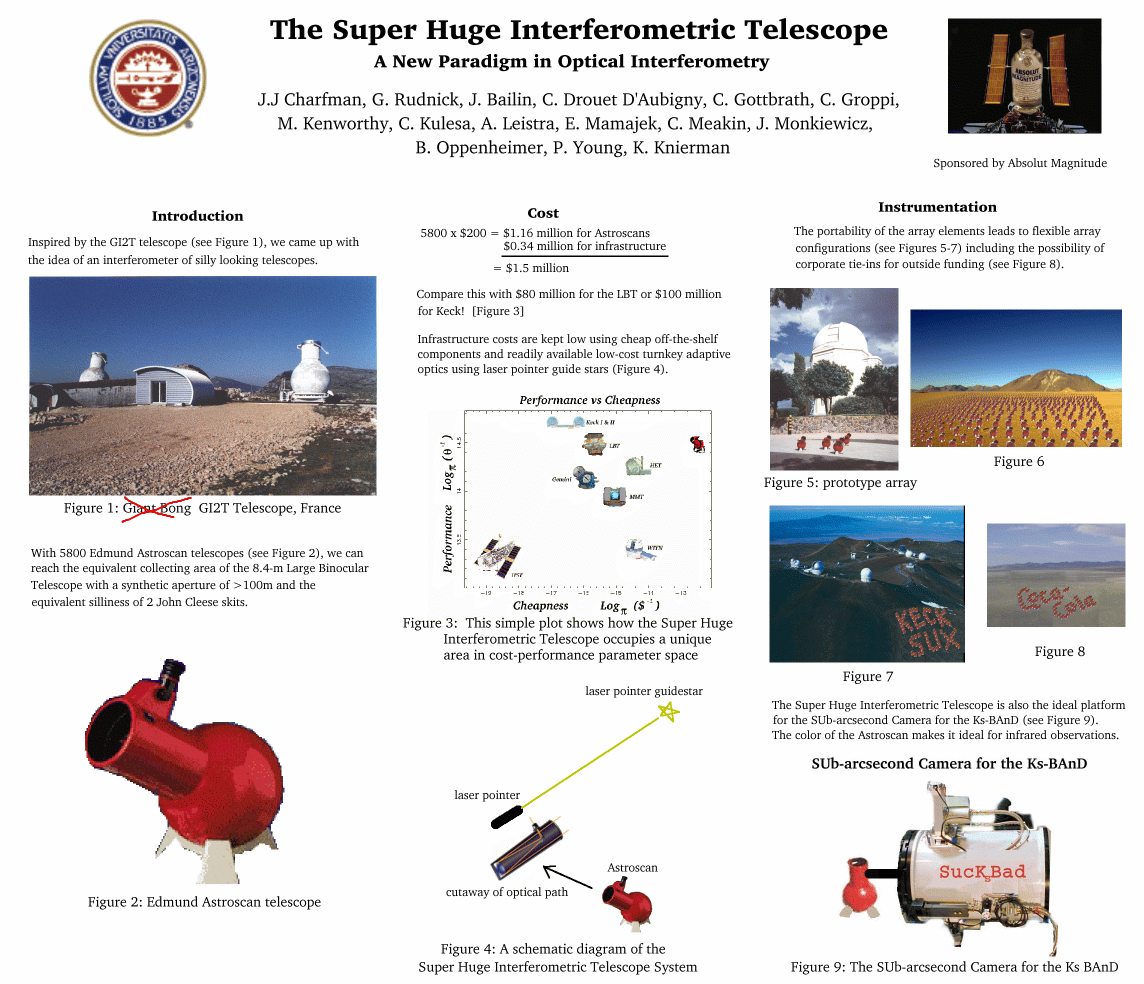
Re:BLTYes, that would have been nicer. In a hallway in the Steward Observatory office building, there was once a poster illustrating the proposed Super Huge Interferometric Telescope I think the poster was done by bored grad students.
We were NOT bored! Saved for posterity:
Hmmm. Actually... I guess we were bored...
http://loke.as.arizona.edu/~ckulesa/superhuge/poster-halfsize.gif
and there was a BLT too:
http://daffy.as.arizona.edu/gradplays/play2k/blt.jpg -
Re:BLTYes, that would have been nicer. In a hallway in the Steward Observatory office building, there was once a poster illustrating the proposed Super Huge Interferometric Telescope I think the poster was done by bored grad students.
We were NOT bored! Saved for posterity:
Hmmm. Actually... I guess we were bored...
http://loke.as.arizona.edu/~ckulesa/superhuge/poster-halfsize.gif
and there was a BLT too:
http://daffy.as.arizona.edu/gradplays/play2k/blt.jpg -
Links to hi-res images
Here are the links at which all the images taken by the HiRISE instrument can be found from low res to high res raw data :
http://mars.jpl.nasa.gov/mro/gallery/press/20080303a.html/
http://hirise.lpl.arizona.edu/PSP_007338_2640/
jdb2 -
Re:Obligatory
-
Mexicans
What right to Mexicans have to cross into our territory and undermine our values and freedoms
I'm going to reply as if you meant "what right do Mexicans". Fact is is many, maybe not all, Mexicans are of Native American Indian Tribe descent and their ancestors have been here a lot longer than any conquering Europeans. Some Indian tribes even have the right to cross the US Mexican border whenever they want. Such as the Tohono O'odham Nation and other Indian tribes. Actually the Tohono O'odham Nation straddles the US Mexican order with part in the US and part in Mexico. Though the tribes have the right to cross the border many are still being harassed.
Falcon -
Religion and Science are not incompatible
As opposed to the bridge to nowhere or the Woodstock memorial.
Bridges and memorials don't pose a challenge to religious dogma.
You seem philosophically akin to the ignorant bible thumper who takes the mistranslated English version of the bible literally in every way, you seem to merely be the mirror image that thinks science means anti-religion. The truth is that science and religion are compatible. The Vatican operates a telescope and funds research:
Dark Matter and Energy in the Cosmos
The Acceleration of the Universe
Quasars
Globular Clusters
A Supernova Discovery
http://clavius.as.arizona.edu/vo/R1024/Research.html
History is full of religious people who are also scientists. One example is psychics professor and atronomer, and Roman Catholic Priest, Georges Lemaître. The guy who proposed the big bang theory.
http://en.wikipedia.org/wiki/Georges_Lema%C3%AEtre
You should note that some scientists were closed minded and dismissed Lemaître's theory because he was a priest, not on merit. I guess for some science becomes a religion and their minds close. I prefer the approach of Hawking and other scientists throughout history, that scientists are exploring the mechanics of the universe and that proving/disproving the existence of God is outside of their work. -
Funny, I always thought it was a giant asteroid...
At first blush, the plague model makes me wonder about concurrent evolution. It's not really in the interest of any plague to actually kill its victims -- the virulent strains of bubonic plague, for example, are actually not very successful compared to influenza rhinovirus.
The giant asteroid model has some good things going for it, in particular the presence of charcoal fragments in and just above the K/T iridium layer in samples taken from many locations around the world. That seems to support the idea (advanced by Durda, Kring, et al. a few years ago) that heat of re-entry from the giant impact caused a worldwide holocaust (in the literal sense). The animal species that survived fit a pattern that they either could survive in deep water or could hide in holes.
Durda & Kring showed that a Chixculub-sized impact (and, more importantly, re-entry of fragments thrown up into space by the impact) would heat practically the entire outer atmosphere to incandescence for a few days. Under those conditions, the great outdoors would closely approximate the conditions in an electric oven set to "broil".
That seems more plausible than gradually killing them off over time -- I would think that after a few generations, the dinosaurs would become much more resistant and the bugs less virulent. -
Similar calibration for imaging sensors too...
I had a remote sensing professor at the University of Arizona that frequently took road trips with his students out to remote areas in Nevada to calibrate imaging sensors. For this, the absolute flatness isn't as important as the high reflectance of the dry lake beds they use. Here is more info.
-
Re:The gods must be crazy too
1) The Vatican is a sovereign state. You can support that proposal all you want, but just be aware that it's analogous to saying that you want to support a proposal to take all the profits and money that Denmark has accumulated and direct it to the recipient of your choice.
2) Take a look at the Vatican Observatory sometime. http://clavius.as.arizona.edu/vo/R1024/VO.html -
And the U.S. is collaborating ...
... , for instance at this place, where we have, as only one example of a high ranking AI-researcher, Dr. Feiyue Wang, Chinese Academy of Sciences (also advisor to the government), who does interesting research like, e.g. "Pedestrian Detection from a Moving Vehicle" (translate for yourself). I had this person on the radar earlier.
CC.