Slashdot Mirror
Domain: arxivblog.com
Stories and comments across the archive that link to arxivblog.com.
Comments · 20
-
Wavelength can't fit within the universe(?)
What does this statement mean?
At very small accelerations, the wavelengths become so large they can no longer fit in the observable universe. When this happens, inertia can take only certain whole-wavelength values and so jumps from one value to the next.
Reading the reference http://arxivblog.com/?p=207 didn't help me understand.
-
Re:Drake equation?
You want to read this paper: http://arxiv.org/pdf/0903.1628 (blog post about it: http://arxivblog.com/?p=1297)
He does an interesting discussion on how to narrow the search down, although its gets scifi-ish now and then.
-
WarningTo all Individual Investors:
Stock Market is a Poker Game played by these big companies.- The Capital Group Companies
- Fidelity Management & Research
- Barclays PLC
- Franklin Resources
- AXA
- JPMorgan Chase & Co
- Dimensional Fund Advisors
- Merrill Lynch & Co
- Wellington Management Company
- UBS
-
Re:Two perpendicular electric fields?
I haven't yet looked at the video, so I can't say for sure. I was speaking of the quote on this page: http://arxivblog.com/?p=401 which says, "At one point they divide their cell into nine smaller ones and the liquid in each cell rotates in exactly the same way."
The fact that the rotation goes one way and then another says that the rotational symmetry is broken spatially, and temporally, so *something* is not in steady-state (despite their claims). Something isn't consistent (it may just be an error in the slashdot submission -- heaven knows THAT's never happened before), especially as it says, "The puzzle is this: the electric fields are static, so what's driving the motor?". The paper at http://arxiv.org/abs/0902.3733 doesn't especially address it, and, in fact, a claim that _static_ fields (carrying no angular momentum) can lead to this sort of rotation stinks of kookiness. Either I'm missing something big (it's entirely possible) or this *really* needs to be looked into (as I suspect will happen).
-
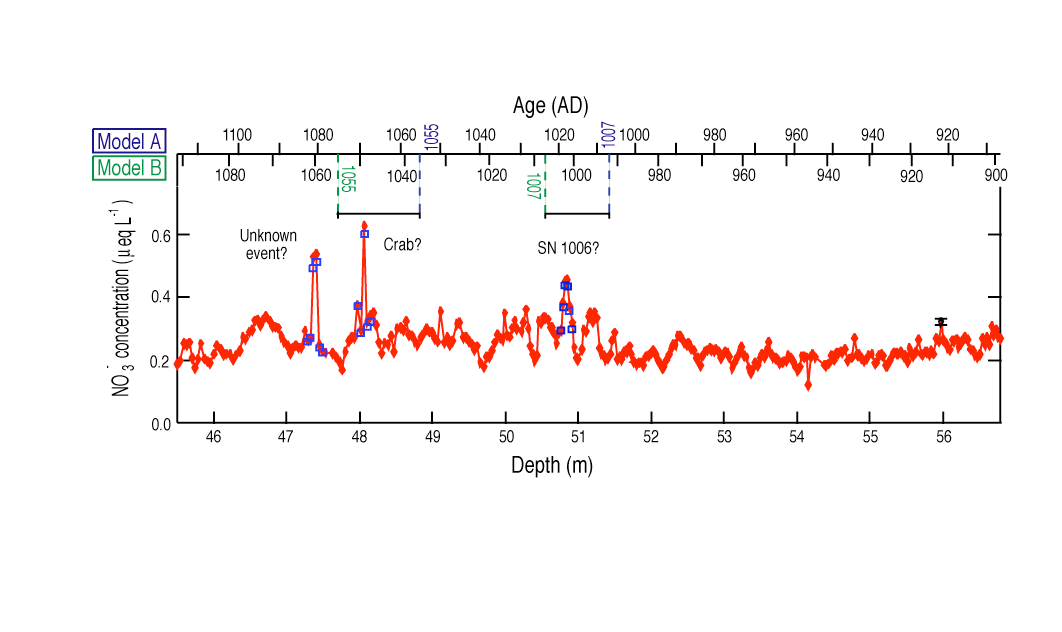
Model A/B
Look at the image in the article:
If these really are the supernovae, doesn't this mean that "model B" is right and "model A" is wrong?
-
Re:Talk about timing
Having read your post, it sounds like you'd be interested in this article on using networks to model power in markets I saw on arxivblog.
For me, the takeaway is that we are in an infantile stage when it comes to modeling real economic systems. The takeaway for Austrian School people is "you have no chance to survive. Make your time!"
-l
-
Re:Mistake in summary
Summary is also incorrect in another slight detail:
"So if there are only 200 advanced civilizations in our galaxy, the chances are that theyâ(TM)ll never notice each other."
That's a quote from TFA. (Link provided for those who are lazy to scroll up
-
Re:Questions for a physicist in this field
It is not clear wether antimatter reacts to gravity in the same way as matter does.
http://arxivblog.com/?p=450
The force of gravity on antimatter has never been directly measured but a growing number of physicists believe that such an experiment is within their grasp. Today, a group attempting to design an experiment called AEGIS (Antimatter Experiment: Gravity, Interferometry, Spectroscopy) outline their plans to measure this force.
In some ways itâ(TM)s an ambitious plan. The team wants to build AEGIS at CERN, the European particle physics laboratory near Geneva, where the building blocks of antihydrogen, low energy antiprotons and positrons, are in relatively good supply.
more in the paper about AEGIS -
I Am Forever in Debt to Arxiv
When I was a freshman at the University of Minnesota, a professor instructed us to use Arxiv as a resource (I think Citeseer was another but paled in comparison). A large part of my undergrad and grad school days were spent perusing Arxiv and sometimes implementing ideas I had read in the Computer Science section. My hard drive became strained by the sheer number of PDF/PS files in my user directory. My room was littered with papers printed off to read on the bus or at work. My base knowledge of computer science I owe to my professors, most of the things beyond that came from Arxiv.
I owe a lot of my knowledge to that site. Here's to another 50,000 papers, Arxiv. And another and another and another
Also, the Arxiv Physics blog is a regular favorite in my Liferea news feed account. -
Re:My eyebrows are raised
It's nothing like echolocation. First of all, echolocation is active scanning, vision is passive scanning (nobody can detect you're looking at them, however you can tell if someone's using echolocation). Echolocation is dependant upon 1 or 2 sensors, while vision needs thousands (and prefers millions) of sensors.
The calculations are explained in this link :
The article makes several good points. After minimal practice you are able to identify the location of the sun blindfolded.
A bit more practice and you can find people in closed rooms. Or behind you. This is trivially easy if the person behind you is really close, but with training you can increase the range quite a bit. It's impossibly to "feel" further than 2 or 3 meters or so, however, so while it beats our eyes in low light conditions at short ranges, it's not useful to see very far (the article explains this : it *is* possible to make skin vision work for very, very long distances, but the computational cost is off the scale).
Not only do we have skin vision, the article claims, but we use it often. To avoid staring into the sun for example, but also to detect hot objects before touching them.
Do an experiment. Heat up your stove. Hold your hand above it. It's quite clearly there isn't it ? Surely this must be the heated air rising, right ? (even though if you calculate how fast the heat transfers into your hand it doesn't quite make sense, and you don't actually feel air rise)
So now try the same with a pot. Try to identify if it's hot or cold, by just holding your hand close to it (don't touch it). You should, again, with a little concentration, be able to do this with 100% accuracy. Nevertheless, with a vertical surface, there is hardly any heated air coming to your hand, yet you're able to identify the heat from about the same distance.
We're not only able to see with our skin, but we see more than we see with our eyes. No amount of visual inspection with your eyes would tell you a cooking pot is hot or cold : the radiation that gives it away is outside of the spectrum of our eyes (this is due to the limitations of the lens "assembly"). Nevertheless clearly we can detect that radiation.
The theory goes that this is how eyes developed. Skin is sensitive at very short range, and can actually form images of very close objects. But even with the huge brain humans have it only works for at best a few meters.
However a dimpled piece of skin will see more, due to it's shape and will be able to focus further. Making that dimple moveable is an obvious next step.
From there it's a short step to what amounts to a pinhole camera.
Fill a pinhole camera that is round with a drop of water and you've got basic optics (that aren't very stable).
Put a transparent layer of skin above the droplet of water and you have reptile eyes, much, much more stable than the pinhole kind and not nearly as prone to infection.
Let the skin immediately above the hole in the skin grow a little bit and you've got mammal eyes. Add a muscle within that loose hanging skin and you've got human eyes.
-
Dupe from 3 weeks ago
Solar Systems Like Ours Are Likely To Be Rare
KentuckyFC writes
"Astronomers have discovered some 250 planetary systems beyond our own, many of them with curious properties. In particular, our theories of planet formation are challenged by 'hot Jupiters,' gas giants that orbit close to their parent stars. Current thinking is that gas giants can only form far away from stars because gas and dust simply gets blown away from the inner regions. Now astronomers have used computer simulations of the way planetary systems form to understand what is going on (abstract). It looks as if gas giants often form a long way from stars and then migrate inwards. That has implications for us: a migrating gas giant sweeps away all in its path, including rocky planets in the habitable zone. And that means that solar systems like ours are likely to be rare." -
Re:Everything she touches, / Changes.
Doesn't look like a "woosh". I guess the GP is simply talking about another factor (but didn't care to give a frame of reference). Anyway, I'd ignore any aether based jokes.
I also tought about the Milkway's core after I readed somebody talking about dark matter, but this graph (from another previous poster) shows peak activity after the aphelion, not before it.
-
Re:But the data is awful
But... look at the data. That correlation is *terrible*. The phase is off.
Also, note that since the perihelion is right around Jan 1, only about eleven days after solstace-- this data equally well correlates with season.
It seems like it's affected by the angle of incident solar radiation.
-
Synchronized to r^2, not r
This graph seems to indicate that the correlation is between the decay rate and the radius of Earth's orbit squared, not just r.
Could it be that the correlation between decay rates is with Earth's orbital velocity, acceleration, or dTheta/dT (rate of change of the Earth/Sun vector due to Earth's elliptical orbit)?
Additionally, there seems to be a phase shift between peak r^2 and peak decay rates with the decay rate peak seemingly correlated with our peak acceleration toward the sun.
-
But the data is awfulBut... look at the data. That correlation is *terrible*. The phase is off.
Also, note that since the perihelion is right around Jan 1, only about eleven days after solstace-- this data equally well correlates with season.
-
Re:Huh.
I can believe time travel before I believe faster than light travel.
We are, actually, much closer to FTL travel than we are to time travel. You can't travel faster than light through the fabric of spacetime, but, as we all know, that fabric isn't flat. If you can change the shape (as large objects do), then you can effectively get from point A to point B faster than light could by taking the normal route. See:
http://arxivblog.com/?p=523 or
http://blog.wired.com/wiredscience/2007/12/physicists-do-t.htmlIt's completely theoretical, and requires extra dimensions, and we have no chance of doing anything with it any time soon. But, that's farther than we are with time travel.
-
15000!
Are they nuts?
That android:
http://arxivblog.com/wp-content/uploads/2008/07/nao.jpgIs not nearly hot enough for that price!
This is what we want:
http://www.universeguide.com/Pictures/RommieFace.jpg -
Re:Okay then, what's the point?Well, it might not be that useless, if their goal was to go after individuals.
But I think the bigger prize here is getting their grubby paws on more accurate viewing figures than could ever be achieved by something like Nielson. That, after all, is why advertising $$$ continues to flow online -- a trend which (hopefully sooner rather than later) will wipe Viacom and all the rest of the old-media dinosaurs out.
-
Re:overreaching /. summary
Are you trying to say the circle photographs they took aren't high res enough? I thought I could tell plenty about the virus. It's circular and its composed of mostly 1 color...
-
Re:Where will you be in 20 years?
You might need to know some quantum physics if your gonna program 20yrs from now: http://arxivblog.com/?p=354