Slashdot Mirror
Domain: aspell.net
Stories and comments across the archive that link to aspell.net.
Comments · 9
-
Re:Evolution actually working?
Why would it need to when there are perfectly good, widely used, third party spell checkers available (aspell)? Tell me, exactly, what the point would be in integrating it with a desktop environment, where this functionality is clearly not specific to that environment (many console programs use spell checking as well), other than to bloat that environment.
-
Re:I'm sorry but no
-
Re:aspell?
It is quite possible to make a set of rules for aspell that make it blind to a given programming language. Such things have already been done for applications like TeX/LaTeX, HTML, etc. Indeed, the work is quite trivial. Please post to the aspell-devel mailing list, ( see http://aspell.net/ ) and maybe volunteer to do some of the setup work for your favourite programming language.
-
Re:Maybe its just me but...
Wasn't this sort of stuff available in Linux years ago?
Exactly this capability has been present in windows for quite a few years now. (Back to 3.1 even?)
You can assign a keyboard shortcut to any windows shortcut. Alt-Tab switches between active applications.
I always find it comical when someone tries to sell a software product that is completely redundant. Yet this stuff keep selling, I guess there must be enough suckers out there who don't know their operating system very well.
Granted there is no spell checking native to the windows OS itself, but GNU Aspell (Win32) has worked fine for me for a number of years now. -
Sponsor someone to write an Aspell interface
-
Re:Encryption
Already ahead of you.
Quote:
"GNU Aspell is a Free and Open Source spell checker designed to eventually replace Ispell." -
Three things that make vi even better
-
Re:Do we really need another 3D suit?It's "suite," asshole. You could at least make sure you got the word right before you use it 6 times.
No one asked you what was noble and what wasn't. If you know the slightest thing about programming you'd be aware that you don't start writing something beat what's already been made, you start by writing something, and then you add to it, and as your knowledge increases you can take on more and more complex or difficult tasks. At this moment, there is no open source 3D modeller/renderer/kitchen sink which these guys can go to and learn how to do these complex things. The algorithms used by these complicated applications are all but unknown to the community; the proprietary ones certainly aren't published in books, and even if they were it would take a great deal of skill to "get inside" them, figure out how they work, etc.
We have to start at the beginning.
Did you use the Gimp three years ago? I tell you it wasn't a "photoshop-alike" then. We have to start somewhere and then move up. There are programs we have in free software that are so advanced, there's no analog for them in closed-source. For example, the RADIANCE renderer is the only one that does light accurately, and it has been free for ages and will become open source in December. Aspell uses a new algorithm that beats every other spell checker. At its inception, would you have said we shouldn't invest this time and effort into another spell checker?
The problem is that people like you look at open source development like closed source development. As though when a project is formed, some segment of the total number of developers have to be allocated to it. Fortunately, the way it really works is developers work on whatever they are attracted to. Even huge projects like Mozilla have at the core less than 20 developers. I haven't checked, but I would guess that these 3D projects will have 2-4 core developers. Everyone else will contribute from time to time, or possibly even just once. But the people who work on Moonlight are not people who necessarily would have worked on Blender. They are not even necessarily people who would have developed for anything at all.
What does a professional setting have to do with whether or not something should be developed? Take enlightenment for example. I bet many people said, this is a window manager which will never be used in a professional setting. And yet I know several sysadmins who have used enlightenment as their window manager! It's like science, we don't research the things we think are going to bring about "useful" discoveries, because that's counter-productive and we never know which research will result in useful discoveries. Instead, we just generate all of the software we'd like to generate, and some of it will get used, and some will not. AWK is a good counter example; it was developed for a particular purpose for which it is extremely useful (parsing text files with very uniform structure). And yet, it has fallen by the wayside because Perl can do essentially the same things, but is a more powerful programming language in general.
To summarize:
- Yes, we do need another <insert software-type here>.
- No, it doesn't matter what the software is. You think every window manager should be like TWM?
- People will develop what they want to develop, regardless of whether or not YOU think it is prudent or a good use of "resources" (ie. people besides you).
- Start at the beginning, and work your way up. RMS stated that the GNU system would encompass everything from a shell to a spreadsheet. Linus just wanted a kernel. Which one has been useful the longest? Don't bite off more than you can chew.
- Professional != Better (necessarily).
--
Daniel -
Re:A meta-question.GUI-based spellcheckers come to mind
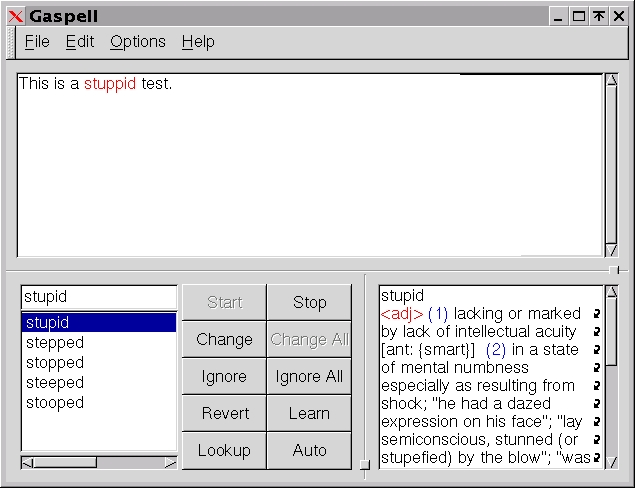
Who wants a GUI-based spellchecker (other than one built into a word processor)? If you really do, there's gaspell.