Slashdot Mirror
Domain: aviation-history.com
Stories and comments across the archive that link to aviation-history.com.
Comments · 30
-
Re:And where are all the hurricanes?
What are you talking about? The British had the Hurricanes and they didn't attack us.
-
Re:Who?
3 seconds later on Google:
http://www.aviation-history.com/airmen/alcock.htm
Captain John Alcock and Lieutenant Arthur Whitten Brown, in a modified Vimy IV, made the first non-stop aerial crossing of the Atlantic. They took off from Lester's Field, near St. Johns, Newfoundland on June 14,1919, and landed June 15,1919, at Clifden in Ireland. The time for the crossing was sixteen hours, twenty-seven minutes.
The news of the adventure spead like wildfire and the two men were received as heroes in London. For their accomplishment, they were presented with Lord Northcliffe's Daily Mail prize of £10,000 by Winston Churchill, who was then Britain's Secretary of State. A few days later, both men were knighted at Buckingham Palace by King George V, for recognition of their pioneering achievment. -
Re:Or fission
Reference? Airliners where forced to always fly IFR after a collision between two airliners over the Grand Canyon. http://en.wikipedia.org/wiki/1956_Grand_Canyon_mid-air_collision#Catalyst_for_change
The NB-36 test plane only flew between 1955 and 1957. Since the Grand Canyon crash happened right in the middle of the test flights I would say that the rules couldn't have been put into place for the test flights. Also the NB-36 always flew with chase planes to warn the pilots about anything that in the area and as you can see from this picture http://www.aviation-history.com/articles/nuke-american.htm the NB-36 did have a windscreen. Also the reactor was at the back of the plane so there would not need to be much shielding in windscreen area if any at all. -
Re:A-380 halfway there
I'm going to guess, however, that if it actually IS done, that it will be some variation of a Rutan Long-EZ, since they are widely known/touted as "the plane" for high-efficiency experimental-class aircraft.
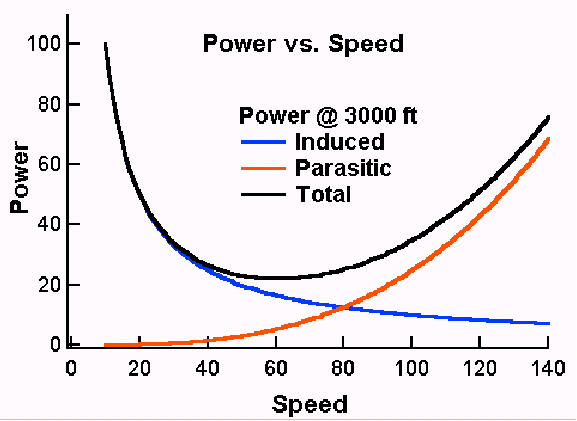
Wikipedia says that a Long-EZ will do 1600 miles on 52 gallons of fuel. That's 61.5 passenger miles per gallon. It also typically cruises at 184mph - parasitic drag will be 3.39 times less at 100mph, but induced drag will be 3.39 times greater. I am unable to find a chart of both for a Long-EZ (here is a generic one), but 100mph probably isn't that far off from the minimum drag speed.
I suspect it'll be some variation of a motorglider - probably one that seats at least two. They have much higher aspect ratio wings, much lower sink rates, and would probably have much lower drag at 100mph.
The Voyager around-the-world aircraft (another Rutan creation) did only 41 passenger miles per gallon (averaged across the entire flight), but they were hauling 9000 lbs of fuel towards the start (53 passengers worth). I suspect it could win the challenge right now - but it'd make a lot more sense to build a different one than to unhook it from the Smithsonian ceiling.
-
Re:2 seconds of research reveals...
F-15, B-58, F-14 were all Mach 2.2+. The B-58 Hustler, http://www.aviation-history.com/convair/b58.html, was a bomber active in the late 1950s.
Only the F-15 is still in active service today. -
this kind of existed..... blimp-helicopter hybrid
Piasecki Aircraft in PA had something like this in the 80s. http://www.piasecki.com/pa-97.htm
it was intended for heavy lifting. a blimp with 4 helicopters on outriggers. the company has building helicopters as long as they have existed, so if the last 20 years did not make that one pan out, it makes you wonder if there is enough need that people/government would invest in them? i am sure there are times somebody wishes they had something with that amazing lifting power (like to transport godzilla). you figure you can do some amazing moving with a Sikorsky Skycrane http://www.aviation-history.com/sikorsky/s64.htm -
Re:What a strange comparison
Cessna 152 Specs:
Vne (never exceed) 145 knots = 166.86302 mph
Vno (normal operating) 105 knots = 120.831842 mph
The Cessna 152 is representative of a basic entry level aircraft that travels (cruise/normal operation) at about 51% of the Bullet Train's reported speed on a calm day.
232 mph = 201.602488 knots
So an airplane needs to break 201 knots to be considered "faster than the Bullet plane".
This plane is far from being "entry" level... but comes close to the same speed. It only has space for four passengers. It is a single engine plane.
This plane is two engine and fast, but I'm not sure how many passengers it can carry.
The GeeBee R-2 is an exceptionaly fast prop aircraft. 296mph flat-out top speed.
The P-51 Mustang is well known as a fast prop aircraft. I don't know if many modern props are made to go this fast today.
I just wanted to follow up the pp and talk about the speeds of planes. The speed of this train is attainable to the more serious (and speed minded) of private aviators. Most private aviators are more motivated by fun or ease of use.
For some "fun" is fast. For others it is being able to pack the whole family down to a grass-strip by the beach. For others it is neat tricks or an open cockpit. Depends on the pilot.
In the US a private pilot can pretty much exclusively choose his own spots to land as long as his plane can land at the smaller strips. Almost every town (even if you don't know it) has either a Municipal airport or a small grass strip. You'd be suprised at the size of a plane (that Mooney for instance, it may be able to) that can land at some of these places. This is the advantage in either smaller or slower aircraft (or at least aircraft that can slow for a slower landing).
Take a favorite of mine The Piper Cub for example. One of these can land on what amounts to a postage stamp, getting in and out of tight bush locations. Also reliable and solid. They have a short range and slow speed, but high utility out in the middle of nowhere. They're also very docile.
In any case... planes are for the win! I'm not too sure about trains. You certainly can't hire one for yourself easily or buy one. -
Re:From the same company...
How about Mitsubishi Rockets, from the folks that brought you the Zero.
-
Re:Manned spaceflight?
Is this reliance on a back-up plan not just another example of a lot of Western society becoming increasingly risk-averse?
During an age of exploration, deaths were treated as a hazard of the job - Amelia Earheart's disappearance did not stop the aviation industry from developing. If the same thing happened today, there would be public outcry about how to make {fill in transportation mode} "safer" (= find someone to blame when things go wrong)
Keeping with the aviation parallels, Lindbergh would probably not have been allowed to take off today - single engine, no radio, no forward visibility and so on - and yet he is (rightly) credited with pulling off an amazing feat*, rather than "doing something foolhardy and dangerous"
* being picky, the amazing part was landing at his chosen destination (Paris), rather than flying non-stop across the Atlantic, as that had already been done back in 1919 by Alcock & Brown. Or that he did it solo. -
Light aircraft?I assume this is for (small) light aircraft, as anything bigger than a sopwith camel either
- Flys above clouds (if present)
- Doesn't have a flight deck pointing towards the ground (granted they bank, light refects and low angle beams)
- Doesn't hang around if one place long enough for any ground based beam to hit someone eye for more than fractions of a second, so it doesn't matter (unless your talking about one of these)
-
See something like this before!
My dad used to be part of the Woodwings Flying Circus, and would usually perform on Plumpton Racecourse (UK). One of the guys there, Keith is his name built and flew one of these. Truely a marvious machine indeed! -- Sadly it was incapable of cutting the grass at the same time.
It rolled, looped, even capable of doing stall turns, wing-overs and inverted flight.
Basically all it is, is a aerofoil wing. The handle is used as the tail fin to keep the craft stable enough to fly. Trouble is it needs to be flown on full throttle pretty much most of the time to keep it airbourne and to keep the nose up. This would be achived by ajusting the thrust from the engine by a few degrees and by bringing the CG (Centre of gravity) forward.
The main control for this craft would be elevon's.
Just some info to explain what an elevon is...
(Taken from http://www.aviation-history.com/theory/elevon.htm)
"The elevon is used as an aileron. Ailerons control motion along the longitudinal axis. The longitudinal axis is an imaginary line that runs from the nose to the tail. Motion about the longitudinal axis is called roll.
The elevon is also used as an elevator. Elevators control motion along the lateral axis. The lateral axis is an imaginary line that extends crosswise, from wingtip to wingtip. Motion about the lateral axis is called pitch."
Anyway, I'm into R/C aircraft and might have to get one of these for myself! I've got a 60-size 2-stroke engine doing nowt at the moment!
-
Re:Is this supposed to be a new form of mass trans
I rather think Alcock and Brown http://www.aviation-history.com/airmen/alcock.htm were ahead of Lindbergh, although his solo effort was a no less remarkable achievement.
-
SCRamjet = Supersonic Combustion RamjetSo what's a Ramjet?
There's one fundamental difference between an ordinary jet engine and a scram jet engine: The Ramjet has no moving parts.
The all jet engines,operate according to Newton's Third Law of Motion:
For every action, there's an equal opposite reactionThe standard jet engine, invented by Sir Frank Whittle, sucks in air at the front. Then this air is mixed with fuel, and made to combust. The combustion causes the air to exit the engine at a velocity greater than when it came in, thus creating thrust. The escaping air causes the turbine to spin, and this intern activates the compressor, sucking more air in.
The Ramjet has no turbine and compressor unit. Ramjets fly supersonically and have an inlet which injests subsonic air after it goes through a shock wave in front of the inlet. The intake is slowed down aerodynamically, and then mixed with fuel and made to combust. But after about Mach 5, ramjets don't work so well.
The scramjet is almost but not quite entirely like a ramjet. The only difference being in a scramjet the combustion takes place as the air is travelling through the chamber at supersonic velocities.
More about the scram jet. Or another more concise explanation.
Moderate this comment
Negative: Offtopic Flamebait Troll Redundant
Positive: Insightful Interesting Informative Funny -
Re:Ramjet != Scramjet
http://www.aviation-history.com/engines/ramjet.ht
m
No they aren't equal, but they are damn similar. -
What is a scramjet?
For those who want to know what a scramjet is, and how it works, check this page.
A ramjet has no moving parts and achieves compression of intake air by the forward speed of the air vehicle. Air entering the intake of a supersonic aircraft is slowed by aerodynamic diffusion created by the inlet and diffuser to velocities comparable to those in a turbojet augmentor. The expansion of hot gases after fuel injection and combustion accelerates the exhaust air to a velocity higher than that at the inlet and creates positive push.
Scramjet is an acronym for Supersonic Combustion Ramjet. The scramjet differs from the ramjet in that combustion takes place at supersonic air velocities through the engine. It is mechanically simple, but vastly more complex aerodynamically than a jet engine. Hydrogen is normally the fuel used.
This is all very different from conventional airliner engines, which are a gas turbine/fan nacelle called a "turbofan". (A "turboprop" is a gas turbine driving a propeller instead of a fan, BTW.)
-
I think I figured it out...
Snoopy's Sopwith Camel doesn't look like it is set up well enough to survive re-entry.
-
Re:Uh, Submarine?
Wonder if this is how the Supermarine company - makers of the Supermarine Spitfire - got their name.
-
Technical Schematics
Technical schematics and documentation can be found here.
-
Re:Wright Flyer vs Flying Saucer.
> had used lift tables on their early gliders that had been made 30 years before by a German man
That "German man" was Otto Lilienthal, hardly an obscure figure. In fact, many consider him at least as important as the Wrights, since he pioneered controllable heavier-than-air flight and made further pursuits into and consideration of flight even acceptable. And he did it all alone. -
Re:50 years from now...
I did a quick Google on the first time humans passed the "sound barrier" in 1947. 50 years later, every school kid knows^W should know Chuck Yeager's name
Please correct the above.
Not to take anything away from Chuck Yeager, who did a terrible dangerous thing, but in 1997 the US Air Force has admitted that George Welch broke the sound barrier twice in the XP-86 (the test version of the Sabre, which was a front line fighter through the 1950's and early 60's).
Although ordered not to enter supersonic trials until Bell's project was complete, he purposly dove his plane on October 1st, 1947, and again 15 minutes before Yeagers flight on October 15th, 1947. He later died testing the YF-100 in 1954.
This is why Yeager's record has changed from "The first man to break the sound barrier" to "The first man to break the sound barrier in level flight", but they still try to avoid mentioning George Welch.
This is also why you shouldn't always trust Google. Check again, but this time for his name and you'll find a lot of articles that mention this. He was also involved in another famous aviation act, as he was one of the few pilots who took off from Pearl Harbour to attack the incoming Japanese air raid, and you'll find that he is also widely discussed as one of the few people who should have been ordered the Congressional Medal of Honor twice.
Click Here for information on his actions at Pearl Harbour
Click Here for information about him breaking the sound barrier -
Re:This is what's needed
The problem is that most of the teams are using rocket based technology. If you look at the development costs for the Gemini and Apollo space programs they were astronomical. ScramJet is a new promising technology. Hopefully these companies will see this and thats the only way space travel will enter the public sector.
-
Re:A ridiculous concept from the startTo appreciate the test you have to have a basic understanding of what the scramjet does.
I agree completely. So why do you then tell us the following? You have been misled, my friend.
A scramjet seperates the hydrogen and oxygen molecules in the atmosphere and uses the hydrogen molecules as fuel for the engine. In doing this you have an engine that can go significantly faster, an engine that uses up a fraction of the fuel load of traditional aircraft and an aircraft that expels significantly less harmful waste in the atmosphere then a traditional jet engine.
Quick primer on scramjets, from the top:
In a typical jet engine (see here, for example) air enters through an intake at the front, and passes through several fan stages to compress (and heat) the incoming air. Squirt fuel into this hot air, and the rapid combustion generates exhaust at high temperature and pressure. This high pressure exhaust propels the jet (and drives a turbine which turns the fans in the compressor).
The downside of this design is that it is mechanically complex--those compression stages have large, finely-machined, rapidly-moving parts which are subject to wear, tear, and accidental failure; they also add a significant amount of weight to the engine.
Enter the ramjet. (See also cutaway figure.) Instead of using fans to compress incoming air, a ramjet uses a specially shaped inlet. Air enters the jet inlet at high speed, and then is forced through a narrow aperture. The result is compression without fans. Unfortunately, the ramjet will only work when the jet is travelling at significant speed--there isn't going to be any air coming into the engine if the aircraft isn't moving.
A scramjet is a supersonic combustion ramjet. In a plain vanilla ramjet, the incoming air is slowed while it is compressed to the point where it is travelling slower than sound. Combustion takes place in air that is still moving quite quickly, but not supersonically. Although easier to manage from an engineering standpoint, requiring subsonic combustion places an upper limit on the speed of a conventional ramjet.
The scramjet functions in a similar manner--incoming air is compressed and heated through a properly shaped inlet, then fuel is injected, and the combustion products propel the jet. The defining difference is that combustion takes place in a supersonic airflow; in practice, this dictates certain changes to the basic ramjet design. Again, the scramjet requires significant airspeed before it can be started.
Quite correctly, you note that the fuel for these beasts is often hydrogen, though in principle nearly any air-combustible liquid or gas could be used. The fuel must be supplied, however--a scramjet cannot extract hydrogen from ambient water vapour. The hydrogen scramjet is inherently no cleaner burning than any other air-breathing hydrogen engine. Given its high operating temperature, I would be quite surprised if it didn't generate significant nitrogen oxides in operation.
-
Re:"Standing on the shoulders of giants"Saying it took off after the Wright Brothers seems to me a bit arbitrary. Have a look at that (simple) timeline:
1783 Montgolfier Brothers France
1849 George Cayley England
1871 Louis P. Mouillard "L'Empire de l'Air"
1878 Alphonse Penaud "Recherches sur la Resistance de l'Air"
1889 Otto Lilienthal "Birdflight as the Basis for Aviation"
1896 Otto Lilienthal dies
1896 Samuel P. Langley USA
1902 Frost Ornithopter England
1903 Wright Brothers USA
1906 Santos Dumont France/Brazil
1908 Glenn H. Curtiss
1908 Samual F Cody England
source, another source
Note, that the year of Lilienthal's death is also (not coincidentally) the last of his more than 2,000 flights (or glides, if you prefer). Interestingly, in the same year he had completed the construction of a powered glider (compressed CO2).
To quote different source about the Wright Brothers
Following in Lilienthal's footsteps, efforts to invent an airplane became commonplace in the 1890's. The majority of the efforts were in Europe, including Captain F. Ferber, Henri Robart, Solirene, Levavasseur, Clement Ader, Percy Pilcher, and Sir Hiram Maxim. In the U.S., prominent attempts were made by Octave Chanute and Samuel Pierpont Langley.
Wilbur Wright wrote in 1912 that "no one else grasped the basics of human flight as clearly and throughly as he did".
And I guess, they were not the only ones influenced by his writings.
-
Re:For those of you too lazy...
Don't forget Otto Lilienthal, who is considered the father of gliding. He did lots of experiments with a sort of hangglider in Germany, some 10 years before the Wright Bro's.
-
Re:Just a question:
remember, google.com is your best friend.
scramjet -
Re:Just a question:What's the difference between a normal jet engine and a scramjet?
Almost everything. Normal jet engines have lots of moving parts - turbines, compressors, etc. Ramjets and scramjets don't have any moving parts. They also require very high velocities to work properly, whereas a turbojet/turbofan is quite happy running all day long without moving.
-
A little more info
A diagram of the difference in design between a ramjet and a scramjet engine can be found here.
For more information, check out the HyShot homepage. -
Re:Aileron Roll????
The correct aeronautical term is "longitudinal axis". Take it from a former freight dog. Or better yet just look at this
-
Scramjet factsThese articles were light on facts, weren't they? Are they worried people are going to try repeating this at home, with parts scrounged from auto stores??
A bit of Googling revealed the following:
From The Ramjet/Scramjet Engine:
- a scramjet is a kind of ramjet
- "A ramjet has no moving parts and achieves compression of intake air by the forward speed of the air vehicle. Air entering the intake of a supersonic aircraft is slowed by aerodynamic diffusion created by the inlet and diffuser to velocities comparable to those in a turbojet augmentor. The expansion of hot gases after fuel injection and combustion accelerates the exhaust air to a velocity higher than that at the inlet and creates positive push."
- "Scramjet is an acronym for Supersonic Combustion Ramjet. The scramjet differs from the ramjet in that combustion takes place at supersonic air velocities through the engine. It is mechanically simple, but vastly more complex aerodynamically than a jet engine. Hydrogen is normally the fuel used."
Finally, here's Scientific American article that gives a bit more technical detail.
-
Re:Mach 2.1 the record? - NOT
Actually, the SR71 uses a hybrid turbojet/ramjet engine. At low speeds the engine acts like a standard turbojet; as speeds rise the engine begins to act more like a ramjet. Here is some good info and pictures.
Here are a couple good pictures of ramjet and scramjet engines. A scramjet is just a form of ramjet that only works above mach 1.