Slashdot Mirror
Domain: beyondveg.com
Stories and comments across the archive that link to beyondveg.com.
Comments · 13
-
Re: Yes
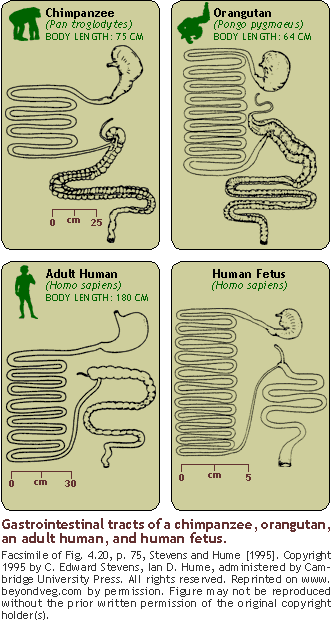
Here's the morphology of chimp, orang and human.
According to your hypotheses, chimps are greater consumers of meat than we are. This is not the case. -
Re:"Paleolithic diets" now vs then
Also, people during that age were not especially healthy. They probably died in their 40s.
Wrong. Half of them died young (typically before the age of 5) and the rest lived to their 60s and 70s, sometimes even older. Reconstructed modal age for primitive hunter-gatherers is 62 to 64 years of age.
There is a marked reduction in average size, and sudden appearance of generalized tooth decay, traces from infectious diseases and formerly absent bone deformities in our record of skeletons from the paleolithic to neolithic transition. Granted, the infectious disease became more widespread because of the growing densities of populations at the time, but the rest has been determined to come from the evolution of the diet. There is also a reduction of serious injuries observed, because less hunting decreased the exposition to dangerous predators and hunting accidents.
As for life expectancy, it decreased slightly with the agricultural revolution until circa 2000 BC, at which point advances in hygiene, sanitation, productivity and trade compensated for the difference. And we only now have caught up the loss in average height. There has been evidence of an adaptation to agricultural diets over time, but its effect is still small in terms of life expectancy.
-
Re:Is it working?
The fact is most Americans are fat and a large number of those are obese, most on a 65-85% carb diet, so I'd rethink my idea about what works. I think you don't grasp the fact that even 100K years is not a lot of time evolutionarily speaking (for 90% of that 100K years grains were a very minor part of the diet). With grain eating comes tooth decay, heart disease, obesity, etc, and no wonder, grains are a sugar, nothing more, nothing less. They may come with a bit of fiber and some vitamins but grains are by no means essential. I am clearly not going to convince you since your mind is already made up. There is plenty of evidence about what our diet consisted of and by and large it didn't consist of grains, largely because they aren't a good source of calories. Much easier to get needed calories from the flesh of animals. Here's a link for you, read its contents and get back to me if you don't mind. Feel free to compose a web page arguing against it point by point if you feel up to it.
http://www.beyondveg.com/cordain-l/grains-leg/grains-legumes-1a.shtml -
Re:Overcoming Duckspeak
Maybe that is not the best study in the world, but you seem to me to be ignoring the context here. I was originally responding to a comment that included stuff on asthma, allergies, and fibromyalgia. The page I am citing and the references covers many allergies, and fibromyalgia in that context (fibromyalgia in practice perhaps often being a catch-all phrase for joint pain which can have multiple causes). Also, you are just out of hand dismissing an MD's report on his own decades of clinical experience. And that experience is also reflected by reports by others, if you look around. It is just not extremely profitable or easy advice to give in this society, compared to pill pushing and surgery selling.
By the way:
"The relation between vitamin D deficiency and fibromyalgia syndrome in women"
http://www.ncbi.nlm.nih.gov/pubmed/21894355And:
"5 Ways To Control Fibromyalgia With Diet: New research shows that picking these foods may ease pain"
http://www.prevention.com/node/27278
http://www.prevention.com/health/health-concerns/5-ways-control-fibromyalgia-diet/5-veg-out
"Some researchers speculate that oxidative stress may be a cause of fibro symptoms. Oxidative stress occurs when the body doesnâ(TM)t produce enough antioxidants to battle cell-damaging free radicals in the body. Most fruits and veggies are packed with important antioxidants, like vitamins A, C, and E, which fight free radicals to keep your body normalized. Certain studies also show a raw, vegan diet can improve symptoms, but thatâ(TM)s difficult for most people to follow. If you do choose to eat meat, though, opt for a small portion of grass-fed beef. "It is an excellent source of iron and vitamin B12, both nutrients which are extremely important in keeping your pain-processing nervous system healthy," says Holton."Of course, they don't cite their studies; some other studies are mentioned here:
http://www.beyondveg.com/cat/links-out/raw-research.shtmlSo, be skeptical of new information. But how about being skeptical about old information, too? And maybe going a bit further and looking around for yourself at a new idea (or an old one that was forgotten or driven out socially)? It's not very scientific to just dismiss all new ideas for lack of enough evidence (for example, what kept us from LENR (Cold Fusion) for two decades because some hot fusion scientists at MIT could not replicate an experiment in a week or two where success would have jeopardized their own livelihood.
http://en.wikipedia.org/wiki/Pseudoskepticism
http://psychology.wikia.com/wiki/Pathological_skepticism
http://pesn.com/2011/12/27/9601994_History_of_MITs_Blatant_Suppression_of_Cold_Fusion/The scientific enterprise in our society is so messed up in so many ways, as reflected in the quotes I collected here; one example:
http://www.pdfernhout.net/to-james-randi-on-skepticism-about-mainstream-science.html#Some_quotes_on_social_problems_in_science
"In the laboratory, Latour and Woolgar observed that a typical experiment produces only inconclusive data that is attributed to failure of the apparatus or experimental method, and that a large part of scientific training involves learning how to make the subjective decision of what data to keep and what data to throw out. To an untrained outsider, Latour and Woolgar argued the entire process resembles not an unbiased searc -
Re:he was giving out business cards....
I'd say this is more of a grey area. I'm guessing that the card-bearing person did not assert he is a professional anything and is certainly not asking for any money in any form at all.
Having skimmed the article myself, I can see why the blogger was pretty upset. Carbs are horribly bad for the organs associated with diabetic disordered. This is especially true in the case of processed starches and grains. Evolutionarily speaking, the ability to eat grains at all is an extremely recent development where chimpanzees, our nearest related species, lacks the enzyme we developed while learning to survive in other environments. The real problem with the carbo-diets and diabetes is that these starches turn into sugar almost immediately resulting in reactions quite similar to consuming too much sugar in a more raw form. The idea of telling people they should eat starches while battling a diabetic condition is... well, shocking.
"Low fat" has little to do with the diabetic condition as fats aren't consumed the same ways as other foods. I think it's important to distinguish the difference between fruits/vegetables and grains. They are as different as fruits/vegetables and trees. We know humans can't eat trees and we know why. Humans can eat grains, but it's not "easy" for the human body to do so when compared to fruits/vegetables.
This article pretty much spells out what I understand about the business of carbs and fat and all that. (So before you call me a quack, go read this sensible, main-stream article on the subject.) The short of it is this: Low-fat is good... low-carb is good. "No carb" is bad.
Sugars and substances like high fructose corn syrup are really bad. But things that turn into sugars are ALSO bad and people simply don't hear this information. They think of grains and food from processed grains are "vegetables" and don't really understand what a problem it actually is. So I feel for this discriminated blogger in that conventional nutritional messages are quite often wrong and even dangerous.
It's interesting that the food industry is doing everything it can to push grains for human consumption. It's also of interesting note that the adaptation in humans which enable the consumption of grains probably saved humans from becoming extinct and certainly enabled the spread of the species across the planet. So I'm kind of torn on the topic of grains... on one hand, it's bad... on the other hand, it probably enabled human survival.
-
Re:How is that different from simply old age?
If you go look at my original post, I was actually just pointing out that a man's age contributes to birth defects just as a woman's does. I was willing to be drawn into this aside, though, because it's a fascinating topic.
In my reading, modern scholarship indicates that ancient people mostly died in their thirties, though some - mainly the very wealthy - did live what we would consider "full" lives. I am more inclined to believe the forensics than ancient record keeping; it is the latter that tends to present evidence of "old ancient people."
It's a controversial area, which does not even touch upon the idea of an evolutionary - that is a biological - impact on the species.
Here are some links I came up with (representing an array of reasonable views):
Tables of ancient life expectancies, with sources.
Review of studies finding "old ancient people."
An archaeologist's blog post discussing this issue.
Roy. Soc. Med. paper finding "old ancient people".
The wiki entry, with lots of information and sources.
A PNAS paper which actually discusses population ratios - very interesting. -
Re:medicine about to undergo profound paradigm shi
Research may be about to undergo a paradigm shift, but new, actual treatments, seem to run many years behind, if they see the light of day at all.
I'll grant you this point, but it's probably for the better. Would you rather new treatments were rushed to market without real science to back them, and let patients discover the side effects for themselves?
Need proof? Read Enzyme Nutrition, by Dr. Edward Howell:
No thanks. Howell's theories are outdated and largely unsupported by modern food science.
Antibiotics kill off all the bacteria, good and bad.
This is a popular fallacy, but not all antibiotics are effective on all forms of bacteria -- as anyone who has had to get a prescription for antibiotics from a doctor knows. Doctors choose the antibiotics to use based on the family of bacteria they want to destroy.
Cooking and over processing kill off natural enzymes that would help digest the food.
That might be true, but enzymes are best understood as catalysts for digestion, not essential parts of the process. They can help speed digestion, but their lack won't prevent it. Your stomach is full of hydrochloric acid -- that's going to break down most any food you throw in there. In addition, digestive enzymes don't have to come from food; they are secreted by the salivary glands, the stomach, the pancreas, and glands in the intestines. What's more, there are other ways to make nutrients from food more accessible, and one of them is cooking -- something humans have done to their food since the dawn of human history. The idea that humans should stamp out the fire and go back to eating raw vegetables now is pretty silly, and is based more on modern reactionary vegan movements than on science.
-
Re:But will it kill prions? (video)
Yes, we are. We're omnivores. http://www.beyondveg.com/billings-t/comp-anat/com
p -anat-1a.shtml -
Re:A good use for this.
For several years, I was an ovo-lacto vegetarian (this actually happened shortly after my first hunt, where my emotions were so strong that I found it difficult to bear the sight of meat for quite some time). Since I live in California, I live near thousands of people who currently practice vegetarianism to varying degrees. I am also personally acquainted with several dozen of them and have had books, articles, studies and personal anecdotes sent my way for many years.
Anecdotally speaking, of course (since I don't know which studies you're referring to), not one of the assertions in the papers and books I've ready is substantiated by anything better than self-serving, anecdotal reports. You'd think that nobody doing vegetarian advocacy had heard of double blind testing. Most of this material (especially the books) don't even get that far, and are instead pure assertion and wishful thinking wrapped up with fake certifications, memberships, and mail-order degrees. And then, my friends who are the most consistent vegetarians are the least healthy people I know. Far too thin (emaciated was the word my fiance used), and constantly complaining about various problems (most seem to have joint problems).
As for the propaganda of the meat industry, I differentiate between advertising and propaganda (where one is hawking a product or service and the other is attempting to alter more fundamental meme patterns about a position or a subject). Not too many people are claiming that a diet of pure meat is even slightly healthy. Instead, the most credible evidence shows that a balanced diet, including moderate amounts of meat (about as much as a single Outback steak divided up over a week), results in the fewest risk factors for long life and overall quality of life.
Personally, I find that the most credible discussions have involved people who have practiced several forms of vegetarianism, have personally observed the changes in their own bodies and who currently have a healthy body image (as opposed to the distorted body image that many with eating disorders have). This site tries very hard to walk a sensitive line (while maintaining a sane position) and is maintained by several lapsed and moderate vegetarians.
And I agree completely that the bigger problem is the moral separation that people have from the cruelty done in their name when they buy packaged meat from the supermarket.
Regards,
Ross -
Frugivores [was: no woodchucks]
-
Frugivores [was: no woodchucks]
-
two more links
http://www.rawpaleodiet.org/ - Raw Paleo Diet Web Site
http://www.beyondveg.com, specifically http://www.beyondveg.com/cat/paleodiet/index.shtml
The second site is the "anti propoganda" - because I'm reasonable. A buddhist principle to keep in mind as you look through it (specifically in regard to raw animal foods) is to "rely on the teaching and not the person". (The author of _Instinictive Eating_ wasn't much of an instinctive eater, smoked, and died a couple of years ago of cancer - the author of some of the beyondveg pages seems to hold this against the diet). -
two more links
http://www.rawpaleodiet.org/ - Raw Paleo Diet Web Site
http://www.beyondveg.com, specifically http://www.beyondveg.com/cat/paleodiet/index.shtml
The second site is the "anti propoganda" - because I'm reasonable. A buddhist principle to keep in mind as you look through it (specifically in regard to raw animal foods) is to "rely on the teaching and not the person". (The author of _Instinictive Eating_ wasn't much of an instinctive eater, smoked, and died a couple of years ago of cancer - the author of some of the beyondveg pages seems to hold this against the diet).