Slashdot Mirror
Domain: bls.gov
Stories and comments across the archive that link to bls.gov.
Comments · 1,395
-
Alternative Facts
Before you go getting your panties all in a wad, the Bureau of Labor Standards (BLS) reports quite a few numbers on unemployment statistics. Unfortunately, too many people harp about the basic unemployment rate w/o taking the time to go look at the other numbers available...underemployment for example. The "redefinition" of unemployment removed people who weren't looking for work from the basic number. But, let's take a look at https://www.bls.gov/news.relea... and see what's actually being produced, and compare apples to apples instead of whining that someone changed (or refined depending upon what spin you'd like to put on it) the calculation.
-
Re:Robots
Indeed, back in 2015 the unemployment rate for people with a 4-year college degree was already just 2.8%. And the republicans ain't going to help people get a degree, after they helped wallstreet loot the student loan program via for-profit colleges there isn't anything left for the people.
-
Re:Whaaa! We don't want those jobs.
If manufacturing jobs inherently made countries great (at all), then China and southeast Asia would be The Best. What made America great during the golden years of blue-collar workers wasn't manufacturing per-se, it was in finding productive use of a workforce which happened to be manufacturing at the time. Today, the economy is more focused on services than products[1], and we should be focusing on how to expand service jobs rather than easily outsourced and automated manufacturing jobs.
By the way, unemployment is below 5%[2], which is quite healthy. More important than jobs is that wages for all jobs are above a subsistence level so that people actually have discretionary funds at the end of the day. We don't necessarily need more jobs (although there's nothing wrong with having them), but we *do* need better wages. Adding jobs (and demand for labor) is one way of achieving that, but it's not the only way. Minimum wage is another. Capping CEO and executive total compensation as a multiple of company-average pay is another. And for what it's worth, I'm not someone who needs better wages, but I recognize that it's important nonetheless.
[1] http://www.businessinsider.com...
[2] https://data.bls.gov/timeserie... -
Re:Is more education, better education . . . ?
Big education gets paid either way...
They sure do. The Department of Education's budget (the appropriation budget is the relevant one) has grown more than six times its budget since 1980. From $14 billion in 1980 ($41 billion in 2016 dollars) to $87 billion in 2016. Those numbers exclude the ridiculous $98 billion that was added by the Recovery Act in 2009, but, in fairness, the budget for that year dropped by $30 billion (so a net gain of $68 billion).
So, yes, Big Education keeps on growing. Clearly the solution here is to keep giving it more money because we have to think of the children. "Educating" idiotic children into becoming idiotic teachers that now perpetuate the problem. All of the people that I am ware of from my graduating year that went on to become teachers were among the worst students.
I don't think college is primarily to blame...
It definitely depends on the college. If it is consistently growing, then it is most likely a major part of the blame. It's the schools that are not significantly growing that are able to maintain standards. The ones that grow have to recruit less-and-less appropriate students and faculty.
After all, looking back at primary and secondary education, they are trying to push Common Core onto the youth's of America with an inspiring, albeit scary vigor. It is people at the top that have established these new and bizarre constructs as the "standards" that will bring those poor kids into the future. Good luck to those with absent-minded parents.
-
Re: Amazing
I've been self-employed for a while, so I've paid for my own health insurance for a couple decades. My experience mirrors OP's. My health insurance cost has increased about 2.5x since the ACA was implemented (vs 1.1068x increase in the CPI) . My deductible has gone up (though roughly in pace with CPI). Vision coverage was dropped. My prescription coverage option tripled in price. And my insurer just switched from being a PPO (I can visit any doctor in their network including multiple doctors if I want) to an EPO (I have to pick one doctor in their network, and s/he has total control over if I can visit a specialist - no real point getting this over an HMO now).
Looking over my past premiums, there was a 18% increase from 2014 to 2015. A 24% increase from 2015 to 2016. And a 18% increase from 2016 to 2017. So that may be why your link found such a small increase in premiums. The bulk of the rise in my premiums has been since 2014, when the stats used by Factcheck.org ended. Crunching the numbers, my premiums rose 47% between 2010-2014 (average 8% per year), but 73% from 2015-2017 (average 20% per year).
Anyway, that's just my experience. I'm curious what other people have seen. -
Re:In this economy?
Only because people have permanently dropped out of the work force. The labor force participation rate is as low as it has been in 2 generations. And creating McJobs and part-time work doesn't quite make up for the loss in full-time, gainful employment. Thus the push for "living wage" we see popping up all over the place, because people are trapped with either no job, or entry level jobs and cannot climb the ladder - the ladder rungs above are full.
-
Re:This is a surprise?
Fine, it's dumb, so it should be easy to debunk. For example, why do universities push EE so hard?
https://www.bls.gov/ooh/archit...
Universities, if they were honest, would scale down their EE departments and relax on the hype and nonsense "careers" they promise prospective students, right?
Because they're not about profit, right?
-
Re:As if this is new
Population explosion can't happen because a UBI can only supply a portion of purchasing power. Logistically, dollars (money) represent labor time, and labor time spent using a certain production method will necessarily result in a certain amount of output (e.g. old farming methods produced 1/10 as much food as modern intensive methods for the same amount of farm labor).
Population tends to grow to scarcity, then slow down. If you look at labor force growth, you can even see the absolute labor force and the absolute population suddenly grow much more slowly when unemployment is high. Check 2008-2014 in the Civilian Labor Force graph, and look at the population over age 16 from 2008-2012. The starting point of each anomaly correlates with a sudden increase in unemployment rate, and the continuing anomaly follows both real unemployment and subconscious sentiment on the economy (which is partially reflected in media sentiment--although you might notice things like Occupy Everything stopped happening even though everyone kept up the narrative of eternal unemployment).
Food scarcity has historically controlled population pretty well. If you have enough fertile land to grow food for 1,000,000 people and have a population of 500,000 with 10% farmers, you have 50,000 farmers. Grow by 10% and you add 50,000 people; you need 5,000 of those to become farmers, and nothing changes: your labor distribution stays the same (10% of 550,000 people are farmers), the human labor time to make food stays the same, the same jobs are available, the same goods per person are available, and the same proportion of income buys the same stuff. You probably want to print up 10% more money to avoid deflation.
If you run out of this good land, then you can still grow on less-good land; you have to carry water and fertilizer, and you get less yield. You have 1,000,000 people and 100,000 farmers; 10% growth means 100,000 more people--1,100,000. Normally that means 110,000 farmers; but to grow food on this less-good land, you end up needing 17% more people, or 117,000 farmers in total. That's labor that can't make other things; and it's more wages to pay for food. Even if you amortize it, food is now 6.3% more expensive--you're paying $1.06 for a $1 hamburger, and you're not making any more money!
That's going to lower standards of living. That means a sense of scarcity instead of abundance, and less population growth.
So what happens in the context of a UBI?
will we have a huge population spike when food and shelter no longer require time and effort for the masses to obtain?
I proposed a Universal Social Security that has a lot of margin of error for risk (it's a surprisingly-small per-month amount, too). If population starts spinning out of control without providing the labor to compensate--if GDP-per-capita goes down--then the amount of money left over after food and shelter shrinks; the narrow margin of error in your grocery shopping gets narrower, and you have to plan a whole lot more; your apartment sizes eventually start shrinking even smaller than that 244sqft I described for a single-person dwelling; and life, in general, gets a hell of a lot harder for the poor.
Anyone employed is, of course, living beyond their barest needs, so isn't affected by this in any notable way. They get to live at a much higher standard-of-living at the low end, and marginally-better above that (up to no change when you're rich); and they're comfortable with or without the USS.
That's the same general economic stressor that exists today to keep the population in check; it just keeps the poor better-supported, instead of leaving them to starve.
Even if the first two children, or even one, is supported by UBI
-
Re:As if this is new
Population explosion can't happen because a UBI can only supply a portion of purchasing power. Logistically, dollars (money) represent labor time, and labor time spent using a certain production method will necessarily result in a certain amount of output (e.g. old farming methods produced 1/10 as much food as modern intensive methods for the same amount of farm labor).
Population tends to grow to scarcity, then slow down. If you look at labor force growth, you can even see the absolute labor force and the absolute population suddenly grow much more slowly when unemployment is high. Check 2008-2014 in the Civilian Labor Force graph, and look at the population over age 16 from 2008-2012. The starting point of each anomaly correlates with a sudden increase in unemployment rate, and the continuing anomaly follows both real unemployment and subconscious sentiment on the economy (which is partially reflected in media sentiment--although you might notice things like Occupy Everything stopped happening even though everyone kept up the narrative of eternal unemployment).
Food scarcity has historically controlled population pretty well. If you have enough fertile land to grow food for 1,000,000 people and have a population of 500,000 with 10% farmers, you have 50,000 farmers. Grow by 10% and you add 50,000 people; you need 5,000 of those to become farmers, and nothing changes: your labor distribution stays the same (10% of 550,000 people are farmers), the human labor time to make food stays the same, the same jobs are available, the same goods per person are available, and the same proportion of income buys the same stuff. You probably want to print up 10% more money to avoid deflation.
If you run out of this good land, then you can still grow on less-good land; you have to carry water and fertilizer, and you get less yield. You have 1,000,000 people and 100,000 farmers; 10% growth means 100,000 more people--1,100,000. Normally that means 110,000 farmers; but to grow food on this less-good land, you end up needing 17% more people, or 117,000 farmers in total. That's labor that can't make other things; and it's more wages to pay for food. Even if you amortize it, food is now 6.3% more expensive--you're paying $1.06 for a $1 hamburger, and you're not making any more money!
That's going to lower standards of living. That means a sense of scarcity instead of abundance, and less population growth.
So what happens in the context of a UBI?
will we have a huge population spike when food and shelter no longer require time and effort for the masses to obtain?
I proposed a Universal Social Security that has a lot of margin of error for risk (it's a surprisingly-small per-month amount, too). If population starts spinning out of control without providing the labor to compensate--if GDP-per-capita goes down--then the amount of money left over after food and shelter shrinks; the narrow margin of error in your grocery shopping gets narrower, and you have to plan a whole lot more; your apartment sizes eventually start shrinking even smaller than that 244sqft I described for a single-person dwelling; and life, in general, gets a hell of a lot harder for the poor.
Anyone employed is, of course, living beyond their barest needs, so isn't affected by this in any notable way. They get to live at a much higher standard-of-living at the low end, and marginally-better above that (up to no change when you're rich); and they're comfortable with or without the USS.
That's the same general economic stressor that exists today to keep the population in check; it just keeps the poor better-supported, instead of leaving them to starve.
Even if the first two children, or even one, is supported by UBI
-
Re:As if this is new
Population explosion can't happen because a UBI can only supply a portion of purchasing power. Logistically, dollars (money) represent labor time, and labor time spent using a certain production method will necessarily result in a certain amount of output (e.g. old farming methods produced 1/10 as much food as modern intensive methods for the same amount of farm labor).
Population tends to grow to scarcity, then slow down. If you look at labor force growth, you can even see the absolute labor force and the absolute population suddenly grow much more slowly when unemployment is high. Check 2008-2014 in the Civilian Labor Force graph, and look at the population over age 16 from 2008-2012. The starting point of each anomaly correlates with a sudden increase in unemployment rate, and the continuing anomaly follows both real unemployment and subconscious sentiment on the economy (which is partially reflected in media sentiment--although you might notice things like Occupy Everything stopped happening even though everyone kept up the narrative of eternal unemployment).
Food scarcity has historically controlled population pretty well. If you have enough fertile land to grow food for 1,000,000 people and have a population of 500,000 with 10% farmers, you have 50,000 farmers. Grow by 10% and you add 50,000 people; you need 5,000 of those to become farmers, and nothing changes: your labor distribution stays the same (10% of 550,000 people are farmers), the human labor time to make food stays the same, the same jobs are available, the same goods per person are available, and the same proportion of income buys the same stuff. You probably want to print up 10% more money to avoid deflation.
If you run out of this good land, then you can still grow on less-good land; you have to carry water and fertilizer, and you get less yield. You have 1,000,000 people and 100,000 farmers; 10% growth means 100,000 more people--1,100,000. Normally that means 110,000 farmers; but to grow food on this less-good land, you end up needing 17% more people, or 117,000 farmers in total. That's labor that can't make other things; and it's more wages to pay for food. Even if you amortize it, food is now 6.3% more expensive--you're paying $1.06 for a $1 hamburger, and you're not making any more money!
That's going to lower standards of living. That means a sense of scarcity instead of abundance, and less population growth.
So what happens in the context of a UBI?
will we have a huge population spike when food and shelter no longer require time and effort for the masses to obtain?
I proposed a Universal Social Security that has a lot of margin of error for risk (it's a surprisingly-small per-month amount, too). If population starts spinning out of control without providing the labor to compensate--if GDP-per-capita goes down--then the amount of money left over after food and shelter shrinks; the narrow margin of error in your grocery shopping gets narrower, and you have to plan a whole lot more; your apartment sizes eventually start shrinking even smaller than that 244sqft I described for a single-person dwelling; and life, in general, gets a hell of a lot harder for the poor.
Anyone employed is, of course, living beyond their barest needs, so isn't affected by this in any notable way. They get to live at a much higher standard-of-living at the low end, and marginally-better above that (up to no change when you're rich); and they're comfortable with or without the USS.
That's the same general economic stressor that exists today to keep the population in check; it just keeps the poor better-supported, instead of leaving them to starve.
Even if the first two children, or even one, is supported by UBI
-
This is not news or new
Computers/automation/robotics have been replacing workers of all stripes including white collar workers since the ATM was introduced in 1967. Every place I have ever worked has had internal and external software that replaces white collar workers (where you used to need 10 people now you need 2).
The reality is that the economy is limited by a scarcity of labor when government doesn't interfere (the economy is essentially the sum of every worker work multiplied by their efficiency as valued by the economy in dollars). As people are freed from jobs that are highly repetitive, there are always more complex, less repetitive jobs out there because the consumer is always looking for the next big thing to improve their lives/increase their free time/reduce their work load. Entire multi billion dollar industries have been created after the introduction of the ATM and will continue to be created. Competition will always push prices down to equilibrium with demand, and I predict now that when fast food restaurants are completely automated with one or two highly skilled technicians (who can make $45k a year btw) running things, prices will drop to levels near what you would pay to make the food at home, order accuracy will be higher, and food borne illness will be unheard of (48 million people get sick, 128,000 are hospitalized, and 3,000 die every year from food borne illness.) Food handling automation was inevitable, the minimum wage hike is just a catalyst to make it happen a little sooner. When driving is automated, traffic will be much lighter, people will not have to own their own cars to travel anywhere; pollution will go down due to the elimination of bad driving habits, ride sharing and reduced traffic. Traffic fatalities, one of the top causes of death in ages 18-25 (over 40,000 per year in total) will be a thing of the past. There will still be fatalities, but probably reduced by 100x or so in the first 10 years.
https://www.cdc.gov/foodborneb...
https://crashstats.nhtsa.dot.g...The biggest mistake we could make as a country is to go the way of the universal basic income. If we get to a point where there are 10x more job seekers than jobs, then we can revisit the issue, but right now there are about 5.5 million job openings in the US and there would probably be 4x that if the government wasn't actively chasing businesses to Asia. Current real unemployment is about 6% so 9.6 million. When US companies bring back $2.1T this year and the health insurance boondogle is fixed (universal annual HSAs, nationwide competition, standardization of policies; identical to what was done by Republicans to life insurance in the 1990s which reduced the costs by 60%), the job market will very likely explode. Economists understand this and that is part of why the DOW is up 1200 points since the election. The Obama economy was of his own making after the first 2 years due to the ACA and excessive regulation, and, like the Carter economy, it will be unleashed with the next administration.
http://www.cnbc.com/2016/06/03...
https://www.bls.gov/news.relea... -
Re:keep feet off any Carnival cruise ship.
"pursue". Don't you have a spell checker?
"Such stories do good to motivate kids to pursue any STEM area."
Are you stupid?
https://www.bls.gov/ooh/archit...
"Employment Change, 2014-24 -100"
STEM is *THE* field that's being outsourced you fucking moron!
-
Re:You are insane
Claims for first-time unemployment benefits are around 250,000* monthly. How many calls a month should our president be making to private companies? I'm not familiar with the terms of whatever deal Trump made with Carrier and if it costs taxpayers money.
On the topic of making stuff up, someone has to be wrong and I don't know how the left and right can be living in such alternate realities. What about the current unemployment rate*? At 4.6% it's only 0.2% higher than the lowest it's been in 10 years; 3.8 was the lowest that's gone in 20 years. Is this number wrong or made up? Do you have more examples of what you feel is made up?
* https://www.dol.gov/ui/data.pd...
** https://data.bls.gov/timeserie... -
Re:Meal breaks
California has the largest economy in the US
As they should, because they have the largest population of any state in the US. About 1 of 8 people in the US live in California.
A more interesting statistic would be Gross State Product GSP per capita in each state. In 2012, California's GSP ranked 17 among all states and in 2015 it still only ranked 10. In 2015, California's GSP per capita was only about 11% higher than the US GDP per capita.
Income in California is also very much distributed at the upper end -- from 2012 through 2014, 48% of the state income tax was paid by the top 1% of taxpayers.
As well, according to the Department of Labor, in November 2016 California had relatively high unemployment compared to other states -- 38 states had lower unemployment rates.
Overall, California's economy isn't particularly impressive.
-
Re:every ?
I know Trump does it a lot but that doesn't mean it is okay for you to just make up facts that seem like they fit your world view.
-
Re:heck of a choice
Nope. I am not talking about the total number out of work, I am talking about the labor force participation rate. The percentage of working-age people who could work - but are not. It is at a 40 year low. The unemployment rate does not factor participation in, but is based upon people considered actively looking for work versus those who are working.
It's a shell game. Let's say the rules are that if you qualify for unemployment insurance, and are drawing, then you are unemployed. If you do not qualify for unemployment insurance, and are not working - then you don't count at all. And obviously if you are working, you are working. Here's how it plays out:
You and are compose 100% of the labor force. We are both working. We have 0% unemployment, and 100% labor force participation rate. I lose my job. We now have 50% unemployment, and 50% labor force participation rate. I cannot find a job before my unemployment runs out; thus I am considered (under current unemployment calculation processes) to be no longer in the labor force. Thus unemployment plummets back to 0% - but the labor force participation rate is still at 50%.
Cooking who we called "working" and "not working" dramatically changes the unemployment rate. It's how you can have an increasing number of potential workers, and people who want to work but are not, and still have a falling unemployment rate. It's a shell game, designed to push a narrative of "happy days are here again!"
-
Re:Google, Motorola, Intel . . .
Kansas, BTW, is firmly middle of the pack on both measures. Kansas is #25 of 50 in terms of GDP per capita, and according to the Mercatus rankings, they're #27. So Kansas isn't a perfect example.
Kansas is a perfect example. Forget GSP (the state version of GDP) and Mercatus. Look at the trendlines. Since they've had this experiment in extreme trickle-down economics, they're rapidly heading into the shitter.
-
Re:your privacy for some magic beans
Is there any statutory legal obligation to credit public holidays like Thanksgiving as leave for those who are made to work it in the US?
No. In fact, though employers may grant some number of holidays as paid each year, it is not required by US federal law.
My wife works in retail and runs a few stores, and the only day they don't open now is Christmas day, however all 7 other UK public holidays are added to their leave so in some ways it works out for her as she can combine them all for an extra full week. Means she has something like 34 days leave a year now.
American retail employees typically receive minimal benefits and low pay, unless they are skilled commissioned salesmen or managers.
Personal example: I worked at a jewelry store years ago. The low hourly wage was augmented by a small commission (1-2%), although I received decent wages from Black Friday through the end of December (35-45% of our annual sales were in those 5 weeks).
-
Re: Americans?
Actually, outsourcing and importing for cheaper is part of what gives the poor a better quality-of-life. The unemployment argument is a red herring: bringing any trade jobs back incurs an added cost, which raises prices and thus eliminates other jobs. If those prices raise enough to diminish the newly-created jobs beyond the number of jobs lost, then you have a net-loss of employment; this means American workers producing trade-import goods would need to be paid little to net-create jobs.
Even then, the change is disturbing.
Right now, Men and Boys's Cotton Trousers and Shorts retail for an average of $14.97 per pair (this is a rough Google number, and is probably inaccurate; it's also the only factor that can be variable and still correctly-demonstrate the principle). The Chinese import cost is 6 cents per pair (40,000 pairs shipped in a 40-foot shipping container, at an import cost less than $1,300 from China to US), with the Chinese labor cost at $6.14 per pair (via the published total number of imports of MBCT from China PRC and the total cost of those imports at import time). The difference in import and price includes the domestic shipping (truck drivers), retailing (inventory associates, cashiers, managers), logistics, and infrastructure (power, maintenance, rent) involved in local sale, as well as the profits.
If we paid American factory workers above $18/hr to make MBCT, with a retail average of $14.97, we would lose total American jobs; if we paid under $18/hr, we would gain jobs. This is because the cost of MBCT would increase, and the total purchaseable goods would thus decrease, impacting the entire logistics chain of shipping and selling them, as well as reducing the number of factory jobs to make them; and the factory jobs recovered from China are added to the job market, offsetting this. If more jobs are lost than gained, you lose jobs in total.
That's not the issue.
Say you pay your factory workers $21/hr, the same salary as a GM line worker. The price of MBCT goes up from $14.97 to $50.57 (remember: $8.83 of that goes to American wages for cashiers, truck drivers, shelf stockers, and the like, with some carved out for taxes and profits; I'm assuming profit margins and taxes fall instead of increasing as well, instead of adjusting that $8.83 larger). Today, a $21/hr income lets you buy MBCT at 0.71 hours's work per pair. With $21/hr factory workers, they'd work for 2.4 hours to afford a pair.
If you pay them an $8.25 minimum wage, the price rises to only $25. Today, an $8.25/hr wage lets you work for 1.8 hours and buy pants; at $25, an $8.25/hr wage requires you to work for 3.0 hours to afford the same pants you're making.
If you think that sounds ludicrous, consider: before globalization, the median American household spent 12% of its income on clothing; once we started outsourcing to China, this rapidly fell to 4%. It's now under 3.5%--it's only slowly continued to fall since the great globalization revolution. That means globalization in fact decreased costs to 1/3 what they were.
Outsourcing your jobs to another country that does the work a hell of a lot more cheaply creates an enormous capacity to buy, but somebody has to transport all that shit you're buying once it comes off the docks. You can't sail a ginormous shipping friggate up the mid-western basin to Colorado. That creates local jobs. Even then, unemployment dips nice and friendly-like, but it gets buffed out as population expands to fill the abundance of jobs, until some factor of scarcity (job scarcity, food scarcity, etc.) creates an expanding population in poverty and slows growth. Likewise, a small loss of jobs slows population growth until it adjusts to fit its economy's capacity, and can have a profound effect on the size of the labor force.
-
Re: Americans?
Actually, outsourcing and importing for cheaper is part of what gives the poor a better quality-of-life. The unemployment argument is a red herring: bringing any trade jobs back incurs an added cost, which raises prices and thus eliminates other jobs. If those prices raise enough to diminish the newly-created jobs beyond the number of jobs lost, then you have a net-loss of employment; this means American workers producing trade-import goods would need to be paid little to net-create jobs.
Even then, the change is disturbing.
Right now, Men and Boys's Cotton Trousers and Shorts retail for an average of $14.97 per pair (this is a rough Google number, and is probably inaccurate; it's also the only factor that can be variable and still correctly-demonstrate the principle). The Chinese import cost is 6 cents per pair (40,000 pairs shipped in a 40-foot shipping container, at an import cost less than $1,300 from China to US), with the Chinese labor cost at $6.14 per pair (via the published total number of imports of MBCT from China PRC and the total cost of those imports at import time). The difference in import and price includes the domestic shipping (truck drivers), retailing (inventory associates, cashiers, managers), logistics, and infrastructure (power, maintenance, rent) involved in local sale, as well as the profits.
If we paid American factory workers above $18/hr to make MBCT, with a retail average of $14.97, we would lose total American jobs; if we paid under $18/hr, we would gain jobs. This is because the cost of MBCT would increase, and the total purchaseable goods would thus decrease, impacting the entire logistics chain of shipping and selling them, as well as reducing the number of factory jobs to make them; and the factory jobs recovered from China are added to the job market, offsetting this. If more jobs are lost than gained, you lose jobs in total.
That's not the issue.
Say you pay your factory workers $21/hr, the same salary as a GM line worker. The price of MBCT goes up from $14.97 to $50.57 (remember: $8.83 of that goes to American wages for cashiers, truck drivers, shelf stockers, and the like, with some carved out for taxes and profits; I'm assuming profit margins and taxes fall instead of increasing as well, instead of adjusting that $8.83 larger). Today, a $21/hr income lets you buy MBCT at 0.71 hours's work per pair. With $21/hr factory workers, they'd work for 2.4 hours to afford a pair.
If you pay them an $8.25 minimum wage, the price rises to only $25. Today, an $8.25/hr wage lets you work for 1.8 hours and buy pants; at $25, an $8.25/hr wage requires you to work for 3.0 hours to afford the same pants you're making.
If you think that sounds ludicrous, consider: before globalization, the median American household spent 12% of its income on clothing; once we started outsourcing to China, this rapidly fell to 4%. It's now under 3.5%--it's only slowly continued to fall since the great globalization revolution. That means globalization in fact decreased costs to 1/3 what they were.
Outsourcing your jobs to another country that does the work a hell of a lot more cheaply creates an enormous capacity to buy, but somebody has to transport all that shit you're buying once it comes off the docks. You can't sail a ginormous shipping friggate up the mid-western basin to Colorado. That creates local jobs. Even then, unemployment dips nice and friendly-like, but it gets buffed out as population expands to fill the abundance of jobs, until some factor of scarcity (job scarcity, food scarcity, etc.) creates an expanding population in poverty and slows growth. Likewise, a small loss of jobs slows population growth until it adjusts to fit its economy's capacity, and can have a profound effect on the size of the labor force.
-
Re:That can't be right
Uh, that rebuttle isn't so obvious. Food prices continue to be extremely low because population doesn't expand to drive prices up. The moment scarcity starts to set in, unemployment starts going up, poverty starts increasing, and we get more poor people and fewer middle- and upper-class. Do you see that happening around you?
My argument is that population expands to fit abundance. Do you see population rapidly expanding to consume all of our employment opportunities? What if I told you that the labor force would slow its expansion during high unemployment? What if that actually happened from 2008 to 2012? What if the population somewhat dipped during that time?
You haven't provided any argument that says that expanding beyond our means would not cause population to slow its growth, while I have shown good reasoning that it does and demonstrated the effect actually occurring during times when poverty (and thus individual access to means) has increased.
-
Re:That can't be right
Uh, that rebuttle isn't so obvious. Food prices continue to be extremely low because population doesn't expand to drive prices up. The moment scarcity starts to set in, unemployment starts going up, poverty starts increasing, and we get more poor people and fewer middle- and upper-class. Do you see that happening around you?
My argument is that population expands to fit abundance. Do you see population rapidly expanding to consume all of our employment opportunities? What if I told you that the labor force would slow its expansion during high unemployment? What if that actually happened from 2008 to 2012? What if the population somewhat dipped during that time?
You haven't provided any argument that says that expanding beyond our means would not cause population to slow its growth, while I have shown good reasoning that it does and demonstrated the effect actually occurring during times when poverty (and thus individual access to means) has increased.
-
I understand your argument
You're saying that the value of a job isn't as important of the purchasing power created from its wages. And as I said, I generally agree that we have more purchasing power. You don't need to justify that point any further or defend it with an Economics 101 lesson. (While I'm not an economist, I am a mathematician, who, as such, is inclined to tell you that "you and ten people" is eleven people total, though your math indicates a labor pool of ten. Try not to fail mathematics when you argue mathematics.) Arguing about purchasing power being up when median income isn't is like a patient telling his doctor that he's not worried about his cholesterol levels because he exercises everyday and feels fit. In both cases, there are indications that things aren't as healthy as they seem.
I disagree that purchasing power alone, apart from job value, is the only metric worth evaluating. And you already gave the reason why: The existence of capital induces demand for products, which induces a demand for labor. Median income measures the strength salaries have to pay for products and services, which induces job creation. It matters significantly. So when lower-wage jobs replace higher-pay jobs*, when existing jobs producing the same product pay less to laborers, and when jobs move to overseas markets where labor is cheaper, less demand for labor is induced. Less demand for labor creates less demand for work, restricting access to capital among laborers, which restricts their access to goods and services, decreasing quality of life. All this happens, even if our purchasing power has risen relative to median income.
Also, I found your labor force statistics fascinating. Honestly. Though I'd like to know their source.
Finally, I don't disagree people want security, but they want it through a job. People find value in work. If you don't believe me, visit with some blue-collar workers, and listen to Mike Rowe's take on it.
* For example, manufacturing jobs are down, while Leisure and Hospitality jobs are up. It doesn't take an economist to tell you that they don't pay the same. And this is happening in labor pools across the country.
-
I understand your argument
You're saying that the value of a job isn't as important of the purchasing power created from its wages. And as I said, I generally agree that we have more purchasing power. You don't need to justify that point any further or defend it with an Economics 101 lesson. (While I'm not an economist, I am a mathematician, who, as such, is inclined to tell you that "you and ten people" is eleven people total, though your math indicates a labor pool of ten. Try not to fail mathematics when you argue mathematics.) Arguing about purchasing power being up when median income isn't is like a patient telling his doctor that he's not worried about his cholesterol levels because he exercises everyday and feels fit. In both cases, there are indications that things aren't as healthy as they seem.
I disagree that purchasing power alone, apart from job value, is the only metric worth evaluating. And you already gave the reason why: The existence of capital induces demand for products, which induces a demand for labor. Median income measures the strength salaries have to pay for products and services, which induces job creation. It matters significantly. So when lower-wage jobs replace higher-pay jobs*, when existing jobs producing the same product pay less to laborers, and when jobs move to overseas markets where labor is cheaper, less demand for labor is induced. Less demand for labor creates less demand for work, restricting access to capital among laborers, which restricts their access to goods and services, decreasing quality of life. All this happens, even if our purchasing power has risen relative to median income.
Also, I found your labor force statistics fascinating. Honestly. Though I'd like to know their source.
Finally, I don't disagree people want security, but they want it through a job. People find value in work. If you don't believe me, visit with some blue-collar workers, and listen to Mike Rowe's take on it.
* For example, manufacturing jobs are down, while Leisure and Hospitality jobs are up. It doesn't take an economist to tell you that they don't pay the same. And this is happening in labor pools across the country.
-
Re:That can't be right
U6, January 2009: 14.2
U6, November 2016: 9.3Source: Bureau of Labor Statistics
-
Re: Surprised
For example, here in Michigan, for the six months that you're collecting unemployment payments, you count as unemployed. When that six months is over, they cut you off and remove you from the 'unemployed' category
This is wrong. The unemployment statistics are not connected at all to unemployment benefits.
Unemployment statistics are created from surveying the population. Not just counting people receiving unemployment benefits. That is how BLS creates multiple unemployment statistics - they have to find out why someone is not employed to produce the statistics.
This table gives a quick-and-dirty synopsis of U1 through U6. Google can give you plenty more detail.
During your slightly-over-a-year job search, you would have been counted in U2 and U3, then U1 and U3, then depending on what was going on you may have stayed in U3 or moved to U4.
-
Meanwhile, back in the real economy...
The number of people considered "not in the labor force" increased by nearly 450,000 in November. The total is now at a record high of 95 million.
http://www.bls.gov/news.releas...
The "unemployment rate" that the politicians, economists and media like to talk about is bullshit. It doesn't really mean a hell of a lot when the government can arbitrarily adjust the size of the "labor force" to produce whatever fraction they want. It's not like 450,000 people just decided to retire in November. People fall into this category when their unemployment benefits run out, but they're still unemployed.
IMO, the most relevant metric for assessing the employment situation of the U.S. economy is the employment to population ratio.
http://www.bls.gov/news.releas...
I say it's the most relevant because it can't be so easily manipulated like the other "unemployment rate". Also because the working people, in one way or another, have to support themselves as well as all the non-working people. Of course there are a few who are living on retirement savings, but if they're old enough, they're getting their SS checks too, so they're still being supported in part by working people. That ratio is 59.7% at the moment, which is barely one percentage point above the lows it hit in the wake of the 2008 financial meltdown. The whole "economic recovery" and the "unemployment rate" which has gone from 8-9% down to 4.9% is an illusion. The real economy and real employment situation still suck.
Actually, I think an even more interesting metric would throw kids into the equation. They need to be supported too. In that case, we've got a country where ~152 million people are supporting 320 million people, so the unemployment rate is really 52.5%
-
Meanwhile, back in the real economy...
The number of people considered "not in the labor force" increased by nearly 450,000 in November. The total is now at a record high of 95 million.
http://www.bls.gov/news.releas...
The "unemployment rate" that the politicians, economists and media like to talk about is bullshit. It doesn't really mean a hell of a lot when the government can arbitrarily adjust the size of the "labor force" to produce whatever fraction they want. It's not like 450,000 people just decided to retire in November. People fall into this category when their unemployment benefits run out, but they're still unemployed.
IMO, the most relevant metric for assessing the employment situation of the U.S. economy is the employment to population ratio.
http://www.bls.gov/news.releas...
I say it's the most relevant because it can't be so easily manipulated like the other "unemployment rate". Also because the working people, in one way or another, have to support themselves as well as all the non-working people. Of course there are a few who are living on retirement savings, but if they're old enough, they're getting their SS checks too, so they're still being supported in part by working people. That ratio is 59.7% at the moment, which is barely one percentage point above the lows it hit in the wake of the 2008 financial meltdown. The whole "economic recovery" and the "unemployment rate" which has gone from 8-9% down to 4.9% is an illusion. The real economy and real employment situation still suck.
Actually, I think an even more interesting metric would throw kids into the equation. They need to be supported too. In that case, we've got a country where ~152 million people are supporting 320 million people, so the unemployment rate is really 52.5%
-
Re:That can't be right
Don't you understand that the workforce participation ratio only includes so-called "working-age" Americans and excludes retirement age Americans?
This is an incorrect statement in reference to the labor force particiation rate, which your chart is referring to
http://www.bls.gov/cps/cps_htgm.htm#definitions
"The labor force participation rate - This measure is the number of people in the labor force as a percentage of the civilian noninstitutional population 16 years old and over (Emphasis mine). In other words, it is the percentage of the population that is either working or actively seeking work."
Notice that there is no cap of the age for the denominator. Hence, 95 year old retirees are in the denominator.
-
Re:I appreciate using the correct Unemployment met
I dispute those numbers.
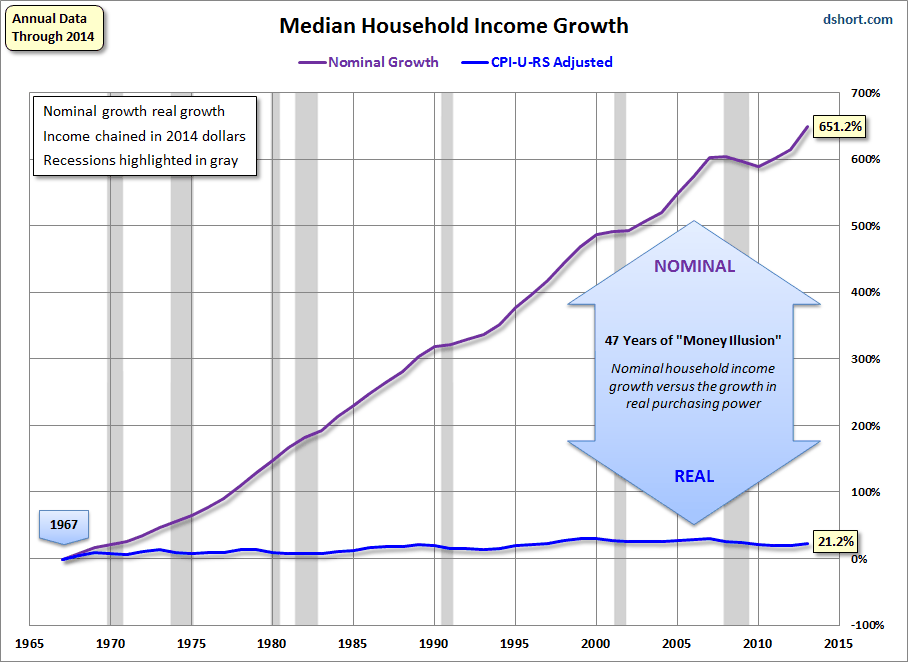
There has been a very real growth in nominal median household income, while people claim that real household income is flat even as far back as pre-1970.
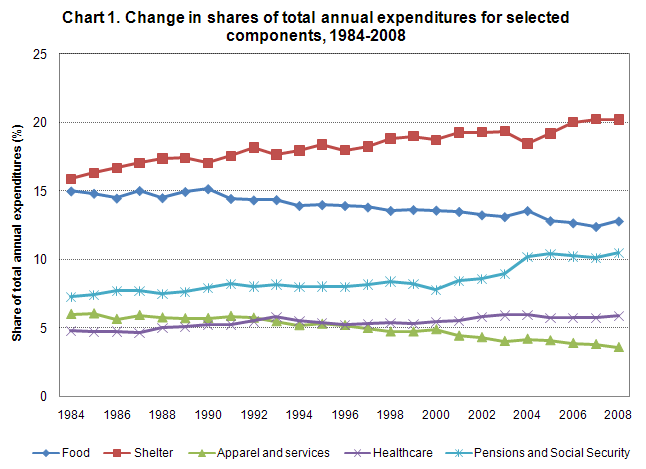
Meanwhile, we see in the long term reductions in the percent of that income spent on food and clothing, as well as a 31% increase in spending on shelter while the median size of shelter increases by 56% and the household size (persons) decreased by 15%. That means spending 84% as much on shelter (and 71% per area per person, but that's irrelevant except to say that we're not cramming lots of people into cramped little spaces).
Even since 2005, the food expenditure was 13% and it's now under 12% (personally, it's 3.9% for me, and I eat out a lot--frequently spending $15 for one meal, but not nearly on every meal). Across the past decades, people have been enabled to put more money into savings, buy more and better healthcare, and spend much of their money on entertainment and other discretionary spending.
That doesn't even get into what accounts for "equivalent goods and services" these days.
Dual-core desktops hit the market in 2005. That's quite a shock compared to 66MHz 486DX or 200MHz Pentium Pro chips that cost $200. Never mind the constantly-falling price of RAM, hard disk, and SSD. PCs, costing thousands of dollars in the early 90s, were $350 commodity items in the mid-2000s.
Cell phones of 1983 cost $4,000 for the phone and $55/month for the service, plus 42 cents per minute voice. Two hours per week would net you $250/month service. That's a $9,000 phone and $550/month service today. Somewhere along the line, we got consumer cell phones with $100/month service; then we had $250 flip phones, $40/month service, and text and video messaging; and now we have heterogeneous hex-core smartphones with 2GB RAM for $350, backed by $60/month service with high-speed data (although I pay $35/month to Ting instead).
An ISDN 128K line in 1998 cost $35/month and required a $250 modem. Today I get 200Mbps Comcast service over an $80 modem--it's $54,687 worth of ISDN lines all tied together for $83. Do you remember DSL talking about their wicked-fast "three megs" in 2005? I have 70 of those.
Even cars only standardized transistor radio and air conditioning in the 1950s. Now we have antilock brakes, traction control, EFI, complex suspension systems, air bags, vehicle dynamics that prevent rolling and skidding, sensors and cameras to assist in lane control and parking, and all other manner of highly-complex systems with many moving parts. Somehow, we don't pay a bigger chunk of our income for these things: cars cost about the same proportion of our income, but come loaded. This will remain true when we all have self-driving vehicles.
Your argument is essentially that somebody else has told you that we're producing more, we're not earning more, and our buying power is not increasing. My argument is that the percentage of the median income being spent on goods like food, clothing, and shelter square-footage has gone down; people have spent more on luxury, leisure, savings, and medical care; and that the common goods and services we consume have rolled in more stuff we couldn't have afforded years and decades ago, essentially taking the same portion of our money and giving us more stuff in exchange.
Reality suggests buying power has increased. A lot. People like me--at $75,000 income--are pocketing all the extra money. I bought a house and paid off the mortgage in 3 years. I'm getting ready to buy a car, but I have a couple debts I want to clear out first (adding payments on top of other payments is stupid). I bought myself a $7,000 piano for the house. I put $18,000 into my 401(k) and $3,385 into my HSA this year
-
Re:That can't be right
In the manufacturing world, that's what. Since the "Great Recession" started, manufacturing jobs never got close to back to what it used to be. So that begs the question, in what sector are these jobs created, since it could not possibly be in manufacturing?
-
Re:That can't be right
The Employment-population ratio [stlouisfed.org] is down significantly, but that doesn't necessarily indicate people who want work can't find it. Things like "retirement" and "wages that don't cover daycare" come in to play.
Don't you understand that the workforce participation ratio only includes so-called "working-age" Americans and excludes retirement age Americans?
-
Re:Wait a year
Looks like it happened a few times: http://data.bls.gov/timeseries...
-
Re:That can't be right
Only 92 million Americans are out of work. A number that haven't changed in four or five years.
Currently as of November 2016, 59.7 of the adult population is employed. That means that out of the 245.3 million adult Americans (also per November 2016), 98 million are unemployed.
But that figure isn't too useful alone. It doesn't reflect either those who live on their fortunes (including pensioners), nor does it account for those who are underemployed.And as for the number not changing, look at the statistics. There's a small but significant and near linear climb in employment rates for the last five years. It's not big enough to make up for the toll the 2009-10 recession took, but it's certainly pointing upwards.
-
Re:Fake news
The labor force participation rate ticked down to 62.7 percent.
Come on man, it's right in the summary. But "statistically employed" isn't the term you are looking for, you are thinking of "Labor Underutilization"
If you don't care to actually google something, read this, it seems like a pretty reasonable explanation of what that number means and gives a whole bunch of other numbers and trends that are actually a more useful gauge of unemployment. link I have no idea if the source is reputable, but the charts are sourced from CBO numbers, so I assume it's accurate.
-
Re:Labor Participation Rate, the Unmentionable...
Please note that not everyone believes the BLS statistics. They have changed their definitions several times over the years seemingly always in a direction that makes the current situation look cheerier. Look around and you will find other parallel opinions that show the same trend, but with worse absolute numbers.
-
Re:Uneven
You are on to something. I would only add that blue collar workers used to have a way to counter such measures, but they have been leaving unions for decades.
-
10x more job loss than coal
In 2014 there were 1.8 million truck drivers. Average pay was $40K. That's damn good money for a job that doesn't even require a high school education.
Those people are fuuuuuucked. More fucked than any other industry. More fucked than buggy-whip makers. More fucked than coal miners. In 1980 there were only 230,000 coal miners. Over the last 30 years that's dropped by about 150,000 jobs. But once the they get a working retrofit kit for trucks that are already on the road, the trucking industry is going to shed 90% of their drivers in less than decade.
And all the ancillary businesses that depend on truckers, like truckstop restaurants and convenience stores, even hookers, they are are fucked too.
These guys are going to react very poorly to this inevitable future. If Trump's election scared you, get ready from somebody 10x worse when this plays out.
-
10x more job loss than coal
In 2014 there were 1.8 million truck drivers. Average pay was $40K. That's damn good money for a job that doesn't even require a high school education.
Those people are fuuuuuucked. More fucked than any other industry. More fucked than buggy-whip makers. More fucked than coal miners. In 1980 there were only 230,000 coal miners. Over the last 30 years that's dropped by about 150,000 jobs. But once the they get a working retrofit kit for trucks that are already on the road, the trucking industry is going to shed 90% of their drivers in less than decade.
And all the ancillary businesses that depend on truckers, like truckstop restaurants and convenience stores, even hookers, they are are fucked too.
These guys are going to react very poorly to this inevitable future. If Trump's election scared you, get ready from somebody 10x worse when this plays out.
-
Re:FinallyThe fact that the article is optimistic doesn't mean it's correct. I realise that nowadays about 58 mln. out of 149 mln. jobs are managers and professionals versus 26 mln. service, 33 mln. sales, 14 mln. "natural resources" and 18 mln. production and transportation (see http://www.bls.gov/cps/cpsaat0... ). I understand that new technologies also produce new jobs and I don't want to be a doomsayer, but I still think the outlook for "ordinary" (i.e. low-skilled or unskilled) jobs is not good. Here's why.
Automation makes no business sense unless it contributes to the bottom line. Meaning it should be better, cheaper, or faster than existing human labour (preferably all three). If the total amount of (wage paying) man hours per unit of output isn't lower than without automation, it's not competitive. In all three cases it will mean a net reduction in human labour in a particular niche plus support jobs (insofar as they are billed through to the work they're replacing),.
In the past there were always new investment opportunities (new things to do; often new natural resources to exploit) that would absorb that labour, and offer a return on investment. In other words: it would drive up our collective wealth to more than pay for those new jobs.
For better or worse I don't quite see where the next big economic expansion is to come from (and if I did I wouldn't be telling you until I had secured a slice of the pie). I fear it may be absent.
Unfortunately some of the biggest niches in US labour market are in manual work: manufacturing things, mining, driving trucks, warehousing, janitorial work, and the service industry.
Ever read about the time when so much employment was in farming jobs? Mostly gone. Automated. Jobs absorbed by industry.
Manufacturing jobs are shifting. Some offshore. Some to automation. As far as I know, the bulk of shop floor manufacturing jobs (just look at the automobile industry) are assembly-type jobs (i.e. not skilled machining). Which can be automated as pick and place robots become more affordable and more capable.
Warehousing: same thing. Jobs being automated. Just ask Amazon. Easier to run 24/7 and no more restroom breaks.
Driving trucks seems on its way to being automated too. According to this site http://www.alltrucking.com/faq... there are about 3.5 mln. truck drivers in the US. What if we can eliminate just the easiest 10% of those? See e.g. https://www.theguardian.com/te... and http://www.latimes.com/project... and https://www.wired.com/2015/05/... and here http://www.bloomberg.com/news/... . Any ideas where about 350k former truck drivers will find employment? That's a lot of low-skilled jobs to offset by generating new demand. In fact, it's about 2% of the labour force (see http://www.bls.gov/cps/cpsaat0... ).
I believe that mr. Trump's recent win is mostly because whole groups of US citizens are facing the problem that what they have to offer (their labour) is no longer in demand. It can be (and often has been or is being) replaced by automation, different products, even cheaper competition offshore, or illegal immigrants. That should at least tell us that people are feeling the squeeze.
To continue a bit with mr. Trump: his promises seem to hinge on three economic pillars: erecting trade barriers, exploiting the commons for commercial gain (as in exchanging environmental protection statutes for operating profit), and injecting a trillion
-
Re:FinallyThe fact that the article is optimistic doesn't mean it's correct. I realise that nowadays about 58 mln. out of 149 mln. jobs are managers and professionals versus 26 mln. service, 33 mln. sales, 14 mln. "natural resources" and 18 mln. production and transportation (see http://www.bls.gov/cps/cpsaat0... ). I understand that new technologies also produce new jobs and I don't want to be a doomsayer, but I still think the outlook for "ordinary" (i.e. low-skilled or unskilled) jobs is not good. Here's why.
Automation makes no business sense unless it contributes to the bottom line. Meaning it should be better, cheaper, or faster than existing human labour (preferably all three). If the total amount of (wage paying) man hours per unit of output isn't lower than without automation, it's not competitive. In all three cases it will mean a net reduction in human labour in a particular niche plus support jobs (insofar as they are billed through to the work they're replacing),.
In the past there were always new investment opportunities (new things to do; often new natural resources to exploit) that would absorb that labour, and offer a return on investment. In other words: it would drive up our collective wealth to more than pay for those new jobs.
For better or worse I don't quite see where the next big economic expansion is to come from (and if I did I wouldn't be telling you until I had secured a slice of the pie). I fear it may be absent.
Unfortunately some of the biggest niches in US labour market are in manual work: manufacturing things, mining, driving trucks, warehousing, janitorial work, and the service industry.
Ever read about the time when so much employment was in farming jobs? Mostly gone. Automated. Jobs absorbed by industry.
Manufacturing jobs are shifting. Some offshore. Some to automation. As far as I know, the bulk of shop floor manufacturing jobs (just look at the automobile industry) are assembly-type jobs (i.e. not skilled machining). Which can be automated as pick and place robots become more affordable and more capable.
Warehousing: same thing. Jobs being automated. Just ask Amazon. Easier to run 24/7 and no more restroom breaks.
Driving trucks seems on its way to being automated too. According to this site http://www.alltrucking.com/faq... there are about 3.5 mln. truck drivers in the US. What if we can eliminate just the easiest 10% of those? See e.g. https://www.theguardian.com/te... and http://www.latimes.com/project... and https://www.wired.com/2015/05/... and here http://www.bloomberg.com/news/... . Any ideas where about 350k former truck drivers will find employment? That's a lot of low-skilled jobs to offset by generating new demand. In fact, it's about 2% of the labour force (see http://www.bls.gov/cps/cpsaat0... ).
I believe that mr. Trump's recent win is mostly because whole groups of US citizens are facing the problem that what they have to offer (their labour) is no longer in demand. It can be (and often has been or is being) replaced by automation, different products, even cheaper competition offshore, or illegal immigrants. That should at least tell us that people are feeling the squeeze.
To continue a bit with mr. Trump: his promises seem to hinge on three economic pillars: erecting trade barriers, exploiting the commons for commercial gain (as in exchanging environmental protection statutes for operating profit), and injecting a trillion
-
Re: And to think the DNC wanted to face Trump...
Not working full time is the underemployed stat. I am very sure about these issues with BLS stats. My research professor for my grad degree did work in econometrics and always commented that the BLS unemployment series was manipulated to hell and back.
The good thing with science as compare to say opinion, is that the data published and independently verifiable.
Here's some data I googled from BLS: http://data.bls.gov/timeseries... I await your comparison data that contradicts this.
I'm not saying you are wrong, but your claim will need need more evidence than 'I said so'.
BTW, the last link you supplied supports my argument not yours (ie why U3 is preferred over U6). -
Re: And to think the DNC wanted to face Trump...
The "not in the work force" number includes only healthy citizens, age 16-65. So your argument about your parents and daughter is invalid.
Additionally, the number is now at the highest percentage since it was first calculated in 1978. In other words, the labor participation rate (i.e. the percentage of people who are of age and wish to have jobs) is at its lowest rate since 1978 (when it was first tracked).
U6 unemployment, on the other hand, does not include anyone unemployed longer than 12-26 months (depending on whether they try to find a job or not). This means they fall to those no longer in the labor pool. That number has grown by 14.4 million people under Obama.
See here:
Labor Participation Rate
No other president since 1980 has presided over such a steep decline (3.4%) in the participation rate, and George W. Bush was the only other president with a net decline (1%). (Note, the graph can be adjusted to include data from before 1978 which has been retroactively calculated, and which is lower, because of the low participation of females in the work force prior to the late 1970's / early 1980's.)
That 3.4% drop indicates 14.4 million more people out of work, and off the unemployment rolls. Typically about a 250,000 job change is needed for 0.1% of unemployment rate change. That would indicate another 5.76% of unemployment to add to the U6 number of 9.5% giving a grand total of 15.26% unemployment, right in line with the original poster, and also a good indicator of why those 15.26% of people, who kept hearing about this great "economic recovery" going on probably swung from blue to red in the election.
Unemployment rates
Vote Swing Map
Look at where the growth in red votes came from in this election. Blue-collar working class states. You know, the ones who get ignored compared to those shiny city slickers that Hillary campaigned to, and who showed up at Trump rallies just in time to be called "deplorable" and "irredeemable" by Hillary. These aren't racists, or fascists, or any of the other names that get used for Trump supporters, they're people who were sick of being ignored. Trump didn't ignore them. Hillary did. Hillary literally did not visit Wisconsin after the primaries since it was "in the bag" for her. Trump did. Guess who won? -
Re: And to think the DNC wanted to face Trump...
The "not in the work force" number includes only healthy citizens, age 16-65. So your argument about your parents and daughter is invalid.
Additionally, the number is now at the highest percentage since it was first calculated in 1978. In other words, the labor participation rate (i.e. the percentage of people who are of age and wish to have jobs) is at its lowest rate since 1978 (when it was first tracked).
U6 unemployment, on the other hand, does not include anyone unemployed longer than 12-26 months (depending on whether they try to find a job or not). This means they fall to those no longer in the labor pool. That number has grown by 14.4 million people under Obama.
See here:
Labor Participation Rate
No other president since 1980 has presided over such a steep decline (3.4%) in the participation rate, and George W. Bush was the only other president with a net decline (1%). (Note, the graph can be adjusted to include data from before 1978 which has been retroactively calculated, and which is lower, because of the low participation of females in the work force prior to the late 1970's / early 1980's.)
That 3.4% drop indicates 14.4 million more people out of work, and off the unemployment rolls. Typically about a 250,000 job change is needed for 0.1% of unemployment rate change. That would indicate another 5.76% of unemployment to add to the U6 number of 9.5% giving a grand total of 15.26% unemployment, right in line with the original poster, and also a good indicator of why those 15.26% of people, who kept hearing about this great "economic recovery" going on probably swung from blue to red in the election.
Unemployment rates
Vote Swing Map
Look at where the growth in red votes came from in this election. Blue-collar working class states. You know, the ones who get ignored compared to those shiny city slickers that Hillary campaigned to, and who showed up at Trump rallies just in time to be called "deplorable" and "irredeemable" by Hillary. These aren't racists, or fascists, or any of the other names that get used for Trump supporters, they're people who were sick of being ignored. Trump didn't ignore them. Hillary did. Hillary literally did not visit Wisconsin after the primaries since it was "in the bag" for her. Trump did. Guess who won? -
Re:Short Lived
I see the labor force participation rate climb from 1970 to 1990, flat until 2007, then fall. That decline is a pretty recent thing...
-
Re: And to think the DNC wanted to face Trump...
Yes, but you need to take into account Baby Boomers are retiring at an ever increasing rate, which impacts the rate. The age demographic of the nation plays heavily into the workforce participation numbers.
http://money.usnews.com/money/blogs/on-retirement/2014/07/22/12-baby-boomer-retirement-trends
Actually, the numbers, as a percentage, haven't been this LOW since 1978. Go to the BLS, choose "Civilian Labor Force Participation Rate - LNS11300000", then change the date range to anything from as far back as 1948 to present.
-
Re: And to think the DNC wanted to face Trump...
Sorry, I'm totally non-partisan, being disgusted by political parties in general. It counts always.
And no, that number does NOT include those over the age of 18 only. The number it is based on is called the "civilian non-institutional population", of which the definition is:
In the United States, the civilian noninstitutional population refers to people 16 years of age and older residing in the 50 States and the District of Columbia who are not inmates of institutions (penal, mental facilities, homes for the aged), and who are not on active duty in the Armed Forces.
The age is 16+, which you can see in the BLS statistics for yourself.
So, it excludes young children, but assumes everyone 16 and older is working, which is a very outdated assumption. Retired doesn't count, unless you're actually in a nursing facility. Military doesn't count. Full-time students don't count. Housewives don't count. Etc.
There are too many caveats to that number for it to be useful as anything other than a misleading, FUD talking point. This article in the WSJ breaks this down nicely.
The real answer is complex, and you can't break it down to a single sound bite. I still maintain the U-6 is a more accurate representation for trying to convey the total unemployment/underemployment picture. I don't think you fall off of U-6 after a set period of time. As it is compiled from a survey, I think you fall off if you flat out say you've just given up looking.
While there are employment issues in the U.S., saying things like "there are 95 million people out of work" just isn't accurate. Most people have a basic understanding that there are approximately 300 million people in the U.S., and the go "OMG! 1/3 of the population is unemployed! Those people need jobs." And that just isn't true.
-
Re: And to think the DNC wanted to face Trump...
Sorry, I'm totally non-partisan, being disgusted by political parties in general. It counts always.
And no, that number does NOT include those over the age of 18 only. The number it is based on is called the "civilian non-institutional population", of which the definition is:
In the United States, the civilian noninstitutional population refers to people 16 years of age and older residing in the 50 States and the District of Columbia who are not inmates of institutions (penal, mental facilities, homes for the aged), and who are not on active duty in the Armed Forces.
The age is 16+, which you can see in the BLS statistics for yourself.
So, it excludes young children, but assumes everyone 16 and older is working, which is a very outdated assumption. Retired doesn't count, unless you're actually in a nursing facility. Military doesn't count. Full-time students don't count. Housewives don't count. Etc.
There are too many caveats to that number for it to be useful as anything other than a misleading, FUD talking point. This article in the WSJ breaks this down nicely.
The real answer is complex, and you can't break it down to a single sound bite. I still maintain the U-6 is a more accurate representation for trying to convey the total unemployment/underemployment picture. I don't think you fall off of U-6 after a set period of time. As it is compiled from a survey, I think you fall off if you flat out say you've just given up looking.
While there are employment issues in the U.S., saying things like "there are 95 million people out of work" just isn't accurate. Most people have a basic understanding that there are approximately 300 million people in the U.S., and the go "OMG! 1/3 of the population is unemployed! Those people need jobs." And that just isn't true.
-
The data is already out there, its called the OES
We annually get reporting requests from the department of labor, a large percentage of companies do. The results end up here: http://www.bls.gov/oes/current...
If you want to look at wage information, that's a good place to go. It's not localized by region, but it's a decent overall report.
-
Re:Lots of other stuff too..The actual inflation rate is a rather personal thing. And, it depends on some rather personal questions:
- * Has the price of the stuff that YOU buy gone up or down?
- * Why did you buy that stuff?
- * What do you actually need to buy to survive?
- * What do you need to buy to be content?
In specific, only you can answer these questions. However, there are some common general trends:
- * The measure of inflation published by the US government: http://www.usinflationcalculat... will be different from the measure of inflation that you experience. The pressures to influence the rate of inflation published by the US government are different from the pressures that influence YOUR purchasing. A couple years ago, Forbes had an interesting opinion piece that pointed out some of the pressures on the US government to manipulate the published rate of inflation: http://www.forbes.com/sites/pe...
- * It is very hard to interpret the published US rate of inflation, because they change their methodology ALL THE TIME: http://www.bls.gov/cpi/cpi_met...
- * In general, these changes in methodology tend to minimize the published rate of inflation. Older methods, yield a much higher rate of inflation: http://www.shadowstats.com/alt...
- * If any of the things that YOU buy experience higher rates of inflation, then it's costs will dominate your budget. This is particularly compelling when the item is a non-optional part of your expenses, such as food, housing, clothing, medical, maintenance of income, community interaction, or interaction with family.
To add an insignificant personal data point, every time I have measured the increase in the expense of food, housing, medical or maintenance of income in the last 30 years, my results have traced the US methodology used back in the early '80s instead of current methodology. For the last 35 years, I have held jobs at the same university in the leading edge of IT. Back then, my monthly salary was about $35K. If my salary increases had matched the cost of living according to the methodology used in 1982, my current monthly salary would exceed $250K. The current actual costs of food, housing, medical and maintenance of income would be about the same percentage of my budget NOW as they were then. Instead, my salary has trailed the actual published inflation rate, and my current mandatory costs are crippling me.