Slashdot Mirror
Domain: cdc.gov
Stories and comments across the archive that link to cdc.gov.
Comments · 2,135
-
Statistics
Per the CDC, in 2010:
Deaths:
369 children(1-14) by firearm
208 were homicide(IE intentional by other)
81 were suicides(tragic, but would they have used something else if a firearm wasn't available?)
62 were unintentional
Another source on injuries
1,535 injuries over a 5 year period, or 307/year.A 'few hundred' is correct, but in a country of over 300M people, you'd be hard pressed to find many common activities that are less dangerous on the whole. While I always recommend keeping guns locked up, saying it's a pressing issue compared to things like the proper use of car seats, pool safety, etc... For example, on average 707 children(0-14) die each year from drowning. 3,533 experience nonfatal submersion injuries.
-
Statistics
Per the CDC, in 2010:
Deaths:
369 children(1-14) by firearm
208 were homicide(IE intentional by other)
81 were suicides(tragic, but would they have used something else if a firearm wasn't available?)
62 were unintentional
Another source on injuries
1,535 injuries over a 5 year period, or 307/year.A 'few hundred' is correct, but in a country of over 300M people, you'd be hard pressed to find many common activities that are less dangerous on the whole. While I always recommend keeping guns locked up, saying it's a pressing issue compared to things like the proper use of car seats, pool safety, etc... For example, on average 707 children(0-14) die each year from drowning. 3,533 experience nonfatal submersion injuries.
-
The Numbers
In the US, gay and bisexual men make up the majority of new HIV cases. But, among heterosexuals, women outnumber men in the number of new HIV cases. For whatever reason (perhaps because semen sticks around longer in the vagina than female wetness stays around on the penis after sex), it's known that a woman's chances of contracting HIV from an HIV-positive male is higher than the chances of a man's chances of contracting HIV from an HIV-positive female. If I remember correctly, the chances of an infection are about double for women compared to men.
"Women have a much higher risk for getting HIV during vaginal sex without a condom than men do" - http://www.cdc.gov/hiv/risk/ge...
You'll also note that, on the graph shown on this article, if you ignore the gay and bisexual men graphs (listed as "MSM" or "men who have sex with men"), women outnumber men in new infections. For example, in the US, about twice as many heterosexual black women (5300/year) are diagnosed with HIV each year as the number of heterosexual black males (2700/year).
Perhaps what's going on in Africa is that homosexual males are less likely to get HIV - because so many of them are in the closet or keep to a small number of sexual partners for fear of attacks. http://www.theguardian.com/wor...
Or maybe HIV is just so common in Africa that transmissions among heterosexuals has surpassed the homosexual rate (which, given the two risk factors of "gay" and "in Africa" has got to be putting homosexual HIV rates near 100%, but you can't get higher than 100%).
Or maybe there's just a lot more sleeping around in Africa among heterosexuals. Afterall, the reason the homosexual HIV rates are so high is because gay men tend to have a lot of sexual partners.
The important thing to keep in mind here is that, if you ignore the homosexual male population, the rates of HIV infection among heterosexual women is naturally higher than the HIV infection rate among heterosexual men. -
What's the reason in the US then?
Per the CDC, black hetero females in the US have just about 4 times the new HIV infection rate than white hetero females: http://www.cdc.gov/hiv/statistics/basics/ataglance.html
More CDC statistics here: http://www.cdc.gov/hiv/statistics/basics/
Certainly this is a worthwhile course of investigation by the Norwegians, but the relatively high black female HIV prevalence in the US could indicate factors specific to race and not merely location.
-
What's the reason in the US then?
Per the CDC, black hetero females in the US have just about 4 times the new HIV infection rate than white hetero females: http://www.cdc.gov/hiv/statistics/basics/ataglance.html
More CDC statistics here: http://www.cdc.gov/hiv/statistics/basics/
Certainly this is a worthwhile course of investigation by the Norwegians, but the relatively high black female HIV prevalence in the US could indicate factors specific to race and not merely location.
-
Re:Death sentence
HIV virons present in blood are not, and infection may occur.
HIV survives for very short times outside the human body even in blood. Here is a quote from the CDC;
Except for rare cases in which children consumed food that was pre-chewed by an HIV-infected caregiver, HIV has not been spread through food. The virus does not live long outside the body. You cannot get it from consuming food handled by an HIV-infected person; even if the food contained small amounts of HIV-infected blood or semen, exposure to the air, heat from cooking, and stomach acid would destroy the virus.
This is an identical risk to Uber and to Slugging. Taxis control this risk with background checks and traceability;
You just contradicted yourself. Risks with less controls are higher risk. As for tractability, all Uber has is a cell phone number which could be a burner phone.
Consumers control this risk via lawsuit
which is useless agains a driver with no money and no insurance.
uninsured driver insurance, if they have auto insurance.
Which may not cover being a passenger in an uninsured vehicle and may not pay much at all.
You miss the whole point
Most people can not tell the difference between a taxi and Uber and think they are taking the same risk when they are not. -
Do a proper threat assessment there.
Because any place that is designated as a "gun-free zone" thereby becomes a place of danger. Nowdays they are refered to as "Rob Me zones".
Generally speaking, bars are rather filled with people, so robbing people inside is impractical and a bit silly of an idea even when everyone is supposed to be disarmed.
Robbing them in the parking lot is a possibility -- bars seem to attract crime of all sorts -- but the typical target you want to mug is someone who can't defend themselves. For a bar, that most likely means drunk people, who would be in no condition to defend themselves if they did have a gun; you'd just end up with an escalation of the situation that would most likely work against the armed patron by encouraging the mugger to attack while the patron attempts to draw.
On the other hand, the threat of impulsive, alcohol-fueled murders in a flash of anger is massively increased when you let someone carry a weapon into a bar. 50% of all murders are committed under the influence of alcohol. Allowing guns into bars is a recipe for raising the local homicide rate.
Just look at what happened to the schools !
Over 99% of schools will never have a school shooting throughout their lifespan. There were 38 school shootings in 2000-2010 resulting in the deaths of 33 victims (not including the shooter). This number does not include colleges but does include a handful of non-public schools. There are just under 99,000 schools in America, meaning that around 4% of 1% of schools had a shooting, and of those most were single-target attacks or very short opportunistic attacks rather than the slow, deliberate Columbine or Virginia Tech style massacre that people hold up as an example of where a gun might help.
On the other hand, 606 people died of firearms accidents and 19,392 people died of suicide just in 2010 alone. So with that in mind, what exactly do you think would have been solved by bringing guns to a building filled with curious children and emotionally wrought teens other than a lot of opportunities for tragedy.
You have to do a fair threat evaluation. Guns in schools are a far bigger threat than they are a threat neutralizer.
-
Re:Gun nuts
Ironic that you earlier criticized me for making an assumption about the reliability of "smart" guns, then proceed to make a number of your own assumptions about my motivations and rationale. Pot, say hello to kettle.
Fair enough. Nice to meet you, kettle.
That aside, what "drives [me] to the conclusion that the threat of deadly force against others is the way for [me] to feel secure in your person," is the fact that there really are other people out there, who would intentionally harm you, me, our loved ones, or anyone else, if they feel they can gain some sort of advantage from it, whether it be by theft of our property, a feeling of self-justified murder (like someone shooting someone else for cutting them off in traffic; it happens), or for no good reason whatsoever (a la Adam Lanza/James Holmes), and I refuse to be victimized without a fight.
Are such occurrences relatively rare? Yes, but they do happen, usually when you least expect them, and as the saying goes, "better to have it and not need it, than to need it and not have it."
I do see your point. According to the FBI, there were 4.8 homicides per 100,000 (14,400) in the US in 2012. I guess there is always that possibility. However, according to the CDC death by homicide isn't even in the top 15 causes of death, which (relatively speaking) makes death by homicide fairly rare.
Given that there were 10.8 automobile deaths per 100,000 (34,080) in the US the same year. That means that you're ~2.5 times more likely to die in an automobile accident than by homicide. Since you are much more likely to die in or by an automobile, what steps do you take to avoid that? Stay off the roads? Live in a place with limited access for automobiles? Since you appear to be concerned about your safety, I'm sure you've done the research and have taken whatever (presumably at least 2.5 times more) steps are necessary to protect you from death by automobile. I'm sure you also expend the appropriate time and resources trying to minimize the impact of all the other more likely causes. If not, then your argument seems to be somewhat specious.
Again with the assumptions. For your information, the death caused by a gunshot from a trained person (which I am - unlike some folks, I actually practice with my weapons fairly regularly, and pride myself on being a pretty damn good shot) is far, far less gruesome and painful than other possible methods; would you prefer that, instead of a
Ranting aside, to answer your leading question, I have no drive to "threaten anyone who may stand in my path," presuming that person isn't threatening me. Where do you get the idea that 2nd Amendment advocates are violent aggressors, anyway? Because FYI, that's a total myth.
You're right. I'd much rather you shoot me to death than stab me to death. How magnanimous of you. Can I send you a gift as a thank you?
The phrase "...anyone who may stand in your path" was meant to to mean that they made you feel threatened. In retrospect, I should have been more explicit. My apologies for the confusion.
I don't (and didn't say) believe that 2nd Amendment advocates are violent aggressors. What I did say is that if you *carry* a gun, you are making the decision (in advance) that you are (for whatever reason) willing to take another person's life.
I don't know you. It's conceivable that you are a kind, caring human being who wouldn't harm another person except for clearly defined and objectively deter
-
Re:Nitrogen? No, CO.
I find it hard to believe that no one has looked into execution using Carbon Monoxide. The cost is negligible and the effect inarguable. You feel drowsy, you fall asleep, and you die.
It's so sneaky and lethal, the CDC estimates it killed > 16,000 people in the U.S. in a five year time period alone.
http://www.cdc.gov/mmwr/previe... -
Re:not only that
The problem for vegetarians (and more especially for vegans) is not getting enough proteins, it's getting all of the required amino acids
What problem? Rice and beans in combination contain all the amino acids you need.
-
Re:What could possibly go wrong
You post, in short: "OH LORDY I'M TOO SCARED TO ACTUAL READ THE ARTICLE!" I mean, come on. Yes, it's important enough that you need important info, but when it's handed to you don't you think you should read it instead of looking foolish?
This is Slashdot. Who actually reads the article? Besides, my point wasn't that I was scared that something would go terribly wrong with this. I am just saying I've lived in those South American countries and sometimes shortcuts are taken. If what they are doing is safe and reasonably studied, then I think they should do it. The person's post was basically saying that we, in the first world, have no right to judge them for what they do to save lives. I am trying to make the point that every country in the globe is connected. If something does go wrong, it can spread to the first world. And in fact dengue itself has already spread to the United States. So inaction on the parts of these countries could increase the chance of it spreading further into the US. My whole point is that this guy is no better than the people he is deriding. That caution should be displayed when releasing non-native insects (in this case, genetically modified mosquitoes). As long as Brazil and its researchers have done due diligence, then go for it. And no, its really not all that important to me, in the long run. It would likely take generations for any sort of side effect to work its way the thousands of miles to North America - unless the side effect is the eradication of the mosquitoes, then we'd likely do it here.
-
Re:What could possibly go wrong
What could go wrong? I don't know, maybe a disease that kills 22 thousand people? Sorry developing country kids, you gotta die, but hey, at least you don't have to worry about something that might somehow be even worse, like the dangers of unknown consequences, in other words, I don't have an actual argument, but I do have the first world heebie-jeebies, so here's a non-falsifiable appeal to ignorance. Try not to die of hemorrhagic fever while I vacuously muse about precaution from my overpriced organic café. Man, I'm glad you 'What could possibly go wrong' people weren't around when some crazy dude tried fighting disease by injecting people with dead viruses.
I'm not an entomologist, nor an ecologist, but I do recognize the standard MO among genetic engineering opposition, and this looks like the same horse shit type of opposition we see when dealing with genetically engineered crops, so unless someone can give me an actual reason (no, Jurassic Park doesn't count) as to why this is not worth trying, I fail to see the problem with this.
Used to live down there in dengue country. I am definitely concerned about what the potential outcome is. I can't tell you how many times I've been sprayed in the face by pesticide trucks, too, while walking down the street. It's a pretty nasty disease. However, the last time Brazilians let a lab experiment out in the wild, it caused all sorts of unintended consequences (yesI Know this was an accident). I am not saying this is as likely to happen, but do we know for sure how these mosquitoes will be once they breed in the wild? Or are they only releasing females, and if so, will they all die before becoming sexually mature?
-
Re:What could possibly go wrong
What could go wrong? I don't know, maybe a disease that kills 22 thousand people? Sorry developing country kids, you gotta die, but hey, at least you don't have to worry about something that might somehow be even worse, like the dangers of unknown consequences, in other words, I don't have an actual argument, but I do have the first world heebie-jeebies, so here's a non-falsifiable appeal to ignorance. Try not to die of hemorrhagic fever while I vacuously muse about precaution from my overpriced organic café. Man, I'm glad you 'What could possibly go wrong' people weren't around when some crazy dude tried fighting disease by injecting people with dead viruses.
I'm not an entomologist, nor an ecologist, but I do recognize the standard MO among genetic engineering opposition, and this looks like the same horse shit type of opposition we see when dealing with genetically engineered crops, so unless someone can give me an actual reason (no, Jurassic Park doesn't count) as to why this is not worth trying, I fail to see the problem with this.
-
Re: Maybe not extinction...
Sure:
http://www.irpa.net/irpa9/cdrom/VOL.1/V1_46.PDF
http://e360.yale.edu/feature/boom_in_mining_rare_earths_poses_mounting_toxic_risks/2614/
http://www.atsdr.cdc.gov/toxprofiles/tp147-c4.pdf
http://www.resourceinvestor.com/2011/06/29/the-future-of-thorium-as-nuclear-fuel
http://web.mit.edu/12.000/www/m2016/finalwebsite/problems/disposal.html
http://web.mit.edu/12.000/www/m2016/finalwebsite/problems/disposal.html
-
Re:Shocking...
Vaccines killed exactly zero people.
This is demonstrably untrue. There are all kinds of complications that can cause a vaccine to be fatal to a patient. While that may not make vaccines "unsafe" for the general population, they are not infallibly benign, and there are many reports of deaths after vaccine injections.
For your edification, here is a list of contraindications for various vaccines in pre-adolescent children. Of course, many of those conditions won't be known in very young children, and in extreme cases the vaccine (or component of the vaccine) can cause death.
In all, 17 deaths among Chinese children aged 5 and younger have been reported following hepatitis B vaccines administered in late 2013.
In 1933, the whole cell pertussis vaccine’s ability to kill without warning was first reported in the medical literature when two infants died within minutes of a pertussis shot.3 In 1946, American doctors detailed the sudden deaths of twins within 24 hours of their second diphtheria-pertussis shot.4 In 1986, the U.S. Congress passed the National Childhood Vaccine Injury Act and has awarded over $2 billion dollars in compensation for deaths and injuries caused by vaccines.
-
Re:Hmm
Too late... http://www.cdc.gov/measles/out...
-
Re:is all madness
"we now live in a world where the car kills more children than anything else, "
that ios a good thing. I feel you should know that's mostly due to people not using seat belts and car seats. Also, there has been a 40% reduction of deaths from auto accidents for children. Oddly enough, poisoning and suffocation are skyrocketing.Morbid fascination:
http://www.cdc.gov/injury/wisq...
http://www.cdc.gov/vitalsigns/....
-
Re:is all madness
"we now live in a world where the car kills more children than anything else, "
that ios a good thing. I feel you should know that's mostly due to people not using seat belts and car seats. Also, there has been a 40% reduction of deaths from auto accidents for children. Oddly enough, poisoning and suffocation are skyrocketing.Morbid fascination:
http://www.cdc.gov/injury/wisq...
http://www.cdc.gov/vitalsigns/....
-
Re:Why do people listen to her?
Oh I see, your source of information is a blog. Forgive me if I believe the CDC and the WHO. Also your source doesn't understand medicine very well because even they said:
"We have compensated cases in which children exhibited an encephalopathy, or general brain disease."
Encephalopathy is not Autism nor linked to Autism. In a very desperate attempt to make any link, the author of the blog is basically making shit up.
-
Re:Appeal to authority is not good enough
Well, there is also this page about the known possible side effects of various vaccines http://www.cdc.gov/vaccines/va.... The MMRV vaccine is known to cause permanent brain damage in very rare cases. Critics of the National Vaccine Injury Compensation Program http://www.hrsa.gov/vaccinecom... claim that it serves to conceal information about the real risks of vaccinations, and disincentivises vaccine manufacturers from developing vaccines without severe side effects or from developing tests to identify kids at risk of the more severe side effects.
That being said, my daughter is vaccinated because the rates of serious side effects are so low that it only make sense.
-
Re:Appeal to authority is not good enough
I don't understand what you and JM mean by "safer" versions of the vaccines. What data do you have to support the supposed lack of safety of the vaccines?
If you had measles and mumps and it was no big deal, you were lucky. There are many who are not so lucky. You are making the same mistake JM does- equating a single data point- your personal experience- to a generalized experience. Science/public health doesn't work that way.
I suggest you look up the potential problems caused by measles, mumps, and the other diseases we vaccinate against before you make statements about how it is better for people to get the diseases than to be vaccinated. These will get you started:
http://www.cdc.gov/vaccines/vp...
http://www.cdc.gov/mumps/about...
http://www.cdc.gov/vaccines/vp...Ignorance is a choice. Smart people recognize their ignorance and attempt to rectify it. Stupid people choose to remain ignorant. Which are you?
-
Re:Appeal to authority is not good enough
I don't understand what you and JM mean by "safer" versions of the vaccines. What data do you have to support the supposed lack of safety of the vaccines?
If you had measles and mumps and it was no big deal, you were lucky. There are many who are not so lucky. You are making the same mistake JM does- equating a single data point- your personal experience- to a generalized experience. Science/public health doesn't work that way.
I suggest you look up the potential problems caused by measles, mumps, and the other diseases we vaccinate against before you make statements about how it is better for people to get the diseases than to be vaccinated. These will get you started:
http://www.cdc.gov/vaccines/vp...
http://www.cdc.gov/mumps/about...
http://www.cdc.gov/vaccines/vp...Ignorance is a choice. Smart people recognize their ignorance and attempt to rectify it. Stupid people choose to remain ignorant. Which are you?
-
Re:Appeal to authority is not good enough
I don't understand what you and JM mean by "safer" versions of the vaccines. What data do you have to support the supposed lack of safety of the vaccines?
If you had measles and mumps and it was no big deal, you were lucky. There are many who are not so lucky. You are making the same mistake JM does- equating a single data point- your personal experience- to a generalized experience. Science/public health doesn't work that way.
I suggest you look up the potential problems caused by measles, mumps, and the other diseases we vaccinate against before you make statements about how it is better for people to get the diseases than to be vaccinated. These will get you started:
http://www.cdc.gov/vaccines/vp...
http://www.cdc.gov/mumps/about...
http://www.cdc.gov/vaccines/vp...Ignorance is a choice. Smart people recognize their ignorance and attempt to rectify it. Stupid people choose to remain ignorant. Which are you?
-
Re:Has this changed?
The CDC recommended vaccination schedule is easy to find, and contains a "Common Core" of vaccinations (your list, plus a couple more---this is not much, much longer than your list). Of those on the list, the only one that is not obviously part of building herd immunity is the Tetanus vaccine, though given how nasty Tetanus can be to an individual and how effective the vaccine is, it seems like an obvious choice to me.
-
Re:Appeal to authority is not good enough
"A European schedule"?
You are aware that Europe contains a great many countries, right?
And that some countries (e.g. Belgium, Bulgaria) in Europe run faster schedules (vaccinations at 2, 3, and 4 months) than the USA does (which does vaccinations at 2, 4, and 6 months).
Here's a handy summary of Europe's vaccine schedules. Compare it to the USA's schedule.
-
Re:McCarthy the Playmate?
You don't have to have professional medical experience to accept what medical professionals say...
No, you just need to be gullible.
Doctors have been taking kick-backs for prescribing drugs for years. They have a long historical record of gettings things wrong. Previously using the wrong drugs and killing a bunch of people was not too serious, a number were probably going to die anyway. However something you are giving to an entire generation of healthy children you had better be pretty damn sure there aren't going to be side-effects down the line.
As much as I hate to admit it - you're right.
Food for thought: "preventable medical harm" kills or incapacitates more Americans every year (210,000 to 400,000) than homicides (11,000 - 16,000) and auto accidents (30,000 - 35,000) combined.
That makes medical errors one of the top 3 causes of death in America.
Definitely something to keep in mind the next time a medical "professional" starts talking down to you because you questioned their "wisdom."
-
Re:Added benefit
"Consumption" was an old name for tuberculosis. TB is normally transferred through the air, not food contamination.
From the CDC:
"Before the invention and acceptance of pasteurization, raw milk was a common source of the bacteria that cause tuberculosis,
-
If they already have the plants, then all is lost.
This is probably why the CDC released the zombie preparedness plan.
-
Re:we're all effed
Another side effect not mentioned in TFA is that mosquito zones would increase, allowing them to reach areas previously too cold to breed. Combined with mosquito borne diseases, could lead to a most epically disasterous time.
-
Re:Autism is the new ADD
It's not a theory, it's a wild conjecture. Where is your evidence for a rise in misdiagnosis?
Oh, I don't know - maybe the fact that this study is based in the US, which has a track record of "over-diagnosing" mental health disorders in children, such as ADHD ( http://www.cdc.gov/ncbddd/adhd..., http://www.psychiatrictimes.co...).
Fool me once, shame on
-
1 in 3 are Alcohol
http://www.cdc.gov/motorvehicl...
So:
30% Alcohol related
25% Cellphone related
5% Texting (separate?)
-----
60% of accidents could be eliminated if people would stop using cellphones, texting and driving drunk.That would be really nice.
-
Re: Jenny McCarthy
No, I won't attempt to teach the basics of rhetoric and logic here, I studied them for years in a formal environment as opposed to you pointing to Wiki articles for fallacy definitions.
I'm sure you're well aware, then, of the argument-from-authority fallacy. I dare not link to Wikipedia, of course. That would make me a bumbling amateur, right?
Attempting to nitpick the name of the fallacy won't change the fallacy from true to false either, so it's a poor argument all around.
I wasn't being obtuse. I really don't get you.
Herd immunity does not claim 100% is needed, so you are again using fallacy arguments. You said yourself that some people can not be vaccinated so you provide an impossible condition and you know it.
Well, you not being vaccinated probably means one more potential carrier, right? ('Probably' because of the chance it wouldn't have worked on you.) The only way this doesn't affect me is if I'm 100% guaranteed to be immune. (Or, I suppose, if I'm 100% guaranteed never to meet you, or if I'm already infected.) I don't see that I can be missing much here, but if this reasoning is unsound, please point out in what way.
You not getting a vaccination doesn't affect me much, sure, but without 100% effective vaccinations, it surely has to affect me some non-zero amount. (The impossibility of 100% effective vaccinations doesn't affect the reasoning here.)
I was not unclear with what you replied "What?' to, so try and work on your reading and comprehension skills.
Condescension doesn't strengthen your position, but I thought it was clear: I don't know where you're getting this from: the irrational and fallacy ridden separation you attempt to make between people that "can't" and people that "won't" get vaccinated. I certainly wasn't trying to make any such distinction.
Regarding the facts, then: there seems to be a 1 in 1,000,000 risk of Guillain-Barré syndrome, and it's also not good for people with severe egg allergies. Regarding whether flu shots have saved lives, this source says it's unclear. (It's still possible it's saved many people from a few unpleasant days of flu, mind, and that alone could make it worthwhile.)
Even if you're right that flu shots in particular aren't worthwhile, vaccinations have proven themselves on other diseases. I don't think anyone would argue that flu shots are the most important vaccination.
I'm sure you're well aware, then, of the argument-from-authority fallacy. I dare not link to Wikipedia, of course. That would make me a bumbling amateur, right?
As stated, nitpicking a fallacy name does not make a fallacy true. A fallacy is still a fallacy, and falsity is still falsity. Faulty logic most often can be described using numerous "named" fallacies depending on the point of reference. Continuing to debate the point will never make faulty logic good logic, it's nitpicking and diversionary.
Well, you not being vaccinated probably means one more potential carrier, right? ('Probably' because of the chance it wouldn't have worked on you.) The only way this doesn't affect me is if I'm 100% guaranteed to be immune. (Or, I suppose, if I'm 100% guaranteed never to meet you, or if I'm already infected.) I don't see that I can be missing much here, but if this reasoning is unsound, please point out in what way.
You just said probably, which is a correct statement. Then again you claim you want a 100% guarantee. No such guarantee is possible no matter what the circumstanc
-
Re: Jenny McCarthy
No, I won't attempt to teach the basics of rhetoric and logic here, I studied them for years in a formal environment as opposed to you pointing to Wiki articles for fallacy definitions.
I'm sure you're well aware, then, of the argument-from-authority fallacy. I dare not link to Wikipedia, of course. That would make me a bumbling amateur, right?
Attempting to nitpick the name of the fallacy won't change the fallacy from true to false either, so it's a poor argument all around.
I wasn't being obtuse. I really don't get you.
Herd immunity does not claim 100% is needed, so you are again using fallacy arguments. You said yourself that some people can not be vaccinated so you provide an impossible condition and you know it.
Well, you not being vaccinated probably means one more potential carrier, right? ('Probably' because of the chance it wouldn't have worked on you.) The only way this doesn't affect me is if I'm 100% guaranteed to be immune. (Or, I suppose, if I'm 100% guaranteed never to meet you, or if I'm already infected.) I don't see that I can be missing much here, but if this reasoning is unsound, please point out in what way.
You not getting a vaccination doesn't affect me much, sure, but without 100% effective vaccinations, it surely has to affect me some non-zero amount. (The impossibility of 100% effective vaccinations doesn't affect the reasoning here.)
I was not unclear with what you replied "What?' to, so try and work on your reading and comprehension skills.
Condescension doesn't strengthen your position, but I thought it was clear: I don't know where you're getting this from: the irrational and fallacy ridden separation you attempt to make between people that "can't" and people that "won't" get vaccinated. I certainly wasn't trying to make any such distinction.
Regarding the facts, then: there seems to be a 1 in 1,000,000 risk of Guillain-Barré syndrome, and it's also not good for people with severe egg allergies. Regarding whether flu shots have saved lives, this source says it's unclear. (It's still possible it's saved many people from a few unpleasant days of flu, mind, and that alone could make it worthwhile.)
Even if you're right that flu shots in particular aren't worthwhile, vaccinations have proven themselves on other diseases. I don't think anyone would argue that flu shots are the most important vaccination.
-
Re:This is where the money is short sighted.
In 2010, the combined profits of the six leading tobacco companies was U.S. $35.1 billion
That just tells us how many morons still exist in the world. Yes, *morons*. They know smoking is bad for them, yet they *start* smoking. Rationality be damned!
-
Re:A bit of common sense maybe?
You should have stated upfront that you oppose vaccines for religious reasons due to their animal/ human components.
That is your prerogative, and I salute your for sticking to your principles.
However, I very much object to your wasting our time by beginning your thread with "Convince me that I and my entire family should vaccinate." while not telling us of this religious objection. We can only discuss the scientific and medical principles involved in vaccination.Make vaccines that are absolutely proven to be 100% safe and stop using crazy ingredients in them.
If you have religious objections to components, then safety is irrelevant; the components are still there.
So why do you even mention it?BTW, your body makes formaldehyde to form DNA and amino acids. You have about 5 milligrams in your blood right now.
Aluminum is in there for a reason, and it is quickly excreted just like the aluminum in your food. Some vaccines contain it, some do not.
It's been used for some 70 years.
http://www.cdc.gov/vaccinesafe...
http://www.chop.edu/export/dow...The rant you hear about adding monkey cells, fetal cells, dog cells or whatever to the vaccine is incorrect.
The cells are not added to the vaccine, the cells are used as food to grow the virus. So yeah, the cells, they're in there, but they're not added after the fact.For those who don't know, vaccines have to be grown on some substrate. Bacteria can be grown on almost anything.
Viruses can only be grown in cells. Because viruses tend to be species specific, the ones that infect humans need to be grown on animal cells. Some are grown in eggs, some in cell cultures. One example the "monkey kidney cells "is the Vero cell culture that was taken from a monkey's kidney about 50 years ago. Others use human cell cultures, and some use cell cultures originally from other animals.
The insect one is a substitute for egg-grown viruses, except that insect cells are used to produce certain proteins found in flu virus and not the whole flu virus.I doubt that there will ever be anti-virus vaccine that does not have somewhere in its production some human or animal cell product.
-
Re:Anti-Vaxxers? Try Population Density
No, that phenomenon is a result of genetic stagnation. Population density is only bad if hygene is poor and social services (*ahem* health care *ahem*) are poor. Otherwise, there's nothing wrong with it.
The H041 outbreak doesn't exist. H041 was one strain found in Japan that was never found again. MRSA is a result of overuse of antibiotics, especially in livestock feed, where much of it runs off into groundwater in minute quantities. And antibiotic resistance transfers between bacteria, so one bacteria that develops resistance can basically "infect" its neighbors to also be resistance.
None of this is due to population density. There are numerous places with much higher population density, without so many widespread health issues. The anti-social behavior of American culture doesn't help either.
-
Re:Wrong, study shows disfavor with science.
So are some of these vaccines. In fact, for some of the weakened-virus instead of killed-virus variety, some of these vaccines *are* the disease they are hoping to prevent.
What are the real risks of vaccines? Incredibly hard to tell when even the CDC uses weasel words like "risk of death is extremely small" instead of giving us a percentage from the study- and the original white papers are always paywalled and copyrighted. You can't calculate risk without knowing actual numbers.
-
Re:Sinister?Look, if you're trying to support wild statistical claims that disagree with what's out there in reputable sources, post a link to them. Don't reference that they're in reputable sources somewhere and then bitch at me when all I can find is stuff that contradicts you.
I provided a link to the Gardasil issue which are admitted to. From this page the reports are roughly 25,000 reported serious problems from the vaccine. Looking at the total of 600,000 vaccines given that is a 4% chance that a person can have a serious side effect. The numbers I provided were actually being extremely kind to Gardasil.
OK, let's look at the data carefully. Start with the CDC summary: 57 milion doses, 22,000 reports to VAERS. Of those, 8% were serious. That works out to about 3.5 in 10,000. Given that VAERS is self-reported and doesn't require an actual diagnosis or necessarily any evidence that the issue was vaccine related, even that data is pretty overstated. Hopefully, we're using the same definition for "serious" (which for these purposes is typically "hospitalization, chronic injury, or death"). I suspect we're not, because anything with a 4% chance of serious side effects would be considered straight up poison and ripped from the shelves.
On to the NHS site. It gives no numbers for such "serious" side effects, but does gives other stats:
>10% for redness at the injection site or headaches.
>1% for fever, nausea, painful limbs.
~0.01% for hives
Self reported and without statistics (more like VAERS) are a series of disorders, most of which are not especially serious, but a couple of which are moderate to severely serious (Guillain Barré syndrome). Of course, the HuffPo site you linked notes that the statistics thus far have shown that those serious disorders appear to occur in the HPV vaccinated population at the same rate as the population at large, so it's rather hard to claim that the vaccine was the cause.
It's amazing to me that we're using the same sites and you're coming up with numbers that don't appear to be anywhere in those sites. The best I can come up with is that your methodology takes all possible reactions including "redness at the injection site", takes the 10% probability of that, notes that there was an unconfirmed case of Dutch elm disease in there, and says "Dutch elm disease (or similar) in 10% of cases!"It's really not difficult to Google "gardasil vaccine harm" to find all kinds of reports on the vaccine.
Here is a link to the Google search results of alien abduction cases. You'll note a variety of sources with a lot of different anecdotes, as well as more serious academic sources. Depending on which site you go to, you get very different results. My concern here is that your idea of "education" is reading all of the sites and averaging what you read.
And as mentioned before, we don't know that the vaccine is truly effective.
From the FDA in 2013: The vaccine is effective against HPV types 16 and 18 which cause approximately 70% of cervical cancers, and against HPV types 6 and 11 which cause approximately 90% of genital warts.. Maybe there's some cutting edge research (or web site rumor mills) that indicates otherwise. Maybe those unnamed sources are even right. But they're usually not.
Or did you not know about these [therefusers.com]?
200 cases out of ~60 million doses? I'm definitely willing to believe that. But not 4%. I'd say that's an excellent result and that compensating the rare problem case is perfectly reasonable. I mean, giving peanuts to 60,000,000 people is likely to cause adverse reaction
-
Re:Sinister?Sure, the numbers will vary based on the vaccine, but that doesn't mean that your source isn't complete crackpottery and bullshit using made up numbers. That's my complaint. I'm less concerned about you eyeballing those bullshit numbers and rolling them into one rough "order of magnitude" number of how dangerous vaccines in general are. I'll happily grant that there are trade-offs for everything. A vaccine against a disease that's hard to spread and no more than a nuisance doesn't benefit you much, and if it has potentially serious side effects, it may not be worth it. But we're talking about stuff like polio. Polio isn't a minor ailment with occasional complications. Symptomatic polio is a crippling disease at best and at worst it's fatal. Paralytic polio had a mortality rate of 2-30%, depending on the demographic.
It was not, but took years to prove otherwise. Meanwhile many young women have become sterile and permanently damaged by the vaccine.
Let's dig into that a little bit. Where are you getting your data? Because the VAERS data seems not to show anything of the sort. It looks like we're talking about something that has the potential to prevent tens of thousands of cases of cancer per year and weighing it against a moderate to low probability of such scourges as "headache" and, granting your claim some credence, a vanishingly small probability of sterility.
To the second point again you choose a fragment to argue instead of what was actually said. We know that there are risks from the vaccine just like there are risks from the disease.
Sure. The problem is that we're talking about real numbers that can be compared. And your numbers are total nonsense. That means that while your reasoning is valid, your conclusion is simply wrong. If you had to choose between a 1/1,000,000 chance of death and a 1/1,000 chance of death, there's really no sensible argument for choosing the latter, all else held equal. In 1952, there were 58,000 cases of polio in the US, which is 3.7 in 10,000. From what I can find, the vaccine causes anaphylaxis at about 1/1000 that rate (worst case). It looks like vaccine derived polio is, what, 1 in 10,000,000-ish? So what factors are we considering here?
-
Some good, some bad-Only retards get frothy rabid
some vaccines are good, some are unnecessary and thus bad. dont get the flu vaccine. bring on the hate, i think you religious nuts are hilarious and will probably die falling off of your soapboxes before i or anyone else i know dies from flu =-)
immune systems exist for a reason, and so do our thinking skills.
http://www.cdc.gov/flu/about/d...
http://www.cdc.gov/nchs/data/n...
"Does CDC think that influenza causes most P&I deaths?
No, only a small proportion of deaths in either of these two categories are estimated to be influenza-related. CDC estimated that only 8.5% of all pneumonia and influenza deaths and only 2.1% of all respiratory and circulatory deaths were influenza-related."
-
Some good, some bad-Only retards get frothy rabid
some vaccines are good, some are unnecessary and thus bad. dont get the flu vaccine. bring on the hate, i think you religious nuts are hilarious and will probably die falling off of your soapboxes before i or anyone else i know dies from flu =-)
immune systems exist for a reason, and so do our thinking skills.
http://www.cdc.gov/flu/about/d...
http://www.cdc.gov/nchs/data/n...
"Does CDC think that influenza causes most P&I deaths?
No, only a small proportion of deaths in either of these two categories are estimated to be influenza-related. CDC estimated that only 8.5% of all pneumonia and influenza deaths and only 2.1% of all respiratory and circulatory deaths were influenza-related."
-
Re:Flu Shots are Ruining Vaccinations
Tens of thousands of people die every single year from flu. My wife is an ICU nurse and watches people die every year from it.
Which is 100% made up bullshit. Even if it was true universal application of the flu vaccine won't prevent that since it is at most only 61% effective, which is well below the threshold to make herd immunity effective.
So next time you get the flu spend the time thinking about all the people you interacted with while you were a walking virus factor and wonder just how many of them your stupidity killed.
Less than those killed by your HHV-6 infection.
-
Re:Sinister?
Those numbers you quote seem to be made up. From the CDC http://www.cdc.gov/vaccinesafe... A quick conservative calculation on the numbers they give show risk of severe adverse reaction to be about 226 in 57 million (or about 1 in 252,000) and I doubt all of the severe adverse reactions fell into the death category so that's probably even a low number.
-
National institute?
[N95 facemasks] are certified by the National Institute for Occupational Safety and Health
Whose national institute? Ah, I see. I wonder what China's equivalent institute certifies, or if they even have an equivalent institute.
-
Re:Take That, Capitalists!
I've actually heard that a very small amount isn't a bad idea for long-term storage of emergency water.
From the CDC:
Prepare an Emergency Water Supply
- Store at least 1 gallon of water per day for each person and each pet. You should consider storing more water than this for hot climates, for pregnant women, and for persons who are sick.
- Store at least a 3-day supply of water for each person and each pet (try to store a 2-week supply if possible).
- Observe the expiration date for store-bought water; replace other stored water every six months.
- Store a bottle of unscented liquid household chlorine bleach to disinfect your water and to use for general cleaning and sanitizing.Water Containers (Cleaning and Storage)
Unopened commercially bottled water is the safest and most reliable emergency water supply.
Use of food-grade water storage containers, such as those found at surplus or camping supply stores, is recommended if you prepare stored water yourself.
Before filling with safe water, use these steps to clean and sanitize storage containers:
- Wash the storage container with dishwashing soap and water and rinse completely with clean water.
- Sanitize the container by adding a solution made by mixing 1 teaspoon of unscented liquid household chlorine bleach in one quart of water.
- Cover the container and shake it well so that the sanitizing bleach solution touches all inside surfaces of the container.
Wait at least 30 seconds and then pour the sanitizing solution out of the container.
Let the empty sanitized container air-dry before use OR rinse the empty container with clean, safe water that already is available.But it just seems too weird. Like burning out a chest cold w/ cigars or flushing through a stomach virus with Drano.
Well, I'd say it's better than using leeches, but then again, I think I'd rather stick a blood-sucking parasite on my nipple than willfully down any amount of Clorox...
-
Re:Mercury next, please
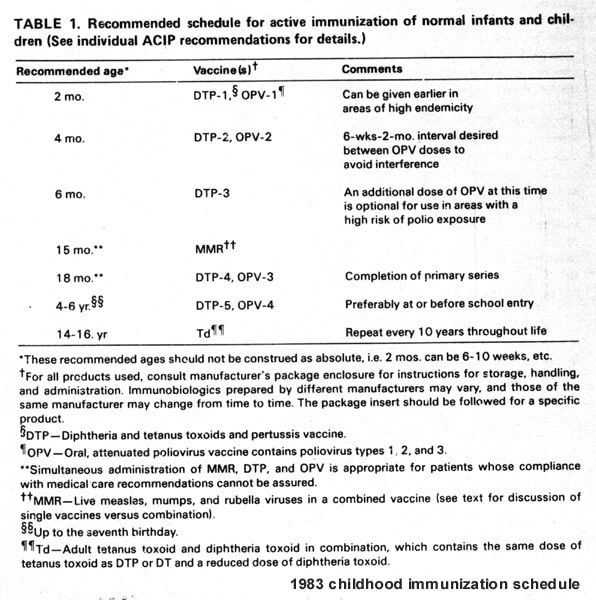
I don't know if the verdict is out on that. What is different than the 1980s is the sheer volume of recommended shots by age 2. -- at least 2 orders of magnitude.
Not even close. If you count up all of the individual things you're vaccinated for by 24 months as recommended by the CDC in 2013 you get around 45. In 1983 the total was 8. That is nowhere near two orders of magnitude difference.
So you got to wonder how the immune system reacts to produce antibodies for so many of these dead viruses. That is something that hasn't been researched fully.
In the same way it reacts to anything else. As the CDC explains:
No evidence suggests that the recommended childhood vaccines can “overload” the immune system. In contrast, from the moment babies are born, they are exposed to numerous bacteria and viruses on a daily basis. Eating food introduces new bacteria into the body; numerous bacteria live in the mouth and nose; and an infant places his or her hands or other objects in his or her mouth hundreds of times every hour, exposing the immune system to still more antigens. When a child has a cold they are exposed to at least 4 to 10 antigens and exposure to “strep throat” is about 25 to 50 antigens.
Adverse Events Associated with Childhood Vaccines, a 1994 report from the Institute of Medicine, states: “In the face of these normal events, it seems unlikely that the number of separate antigens contained in childhood vaccines
-
Re:Mercury next, please
I don't know if the verdict is out on that. What is different than the 1980s is the sheer volume of recommended shots by age 2. -- at least 2 orders of magnitude.
Not even close. If you count up all of the individual things you're vaccinated for by 24 months as recommended by the CDC in 2013 you get around 45. In 1983 the total was 8. That is nowhere near two orders of magnitude difference.
So you got to wonder how the immune system reacts to produce antibodies for so many of these dead viruses. That is something that hasn't been researched fully.
In the same way it reacts to anything else. As the CDC explains:
No evidence suggests that the recommended childhood vaccines can “overload” the immune system. In contrast, from the moment babies are born, they are exposed to numerous bacteria and viruses on a daily basis. Eating food introduces new bacteria into the body; numerous bacteria live in the mouth and nose; and an infant places his or her hands or other objects in his or her mouth hundreds of times every hour, exposing the immune system to still more antigens. When a child has a cold they are exposed to at least 4 to 10 antigens and exposure to “strep throat” is about 25 to 50 antigens.
Adverse Events Associated with Childhood Vaccines, a 1994 report from the Institute of Medicine, states: “In the face of these normal events, it seems unlikely that the number of separate antigens contained in childhood vaccines
-
Re:Mercury next, please
I don't know if the verdict is out on that. What is different than the 1980s is the sheer volume of recommended shots by age 2. -- at least 2 orders of magnitude.
Not even close. If you count up all of the individual things you're vaccinated for by 24 months as recommended by the CDC in 2013 you get around 45. In 1983 the total was 8. That is nowhere near two orders of magnitude difference.
So you got to wonder how the immune system reacts to produce antibodies for so many of these dead viruses. That is something that hasn't been researched fully.
In the same way it reacts to anything else. As the CDC explains:
No evidence suggests that the recommended childhood vaccines can “overload” the immune system. In contrast, from the moment babies are born, they are exposed to numerous bacteria and viruses on a daily basis. Eating food introduces new bacteria into the body; numerous bacteria live in the mouth and nose; and an infant places his or her hands or other objects in his or her mouth hundreds of times every hour, exposing the immune system to still more antigens. When a child has a cold they are exposed to at least 4 to 10 antigens and exposure to “strep throat” is about 25 to 50 antigens.
Adverse Events Associated with Childhood Vaccines, a 1994 report from the Institute of Medicine, states: “In the face of these normal events, it seems unlikely that the number of separate antigens contained in childhood vaccines
-
Re:Great news.
The CDC advice always left me a little annoyed since it's their life that they are risking by advising those allergic to eggs to get inoculated and now with the new vaccine I can finally get a flu shot without risking my life.
The advice I've always seen says that you may not be a candidate for it if you have an egg allergy, not recommending you get it despite an allergy.
Right off the CDC site:
Special Consideration Regarding Egg Allergy:
People who have ever had a severe allergic reaction to eggs may be advised not to get vaccinated. People who have had a mild reaction to egg—that is, one which only involved hives—may receive a flu shot with additional precautions. Make sure your health care provider knows about any allergic reactions. Most, but not all, types of flu vaccine contain small amount of egg.
-
Re:BMI
Yeah BMI isn't a hard number to go by, there are many factors that can affect it. Generally speaking if your overweight you know it... you don't need some number to tell you. I'd rather see labels disappear and just focus on what you need to do to stay healthy. http://www.cdc.gov/obesity/dow...