Slashdot Mirror
Domain: ciclops.org
Stories and comments across the archive that link to ciclops.org.
Stories · 22
-
Enceladus's 101 Geysers Blast From Hidden Ocean
astroengine writes: New observations from NASA's Saturn-orbiting Cassini spacecraft have revealed at least 101 individual geysers erupting from Enceladus' crust and, through careful analysis, planetary scientists have uncovered their origin. From the cracked ice in this region, fissures blast out water vapor mixed with organic compounds as huge geysers. Associated with these geysers are surface "hotspots" but until now there has been some ambiguity as to whether the hotspots are creating the geysers or whether the geysers are creating the hotspots. "Once we had these results in hand, we knew right away heat was not causing the geysers, but vice versa," said Carolyn Porco, leader of the Cassini imaging team from the Space Science Institute in Boulder, Colo., and lead author of one of the research papers. "It also told us the geysers are not a near-surface phenomenon, but have much deeper roots." And those roots point to a large subsurface source of liquid water — adding Enceladus as one of the few tantalizing destinations for future astrobiology missions. -
Cassini's Christmas Gift: In the Shadow of Saturn
astroengine writes "As the Cassini mission continues to orbit the ringed gas giant Saturn, it's hard to imagine what magnificent view the NASA spacecraft will show us next. Today, however, is one for the history books. As a very special Christmas holiday treat, the Cassini Imaging Central Laboratory for Operations (CICLOPS) team have processed a magnificent view of Saturn that is rarely seen — a portrait from the dark side of the planet." -
The Swirling Vortex of Titan
sighted writes "New images from the robotic spacecraft Cassini show the ongoing formation of a massive vortex in the atmosphere of Saturn's planet-sized moon Titan. (See also this animation.) The same moon has recently provided tantalizing hints of an underground ocean as well. Future missions, if any are ever funded, will have plenty to explore." -
Using Shadows To Measure the Geysers of Enceladus
The Bad Astronomer writes "A lot of folks are posting about the amazing new pictures of the icy moon Enceladus returned from the Cassini spacecraft. However, one of them shows the shadow of the moon across the geyser plumes. This has been seen before, but I suddenly realized how that can help determine the geysers' locations, and I thought Slashdot readers might be interested in the general method." -
The Rain On Saturn Falls Mainly From Space
The Bad Astronomer writes "Astronomers have discovered that the source of water in Saturn's upper atmosphere is none other than the geysers erupting from its moon Enceladus. The geysers spew water into space, most of which is lost. A small amount, though, falls to Saturn... equivalent to only about 7.5 kilos/second over the entire planet (PDF). A typical rainfall on Earth is 42 trillion times heavier." -
Saturn's Moon Prometheus Spawning Moonlets
astroengine writes "For the first time ever, astronomers have witnessed the formation of celestial objects... in Saturn's rings. As the Saturnian moon Prometheus dashes through the gas giant's rings, it leaves large formations of ice behind, some as large as 12 kilometers in diameter. When the small moon makes another pass, it is not known whether these giant 'snowballs' remain or get destroyed, but according to Linda Spilker, from NASA's Jet Propulsion Laboratory: 'You can think of Saturn's rings as miniature versions of the disks where planets form. The same physical processes are occurring.'" The Planetary Society blog has further explanation, as well as pictures and a movie of Prometheus' interaction with Saturn's rings. The Cassini team has released some fantastic images of the fans and clumps in the F ring, as well as a simulation showing how the ring's particles are affected by the moon's passing. -
Saturn's Moon Prometheus Spawning Moonlets
astroengine writes "For the first time ever, astronomers have witnessed the formation of celestial objects... in Saturn's rings. As the Saturnian moon Prometheus dashes through the gas giant's rings, it leaves large formations of ice behind, some as large as 12 kilometers in diameter. When the small moon makes another pass, it is not known whether these giant 'snowballs' remain or get destroyed, but according to Linda Spilker, from NASA's Jet Propulsion Laboratory: 'You can think of Saturn's rings as miniature versions of the disks where planets form. The same physical processes are occurring.'" The Planetary Society blog has further explanation, as well as pictures and a movie of Prometheus' interaction with Saturn's rings. The Cassini team has released some fantastic images of the fans and clumps in the F ring, as well as a simulation showing how the ring's particles are affected by the moon's passing. -
Saturn's Moon Prometheus Spawning Moonlets
astroengine writes "For the first time ever, astronomers have witnessed the formation of celestial objects... in Saturn's rings. As the Saturnian moon Prometheus dashes through the gas giant's rings, it leaves large formations of ice behind, some as large as 12 kilometers in diameter. When the small moon makes another pass, it is not known whether these giant 'snowballs' remain or get destroyed, but according to Linda Spilker, from NASA's Jet Propulsion Laboratory: 'You can think of Saturn's rings as miniature versions of the disks where planets form. The same physical processes are occurring.'" The Planetary Society blog has further explanation, as well as pictures and a movie of Prometheus' interaction with Saturn's rings. The Cassini team has released some fantastic images of the fans and clumps in the F ring, as well as a simulation showing how the ring's particles are affected by the moon's passing. -
Kilometer-High Waves Flow In Saturn's Rings
An anonymous reader sends along a Cosmos Magazine piece on the discovery by NASA's Cassini probe of vertical structures in Saturn's rings, 150 times as high as the rings are thick. The structures were seen because a once-every-15-years orientation of the rings caused vertical features to cast visible shadows. "NASA's Cassini probe has uncovered for the first time towering vertical structures in Saturn's otherwise flat rings that are attributable to the gravitational effects of a small moon. 'We thought that this vertical structure was pretty neat when we first saw it in our simulations,' said John Weiss, the paper's lead author at the Cassini Imaging Central Laboratory for Operations in the US city of Boulder, Colorado. 'But it's a million times cooler to have your theory supported by such gorgeous images. It makes you suspect you might be doing something right,' he added." Update: 06/17 19:29 GMT by KD : The CICLOPS team sent a note correcting the attribution of the quote; the linked article also had it wrong, and has since been corrected. -
Hydrocarbon Rain Swells Titan's Lakes
Rob Carr writes "According to the Cassini team, 'Recent images of Titan from NASA's Cassini spacecraft affirm the presence of lakes of liquid hydrocarbons by capturing changes in the lakes brought on by rainfall.' The northern lakes are now larger following a period in which hydrocarbon clouds covered their skies. (The research was published in the journal Geophysical Research Letters.) This change adds to the evidence these areas are indeed hydrocarbon lakes. But this discovery raises several more questions: where is the methane in the atmosphere coming from, and how long can this complex hydrocarbon cycle on Titan go on? The new evidence emphasizes the need for another mission to Titan." -
First Images From 50-km Enceladus Flyby
CheshireCatCO writes "The first pictures from yesterday's flyby of Enceladus are now public. At closest approach, Cassini was set spinning to cancel out the apparent motion of Enceladus so as to capture unsmeared images during the 40,000-mph flyby. Although it wasn't clear that this would work (errors in pointing could easily have made the cameras miss their targets), the maneuver panned out beautifully, producing spectacular images of the surface. Images show the 'tiger stripes' at the south pole, including at least one location that has been identified as a source of a jet, as well as considerable vertical relief, easily visible thanks to the low sun-angle near the south pole at present. Processed, enhanced images should follow shortly." -
Cassini To "Skeet-Shoot" Enceladus
CheshireCatCO writes "When Cassini makes its closest approach (50 km) during the flyby of the moon Enceladus next Monday 11 August, the spacecraft will be zipping by too quickly to turn and image in the usual way. So the Cassini team will be trying something new: a 'skeet-shoot' of the surface. The spacecraft will start to spin before the closest approach to the south pole so that when the best resolution is possible, the moon will drift through the field of view slowly enough to acquire unsmeared images. Of interest are the eruption-sites on the surface that give rise to the plume extending thousands of kilometers into space and producing Saturn's E ring. This flyby will be optimized for the imaging instruments (ISS, VIMS, CIRS, and UVS) in contrast with the March flyby, which was designed for the fields-and-particles instruments." -
Cassini To "Skeet-Shoot" Enceladus
CheshireCatCO writes "When Cassini makes its closest approach (50 km) during the flyby of the moon Enceladus next Monday 11 August, the spacecraft will be zipping by too quickly to turn and image in the usual way. So the Cassini team will be trying something new: a 'skeet-shoot' of the surface. The spacecraft will start to spin before the closest approach to the south pole so that when the best resolution is possible, the moon will drift through the field of view slowly enough to acquire unsmeared images. Of interest are the eruption-sites on the surface that give rise to the plume extending thousands of kilometers into space and producing Saturn's E ring. This flyby will be optimized for the imaging instruments (ISS, VIMS, CIRS, and UVS) in contrast with the March flyby, which was designed for the fields-and-particles instruments." -
Cassini's Best Images
CheshireCatCO writes "The winners of the best images from the Cassini spacecraft (taken since Cassini images of Saturn were first acquired in February 2004) have been announced. The winner of best color image is In Saturn's Shadow, the stunning, high-phase portrait of Saturn from opposite the Sun. Winners of best black-and-white and best movie (both categories resulted in ties) are also available." -
Cassini's Best Images
CheshireCatCO writes "The winners of the best images from the Cassini spacecraft (taken since Cassini images of Saturn were first acquired in February 2004) have been announced. The winner of best color image is In Saturn's Shadow, the stunning, high-phase portrait of Saturn from opposite the Sun. Winners of best black-and-white and best movie (both categories resulted in ties) are also available." -
Cassini's Iapetus Flyby
cupofjoe writes "The Jet Propulsion Laboratory is reporting on the Cassini spacecraft's recent close flyby of the Saturnian moon Iapetus, highlighting images taken from distances 100 times closer than the Voyager 2 flyby in 1981. Near real-time images were shown to Cassini mission team members in a presentation at JPL yesterday, during which a pre-recorded message from Arthur C. Clarke was played to the audience. Clarke wished them luck on the flyby, reminding all present that he had included a pretty accurate description of Iapetus in the original 1968 text of "2001: A Space Odyssey", years before Voyager made its flyby." -
Cassini Returns Amazing New Imagery from Saturn
SeaDour writes "The Cassini spacecraft has recently entered a highly-inclined orbit around Saturn, revealing some never-before-seen images of the planet's ring system as seen from above and below the planet. 'Sailing high above Saturn and seeing the rings spread out beneath us like a giant, copper medallion is like exploring an alien world we've never seen before. It just doesn't look like the same place. It's so utterly breath-taking, it almost gives you vertigo.' The spacecraft will eventually return to its standard orbit parallel to the ring plane in late June." -
Cassini Returns Photos of Hyperion
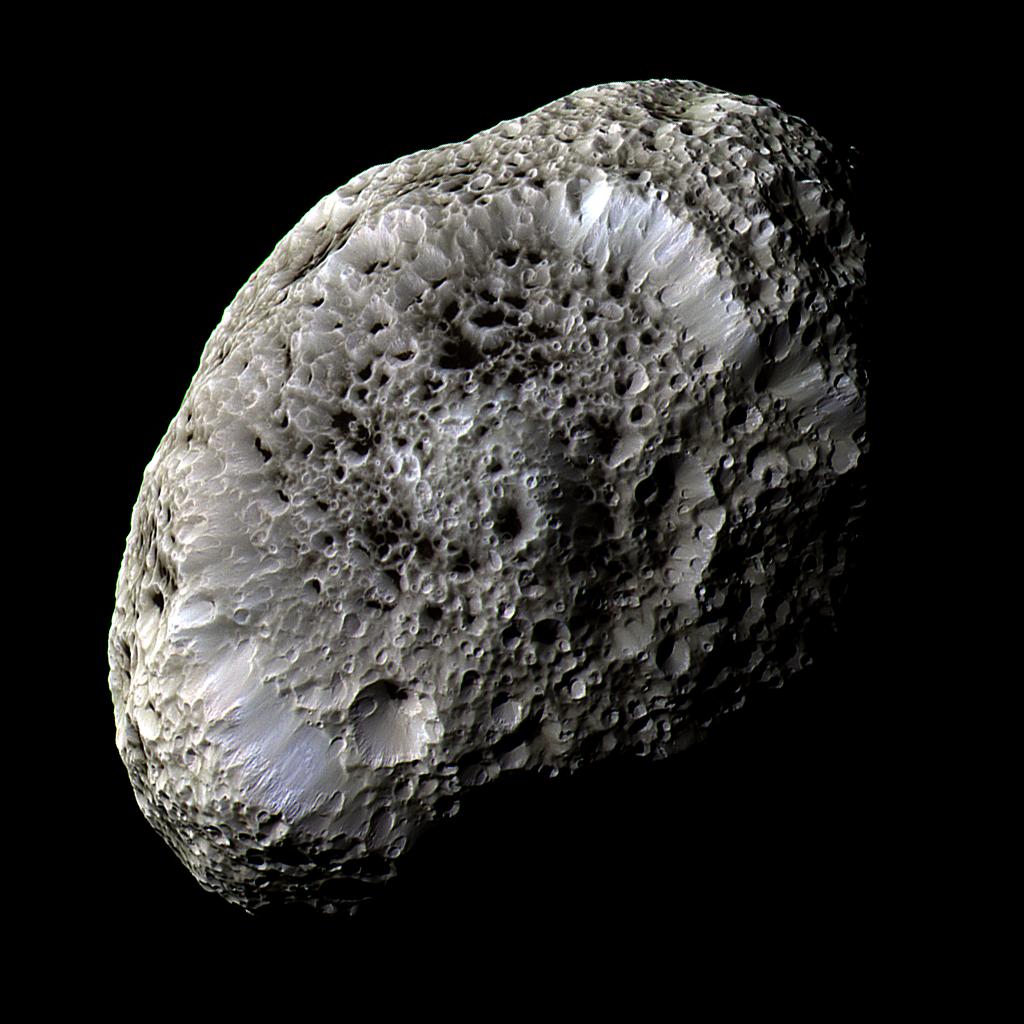
imipak writes "The Cassini Saturn probe has captured the previously unseen northern polar region of Saturn's moon Hyperion. Its weirdly eroded surface looks like nothing else in the solar system seen so far, demonstrating once again that when it comes to planetary exploration, "expect the unexpected" is more than just glib advice from the Hitch-hiker's Guide!" -
Possible Cryovolcano Discovered on Titan
Rei writes "NASA's Jet Propulsion Laboratory is reporting that the Cassini spacecraft has observed what appears to be a cryovolcano on Saturn's moon Titan. Given the absense of a global methane sea on Titan, the snail-shaped structure with what appears to be a caldera on top could explain how Titan's methane stays replenished. It could further explain the dry drainage channels discovered by the Huygens lander as being formed by heavy methane rainfall after eruptions." -
Titan Moon's Bright Hot Spot
An anonymous reader writes "Saturn's largest moon, Titan, has been the target of great interest because of its unusual pre-biotic chemistry and thick atmosphere. The Colorado-Boulder Space Science Institute announced a new mystery today involving a persistently bright spot, perhaps one of four possibilities. The spot could be a surface coloration, a mountain range, a cloud, or a hot spot." -
Saturn Rings But No Spokes
An anonymous reader writes "Scientists continue to ponder why images of Saturn's rings today lack the 'spokes' or dark radial bands radiating outward and first observed on the Voyager flyby. The Boulder-based Cassini Image Team describes 5 visible moons, plans for the descent probe going into the Titan moon's hydrocarbon-rich atmosphere and the expected orbital entry around Saturn less than 4 months from now." -
Stunning, Detailed New Image of Jupiter
darenw writes "From the Cassini spacecraft's flyby of Jupiter in late 2001, a new mosaic image has been assembled, revealing a stunning amount of detail, beautiful waves, swirls and spots in Jupiter's atmosphere. Get the story and images at the Cassini imaging team website." This is a huge image. My eyeball guess is that each pixel is the size of Pennsylvania.