Slashdot Mirror
Domain: ddo.com
Stories and comments across the archive that link to ddo.com.
Stories · 9
-
Turbine Responds To DDO Community Protest
Zarrot writes "Turbine has listened to the community and backed away from the partnership with SuperRewards that we discussed yesterday. Quoting: 'Based on your feedback, we're stepping away from the "Offer" category for now. We'll keep exploring alternate ways for players who want points to get them. We'll also continue to innovate in pricing and accessibility because that's who we are. As of today, the Offer Wall is coming down. We'll collect all the feedback we've received over the last few days and will use it to guide future decisions.'" -
DDO's Turbine Partners With Notorious SuperRewards
Zarrot writes "In the next step for their Free 2 Play model, Turbine Entertainment, publisher of Dungeon and Dragons: Online, Lord of the Rings: Online, and Asheron's Call, has partnered with notorious 'lead generation company' SuperRewards. Initial testing by forum users shows that just accessing the page without clicking on any offers sends the user's email and game login in clear text to SuperRewards. Reports of new spam and fresh malware infections on test systems are already being reported on the company's forums. Is the Zynga business model the future of Internet gaming?" -
DDO's Turbine Partners With Notorious SuperRewards
Zarrot writes "In the next step for their Free 2 Play model, Turbine Entertainment, publisher of Dungeon and Dragons: Online, Lord of the Rings: Online, and Asheron's Call, has partnered with notorious 'lead generation company' SuperRewards. Initial testing by forum users shows that just accessing the page without clicking on any offers sends the user's email and game login in clear text to SuperRewards. Reports of new spam and fresh malware infections on test systems are already being reported on the company's forums. Is the Zynga business model the future of Internet gaming?" -
Gen Con 2006 in a Nutshell
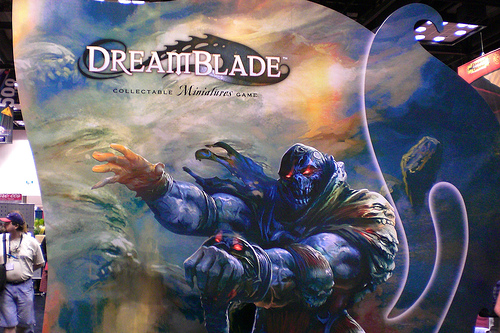
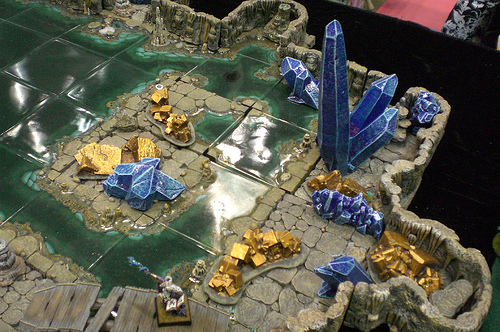
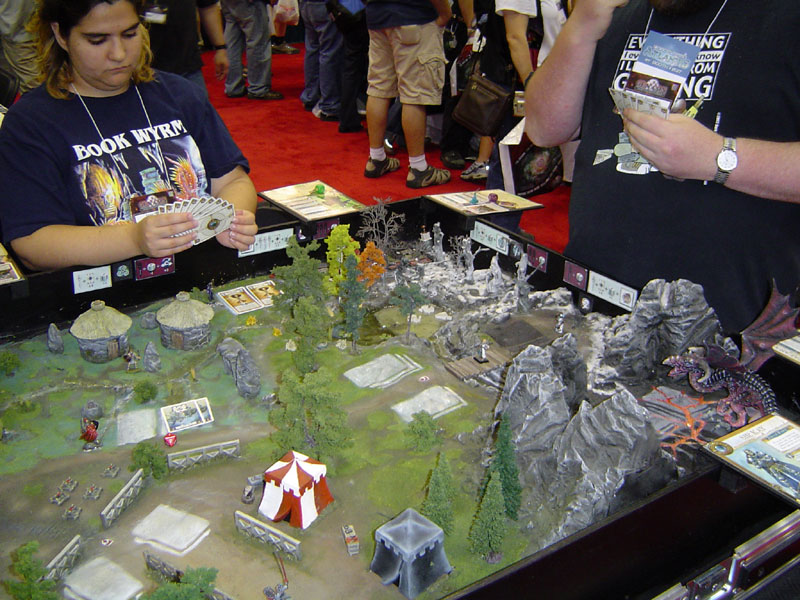
Another year, another trip into the heart of dorkness. Gen Con Indy 2006 was marked, not so much by the big releases (because there weren't that many this year), but by changes in the wind. Several newer systems were in their second year, garnering praise for their continued quality. Some games that we saw last year weren't even around this year. Others were just not doing as well as their creators would have hoped. The focus, though, was entirely on the games ... and next year's convention. The talk in the halls and on the exhibit hall floor, when not about dice and mechanics, surrounded what Gen Con will be like next year and the changes that videogames will bring to the event. Read on for my comments about what I saw this year, what worked, what didn't, and a few words on what might result from next year's changes. The most notable launch this year (if only by force of advertising alone) was Wizards of the Coast's (WotC) Dreamblade. A 'collectable miniatures' game, WotC is building on their experience with the D&D and Star Wars miniature games to try for another hit along the lines of Magic: The Gathering. You can't doubt their sincerity: a $20K tournament was held at the convention, and $1000 mini-tournaments are going to be held across the country in the coming weeks. It's difficult to describe the 'genre' of the game, but the gent demoing the title at the Wizards booth likened it to a cross between Magic and Chess. In Dreamblade, you take on the role of a Psionic master, creating creatures out of dreamstuff. Strange and twisted nightmares are summoned onto a board. You advance these creatures across the board, trying to hold certain areas while simultaneously destroying your opponent's. The game is broken up into discrete turns, and a game session has a limited number of turns before it is over. The mechanics seemed very simple to pick up, but there was a good deal of strategy inherent in the interaction between board, creatures, and players.
Last year's con report had me talking about another Wizards launch, a card game called Hecatomb. You may recall me saying 'The quick Demo I had the chance to take in wasn't enough to make me run off and buy it, but I look forward to taking a closer look in the future.' Hecatomb has since joined the creepy creatures it portrayed in deathless slumber. Just one year later, a friend bought eight starter sets of last year's 'next big thing' from a dealer for $10 and a trio of lollipops. I imagine the game died because of poor sales, but I couldn't tell you for sure what happened there. If anyone has details, please share. As surprised as I was this year to learn Hecatomb had already succumbed to market forces, I was even more surprised to see them launching a new game so soon afterwards. Dreamblade has a weightier feel than Hecatomb did last year, though. While I don't think it will be replacing D&D minis any time soon, I also have the feeling it won't be gone by the time Gen Con Indy 2007 rolls around.
Beyond card games, last year also saw the launch of a few powerhouses in the table-top roleplaying market. Shadowrun 4th edition, Mutants and Masterminds 2nd edition, and Mage: The Awakening all took the stage, to varying amounts of applause. A year later, and each of them has been well received by their intended audiences. The superhero title Mutants and Masterminds has had brisk sales as gamers come to love its very different approach to the d20 system. New supplements include a GM's guide, a campaign setting, and a brand-new powers book. Mage, as successor to White Wolf's 'Ascension' line, continues to impress old and new gamers alike. A new sister product was on offer at the con, Promethean: the Created. Promethean is a storytelling game about crafted creatures, golems or monstrosities from the labs of Frankensteinian scientists. I didn't have a chance to catch a demo, but a flip through the book and initial player reactions would indicate White Wolf is living up to its usual level of quality. Shadowrun has had a somewhat slow year, product-wise, but FanPro was offering a major release at their booth: Street Magic. This first real look at magic in the 2070s answers a lot of questions, and begins to get players and GMs into the feel of the reworked setting. From talking to the folks at their booth, and observing games around the con, adoption of the refined 4th edition rules has been a huge success. Having run a campaign with the new rules, I can definitely vouch for their simplicity and transparency.
Another 'continuing success' story revolves around the booth manned by the buccaneers of Privateer Press. Publishers of the tactical miniatures games Warmachine and Hordes, as well as the RPG setting Iron Kingoms, Privateer runs a bustling booth. As it's usually packed with enthusiastic fans, I've never really had the chance to check out their products. I'm very much late to the party, but I finally had the chance to take in some demos and I wanted to be sure to mention them. I'm not much of a wargamer, but the high-fantasy-meets-steampunk on the battlefield feel of their titles was enough to turn my head. Warmachine's uncomplicated game mechanics made a demo a highly enjoyable experience, and the incredible detail the figurines sport is something all lead-crafters should strive for. Beyond the simplicity of their wargaming offerings, I also had the chance to enjoy a session of the Iron Kingdoms RPG. Despite its D&D roots, the title felt very different from many 'traditional high fantasy' games I've played. In an industry built around new takes on old concepts, it was great to see the lengths they've gone to in order to step beyond what we think of as Dungeons and Dragons.
There were some brand-new products and announcements in the offing this year as well. An announcement I heard mentioned several times as I walked the hall is next year's plan to reintroduce the d20 Star Wars RPG. The discontinued product line is going to be relaunched, with a slimmed-down rules system and a lot of detail dropped into the game's tweaks. The reappearance of Runequest was a smaller, but just as appreciated, product event. The new line by Mongoose is a relaunch of the 1978 Chaosium title, with industry heavyweights like Robin Laws and Kenneth Hite contributing material. RuneQuest was a predecessor game for some of the most popular titles in the industry today, and so it will be very interesting to see how the new rules and setting appeal to gamers of today. The largest launch at the con, if only by virtue of physical size, was the Ptolus campaign setting from Malhavoc Press. Weighing in at over 700 pages, the book feels almost brobdingnagian to hold; just finding a comfortable position to read the thing was something of a challenge. It's well worth the effort, though. The depth of information, quality of production, and freshness of the setting are inspiring. At $120, it's certainly not for everyone, but it made quite an impression at an overall fairly quiet convention.
Two previews this year may have dipped below the radar for some convention attendees, if only by virtue of the challenges in playing them. While not yet officially launched, the World of Warcraft Trading Card Game and the EVE: Second Genesis Collectible Card Game were visible from many places in the convention hall. Actually getting the chance to learn more about them, though, was something of a trial. In point of fact, I didn't get the chance to play either of them. I can't really fault EVE's creators for my lack of information: EVE's double-decker booth had an intimidatingly long line for much of the convention. I go to Gen Con primarily to play games, and I just never had the time to wait around. If anyone has first-hand experience with CCP's newest endeavor, please feel free to share. The WoW CCG, on the other hand, was actually being demoed by appointment only. I didn't make the cut. If you're interested in the game itself, Upper Deck has a Gen Con blog, which ran for much of last weekend. In between the sycophantic statements, the author talks about some fairly interesting game mechanics that I'm sure would have been really interesting to check out.
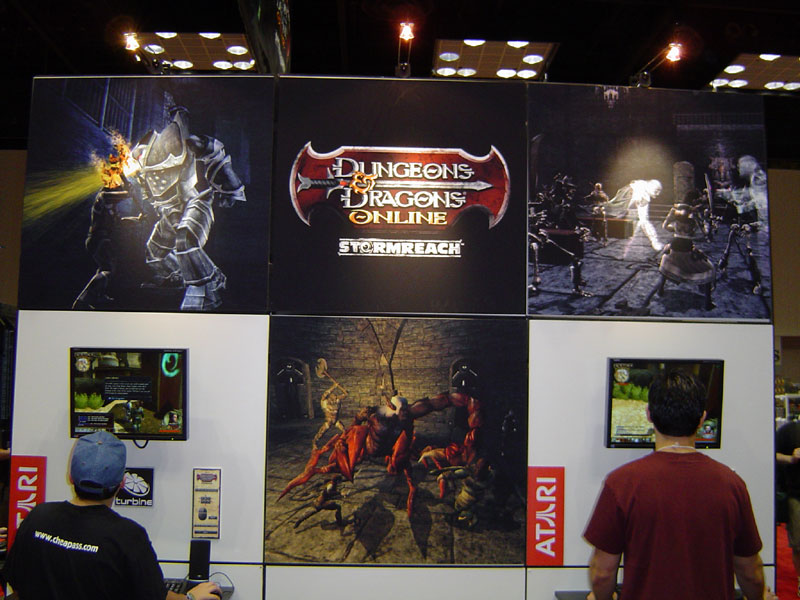
If you'd rather your gaming be electronic in nature, there were several titles showing on the exhibit hall floor. A harbinger of next year's hoped-for flood, the few titles showing typified the computer games of years past: based in roleplaying and for roleplayers. Unsurprisingly, Dungeons and Dragons Online (DDO) was there again this year. A much less enthusiastic crowd surrounded their booth; the game's launch left few who hadn't already been exposed to the game and desperately wanted to play. Despite the lack of a fervent crowd, Turbine was proudly showing off the next module for the title and seemed to be honestly seeking player feedback on where to go next. There were several developers on-hand speaking to the con-goers, and the one that came up to me began 'Hi there. Do you have any complaints about the game?' While I'm still not sure about where they've gone with DDO, it's good to see they're honestly seeking input on what they've done so far. Mythic, on the other side of a wall from Turbine, was far less interested in such feedback. Their booth was staffed by PR and marketing hires; while perfectly nice and very willing to walk me through a demo of Warhammer Online, my technical questions about the game went over their heads. I wasn't very impressed, either with Mythic's showing or with the game itself. The buzz around the convention seemed to be that it is 'too much' of a World of Warcraft (WoW) ripoff. The thematic links between Warhammer and WoW are obvious, but Mythic didn't seem terribly interested in distancing itself from the millions-strong Blizzard title. Another very familiar face was Neverwinter Nights 2, the unapologetic sequel to the 2002 Bioware title. Essentially 'just' a prettier version of the first game, with updates to the Dungeons and Dragons 3.5 rules-set, it was still one of the most popular PC games at the convention. The module construction tool was available for perusal as well. While I only had a few minutes to slap together a bare-bones adventure, the whole experience was very intuitive. They've obviously made some major improvements over the Aurora set, and have made the members of the (still-active) Neverwinter community very pleased.
Pleased would also be the best way to describe my reaction to the highly original Pirates of the Burning Sea, (PotBS) which I got to have my first hands-on time with at the convention. Far from 'yet another boring fantasy knock-off', PotBS is going to have Massive gamers yarring in delight when it launches. Ship combat is fast paced, while still remaining highly strategic. There are a number of factions to fight for or against, and a highly involved PvP system that will allow for real 'ownership' of the game world. Pirates was far and away the highlight of my Gen Con experience, and I'm very much looking forward its commercial launch. They're announcing their ship date on the 25th of the month, at PAX, and I certainly hope it's sooner rather than later. A quirky, already available title also on the show floor was the engaging Pox Nora. Essentially an online fantasy miniatures game, Pox is priced at the appealing level of free. Gameplay is a one-on-one skirmish between two players. They pit their randomly assigned figurine armies against each other, taking control of strategic areas of the game board while trying to destroy the other player's units and structures. It's a little odd to get used to at first, but I highly recommend giving it a try if you have some free time.
Free time was the last thing I had this past weekend. As with every year I barely managed to scratch the surface of what was going on around the con. I didn't make it to the ENnies again, and so wasn't there to see table-top gaming's awards show make legends of products and people. I was particularly glad to see that Paizo's Shackled City Adventure Path got several firm nods. The new editions of Shadowrun and Mutants and Masterminds were also highly lauded. I picked up the new Order of the Stick book, No Cure for the Paladin Blues, but didn't have a chance to play the OOTS card/board game. The reaction from a few people I spoke to was kind of 'eh', but they sold out their entire stock on the first day of the convention just the same. I played the live action corridor romp True Dungeon again this year, and this time around it just plain old sucked eggs. My group made it to the last room perfectly fine (where we died, which is to be expected), but the entire event felt poorly planned and executed compared to previous experiences. I will definitely not be playing again next year. I also didn't have the inclination or finances to buy one of the two massive D&D figurines Wizards of the Coast was showing off at the convention. The Gargantuan Black Dragon, already available, stood wing-to-wing with the as yet unreleased Colossal Red. Along with the enormous Cthulu HorrorClix figure (another game I didn't get to play this con), they ensured there were many people lugging around too-big boxes for much of the event. I also didn't get a chance to see the screenings of The Gamers 2, or attend the Videogames Live concert that coincided with the weekend's festivities. There's always so much going on at Gen Con, it's a yearly trial to prioritize what 'has' to be done.
One thing I did get to see was a trailer for Dungeon Runners, one of the new 'free' games that NCSoft is developing. The presence of videogames was notably larger this year, with a room set aside for the videogaming tournaments and a large screen in one of the main hallways displaying trailers for upcoming titles. Last year (and in years previous) videogames were relegated to some out-of-the-way corner of the convention, as more traditional gaming types retained the attention of advertisers, companies, and attendees. All of these elements were signs of things to come. As you've no doubt heard by this point, the downsizing of E3 next year has resulted in a number of pretenders to the throne. Gen Con LLC has announced their intention to try for the crown. Gen Con So Cal will be moved to the LA Convention center next year, and Indy is going to be offering an additional 43,000 square feet to videogame publishers and developers that would like to get some face time with the pen-and-paper set. Opinions were decidedly mixed at the convention, and I have to say that I'm more than a little trepidacious about what these changes might mean for the 'best four days in gaming'.
The Indy convention is the successor to the con held in Milwaukee for many years. It has always held a place of honor as the 'con of cons', but that place is no longer assured. I simply can't see game publishers wanting to trek out to the Midwest, when there is a perfectly good alternative a few months later on the West coast. I'm definitely biased, being a midwesterner myself, but I hate to think of the tradition of Gen Con being tossed aside in a bid for videogaming advertising dollars. Gen Con has always been about wargaming, pen and paper RPGs, miniatures, card games ... it's nerdy and 'uncool', to be sure, but for the people who care about such things this convention has always been a place they could call 'home'. The cover for this year's events booklet even bought into that sentiment, saying in as many words "Welcome to Gen Con ... Welcome Home!"
The slick production values of an E3-like spectacle have no place in the world of shoulder-dragon-wearing gamer hippies, chicks in chainmail bikinis, and smelly dorks chortling over the latest escapades of Drizzt Do' Urden. If videogames come to Gen Con on their terms, with bright lights and booth babes, the Gen Con that I've enjoyed for so many years will be over and done with. If Peter Adkinson and Co. are serious about incorporating electronic gaming into this pen-and-paper palace, they're going to need to bring videogames to us on our terms. Keep things friendly, keep them relatively quiet, and speak honestly about what you have to offer. The future of Gen Con will be written in the events of 2007 and despite my fears I'll be there for yet another year of dice, cards, and German board games. It is, after all, a little piece of home. -
Dungeons and Dragons Online Impressions
Tabletop roleplaying has been a fixture in my life since I was ten. You can probably imagine my enthusiasm when I heard of the joint venture between Asheron's Call developer Turbine and D&D publisher Wizards of the Coast. The goal: A Massively Multiplayer game set in a D&D campaign. Keith Baker's Eberron was tapped for the gameworld's flavour, with the d20 ruleset providing the skeleton on which to create the title's mechanics. The result is Dungeons and Dragons Online (DDO), which has been in the works for about two years now. DDO is faithful in ways I wouldn't have thought possible, but still manages to raise conflicting opinions for me. DDO has real-time traps and combat, beautiful graphics, and still fails to interest me on any level of my gamer soul. Read on for my impressions of a most perplexing MMOG.- Title: Dungeons and Dragons Online
- Developer: Turbine Entertainment
- Publisher: Atari
- System:PC
One aspect of the title I know I have a firm grasp on is the setting. Eberron was developed by Keith Baker for a contest held by Wizards of the Coast a few years ago. Since then the pulp action setting for the D&D system has become the company's premier IP. Novels, sourcebooks, comics, and miniatures are all being created with the Eberron world in mind, and Dungeons and Dragons Online is the second work of electronic entertainment to use the setting. You may recall Dragonshard, the D&D RTS title. That too is based in Eberron, but with an (understandably) less immersive look at the setting. DDO delves deep into the backstory of the gameworld. Set in the settlement of Stormreach on the continent of Xen'drik, the game allows you to explore some of the elements that make Eberron unique. The powerful merchant and political factions known as Dragonmarked Houses make an appearance in the game, as benefactors and opponents. Dragons are rare, powerful, and mysterious. While I would have liked to get more of the backstory from the setting's main continent of Khorvaire, there is a definite sense of place in DDO. It's thin, but it's there.
Creating a character is the first of many DDO aspects that reinforce a D&D feel. Attributes are created using the 'point buy' system, allowing a player to build a character to fit a class without relying on random die rolls. If you're uninterested in tweaking a character's skills and attributes, you can simply select a class/race combo and accept the pre-built character the game will provide you. Prebuilt characters all have fairly sane choices made as regards attributes and skills, and if you're not interested in learning the particulars of D&D character creation it's a safe choice to make. All of the D&D iconic classes are available (even poncy bards), along with the typical player races. The Warforged are the stand-out race for the game, living constructs that resemble animated statues. In the game's lore, Warforged were construct troops created for a titanic century-long war. With the war at an end Warforged are emancipated creatures and can fill any role the fleshy races do. While I find them intriguing plot elements, I've heard a lot of player commentary about their inhumanity. It's a fact that the race most often played in a MMOG is 'human', and the unliving nature of the Warforged may make them an unpopular race. Just the same, their inclusion is a powerful reminder of the setting's background. The classes available are typical to what you'd find in most MMOGs; With good reason, as most MMOGs stole their class concepts from D&D in the first place. One class element that might surprise some folks who haven't done table-top gaming before is the role of the cleric. D&D clerics are almost as powerful front-line fighters as your fighter or paladin. They wear heavy armor, kick ass, and take names in the pursuit of their god's goals. Rogues are also fundamentally more useful than in many typical MMOGs. There are plenty of traps in D&D dungeons, and rogues are the only ones who can disable them. Making your character 'feels' very D&D, and sets the stage for your integration into the Eberron setting.
Once you're in the game, you'll find that the D&D setting is the least of the elements setting DDO apart from other MMOGs. Combat is a very different animal than almost any other title in the genre. In a word, DDO combat is realtime. Instead of hitting fight and using abilities as they become available, or simply watching as your avatar filets a bunny, DDO is a click-fest worthy of either Diablo game. Each click is a swing of the sword, and whether you 'hit' or not is determined by your stats. In the corner of the screen you're shown your to-hit roll, which is a random number between 1 and 20 modified by your Strength score. To score a hit, you have to get higher than your opponent's AC, and on a natural 20 you do more damage (a critical hit). In other words, you're going to do a lot of missing. This gets frustrating very very quickly. In fact, it's gets just boring after a while. Tabletop D&D combat is fun because it's abstract, with the blows landing on the screen in your mind. Actually having to sit there and watch the swords swing over and over is more than a little tedious. D&D monsters aren't like the villains of Diablo; They jump around, move out of range, and generally do their best not to get killed. That means that in addition to repeatedly clicking on your opponent you're going to be trying to follow their movements. It's all too dang chaotic to be truly fun.Besides just poking the baddies, there is actually a good deal of depth to DDO combat. All characters have the option of using some tactics in their fighting. Skills actually play a large part in combat if used correctly. Diplomacy attempts to throw off aggro, making a monster attack someone else. Intimidate is the opposite, encouraging foes to attack your character. Rogues can use the Hide and Move Silently skills to avoid notice, and bypass monsters if need be. If they don't, they can strike from hiding and possible score a sneak attack for massive damage. Rogues can even do sneak attacks in combat by using the Bluff skill to throw an opponent off balance. Magic is more your typical MMOG fare. Wizards, Clerics, etc, have mana points which are used up by spellcasting. Even with that as the base mechanic, the system is very D&D. Spellcasting classes have only a few spell slots, and can only swap out what they have online when resting. Further, arcane spellcasters only know a subset of their available spells and must find or purchase additional spells before they can use them. These elements are all laudable additions to the game, but in reality many combats feel more like a group of individuals doing their own thing than a party effort. Because of the frenetic nature of real-time clicky combat fights are fast and hard to manage. A group comfortable with each other, with voice chat in use, will have a good deal of success. Pick-up groups, though, are at even more of a disadvantage than in most games simply because things happen so fast.
That's what you do in combat. What you're actually *doing* when you play DDO is almost entirely dungeon-crawling. You receive quests from the people of Stormreach, all of whom need help with this or that. Like City of Heroes/Villains, your missions are instanced, meaning that you and your party get to play around with your own copy of the dank basement/decaying sewer/giant ruin that you have to explore. With the missions instanced, DDO dungeons are allowed to do some really interesting stuff. Traps, for example, are deadly challenges that affect the world in real-time. More than just kicking open a chest and being set on fire, razor-sharp blades swing from the ceiling. Splashes of acid fly from spigots in the walls. If you don't have a rogue with you, some traps can be avoided by using your platforming skills to time the gap in a trap's movement. If you do have a rogue handy, the trap mechanisms can be searched out and disabled. The traps are a very cool addition to the genre, but the quests are unfortunately laughable. The thin layer of Eberron that I mentioned above is mostly related through quest text, and what is offered through NPC interaction is cookie cutter and boring. Quests usually have a voice-over, from an intangible Dungeon Master, to spice up your understanding of the situation and evoke the table-top setting. In my opinion, the voice-over doesn't add much. In truth, the storytelling that Everquest 2 and World of Warcraft manage through questing makes the story attempts of DDO look like a student project MOO in comparison.
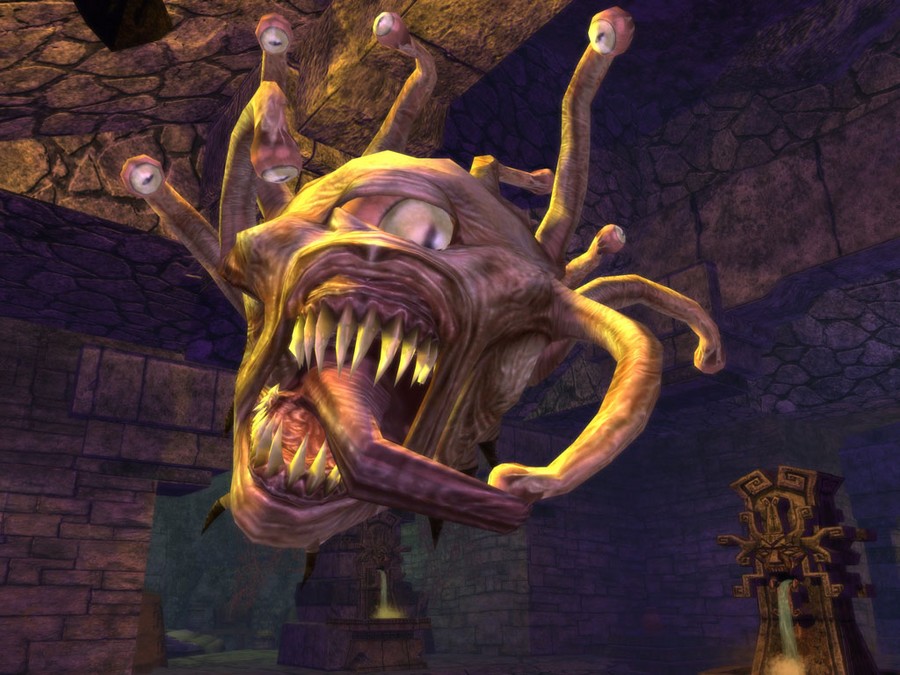
Besides traps, dungeons are populated with all manner of gross and icky critters. While you start off fighting skeletons, slimes, and kobolds, you eventually graduate to some of the archetypal monsters of the Dungeons and Dragons product line. They're smart, too, with even the dim-witted kobolds doing their best to dance outside the range of your swordarm. You get real satisfaction from slaying enemies in DDO, both because they're a real challenge and because you can stop clicking for a little while. What you don't get is XP. Experience points are only handed out at the end of the mission, when quest objectives are completed. While some missions may have a subquest asking you to slay x number of monsters in the dungeon, each individual kill nets you nothing more than a clear hallway. I'm pretty ambivalent about this design decision. On the one hand, I like that they're emphasizing the quest instead of bashing in a kobold's brains. On the other, I don't feel quite the surge of success for whacking the baddie I might get in another game. Additionally, since the quests are so blah the XP I receive for completing them seems ill-gotten somehow. It's a toss-up, but it mostly feels like they made this decision just to be different.That XP is put towards your next level, as with all MMOGs. There is a difference here, though, in that each level is a very long time coming. You do gain in power on a semi-regular basis, but instead of gaining a level you gain a rank. Each level is broken down into four ranks, waypoints along the road to your next level. Each rank nets you an action point, which can be spent on a character enhancement. Every race/class combo has different enhancements available to it, and all of them increase specific aspects of your character abilities. (+3 to Search, for example.) With every level being a major milestone, it won't come as a surprise that there aren't that many to gain. At the moment DDO only allows you to achieve level 10, rank 4. You can go no higher than that, but there are plans in the works to add level 11-20 content at a future date. For most normal players this will take a while; the much loved experience penalty is enacted if and when you wipe. If you die and other folks are still alive, they can take you to a resurrection shrine in the dungeon to revive you. Rest shrines are usually nearby these areas, allowing characters to regain hit points and mana mid-dungeon. Besides these rest shrines, the only way to heal HP in-dungeon is with a potion or clerical spell. I hate hate hate almost everything about these design decisions. In reverse order: Long downtimes suck. HP and MP not regenning sucks. It is not fun to sit in an inn after a mission is over watching my hp bar creep upwards. You can buy food and drink to improve this rate of regen, but it's nothing like the regeneration you'd see in other modern MMOGs. Experience penalties are evil. Taking away accomplishment from a player is the worst thing you can possibly do. It's not as harsh an experience as you'll get in FFXI, but it's still frustrating to have XP taken away because of something you may not have even had control over. Finally, their decision to ship with only ten levels is a very bad one. I'll expand on why that is below.
You'll note I've usually said 'you' when talking about gameplay, but that's misleading. I should be saying 'you and your party', because in order to play DDO you'll have to be grouped. I'll say that again so you can be clear on this: It is not possible to play Dungeons and Dragons Online solo. The intention, of course, is to evoke the flavour of a table-top session. The publisher has even included voice chat as a built-in feature to the game client to facilitate team communication. The result is a title that you cannot play alone. Some classes, like spellcasters and rogues, will have trouble soloing even the introductory quest when you first get off the boat. Clerics are probably the best soloing class, as they can heal themselves most effectively, but after the first few 'figure out the game' dungeons they're outmatched by the strength of most monsters. I can't really fault them for deciding to go this route, but it's a very harsh line. Even Vanguard, the upcoming hardcore MMO being designed very specifically with grouping in mind, is said to have something like 15% of its content geared for solo players. There isn't even that much for the individual in DDO.
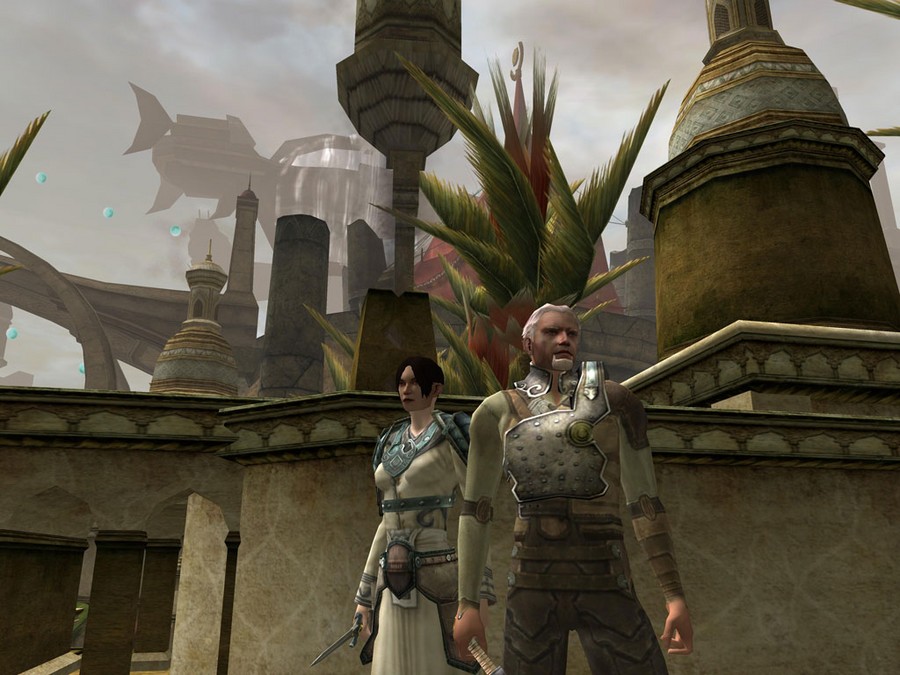
The one thing I can say without prevarication is that Dungeons and Dragons Online looks good. The streets of Stormreach are beautifully laid out, with a style of architecture that really gets across the character of Eberron. A floating inn out over the water is just the tip of the iceberg; DDO has a truly unique look. Character and monster animations are well done, and the soft lighting that pervades the game gives an otherworldly charm to the title. The visual look does more than anything else to establish the character of the dungeons and city streets you'll be exploring. The sound situation has likewise gotten a good deal of attention, but the results there seem merely adequate. Sound effects are competently accomplished, and the musical track highlights game moments without being offensive. There is 'combat music', though, which I'm already tired of. Combat music is fine in a single-player RPG, but FFXI is the only MMOG in which I find that acceptable.
Another website is quoted in a DDO television commercial as offering "A Genuine Online D&D Experience". Whoever it was that came up with that piece of pabulum has never actually played Dungeons and Dragons. Table-top D&D is about storytelling, camaraderie, and having fun with your friends. Somehow in the brave new electronic frontier, these qualities are translated into meaningless grind quests, chaotic click-fest combat, and swearing over voicechat. I'm enormously frustrated by DDO because there is just so much new and interesting going on here. The skill use and traps are real firsts for the genre, providing meaningful player choice in how to navigate a dungeon and how to do combat. These awesome mechanics are sandwiched side by side with other elements that seem more appropriate for launch-day Ultima Online. There are so many contradictions within this game that it's hard to know which is most confusing, but I have a top pick. For those who will like this game, they're going to just eat this thing up. And when I mean eat it up I mean "grind through the game in about a month or two". There were already characters at max level before the game's headstart event had finished out. Whoever did that payed about fifty bucks for ten days or so worth of play. They undoubtedly started a new character, but because of the simple questing structure there's almost no replay value currently in the game. Thankfully not all is doom and gloom. Turbine just announced that they're already planning to add 15 new dungeons and a raid on a dragon's lair in April. That commitment to new content is the going to be the only thing keeping the hardcore around because there is nothing at all available for you once you hit level 10. There is nothing to the endgame yet; It's all still in production.
So, let's review: The game isn't for the hardcore because they'll eat the content too quickly. It's not for the casual gamer because it's impossible to play on your own. Dungeons and Dragons Online is very specifically crafted for folks playing with other people at a non-hardcore pace. And in a way I think that's a good thing. It's good they have a target audience in mind, and if I were planning on adopting DDO as my game of choice that would probably be a good description of me. Just the same, it's a very bold decision to make. Only time will tell for sure, but I have a feeling it's a decision that will come back to haunt them. In the meantime: If you've got a group of regular online gamers you play with, you and your crew should consider giving DDO a try. It's got some interesting new elements that make it stand quite apart from most other Massive games. Don't be surprised if you get bored of it sooner rather than later, but if you and your group are tired of raiding Molten Core for the hundredth time this should keep you out out of Azeroth for a month or two. Hardcore gamers should stick to whatever they're playing now. They'll eat this title for lunch and find themselves frustrated with the lack of endgame content. Casual players should just keep on moving. If you're not willing to commit the time and energy to the constant search for a group, you won't find anything to do here. At the end of the day, DDO is a game with a great deal of promise squandered by some very confusing design decisions. Now go find your DM and give him a hug. -
Dungeons and Dragons Online Beta Impressions
The NDA for the Dungeons and Dragons Online Beta is now a thing of the past. F13's piece prior to the lifting of the NDA is a good place to get started. They also have a lively discussion going, discussing all aspects of the upcoming game, which launches February 28th. From the f13 piece: "The most important thing to understand about DDO is Turbine is trying a different take on the genre. People looking strictly for a WoW clone in a D&D flavored wrapper won't find it. For some that may be a good thing, for others not so much. Oh to be sure, it has a lot of the same trappings as your previous favorite graphical-Diku-mud; after all, most fantasy computer role playing games owe a little or very large portion of their structure to the granddaddy of all pen and paper rpgs, Dungeon & Dragons. So it comes as no surprise to find this game with familiar fantasy races, defined character classes, and easily recognizable fantasy monsters, magic items and spells. But, as I have grown fond of saying these last several years, the devil's in the implementation. To that end, DDO is almost as easily defined by what it is NOT as by what it IS." -
D&D Online Stress Beta Begins
kafka47 writes "Turbine's much-anticipated MMO, "Dungeons and Dragons Online: Stormreach", is now opening up its stress test to Fileplanet subscribers. The registration is free, and it is a great opportunity for MMO and D&D fans to sign up and try out the game! Paid subscribers get a higher-rez client, but if you're curious about what DDO has to offer (and by all accounts, it's a lot) this is your chance to see it early." -
Gen Con Indy 2005 In A Nutshell
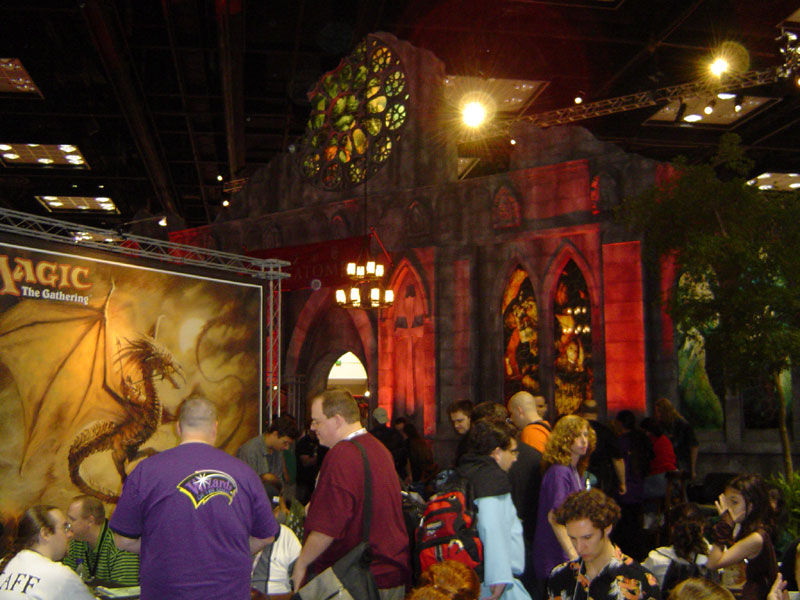
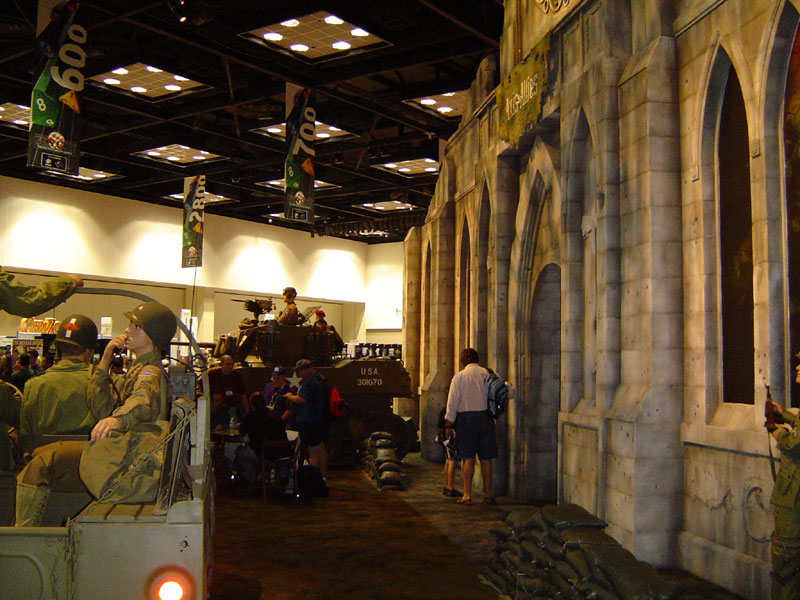
Every year, the pilgrimage to Gen Con brings tabletop roleplayers, wargamers, boardgame enthusiasts, and LARPers together for four days of unbridled nerdery. Besides participating in games, some of which have been around for decades, there are always new releases and previews to tantalize the gaming public. Gen Con is the tabletop industry's version of E3, where the year ahead is laid out by the big names. Read on for a taste of what your Friendly Local Gaming Store will have to offer in the near future. The biggest kid on the block in the tabletop market is Wizards of the Coast. Publisher of Dungeons and Dragons, D20 Modern, Magic: The Gathering, Pokemon, and the Avalon Hill stable of games, WoTC is a major sponsor of Gen Con and regularly dominates the Exhibition Hall. This year the company had a two faceted pavilion, each side themed to their major releases this year. One side was a decaying and blasphemous Cathedral, with images of demons and spirits splayed across the facade. The imposing edifice was advertising the release of Hecatomb, a somewhat unique collectable card game. Instead of the traditional cards, Hecatomb is played with semi-transparent pentagonal playing pieces. As a player, you take on the role of a Summoner of foul creatures large and small. Spirits from your hand can be played into your manapool and later tapped to fuel the summoning of other creatures. The transparent nature of the cards allows for the different beasts to be amalgamated into horrible creatures they refer to as Abominations by stacking cards atop each other. Rules text shows through the highest card to allow Abominations to combine the strength (and sometimes powers) of numerous smaller critters into a ghastly whole. The play style was very reminiscent of Magic: The Gathering, but the presentation and art gave the game a very mature tone. The quick Demo I had the chance to take in wasn't enough to make me run off and buy it, but I look forward to taking a closer look in the future.The other side of WoTC's coin was a more traditional church, albeit one broken and battered by the ravages of war. The release of the Axis and Allies miniatures game was the rationale for the theming, and the addition of several vintage military issue vehicles (an APC, a jeep, etc) on the show floor added to the atmosphere. The minis game itself received a lot of attention, as the "random pack of pre-painted miniatures" concept that Wizards has used with great success in their D&D and Star Wars lines reached a wider audience. The Axis and Allies line will invite WWII aficionados to recreate battles of the war, and engage in their own skirmishes, using a simple set of battle tactics and their miniatures. The D&D and Star Wars lines have tournament support and an avid collector base, and I imagine this series will garner similar attention.
Wizards also publishes tabletop roleplaying books, though sometimes pavilion visitors seem not to notice. The two campaign settings that the company supports most heavily right now are Ed Greenwood's venerable Forgotten Realms, and the recently minted Keith Baker world known as Eberron. Products for both campaign settings and the core Dungeons and Dragons line seem to be moving beyond some of the tried and true formulae they've used before.The core line, for example, will see the release of Heroes of Horror, a follow-up to Heroes of Battle that can be used to overlay a traditional D&D game with a horror tone. Races of the Dragon will explore dragons, and half-dragons, and kobolds but it will also contain a transformative race. IE, a race a character can become during the course of play. They're not completely breaking the mold, though, with a new Tome of Magic set to introduce some new styles of spellslinging to the core books.
The Realms will have a title called Powers of Fearun, which will discuss the impact a character can have on the Realms as a whole, given sufficient power. A new adventure entitled Sons of Gruumsh will welcome back published modules to the FR setting, and a semi-monthly column by Ed Greenwood in Dragon magazine will explore the Cities of the Realms. Companions of Valor will explore what it means to be a hero in the Realms, and grew out of the Forgotten Realms seminar from Gen Con 2004. The book will be a series of tools for PCs, ways for them to make their own name as heroes. The next Mini set, Underdark, will feature several prominent Realms personalities and monsters.
Eberron, meanwhile, moves on from the basics as the company continues to widen the world's scope. A Player's Guide to Eberron will act as a sort of gazeteer, with two page spreads on each topic, personality, or location. The guide aims to be a completely player-friendly tome that you can use to get to know the lay of the land. Magic of Eberron will delve more deeply into some of the unique arcana in the setting. Elemental bindings, Artificers, and warforged all get a look. Another adventure will be in the offing; separate from the previous three-book adventure set but with ties to it, entitled The Voyage of the Golden Dragon. Voyage will introduce a ship of war that never got the chance to be used in battle. The Golden Dragon now acts as a vessel of peace, traveling the five nation and usable as a kind of floating base of operations by PCs.
Love them or not, WoTC is a publisher of some great games. A new version of RoboRally!, and the title Monsters Menace America also made their debut this month. They're likely to continue to be one of the top names in the tabletop industry for many years to come.
Wizards of the Coast wasn't the only publisher at Gen Con this year, of course. FanPro, in association with Wizkids, put out the latest version of the magic/cyberpunk RPG Shadowrun. Now in its Fourth Edition, the setting has received its most serious overhaul to date. The basic mechanic has been reworked, major advancements have been made to the state of in-game technology, and the political boundaries of the North American Nations have been redrawn. Though the plot elements are compelling, the new simplicity of the core game mechanic will be the most widely felt change. Previous editions of Shadowrun required a player or GM to roll a number of six-sided dice equal to a skill or attribute, with the intent of hitting a target number determined by the situation. The lowest a target number could get was 2, but the sky was the limit for difficulty. The fluidity of combat often meant there would be high target numbers, which required a participant to roll a six on a die, so that the six could be rerolled and a higher number achieved. Fourth Edition does away with this clumsiness, with all dice rolled in the game now seeking either a five or a six to be determined a hit. All rolls are made with a number of dice equal to the requisite attribute + skill combination. Penalties result in fewer dices being rolled at the outset, and the GM is encouraged to assess penalties on the fly rather than being confined by arcane tables. The simplicity of this mechanic allows for the GM to gain a better grip on the fast and loose nature of combat in the real world, the astral plane, and the virtual reality of the Matrix. Speaking of the Matrix, the most important plot change is probably the advent of a wireless Matrix. The old "decks" have been removed in favour of an Artificial Reality overlay to normal vision. This requires computer criminals to come on-site with the rest of the Shadowrun team in order to participate, and opens up the role of the hacker in the game to a previously unknown degree. I've been playing Shadowrun for 15 years now, and I'm very excited about the changes this latest edition have brought around. Here's hoping FanPro follows up the new edition with some material that allows us to better come to grips with the setting changes.
Recent years at Gen Con have seen video game publishers arriving to show off their work as well. NCSoft has been a presence at the con since the release of City of Heroes (partially because of Jack Emmert's background in the tabletop industry). This year all they really had to show was the City of Villains character creator, and not even all of it. All the action was over at the booths occupied by Blizzard and Atari.Dungeons and Dragons Online is still something of an enigma. While the closed Beta recently got underway, there are still too few firsthand experiences out there to really get a sense of what the game as a whole will be like. I had a chance this past weekend to get a feel for what the dungeon-crawling experience will be like, though, and I was very surprised by what I saw. Given the nature of online games, I've come to expect a level of abstraction in the mechanics. DDO was incredibly hands on, and in many ways felt like a single-player mission that you really wanted some help on.
Talking to a villager netted my cleric a quest, a trip into the Maw of Xoriat. Immediately I saw that they are aiming for a unique feel, as each mission had a time limit associated with it. If you didn't complete the mission in time, you would be unceremoniously summoned back to the village. Entering the crypt, there were several sarcophagi that could be interacted with. Swinging his heavy mace, my cleric smashed through the rock exteriors to get at the sweet loot within. Looking down a corridor, I was presented with a series of traps. A pair of swinging blades blocked my pack on either side of the hallway. Good timing was required to make it past without taking damage. Further down the hall was a series of large blades which snapped up from the floor in quick succession. When one set of blades was up, another was down, allowing the observant player to pick a path through the blades. If I'd had a rogue in my party, she could have disarmed the traps and allowed us to pass without having to deal with them.
Moving through the dungeon, I encountered various beasts and undead. Combat was realtime, with a clickyness that satisfied. A notification in the corner allowed you to follow along with the dice rolls and Challenge Rating of the creature you faced, if you were so inclined. Besides satisfying thwacks with my mace, I was able to counter the creatures by turning undead and flame striking the creatures with magic. One flame strike near a locked doorway revealed that the doors are as destructible as the crypts. A team without a rogue can bash through an impediment, assuming they have a strong enough fighter or a well equipped spellcaster. The whole experience had interesting little touches, such as a perverted altar that was cleansed by a use of the turn undead class ability. In a nod to gamers of all stripes, one room had me utilizing a simple version of the 'Pipes' game to allow magical energy to flow across the room. The energy stemmed from a source in the floor, and tiles around the room had grooves in them which allowed the mana to flow. By right clicking on the tiles, I could rotate them such that they formed pathways. While my time with DDO was relatively short, I found the entire experience much more interesting than I'd originally thought it would be. The near constant attention at their booth led me to believe others had the same impression.
Blizzard also had no trouble keeping their booth full, with machines allowing play of World of Warcraft (and several 60th level characters to tool around in) and StarCraft: Ghost. I'd yet to have the opportunity to try out Ghost, so I gave the tactical shooter a try, on the XBox. My reactions were, unfortunately, somewhat mixed. While the overall Starcraftyness of the experience was very enjoyable, the actual gameplay left something to be desired. Squishy controls, simple tactics, and a lack of polish on the game made it hard for me to fully understand what the title will look like when it is released. In the demo level I played, Nova stalked her way through a Terran base already overrun by Zerg. The Zerglings where just as fast and ferocious as you'd hope, and actually walking through a Zerg structure was stomach clenching. The scenery was nice, but the gameplay needed help. I'm sure that when the title is released (whenever that will be) there will be little to complain about, but the rough demo I saw this past weekend didn't have enough "there" there to give me an accurate impression.
Anyone familiar with tabletop roleplaying has likely heard of Vampire: The Masquerade and White Wolf. Two years ago at Gen Con they re-launched the World of Darkness and rebooted all of their campaign settings. This year's con saw the relaunch of the magic-bound title Mage. This time appended with the subtitle "The Awakening", the new version of the game takes a serious textual shift away from the old version of the game. While the original Mage was a grand tapestry of gifted individuals making and unmaking the very fabric of reality, the new Mage is a much more accessible storyline. There are now distinct spells used by Mage characters, a backstory involving the continent of Atlantis, mana points as a game mechanic, and an elimination of the inherent conflict between magic and technology. I'm just going to come out and say that, while I like the new World of Darkness game mechanic and think White Wolf is doing interesting things with their old brands, this particular relaunch is a kick in the face to old Mage players. Mage was a fundamentally different game from every other title in their library, and a change a pace from most titles on the market. By reorienting it with the "vision" of the other World of Darkness lines they've essentially gutted everything that was special about the setting. I'm not really a big fan of this decision.
Two board games that have gained a lot of attention recently, and with good reason, were shown off at the convention this year. Shadows Over Camelot and Arkham Horror are examples of some of the new ideas that are entering the boardgame market. Five years ago you had to buy a German title in order to get a great adult boardgame experience, but today Days of Wonder allows the same enjoyment factor with their Arthurian style epic. In Shadows Over Camelot, you take on the role of Knight of the Round, fighting dark knights, dragons, questing for the grail, and holding off the barbarian hordes. The game is cooperative but doesn't allow totally free communication between players, so the title encourages creative collaboration on the numerous quests that knights can go on. For example, in order to obtain Excalibur a knight or knights must travel to the Lady of the Lake's lake and each round expend a card in order to make the sword draw closer to the shore. In the meantime, as each player goes a "bad things" card is pulled. One of these types of bad things makes the sword float away from the shore. While one player can often keep the sword from floating out of sight, in order to actually obtain the relic several knights must collaborate to assure victory. The game also incorporates subterfuge, by allowing for the possibility of a traitor in your midst. The traitor will actively work against the other players, seeking to destroy Camelot for his own victory. A complex title with easy to understand rules, Shadows Over Camelot is a great way to makes sure you stay friendly with your friends.Indeed, if you are looking for cooperative games this is a good year to do it. Arkham Horror, from Fantasy Flight Games, also allows players to band together against a common foe. In this case, players take on the roles of investigators into the occult. There are many characters to choose from, and each has a special quirk. As your character, you and the other players work together to ensure that the arrival of a Great Old One does not occur. Based loosely on the works of H.P. Lovecraft and the roleplaying title Call of Cthulu, Arkham horror pits you against things from beyond our ken as they enter our world through mystical gates. In order to ensure the survival of the town of Arkham, MA, investigators must slay the creatures as they exit the gates. Once the path is clear they must enter the mystic realms, where they have otherworldly encounters of the horrifying and fantastic. If they are successful there, they can return to the village and seal off the gate. Changing conditions in the village constantly keep the gameplay from getting stale, and after only a short time there will be monsters a-plenty to challenge even the largest group of investigators. This Call of Cthulu in-a-box is a thoroughly enjoyable experience, and another way to make sure you do more than just frag your friends on the weekends.
There are literally hundreds of new products shown at every Gen Con, and I couldn't hope to explore them all. Dice Boxes, card games (including a World of Warcraft CCG), roleplaying games, boardgames, and virtual reality games were all shown off to the general public for the first time this past weekend. Every year is a different experience, and I've always had the opportunity to look back and say that it was worth the trip. This year was especially meaningful, as I was wed to my fiancee Katharine on the 13th. Though Gen Con wasn't our honeymoon (we're not that dorky), we did have the chance to be serenaded by a Klingon and his Vulcan wife in honor of our union. There are few places in the world where such a thing could be experienced, and I'm already looking forward to next year. -
MMORPG Circle of Life
The Massive Gaming market continues to change. Wednesday marked the sunset of Earth and Beyond, a decision made by EA back in March due to a refocusing on future projects. While E&B heads out of the picture, the new French MMOG Saga of Ryzom opened its first US server this week after a lengthy beta period. Impressions of the game are available at Gamebunny and MMORPGDot. And looking towards the future, the Dungeons and Dragons Online website just went live yesterday.