Slashdot Mirror
Domain: debtdeflation.com
Stories and comments across the archive that link to debtdeflation.com.
Comments · 52
-
Re:demagogic nationalistic mercantilist nonsense
You are likely immune to arguments that oppose your dogma, so I mostly don't bother. Doesn't mean that I can't. When you are done reading the Bastiat that I linked before, ponder on Mr. Keen's writings:
http://www.debtdeflation.com/b...
Google "photos of detroit" if you want to see the real-world applications of Keen's ideas. Or replace "detroit" with any of dozens of rust-belt cities and towns. A widespread failure to comprehend this is what sealed Trump's victory.
If you don't understand the depth of your dogma, consider that what you call "industrial bribery" and "stealing" is merely the government taking slightly less than it said that it was going to. You should be fucking ashamed of yourself for perpetuating that moral inversion. But you aren't. You are smug, convinced that the latest fad in economics, what you call "free trade" without any comprehension of the irony, is the ultimate and final truth of the universe.
And if, a month ago, you imagined yourself to be a conservative who wanted government to get out of the meddling business, double shame on you.
-
Re:Go after the real thieves lol
Nope. US Fed did what is required from the start, so the recession in the US turned out to be far more shallow than in Europe (where the ECB blundered for several years). In Japan it's the contrast is even more stark - after a decade of slow stagnation and deflation (or near-deflation) they started growing almost immediately after the central bank and the government decided to be 'irresponsible'.
And yet Australia, which gave cash to tax payers instead of bank managers, did even better. But even though Australia completely avoided a technical recession, all they have done is delay the inevitable.
When you start modelling money and debt, global economies still look very sick indeed.
-
Re:how many products?
The problem with Bill Mitchell's approach to monetary theory (Chartalism), is that it is focuses on public debt when it's the inevitable deleveraging of private debt that cause recessions and depressions. Given, it may be a workable approach, but it's not very direct. Steve Keen, on the other hand, focuses directly on the role of private debt in the macroeconomy. He's currently working on a dynamic model fully capable accurately simulating booms, recessions and depressions in all their glory, and he already has some very instructive models. You can check out his blog here, his "manifesto" here, and his research papers here.
-
Re:how many products?
The problem with Bill Mitchell's approach to monetary theory (Chartalism), is that it is focuses on public debt when it's the inevitable deleveraging of private debt that cause recessions and depressions. Given, it may be a workable approach, but it's not very direct. Steve Keen, on the other hand, focuses directly on the role of private debt in the macroeconomy. He's currently working on a dynamic model fully capable accurately simulating booms, recessions and depressions in all their glory, and he already has some very instructive models. You can check out his blog here, his "manifesto" here, and his research papers here.
-
Re:Wow.
-
Re:Wow.
A perspective on Australia's government debt and spending based on average trends.
For some more depth on the dynamics of the economy and how governments should react to crisis, I'd suggest reading some of Steve Keen's research in this area. -
Re:Transactional Currency, not Safe Haven Storage
And yet this massive increase in m0 has had no impact on any other measure of the money supply. Nor has it had much impact on the general health of the economy.
-
Re:Transactional Currency, not Safe Haven Storage
And yet this massive increase in m0 has had no impact on any other measure of the money supply. Nor has it had much impact on the general health of the economy.
-
Grab monetary policy from the private bank system
Start using money creation for funding government instead of giving private banks exclusive use of it, and limit government spending based on hitting the inflation target; you can pay for this and much more beyond it.
I know neoliberals/neoclassicists/libertarians will skewer me for even suggesting this (and will probably get downmodded to hell), and I know 'conventional knowledge' says using money creation for funding is an unspeakable evil, but when you break this taboo and purposely limit spending by the inflation target, it transforms much of what people think they know about economics.
Post Keynesian's, like Steve Keen (the only person to both predict and model the current economic crisis before it developed), Stephanie Kelton, and Bill Mitchell (among many others), are going a long way towards dragging economics out of the dark ages, and towards developing it into a proper science.
It's quite hard to believe that economics, in its current neoclassical form, has survived the economic crisis and is still taken credibly; virtually the entire field outside of heterodox schools, failed to spot something as blindingly obvious as private-debt vs GDP, as a massive indicator of an upcoming crisis.
-
Re:Economics - Simple Vs Complex system modelling
Better link to the google talk by Steve Keen. and the short intro video "Minsky, turning economics into a science".
-
Economics - Simple Vs Complex system modelling
Wonder if the RBA will now start listening more to one of Australia's most forward thinking economists, Dr Steve Keen. Surprisingly, the vast majority of economist model "the economic system" based on simple linear assumptions. Steve Keen is trying to change all that by modelling the economy for what it is: a complex system. (See this short intro video). It is amazing the amount of flak he gets for applying complex system modelling techniques to the world of economics... (see some of his arguments with Krugman)
Here is a link to a presentation Dr Keen gave to google, interesting stuff.
-
Re:Basis of the US economy
This is a problem with the US economy in general - it is based on growth.
Can you name an economy that is based on anything but growth?
Those European/Asian countries that have been around for thousands of years are more stable, and have economies based more on sustainable goods and services.
Which ones? Germany and China? Seriously? Sorry, but no. Both are driven by exports and excess savings, and they recycle profits by lending the latter to their customers. If their customers default (and they probably will) and set up stiffer trade barriers (which they likely will too), they'll tank... Hard... Much harder than economies that traded goods and services for funny money. Oh, and they both have major demographic problems due to low birth rates. And China additionally has a major rebalancing problem on its hands.
One of the main economic numbers that drives the US stock market is "new housing starts" - a number based solely on having the population continually increasing.
I suspect that Bernanke has a lot more to do with it than you suggest. He's continuing to inject liquidity into the banking system. Since the money isn't getting lent out to businesses and consumers, it needs to go somewhere, and that somewhere happens to be asset markets.
Once that slows down - and can't even be propped up by the banks fudging mortgages - the entire country is headed for a depression.
The entire country is likely headed for a depression no matter what.
-
Re:Question for economics wonks
Merely alleging that double entry bookkeeping creates money doesn't make it true
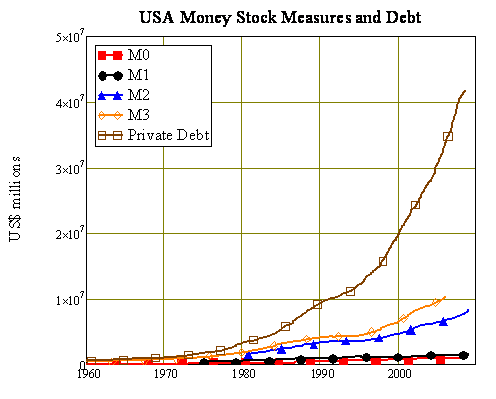
I'd suggest you read this. And pay particular attention to this graph that compares the level of debt, issued by banks, with other supplies of money.
Credit issued by banks, completely dwarfs all other forms of money in the economy.
-
Re:Question for economics wonks
Merely alleging that double entry bookkeeping creates money doesn't make it true
I'd suggest you read this. And pay particular attention to this graph that compares the level of debt, issued by banks, with other supplies of money.
Credit issued by banks, completely dwarfs all other forms of money in the economy.
-
Re:Question for economics wonks
The biggest force in the economy, is the acceleration in the total level of debt. When it's accelerating, we're having a boom. When it's decelerating, we're in a slump.
Collectively spending more than we earn on credit causes a boom. Living within our means and paying off our debts causes a slump. At least when the level of debt is as high as it is these days. When you add the change in debt to GDP for the US, you can easily see the effect of the big slump in 2008.
It's not hoarding that causes deflation, or vice versa. Sure the velocity of money goes down, but that's because people are spending less than they earn and are trying to pay off their debts. They aren't just holding onto the cash.
-
Re:Stupid thieves
storing people's deposits that are not to be loaned out and making loans with deposits that can be loaned out, where the client of the bank is informed that his deposit is partially loaned out but he is making some interest on it
If banks actually worked that way, sure. But they really don't. Banks create a loan and a deposit *at the same time* through the magic of double entry book-keeping.
-
Re:economics ?
Nobel prize in economics.
that's Nobel prize in pseudo-science.
Agreed. But you might want to check recent developments introduced by outcasts.
Steve Keen's research, in particular, is by no means pseudo-science. He teaches finance in Sydney, and he's mostly known throughout the profession for his book, titled "Debunking Economics". His reasoning and methodology are mostly impeccable (my understanding is he was an engineering before he looked into economics).
He has a YouTube channel where he posted his lectures from earlier this year. Highly recommended if you've a few evenings to spare. The first 6 or 7 are about why economics is shite; the later ones are about building new models from the ground up.
http://youtube.com/profstevekeen
And a blog:
-
Re:Good luck with all that, you idiots ...
The financial crisis is hitting us right now. Our housing bubble has started its decline, and almost nothing will prevent it. Another first home owners scheme? Not going to work this time.
Mark my words, the worst of this crisis is still to come.
-
Re:Didn't the chinese adapt cracking from the Stat
Some, like the Australian Steve Keen, is working on creating actually testable theories and models. Thing is tho that modeling economies is a bit like modeling weather, as there are several feedbacks involved.
http://www.debtdeflation.com/blogs/
I hope his blog can take being linked to on slashdot...
-
just leaving this here...
-
Re:Fact-based solutions already exist
I made none of those claims.
As for economics being wrong:
http://www.debtdeflation.com/blogs/2011/08/04/behavioral-finance-lecture-01-debunking-revealed-preference/
http://www.debtdeflation.com/blogs/2011/08/12/behavioral-finance-lecture-01-debunking-demand-and-supply-analysis/
http://www.debtdeflation.com/blogs/2011/08/17/behavioral-finance-lecture-03-debunking-capm-and-conventional-behavioral-finance/ -
Re:Fact-based solutions already exist
I made none of those claims.
As for economics being wrong:
http://www.debtdeflation.com/blogs/2011/08/04/behavioral-finance-lecture-01-debunking-revealed-preference/
http://www.debtdeflation.com/blogs/2011/08/12/behavioral-finance-lecture-01-debunking-demand-and-supply-analysis/
http://www.debtdeflation.com/blogs/2011/08/17/behavioral-finance-lecture-03-debunking-capm-and-conventional-behavioral-finance/ -
Re:Fact-based solutions already exist
I made none of those claims.
As for economics being wrong:
http://www.debtdeflation.com/blogs/2011/08/04/behavioral-finance-lecture-01-debunking-revealed-preference/
http://www.debtdeflation.com/blogs/2011/08/12/behavioral-finance-lecture-01-debunking-demand-and-supply-analysis/
http://www.debtdeflation.com/blogs/2011/08/17/behavioral-finance-lecture-03-debunking-capm-and-conventional-behavioral-finance/ -
Re:Some notes on Marx and capitalism
Marx did question having Russia bootstrap from Monarchy directly to communism. Also, for Marx communism was just a stepping stone towards true socialism. And it required the industrial buildup that capitalism provided. This to provide the production capacity to cover the basic needs of the people.
Still, there is as least one person that have taken a serious look at Marx and found him overlooking the effects of industrial machinery. Or if not overlooking, at least not talking about it enough so that later persons building on his writing have ended up focusing too much on the worker and not enough on the industrial machinery.
-
Re:Why? Bitcoin and Slashdot?
-
Re:Timeless BS
Freud may have been smoking something in addition to cigars (but he still managed to awaken interesting in workings of the mind), but Marx seemed to have been on the right track. Sadly Marx managed to sidetrack himself by focusing too much on the worker and not enough on industrial machinery.
-
Re:This is *NOT* capitalism
You want to know what drives the employment level in the economy? The acceleration in the level of debt.
-
Re:Better yet: stop using debt as money
You are confusing a stock (debt) with a flow (income). It is quite possible for money to circulate around the economy more than once in a year. Assuming bankers spend the money they make from interest, it is entirely possible for debt's and interest payments to reach an equilibrium in the economy without the continual creation of new debt. See the video from Why credit money fails linked earlier for more details and simulations of such a working economy. Of course it never works in practice because bankers are greedy.
-
Re:On the subject of economics and money...
Steve Keen knows his stuff. I highly recommend his blog to anyone interested in economics, even though I disagree with several of his conclusions and proposals.
He was recently able to give the full (long) version of his standard presentation in Michigan. Go watch it. http://www.debtdeflation.com/blogs/2010/11/15/why-credit-money-fails/
-
On the subject of economics and money...... I highly recommend people read up on the work of Steve Keen.
a professional economist and a long time critic of conventional economic thought. As well as attacking mainstream thought in Debunking Economics, I am also developing an alternative dynamic approach to economic modelling. The key issue I am tackling here is the prospect for a debt-deflation on the back of the enormous debts accumulated in Australia, and our very low rate of inflation
-
Re:As the economy improves???
Well, yes. Without the massive government response around the western world, things would be much bleaker.
Since the 80's banks have been lending money mainly using existing assets as security. When you go to an auction, the price of a house was set such that the interest burden was roughly equivalent to the cost of rent.
As interest rates have fallen all this has done is encourage buyers to borrow more while paying the same amount of interest.
Rising asset prices encourages "investors" to get into the market to make some easy money.
But all this did for the last 30 years was give everyone the illusion of wealth. Borrowing money against their asset value, where that value was based on how much people were borrowing. Increasing debt levels without doing anything productive with the loaned money.
Just before the party ended, the private sector of the US economy was borrowing $4 trillion a year. Adding significantly to demand, and dwarfing any amount spent by the government.
So now that party has finished. Debts are being repaid (or defaulted), and this reduction in debt is now subtracting from our ability to spend.
However it's not the change in debt that gives us the feeling of growth / recession. Just like in a car, it's the acceleration that you feel. The "credit impulse" that has a direct effect on GDP and employment. And right now, though the level of debt is still falling, debt growth has accelerated slightly. Giving economists the impression that we're out of the woods, and all our problems are behind us. (Steve Keen explains this idea in more detail here)
But we still have a mountain of debt to repay.
-
Re:YOUR tax dollars is paying for it
The party is already winding down.
-
Re:Business basics
Lack of demand is why unemployment won't go down, and demand driven by credit is unlikely to recover any time soon.
Bingo. Increasing demand creates jobs. Demand can be calculated by summing income (ie GDP) plus change in debt, if you borrow money and spend or invest it this increases demand. Therefore the change in demand can be calculated by measuring the change in GDP plus [change in [change in debt]]. So if you want to know what the employment situation will be like, look at the acceleration of the aggregate debt level. In the last year, total demand dropped about 17% in the US, so I wouldn't hold out much hope for employment getting any better in the near future.
-
Re:How secure
And of course our current financial system isn't really based on fiat currency. The lions share of the "money" in circulation has been created through the issuing of credit from banking institutions.
-
Re:The problem is not an efficient algorithm
-
Re:The problem is not an efficient algorithm
-
Re:I for one...
I don't believe in Austrian economics, I don't think they are right. The problem with monetary instability goes deeper than to FRB, it goes (I believe) as far as to lending for profit.
Steve Keen has a nice theory (developed from Minsky) about this. I don't have much time to explain, but you can find his blog at http://www.debtdeflation.com/
He notes, for example, that changes in M2 are preceeding changes in M0 (which by itself invalidates Austrian theory, by the way). Which means that commercial banks increase debt first, and then come to central banks asking to cover it. If we hadn't FRB or central banks would refuse to cover this additional debt, then you would have a credit crisis. But not always the debt is unsustainable - if you have real growth, then growth in debt can be sustainable. That's the basic advantage of FRB with respect to gold standard - unlike gold standard, FRB can adapt money supply to finance real growth. With gold standard, it pays off to hold on money during real growth, because money increase value, and it means nobody wants to invest. But they are both inherently unstable, because the debts can grow even if there is no corresponding real growth.
-
Re:Get rid of Economic Man
Along this vein I can highly recommend reading the works of Steve Keen. Who has been pointing out the flaws in "neoclassical" economics for years, and had no trouble predicting this economic collapse.
-
Re:Get rid of Economic Man
Along this vein I can highly recommend reading the works of Steve Keen. Who has been pointing out the flaws in "neoclassical" economics for years, and had no trouble predicting this economic collapse.
-
Re:Surely not?
Here's the main problem. Most of the people working in economics don't have a clue how the economy actually functions. They didn't predict this crisis, and they are still saying we are going to recover soon when the data really doesn't support that point of view. I've been reading Steeve Keen's blog for a couple of years. He did see this coming, and his predictions of just how bad this will turn out have been holding so far.
I would really like things to go back to how they were in the 30's to 50's in terms of legislation. Back then everyone remembered the Great Depression, and people had a much better understanding of the risks of widespread leverage. But since that generation died out we've been convincing ourselves we know better and have repealed all the laws that held the financial / banking system in check.
-
Re:Picking up nickels in front of a bulldozer
It's only a "black swan" if you ignore debt levels. Anyone who's been watching the growth of debt in western economies could see this crisis coming.
-
Re:Picking up nickels in front of a bulldozer
It's only a "black swan" if you ignore debt levels. Anyone who's been watching the growth of debt in western economies could see this crisis coming.
-
Re:Wow!
-
Re:Wow!
Yeah he gets pretty worked up. And the maths he tries to use is too complex for most economists to follow. But that's the point. Economists make far too many assumptions about the world that are just plain wrong. And when the world doesn't behave like their model they assume the world is wrong. They assume everything would have turned out ok if only people understood their models better.
-
Re:Wow!
Yeah he gets pretty worked up. And the maths he tries to use is too complex for most economists to follow. But that's the point. Economists make far too many assumptions about the world that are just plain wrong. And when the world doesn't behave like their model they assume the world is wrong. They assume everything would have turned out ok if only people understood their models better.
-
Steve Keen
I'm been reading this guy's blog recently, and he has some interesting thoughts on why economists didn't predict the global financial crisis, and how their approach is completely wrong. He's an academic at an Australian university whose predictions of late seem pretty damn close to the truth. He puts together economic models using differential equations - an approach that seems to be very different from most other economists. He essentially says that excessive private debt is to blame for our economic problems.
http://www.debtdeflation.com/blogs
Here's two of the more interesting entries:
DebtWatch - Oct 08
DebtWatch - Dec 08 -
Steve Keen
I'm been reading this guy's blog recently, and he has some interesting thoughts on why economists didn't predict the global financial crisis, and how their approach is completely wrong. He's an academic at an Australian university whose predictions of late seem pretty damn close to the truth. He puts together economic models using differential equations - an approach that seems to be very different from most other economists. He essentially says that excessive private debt is to blame for our economic problems.
http://www.debtdeflation.com/blogs
Here's two of the more interesting entries:
DebtWatch - Oct 08
DebtWatch - Dec 08 -
Steve Keen
I'm been reading this guy's blog recently, and he has some interesting thoughts on why economists didn't predict the global financial crisis, and how their approach is completely wrong. He's an academic at an Australian university whose predictions of late seem pretty damn close to the truth. He puts together economic models using differential equations - an approach that seems to be very different from most other economists. He essentially says that excessive private debt is to blame for our economic problems.
http://www.debtdeflation.com/blogs
Here's two of the more interesting entries:
DebtWatch - Oct 08
DebtWatch - Dec 08 -
Re:Wow!
Another great evangelist for change, an economist who foresaw this crisis; Steve Keen.
-
Re:It's *money* which is the Ponzi scheme
Nope, that's not quite how it works either since you missed the part where the bank borrowed some amount (say $10) to cover your loan from the FED or overseas, and you deposited (or spent and the seller deposited) that $100 into another bank account. I suggest you read The Roving Cavaliers of Credit recently written by Steve Keen, which explains how a pure credit economy can function and how it can fail.