Slashdot Mirror
Domain: devx.com
Stories and comments across the archive that link to devx.com.
Stories · 27
-
Code Repository Atlassian Buys Competitor BitBucket
Roblimo writes "Wow. Atlassian sent press releases out about this, and we're happy for them. But isn't Git easy to install and use — for free, even if your project is proprietary and secret, not open source and public? Whatever. Some people seem to feel better about proprietary software than about FOSS, and the majority of Atlassian's business comes from meeting the needs of behind-the-firewall, proprietary code repositories. At least Atlassian has free versions of its repository for FOSS and small-scale proprietary developers. Which is sort of nice." -
Can an Open Source Map Project Make Money?
Roblimo writes "Bing and Mapquest both use output from OpenStreetMap.org. Mapquest supports the project with money for equipment and access to the code they've written to integrate OSM's work with their display. Bing? They just take from the project and do nothing for it in return. This may be okay in a legal sense, but it is a seriously nekulturny way to behave. Even so, having Microsoft's Bing as a reference might help the project's founder make money. They've put a lot of work into this project, and it's doing a lot of people a lot of good, so they certainly deserve some sort of payback, either direct or indirect. They have a few ideas about how they might legitimately earn a few bucks from their project while remaining free software purists. Do you have any ideas, yourself, about how they might turn a few bucks from OSM?" -
Net Neutrality — Threat Or Menace?
Roblimo writes "I had a dream. In it, I was CEO of a large telecommunications company that was also a major broadband Internet provider and all five members of the FCC were stabbing me with pitchforks and yelling in my ear that my company would be treated as a common carrier, not as a special entity they couldn't regulate. That's when I woke up..." -
Frank Zappa's Influence On Linux and FOSS Development
Roblimo writes "Zappa's 'Dinah-Moe Hummm' is totally about Linux, at least in spirit, while the song 'Montana,' with its talk of zirconium-encrusted tweezers and dental floss, 'is obviously about Mac users.' Not only that: In the early '70s Zappa wrote a song called 'Penguin in Bondage,' an obvious foretelling of the anti-Linux lawsuits and threats from SCO, Microsoft, and other evildoers. Zappa was also a heavy user of the Synclavier, an electronic music machine that was a precursor to today's 'studio on a computer' recording and sound editing software. According to an article on DevX, today Zappa would no doubt be using Linux and Ardour for most of his recording and composition." -
Bjarne Stroustrup On Concepts, C++0x
An anonymous reader writes "Danny Kalev has an interview with Bjarne Stroustrup about the failure of concepts, the technical issues of concepts, whether the ISO committee's days are over, and whether C++ is at a dead-end. 'I don't think that concepts were doomed to fail. Also, I don't think concepts were trying to fix many things or to transform C++ into an almost new language. They were introduced to do one thing: provide direct language support to the by-far dominant use of templates: generic programming. They were intended to allow direct expression of what people already state in comments, in design documents, and in documentation. Every well-designed template is written with a notion of what is required from its arguments. For good code, those requirements are documented (think of the standard's requirements tables). That is, today most templates are designed using an informal notion of concepts.'" -
Will Oracle Keep Funding Sun's Pet Java Projects?
gkunene writes "Oracle expects Sun to contribute to its operating profit right away. To make that happen, Oracle may pull funding and staff from projects such as JavaFX, Project Looking Glass, and Project GlassFish." -
Will Oracle Keep Funding Sun's Pet Java Projects?
gkunene writes "Oracle expects Sun to contribute to its operating profit right away. To make that happen, Oracle may pull funding and staff from projects such as JavaFX, Project Looking Glass, and Project GlassFish." -
Interview Update With Bjarne Stroustrup On C++0x
An anonymous reader writes "DevX interviewed Bjarne Stroustrup about C++0x, the new C++ standard that is due in 2009. Bjarne Stroustrup has classified the new features into three categories: Concurrency, Libraries and Language. The changes introduced in Concurrency makes C++ more standardized and easy to use on multi-core processors. It is good to see that some of the commonly used libraries are becoming standard (eg: unordered_maps and regex)." -
Intel Chief Evangelist Comments on Linux Scheduler
ByeByeWintel writes "James Reinders is Intel's Chief Evangelist for Intel's Software Development Products. In a recent interview on Devx.com he stated: 'If I could get ONE wish fulfilled would be for OS scheduling to focus on processes, and not threads, for scheduling. And demand that processes manage their scheduling of threads ... There is a lot of opportunity for operating systems to offer these types of control in the 'running of applications' interfaces. I'd like an OS to let me specify the 'world' my application runs in (which processors, how many, etc.) These interfaces are available in Windows at run time (the task manager will let you adjust where a running task can go).'" -
Eolas vs. Microsoft Lawsuit Settled and Sealed
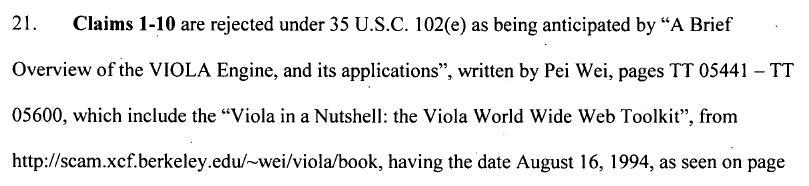
theodp writes "The Seattle P-I's Todd Bishop reports that Microsoft has settled its 8-year-old web browser plug-in patent dispute with Eolas. The spat begat the click-to-activate Web after Microsoft was slapped with a $500+ million patent infringement judgement. Neither Eolas nor Microsoft will be disclosing terms of the deal, although Eolas told investors to expect a dividend (PDF). Microsoft didn't say whether or how the settlement would affect its approach to the underlying technology in IE or other programs. Just last month, the USPTO issued a non-final rejection of the patent's claims, citing the work of Pei-Yuan Wei as prior art." -
Verizon Crippled Bluetooth Features in Motorola V710
djdoubles writes "Apparently Verizon Wireless has put firmware with crippled Bluetooth features in the new Motorola v710 phone. A lot of people have been anticipating a Bluetooth phone from Verizon, only to be disappointed by lack of OBEX. Verizon says they have no plan to add OBEX because it doesn't fit their business model--greedy bastards. PC Magazine doesn't have very nice things to say either. More discussion here." -
Microsoft, Monocultures, Security FUD & Other Fun
techiemac writes "Dan Geer, who has been mentioned on Slashdot before due to his warnings about Microsoft's "monoculture" has just been written up by AP for his warnings about the widespread use of Microsoft products and the serious security flaws that are being discovered. This story is quickly becomming big news (Yahoo is currently carrying it on their front page). For those who don't know, Dan Greer was fired from @Stake Inc for his criticism of Microsoft (they are a big client of @Stake Inc). " Somewhat related, there has been interesting reaction pieces on ORA and OSDN to a recent, some say ill-informed article run on DevX. -
Defending Open Source Security
dpilgrim writes "DevX's A. Russell Jones as thrown down the gauntlet, questioning the security of Open Source software. I've picked up the gauntlet and posted a response over on the O'Reilly Network. As previously discussed on /. Jones' comments are too controversial to ignore." -
Is Open Source Fertile Ground for Foul Play?
jsrjsr writes "In an article DevX.com entitled Open Source Is Fertile Ground for Foul Play, W. Russell Jones argues that open source software is bad stuff. He argues that open source software, because of its very openness, will inevitably lead to security concerns. He says that this makes adoption of open source software by governments particularly worrisome. In his words: 'An old adage that governments would be well-served to heed is: You get what you pay for. When you rely on free or low-cost products, you often get the shaft, and that, in my opinion, is exactly what governments are on track to get.'" -
Code Generation in Action
Simon P. Chappell writes "Now, I enjoy a good technical book more than the next geek, but it's been quite a while since one left me quite so excited with the possibilities that it presented. Code Generation in Action is beyond interesting, it is a masterful tome on its subject matter, written by one who is obviously an experienced practicioner in his craft." If "code generation" isn't a familiar term to you, this enthusiastic overview on devx.com is a concise introduction to what code generation is about, though it makes no pretense of ambivalence about its importance as a programming tool. Read on for the rest of Chappell's review. Code Generation in Action author Jack Herrington pages 342 (10 page index) publisher Manning rating 9 reviewer Simon P. Chappell ISBN 1930110979 summary A masterful tome.
Overview Code Generation in Action, CGiA to its friends, is presented in two parts. The first part is four chapters, and covers a code generation case-study, the basic principles of code generation, including the different types of code generation strategies together with reasons why you would or would not use each strategy. The book's chosen toolset for building generators is presented next, and then some walk-through examples of building simple generators wraps up the first part.The second part is a kind of a cross between a cookbook and a list of engineering solutions. There are nine chapters with the breadth of solutions covered being quite impressive, covering the gamut of generation of user interfaces, documentation, unit tests and data access code. Each chapter presents a couple of solutions within its topic area, often for different technologies within that topic. For example, the user interface chapter covers the generation of Java ServerPages, Swing dialog boxes and then Microsoft MFC dialog boxes. No favouritism here!
What's To Like There's a lot to like with this book. The writing is very clear and of good prose. I found the introduction to be very compelling, and I felt completely drawn in by the opening case-study. The four chapters of part one are a concise case for code generation, and would be very useful information to help persuade co-workers and management of the positive risk/benefit ratio with trying code-generation on a live project.It would be impossible to try enough of any solution from part two in a time-frame short enough to make this review useful, but in the solutions that match my areas of knowledge, I found myself admiring Herrington's straight-forward and pragmatic approach.
What's To Consider There are two aspects of this book that I want to flag. One of these aspects, some will love and others will hate, and that is the choice of generator language for CGiA. The author has chosen to use Ruby as his working language. This is an interesting choice. Ruby is certainly a language that is inspiring a lot of admiration these days (in fact, it's hard to get Dave Thomas to stop talking about it :-), but with the majority of the code-generation examples being for Java-related technologies, I wonder why Java was not selected instead.I also found myself wondering about the lack of discussion of how to integrate these Ruby tools into a typical Java build process. Many developers I know use ant to bring automation and consistency to their builds, yet the book doesn't mention this. (JRuby anyone?) Certainly something to consider for the second edition or future code-generation authors.
SummaryThis is a masterful tome that inspires and delights, although the two issues raised above did cost it a perfect score of ten.
Table Of Contents- Code generation fundamentals
- Overview
- Code generation basics
- Code generation tools
- Building simple generators
- Code generation solutions
- Generating user interfaces
- Generating documentation
- Generating unit tests
- Embedding SQL with generators
- Handling data
- Creating database access generators
- Generating web services layers
- Generating business logic
- More generator ideas
You can purchase Code Generation in Action from bn.com. Slashdot welcomes readers' book reviews -- to see your own review here, read the book review guidelines, then visit the submission page. -
Linux vs. Windows: Choice vs. Usability
ThaReetLad writes "In this article at DevX, Executive Editor A. Russell Jones makes the case for a standardised GUI for Linux. He argues that the promotion of choice of GUI as a positive feature of using Linux is detrimental to its chances of attacking Microsoft's home user monopoly. From the article: '...the open source community must recognize that its primary goals: freedom of choice, freedom of source code, and freedom to alter applications, are not the goals of the average user.' In particular he argues that the choice of desktop between KDE, Gnome, IceWM etc, is not one that a former windows user, even a fairly technically competent one, is going to able to make an informed choice on, and that they should not be forced to make that choice in order to get good use out of any applications they might want to use." -
Linux vs. Windows: Choice vs. Usability
ThaReetLad writes "In this article at DevX, Executive Editor A. Russell Jones makes the case for a standardised GUI for Linux. He argues that the promotion of choice of GUI as a positive feature of using Linux is detrimental to its chances of attacking Microsoft's home user monopoly. From the article: '...the open source community must recognize that its primary goals: freedom of choice, freedom of source code, and freedom to alter applications, are not the goals of the average user.' In particular he argues that the choice of desktop between KDE, Gnome, IceWM etc, is not one that a former windows user, even a fairly technically competent one, is going to able to make an informed choice on, and that they should not be forced to make that choice in order to get good use out of any applications they might want to use." -
TopCoder, Math, and Game Programming
reiners writes "DevX.com has an interesting interview with David Arthur (dgarthur), the 2003 TopCoder Collegiate Challenge winner. Arthur discusses many interesting topics: the similarities between TopCoder problems and math problems, why TopCoder performance is positively correlated with 'real-life' programming performance, and why game programming is where the action is." -
TopCoder, Math, and Game Programming
reiners writes "DevX.com has an interesting interview with David Arthur (dgarthur), the 2003 TopCoder Collegiate Challenge winner. Arthur discusses many interesting topics: the similarities between TopCoder problems and math problems, why TopCoder performance is positively correlated with 'real-life' programming performance, and why game programming is where the action is." -
Psychology of a Programmer
-
Psychology of a Programmer
-
Another .NET Language
Wankers Anonymous writes "In an interview with David Simmons, CTO of SmallScript Corp., Learn about a new .NET language about to debut, the ins and outs of its creation, as well as some insider history behind the genesis of the .NET platform. " -
New S# Language - Smalltalk for .Net
curador writes "In an interview with David Simmons, CTO of SmallScript Corp., we learned about a new .NET language about to debut...." I was surfing around and found this article and had not noticed it on /. yet so start your flame engines please!" -
Interview With Herb Sutter
Anonymous Coward writes "Herb Sutter, a C++ luminary, recently joined Microsoft's Developer Platform and Evangelism Division, where he acts as a liaison between Microsoft and the C++ developer community. In this interview he speaks about his new job, the role of C++ in the .NET framework, and the current state of C++." -
Microsoft Calls Viruses "Industrial Terrorism"
evenprime writes: "John Ashcroft wants congress to declare computer crimes to be terrorism, and now it looks like microsoft is trying to jump on the bandwagon. In a recent column discussing microsoft's new STPP security program, microsoft's Michael Lane Thomas stated that destructive viruses should be recognized as acts of 'industrial terrorism.' Sounds like microsoft's future security plans may depend more on legislation than on code audits." -
Win2k delay claimed to be helping spread of Linux
Threnody writes " Great article about Windows 2000 delay. Apparently Linux has grown from negligible in the '97 poll to 13% today. This is the latest results from IDC, the pre-eminent measuring company. They were measuring business usage. They also talk about the fact that many major organizations are not interested in rolling out Win2k right away, because of being burned before.Update: 08/19 02:08 by H :I've also been informed by a number of people that DevX is currently running a poll along much the same lines. -
Linux vs. NT poll