Slashdot Mirror
Domain: dspguide.com
Stories and comments across the archive that link to dspguide.com.
Comments · 16
-
I think that they are two overlapping domains.
The best book I have ever read on DSP is "The Scientist and Engineer's Guide to
Digital Signal Processing" - pdfs are on http://dspguide.com/. All of the sample code is in BASIC - yes, BASIC! I have successfully then gone on and implemented many of the ideas presented in many languages, and even in hardware. This highly useful maths can be presented in the what is arguably the worst of programming languages, and it is still very informative,Some important areas of programming have very little maths at all. For example math does not care if you just name all your variables "aaaaaa" through "zzzzzz" - the answer is just the same.
In short both sides of the argument are wrong. Programming and math sit beside each other, with quite a bit of overlap. When working on problems that are in this overlap, you have a bias towards seeing it as solving maths with a programming tool, or programming with maths as a tool.
-
Re:Interesting...
I'm not the author, but one of the reasons I recommended it is that's it's completely free to download (legally)-only the printed, bound book is sold,
http://www.dspguide.com/pdfbook.htm
And it does cover exactly the stuff that you'll need to make something like this -
Re:Interesting...
This is a great place to start, http://www.dspguide.com/
-
Re:Dangerous animals
http://www.dspguide.com/ch22/1.htm
The information that you'd be interested in is in the last 3 paragraphs of the page...
Here's a quote:
"First, frequencies above about 1 kHz are strongly shadowed by the head. In other words, the ear nearest the sound receives a stronger signal than the ear on the opposite side of the head."
This is basically saying that a higher frequency waveform will be louder in the ear closest to it (i.e. not have the sound dampened by the head) and therefore we will perceive where the frequency is coming from easier (because it will be louder in the ear closer to it).
Whereas a lower frequency will be more likely to have an equal amplitude in both ears and thus would be more difficult to perceive the direction of.
QED Bitches???
-
Benford's law explained
This reminds me of an interesting article (PDF) I found a while back which explains Benford's law nicely. To quote:
In short, the logarithmic pattern of leading digits comes from the manipulation of the data, and has nothing to do with patterns in the numbers being investigated.
[...]
The largest numbers in this set are about a million times greater in value than the smallest numbers. This extensive spread is a key part of stamping the logarithmic pattern into the data. That is, 543,923,100 must be divided by 100,000,000 to place it between 1 and 9.99999, while 1,221 only needs to be divided by 1,000. In other words, different numbers are being treated differently, all according to an anti-logarithmic pattern.
-
Re:What's next?
True, and I'm familiar with that, but it feels like there's so much processing involved to get audible sound out that you should try to listen to the Mona Lisa by taking a high resolution scan, and applying appropriate filters to the data until you find something that suits your ears. Unless they've found out from the phase shifting of the RF that the surface of the sun vibrates like a drum head or a tympani and we can't hear it because of the vacuum and distance, or the electromagnetic field of Jupiter wobbles like a violin string, I'm not buying it. (Or even less musicly than the instrument examples) There's nothing magic about cosmic white noise.
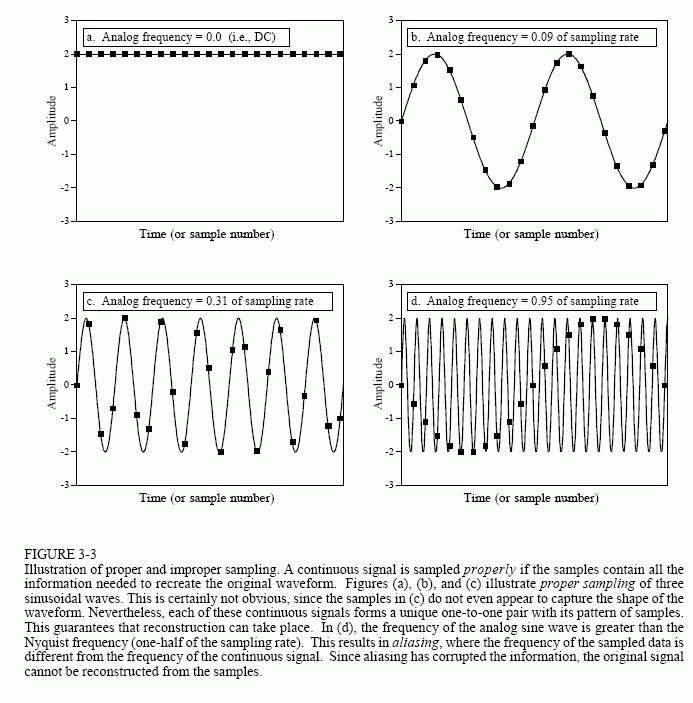
Your tv is sampling at well below the nyquist frequency of the cosmic radiation and outputs a hiss. A rough illustration of the nyquist frequency can be found here so you can see what I'm talking about. -
The Scientist and Engineer's Guide to DSP
Anyone thinking about mechanical or electrical engineering should read this before any signals and systems class. It's very readable with emphasis on practical approaches to engineering problem and how mathematics can solve them.
Best of all, you can get it here free
-
Re:Hopelessly confused about a "single photon"
You know how you get that grainy effect in your vision under very low light conditions with well adjusted night vision? That's quantum noise due to individual photons hitting your eye.
Very interesting. From the link:
"Vision appears very noisy in near darkness, that is, the image appears to be filled with a continually changing grainy pattern. This results from the image signal being very weak, and is not a limitation of the eye. There is so little light entering the eye, the random detection of individual photons can be seen. This is called statistical noise, and is encountered in all low-light imaging, such as military night vision systems."
-
Re:Hopelessly confused about a "single photon"
You know how you get that grainy effect in your vision under very low light conditions with well adjusted night vision? That's quantum noise due to individual photons hitting your eye.
-
On DSP, and one recommended by Knuth in TAOCP
Somewhere in "The Art of Computer Programming" Knuth recommends:
"How To Lie With Statistics", Darrel Huff, 1954.
This book goes no deeper into the math of statistics than average, mean and mode, but the examples of such things as selection biases and the (mis)use of graphs in advertising and propaganda make this a classic book, AND a hoot. It may fall more into the humor category than technical, but what it does cover, it covers correctly. As the author says in the intro, it's actually how to protect yourself from those who would use statistics to lie to you.
Back to deep technical know-how:
"Discrete-Time Signal Processing", 2nd. Ed., 1999, Oppenheim/Schafer/Buck
This is effectively the Third Edition of the venerable "Digital Signal Processing" by Oppenheim&Schafer
Well, ok, while I'm posting, here's a third book, another on DSP, with free online and not-free dead-tree versions available here:
http://dspguide.com/
It's a little more readable than "Discrete-Time..." and as a result you may actually get more out of it. -
Re:Ham Radio
You can get a copy of Now You're Talking! for about $20 and the exam itself will cost $14. NYT! is a very good book for the exam if you also want to understand the concepts. If you think Ham is too low tech, check out some of the DSP stuff and homebrew DSP equipment
-
Re:This is cause for celebration.
Ever tried Google? Try searching "GIF file format".
Even the first link has info on the format, except that particular info is hard to read. I've seen better documets about the subject.
For just the plain LZW algorithm, try this
- Jeppe Jääkarhu -
This FPGA?
I thought that the parent was referring to FPGAs or Field Programmable Gate Arrays
These devices are chips that can be programmed to perform a certain function. They used to mainly be used for prototyping, but recently are being used for all kinds of things (even processors) because they allow you to produce small numbers (even just 1) of a chip cheaply and quickly, without having th rely on the economies of scale that you get with the hardwired chips.
The specific application the grand-parent was probably referring to was Digital Signal Processing (DSP). This is a common application for FPGAs (don't ask me why....IANA-EE (yet)). DSPs are used to (suprise) process signals digitally. This could include (de)compression, (un)encrypting, filtering, and/or frequency modulation in hardware.
I haven't had my DSP classes yet, so I may be a little off, but that's the general gist of it... -
We are now passing the point...
Err.. Ok then - imho, you missed the point
From my understanding of linear systems (PDF file-54k)(I don't know the full workings of echo cancelation), they behave homogenously and additively. That's to say if you have a mix of signals (original & echo) and you take out the echo component, for e.g. my mixing it with an out-of-phase synthesized estimate of said component.. then it's gone, no artefacts, apart from any error in your estimate of what's echo and what's original - that's the clever bit. -
Re:A first step.. (not really)There's been lots of other work done on this. I've put up some links on my own site, but rather than get swamped I'll copy them here. I'm doing my thesis on automatic music classification. I've been planning to start a free software project from it; I was going to wait until I finished my thesis (a couple months from now), but since we're all talking about it now, I went ahead and created a SourceForge project (project name "vole").
- MMM Group at University of Nijmegen [publications]
- Machine Listening @ MIT Media Lab
- Affective Computing @ MIT Media Lab
- Musclefish
- Music, Cognition, and Computerized Sound, Perry R. Cook
- Music, Mind and Machine, Peter Desain and Henkjan Honing
- The Scientist and Engineer's Guide to Digital Signal Processing, Steven W. Smith
- Neural Networks for Pattern Recognition, Christopher M. Bishop
- Tracking Musical Beats in Real Time, Paul E. Allen and Roger B. Dannenberg
- A Model for Musical Rhythm, Jeff A. Bilmes
- Autocorrelation and the Study of Musical Expression, Peter Desain, Siebe de Vos
- A Beat Tracking System for Audio Signals, Simon Dixon
- Prediction-Driven Computational Auditory Scene Analysis for Dense Sound Mixtures, Daniel P. W. Ellis
- A Similarity Measure for Automatic Audio Classification, Jonathan Foote
- Representing Rhythmic Patterns in a Network of Oscillators, Michael Gasser and Douglas Eck
- Adaptive Signal Models: Theory, Algorithms, and Audio Applications, Michael Mark Goodwin
- Recognition of Music Types, Hagen Soltau, Tanja Schultz, Martin Westphal, Alex Waibel
- Irrelevant Features and the Subset Selection Problem, George H. John, Ron Kohavi, Karl Pfleger
- Beat tracking with a nonlinear oscilator, Edward W. Large
- Modeling beat perception with a nonlinear oscilator, Edward W. Large
- Automatic Transcription of Simple Polyphonic Music: Robust Front End Processing, Keith D. Martin
- Musical instrument identification: A pattern-recognition approach, Keith D. Martin and Youngmoo E. Kim
- Music Content Analysis through Models of Audition, Keith D. Martin, Eric D. Scheirer, Barry L. Vercoe
- Musical Sound Information: Musical gestures and embedding synthesis, Eric Metois
- A Machine Learning Approach to Musical Style Recognition, Roger B. Dannenberg, Belinda Thom, and David Watson
- Resonanc e and the perception of musical meter, Large, E. W., & Kolen, J. F.
- Music-Listening Systems, Eric D. Scheirer
- Tempo and beat analysis of acoustic musical signals, Eric D. Scheirer
- Content-Based Classification, Search, and Retrieval of Audio, Erling Wold, Thom Blum, Douglas Keislar, James Wheaton
- Classification, Search, and Retrieval of Audio, Erling Wold, Thom Blum, Douglas Keislar, James Wheaton
-
Re:Sorry, broActually there was a report a while ago that these machines were adjusted to give a less detailed picture for privacy reasons. They found that there was "too much" detail of the body surface.
The X-ray backscatter technology barely views under the skin. The Secure 1000 requires front and back scans, with a lot of surface detail.
Several months ago Slashdot discussed this from American Security. But this low-power X-ray scans through the body, so bones are visible while skin is less visible.