Slashdot Mirror
Domain: ed-thelen.org
Stories and comments across the archive that link to ed-thelen.org.
Comments · 74
-
"Fast enough" != "Supercomputer"
My desktop machine is faster than a Cray 1, and it'll never be labelled "Supercomputer" by any rational being.
Unless their architecture actually hits the Top Ten, I'm not going to be impressed that it's overcoming its handicap. Unless you're running a Special Olympics for computers and "everyone's a winner." -
Re:Sinclair QL
And I'm likely wrong 'cos I'm writing this using neurons that I haven't accessed since 1983 or so
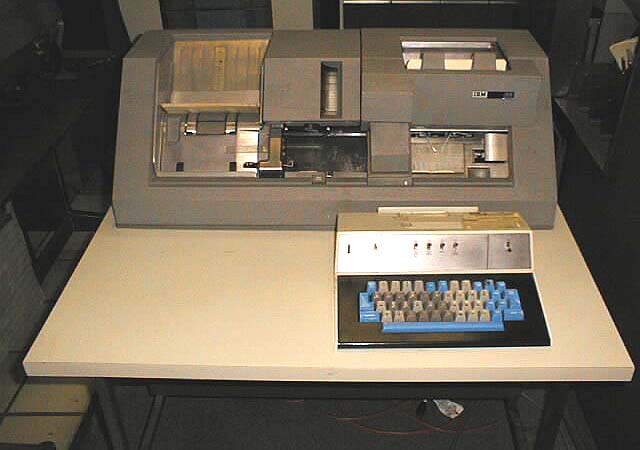
Scary isn't it? I can remember how to use the IBM 029 card punch into which I entered the seven instructions on the framed printout that graces my office walls.
A machine I have not seen since 1980. -
Re:Reminds us of the old days...Read the notes at the end of that document.
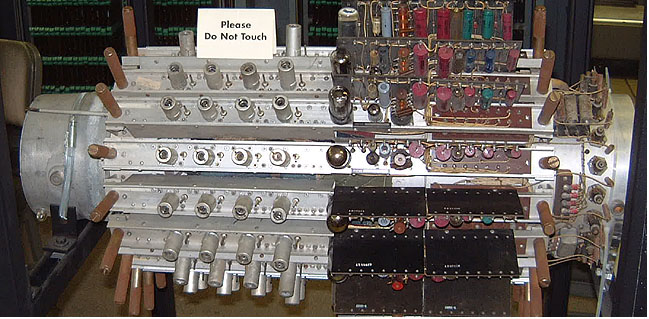
The main memory held 1000 words, but that was composed of 100 mercury channels. (The whole memory system had 126 channels, but some of the channels were not part of main memory.) Each channel was a single acoustic path through a mercury tank, with 18 channels per tank. A main memory channel stored 10 words, with each word composed of 12 characters (11 digits plus sign), each of which was 6 bits plus a parity bit. That comes out to 840 bits.
The note estimates 1000 total bits per channel based on the clock rate and the maximum access time, but I think he got his numbers a little wrong. (He used a clock rate of 2.5 MHz, but it should be 2.25 MHz, which gives an answer of 900 bits.)
-
Reminds us of the old days...
... in which complete computer memories worked like this: those were called mercury delay line memories, in which pressure waves in mercury lines basically held information.
The UNIVAC I had such an 18-channel memory. More information can be found here, here, and here.
These channels could hold a whopping kilobit!
-
Reminds us of the old days...
... in which complete computer memories worked like this: those were called mercury delay line memories, in which pressure waves in mercury lines basically held information.
The UNIVAC I had such an 18-channel memory. More information can be found here, here, and here.
These channels could hold a whopping kilobit!
-
Reminds us of the old days...
... in which complete computer memories worked like this: those were called mercury delay line memories, in which pressure waves in mercury lines basically held information.
The UNIVAC I had such an 18-channel memory. More information can be found here, here, and here.
These channels could hold a whopping kilobit!
-
Re:Stratus prior art
I think you're right. I found this page that, about halfway down, discusses the Stratus and some of its design choices. Very interesting.
-
Re:An Wang, Inventor of core memory
I seem to recall that the first computer memory was actually troughs of mercury relying on the slow propogation of electricity through that substance. We've come a long way, and Wang's work was certainly important.
-
Not impressed.
I wont be impressed until they have a working difference engine like the British Science museum.
(I'm sure that there is a "back in my day the computers had cogwheels" joke to be had) -
Re:Bring back the Delta Clipper!
The Delta Clipper was not capable of orbit; not even close. It only looked good because it wasn't attempting the really hard part. ANY single-stage to orbit vehicle requires very advanced technology - there is no "off-the-shelf" engine with the specific impulse, and no "off-the-shelf" material with the strength/mass ratio, required. It's a simple matter of physics. The rocket equation tells us that getting into orbit using currently available rockets will
The Lockheed X-33 tried to get around this in two ways: use a higher efficiency rocket engine (the aerospike) and light-weight composite structure, allowing a greater portion of the remaining mass to be used as payload. It's the only possible approach if you are limited to single-stage to orbit. Don't kid yourself, the other X-33 proposals were just as risky. It says a lot about the ignorance of the author that he even used this argument; it doesn't hold up to closer inspection.
Regardless of how important you happen to think space travel is (and I think it's nothing less than the key to the future of the human race, ultimately), there are a few really big problems with the future of space travel: physics (we have to find a more efficent engine), investment (we have to convince people that space is worth the real investment required) and "religion" (it seems like every person involved has an absolutely unwavering opinion of the ONE TRUE WAY to get into space, and they simply will not engage in a rational debate).
The last point is actually important, and well illustrated by the article; the author clearly belongs to the "ballistic re-entry" sub-sect of the "expendible launch vehicle" religion. He spends many more words attacking the "winged, reuseable" approach than explaining why his particular approach is so much better. Which of course it isn't - all designs have drawbacks. Trust me, the designs that are built are chosen on more than just the basis of the oft-repeated "pilots want to fly something with wings".
To illustrate the situation, consider the choice between Russian-style expendible capsules and what the Shuttle should (would) have been given proper development funding (the cuts by the Nixon administration forced the use of solids; as any good engineer understands, this one bad choice forced a cascading series of ever more disastrous adjustments, ultimately killing the concept).
Anyway, the Russian capsules work rather well, and are moderately reliable. However, they cost on the order of $20 million per launch (at Russian wages). This cost can likely not be further reduced, since you can't amortize the construction cost of the vehicle and booster over several flights. A truly reuseable Shuttle (say, an X-33 derivative launched off the back of a 747 or something), while considerably more expensive to build, can fly 100 times. That's the only reasonable way to get launch costs below something like $1000 pound (where according to some analysts it becomes economically feasible to develop space in a big way).
To make a long story short you have a choice: a) pick the initially cheaper option of expendible capsules, and be forever stuck at relatively high launch costs, or b) pay the steep development cost of a truly re-useable vehicle, and in the long term you'll have a cheaper way of getting to space. NASA started with option b, spent most of the money, then was forced to adopt some aspects of option a, ending up with the worst of both worlds.
Of course, now I've revealed my own religion.
I'll probably be tied to a launch tower and burnt by the flames of an expendible (solid) booster for it...
-
Re:Kitchen Storage
It's obviously from the early 70s. look at the drugs they must have been on!
-
Kitchen Storage
Each disk was the size of a washing machine and cost around $20,000.
An interesting gap in Gray's memory. He's not describing the disk, he's describing the drive. In 1970, all storage was removable. A free-standing IBM drive was not only the size of a washing machine, it looked like one, because the top opened up to insert or remove a disk pack. There were other multi-drive consoles that resembled pizza ovens. -
Re:Blame the enemy...
Actually, if you take a look here: http://ed-thelen.org/ you can see that Nike Hercules were typically only conventionally tipped for training purposes (it was the Nike Ajax that was conventional-only) and most had Surface-to-Surface capabilities. Granted, their range would typically keep them within the continental US, but also all water ways, etc. But this is only for US-based missles. They were also deployed all over Europe, Korea, etc.
-
The classics
My basement is continually collecting classic computers. And classic clothes, books, toys, baby furniture..... Any bids?
I went to a Smithsonian exhibit a dozen years ago with a very impressive array of vintage (aka "classic" or "old" or "junk") computers. They do collect almost anything after all, and can display only about 5% at any one time. The computers weren't on; I'd be interested in how many years we'll be able to save working Commodore and the like. After all, computers were never meant to be just looked at.
A computer part I'd really like to see old-fashioned magnetic core memory -- that still works! It just sounds so improbable.
I saw a lecture years ago by an MIT professor who worked on the Apollo mission designing an on-board guidance computer (AGC) described here (they planned to used ground-based telemetry but worried the Soviets might jam their signals out of pique or something -- nothing happened). He commented that when they delivered the unbelievably expensive core memory with its delicate wound wiring, they handled it with the utmost caution -- it was 2K (RAM) after all! -
5 kiloton conventional explosion...
I'm going to respond to the article logically, resisting the impulse to immediately smack the conspiracy theorists upside the head.
Being European, I was not familiar with the incident. Running a very quick search shows that there was an accident at a port (Port Chicago), when it was used for loading and transporting ammunition during WW2.
Sources say that there was an explosion of approximately 5 thousand tons of conventional explosives, started accidentally. Undoubtedly it was a massive chain reaction and there had apparently been some (certainly understandable) concern over the safety of the facility.
The article source claims it was a nuclear weapon.
The documentary "Trinity and Beyond - The Atomic Bomb Movie" (good footage, narrated by William Shatner) contains recently de-classified footage. It shows the US military staging a conventional explosion of the order of a kiloton, designed to help figure out what to expect from a real nuclear explosion. And guess what... it behaved very much like you would expect a nuclear explosion.
The facts are as follows:
(1) There was a big explosion.
(2) A 5-kiloton conventional explosion could at first glance be mistaken for a nuclear explosion. Big explosions look similar, it doesn't matter how they're triggered.
The critical problem with their argument is as follows: The test site of the very first atomic weapon, Trinity, is still noticably radioactive today, possibly dangerous. Indeed, the fallout effects are still noticable from other sites exposed to nuclear weapons - in the environmental and survivor's radiation poisoning.
To those who assert that the Port Chicago explosion was the result of a nuclear explosion - how do you explain a nuclear weapon with no fallout and radioactivity? I vouch that you are trying to manipulate the facts to justify a theory - rather than basing your opinions from facts.
You would have thought that during a "20 year investigation" they would have gone out there with a geiger counter and check out the background radiation. Which would have discounted nuclear weapons very quickly. -
One that did work ... and prior news
1. Fifty-Year-Old Computer Being Restored
On Monday November 22, @10:50PM with 116 comments
James Green directs us to "a Sunday Age (Melborne) article which describes the discovery of a 52 year old computer found in a dusty warehouse weighing in at...
I guess Geek.Com is behind
2. The first Transistor computer, TX-0, was restored to demonstratable condition in the 1980's by The Computer Museum. Yes it worked again, No question; as an original member and early volunteer of TCM (before the first tmove), I was there, and saw it run.
TCM was once of Boston, then of Marlboro, now of SilliValley. See the TCM Project Description and the Alumni page. It was built in 1957, so would be only 45 years old. I'm not sure what happened to it when DEC sold the building, or John McKenzie, who got it to work again. Shag Graetz's classic Creative Computing article on PDP-1 SpaceWar includes it's TX-0 predecessor. (and French translation) The TMRC pages include TX-0 history as well. See also Levy/Hackers
-- bill / n1vux
-
One that did work ... and prior news
1. Fifty-Year-Old Computer Being Restored
On Monday November 22, @10:50PM with 116 comments
James Green directs us to "a Sunday Age (Melborne) article which describes the discovery of a 52 year old computer found in a dusty warehouse weighing in at...
I guess Geek.Com is behind
2. The first Transistor computer, TX-0, was restored to demonstratable condition in the 1980's by The Computer Museum. Yes it worked again, No question; as an original member and early volunteer of TCM (before the first tmove), I was there, and saw it run.
TCM was once of Boston, then of Marlboro, now of SilliValley. See the TCM Project Description and the Alumni page. It was built in 1957, so would be only 45 years old. I'm not sure what happened to it when DEC sold the building, or John McKenzie, who got it to work again. Shag Graetz's classic Creative Computing article on PDP-1 SpaceWar includes it's TX-0 predecessor. (and French translation) The TMRC pages include TX-0 history as well. See also Levy/Hackers
-- bill / n1vux
-
Re:The oldest working computer ?
The US Military was using this as late as 1994 for bolth NTDS and navigation. First units were delivered in 1958. God bless Seymore.
-
You could try this...
-
CDC-160A, anyone?
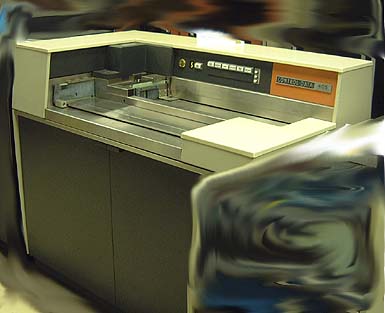
This fine 1962-vintage baby sported a high-speed paper-tape punch that arose straight out of the desktop through a trapdoor.
For only $60,000 you got a full 8K of memory--and that's 8K WORDS, not bytes, folks--and a blazingly fast 0.00016 GHz clock.
The console had a numeric display that actually projected numeric octal digits onto a groundglass.
They were often used in conjunction with CDC-1604 computers, but were fully capable computers in their own right.
Plus, they were fully functional desks. -
Re:Quantum-like Storage
A similar idea has already been implemented. Some
Canadian researchers used an existing 8000km fiber
optic network as a storage device. Basicly, the network
is configured as a loop and the
data to be stored is simply sent onto the network.
Packets of data are placed onto the network and can be
pulled from it as they pass a node on the network.
It's kind of like a cross between a token ring network
and a mercury delay line. You can find a few more
details from this link. -
Re:OMFG, you're insane
A 386 is probably overkill
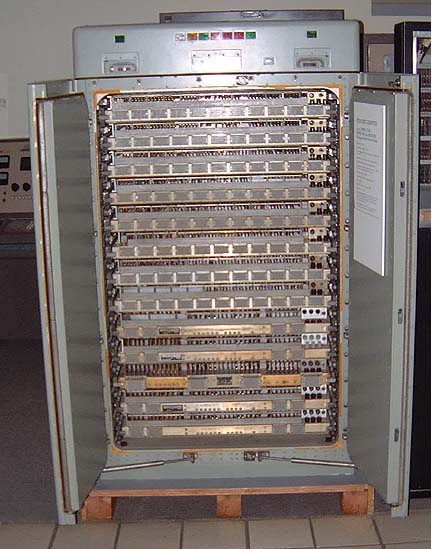
True. The old (but still in service) Nike Hercules guidance computers were just a bunch of op-amps and assorted sensors (see here).
I mean to say that the Hercules missile systems are still in service, their computers have been upgraded to solid-state units. -
Re:First mouse, but not first pointing device
Here's a picture of the Nike Battery Commander's Console, showing the sliding crank device. Note the two radarscopes set into the desk, and the crank to the lower right of each. That was how the battery commander selected the target to be shot down.
-
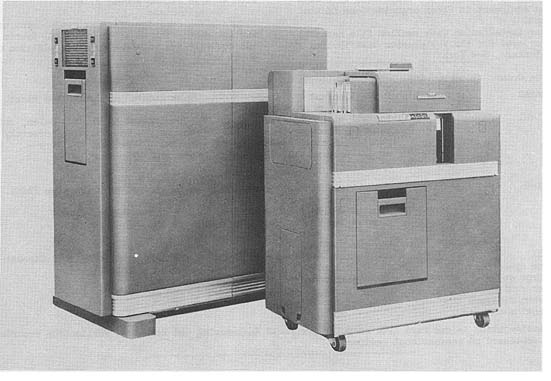
Re:Anyone for an emulator?Rather than replying to a couple of the other joyless and uncurious morons who replied to your message, I thought I'd say that yes, I think the idea of a PIC-based emulator for something like this is fun - especially when compared with the size and power requirements of the original (here's a picture).
IIRC, the MIT Computing Museum (or whatever it's called) in Boston has some exhibits along these lines. The Dr. Dobb's article mentions that The Computer Museum History Center has a 604 on display, so perhaps they'd put a PIC emulator next to it, which could make for a fun resume item!
Google turned up this page which contains some info on the 604's basic instruction set.