Slashdot Mirror
Domain: eia.gov
Stories and comments across the archive that link to eia.gov.
Comments · 833
-
Re:Total Capacity
Gas plant capacity isn't high.
In 2015 the US had 503963.9 MW of gas generation capacity - http://www.eia.gov/electricity...
Which supplied 1,333,482 thousand MWh of electricity - http://www.eia.gov/electricity...
For a capacity factor of 30.19%.
TL;DR: We have a shit-ton of gas peaker plants that sit around idle most of the time.
-
YES oil IS subsidized. Stop being an idiot.
And those subsidies are? I keep hearing about them, but all I ever get is some handwaving and "tax breaks" which are available to ALL companies, not just energy companies...
You mean besides the oil wars in the middle east that have cost trillions of dollars and caused the deaths of millions?
Besides the CO2 that's increasing Earth's greenhouse effect?
Besides the environmental damage (mining, oil spills, contaminated water supplies, fracking chemicals getting everywhere, etc) that never seems to get cleaned up?
Yeah, because besides all of those externalized costs, there are subsidies totaling around $30 billion per year! https://www.eia.gov/analysis/r...
Is that enough? Can we stop denying that fossil fuels are subsidized now? I'm tired of hearing this argument. Do some research instead of parroting that tired myth FFS.
-
Re:Solar now competitive with coal and gas?
-
Re:Citation please
The first clue for me is that his numbers for coal is lower than natural gas. That hasn't been true for years.
The EIA (Energy Information Administration) publishes costs for the total operation, maintenance, fuel, and total cost per kWh.
The site uses "mills per kWh" - or thousandths of a dollar per kWh.
The total costs are:
Nuclear: 25.71 - 2.57
Fossil (Oil & Coal) 37.26 - 3.73
Hydroelectric 13.42 - 1.34
Gas Turbine (Natural Gas) 33.24 - 3.32It doesn't cover solar, but the actual 2015 costs are nowhere near what whoever57 claimed.
-
Re:Carrots are usually better than a stick.
Please cite facts on solar energy vs. coal vs. CCNG vs. Wind
Sure. See Table 1b in this EIA report. To summarise:
Geothermal: 45.0
Advanced Gas CC: 57.2
Wind: 64.5
Hydroelectric: 67.8
Solar PV: 84.7
Advanced Gas CC with CCS: 84.8
Biomass: 96.1
Advanced Nuclear: 102.8
Advanced Coal with CCS: 139.5
Wind (Offshore): 158.1
Solar Thermal: 235.9Total levelised cost values in 2015 dollars per MWh, not including tax credits.
-
Re:I guarantee
I guess you haven't heard about natural gas. Gas fired plants are being built hand over fist.
This is why Slashdot moderation sucks. The above post is a very good rebuttal of the parent. Maybe should have included a citation like this. Yet as of now it languishes at -1 moderation while the pseudo-intellectual parent gets +5.
As for how much capital it takes to build a plant and the required lead time, go read the pdf available from here. Reading the table seems sure doesn't seem to corroborate the facts silentcoder promotes.
-
Re:I guarantee
I guess you haven't heard about natural gas. Gas fired plants are being built hand over fist.
This is why Slashdot moderation sucks. The above post is a very good rebuttal of the parent. Maybe should have included a citation like this. Yet as of now it languishes at -1 moderation while the pseudo-intellectual parent gets +5.
As for how much capital it takes to build a plant and the required lead time, go read the pdf available from here. Reading the table seems sure doesn't seem to corroborate the facts silentcoder promotes.
-
Not wind vs nuclear - wind AND nuclear
My BS meter just twitched.
You need to take it into the shop to have it fixed. It's clearly malfunctioning.
Wind, at about 2% of the total energy market is tiny.
Even 2% of US generating capacity (not the actual number) is an enormous amount of power and the amount of wind power generating capacity is growing fast. Wind accounted for about 4.4% of US energy production in 2014. Some countries generate double digit percentages of their electricity from wind with Denmark topping the list at 39%! The US accounts for a (disproportionate) 18% of world energy consumption despite being just 5% of the population. If other countries (particularly India and China) follow our lead that is not sustainable without huge increases in the use of renewable energy.
This hostility from the government towards nuclear power is one big reason why I have trouble believing in the global warming hysteria.
The hostility towards nuclear power does not come from the government. It comes from citizens who are nervous about nuclear power and the consequences of what can happen when things go wrong. (see Chernobyl and Fukishima) There also is the as yet unsolved problem of nuclear waste disposal. Granted some (not all) of their concerns are more perception than reality but perception is what drives policy regardless of whether it is true. It also comes from financiers who look at a LONG track record of cost overruns and cost uncertainty in building nuclear plants.
This hostility towards nuclear power on costs is also something that bothers me. The reason it costs so much is because we've forgotten how to build them.
No we haven't. Nuclear power plants are being built routinely and have advanced significantly. Just not in the USA. I'm an accountant. The reason nuclear power plants cost so much is twofold. 1) They are very complicated and have to be engineered to very high standards with careful attention to safety culture to avoid disasters. This level of engineering and safety is very expensive and prone to cost overruns. Nuclear plants are (comparatively) cheap to operate but very expensive to build. Worse, there is considerable cost uncertainty surrounding their construction. When this happens financing costs for construction rise considerably. Private financing is very difficult to come by as a result. Public financing is substantially more expensive and harder to get. 2) Nuclear power plants are considered so risky by insurance and financing companies that they cannot be built without government guarantees. The risk profile is one where the odds of a disaster are (generally) low but the consequences are very high and challenging to quantify. That makes insuring and indemnifying them very expensive.
I'm not impressed with wind power. Nuclear power, on the other hand, is a much better solution.
You can waste your time being "not impressed" with wind power but it's an important and fast growing and affordable and clean source of energy. It's not going to solve all our energy needs. No one form of energy (not even nuclear) is going to do that. Stop thinking in terms of either/or and start thinking in terms of balanced portfolio. Nuclear fission will be an important part of the energy portfolio for the foreseeable future and it has almost none of the climate change issues we get from fossil fuels. The goal is to reduce the amount of fossil fuels used to a level lower than what the Earth's ecosystem can handle. This number isn't zero but it's far lower than where we are now. To do this with existing technology will require some combination of wind, solar, nuclear, geothermal, and hydro. Battery and energy storage technology will matter greatly. I think distributed power (solar panels on roofs) are going to matter a lot as well.
-
Still nothing but a minor problem
Domestic cats don't kill eagles and other typical endangered species of bird.
Domestic cats most certainly do kill endangered species of birds. They may not kill eagles but the certainly kill other threatened species in substantial numbers. Cats are an invasive species and a poorly controlled one at that.
Let us not also forget about bats,
Same deal as with birds. Windmills are simply not a significant threat to their populations.
and the fact that renewable provide a tiny amount of energy today.
You think 10% of US energy consumption is a tiny number? I think you don't understand the definition of the word "tiny".
-
Re:Minor problem
... and the fact that renewable provide a tiny amount of energy today.
According to the US Energy Information Administration renewables make up 12% of worldwide energy production, compared to 33% for liquid fuels, 28% for coal, 23% for natural gas, and 4% for nuclear.
Growing the industry by orders of magnitude will
... cause renewables to produce 1200% of total worldwide energy production.
-
Re:I like what the US Navy came up with better
One of the biggest problems with wind farms is that peak demand (hot days, little wind) correspond with least output, and vice-versa. Putting one of these water to fuel plants with every wind farm located near water would solve that. Note that jet turbine powered generators are used for peak power demand anyway ( http://www.eia.gov/todayinener... ) so half the needed infrastructure for this is already in place.
-
Re:I don't mean to belittle this
US solar capacity factors are vastly higher than 14,5%. And you don't need to explain what capacity factor and nameplate capacity are, people aren't idiots.
We don't know what the capacity factor of this plant is, but at around $1/W nameplate for almost-no-operations-costs power produced at peak consumption hours, it will be quite cost effective.
Your calculation is not just wrong, but stupid. First off, hint, check your units in your divisor: where is seconds per hour coming from? You have nothing in seconds in that formula. The "hours" in "hours per year" is supposed to cancel with the hours in kilowatt hours, the MW and kW are supposed to cancel out watts, leaving you with $/years. Instead your denominator has an additional seconds per hour in it. You should have had 1000kW/MW there. But beyond that, that's not how power markets work. There's no "constant value of power", and even if it was, that value would not be the same as the incremental residential rate. Power varies by a number of factors, such as time of day and responsiveness to demand. At low penetration, solar power is worth more than baseload as it compensates for demand peaks. At high penetration, solar is worth less than baseload because of its complete lack of response to demand. Lastly, simple payback periods are not how you determine whether an investment is an economically appropriate decision as they don't take into account the time value to money. You calculate an X-year ROI based on what sort of financing rates you can get on the project (which in turn are largely based on risk) and compare it to other ROIs you could get from other projects. I'll save you the time: this plant easily makes economic sense.
-
I don't mean to belittle this
I don't want to belittle this because India is one of the places where solar actually makes sense. But even there its capacity factor is only about 20%. Compared to 14.5% for the continental U.S. and about 10% in Germany. Capacity factor is the ratio of actual electricity produced (after taking into account night, weather, angle of the sun, downtime due to maintenance, etc) to nameplate (maximum) capacity.
So while it's capacity is 648 MW, its average electrical generation over a year will only be about 20% that, or a more modest 130 MW. Electricity costs about 8 cents/kWh in India. So payback time (excluding operational expenses and interest on loans) will be
($679 million) / (0.2 * 648 MW * 3600 sec/hour * 8766 hours/year * $0.08/kWh) = 7.47 years
India is one of the better places for solar. (The 150,000 home figure seems a little screwy, since 648 MW / 150,000 homes = 4320 Watts, which is about 3.5x the electricity consumption of the average U.S. home. I suspect the 150,000 homes figure already took into account capacity factor, and is not "at full capacity" as TFA claims.) -
Cost of energy [Re:unlikely]
When your electricity rate goes from 0.07 to 0.18kWh in less then 10 years, and people have problems keeping the lights on? \
The cost of energy in constant dollars has been going down, not up.
Here's a graph of energy costs. Electrical costs have dropped from about $0.026/kWh (equal to $0.21/kWh in today's dollars) in 1960 to $12.67/kWh today.
http://www.eia.gov/outlooks/st... -
An idiot wrote this
America has been shutting down coal plants since Obama came to office. However, it NOTHING to do with regulations from him. It had to do with the fact that Nat Gas and wind are MUCH CHEAPER than coal is here. Combine that with all coal plants having to have ZERO mercury emissions.
Coal WAS 33% in 2015. Coal is now down to 27% of America's electricity. and for 2017, should be around 20-24%.
In addition, only idiots will think that trump can bring back coal (yes, he promised, but again, only idiots believe that). WHy is this so? Because coal is TOO EXPENSIVE compared to nat gas and wind. IN addition, with the new nukes that will be on-line and tested in the next 4 years, these will replace MORE of our coal plants.
The real question is less about Western nations, and more about CHina.
China currently gets either 75 or 88% of their electricity from fossil fuel (depends on which chinese gov group gives you information).
They currently have around 1.2TW of coal capabilities, and are building out 35-50 GW of new coal plants EACH YEAR. Even this year, they will do 35 GW.
Around the year, 2030. they will have 1.9-2 TW of coal plant capabilities and only then will they quit building new coal plants.
Even if the ENTIRE west, including Japan and South Korea, shuts down 100% of our coal plants, that is actually less than 1TW. So, China will build out ~3/4 of what the west has. Unless that stops, nothing we do will matter.
The far left has to quit ignoring science and numbers and start hammering on CHina FOR REAL. In addition, so does the entire western gov. -
Re:Wow, all the way back to 1979...
I personally don't rule out nuclear as a solution (heck, anything is better than coal). There are undeniably cases where nuclear is the best option. However, it's an not the cheapest and has some significant risk (low chance of failure, but expensive consequences), so there may well be better options in other cases. Any serious energy policy has to consider all the options on their merits - including renewables.
All a carbon tax will do is make people poorer and government bigger
Carbon taxes are not intended to reduce demand, they're intended to raise prices of carbon-intensive energy sources, making carbon-neutral sources like nuclear and renewables more competitive. Additionally, the revenue from the tax can be used to mitigate the health & social costs of emissions, invested in carbon-neutral energy development and infrastructure, and/or used to offset the short-term price rises for consumers. That's how it was implemented in Australia, and it was working (overall impact on CPI was tiny, fossil-fuel energy demand dropped, and carbon-neutral energy demand increased).
Wind, solar, hydro, geothermal, etc. are expensive, unreliable, and/or geography dependent.
These are geography-dependent, but between them they can cover a very wide range of geography (nuclear is an option for the remainder). They are reliable in the sense that they have well-defined capacity factors - lower than coal (which can still be as low as 45%), but this can be covered by widely-distributed generation as it is today, with some grid-level storage as a backup. Dealing with intermittency has been well studied.
As for expense, the (unsubsidised) levelised cost of onshore wind, hydro, solar PV, and geothermal, are all well below that of nuclear and coal, especially with carbon capture.
I took a look at your links and saw no mention of nuclear power.
Yeah, a lot of the focus (and all of IPCC WGI & WGII) is on getting people to recognise the problem first. Once we're past that, we can happily debate different solutions - nuclear, solar, lawyers on bicycles or whatever.
All too often I see the catastrophic anthropogenic global warming alarmists backing us into an impossible corner by denying the use of fossil fuels and nuclear power.
Please don't conflate the science establishing that AGW exists, with proposed solutions like whether or not we use fossil fuels or nuclear. The science only says, if we emit this much CO2, we can expect these estimated consequences. These findings are entirely independent of any solutions we choose, and sadly way too many people completely deny the science because they don't like a particular solution that someone suggested. We need to accept that the problem exists, then we can propose better solutions - which can certainly be nuclear, if you prefer.
If the idea of another nuclear power plant going on line every week makes you uncomfortable
A lot less uncomfortable than more coal plants, frankly. Though I would disagree that nuclear is our only alternative, based on the research I've done (see above links).
-
Re:Installation cost?
The cost of electricity on a remote island is very different than just the cost of the fuel on the mainland. You have neglected the cost of getting the fuel there and the cost-of-ownership for the diesel generators.
Another approach to costing this system out, since sadly the article itself gives no numbers, is to consider the retail cost of the electricity. A handy comparison is Hawaii - another island location that, until recently anyway, generated almost all of its electricity from diesel shipped from the mainland. In Hawaii, the typical household electric rate is $0.33/kWh, or about $330/MWh. The array is 1.4 MW. Let's say that it has a capacity factor of 25% (i.e., in a 24-hr day, one could expect a total output of 1.4 MW * 24 h * 0.25 = 8.4 MWh). Over one year that's about 12,000 MWh of electricity, which would have a retail value of $4 million.
These days the cost of a large grid-tied PV system is about $2/W. Installation on Ta'u is undoubtedly more expensive, so let's roughly triple that price to $6/W. By that estimate. the panel array would have cost $8.5 million to install. The Tesla Powerpack costs about $250/kWh. Again, installation on a remote island costs more, so let's double it to $500/kWh. Their system has 6,000 kWh, representing a cost of $3 million.
By these estimates, their system cost was $11.5 million. Rated against the electricity cost, the breakeven period is just a few years. Maybe I'm off in my estimates here or there by a factor of, say, 2. But even under worst-case assumptions, I would hazard that the total cost over 20 years is lower with PV than diesel, and with far fewer long-term risks. -
Re:futurist
The US consumers about 7 billion barrels of oil per year
https://www.eia.gov/tools/faqs...
That means a 2 billion barrel find would last less than 4 months
That makes your 2nd guess the closest
-
Re:Does Tesla actually make a profit?
" the transmission line efficiency is about 50%"
You're way off on that one - How much electricity is lost in transmission and distribution in the United States?
The U.S. Energy Information Administration (EIA) estimates that electricity transmission and distribution losses average about 6% of the electricity that is transmitted and distributed annually in the United States. 1
...
1 Average of annual losses in 2005 through 2014. Estimated losses in 2014 for the entire United States were about 5%. -
Re:cost
Sorry, but I have no faith in numbers from Wiki or the LCOE they cite, and further, they include TCO figures for wind/solar that are largely based on speculation and guesswork
Erhm.
he following data are from the Energy Information Administration's (EIA) Annual Energy Outlook released in 2015 (AEO2015). They are in dollars per megawatt-hour (2013 USD/MWh). These figures are estimates for plants going into service in 2020.[55] The LCOE below is calculated based off a 30-year recovery period using a real after tax weighted average cost of capital (WACC) of 6.1%. For carbon intensive technologies 3 percentage points are added to the WACC. (This is approximately equivalent fee of $15 per metric ton of carbon dioxide CO2)
Link to the report itself.
So, what, exactly is wrong with this? I mean, oil prices are subsidized by themselves by most oil producing countries.EA estimates reveal that fossil-fuel subsidies are becoming increasingly concentrated in the major oil- and gas-exporting countries. The share of Middle East oil exporters, for example, in the world total has risen from 35% to 40% over the last four years. The main reason for this trend is that high oil prices over much of the period meant that they, as net oil exporters, did not have the same fiscal incentive to reform energy pricing as that in many other parts of the world. Instead, the rise in government revenues from oil exports allowed an increase in government spending, often on social support programmes, expanding infrastructure and subsidies to food and energy. Over the period 2009-2014, fossil-fuel subsidies for this group of countries have, on average, been equivalent to more than one-quarter of government expenditure.
Soi why would it be wrong to factor in the tax-breaks and susidies given to renewables, when the point of comparison in terms of fossil fuels is also heavily subsidized by producing nations and the environmental damage caused by oil/coal means that the true cost of using these fuels is in fact externalized because there's a delay between using fossil fuel's and seeing the effect of the usage in the climate and thus the global economy?
The inclusion of subsidies does not make the price comparisons invalid, it makes them more accurate. Unless you want to start to calculate the actual, unsubsidized cost of oil/coal as well.
-
Re: he bet on the winner
> coal burning hasn't been shown to be a big deal
Wow you have really gone full retard, haven't you?
What's next, chemtrails and HAARP?Companies love to sell things cheap and to hell with the real costs to:
1) The planet
2) The peoples health
3) Hell, everything else that's living's health
4) Future generationsHave we cleaned up coal a great deal via EPA requirements? You bet. Still I'd rather see them continue to focus on fracking and natural gas. From the eia coal regardless of how much cleaning you do to it produces about twice the CO2 as natural gas. Despite some solvable issues, generally fracking has worked afaik.
I'd rather see zero emissions sources, such as careful use of nuclear, solar, etc, or at least moving towards them. With nuclear you have to figure out how to first get rid of all the old plants and build new plants and second make sure no one cuts corners on safety for the entire lifetime of the plant, not even once.
-
Re:actually, go ahead. This will not matter
Right here from EIA.Likewise, if you do not want to accept those figures, then simply note the fact that Utilities are shutting down coal plants and replacing them with a mix of nat gas and wind. The reason for the wind is that it can be cheaper than nat gas depending on the area.
-
Re:"Do more, but not anything really effective."
How about nuclear energy? That doesn't fart out carbon, and then we can still use, you know, electricity rather than...
Because it's too expensive compared to the alternatives. Pay attention to Tables 4a and 4b, which show (respectively) capacity-weighted and non-weighted LACE minus LCOE in $/MWh (tax credits included) for the different types of utility-scale power plants entering service in 2022: where the net difference is positive, it's economically attractive to build that type of power plant. Bearing in mind that non-dispatchable plants aren't perfectly comparable to dispatchable ones, as a first-order approximation we can see that advanced nuclear, offshore wind, and solar thermal are all currently bad ideas; onshore wind is either okay or just barely bad depending on how it's weighted; solar pv is okay; natural gas is good as long as it doesn't have carbon capture & storage (in which case it's bad, but only about half as bad as nuclear); and geothermal is great.
Until those numbers change, it won't matter what the nuke-nerds OR the NIMBYs say -- people build what makes them the most money, and that's currently wind, solar pv, nat gas, and geothermal.
-
Re:And I keep coming back to my same question
Burning coal is 18th century technology. Moving on to more efficient 21st century technologies may well be an advantage, not a disadvantage, and being early in adopting technologies that the rest of the world will move to could have significant advantages.
You may be right or not. So far it is only a wishful thinking. Coal is still the cheapest. When something else becomes cheaper then people and companies will gladly move to it.
No, in fact coal is relatively expensive even with subsidies. This is one of the main drivers for switching to renewables, so you got that part right -- except for the "gladly" part. People seem to be fighting renewables even though they're cheaper than fossil fuels. In order from cheapest energy to most expensive, the cheapest is geothermal (although it's not widely available), followed by hydroelectric (again, not available everywhere), followed by wind (same story), followed by natural gas, then coal. In fact, coal is nearly as expensive as nuclear right now -- interesting fact. Look it up yourself. https://www.eia.gov/forecasts/... In the meantime, quit posting things that are factually wrong. Of course, if you made electricity consumers pay for fixing the environmental damage that coal mining/burning costs I imagine it would be by far and away the most expensive.
-
Re:Whats a power grid owner to do?
Solar received $4.393 in subsidies while generating 19 billion kWh in 2013 (tables ES4 and ES5). That's a subsidy of 23.1 cents/kWh. The average price of electricity in the U.S. across all sectors is only about 11 cents/kWh.
Solar is its own worst enemy. If it weren't for the massive subsidy it receives, it would only see fringe use in places like sailboats and mountaintop weather stations. Nobody has to try to slow solar down - it is in fact solar proponents who have to keep up these hugely disproportionate subsidies to make it appear competitive.
Note: I fully support renewables like wind and geothermal, which receives subsidies of 3.5 and 1.4 cents/kWh respectively. (And just for completeness, the subsidies for coal, gas, and nuclear are 0.06, 0.06, and 0.2 cents/kWh respectively.) But solar still needs another decade or two in the R&D stage before being rolled out to the masses like its proponents are currently trying to do. The current push is premature to say the least. I suspect that's what's really going on here - Tesla is trying to get a piece of the solar subsidy pie. -
Re:Whats a power grid owner to do?
Solar received $4.393 in subsidies while generating 19 billion kWh in 2013 (tables ES4 and ES5). That's a subsidy of 23.1 cents/kWh. The average price of electricity in the U.S. across all sectors is only about 11 cents/kWh.
Solar is its own worst enemy. If it weren't for the massive subsidy it receives, it would only see fringe use in places like sailboats and mountaintop weather stations. Nobody has to try to slow solar down - it is in fact solar proponents who have to keep up these hugely disproportionate subsidies to make it appear competitive.
Note: I fully support renewables like wind and geothermal, which receives subsidies of 3.5 and 1.4 cents/kWh respectively. (And just for completeness, the subsidies for coal, gas, and nuclear are 0.06, 0.06, and 0.2 cents/kWh respectively.) But solar still needs another decade or two in the R&D stage before being rolled out to the masses like its proponents are currently trying to do. The current push is premature to say the least. I suspect that's what's really going on here - Tesla is trying to get a piece of the solar subsidy pie. -
Heat Death of the Planet
You'd need to invent some special technology to radiate all that waste heat back out into space or your 'free energy from the sun' engines would bake you to death.
The problem with using space-based industry to send power to Earth has a very simple problem: heat. If we replaced all the of energy industries with space based solar cells we'd no longer locally generate power. But our devices would still inefficiently convert that power to work with waste heat. This makes the energy budget for the Earth even more fun to calculate.
Today "insolation adds 1366 W/m2 to the Earth. A lot of that trapped by the Atmosphere, rocks, water in the oceans and a non-trivial part in plants. Putting more solar cells on the surface of the Earth doesn't really change the heat budget. Trapping more of the light with greenhouse gases does, pushing the balance up a bit. Blocking out Sunlight with soot pushes it down a bit.
Focusing more light on the Earth does change the budget and quickly. Just to meet today's needs we would have to provide between 525 and 600 quadrillion Btu (source). Right now we do that with the sunlight energy either already stored up here or current sunlight falling onto the planet from space. (And some geothermal left over from radioactive material and the heat trapped from smashing a bunch of stuff together to make the planet.)
Right now, since we are supposed to be in an Ice age, this might be an advantage. Without the constant pumping of greenhouse gases to keep the temperature up this in-fall of more energy and waste heat could be used to keep the surface comfortable.
But what happens when we go past that point? Nobody wants to turn off their TV, air conditioning or cellphones for a few days to keep the heat budget in check. Just like today nobody wants to stop using the cheapest oil, coal or plasticizer no matter the cancer, coughing or smog filled skies.
-
Verge of being cost effective
The Powerwall 2 can store 14 kWh of energy
In other words, they've improved it from storing $1 worth of electricity to $1.40. But you still need to cycle it many thousands of times with FREE electricity before it breaks even.
A quick search shows that the average household electricity usage is about 10K kWh per year (900-ish per month), ranging from 14K in Louisiana to 6K in Hawaii.
Using your numbers, that would be roughly $1000/yr. The powerwall costs roughly $7000 installed with inverter and other extras, or you can lease it for 9 years for $5,000 which includes installation, a maintenance agreement, the electrical inverter and control systems.
Tesla is offering a ten year warranty on the batteries, and there's some discussion about how a battery can last for 3650 cycles (mostly because the 14K powerwall is a 20K battery pack that's discharged much more shallowly than if it was an actual 14K battery, and other tricks).
The total cost comes out to about 0.15/kWh.
"Tentative Conclusion: The battery is right on the verge of being cost effective to buy across most of the US for day/night arbitrage. And it’s even more valuable if outages come at a high economic cost."
-
Re:Renewables will never work
What that means is that the total MWs of installed capacity for renewables is higher than the that of coal. That doesn't mean that renewables will generate more MWhs than coal however, because coal tends to have a higher capacity factor than renewables.
Not to mention that it's physically impossible to have optimal sun conditions over every solar panel in the world simultaneously.
Coal don't care about the time of day, it burns as sweetly at midnight as it does at noon...in any time zone.
-
Meaningless PR
Capacity in solar and wind energy production is misleading since neither can produce as much power per unit of capacity as fossil fuel plants can. The US EIA, https://www.eia.gov/electricit...
-
Meaningless PR
Capacity in solar and wind energy production is misleading since neither can produce as much power per unit of capacity as fossil fuel plants can. The US EIA, https://www.eia.gov/electricit...
-
Re:Did renewables replace any carbon based plants?
How many carbon based power plants were taken off-line and replaced by renewable generation capacity last year?
After much research, I haven't found a single instance of that happening - ever.
That's a strange way to word it. In a given year for a given region there is a forecasted capacity demand requirement and sufficient installed capacity (plus a reserve margin) must exist to serve that demand. If a generation unit retires it isn't necessarily replaced by a single unit one-for-one, so looking for an instance doesn't really make sense. You need to look at it in aggregate.
A lot of coal plants have closed down in the last few years, but there haven't been many new coal plants brought online. The difference has been made up of primarily natural gas and renewables. Here is a source showing what happened in 2015. All that dark grey below the line is are coal retirements and all that green above the line are wind capacity additions.
-
Re:Renewables will never work
The wording in the summary is confusing (not that I read the article, it said you had to register), but this part is key:
"It was also more than the amount of conventional fossil fuel or nuclear power added in 2015, leading renewables to surpass coal's cumulative share of global power capacity -- though not electricity generation."
What that means is that the total MWs of installed capacity for renewables is higher than the that of coal. That doesn't mean that renewables will generate more MWhs than coal however, because coal tends to have a higher capacity factor than renewables.
-
Re: Renewables will never work
The capacity of an installed solar panel is the sum or average of expected generation over a day/month/year, so it takes generation time and location into account.
Wrong. See:
https://www.eia.gov/tools/faqs/faq.cfm?id=101&t=3
http://exploringgreentechnology.com/glossary/installed-capacity-definition/
https://www.quora.com/What-does-it-mean-when-a-solar-panel-has-a-capacity-of-say-100kWThe proof renewables work is all the lies told by those who hate them. If they didn't work, then they wouldn't need to lie so much to make them look bad.
By this logic, should I conclude that renewables don't work, because you're lying to make them look good?
-
Re:Economics?A few quibbles with your math:
At a U.S. average rate of 12 cents/kWh = $120/MWh
That may be the average retail rate paid by you and me. But as for what the generator can sell the electricity at, you need to look at the wholesale rates. Squinting at this graphic from the EIA, you can see the wholesale rates tend to hover at around $50/MWh, or a bit less than half the figure you were using. Because nuclear tends to supply baseload, rather than peaking, power, it may even be less than that. So you should figure only about $400 million of power generated per year.
Secondly, you have neglected operating costs: those nuclear engineers don't come cheap, and neither does enriched uranium. This table from the EIA tabulates the operating cost of various power plants, priced in $/1000 ("mils") per kWh generated, which is the same as $/MWh. Operation and maintenance for a nuke plant in 2014 ran about $18/MWh, and from the table seems to be increasing pretty quickly. For the 1 GW plant you hypothesize, the operating costs end up at about $140 million / yr.
So the net revenue for the plant may only be about $250 million/year, not $947 million/year. Over the lifetime of the plant, that gets you maybe $10 billion of net revenue. That's perhaps 2x the initial investment and doesn't take into consideration things like Net Present Value, etc. All in all, it doesn't look so rosy from an investment standpoint.
There's also the cost of decommissioning, which is a number that's hard to pin down, since very few plants have been fully decommissioned. Some poking around gave me figures anywhere from 10%-100% of the initial cost. Nuke plants are supposed to be setting aside that decommissioning cost during the life of the plant, so it may be baked into the operating cost numbers already. On the other hand, those decommissioning funds, like public pensions, are generally believed to be vastly underfunded. Leaving aside the externality of sticking the cost to the public, one should assume that, in year 40 (or 60), you'll need to cough up another $500 million to $5,000 million. -
Re:Economics?A few quibbles with your math:
At a U.S. average rate of 12 cents/kWh = $120/MWh
That may be the average retail rate paid by you and me. But as for what the generator can sell the electricity at, you need to look at the wholesale rates. Squinting at this graphic from the EIA, you can see the wholesale rates tend to hover at around $50/MWh, or a bit less than half the figure you were using. Because nuclear tends to supply baseload, rather than peaking, power, it may even be less than that. So you should figure only about $400 million of power generated per year.
Secondly, you have neglected operating costs: those nuclear engineers don't come cheap, and neither does enriched uranium. This table from the EIA tabulates the operating cost of various power plants, priced in $/1000 ("mils") per kWh generated, which is the same as $/MWh. Operation and maintenance for a nuke plant in 2014 ran about $18/MWh, and from the table seems to be increasing pretty quickly. For the 1 GW plant you hypothesize, the operating costs end up at about $140 million / yr.
So the net revenue for the plant may only be about $250 million/year, not $947 million/year. Over the lifetime of the plant, that gets you maybe $10 billion of net revenue. That's perhaps 2x the initial investment and doesn't take into consideration things like Net Present Value, etc. All in all, it doesn't look so rosy from an investment standpoint.
There's also the cost of decommissioning, which is a number that's hard to pin down, since very few plants have been fully decommissioned. Some poking around gave me figures anywhere from 10%-100% of the initial cost. Nuke plants are supposed to be setting aside that decommissioning cost during the life of the plant, so it may be baked into the operating cost numbers already. On the other hand, those decommissioning funds, like public pensions, are generally believed to be vastly underfunded. Leaving aside the externality of sticking the cost to the public, one should assume that, in year 40 (or 60), you'll need to cough up another $500 million to $5,000 million. -
Who's average?
Where do you think the power for that electric car comes from? 75% of that power on average comes from burning coal.
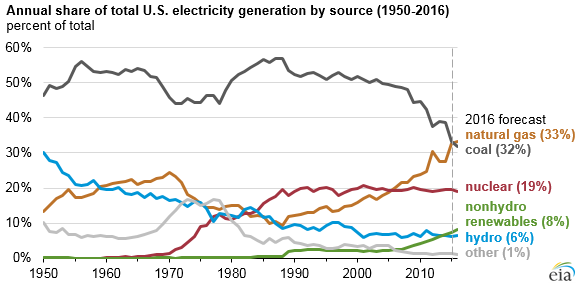
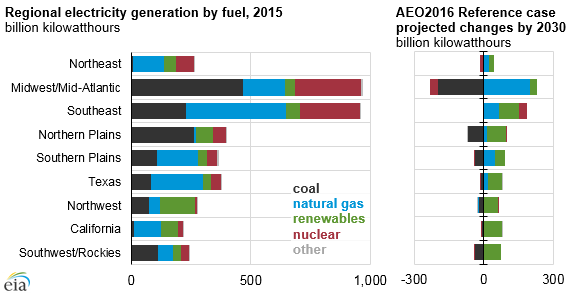
Who's average? The percentage of electricity generation fueled by coal in 2015 was 38%. (EIA source, with trend) Even regionally, electricity generation from coal sources exceeded 50% in only one region in 2015 -- the Northern Plans, which represent an area defined in the north by North Dakota to Wisconsin, by the south from Kansas to Illinois (excluding Chicago Land), and less than 10% of total generation in tUSA. And even in the Northern Plains, it was less than 75%. Please show up with data and facts, not horse apples.
-
Who's average?
Where do you think the power for that electric car comes from? 75% of that power on average comes from burning coal.
Who's average? The percentage of electricity generation fueled by coal in 2015 was 38%. (EIA source, with trend) Even regionally, electricity generation from coal sources exceeded 50% in only one region in 2015 -- the Northern Plans, which represent an area defined in the north by North Dakota to Wisconsin, by the south from Kansas to Illinois (excluding Chicago Land), and less than 10% of total generation in tUSA. And even in the Northern Plains, it was less than 75%. Please show up with data and facts, not horse apples.
-
Re:The cleanup
In actually socialist societies like Germany they are getting rid of coal and using taxation to make sure it pays for the damage it does.
Not really.
One for, most of the gains in renewables in Germany came from nuclear losses: https://en.wikipedia.org/wiki/...
In 2015, 44% of German power came from coal: http://www.eia.gov/todayinener...
https://en.wikipedia.org/wiki/...Even the US has a lower percentage coal use (currently around 33%). And the US has been trending downward, whereas Germany has been trending sideways.
And Germany imports about two-thirds of its energy, which comes primarily from fossil fuel sources (https://en.wikipedia.org/wiki/Energy_in_Germany#Energy_Consumption). It's just passing on "externality costs" to other countries.
-
Re:Black swan events
In contrast, subsidies for different energy sources are 23.1 cents/kWh for solar, 3.5 cents/kWh for wind, and 0.2 cents/kWh for nuclear. (Tables ES4 and ES4. Solar received $4.393 billion in subsidies while generating 19,000 GWh. Wind received $5.936 billion while generating 5,936 GWh, and nuclear received $1.66 billion while generating 789,000 GWh.) That's right. The subsidy for solar is 1650x more expensive than cleaning up nuclear accidents. The subsidy for wind is 250x more expensive.
[...] Statistically, per unit of energy generated, nuclear power is the safest power source man has invented.
BLESS YOU for bringing forward subsidy per units of energy produced.
I'd like to Krazy-Glue some of these Slashdot posters to the wall and dangle a bottle of nail polish remover in front of them, to be handed over after they answer the question: "Would YOU personally pay ~115 times more for solar, and ~17 times as much for wind?" I should be allowed to glue my poster. I should be allowed to think.
Glad to see you got modded up in general, but sad to see the only commenters you get repeat that "economics don't work out" yarn they heard somewhere and repeat only when emotional appeals will not work. Deep down they just do not like nuclear energy and will grasp at anything. As it stands... to completely green-field Three Mile Island Unit 2, there have been estimates of ~$918 million, of which ~$665 is in the bank. That ~$253 million deficit is hardly worth crowing about... and I strongly suspect that 918 million is the 'Epi-Pen' price, you know, the amount things cost if you lock the most greedy, opportunistic people together in a room and don't let them out until they deliver a nice pork barrel. These things could (and should) be done for less.
-
Re:Wouldn't need subsidies
This is the dumbest thing I have read so far today. Nukes have historically been about twice the cost of coal. If they were "obviously" cheaper, they wouldn't require subsidies, and they would have replaced coal plants long ago.
This link shows the relative cost of operating a fossil vs nuclear plant through 2014. When fuel and O&M costs are considered, nuclear comes out cheaper.
http://www.eia.gov/electricity... -
Black swan events
Three Mile Island was the only major commercial nuclear accident in U.S. history. Nuclear power in the U.S. has generated 24,196,167 GWh between 1971-2015. At an average price of 12 cents/kWh, that's $2.90354 trillion. So the approx $3.4 billion in cleanup and lossses from TMI is 0.117% of that. Or in other words, at a retail price of 12 cents/kWh, the historical cost of cleaning up nuclear accidents in the U.S. is 0.014 cents per kWh.
In contrast, subsidies for different energy sources are 23.1 cents/kWh for solar, 3.5 cents/kWh for wind, and 0.2 cents/kWh for nuclear. (Tables ES4 and ES4. Solar received $4.393 billion in subsidies while generating 19,000 GWh. Wind received $5.936 billion while generating 5,936 GWh, and nuclear received $1.66 billion while generating 789,000 GWh.) That's right. The subsidy for solar is 1650x more expensive than cleaning up nuclear accidents. The subsidy for wind is 250x more expensive.
Nuclear decommissioning costs are already paid for by the NRC's Financial Assurance fund. A portion of the revenue from electricity sales are placed into this fund.
The problem with insuring nuclear plants is just a quirk of statistics. The more times you roll the dice, the narrower the bell curve becomes and the more predictable the average outcome. e.g. A 1d100 has an equal chance to produce any result between 1 and 100 - the probability distribution function is a straight line. 2d50 produces a triangular PDF, with the values in the middle tending to be more likely. 10d10 produces an even more compact PDF - a narrow normal curve with results in the middle much more likely than the extremes. And 100d0.5 will always produce 50 - its PDF is just a single peak in the middle.
This is a problem for insuring nuclear plants - because they produce so much energy you don't need very many of them. Whereas there are thousands of coal plants, and (potentially) millions of solar installations, there are only operating 100 nuclear plants in the U.S. So insuring a nuclear plant represents a greater risk for the insurer. Even though the mean outcome will be that there is 1 accident every 30 years, the chance of a 2nd or 3rd accident is still significant and the amount the insurer has to pay out may easily surpass how much they've collected in premiums if they assume the statistically most likely outcome of a single accident.
The insurance company's response is to increase the premium to also cover that 2nd or 3rd event even though they're unlikely. In contrast, with thousands of coal plants they can be much more confident that there will be (say) only 10 accidents every 30 years, and 20 or 30 accidents is extraordinarily unlikely. So the premiums can be lower, even if the average risk (mean) is exactly the same. If there were some way to build thousands of small-scale nuclear plants instead of 100 large ones, private insurance wouldn't be a problem. You get around this problem by creating the largest insurance pool possible, which in this case would be nationalized insurance covering all 100 nuclear power plants.
Statistically, per unit of energy generated, nuclear power is the safest power source man has invented. -
Re:why?
Here is a table that lists it at 78% (and claiming 73% for 2015)
BUT, that does not include the 17% extra coal that China recently admitted to burning (and that is STILL to low).
Here we see that America used 33% coal for our electricity, and it is dropping still.
Now as to how I got the less than 15% for America vs close to 50% for China, Here is NASA's OCO-2 map of Oct-Nov, 2014. That time frame was picked because Ag does not play a major part during that timeframe. This is basically a base-line of emissions. Sadly, OCO2 is not fully capable of showing TRUE amounts. The numbers indicated are rough estimates. If you look carefully at China, it has an area bigger than Europe and bigger than the entire American eastern seaboard that runs from the atlantic to past the mississippi, that is emitting at 401+ (basically, it topped the sensors) PPM. This is China's BASE from 2 years ago, and current OCO-2 data shows that it has INCREASED last year (contrary to the lies put out by gov groups). America, has that area, smaller than China, and is around 395-397 ppm. It is a great deal less CO2 being emitted. Then we have Europe. which is around 393-395. It is similar in size to America's eastern seaboard, but, it is also less.
OCO3 was supposed to come out this year, and it would tell us EXACTLY how much is being emitted. However, after O talked with China about emissions, OCO3 was delayed for 2 years. This is an item that is easy to take up to space (ride up to ISS), and then is simply plugged in on the outside of the ISS. It is TRIVIAL to set this up. So, it appears that O was talked out of adding which NASA is pretty upset about. So am I. My gut feeling is that this will show that China is at or MORE than 50% of global emissions. In addition, Europe is also likely to come up. Oddly, the most monitored nation on this planet, is America so, we are likely at what we thought.
So, out of the two of us, the only one pulling from their ass and not having a grasp of this, is you. And sadly, you are probably another far leftie idiot that runs around screaming about America emitting without giving a flying fuck about China or where all the growth is occurring. -
Greenhouse gas
The real polluter is China, at an official 1/3, and far more likely to be close to 50%.
China 28%, the United States next at 16%. Since America has less than 1/4 the population of China, though, we're still putting out 2.5 times more greenhouse gas per person. Source: https://www.epa.gov/ghgemissio... alternate source: http://www.ucsusa.org/global_w...
Even now, America is under 33% coal for their electricity, Sadly, theirs continues to rise, while America's continues to drop.
yep, America is about a third: http://www.eia.gov/energy_in_b... That's primarily because of the drop in cost of petroleum and natural gas. I don't have good numbers for China, but they do burn a lot of coal.
The one that should be putting their money into dramately lowering their emissions is China.
The answer is "both". Since China already uses only 40% as much fossil fuel per person than the US does, it's going to be 2.5 times easier to reduce the US emissions, of course. But, this is exactly why it is a wicked hard problem : no single actor, no single organization, no single country can solve the problem on its own. The problem is global in scale.
-
Re:It Sounds Like...
What replaces fossil fuels must have comparable energy densities and portability/replenishment/refueling cycle times and ranges.
You're thinking in terms of transportation which accounts for about 28% of our energy use (in the USA). Most stationary applications can use electrical power and it doesn't matter how that's generated. Even in transportation electric cars currently have the range for about 90% of most people's driving and with battery technology improving year by year the range continues to improve.
Solar and wind power are competitive on price with other forms of power generation and they continue to get cheaper. It's just a matter of building out the infrastructure.
-
Re:Offshore wind is very uncompetitive
I suggest you recheck your numbers based on updated estimates. They've dropped it to 14 cents per kWh for offshore. EIA's estimates for fast-changing technologies are notoriously bad anyway. I'm also puzzled where they actually got their estimates from when the first US offshore farm is still being built. Half a data point is not a large sample.
-
Re:Ye olde 'negawatts' concept
California has given up on bringing new power generation online,
"Almost half of all capacity added in 2013 [across the US] was located in California." "Nearly 60% of the natural gas capacity [across the US] added in 2013 was located in California." http://www.eia.gov/todayinener...
California's total electrical generation capacity has gone from 55,344 MW in 2001, to 79,359 MW in 2015. That's an average increase of 1,644 MW of new capacity going online each and every year.
http://energyalmanac.ca.gov/el...
Energy standards in California call for 33 percent of the stateâ(TM)s power to come from renewables by 2020 and 50 percent by 2030, and so the state is building new wind and solar capacity as fast as possible. The recently built Ivanpah plant was the world's largest, and it's in California, not Arizona, for good reason.
In fact you can get a current list of power plants planned, under construction, and newly online, here:
http://www.energy.ca.gov/sitin...
Conservation is fine is a short-term solution to shortage - of anything - but in the long run there is no substitute for generating more power
California "has one of the lowest per capita total energy consumption levels in the country. California state policy promotes energy efficiency. The state's extensive efforts to increase energy efficiency and the implementation of alternative technologies have restrained growth in energy demand." https://www.eia.gov/state/anal...
-
Re:Ye olde 'negawatts' concept
California has given up on bringing new power generation online,
"Almost half of all capacity added in 2013 [across the US] was located in California." "Nearly 60% of the natural gas capacity [across the US] added in 2013 was located in California." http://www.eia.gov/todayinener...
California's total electrical generation capacity has gone from 55,344 MW in 2001, to 79,359 MW in 2015. That's an average increase of 1,644 MW of new capacity going online each and every year.
http://energyalmanac.ca.gov/el...
Energy standards in California call for 33 percent of the stateâ(TM)s power to come from renewables by 2020 and 50 percent by 2030, and so the state is building new wind and solar capacity as fast as possible. The recently built Ivanpah plant was the world's largest, and it's in California, not Arizona, for good reason.
In fact you can get a current list of power plants planned, under construction, and newly online, here:
http://www.energy.ca.gov/sitin...
Conservation is fine is a short-term solution to shortage - of anything - but in the long run there is no substitute for generating more power
California "has one of the lowest per capita total energy consumption levels in the country. California state policy promotes energy efficiency. The state's extensive efforts to increase energy efficiency and the implementation of alternative technologies have restrained growth in energy demand." https://www.eia.gov/state/anal...
-
Re:"Ghandi" quote updated
Personally I'm open to nuclear power, where it makes sense - and there are certainly sites where it makes the most sense. However I disagree that it's always the best alternative, and especially that any other option is "suicide".
For one, nuclear isn't as cheap as you seem to think. According to the EIA, (onshore) wind and solar PV both have significantly lower LCOE than nuclear, at $58.5 and $74.2 per MWh, vs $99.7 for nuclear. That's after accounting for their lower capacity factors, and before any tax credits. Wind and solar are cheaper to build, generally cheaper to maintain, and have zero ongoing fuel costs.
And while I agree that modern nuclear has a very low chance of dangerous failure, it's still non-zero, and you have to multiply that chance by the economic costs of consequences, which can be very high. Failure costs aren't factored in to the above numbers, but they can't be dismissed either. Despite that, I think nuclear should still be considered, particularly for more northern sites where solar is less effective and available wind may not be enough.
I'm guessing your objection to solar & wind is the "baseload" concern, where low capacity factors require alternate sources. This isn't a new issue for the energy industry (nothing has a 100% capacity factor), and is traditionally solved by distributing the load over multiple plants. A number of studies show that reliable power is certainly feasible with renewables too. For example, with widely-distributed wind farms, local variations can be spread out over the larger grid, and excess solar can be stored with pumped hydro (where available) or any of a number of commercially-available grid storage technologies, including reflow batteries (which can be easily scaled to almost any desired storage capacity). During the transition (which would likely take decades), existing gas turbines can help cover any shortfalls. I also note that geothermal plants are particularly interesting here, as not only do they have a capacity factor even better than nuclear's, they also have the cheapest LCOE of all.
-
Re:This is the year of the extreme climate claims
I recommend the Internal Energy Statistics of the EIA.