 Slashdot Mirror
World Energy Hits a Turning Point: Solar That's Cheaper Than Wind (bloomberg.com)
A transformation is happening in global energy markets that's worth noting as 2016 comes to an end: Solar power, for the first time, is becoming the cheapest form of new electricity. From a report on Bloomberg: This has happened in isolated projects in the past: an especially competitive auction in the Middle East, for example, resulting in record-cheap solar costs. But now unsubsidized solar is beginning to outcompete coal and natural gas on a larger scale, and notably, new solar projects in emerging markets are costing less to build than wind projects, according to fresh data from Bloomberg New Energy Finance. The chart shows the average cost of new wind and solar from 58 emerging-market economies, including China, India, and Brazil. While solar was bound to fall below wind eventually, given its steeper price declines, few predicted it would happen this soon.
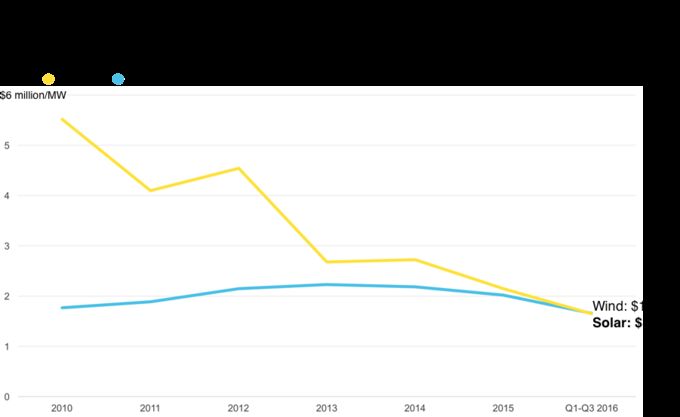
Very confused author. He shows a chart of capacity costs, not actual production cost comparison, then he starts talking about contract prices, which are a very different thing altogether.
Now that's great. That's like saying you're now finally running faster than the kid in the wheelchair.
Wake me when it gets cheaper than fossil fuel.
Errrr reading the statement above says.... "But now unsubsidized solar is beginning to outcompete coal and natural gas on a larger scale"
Aren't emerging market needs by definition significantly less than highly-developed industrialized market needs?
The reason solar is relatively inexpensive right now is because of Chinese panel manufacturing costs, or lack of them.
With the planned 45% (or short-term 15%, if he can't convince congress) tariff, solar may not be cheaper for very long. And/or if China continues to be aggravated about Taiwan.
Well, not here in the US, anyway. They'll still be cheaper everywhere else. Unless China actually stops subsidizing its manufacturers.
I've fallen off your lawn, and I can't get up.
The only way Trump is going to restore millions of coal miner jobs is to bomb this solar and wind installations out of existence. Coal can't exist with cheaper alternatives. Damn free market capitalism!
Wind has been cheaper than coal for 2 years with Solar only about a penny per/kw more. With solar approaching winds price both a far cheaper than even the cheapsest fossil fuel produced power in 100 year old (fully paid for coal plant). 4GWs of solarpower was installed last quarter and install rate is growing at 80%+ per year while prices are falling 20% per year for the last 6 years.
Whats funny to me is the jackasses that think solar and wind power are a partisan political issue, because they aren't.
From what little I know, Thorium seems like it might be viable alternative.
Your numbers are wrong because you are either looking at rooftop solar, which is different to this, or you are looking at costs related to existing solar installations (ie, historical solar costs).
The real "Libtards" are the Libertarians!
Thankfully our dear leader Trump is nearly here. He is sure to repeal all those green energy subsidies and other absurd regulations so that all energy sources can compete on a level playing field.
We are nearly free of this liberal global warming hoax, people!
Glorious days are ahead!
Don't believe a word of it. Frequently they underestimate owner's costs and T&D in these comparisons and only look at simplistic models of construction labor/material and fuel costs. I can tell you that natural gas combined cycle plants are still far cheaper to build and run than solar or wind. And will be for a long time unless NG prices should suddenly increase, which they won't with plenty of gas available through hydraulic fracturing.
I can't comment much about your situation, as I don't know where you live. I can, however, say this in general.
* Intermittency is nothing new to grid operators; through the entire history of power generation, they've been having to deal with demand fluctuation and random losses of plants and lines. Hardware is, and always will be, built to the minimum needed to statistically guarantee a given level of uptime
* There have been many, many studies on the issue of high-renewables grids - here's an example covering cost analyses on wind + solar + HVDC + NG peaking (no power storage) using current technology only.
* A HVDC grid actually saves about three times more than it costs due to lower hardware (and thus capital) requirements for grid operators. While HVDC lines and conversion stations pose their own point of failure risks, overall they increase grid stability against localized failures, particularly cascading failures (AC sync failures don't cascade over HVDC). The stability benefits of HVDC links has led to the US to use a number of them even without long lines, just to connect different disjoint grids together (the lines are the cheap part, relatively - it's conversion stations that are expensive). HVDC provides baseload from Quebec hydro to the northeastern US. Europe and China both make heavy use of HVDC - Europe mainly for submarine links, China mainly for bringing power from the interior to the densely populated coast (plus some HVAC). Both have huge expansion plans.
* Large HVDC grids cause both timeshifting (aka, it's nighttime wind in on the east coast during the evening demand peak on the west and on the west coast during the morning rush in the east coast; likewise with solar shifting) and weather diversity (whenever a front is moving off the east, there's almost always a new one (or more) that has come in from the west).
* Solar and wind tend to run counter to each other. Wind peaks at night; solar in the day. High pressure zones create low winds and lots of sun; low pressure zones create high winds and little sun.
* Combined with NG peaking, these factors can provide a statistically guaranteed uptime with low power costs.
* All of this is based around there being no storage - which is a pessimistic assumption:
** Dirt cheap storage can be had by uprating hydro turbine houses, combined with the aforementioned HVDC grid. Hydro thus shifts from baseload to peaking. There's extensive hydro on both coasts that can be uprated.
** Pumped hydro - as standalone plants or as modifications to existing plants - can often be affordable, but depends entirely on local geography.
** Compressed air has gained some interest, although is not yet cost effective.
** Batteries used to be by far the most expensive option, but their prices too have been plummeting, to the point that li-ion is starting to make some grid penetration. There's not going to be some huge takeoff of it at current prices, but given that large scale production (gigafactory, etc) is expected to halve costs, that would seriously take off. There's other rival chemistries also seeking for the low cost per-Wh / per-W crown.
But, storage is not a necessity when you have peaking, source diversity, and geographic diversity with a modern, well-connected grid.
Sometimes I doubt your commitment to Sparkle Motion.
Don't believe those fake news websites. I looked at multiple energy sources for my house and calculated out these:
Cite your sources or your numbers are meaningless and most likely fictitious. The numbers I've seen aren't even remotely close to that and you didn't bother to account for externalities like the cost of dealing with fossil fuel pollution.
Your numbers make no sense. How the fuck do you pay one set price for a kw? I think you mean kwh - Those are about $.12
Yes, right now natural gas is kicking everyone's ass -- especially coal. That's why those coal mining jobs aren't coming back. It's also why the four nuclear plants under construction in the US were contracted out almost a decade ago and in two of the four cases had to receive federal loan guarantees from the Obama administration.
But this might not last forever. China is making a push to move into natural gas electricity generation, along with the rest of the advanced economies, and the US is just starting to export. The market for gas is still expanding, and in ten years time the price situation may be quite different.
Obama has been a very pro-gas president, but he's also tried to hedge his bets by encouraging alternative technologies. This is a wise course of action because you can't conjure a new technology out of thin air just when you need it.
Post may contain irony: discontinue use if experiencing mood swings, nausea or elevated blood pressure.
Say thanks to communist party for subsidising 60% of your next solar panel purchase.
Obama has been unable to block the growth in gas, despite trying to do so. That hasn't stopped him from grabbing credit for the growth.
Contribute to civilization: ari.aynrand.org/donate
If we move to solar, we will suck up all the sun's light! How will we see and keep warm?
Grid kWh costs are on a sliding scale since there is a base cost for the grid connection. If you use just a few kWh a month they will cost hundreds of cents each, easily more than locally generated power plus storage. And if you can't live without those kWh add in the cost for the backup generator.
Bill the grid infrastructure separately, then generation costs can compete on a fair basis at each particular time of the day. Local storage or backup generation is an unrelated issue.
You can believe all you want, but investments in solar and wind are sky-rocketing.the race between fossil and green is over, and won convincingly by solar and wind
Yes, I'm left. You have a problem with that?
If you are including "storage", then you have to be talking about a solar or wind generator on your house. If you want to be fair, compare to what a hydro, coal, gas or nuclear generator on your house would cost.
Second, you have no idea what you are talking about because you use "kw" when you most likely mean kwh. This is basic stuff. Overall, it is easy to conclude that you are clueless on the subject.
Good. I hope solar absolutely crushes wind. I'm firmly in the "don't want to live anywhere near a turbine" camp. Now you know somebody will retort that they're actually beautiful, don't kill that many birds, hardly ever catch fire, etc.; but I'm not sold. Yeah, they can be beautiful sometimes... in somebody else's neighborhood.
A turbine farm has a way of altering the landscape. Yeah, clean power; but the aesthetics of the environment are altered over entire regions. A solar farm can be tucked into a suburb and you don't even know it unless you can find a hill to climb where you can get a view.
Apparently you're unaware of a certain multi-decade trade imblance that completely moots your point but regardless, they're more than welcome to tax the shit out of our exports which would be.... what, shale oil and shitty movies??
The US exports lots of stuff. Here are the top 10 categories of exports. Machines, electronics, aircraft, vehicles, oil, medical technology, plastics, gems/metals, pharmaceuticals, chemicals. The US is the second largest export economy in the world behind China. In 2014 the US exported roughly $1.45 Trillion in goods.
So Trump being the asshole he is promising to be and starting a trade war will hurt Boeing, Caterpillar, GM, Ford, Intel, etc. Not to mention all of us when the prices of everything goes up in the ensuing trade war. Tariffs do not make things better. They save a few jobs at the expense of most everyone else.
You've missed the bit that a Coal Cellar, and related Coal Scuttles, for Storage for _your_ Coal fired Plant, aren't cheap, (Because it just might have been disingenuous for you to compare apples and oranges...), and that once the costs of manufacture and minimal maintenance are paid back, Solar is essentially free, while you still pay, and pay, and pay for Coal.
How much is that Hydro plant in your back yard cost? Or the Natural Gas Turbine? Did you _really_ get such a good deal on that Nuclear Plant in your basement?
Or just perhaps... you don't understand basic Arithmetic?
"Solar: 60 cents/kw + storage"- Fixed Costs? Running Costs? (And those numbers? Solar is cheaper, but Panels are now more like $0.80/W wholesale.)
"Wind: 12 cents/kw + storage"- Fixed Costs? Running Costs?
"Hydro: 3 c/kw. Coal: 9 c/kw. Gas: 12 c/kw. Nuclear: 12 c/kw."- This makes no "cents" at all. You don't pay for Kilowatts, you pay for kWh. If you actually meant "c/kWh", (Capitalize properly, Moron), then you have given Running Costs, and totally ignore Fixed Costs paid for by somebody else, you innumerate Leech.
The costs compared in the study, numbnuts, are for Large Scale production, not for how many cheap panels you can fit on your Single-Wide roof.
However, even on a small scale, Solar is now very attractive. I put a couple of ~100 Watt Panels, (~$300 including Controller and Stuff.), on my Yacht recently; I already had ~3kWh of Storage, (12V, 270Ah). It was cheaper than the fixed and running costs of a new decent Auxiliary Gas Generator, (1kW Honda, ~$800 plus gas.), and I no longer have to crank up Old Man Volvo, (~$2/hr for fuel, repairs, depreciation; figure on overhaul/replacing after ~4K Hours at ~$6K), to charge the Batteries every couple of days. This is also far quieter. At the $0.24/kWh potentially charged by the local Marina for Shore Power for daily use, installed cost was paid off by October. (~Seven Months of sunlit days.) And I'm not tied to the Dock...
Try posting as "AC" from now on- "Anonymous Cretin". "knightghost" sounds like a silly character out of Monty Python.
Cloud cover isn't necessarily a problem for solar, as the frequencies blocked by the clouds are not the ones that PV cells are most efficient at collecting. You'll see some decrease, but not as much as you might think. Add to that the fact that PV cells become a lot less efficient if they get too hot and sometimes cloudy days can generate more power than sunny ones: less light hits the cells, but they're more efficient at converting it to electricity.
I am TheRaven on Soylent News
This is Slashdot, don't forget. We don't need renewable energy, because coal and oil are just fine. They do not affect the planet in any way, and never will. Pointless place to post an article like that.
Remember, AGW is a vile hippy-commie-plot, rumbled by a plucky band of billionaires and oil companies.
I do not want your cheap brainburning drugs. They are useless for work. And I am a working man today.
"It was known since the 1950s, but due to political considerations, wasn't deployed. That's my version. "
Oh, you mean the Lawrence/Alvarez/Ghiorso MTA A-48? Whimsically named the Material Test Accelerator, originally designed to produce a gram of Neutrons a day, for... things..., it was later used to investigate "Burning" Nuclear Waste or "Breeding" Stockpile material, with a net positive Power Production.
The problem with the MTA was that getting all the Waste concentrated into a form capable of being irradiated was, and is, spectacularly dangerous.
"Do your own reading for real facts"
I don't need to read about it... I was there. The design was eventually refined into the Berkeley HILAC, in Building 71.
That's what it takes to get ahead in the world. While the west, particularly the US, stopped short after decades of R&D yet before commercialization we handed the crown to China for a pittance. Forward looking governments that recognize the next trillion dollar industry. FYI, China is also the largest wind manufacturer and will soon be the largest nuclear manufacturer. But at least we got our fracking...
I can only imagine that this is due to the subsidized solar energy that drove the demand for the first installers and that drove down the price sooner than it would have without it.
The thing is obviously how much time was gained by it. Was it months, years or decades?
And by subsidized I mean not only in the US, but all over the world. If you see the solar fields in e.g. Northern Germany that is at the same height as Winipeg, Canada, so all of the US could easily use solar. Yes, it will be less efficient in the north as it will be in the south. Does not mean it can't be used at all.
Don't fight for your country, if your country does not fight for you.
"Whats funny to me is the jackasses that think solar and wind power are a partisan political issue, because they aren't"
Please tell that to the jackasses in Congress.
Pain is merely failure leaving the body
early adopters of CFLs bought on the theorized cost savings over time of bulbs that were more expensive than incandescents. When was the last time you saw a Compact Fluorescent Light (CFL) actually live to its expected age? Yet it's that expected age that sets the predicted economy of those bulbs. I'm sure the same will be true of the early, expensive, LEDs. They will die younger than expected.
When I see the predicted cost of solar I think it's probably based on the hope that the solar cells and their requisit power conditioners and batteries and backup power systems don't fail or change costs to maintain over the years and years and years of their life expectancy.
Thus I have doubts that the amortized costs are as predicted.
One the other hand that doesn't really matter to the consumer. Some investor is going to eat that cost if the predictions are off. The rate payer is paying what the rates are right now based on that prediction not whatever the actual costs will be.
And my guess is that 30 years from now when we have worked all the kinks out of solar costs will be lower than natural gas and correctly estimated too. I just suspect that there's going to be a lot of utilities that eat it on this one and then public rate commissions will try to pass it along to consumers with surcharges.
I know this triggers cognitive dissonance, but Obama is, in fact, pro-fracking, much to the displeasure of his base. He does favor more regulation than the industry would prefer, including regulations on worker safety and environmental impact.
It boils down to this: while burning more fossil fuel is bad for climate change, the growth of natural gas is largely at the expense of coal. Natural gas emits only half the net CO2 per BTU that coal does.
Clinton's plan was actually pretty good in this respect: continue the shift from coal to natural gas, but to hedge her bets with renewable technologies, locating renewable-related jobs in areas losing coal jobs. That's not as favorable to the coal miners as bringing back the glory days of coal, but the those days just aren't coming back. By 2020 the cost to generate a given amount of electricity with coal will be almost 1/3 higher than generating the same amount with natural gas. Even if you threw out all the safety and pollution regulations they aren't coming back, because you'd have to make coal 1/3 cheaper per BTU than gas before it could compete economically with gas plants, which are more efficient and cheaper to operate. You'd have to cut the price of coal by more than 1/2.
Post may contain irony: discontinue use if experiencing mood swings, nausea or elevated blood pressure.
Now that's great. That's like saying you're now finally running faster than the kid in the wheelchair.
Wake me when it gets cheaper than fossil fuel.
No, I think you are doing just fine asleep because I can see it works well for ya.
I'm curious - is fossil fuel going to last forever? Are you a disciple of the abiotic oil concept, where it is just created continuously so we'll never ever run out? Is this fuel something that politics creates?
That's the thing that is a little hard to understand where people strut around beating their chests and brag about how awesome fossil fuel is compared to all the other energy generating methods. It isn't going to last forever, and I'd rather use them to do other things with, like make lubricants and plastics, and for the lightweight energy dense applications like military use. Especially hard to achieve air dominance without them.
You might not like it, but the solar and wind power projects in the rear view mirror are much closer than they appear.
The shepherds did so well protecting the flock that the sheep no longer believed that wolves existed.
I don't understand this. I've stood right underneath one on a windy day and it wasn't that much louder than the wind. Is the appearance the problem? I'd love some in my valley if they'd actually do something to reduce our extreme surface winds. Too bad they don't have as much of a reduction as one would like.
I've long been tempted to try to implement a low cost windbreak-turbine hybrid system, so that when you build a windbreak, you also get power from it - without it costing much more than traditional windbreak solutions. Basically, think posts with holes to feed cables through at regular heights and low abrasion bushings or coatings at the holes. Nothing particularly special. Push them into the ground as usual. Run a high tension metal wire through each holes, so that you now have a wire fence. Take a reel of spiraled metal or durable plastic, like a collapsible vertical axis wind turbine and cut it at a length to pass between each set of posts. The material should have enough give and be dull at the edges so that it does not injure people or livestock when spinning. Tightly clip the spiral around the wire so that it will exert a rotational torque on it when there's wind, turning each wire into something like a vertical axis wind turbine on its side. As for the wires, at regular intervals, rather than passing through a post, terminate them at a mini generator (bolted through the hole, with an anchor for the next wire to start on the far side). Declare one wire in the windbreak to be the "live wire". All mini-generators need to be rectified and voltage converted, then chained in series (upping the voltage) up to the live wire. Connections across the live wire are chained in parallel (upping the current). The beginning and ends of the live wire are routed into a breaker box for usage, after first passing through an inverter.
Seems like it should work. A challenge might be that performance would probably be pretty sensitive to wire tension, so if you want long runs (to reduce the number of generators / increase generator size), you'd need some combination of very good anchoring and/or an automatic tensioner. Also, being at ground level, you'd need to make sure that your materials are fatigue resistant, since turbulence is highest near the surface. There are certainly cheaper ways to make wind power, but if what you actually need is a windbreak and would like to get some power along with it...
Sometimes I doubt your commitment to Sparkle Motion.
Then we can cut subsidies and zero-interest loans to those companies, right? If they are at "parity" then let the market decide...
Browsing at +1 - no ACs, I ignore their posts. So refreshing!
Li-ion is also starting to get some initial traction for local grid stabilization that my grow into a more generalized resilience that can allow for slower spin up times on peaking solutions.
> Frequently they underestimate owner's costs and T&D in these comparisons and only look at simplistic
> models of construction labor/material and fuel costs
Fuel costs... for solar?
> I can tell you that natural gas combined cycle plants are still far cheaper to build and run than solar or wind.
They simply are not. They are certainly competitive, but in the last two years or so the CAPEX side for PV and wind has been plummeting. Here's a reasonably up-to-date listing:
https://www.lazard.com/media/2390/lazards-levelized-cost-of-energy-analysis-90.pdf
Look on page 11.
Big deal, showoff. I put solar panels on my sedan chair recently.
You are welcome on my lawn.
That's per kW of capacity. You need to multiply that by capacity factor - the ratio of actual power generation to theoretical max capacity - to get a cost comparison per kWh (total energy generated).
Coal's capacity factor ranges from about 0.4 to 0.6.
Wind is about 0.2 to 0.25.
Solar is about 0.1 (Germany to 0.145 (continental U.S.) to 0.19 (Southwest U.S., India).
We "jackasses" think that because the folks advocating wind and solar keep comparing meaningless installed capacity figures (cost per kW). That's like trying to figure out which car is more fuel efficient by comparing the size of their gas tanks. The only way you could think that's a legitimate way to compare the cost-efficiency of different power sources is if you're an idiot, or if you're partisan. Forgive us for giving you the benefit of the doubt and assuming you're just partisan.
Different power sources have different capacity factors. So to compare across different power sources, you have to multiply by those capacity factors so you can compare figures based on actual power generation (kWh or MWh). Wind is already cost-competitive with more expensive coal sources (excluding the cost of coal pollution). Solar probably has another decade to go.
> the frequencies blocked by the clouds are not the ones that PV cells are most efficient at collecting.
Uhhh, yes they are. PV is most efficient in red, and clouds block that just fine.
My panels have been going for six years now, they show a pretty much linear production with cloud percentage.
The temperature effects you note are minor in comparison, I can't even see them on my production charts, except for gross seasonable time frames.
We're bringing coal back! Otherwise these unemployed coal workers are going to keep getting tested!
Grid kWh costs are on a sliding scale since there is a base cost for the grid connection. If you use just a few kWh a month they will cost hundreds of cents each, easily more than locally generated power plus storage. And if you can't live without those kWh add in the cost for the backup generator.
Bill the grid infrastructure separately, then generation costs can compete on a fair basis at each particular time of the day. Local storage or backup generation is an unrelated issue.
As well, try getting them to instal a power line to your house if the place isn't already on a grid. Suddenly solar isn't just cheaper, it's mid bogglingly cheaper.
The shepherds did so well protecting the flock that the sheep no longer believed that wolves existed.
Well done, completely misreading (or failing to read) TFA. TFA discusses recent bids to provide power being cost effective (cheap, in fact) now when comparing the cost of electricity produced (priced per MWh). All your guff about capacity factors is irrelevant when the article discusses actual wholesale prices for electricity.
The real "Libtards" are the Libertarians!
Subsidies for archaic expensive outmoded fossil fuels are the problem.
No cost for pollution.
Exemptions for older less efficient fossil fuel plants.
Subsidies for fossil fuel extraction on public and private lands at rates often 1/1000th what they would be in a capitalist non-taxpayer-subsidized market.
Exemptions from costs for oil spills and the ability to go bankrupt and let the taxpayer pay for the cleanup.
In the last three months the total solar generation of power in the US has literally DOUBLED. Because, even with the massive fossil fuel subsidies, solar is cheaper than all forms of fossil fuels.
Read that again: solar is cheaper than all forms of fossil fuels.
And, yes, we can use variable energy sources to charge loads in places like Taiwan and even North Korea. So, are you SERIOUSLY saying America can't do BETTER than that?
-- Tigger warning: This post may contain tiggers! --
Natgas isnt just good for energy - It's an amazing chemical feedstock. There are companies setting up plastic production plants everywhere because of cheap fracked natgas.
It's energy independence and we need it-
We do, however, need to be careful of the environmental impact and we MUST compensate those who are affected fairly. Don't let slimy fucks weasel out of externalized costs.
In all, It's worth the price.
That was just poking fun at "knightghost" and his many pulled-out-of-his-nether-regions numbers.
It's actually a pretty small Yacht, and the Crew's Quarters are a disgrace:
http://media.gettyimages.com/photos/in-the-satire-the-magic-christian-ringo-starr-plays-youngman-grand-picture-id517724500
I would guess the exact opposite. They have a much larger deficit in production, and need more both to bring them more inline with our consumption patterns, and also for construction of better infrastructure.
This is a bit like saying "Luxry yachts are now cheaper than business jets." It means nothing in the energy economy, where solar merely equals the amount of electricity that the US generates by burning natural gas captured from landfills. And it's only slightly more meaningful than the 7.3 million Mwh we get from burning human excrement strained out of municipal sewer systems. It's the infrastructure that matters, and neither solar nor wind have scalable infrastructures today. Or in the forseeable future.
Oh, and the carbon footprint scare is total FUD put out by the wacky global warming alarmists.
Oh, how I miss the days when these kinds of posts were on /. every day.
A government is a body of people notably ungoverned - AC
If solar and wind are so cheap, how come my electric bill is skyrocketing so that PG&E can meet its renewables mandate?
I've repeatedly reworked my calculations over the years. Coward's are full of logic fallacies, in particular mixing micro and macro. Rather than nerd-rage, maybe you should get out of your tinfoil lined basement once in a while.
Does coal put as much water vapor into the atmosphere as natural gas?
To be honest, the article itself is misleading. It quotes a contract to provide solar power at $29.10 per megawatt hour in Chile, and then states that it's roughly half the price of competing coal power. But it doesn't cite any Chilean coal plant numbers to compare with. Current price of coal (Central Appalachian)* is $48/ton. A ton of coal will generate almost 2MWh (1,927kWh) of electricity in a plant with a heat rate of 10,080 bTU/kWh. So your cost of coal per megawatt hour is $24.90. There is much more info needed, in order to fairly compare these two sources, missing from the article. For instance, will the solar plant provide a constant flow of electricity 24/7 like a coal plant could do, or is the $29.10/MWh contract to provide power only as it's generated, ie when the sun is shining?
*Note there are different qualities of coal, all with different prices, different pollutants, different energy densities. It is possible to get coal for much cheaper than the Central Appalachian price, but this is apparently a preferred grade of coal. I am not a coal expert, so I have no idea if this is on the expensive end or the cheap end of producing electricity with coal.
Is solar able to compete because of super strict carbon / pollutant regulations? Or is it just actually cheaper? No one seems to answer that...
fossil fuel. Most of the cost of solar is financial so the goal is to sell whatever you got even if it is less that your financial cost. You can afford to do this as long as you sell at a higher cost some of the time. Fossil Fuel Power Plants have a minimum price based on the cost of the fuel they are burning. So solar can undercut fossil fuel especially when subsidized.
This person was making this same nonsense claim the last time the topic came up on Slashdot. I wrote a huge, long rebuttal. And here they are again, making the same ridiculous claim.
The short summary: UV is inefficiently used by solar panels and makes up only a few percent of solar radiation (and a fair chunk of it does get blocked by clouds, even if part of it makes it through); near-IR is readily blocked by clouds and is useless to solar panels; the temperature effect is small (as you note); and (again as you note) there's nearly a direct correlation between cloud cover and actual measured generation. Also countering the temperature effect is the concentration effect; for a given temperature, a panel has higher efficiency when there is more light shining on it. The most efficient solar cells use built-in fresnel concentrators to take advantage of this (as well as other tricks such as frequency splitting so that each subcell is optimal for the frequencies of photons falling on them).
Sometimes I doubt your commitment to Sparkle Motion.
...say a carbon tax designed to recoup the many trillions of dollars that will need to be spent on adaptation to fossil-fuel-caused climate change and on compensation of whole climate-displaced populations and farmers, fishers etc and reconstruction of infrastructure destroyed in climate-change-induced wars... (such as Syria, Sudan,...)
then wind and solar would already be far cheaper than fossil-fuel energy.
We don't have such a tax or tax ramp plan, since the people who control the oil resource have most of the money,
and thus have most of the politicians,
and have most of the voters who are subject to the messages in paid marketing and disinformation.
Prediction: Too much uncomfortable truth in one post will probably get this downmodded as troll. That just shows how imbalanced current discourse on this topic has become, due to oil money interests.
Where are we going and why are we in a handbasket?
Don't worry, Trump will fix that.
First off elimination of the Tax loophole for electric vehicles.
Second, add a tax to solar and wind power.
Third additional subsidies to the fossil fuel industries.
Fourth reduce operating expenses of those industries by getting rid of business killing EPA and OSHA regulations.
Fifth, utilize federal govt. resources to make sure that projects like DAPL are completed as desired by his cronies in the industry.
Sixth, squash lawsuits associated with those industries.
The U.S. needs to shut up about how China's solar industry is unfair. If you don't like it, buy from American companies like SunPower and First Solar. Seriously sick of all the whining.
They are partisan political issues because coal and petroleum are deeply bound to the Republican Party. Anything else is a competitor so finds voice in the other side. This is likely to remain the same for a long time because our political system is not one that represents people in general.
Whats funny to me is the jackasses that think solar and wind power are a partisan political issue, because they aren't.
To politicians, EVERYTHING is partisan!
Actually, the Uranium and Radon coal puts into the atmosphere nucleates water vapor into rain, reducing the total water vapor. Of course, the rain is radioactive but hey global warning.
I've seen this "skyrocketing" in solar and wind investments and it is impressive. That is until you compare it to investments in coal, natural gas, and nuclear. The world is seeing considerable growth in energy production but very little of that growth comes from wind and solar.
I haven't checked lately but as I recall the growth of wind in the USA has been big in the recent past, big subsidies will do that. With the economy stagnating for the last five years or so the demand for energy is also stagnant. The growth in wind has been overshadowed by natural gas. The growth in wind and natural gas has primarily only made up for the loss in capacity from closing coal and nuclear plants. Taxes and regulation on coal and nuclear will tend to kill them off, just as subsidies in wind made it grow.
What is perhaps ironic is that the shift to wind has not shown a reduction in CO2 output in many nations. People like to bring up Germany as a nation that in on the path to being "carbon free" but the reduction in German CO2 output is largely from buying French nuclear power.
Reduction of CO2 output in the USA is largely from replacing coal with natural gas and an economic recession, meaning people are using less energy because they buy less stuff and travel less.
Growth in solar and wind don't necessarily mean a reduction in CO2 output because these unreliable energy sources require a backup energy source or the people risk brownouts and blackouts. As of today this means fossil fuels. Idling a coal plant means it is burning coal but not producing energy. Running natural gas turbines means burning twice as much energy per kwh produced than if that same fuel was burned in a boiler.
We now have real world data that show that wind and solar do not always reduce CO2 output. Many will show that there is a limit to how much wind and solar can be added to the grid before problems arise, depending on who you ask this can be between 10% and 30%. The only energy source we have right now that is carbon free (at least as "carbon free" as wind or solar are carbon free), reliable, and safe is nuclear power.
I've brought up before that nuclear power is cheaper than wind and solar too but people will inevitably dispute it. Fine, whatever, I'll concede that point. What cannot be disputed is that nuclear power is more reliable, just as plentiful, lower carbon footprint, and safer than wind or solar. If it is the cost that is holding people back then I must ask, is a few pennies more on your electric bill worth saving the planet?
I am armed because I am free. I am free because I am armed.
And those subsidies are? I keep hearing about them, but all I ever get is some handwaving and "tax breaks" which are available to ALL companies, not just energy companies...
You mean besides the oil wars in the middle east that have cost trillions of dollars and caused the deaths of millions?
Besides the CO2 that's increasing Earth's greenhouse effect?
Besides the environmental damage (mining, oil spills, contaminated water supplies, fracking chemicals getting everywhere, etc) that never seems to get cleaned up?
Yeah, because besides all of those externalized costs, there are subsidies totaling around $30 billion per year! https://www.eia.gov/analysis/r...
Is that enough? Can we stop denying that fossil fuels are subsidized now? I'm tired of hearing this argument. Do some research instead of parroting that tired myth FFS.
I wrote a rather detailed simulation of solar while I was in college for my EE degree. I'm not totally stupid and have some confidence in my numbers and over the lifespan of the system, solar becomes less expensive than hydro (the current least expensive for of electricity generating) at 26c/wp. I also decided to set up an off grid house to test my numbers and they are very accurate (it's amazing what one can do with thirty years of empirical data). I have seen commercial solar on sale for under 26c/wp. This morning I received an email advertisement for grade A solar panels at 28c/wp.
As a caveat, I get 2400 hours of insolation /year from a fixed ground mounted system. At 10c/kwh, this is 24c/electricity/year for every installed watt, so that is roughly 1 year to pay back the cost of the solar panel. Inverters are now under 50c/wp, so figure an additional 2 years to pay back the inverter and those have to be replaced every 10 years. Installation was around 10c/wp so 6 months to pay that back. MPPT charger is another 10c/wp.
I paid a bit more than 28c/wp for my system, but at current prices I would see a system pay for itself in 5 years without subsidies. Five years after that, I would need to replace some components for $2k unless prices have fallen in which case it will be less.
I live in a non-windy area so have not done analysis on that.
It's .27 where I live.
The short answer is no. Gas is an alkane and water is an intrinsic byproduct of combusting alkanes. Coal is a rock, and therefore different everywhere you mine it, but mostly it consists of interlocking aromatic rings of carbon Burning the main component of coal emits no water.
If you're thinking this means gas might have a higher greenhouse impact than coal because water is a potent greenhouse gas, the short answer again is unfortunately, no.
The water from gas combustion would be a concern if water vapor were a trace gas in the troposphere (as CO2 is). But in fact water is quite abundant already, so the the marginal effects of additional water are minor. Also water comes out of the atmosphere much more rapidly than CO2. In fact the discovery of the limited ability of the ocean-atmosphere system to absorb CO2 rapidly (by Roger Revelle in the 1950s) was what shifted scientific consensus from anticipating global cooling to global warming. Prior to that it was believed that CO2 physically could not rise in the atmosphere as quickly as it in fact has.
Post may contain irony: discontinue use if experiencing mood swings, nausea or elevated blood pressure.
My local power coop is filling farm land in the country with solar panels. For miles and miles you can see solar panels where there used to be soybeans and cotton. It's staggering to see so many panels. When electrical coops are putting in so much solar you know it's inevitable. The best thing about it is that during the summer when it hits 100 degrees with 80% humidity and air conditioners are running wide open the solar panels are peaking as well so when they need power the most they generate the most.
This is my view as well. Despite its climate effects moving to natural gas at the present time is a net positive both economically, industrially, and environmentally, especially as it displaces other fossil fuels. However there are major problems awaiting us if we dive in too blindly. There's a lot of money to be made in fracking and this can corrupt a lot of the public decision making process.
Post may contain irony: discontinue use if experiencing mood swings, nausea or elevated blood pressure.
Wow, that's a lot to read. It also looks a lot like one of the "negawatts" talks from Amory Lovins. I've read and heard a lot of explanations like this one, where it sounds so detailed and researched at first that it just must be true. The problem is that while there is a lot of truth in what you say the plan you spell out will not work. Explaining why it will not work would require a post much longer than yours to address the many many small details that were hand waved over. I'll try to explain this in a paragraph or three.
A big problem with wind and solar is that the energy production curves do not match well with demand curves. Claiming diversity in location and source, through the use of long power lines, will fix this is overly optimistic. To obtain this diversity requires large land masses that many nations do not have. If there is an international grid then this brings in politics that many people in Europe which rely on Russian natural gas would be familiar with. Using natural gas, or other fossil fuel back up, to maintain stability on the electricity grid means relying on cheap natural gas, a potential for no net reduction of CO2 output, and with the strong link between natural gas and electricity this means an actual reduction in energy diversity. In the USA this is not such a problem since natural gas is plentiful, domestic, and cheap, but the rest of the world is not as fortunate.
As you admit storage of energy is dependent on having a hydro electric dam nearby, if that is not available then storage gets expensive. If storage cost more than natural gas, which is almost always the case, then people will burn natural gas. Grid level battery storage, compressed gas, flywheels, or whatever, are just too expensive. This claim of using storage to solve this problem either violates the claim of being available now, or the claim of being available for cheap.
I'm no expert in energy policy but I have an education in electrical engineering and I've followed this for a very long time. What I've found is that any future energy plan that does not include nuclear power is always going to be lacking in some way. Had you made even a single mention of nuclear power in your post I would have had no complaints. Nuclear power is as "carbon free" as any other energy source that makes that claim. Nuclear power is reliable and plentiful. Nuclear power is also safer than any energy source we know. People will dispute my claims on nuclear power being cheap but then I must ask, how much is this "smart" grid, energy storage, HVDC transmission, and so forth going to cost? Nuclear power is only expensive now because we forgot how to do it. People will claim that wind and solar will get cheaper if only we invest in development, does this not also apply to nuclear power? So many people will claim that the problems with wind and solar can be solved with future technology advancements, I will agree so long as we can agree that any problems with nuclear power can also be solved with future technology.
We've been developing nuclear power for 70 years and it produces 20% of the electricity in the USA. We've been developing wind and solar power for much longer and it barely registers on the grid. I say that rather than continuing the insanity of throwing good money after bad on wind and solar that we put some money in nuclear and see that grow. We'd be much better off for it.
I am armed because I am free. I am free because I am armed.
That is an extraordinary piece of wishful thinking. The process you are talking about is physically possible of course, but I suspect the reason that cloud seeding has never been statistically shown to work is that the effect is marginal. You have to take into account that you're just adding what's happening already.
This is also why the water from hydrocarbon combustion is less significant than the CO2; there's already a lot of water in the atmosphere; there's not much CO2 (400 ppm). You have to consider the marginal contribution of the next kw/hr you generate.
Post may contain irony: discontinue use if experiencing mood swings, nausea or elevated blood pressure.
Actually, that's wrong. Solar panels are far from peak efficiency in those conditions. The best environment for solar panels is a lightly clouded day. Rising temperature decreases the output.
Mr. Fusion FTW!
You talk about nuclear reactors that can burn spent nuclear fuel and then mention fusion? I don't follow.
Fusion is an energy source that is 20 years away and always will be. What we do have are molten salt reactors, especially the liquid fluoride thorium reactor or LFTR. LFTR is a technology that is derived from a series of experiments with molten salts run from the 1950s to the 1970s. As you point out the politics got in the way since a few prominent Senators could not use molten salt reactors to buy them votes, but others from states where solid fuel reactors were being built could.
I'm curious on where this full size prototype you mention is being built. I'd like to think I'm well informed on developments in nuclear power but I have seen nothing of this. Perhaps such a prototype is being built in China, they've been funding this kind of research for years now, but I have not heard of any such thing in the West.
I am armed because I am free. I am free because I am armed.
Well done, completely misreading (or failing to read) TFA. TFA discusses recent bids to provide power being cost effective (cheap, in fact) now when comparing the cost of electricity produced (priced per MWh). All your guff about capacity factors is irrelevant when the article discusses actual wholesale prices for electricity.
The article completely confuses cost and price. It was written by an idiot.
The problem with HVDC is that single lines are point to point, not networked, and substation equipment is tremendously expensive. Though the cost of the actual materials for the lines themselves is relatively cheap, the cost of the dream of the many hundreds of HVDC lines required to partially mitigate intermittancy is super high because of land acquisition. That includes purchase, legal battles galore, and the cost of uncertainty from those battles. Its a tremendous cost nobody wants to talk about. Its simple to say just build a shitload of lines.
Or we could consider a clean energy strategy that maximizes use of the investments already made in the existing grid, which is serving us well every day.
Cloud cover isn't necessarily a problem for solar, as the frequencies blocked by the clouds are not the ones that PV cells are most efficient at collecting. You'll see some decrease, but not as much as you might think. Add to that the fact that PV cells become a lot less efficient if they get too hot and sometimes cloudy days can generate more power than sunny ones: less light hits the cells, but they're more efficient at converting it to electricity.
I really don't understand how people keep peddling this absolutely false information. Whoever told you that is clueless. You'd be wise to question whatever they tell you, and stop repeating it because it makes you look clueless as well. I'm sure you just trusted the wrong source.
Just put up 5KW of panels last week, for a good price.
Our govt subsidies are going to shift next month and the current LNP government is pro -coal, anti-solar.
While every other country is going gangbusters on solar our dickhead government wants to dig up more coal.
Go well
(excluding the cost of coal pollution).
So you are trying to exclude the primary reason people oppose burning coal?
Hippocrates would like a word with you.
It's not a partisan issue, it's a money issue. If you could find a way to grease politicians with solar you might see them change their tune.
Technically, oil is created continuously.....just REALLY slowly.
"You can believe all you want, but investments in solar and wind are sky-rocketing.the race between fossil and green is over, and won convincingly by solar and wind"
Oh good. Then we can dispense with the bribes (politely known as "incentives") paid to wind and solar power producers?
You can't see ANYTHING from a car, You've got to get out of the goddamned contraption and walk...Edward Abbey
That's bullshit. Clouds degrade performance in direct proportion to their coverage. Heat only has a very minor effect on efficiency. This from direct observation.
"Many will show that there is a limit to how much wind and solar can be added to the grid before problems arise, depending on who you ask this can be between 10% and
Denmark had an average of 42% of it's power from wind alone in 2015 https://en.m.wikipedia.org/wik... Notice how it actually increases with increased power usage, such that in the warmer summer months the percentage is down while in the winter it
has maxed out at over 100% of denmarks energy usage.
Technically, oil is created continuously.....just REALLY slowly.
And probably not in the amounts that would be useful any more.
If we were to get technical, the local lake that I go canoeing on would be producing coal eventually. Each summer it becomes full of vareious water lilies. The die back in the fall, and the vegetable matter sinks to the bottom ans slowly produces methane and compresses. The bubbles rise continously during the summer and fall, and a lot come up when I'm paddling in the shallow regions of the lake. The paddle scrapes against them and its a bubble blast. I wouldn't dare strike a flame at that point.
But if they do ever produce coal, it will be a thin little sliver. It is not at all likely that a Pennsylvanian age will ever repeat itself. The same is likely with oil creation.
The shepherds did so well protecting the flock that the sheep no longer believed that wolves existed.
"I've repeatedly reworked my calculations over the years. Coward's are full of logic fallacies, in particular mixing micro and macro."
Your numbers, as I and others have pointed out, make _no_ sense. Your so-called "calculations" are all GIGO. Do you actually know the difference between a Watt, and a Watt-hour? Do you even understand the terms "Fixed Costs" and "Running Costs"? (Note that I gave examples of both in comparative terms, with a specific Cost-Benefit Analysis. Did all those _actual_ numbers make your head hurt?)
sl3xd's numbers can be discussed, because they use terms and acronyms everybody else is familiar with. "c/kw" is _meaningless_ to the rest of the World, and you don't get to make up new terms without defining them first. BTW, and this is something that you should have learned in Grade School- Show Your Work.
"Rather than nerd-rage, maybe you should get out of your tinfoil lined basement once in a while."
Oh, aren't we _sensitive_ now. I hurt your widdle feelings? What does "tinfoil lined basement" even mean in this context? Usually it is is a term of derision regarding Paranoia, but we already know that you have problems with definitions, and may be suffering from Psychological projection. BTW, I don't have a basement, and the Bilge on "The Magic Christian" is too shallow for tinfoil-lining; I use a Copper Grounding Plate.
But let bygones be bygones, can I interest you in a Cruise? We provide entertainment for all of our "Special" Guests:
https://www.youtube.com/watch?v=QitQrNRw6rE
"Denmark had an average of 42% of it's power from wind alone in 2015"
Which is nice but also meaningless as an example for other nations to use as an example. Here's a few reasons why:
- Denmark is not an island. They take advantage of large electrical connections to other nations to use them as a "battery" for their wind power. The claim of 42% from wind power is creative bookkeeping.
- Location, location, location. Denmark has a geography that is beneficial for wind and hydro storage of their wind. This also gets back to my earlier point that they can easily buy and sell to nations that have not invested so heavily in wind.
- What problem has this solved? While wind power might seem great at first it has resulted in very expensive electricity prices, reliance on foreign nations for electricity, and heavy reliance on natural gas backup for when the wind doesn't blow. This investment in wind, and increases in fossil fuels, has allowed for Denmark to be a net exporter of fossil fuels. If they export fossil fuels and buy electricity from their fossil fuel burning neighbors then have they really made any real gains?
This makes me wonder just how much Denmark is an example to follow. They sell fossil fuels so that they can buy windmills. If other nations follow their example and build out their wind capacity then will Denmark still be able to afford their wind? Would they not turn to their domestic fossil fuels for energy? I expect they would.
Another point is that while Denmark was able to, if perhaps only with bookkeeping, exceed the 20% maximum power from wind estimated by some people that study this sort of thing but that only proves that the estimate was perhaps too low, not that a limit does not exist. Denmark is in a cold climate and a large number of the coal fired plants produce heat and electricity for their communities. Wind does not produce heat like a coal plant. This is true for a lot of locations, they burn coal not just for electricity but also for heat. This is not just for residences and businesses but also for industry. We won't see a cement factory powered by wind any time soon.
I am armed because I am free. I am free because I am armed.
Nuclear power has ramp-up and ramp-down times measured in hours or days. Because of this, it is strictly a baseload power source, just like coal. For peaking power, you need hydro, natural gas, or storage.
(Solar and wind are strange critters from a load-management perspective. They have the response times needed for peaking power, but not the availability.)
"They redundantly repeated themselves over and over again incessantly without end ad infinitum" -- ibid.
You mean, like a peer-reviewed article in Nature? Like the one I linked, making precise case I did?
Solar actually matches very well. Not for 100% of the demand, but most of it. Wind tends to match for that which solar does not.
Peer-reviewed studies in Nature are not "optimism", they're what's colloquially known as "science".
Like?
Virtually all of Earth's population lives on large land masses.
So relying on gas pipelines from Russia is a-okay but relying on power lines to other countries is terrible?
If you'd actually read the Nature article you would have seen that they analyzed various natural gas price scenarios. Furthermore, when the fuel is only used for peaking, its cost becomes relatively minor compared to the cost of the plant. It's NG baseload that suffers from expensive NG, not peaking.
You have a strange definition of "dependent", given that I listed multiple different technologies, and pointed out multiple times that as per the Nature study, it's not needed as all. And then to top it off you added the word "nearby" into there, in a discuss in entirely premised on a high power long distance HVDC grid.
Which was, as was mentioned many times, the premise of the Nature article.
Then perhaps you should leave the energy policy analysis to people who pass peer review in Nature, don't you think?
Which is the sort of thing you would believe as a person who's no expert in energy policy.
The reality is that it's common these days for nuclear plants to cost over $10W in capital costs alone. The price is just plain absurd. Nuclear has always been much more popular on K Street than Wall Street. And it's one of the few industries on Earth that's shown a negative learning curve - costs growing over time rather than decreasing.
The "nuclear renaissance" has died. They made claims that they could make it safer and cheaper. The former claim is untested, but the latter case turned out to be very much not true.
Yes, people tend to dispute false statements.
1) The study included no smart grid
2) The study included no energy storage.
3) HVDC was about 0.3 cents per kWh, but saved about 1.1 cents per kWh in capital investment by being able to better utilize generation hardware.
**smacks head*
Sometimes I doubt your commitment to Sparkle Motion.
The cost of the HVDC grid was a major point of the paper linked above. The answer, 0,3 cents per kilowatt hour, but saving 1,1 cents per kilowatt hour in reduced generation/peaking hardware capital costs. And yes, it's a grid of long lines with two endpoints, not a replacement for AC grids. It's for moving bulk power long distance, not between local substations.
Because simply saying "build a shitload of lines" gets you an article in Nature?
HVDC is not some hypothetically-might-be-good technology, it's increasingly forming the backbone of industrialized nations. The US is falling behind everyone else on this front. Even China is making the US look bad.
Sometimes I doubt your commitment to Sparkle Motion.
Just a minor point, since another poster has gone nutzoid with his own very unique terms...
By "c/wp", I believe that you mean to say "cents/W(sub p)", where W(sub p) refers to Production Watts, rather than Potential Watts. I could be wrong.
Proper formatting _is_ difficult here...
"As a caveat, I get 2400 hours of insolation /year from a fixed ground mounted system."
That seems a bit high; at the 12 hours of average daylight, that's 200 days of usable PV Production. But, Location, Location, Location...
When I calculated for my Boat, I figured on ~240 days, but only ~8 hours of usable sunlight an average day. (It hardly ever rains between mid-April and November.) That comes to ~1920 hours of Insolation/yr. Actual measurements showed a payback of ~7 months, a bit ahead of schedule, but note that I only purchased the Panels; all the other bits I fabricated, that I was comparing Marina Rates, which are high, and also note that this is straight DC- No AC Inverters.
"This morning I received an email advertisement for grade A solar panels at 28c/wp.'
Your ideas are intriguing to me and I wish to subscribe to your newsletter.
"Remember, AGW is a vile hippy-commie-plot, rumbled by a plucky band of billionaires and oil companies."
FTFY:
""Remember, AGW is a vile Chinese-commie-plot, rumbled by a plucky band of Chinese billionaires and Chinese oil companies."
Well, at least they aren't Hippies...
You mean, like a peer-reviewed article in Nature? Like the one I linked, making precise case I did?
You mean the one behind a pay wall? I'm not willing to pay for something that I believe has no real value.
So relying on gas pipelines from Russia is a-okay but relying on power lines to other countries is terrible?
No, it's not. Relying on another nation for something as vital to your survival as food, energy, clothing, and shelter is a very bad idea. Any nation that lacks the resources to feed, shelter, and clothe itself is not a free nation.
If you'd actually read the Nature article you would have seen that they analyzed various natural gas price scenarios. Furthermore, when the fuel is only used for peaking, its cost becomes relatively minor compared to the cost of the plant. It's NG baseload that suffers from expensive NG, not peaking.
Again, pay wall.
Also, "cheap" is relative. There are some nations that lack sufficient domestic supply of natural gas to provide heating and electricity. Those that rely on imports to keep it "cheap" are now at the mercy of a foreign nation. Those that don't have access to "cheap" natural gas will then have to rely on more expensive fuel oil for peak power. Natural gas is inherently expensive to ship and so oil tends to be the backup if a pipe cannot be run.
You have a strange definition of "dependent", given that I listed multiple different technologies, and pointed out multiple times that as per the Nature study, it's not needed as all. And then to top it off you added the word "nearby" into there, in a discuss in entirely premised on a high power long distance HVDC grid.
Again, pay wall.
Hydro is the only technology that exists right now for grid level storage, the others you list are still too expensive to deploy. Like the "cheap" comment above the comment on "nearby" is relative. Across a large land mass means one could run a relatively inexpensive high voltage line. If the hydro dam or other storage is across a body of water then the costs to link the storage to the demand becomes prohibitive.
Which was, as was mentioned many times, the premise of the Nature article.
Pay wall, didn't read.
Then perhaps you should leave the energy policy analysis to people who pass peer review in Nature, don't you think?
What? People can't speak their mind here? Are all posts supposed to parrot peer reviewed articles now? No one told me.
Also, I am giving my understanding of energy policy analysis by people that have published peer reviewed articles. I simply chose not to cite everything out of a desire to be brief and because I've figured out that any claim I make can be easily verified by any one that reads my posts by doing an internet search on their own.
The answer is demonstrably "No".
Interesting. You say that it is impossible for nuclear to become cheaper than wind and solar. A bold statement. So, since you claim it is impossible for nuclear power to ever get cheaper then I guess I'll just call up future Secretary of Energy Perry and tell him to disband the Department he will head up and send all those nuclear engineers home.
Yep, nuclear will never get cheaper, because you said so. Wait, have you published a peer reviewed article in Nature?
The first program commercial scale wind turbine prototype was started in 1975. The first commercial-scale polysilicon panel was introduced in 1982. If you want to start with the first work on the photovoltaic effect in 1839, then you need to start nuclear at the first theories of the atom from the ancient Greek scientist Democritus
That's fine, we can go back to 400 BC for the theory of nuclear power. People have been using wind to propel ships and pump water for much longer. If you want to bring up windmills
I am armed because I am free. I am free because I am armed.
I agree that hydro and natural gas will play a big role in future energy production. Where I disagree is that nuclear is only good for base load power. There are nuclear power designs in the works right now that are able to load follow, they are based off of nuclear reactor designs from the 1950s so this it not new technology.
What limits current nuclear power from load following is that they are water cooled. The reactor itself is very capable of following load but the steam generators prevent them from doing so. A rapid increase in power is certainly possible with a nuclear reactor but if actually done you'd get something like what happened in Chernobyl. A rapid decrease in output and the reactor will not damage itself, at least I don't believe it will, but it could damage the turbines.
What people are working on is an air cooled system that runs much like a natural gas turbine. Throttling it up and down would also be much like a natural gas turbine.
Look up things like brayton cycle, LFTR or liquid fluoride thorium reactors, molten salt reactors, or just load following nuclear.
I am armed because I am free. I am free because I am armed.
A few sheep farms are doing the same because it doesn't impact the sheep and they don't eat the units like goats would.
"The hands that help are better far than lips that pray." - Robert Ingersoll (1833-1899)
I never said it wasn't a good technology, just not as simple a solution and as cheap as some make it out to be. China doesn't have the same land cost issues, they can pretty much just take what they want, and even they are nowhere near approaching a high indeterminacy mitigation factor, nor is getting there is sight.
^There's some truth to this, but a nuclear can load follow quite well, its just that existing designs were never meant to load follow. Large nuclear plants in France have been adjusted to load follow and do so rather quickly. The previous post about taking 'days' is way off mark, btw.
Smaller PWRs designs can certainly load follow with even faster response. Instantaneous or super fast response is really not needed in every generator, some seem to want to make it an eliminating requirement.
As far as Chernobyl similarities, there are significant negative reactivity coefficient differences between designs, those Russian designs were particularly sensitive in that regard, not to mention having safety features intentionally disabled. Existing PWRs are not so sensitive, and new designs have even more robust reactivity management characteristics.
China has a much greater population density, and to get from the interior to the coast you have to pass the infamously rugged Taihang Mountains.
Europe HVDC extensively too, and largely undersea, which is much harder than building overland lines.
Overland HVDC lines are a fraction of the challenge of building an overland AC grid, namely because you use far fewer total lines (they're just much higher power), and thus don't need to acquire and permit nearly as much land. The cost per km of installed HVDC grid is surprisingly low. It's the substations that are expensive.
Sometimes I doubt your commitment to Sparkle Motion.
As I said, most people ignore the land acquisition costs as you seem to. Its not just about the material cost.
And we don't need to much build a lot more overland AC, we already have a bunch of that, we are way ahead of China in that regard. We have an extensive national grid infrastructure.
I've told you what it says. You could also pirate it if you're not willing to pay for it. The fact however that you're indifferent to research published in Earth's most prestigious science journal says enough.
Good. Then let's vastly reduce Europe's natural gas needs with renewables.
And cease to be at the mercy of a foreign nation for a high-renewables grid, as NG needs for peaking are below local production capacity. So cheer.
False.
False. They are being deployed as we speak. In Europe in particular, which has high energy prices, they're not particularly imposing. However, it's cheaper to just interconnect diverse grids with different sources, ala the Nature article.
HVDC lines are cheap per km, it's the substations that are expensive. And a HVDC grid is not a single line, it's a grid. If you draw a line across, say, the US or Europe on a full-scale high-renewables grid you'll cross half a dozen or so HVDC lines.
Just write "Ignorant and proud of it", and we can let this drop.
"Proudly ignorant" is not something that people here welcome, as a general rule.
Barring some radical and massive reversal of 7-decade-long trends, on a technology that often takes over a decade just to build a plant just to test it out and can take decades to discover problems (aka, incredibly slow moving). For the foreseeable future, the answer is simply "No".
Exactly my point: an argument based on when a technology was first researched is idiotic. What matters is the trends for commercial-scale power generation over the past decade.
This is absurd. Wind was largely just research projects from the 70s to the 80s, and not huge ones - and the PTC does not represent a large amount of money, and even without it out wind + peaking is vastly cheaper than nuclear. Meanwhile, you know how many commercial nuclear plants there would be if they had to pay for
Sometimes I doubt your commitment to Sparkle Motion.
I read somewhere that peak usage for air conditioning is in the evening, when people get back home, but peak solar power is at noon.
> They do not affect the planet in any way
Because coal and oil are natural. See?
I started another point by point rebuttal but thought better of it. If you believe that nuclear power is not part of the answer then I gave to wonder what you believe the question to be. I thought the goal was to move away from fossil fuels as quickly as possible.
It seems to me that you fear nuclear power more than global warming. All that tells me is that global warming is nothing to fear. In that case I say we keep digging up the coal because it seems global warming is not an issue any more. It's either global warming is an issue and therefore we must make nuclear part of our energy future or, global warming is a myth and we can keep burning coal. This middle of the road of needing to stop burning coal but we cannot even try nuclear is nonsense.
I'm in the camp that global warming is a hoax largely because of people like you. If nuclear power is not part of the solution, that nuclear power is a greater threat than global warming, then global warming is not a real threat.
All your claims of nuclear being too expensive, unsafe, and taking too long to build was all demonstrated to be false in the 1950s. The USS Nautilus was just an idea in 1951, was laid down in 1952, and was out to sea in 1954. We've learned a lot since then, but also forgot many things. Just like you seem to have forgot that we've been building nuclear power plants on such short time scales for decades.
It's nuclear power or global warming is a hoax.
I am armed because I am free. I am free because I am armed.
It's nuclear power or global warming is a hoax.
I'm upmodded rei because your "argument" is so completely devoid of fact or reason I'm surprised that you can even understand what you are talking about.
You are attached to nuclear power like a religious zealot and just as dangerous blindseer. People like you destroyed nuclear power with all your lies and twisting of the truth so now no one trusts anything that you say. You own the failure of the nuclear industry because when the money was available to try to fix it, people like you argued that no fixing was required. Now science is showing us how you were lying all along.
rei has given you a polite and considered argument and referred you to the standard for scientific publishing. Now, you show your true colors, not that nuclear can save us all but that your happy to take us all down if you can't have your nuclear dream, that's explains why you are all so unreasonable.
Guy's like you are armed because you are too selfish to listen and demonstrate that no one around you is safe if you can't impose your will. Are you a coward too afraid to expend the mental effort to consider what people are saying?
You're not fooling anybody anymore blindseer and I respectfully ask you to reconsider your position. Otherwise you should just go ahead and admit that you support nuclear power because you support nuclear weapons.
I don't understand this. I've stood right underneath one on a windy day and it wasn't that much louder than the wind.
I support wind power, I think we need it. However I suspect that when they are in close proximity to each other there are infra-sound or perhaps standing acoustic wave issues that create mental health issues to nearby residents.
I say this not as an opposition to wind power but to try to understand if there is a connection there we need to be aware of when wind power is being deployed.
First, there are extra costs for solar:
Transportation from desert to city is an added cost. Consider cost of transporting electricity from Sahara to northern Europe, or from SW desert to Northeast US.
Next consider cost of storage to run electricity during the night. Clearly any viable solution to energy cost has to include nighttime and cloudy day wind energy.
I'm upmodded rei because your "argument" is so completely devoid of fact or reason I'm surprised that you can even understand what you are talking about.
I thought I was pretty clear. Nuclear power offers the lowest carbon footprint of any energy source we know of. If people claim that CO2 output from human activity threatens humanity then choosing any energy source other than nuclear power is putting humanity at risk. Since the powers that be choose to use energy sources other than nuclear power then these same powers that be must believe that global warming is not the threat that they claim. If global warming were an actual threat then they'd be supporting nuclear power. This argument also applies to anyone that believes global warming is a threat. Once it is known that nuclear power provides energy with a smaller footprint than wind or solar then those that believe global warming is a threat should also support nuclear power over wind or solar power.
So, it's either choose nuclear power or admit that global warming is a hoax.
There is no doubt that nuclear power, as of right now, produces energy with a lower carbon footprint than any energy source we have available to us. There is also no doubt that nuclear power is the safest energy source we have. Any claims of the costs of building nuclear power, nuclear waste issues, time to build nuclear power are all irrelevant. It's nuclear power or more people die. If you don't believe me then look it up. Lowest carbon foot print and safest energy source we have.
I'm trying to save lives here, what's your excuse?
Now science is showing us how you were lying all along.
I'm lying? Where did I lie? It's simple really, do the math. If global warming is a threat, and the solution is to reduce carbon output, then the choice that reduces carbon output the most is the path to take. If people know this to be true, or at least claim it is so, but choose something else, then why would I not question their motives?
If anyone honestly believes global warming is a threat but do not support the use of nuclear power then they are contradicting themselves.
I see it now, the arguing over HVDC lines, grid level storage, government subsidies, and everything else is pointless. It comes down to just one thing, nuclear power or global warming is a hoax.
I am armed because I am free. I am free because I am armed.
A better measure is levelised lifetime costs, as these include amortised construction capital costs too (otherwise solar looks nearly free):
Geothermal: 45.0
Advanced Gas CC: 57.2
Wind: 64.5
Hydroelectric: 67.8
Solar PV: 84.7
Advanced Gas CC with CCS: 84.8
Biomass: 96.1
Advanced Nuclear: 102.8
Advanced Coal with CCS: 139.5
Wind (Offshore): 158.1
Solar Thermal: 235.9
Total levelised cost values in 2015 dollars per MWh, not including tax credits.
Why would anyone engrave "Elbereth"?
You're comparing the cost of an entire power plant against just the fuel cost without delivery or shipping or operation or cleanup of another and that is more fair than the article?
Watch for Penguins, they eat Apples and throw rocks at Windows.
That may all be true, but neither the USA or China are anywhere near the top of the list [wikipedia.org] when it comes to exports per capita.
That's just the law of large numbers at work. China and America are the first and third largest countries by population in the world. Together they account for roughly 25% of the world population and 33% of the world GDP. As a percent of GDP China is ranked 129th and America is ranked 157th and India is 134th. Those three countries account for over 40% of the world population. There just isn't enough market elsewhere for them to be per-capita leaders on exports. And that's not actually a problem.
What matters is, as was pointed out by Type44Q, whether you have a surplus or deficit.
I have a masters degree in finance and I've worked in the area of global sourcing for manufacturing for many years. I've actually traveled to China and other parts of the globe studying this very issue. It's not as simple as whether you carry a surplus or deficit in trade. The actual evidence for that is equivocal at best and it is hard to make consistent generalizations that reliably work. Look at the top net exports and import countries. It's very much a mixed bag of strong economies and weak ones. Russia, Ireland, and Italy have comparatively weak economies and yet are net exporters. China has a strong and growing economy but it's not as strong as many imagine it to be. The US is a net importer and yet it's unclear so far that this has had a meaningful detrimental effect on the US economy as a whole. (don't confuse the federal debt with net imports) There is justifiable concern about this issue but so far the actual effects seemed to be a mixed bag and dependent on the circumstances of a specific country. Surplus = Good is a simple but wrong argument.
I don't know if this is included in statistics that are released, but for an even better picture you should also include repatriated monies, such as profits from overseas subsidiaries coming into the country, or foreign workers sending money home to their families abroad.
You are talking about the capital account and the current account. Countries with a negative current account are by definition net importers but the evidence is not at all clear that this indicates a problem as a general proposition. Developed economies tend to run a current account deficit and money tends to flow from developed economies to developing ones but it's not clear that this is a harmful state of affairs. There are no simple sound bite sized answers here. You can have a healthy economy with a negative current account.
No I'm not. I'm comparing the price stipulated in a contract from a solar plant to the base cost of coal required to generate the same amount of electricity. I can't factor delivery, shipping, and operation into that, because I'm not citing an actual existing coal plant. As I stated, the article doesn't give any details as to what coal generated electricity costs in Chile. I also don't know how much profit the solar plant is expected to generate, if any, or if the solar plant is receiving subsidies in order to deliver the solar at this rate.
And while we're at it, can we also remove the ones for oil, coal, gas, nuclear ?
It's not a partisan issue, it's a money issue. If you could find a way to grease politicians with solar you might see them change their tune.
Then it's a partisan money issue - and if the elected officials of either party need "greasing" or oiling, I'd prefer frying them - with solar thermal, if need be.
I'm all in favor of an end to the kind of high-dollar bribery that Congress dresses up & calls lobbying
Pain is merely failure leaving the body
That's the problem. No one gives a crap about the future, just saving money now.