Slashdot Mirror
Domain: environment.gov.au
Stories and comments across the archive that link to environment.gov.au.
Comments · 11
-
Re:Coral, a living fossil
Every prior warming and cooling cycle has happened over thousands of years which gave species the chance to adapt
Not only that, the gp is conflating coral reefs in general with the Great Barrier Reef in particular. The GBR is relatively young, and its modern form is only 8,000 years old. It is not invulnerable to change. The GBR contributed $5.68 billion to the Australian economy in 2011-12 and it generated almost 69,000 full-time equivalent jobs.
-
Re:Queue the world ending in 5 ... 4 ... 3 ...
Estimated at 1.5K to 4.5K. Why, would a more precise number change your opinion about AGW as a scientific and technical problem?
-
Re:Australia had the UNESCO report censored.
Couple of points. The abolishment of the carbon tax was the primary election promise of the Liberal National Coalition, so you would expect that to happen.
Our carbon emissions have actually decreased during this current government - See page 3 for a simple graph https://www.environment.gov.au...
You might disagree with the Adani coal project and the Gladstone upgrade but many many people do not. The fuss around the dredging was stupid. You are not going to stop ships going in and out of the harbour, so making it safer and reducing the risk of accidents will reduce the pollution risk. The spoil that would have been put back into a non reef area, some 50nm away from the reef was safe. That soil will now be stored on land and poses no environmental risks.
The legislation re the environmentalists was passed to require you to show some kind of standing with regards to the permits. Without the legislation it was possible for anyone to bring a challenge over and over and over. Environmentalists are still able to challenge approvals but not repeatedly. -
Re:Poor planning
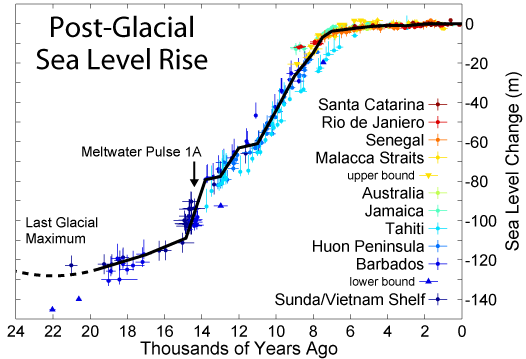
The GP isn't even really correct. Sea level rise was rapid 10,000 years ago during deglaciation, but has been fairly flat for the last 8,000 years or so.... until recently where we've seen accelerated sea level rise.
-
Re:Uhh, goats?
...I hope you are joking.
Feral goats are a serious problem in Australia, along with so many other invasive animals and plants.
A better link to look at would be this one:
http://www.environment.gov.au/biodiversity/invasive/ferals/index.html
-
Good against invasive spieces...
...on condition that it's only ever done after careful thought, planning and testing. (Oh, I guess it won't work then.
But seriously... in Australia we could do with GM solutions like that to fight back against cane toads, imported bees, fire ants, etc., etc., etc.
The Rabbit Calicivirus has already had a massive impact on rabbits in the wild, though being a virus it's a bit more of a loose cannon than hereditary impotence, and the bunnies are now developing resistance.
Personally, I like the idea of hereditary impotence as it can't spread to other spieces, and the only way that it can fail (as far as I can see) is if populations die off before spreading the mutation to other populations.Of course, these options should only be considered in bounded areas, such continents bounded by water. Thinking that these options will limit themselves is folly. What I mean is... if you have an ant that is native to South America that has invaded North America, and the population seems to span across central America, then this kind of GM option is a bad idea, as the disease/mutation may spread from North America through to South America where it's a natural and important part of the ecology. But applying it to Australia should be fine.
-
Good against invasive spieces...
...on condition that it's only ever done after careful thought, planning and testing. (Oh, I guess it won't work then.
But seriously... in Australia we could do with GM solutions like that to fight back against cane toads, imported bees, fire ants, etc., etc., etc.
The Rabbit Calicivirus has already had a massive impact on rabbits in the wild, though being a virus it's a bit more of a loose cannon than hereditary impotence, and the bunnies are now developing resistance.
Personally, I like the idea of hereditary impotence as it can't spread to other spieces, and the only way that it can fail (as far as I can see) is if populations die off before spreading the mutation to other populations.Of course, these options should only be considered in bounded areas, such continents bounded by water. Thinking that these options will limit themselves is folly. What I mean is... if you have an ant that is native to South America that has invaded North America, and the population seems to span across central America, then this kind of GM option is a bad idea, as the disease/mutation may spread from North America through to South America where it's a natural and important part of the ecology. But applying it to Australia should be fine.
-
Re:Of course
Every time someone downloads a movie.. god kills a kitten. I just hope you guys know that. Think of all the cute little kittens.
Thank you, God. Pray, may you choose by preference the ferral kittens in Australia? I heard they are considered pests there.
-
Re:Best museums to see
Scienceworks in Melbourne, Australia. Come to think of it, just come to Australia. Don't bother with Sydney though, they've only got that rather overpolished steampunk exo over at the Powerhouse Museum . But if you are really into natural history, just take a 4WD excursion through Kakadu in the Deep North. You'll see birds that'll reduce you to tears. The wildlife ain't so bad either. But stay away from the pools, they're a croc. Just sayin'.
-
Re:Too late
A lot of mercury is released into the atmosphere from burning coal for electricity. According to the Australian version of the EPA, powering a traditional incandescent light bulb will release of about 13.4mg of mercury over its lifetime versus 2.7mg for a CF bulb. CF bulbs contain 5mg of mercury or less so if you didn't recycle any you'd still release less mercury than would have been released by an incandescent bulb.
Home Depot recycles them for free now and infrastructure to recycle them is spreading all of the time. -
Re:What about the production?
Where does this 5 mg come from? I know its the number the EPA pulled from somewhere but others who
have measured such things don't agree.
http://www.environment.gov.au/settlements/energyefficiency/lighting/publications/fs.html
http://www.state.nj.us/dep/dsr/research/mercury-bulbs.pdf