Slashdot Mirror
Domain: eso.org
Stories and comments across the archive that link to eso.org.
Comments · 208
-
Re:A long time ago, observing a galaxy far, far aw
A list of vindications for Halton Arp:
In most of these cases, cosmologists and science journalists point the public to ad hoc extensions of the Big Bang. Yet, their original model did not predict these observations.
1. Alignment of quasar minor axes (vindication of Arp ejection model)
"The first odd thing we noticed was that some of the quasars’ rotation axes were aligned with each other -- despite the fact that these quasars are separated by billions of light-years"
2. Numerous apparent interactions of objects of wildly different redshifts (not possible with Big Bang, vindication of Arp)
For example, NGC 7603, NGC 4319 and NGC 3628, just to name three. There are many, many more at this point. See the first part of the Universe: Cosmology Quest documentary and Arp's Intrinsic Redshift lecture for a more thorough treatment.
Of particular interest is the press release by the Space Telescope Science Institute - the research arm of NASA's Hubble Space Telescope - promoting the claim that NGC 4319 is not connected by a filament to Markarian 205, the object next to it. These press releases appear to be a case of scientific fraud insofar as they point the readers to visible light photographs from the Hubble instead of the far more radio-deep imagery produced on much less expensive, even amateur, CCD telescopes.
Markarian 205 was reported by Weedman as a Seyfert nucleus appearing within the arms of the lower-redshift spiral galaxy NGC 4319. Most of the argument here has centered on whether or not there is a visible connection between the two. Pictures were published with and without a bridge (Arp once said that he had pictures that showed no bridge as well, and didn't want to be thought lacking in observational skill). There was some early discussion of photographic proximity effects creating false bridges between bright objects, but it doesn't go away with linear detectors. Various reports were given by Arp 1971 (ApLett 9,1), Lynds and Millikan 1972 (ApJLett 176, L5), Stockton et al 1979 (ApJ 231, 673), and Sulentic 1983 (ApJLett 265, L49). Cecil and Stockton (1985 ApJ 288, 201) used CCD data from Mauna Kea to show that there is definitely some kind of luminous object between Mkn 205 and NGC 4319, stating that "Arp was correct in his insistence that his broad-band plates showed luminous intervening material. The opposite conclusions of his critics were - depending on their degree of qualification - either wrong, misleading, or irrelevant."
"We realized that
3. Numerous instances where high-redshift quasars appear aligned with the axes of low-redshift "foreground" galaxies (statistics indicate this occurs far too often for a strict recession velocity interpretation of redshift)
Quasars, Redshifts and Controversies, by Halton Arp (1987)
"To summarize this initial chapter, I would emphasize that with the known densities with which quasars of different apparent brightness are distributed over the sky, one can compute what are the chances of finding by accident a quasar at a c
-
Re:Fudge factor needed! Help
"Black Holes - Gravitational theory and measurements of the visible stellar systems don't result in the working model of what is known about galaxies."
Not sure what you are talking about here. Looking at the orbits of the stars whipping around the center of the Milky Way (Sagittarius A*) indicates that there must be a very large mass there, but there is no light being emitted from that location with all the mass. Nothing but a black hole fits that description. In fact, the Event Horizon Telescope project is in the process of imaging the "shadow" of that black hole to see if it matches the predictions of the General Theory of Relativity.
As it regards dark matter and dark energy, they are admittedly place holders. But there are multiple lines of evidence for dark matter, just no direct detection yet (as in we haven't found a dark matter particle). Modified theories of gravity fail to explain observed properties of galaxy clusters as well as the characteristics of the CMBR, while dark matter does.
-
Re:Giant Mirrors!
The primary mirrors of the VLT are bigger both in diameter and weight, and were made by Schott in Mainz, Germany. See https://www.eso.org/public/ger... for details.
-
Nice !
The fun stuff is now the adaptive optics have perfected to a point where the astronomer pretend theoretical optical precision will be atteignable, albeit on a smaller field of view.
Like described here: https://www.eso.org/public/aus...
Radio telescopes are something different.Their images are in the radio part of the electromagnetic spectrum, obviously, and radio waves have a frequency which makes them able to be recorded with their phase and all. So the signal of several antennas can be recombined by computer like with a giant interferometric radio telescope.
Makes for sharper images, like if you had really a square kilometer dish. With holes. But still gives sharp images.
With optical waves you have to physically recombine the light to do interferometry. The frequency of visible light is order of magnitudes higher than radio waves. Thus optical interferometers are rarer and "smaller".
-
Will be small compared to ESO's ELT
For comparison, see: https://en.wikipedia.org/wiki/...
For details on the ELT, see https://www.eso.org/public/uni...
Will be interesting to see which one will actually start taking pictures of higher quality, first. -
Re:One quibble
So , Was that the link in the article?
Yes, it's in the right-hand margin, with the caption:
"PR Image eso1824c
Neptune from the VLT and Hubble "You could choose to be anything, but for some reason you chose to be a condescending asshole - twice.
Maybe you should look in the mirror. My replies were rather tame and to the point. If you don't like being treated this way, don't cast aspersions on others when the failing is yours.
-
Re:One quibble
But seriously - if you are going to claim that your earth based adaptive optics system will deliver sharper images than Hubble - show us a comparison.
Try reading the article:
https://www.eso.org/public/uni...
Thanks for the link - but why the snark?
-
Re:One quibble
But seriously - if you are going to claim that your earth based adaptive optics system will deliver sharper images than Hubble - show us a comparison.
Try reading the article:
-
Re:Aim it at the moon...
Disclaimer: I have never worked with the VLT.
And possibly damage the telescope too. The moon is vastly brighter than the kinds of things the VLT is meant to image, so if its optics and filters can't deal with that it would be bad.
Usually before doing observations, a dark frame picture is taken without any light falling in (just keep the lid on) and a flat field picture of the horizon is taken when the telescope is flooded with light. This is done to have reference pictures, those are used (among others) to get rid of false negatives (dead pixels) and false positives from the CCD/DSLR camera and to eliminate the effects of dust particles on the lens.
There exist dedicated moon filters for telescopes.
Pictures of the moon have been taken by the VLT.
I agree that a telescope picture would not convince moon landing lunatics, and the calculation by the AC above shows that the resolution of the VLT is not sufficient by a couple of orders of magnitude..
-
Thought this might be the big ESO announcment
But no. Looks like that will been in about 4 hours. I am expecting to be disappointed. With the ESO website using terminology like, "ESO HQ Announcing Unprecedented Discovery" and "groundbreaking observations of an astronomical phenomenon that has never been witnessed before." It unusual for a scientific establishment to use wording like that. Crossing my fingers it will actually be something amazing. I imagine there will be a Slashdot headline.
http://www.eso.org/public/anno... -
Re:What it says about this world
-
Sad in a philosophical sense
The really sad thing here is that it is likely that all of the original Apollo astronauts will be dead before anyone else goes to any non-Earth body.
While I agree that this is sad in a philosophical sense, we should also consider that while we haven't sent people to a non-Earth body, we *have*:
1) Landed on a comet
2) Got up-close-and-personal images of Pluto
3) Also Charon
4) Discovered over 5000 exoplanets
5) Send a probe out of the solar system (*)
6) Maintained a manned space station for the last 18 years
7) Sent several robots wandering around mars and taking pictures
8) (And occasionally vaporizing the miniature martian town centers with its "heat ray")And a bunch of other things, such as mapping the CMB, finding strong evidence for dark matter, imaged an exoplanet, gotten spectrometer readings of the atmosphere in an exoplanet, found an asteroid with rings, and many minor things.
I'm not sure what the utility of sending a human into space is at the present time. Unless there's an obvious use case, it *seems* like the extra effort of sending a human isn't worth the risk, except as a political statement.
Oh, and we're seriously considering mining asteroids. How cool is that?
(*) Depending on the definition of the boundary, and the current definition is "cloudy" at that point, so that the probe seems to be going into and out of the boundary that defines the solar system edge.
-
Re:I'm planning a trip to Chile
The skies in the Atacama Desert are amazingly clear. Check out this video for a sample.
-
Re:It's already been proven.
Realize that this video is not an artist's intepretation, but is actual imagery of stars orbiting something of immense mass, something which can only be a black hole.
That is an interpretation of the data showing the orbits of the stars. Since the actual images were created with using interfering infrared observations, they aren't "real" either. Still, they are impressive. If you watch this video, you'll see the IR reconstructions are a little more wonky than the video you claimed were real images.
It's already been proven.
Science doesn't prove anything. This is strong evidence that there exists a massive dark object at the center of the galaxy, which is consistent with there being a black hole there. Imaging the event horizon would go much farther to support that this dark object really is a black hole, but nothing will ever prove it. Remember there are alternative theories to black holes that have not been disproven.
-
Incorrect link in TFS...
The Very Large Telescope (linked in TFS) has been in service for some years... the telescope under construction is the European Extremely Large Telescope.
-
Skies in Chile...
... are the best in the world for star-gazing. Chile Chill video showing the Chilean night sky....
-
Shedding some light
> The telescope will shed light on the 'dark ages' of the universe,
No, actually the telescope will *collect* light from the dark ages of the universe. If it shed light it would be the world's biggest fucking flashlight.
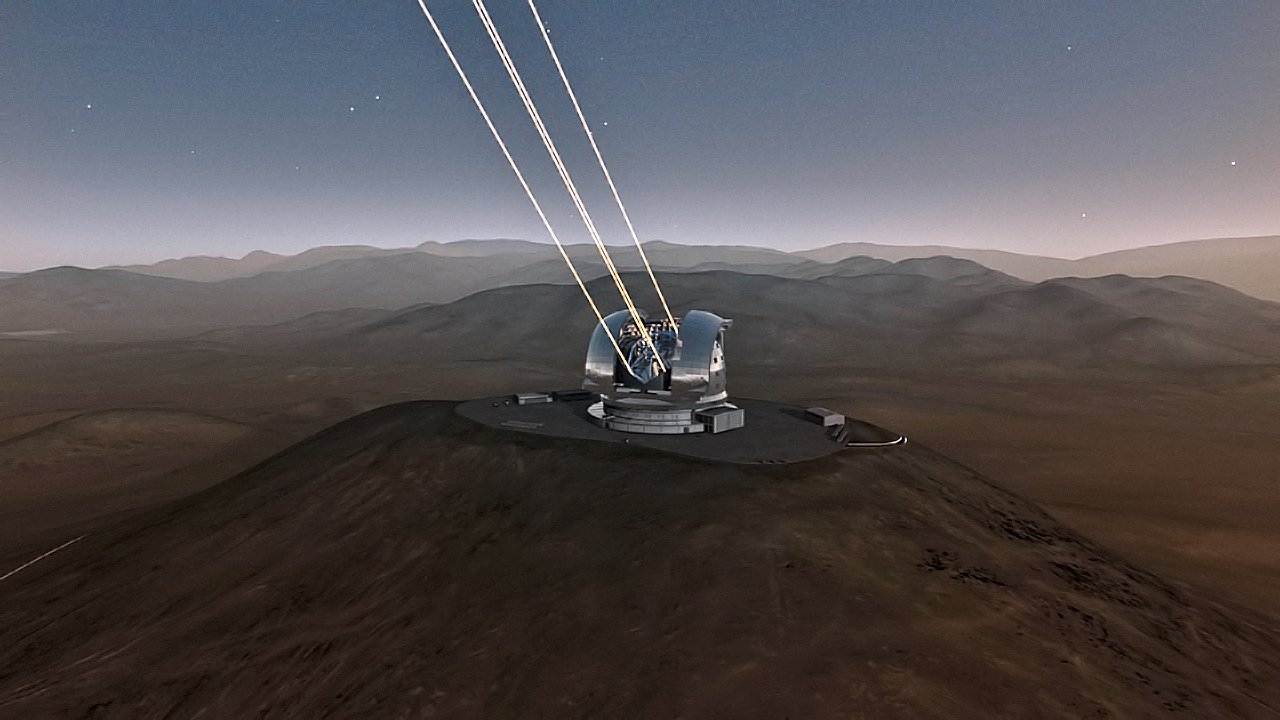
If you want to be pedantic, it *will* shed light, from several lasers mounted on the sides of the telescope structure. Those create artificial stars in the upper atmosphere so that atmospheric distortion can be cancelled by the adaptive optics. But those are attachments, not the main telescope.
-
Better info at ESO
1,300 times the diameter apparently -> http://www.eso.org/public/news...
-
Re:Naming conventions for concentric circles
Telescopes already use the convention:
-
Re:Naming conventions for concentric circles
Telescopes already use the convention:
-
Other Resources
Dr. Gillessen's web page has additional information here - https://wiki.mpe.mpg.de/gascloud/FrontPage and the ESO website has an article as well thatexplains what is happening - http://www.eso.org/public/news/eso1332/
JJW -
Re:Out of curiosity...
How much of a penalty, relative to the penalties incurred for things like small size, subpar optics, etc. does putting up with the atmosphere impose?
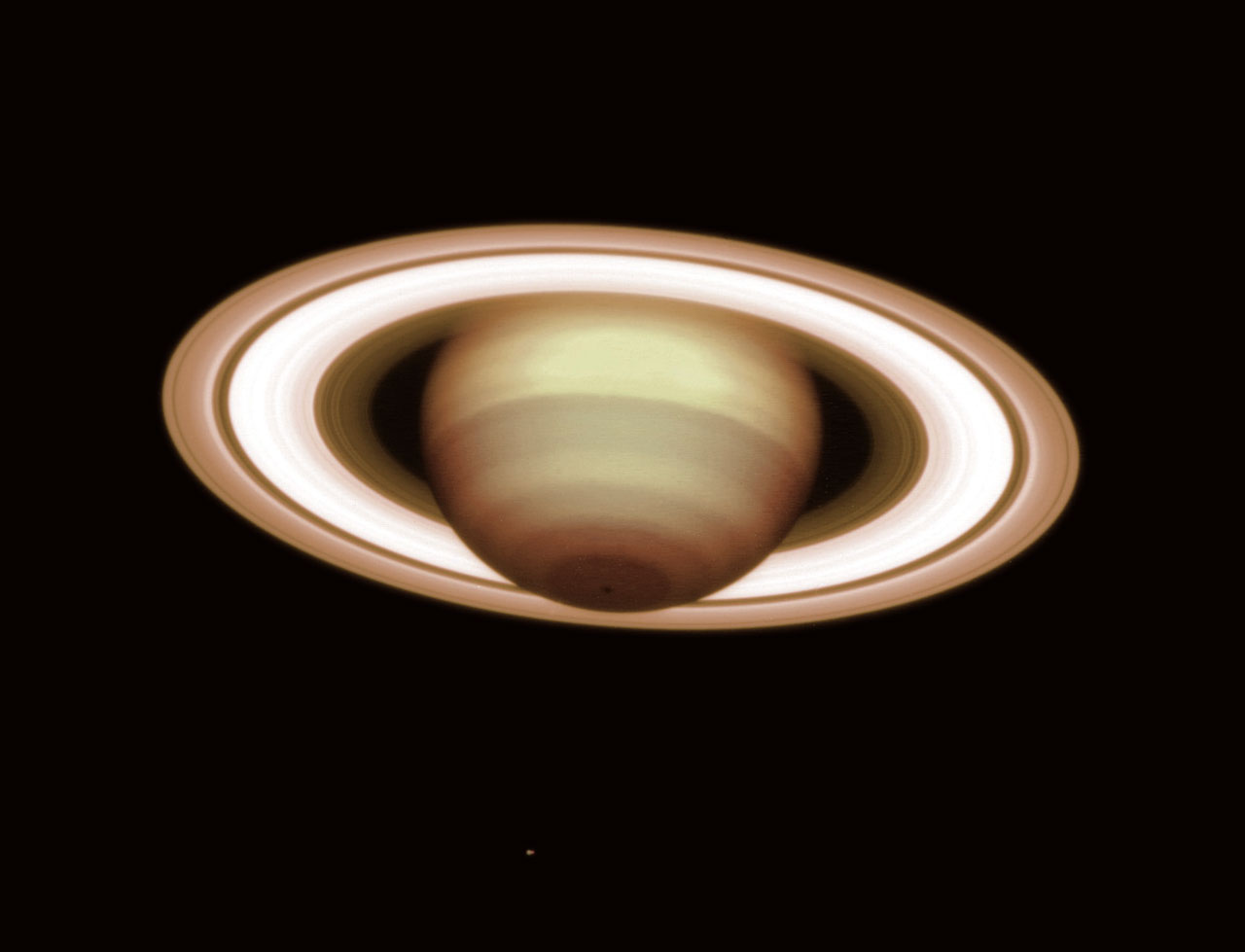
Here's Saturn as seen by ESO's Very Large Telescope in Chile (8.2m mirror, though it can combine 4 of them into an interferometer). The observatory is at 2635m above sea level, so is looking through about 70% of the air you'd be seeing through at sea level (air decreases in density with altitude, so there is diminishing returns for getting up high). The observatory's location was chosen for its perennial clear skies. The photo was taken with what was state of the art adaptive optics a decade ago (2002). I wasn't able to find a more recent photo of Saturn from a large, ground-based telescope in 15 minutes of googling.
Here's Saturn as seen by Hubble (2.4m mirror). Not much of a contest.
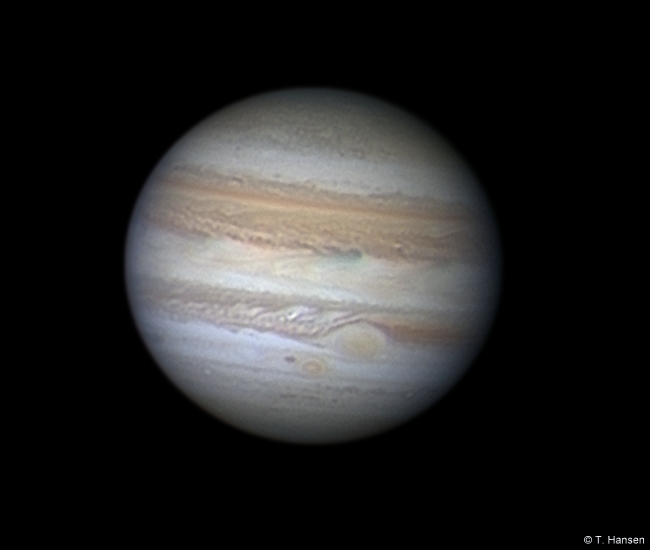
I picked Saturn as an example instead of Jupiter because Jupiter is bigger and closer than Saturn. So even at low resolution you can still get some impressive shots. Here's one taken by an 11" (28cm) telescope.I'm told, by people more closely involved with amateur astronomy than I, that a 200mm aperture is a pretty small instrument, especially for reflector-based designs.
200mm (about 8 inches) is about the size of your basic cheap but serious reflector for an amateur astronomer. It's pretty much the minimum you'd expect anyone doing astronomy as a serious hobby would own.
A quick calc of the Rayleigh criterion says a 200mm scope would have a maximum angular resolution of 0.6 arc-seconds (i.e. two stars closer than this separation would appear as a single dot). Hubble's Rayleigh criterion limit is 0.05 arc-seconds, so Hubble can resolve objects 12x smaller. The Hubble photo is 2150x1000 resolution. Reduce it by 12x to about 180x83 resolution, and that's about the amount of detail in you'd expect in a Saturn pic from a 200mm scope in orbit. IMHO it's not really worth it in the visible band. They'd better be planning to do a lot of UV work with it. -
Re:Out of curiosity...
How much of a penalty, relative to the penalties incurred for things like small size, subpar optics, etc. does putting up with the atmosphere impose?
Here's Saturn as seen by ESO's Very Large Telescope in Chile (8.2m mirror, though it can combine 4 of them into an interferometer). The observatory is at 2635m above sea level, so is looking through about 70% of the air you'd be seeing through at sea level (air decreases in density with altitude, so there is diminishing returns for getting up high). The observatory's location was chosen for its perennial clear skies. The photo was taken with what was state of the art adaptive optics a decade ago (2002). I wasn't able to find a more recent photo of Saturn from a large, ground-based telescope in 15 minutes of googling.
Here's Saturn as seen by Hubble (2.4m mirror). Not much of a contest.
I picked Saturn as an example instead of Jupiter because Jupiter is bigger and closer than Saturn. So even at low resolution you can still get some impressive shots. Here's one taken by an 11" (28cm) telescope.I'm told, by people more closely involved with amateur astronomy than I, that a 200mm aperture is a pretty small instrument, especially for reflector-based designs.
200mm (about 8 inches) is about the size of your basic cheap but serious reflector for an amateur astronomer. It's pretty much the minimum you'd expect anyone doing astronomy as a serious hobby would own.
A quick calc of the Rayleigh criterion says a 200mm scope would have a maximum angular resolution of 0.6 arc-seconds (i.e. two stars closer than this separation would appear as a single dot). Hubble's Rayleigh criterion limit is 0.05 arc-seconds, so Hubble can resolve objects 12x smaller. The Hubble photo is 2150x1000 resolution. Reduce it by 12x to about 180x83 resolution, and that's about the amount of detail in you'd expect in a Saturn pic from a 200mm scope in orbit. IMHO it's not really worth it in the visible band. They'd better be planning to do a lot of UV work with it. -
Re:Amazing
How could this be the largest telescope given that the 40m E-ELT was approved last year?
-
What about these EELT at 39m and
http://en.wikipedia.org/wiki/European_Extremely_Large_Telescope at 39m http://www.eso.org/public/teles-instr/vlt.html at 4 x 8.2m and my favorite mainly because of it's sheer size http://www.gmto.org/ at 6 x 8.4m
-
World's Largest?
Maybe there is another, larger one that got approved a few months ago?
-
World's Largest?
Maybe there is another, larger one that got approved a few months ago?
-
And what's a quasar to do with all this?
Come on, UCLan? Really, a quasar is 4 Gly long?
-
original post
http://www.eso.org/public/news/eso1301/
The original post, which includes the *real* image -not many pixels, but real ones!
SouthX -
Name that hardware
Any of you familiar enough with this kind of thing to identify what sort of hardware they used? This seems like a really neat application of special-purpose hardware. Please, no complaining about how bad it would probably score on Linpack - this is a purpose-built computer for a specific job. Custom boards are so seldom justified these days, I envy the engineers who got to do this.
-
TRAPPIST @ ESO
See also TRAPPIST to Scout the Sky and Uncover Exoplanets and Comets. (TRAnsiting Planets and PlanetesImals Small Telescope) A robotic
-
Re:A field in its infancy
The normal interpretation of seen: http://www.eso.org/public/images/eso0842b/
You know directly observing the object rather than observing an effect caused by it.
Though I was wrong - further away is better for that - the star washing out effect is as big as you would expect so close is bad. of course indirect observation is how we find most of them and closer is better for that.
-
Re:Ugh, summary
Agreed, atrocious summary and terrible title. Here's an alternate.
Survey Finds Too Little Dark Matter Near Solar System
The existence and approximate distribution of dark matter have become standard assumptions in cosmology. According to Nature, it "explains how structure arose in the Universe, how galaxies formed and how the rapidly spinning Milky Way manages to keep from flying apart." However, a paper recently accepted by the Astrophysical Journal studied stellar velocities in our part of the galaxy in an attempt to infer the amount of dark matter present near our solar system and came up with unsettling results. Moni Bidin, the study's lead author, concluded that "at most, only about one-tenth the amount of dark matter predicted by models could exist in the volume of space they examined." Astronomer Frederic Hessman, who is uninvolved in the study, put things bluntly: "If this is right, it turns everything totally upside-down." Physicists are calling for caution and several note the difficulty and sensitivity to error of the present results. Astronomer Chris Flynn, who approved Bidin's paper for publication, cautioned, "I wouldn’t throw out nearby dark matter quite yet” and “The measurement being made is very challenging, and there are a number of ways for it to miss the dark matter even if is there.”
-
soon to be ridiculed
by the much larger E-ELT http://www.eso.org/public/teles-instr/e-elt.html
-
It'll be the largest optical telescope, IF...
and only if, it's completed before the (larger) Thirty Meter Telescope in Hawaii, and the (larger still) European Extremely Large Telescope in Chile.
And even if it is completed before TMT and E-ELT, as soon as either of them is completed, it'll lose the title.
Did I mention both TMT and E-ELT are also targeting completion by the end of the decade? Yup.
So, good luck, GMT!
(And it goes without saying that non-optical radio telescopes, which use dishes instead of mirrors, have long been much larger. And that even submillimeter telescopes, which also use dishes, are working on staying larger, with the 25-meter CCAT planned for Chile later this decade.)
-
You too may be able to use their data.
If you meet their requirements, you can register and download data from http://archive.eso.org/eso/eso_archive_main.html
-
Re:Not just ESO
Correct. The original two partner institutions were
- The National Radio Astronomy Observatory, which operates the North American ALMA Science Center, a regional ALMA Research Center (ARC);
- The European Southern Observatory which similarly operates the European ARC.
Later, the National Astronomical Observatory of Japan joined the consortium, to provide the ALMA Compact Array and a second correlator, among other things.
It's sometimes a bit bewildering working in this multi-site environment, but it's mostly just amazing
-
Re:Not just ESO
Correct. The original two partner institutions were
- The National Radio Astronomy Observatory, which operates the North American ALMA Science Center, a regional ALMA Research Center (ARC);
- The European Southern Observatory which similarly operates the European ARC.
Later, the National Astronomical Observatory of Japan joined the consortium, to provide the ALMA Compact Array and a second correlator, among other things.
It's sometimes a bit bewildering working in this multi-site environment, but it's mostly just amazing
-
Re:More info not linked from the article
a bunch of neat transporter stills (and some copy)
-
Re:Accurate Summary
Yeah. It's so word for word for word cut-n-paste, it didn't even include links to the or the VLT homepage. But, as GP said, at least it's accurate.
-
Re:Shame about flash
What is it with people having some sort of fetish for putting EVERYTHING into the frigging browser?
This problem starts, believe it or not, with certain Web designers. Some people out there will not be able to sleep at night if you and me actually control the way their pages are displayed or their Web-sites used. The Flash obsession, for example, starts with the desire to prevent you from saving videos, and it continues with an absolute necessity of making you watch ads. Me and you understand that it would be elementary to have a browser plugin that detects Web-links to video files/streams and starts an external player. The truth is, clicking on a link to a video is so easy, no one needs a plugin for that. A program like VLC is far superior to any browser gizmo with respect to controlling the video playback. On a phone form-factor, playing back inside the browser window is simply INSANE. Indeed, linking is the simplest solution, and the one with the least overhead, and also the one that was working as far back as there were video players and Web browsers, and, of course, the one still implemented on every frigging Web-site not done by dicks.
I am afraid that HTML5 is not going to change the landscape. People who have a monopoly on serving bits (or just desire it) will persist in using proprietary software and secret protocols. HTML5 will be worse than useless to them for the reason stated above. IMHO, Mozilla and W3C are mostly wasting everyone's time with the video tag. Other tags, such as the ones for Web-forms, seem far more useful. And all of this superfluous BS distracts people from converting over to XHTML, which would actually improve Web documents' quality and compatibility.
-
Re:Perspective
Interestingly, this article from 2 days ago says they've found 5 stars orbiting a star (possibly upto 7 confirmed stars).
-
Original Journal Article
Here is a posting on Science Magazine's ScienceNow, and here is the original journal article originally published in the Monthly Notices of the Royal Astronomy Society. I think it is always better, when possible to refer to original sources when talking about scientific issues. Scientific discussions can become muddled when translated by journalists.
-
Re:Mass vs Radius
Red giant stars would have a much larger radius. The radius of R136a1 is estimated at something like 30 times that of the sun. It is thought that our own sun, when reaching the end of its lifetime, may expand past the orbit of the earth, or 93,000,000/432,000: about 215 times it's original radius.
Here is the link to the original paper. -
Re:dumb question...
That’s already how it’s done.
Nope it isn't, not for "normal" mirrors anyway. Monolithic mirrors are made of uniform piece of material, properly annealed for stress. After polishing, the mirrors are mounted on a specialised structures, called mirror cells. These are designed with the assumption above, and with the goal of making the mirror behave as if it was floating freely.
Adding of a bowl or a frame between the reflecting surface and the mirror cell (which you imply) will induce stress and cause severe astigmatism in the mirror. This is only done in cheap mass-produced Chinese telescopes where they just glue the 6 inch mirror to the bottom.
Here's the ESO setup -- http://www.eso.org/public/images/eso9940b/ - you can see for yourself that the mirror is made from one block of zerodur, there is no supporting "bowl" or "frame" between the mirror and the cell.
-
Re:science vs. religion vs. pseudoscience
First, there is no proof there's a conspiracy to deny publication of dissenting papers. Several investigations have decided that there is no conspiracy. There is an outside chance that one little corner of science may have slipped into pseudoscience, but that's hardly justification for your statements about science in general.
The nondisclosure of data is a serious issue, but it's also not universal and even in this case it sounds like it's more due to the CRU not having the legal right to disclose the data in question, NOT to their unwillingness to do so. That's a problem with the law or with the commercial right-holders, not science. Again, even in the worst case scenario, it's not a justification for your statements about science in general.
Following are a few examples of large, publicly available scientific datasets that were assembled at considerable cost, entirely voluntarily (a small selection, several that I have personal experience with and others that I've included to try to give some breadth to the list):
http://physionet.org/
http://mouldy.bic.mni.mcgill.ca/brainweb/
http://www.med.harvard.edu/AANLIB/home.html
http://archive.eso.org/skycat/servers/usnoa
http://www.astrometry.net/data.html
http://www.ncbi.nlm.nih.gov/genbank/GenbankOverview.html
http://www.ncbi.nlm.nih.gov/guide/data-software/And some publicly available code:
http://noodles.bic.mni.mcgill.ca/ServicesSoftware/HomePage (the MINC tools are apparently available from Debian as well)
http://www.bic.mni.mcgill.ca/~ilana/diffusion/diffusion_tools.html
http://www.vlfeat.org/~vedaldi/code/sift.html
http://www.itk.org/
http://www.cs.cmu.edu/~cil/v-source.html
http://iraf.noao.edu/There's hardly an overwhelming culture of closed and proprietary secret keeping in science as you suggest. Quite the opposite. Sure, some of the non-scientific appendages to science do have issues in that area (journals, for example) but scientists are usually all too willing to do end runs around such things. If you want to read a paper, e-mail the author and he's likely to send you a PDF despite that often being technically a violation of copyright. Failing that, go to a library and they'll let you read it, free.
-
ESO press release
"A magnitude 8.8 earthquake struck central Chile at 03:34 local time (07:34 CET) on Saturday 27 February 2010. The epicentre was 115 km north-northeast of the city of Concepción and 325 km south-west of the capital Santiago. The earthquake has caused significant casualties and damage in the country.
ESO expresses its deepest condolences to the families of the victims, and its sympathy and support for all those affected by the earthquake.
No casualties among ESO staff have been reported. At present, power cuts and network interruptions mean that communication may be limited. Disruption to staff travel plans within, to, and from Chile should be expected. We urge Visiting Astronomers with observations planned at ESO observatories to put their trips to Chile on hold until further notice. International flights to and from Santiago International Airport are currently either cancelled or diverted. Information about observing programmes will be provided at a later date.
Despite being the 7th strongest earthquake ever recorded worldwide, the ESO observatory sites did not suffer any damage, partly as they are engineered to withstand seismic activity and partly due to their distances from the epicentre. At La Silla, a power cut caused observations to stop during the night. Paranal Observatory, the APEX telescope and the ALMA Operations Support Facility and Array Operations Site were unaffected."
A 7.8 quake struck Antofagasta (120km north of the telescope site) in 1995 (http://www.eso.org/public/news/eso9517/).
Various other quakes in the area : http://www.eso.org/gen-fac/pubs/astclim/earthquake/his-paranal-58.html (Historic times to 2000.)
http://earthquake.usgs.gov/earthquakes/eqarchives/epic/epic_circ.php allows you to get at historical quakes map up to 1994 ; 1973 to present and various other formats ; there has been plenty of data for planning quake likelihoods and the engineering responses that would be required.
-
Re:Lots of speculation.
We've got one of the best particle accelerators around (the Sun/Sol) and it hasn't managed to snuff us out yet and it's had BILLIONS of years. The LHC doesn't even come close in power levels comparatively speaking.
Actually that's not true. Basic fusion in the Sun's interior produces particles on the order of 1-20 MeV. These particles in cases when they reach the surface of the Sun can be accelerated by the Sun's magnetic fields, in extreme cases up to around 10 GeV. In comparison, the particle streams of the LHC will be colliding at energies of 10 TeV and up. That's particles with energies three orders of magnitude greater than the most energetic particles coming from the Sun.
All of that is dwarfed by ultra-high energy cosmic rays. One was observed to have an energy of roughly 3*10^8 TeV. Yes, that's almost seven orders of magnitude greater energy than what's going on in the LHC. Imagine a bunch of those whacking a neutron star for millions of years. The surface of a neutron star has a density about 5 to 6 orders of magnitude greater than iron. The interior apparently can be another 8 orders of magnitude, if our models are correct. That's as good an environment for a micro black hole as anything you'll find in nature. Yet we have neutron stars that have been around for at least 100,000 years. My bet is that with improved gravity lensing observations, they'll find more of these ancient neutron stars. -
Re:OMG, there's lot of planets out there
This is interesting: planet inside habitable zone, perhaps with liquid water
-
Re:ESO Press Release
More details can be found in the Press Release of the European Southern Observatory. They have been using a new instrument called HARPS on the "old" ESO 3.6m telescope, which has ben around since 1976.
And HARPS has been operational since 2003.