Slashdot Mirror
Domain: fedoraproject.org
Stories and comments across the archive that link to fedoraproject.org.
Comments · 699
-
Speed access to Fedora Torrents
Help others get Fedora. Seed your torrent for at least a few days. It'll be about a week to a week and a half before demands slows down. If you're concerned about bandwidth use your bandwidth scheduler.
64 bit x86:
Others:
- Fedora 12 i386 CDs
- Fedora 12 i386 DVD
- Fedora 12 i686 Live KDE
- Fedora 12 i686 Live
- Fedora 12 ppc CDs
- Fedora 12 ppc DVD
Sources: Fedora 12 source CDs
Fedora 12 source DVD -
Speed access to Fedora Torrents
Help others get Fedora. Seed your torrent for at least a few days. It'll be about a week to a week and a half before demands slows down. If you're concerned about bandwidth use your bandwidth scheduler.
64 bit x86:
Others:
- Fedora 12 i386 CDs
- Fedora 12 i386 DVD
- Fedora 12 i686 Live KDE
- Fedora 12 i686 Live
- Fedora 12 ppc CDs
- Fedora 12 ppc DVD
Sources: Fedora 12 source CDs
Fedora 12 source DVD -
Speed access to Fedora Torrents
Help others get Fedora. Seed your torrent for at least a few days. It'll be about a week to a week and a half before demands slows down. If you're concerned about bandwidth use your bandwidth scheduler.
64 bit x86:
Others:
- Fedora 12 i386 CDs
- Fedora 12 i386 DVD
- Fedora 12 i686 Live KDE
- Fedora 12 i686 Live
- Fedora 12 ppc CDs
- Fedora 12 ppc DVD
Sources: Fedora 12 source CDs
Fedora 12 source DVD -
Speed access to Fedora Torrents
Help others get Fedora. Seed your torrent for at least a few days. It'll be about a week to a week and a half before demands slows down. If you're concerned about bandwidth use your bandwidth scheduler.
64 bit x86:
Others:
- Fedora 12 i386 CDs
- Fedora 12 i386 DVD
- Fedora 12 i686 Live KDE
- Fedora 12 i686 Live
- Fedora 12 ppc CDs
- Fedora 12 ppc DVD
Sources: Fedora 12 source CDs
Fedora 12 source DVD -
Speed access to Fedora Torrents
Help others get Fedora. Seed your torrent for at least a few days. It'll be about a week to a week and a half before demands slows down. If you're concerned about bandwidth use your bandwidth scheduler.
64 bit x86:
Others:
- Fedora 12 i386 CDs
- Fedora 12 i386 DVD
- Fedora 12 i686 Live KDE
- Fedora 12 i686 Live
- Fedora 12 ppc CDs
- Fedora 12 ppc DVD
Sources: Fedora 12 source CDs
Fedora 12 source DVD -
Speed access to Fedora Torrents
Help others get Fedora. Seed your torrent for at least a few days. It'll be about a week to a week and a half before demands slows down. If you're concerned about bandwidth use your bandwidth scheduler.
64 bit x86:
Others:
- Fedora 12 i386 CDs
- Fedora 12 i386 DVD
- Fedora 12 i686 Live KDE
- Fedora 12 i686 Live
- Fedora 12 ppc CDs
- Fedora 12 ppc DVD
Sources: Fedora 12 source CDs
Fedora 12 source DVD -
Speed access to Fedora Torrents
Help others get Fedora. Seed your torrent for at least a few days. It'll be about a week to a week and a half before demands slows down. If you're concerned about bandwidth use your bandwidth scheduler.
64 bit x86:
Others:
- Fedora 12 i386 CDs
- Fedora 12 i386 DVD
- Fedora 12 i686 Live KDE
- Fedora 12 i686 Live
- Fedora 12 ppc CDs
- Fedora 12 ppc DVD
Sources: Fedora 12 source CDs
Fedora 12 source DVD -
Speed access to Fedora Torrents
Help others get Fedora. Seed your torrent for at least a few days. It'll be about a week to a week and a half before demands slows down. If you're concerned about bandwidth use your bandwidth scheduler.
64 bit x86:
Others:
- Fedora 12 i386 CDs
- Fedora 12 i386 DVD
- Fedora 12 i686 Live KDE
- Fedora 12 i686 Live
- Fedora 12 ppc CDs
- Fedora 12 ppc DVD
Sources: Fedora 12 source CDs
Fedora 12 source DVD -
Speed access to Fedora Torrents
Help others get Fedora. Seed your torrent for at least a few days. It'll be about a week to a week and a half before demands slows down. If you're concerned about bandwidth use your bandwidth scheduler.
64 bit x86:
Others:
- Fedora 12 i386 CDs
- Fedora 12 i386 DVD
- Fedora 12 i686 Live KDE
- Fedora 12 i686 Live
- Fedora 12 ppc CDs
- Fedora 12 ppc DVD
Sources: Fedora 12 source CDs
Fedora 12 source DVD -
Speed access to Fedora Torrents
Help others get Fedora. Seed your torrent for at least a few days. It'll be about a week to a week and a half before demands slows down. If you're concerned about bandwidth use your bandwidth scheduler.
64 bit x86:
Others:
- Fedora 12 i386 CDs
- Fedora 12 i386 DVD
- Fedora 12 i686 Live KDE
- Fedora 12 i686 Live
- Fedora 12 ppc CDs
- Fedora 12 ppc DVD
Sources: Fedora 12 source CDs
Fedora 12 source DVD -
Speed access to Fedora Torrents
Help others get Fedora. Seed your torrent for at least a few days. It'll be about a week to a week and a half before demands slows down. If you're concerned about bandwidth use your bandwidth scheduler.
64 bit x86:
Others:
- Fedora 12 i386 CDs
- Fedora 12 i386 DVD
- Fedora 12 i686 Live KDE
- Fedora 12 i686 Live
- Fedora 12 ppc CDs
- Fedora 12 ppc DVD
Sources: Fedora 12 source CDs
Fedora 12 source DVD -
Speed access to Fedora Torrents
Help others get Fedora. Seed your torrent for at least a few days. It'll be about a week to a week and a half before demands slows down. If you're concerned about bandwidth use your bandwidth scheduler.
64 bit x86:
Others:
- Fedora 12 i386 CDs
- Fedora 12 i386 DVD
- Fedora 12 i686 Live KDE
- Fedora 12 i686 Live
- Fedora 12 ppc CDs
- Fedora 12 ppc DVD
Sources: Fedora 12 source CDs
Fedora 12 source DVD -
Huh, they're using the Nouveau driver...
I notice in the release notes they're using the Nouveau driver for NVidia cards. I've been meaning to check the status of that driver for a while now -- but is this common in distros yet? (I'm a sysadmin mostly working on servers, so I'm a little out of touch.
-
Re:Fedora Server Hammered (of course)
Or grab a torrent! http://torrent.fedoraproject.org/
-
Re:Fedora?
Yes. http://fedoraproject.org/wiki/Statistics - we have seen over 2.4 million installations of Fedora 11 so far, a 20% increase on Fedora 10. Methodology is extensively discussed on the linked page.
-
Great work!
If you read the one page release notes, it seems Fedora actually knows how to try to cater to more general audience too, while still supporting the core Linux audience. I have always thought that why Ubuntu became the "standard" general OS you introduce as first Linux, as Fedora does a lot more things a lot better (and the Red Hat delivered design is imo a lot better than whats delivered from Debian)
What was interesting was the "better than ever tablet support". I have been thinking of getting a tablet pc for convenience in bed, and Linux would actually be quite perfect OS for it since theres no need to play games. Seems they're taken things like that into account too, while Linux community usually forgets the non-techie stuff.
-
Re:Why is there never any stories...
about new gentoo releases?
According to the release engineering page, there was.
Someone should post a story everytime they emerge --sync && emerge world
No, otherwise people running Mandriva cooker should post every time they 'urpmi --auto-update', or people running Debian testing should every time they run 'apt-get upgrade', or users on Fedora rawhide every time they run 'yum update' (ok, for Fedora, maybe not *every* time
Just because you compiled it, doesn't mean you got it sooner than anyone else. (Note, the Mandriva build system is currently not accepting build submissions for "cooker" as cooker is still in freeze, the build system will be back to the usual 50+ packages per day by the end of the week).
-
Re:Fedora/CentOS LiveCDs do contain native extX fsFedora provides Appliance OS spins for recent versions (F10 and up), which are highly stripped down Fedora images, coming in at 100-200 MB of disk. The OS is shipped as an ext3 image, not an ISO image.
However, it's still pointless to do what the submitter is attempting. 486 machines weren't even interesting targets 9 years ago. Any recent version of Fedora won't boot on a 486, since Fedora is now compiled for i686 and up. Even if you got it to boot, it would be too slow for a modern X, and nearly too slow even for a console.
The only modern-day task that a 486 machine can still perform acceptably is IP routing. Most people still have "slow" (by networking standards) DSL or cable connections. An old machine is perfectly capable of handling such speeds. But it's still a very bad idea. Energy costs are so high these days that buying a new low-power router machine is much cheaper than running a 486 even in the medium term (1-2 years), and the new machine will be much more capable and featureful. For $99 you can get a SheevaPlug which comes with Ubuntu and consumes 5 watts.
If I was setting up a 486 machine anyway, my distribution of choice would be Voyage Linux. Voyage is just a very small Debian Lenny installation with a few additional (small) packages for embedded environments. It doesn't ship as an ext2 image, but rather as a tarball that you untar, which is just as good. The kernel is compiled for 486, so (unlike Fedora) it will actually boot. In theory, you can apt-get anything in the Debian repositories (including X, GNOME, etc.), but in practice it won't work on a 486. There are just too many differences between modern X11R7.5 and contemporary versions to the 486 like X11R5 or X11R6. I've done this before, and I can tell you that you won't be happy with the GUI even if you get it to run.
A lot of commenters have suggested running an old distribution. This is a bad idea on any machine that you plan to connect to the internet. Even if there's a firewall in between, old versions of Linux have so many security holes that they represent an unacceptable risk. Old Linux versions are just as insecure as old Windows versions. Don't make the spambot problem worse. As a side note, distributions that provide no mechanism for in-place security upgrades are also insecure. This rules out most mini-distros like DSL or Puppy Linux.
Basically, there's no way to run X securely on such old hardware. Just forget about it. If you intend to use it as a text terminal, then it might be worth setting up. Even then, don't leave it on all the time, or your electricity bill will dwarf any savings. (If you're not paying for the electricity, still, do the rest of us a favor, and save the planet from global warming or something.)
-
Re:Ubuntu Bleeding Edge Features Ready for Prime T
The Fedora Project seems to like it just fine enough for it to be the default starting with Fedora 11 back in April.
Have another look:
http://www.fedoraproject.org/wiki/Features/Ext4DefaultFs -
Re:Most "Features" Have Nothing To Do With Fedora
Actually, most of the features described have been written mostly by Fedora contributors. The full release announcement text - https://fedoraproject.org/wiki/F12_Beta_Announcement - gives explicit credit for many of them.
Since it's Fedora's policy to contribute all possible work to upstream projects, of course other distributions benefit from this work. We don't play the game of having 'exclusive' features to trumpet in our distribution, we play the game of improving the F/OSS ecosystem for all. We don't really see that the fact that many other distributions will also benefit from this work doesn't mean they're important new features for Fedora users.
Of the features mentioned in the Slashdot story:
X.org improvements: Red Hat employee and Fedora project member Ben Skeggs is the major upstream contributor to the nouveau driver and implemented all the nouveau improvements described. Red Hat employees and Fedora project members Dave Airlie and Jerome Glisse are two of the major contributors to the ati/radeon driver and implemented many of the radeon improvements described. RH employees and FP members Adam Jackson and Kristian Hogsborg are major contributors to the intel driver. Adam and Dave also do substantial work on the X server itself and implemented the default support for multi-display spanning.
NetworkManager improvements: these were implemented by Red Hat employee and Fedora project member Dan Williams.
openfwwf: this is upstream work. We are, however, the first distribution to include it by default, as far as I'm aware (do correct me if I'm wrong).
Virtualization work: this is all contributed by the Red Hat employees and Fedora project members who make up the virtualization team, including Mark McLoughlin, Cole Robinson, and Justin Forbes.
Moblin integration: this is a co-operation between the Fedora project and the Moblin project. Fedora itself serves as part of the foundations of the upstream Moblin project (they do draw on other distributions as well for certain things).
GNOME Shell: maintainer and leading contributor is Red Hat employee and Fedora project member Owen Taylor.
-
Be weary of upgrades if your /boot is small
I was bit by the preupgrade CLOSED NOTABUG "bug" where preupgrade requires a sizeable chunk of (temporary) disk space in
I don't recall exactly what I did to work around the huge file "needing" to be in -
Re:Why don't they try fixing Fedora 11 first?
How many times have you been able to do a 'yum update' or 'preupgrade' without having to worry about whether the system will be able to boot correctly?
0, though I did read see warnings about some scenarios in the readmes. I don't know what the problem would have been as I didn't try.
How many times has anaconda crashed mid-install, or failed to detect your RAID and decided instead to wipe individual drives without really telling you, or any number of other nagging problems?
'Bleeding-edge' isn't an excuse by any measure; I never run into any problems when upgrading FreeBSD regularly and its ports tree stays far more current than Fedora's yum packages ever will manage.
0, though I don't use much RAID.
There are areas like sound which do seem to cause problems for a lot of people (though I think that's typical for most PulseAudio distros). And pushing KDE 4.0 does seem to have caused some real issues for a while. But when people claim stability problems like the ones you've described I think it's important to remember the plural of anecdote is not data.
-
Re:This is the Sound of
https://fedoraproject.org/wiki/Bug_info_kernel_sound contains the instructions for filing good reports on sound problems. Note it links to a similar page for PulseAudio, with instructions to follow if the issue seems PA-related.
-
Re:Can't Lock Linux Down
First of all, I do not know how Windows Access Control translates into desktop management noticeable by end users in Windows, to draw the analogy you made to the Linux desktop. I had to look it up just to make sure what you meant here. http://msdn.microsoft.com/en-us/library/aa374860(VS.85).aspx This explains ACL's and low-level permissions. I will not go into details (because I am not an expert, and plenty on Slashdot can fill in for me here), but I think it is safe to say Ubuntu Linux, Linux, GNU/Linux (hello, flamewar), and most Unix variants have a pretty expressive permissions system. As an advancing n00b, it is enough to keep me locked out of my systems when running in a user account that is not in wheel. If you meant something like Local Group Policy and GPO's in an Active Directory environment (where I have to make my bread and butter), Linux has been making strides in this department. You just need to Google like everyone else. If you are looking for tools to lock down the Linux desktop(s), particularly GNOME in this example, there is already an active project using tools like gconf (mentioned in a post below), SELinux, and other security utilities to make a locked down kiosk account pretty easy. It is called xguest. http://docs.fedoraproject.org/selinux-user-guide/f11/en-US/sect-Security-Enhanced_Linux-Confining_Users-xguest_Kiosk_Mode.html I would love to hear what people have to say about it if they deploy it in the field. It is serious enough for a Red Hat sales engineer to bring it up as a cheap alternative to Windows kiosks I must laboriously lock down with aforementioned local GP and GPO's. SELinux is no joke either, since its development is derived from DoD/NSA research. http://en.wikipedia.org/wiki/Selinux That being said, the current Linux solutions, if you figure in NSA/DoD cooperation, are at least as bad as Microsoft products. Only difference is that they are free.
-
Re:PulseAudio is broken
> Where 'abject denial' is defined as documenting the issues and workarounds - https://fedoraproject.org/wiki/Bug_info_PulseAudio#Playback_problems.2C_crackling_or_skipping - and fixing them (most of the issues of this kind were fixed by kernel fixes in the last six months)? Wow, it's like a whole new vocabulary world out here.
You can choose to remain wilfully ignorant in order to make your point, or you can actually take into account the rest of the post you are replying to. I highlighted the general attitude around PulseAudio. Re-read the paragraph starting with "The order of the day...". I have seen examples of each of these things. Have you? If not, you can even find most of them in the article! Are you so tied up in PulseAudio advocacy that you really can't see these things happening?
Anyway, discussion has mostly moved on from here. My position on this whole thing is very clear. I'll drop a reply or two to another couple of posts you've made in this thread that caught my eye, and then I think I'll leave it at that.
-
Re:PulseAudio is broken
"PulseAudio can't even get that right. Stutters and skips are the norm, audio systems that worked previously no longer do, and the backers of this abomination are in abject denial about it."
Where 'abject denial' is defined as documenting the issues and workarounds - https://fedoraproject.org/wiki/Bug_info_PulseAudio#Playback_problems.2C_crackling_or_skipping - and fixing them (most of the issues of this kind were fixed by kernel fixes in the last six months)? Wow, it's like a whole new vocabulary world out here.
-
Re:who's to blame.
"most of the time, however, the issue is there only with pulseaudio. my machine works like a charm without it and stutter with - the developer will have an hard time convincing me that the bug is not in his software, as alsa and arts had never had a problem previously."
if only things were that simple. However, they aren't. Most stuttering issues observed with PA are indeed caused by kernel driver bugs. PA uses more of the ALSA API - the *public* ALSA API, which is exactly what other apps are allowed to use and which is supposed to work - than most previous applications have done. Hence PA exposes bugs in ALSA which have been present but unnoticed until someone came along and actually tried to _use_ the functions in question. This is the case with almost all of the stuttering issues. Most of them have been fixed by ALSA driver fixes in recent ALSA / kernel releases. See https://fedoraproject.org/wiki/Bug_info_PulseAudio#Playback_problems.2C_crackling_or_skipping for a workaround.
-
Re:When will MS learn
Well it's starting with the F11 (been and gone) and F12 changes to x86 support: F11 moves to i586+ and F12 moves to i686+
The stats. used to backup these plans were from smolt data, and download stats.
The other point that was made (maybe on fedora-devel, maybe on IRC) was that the smolt arch. data is misleading as to usage of i?86, as that has been on a steady decline
-
Re:When will MS learn
Well it's starting with the F11 (been and gone) and F12 changes to x86 support: F11 moves to i586+ and F12 moves to i686+
The stats. used to backup these plans were from smolt data, and download stats.
The other point that was made (maybe on fedora-devel, maybe on IRC) was that the smolt arch. data is misleading as to usage of i?86, as that has been on a steady decline
-
Re:When will MS learn
Well it's starting with the F11 (been and gone) and F12 changes to x86 support: F11 moves to i586+ and F12 moves to i686+
The stats. used to backup these plans were from smolt data, and download stats.
The other point that was made (maybe on fedora-devel, maybe on IRC) was that the smolt arch. data is misleading as to usage of i?86, as that has been on a steady decline
-
Re:When will MS learn
Well it's starting with the F11 (been and gone) and F12 changes to x86 support: F11 moves to i586+ and F12 moves to i686+
The stats. used to backup these plans were from smolt data, and download stats.
The other point that was made (maybe on fedora-devel, maybe on IRC) was that the smolt arch. data is misleading as to usage of i?86, as that has been on a steady decline
-
Re:It will also "start to boot" Linux in 1 Second!
But there is no special relationship between this bios and Windows 7, meaning that Linux can't also start-to-boot in 1 second!
The Upcoming Ubuntu 10.04 is going to start up in 10 seconds, meaning that from you hit the power button until you have the system ready are only 11 seconds on this system.
Indeed, 20 seconds to boot is not "incredibly short" by any means, unless you've been trapped in Windows for so long that your standards have lowered. Fedora has been at the 20 second mark for a while now. On "retrofitted" platforms (similar to what is used in the article), Linux has achieved five second boot times.
It's worth noting that in the Linux world, "Done booting means CPU and disk idle" as per Arjan van de Ven, whereas in the Windows world your computer is still loading up services and anti-virus programs even after you get to the desktop. So Linux is booting up faster despite measuring itself against a tougher standard. Hmm...
This whole thing is a non-story except to sufferers of inferior operating systems. The so-called "incredibly short" boot times are merely normal on alternative operating systems, and have been for quite some time.
-
Re:torrent?
-
Re:Concept best applied as a shell/containment
"Add support to Fedora for the Moblin Core NetBook/NetTop/MID desktop environment.": https://fedoraproject.org/wiki/Features/FedoraMoblin
-
Re:Linux audio
Like per-application volume control that no other OS provides (except Windows Vista and higher, Mac OSX, etc)?
Wrong. OSS4 provides per-application volume control. Now check where OSS4 and append some more OSs to that list.
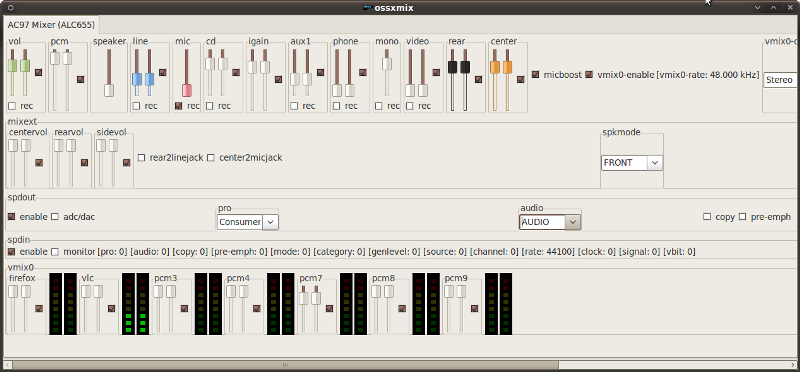
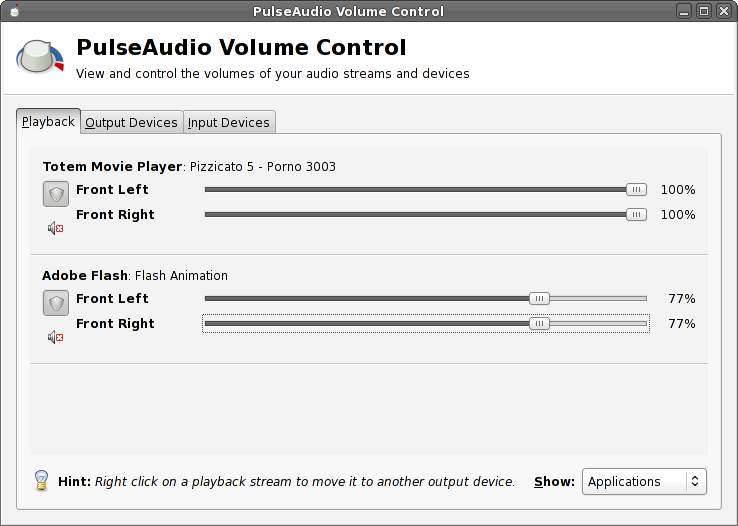
Pulse-audio can also do per-application volume control.If you are still in doubt, look at this OSS4 mixer (vmix0):
http://cafe-ti.blog.br/wordpress/wp-content/uploads/2009/02/ossxmix.png
or the mixer for pulse audio:
http://fedoraproject.org/w/uploads/8/82/Interviews_LennartPoettering_PulseAudio.png
It is good and informative to say certain list of things does X.
It is totally wrong and will take all your credibility away when you say certain list of things is the ONLY that supports X, specially when you show no apparent knowledge or basis to support that certainty. -
Re:Raw speed is probably a moot point....
See Changelog
-
Re:Obligatory XKCD
You're sure about that?
http://koji.fedoraproject.org/koji/buildinfo?buildID=126369
* Fri Aug 07 2009 Kristian HÃgsberg - 2.8.0-4
- Add dri2-page-flip.patch to enable full screen pageflipping.
Fixes XKCD #619. -
Re:Obligatory XKCD
Fedora developer read it for sure:
* Fri Aug 07 2009 Kristian HÃgsberg - 2.8.0-4
- Add dri2-page-flip.patch to enable full screen pageflipping.
Fixes XKCD #619.
xorg-x11-drv-intel-2.8.0-4.fc12 -
Re:Scrum ... isn't this how OSS works?
OSS projects don't generally plan to have feature X, Y, and Z added and working within N weeks/months. OSS usually works by having John, Laura, and Paul submitting some random fix that they decided to spend time on, and if the fixes are sufficient enough for production use, those patches make it into the next release. Having fixed schedules doesn't make OSS == Agile.
I'm not really much of an agile proponent, but without a predetermined goal for what the next release is going to have, then getting the contributors to work feverishly on specific parts of the code that really need improvement is hard. Really large projects like fedora have something like https://fedoraproject.org/wiki/Releases/12/FeatureList which they chip away at through releases, but I don't believe that many small projects I've seen have such targeted collaboration goals.
-
Re:Poor choice for screensaver?
-
Re:But...
What's wrong with getting the torrent from the distro website?
http://www.ubuntu.com/getubuntu/downloadmirrors#bt
http://www.debian.org/CD/torrent-cd/
http://torrent.fedoraproject.org/
etc..I'd be wary of downloading any software (especially something like an operating system) from a site like the Pirate Bay.
Off topic: For me downloading a torrent is actually slower than a direct download most of the time, thanks to my ISP throttling bittorrent. For example, I can download Ubuntu at 1.5MB/sec via http or ftp, but only 300KB/sec with bittorrent...
-
This sounds interesting
It's nice to see this come from the Suse folks, sounds like it would be a nice tool for the Suse users/admins that don't want to use something like:
http://fedoraproject.org/wiki/FedoraLiveCD/LiveCDHowTo (which can create another distribution livecd)The web test drive stuff really looks neat as well.
-
Is a live DVD OK?
If booting off a live DVD is OK then you may want to look at https://fedoraproject.org/wiki/ElectronicLab_Spin .
-
Re:If you need fresh RPMs on RHEL use koji
Or get the sources straight from CVS -- the downside is you won't know whether a particular revision results in a successful build or not, without checking Koji.
-
Re:fair comparison ?
Fedora isn't a dev release. Fedora-11 is the stable track. Fedora-devel is the development track.
https://admin.fedoraproject.org/pkgdb/collections/id/21 - Stable
https://admin.fedoraproject.org/pkgdb/collections/id/8 - Development
Comparison to Jaunty is perfectly valid, as Jaunty is kept up to date with "stable" packages from time to time.
-
Re:fair comparison ?
Fedora isn't a dev release. Fedora-11 is the stable track. Fedora-devel is the development track.
https://admin.fedoraproject.org/pkgdb/collections/id/21 - Stable
https://admin.fedoraproject.org/pkgdb/collections/id/8 - Development
Comparison to Jaunty is perfectly valid, as Jaunty is kept up to date with "stable" packages from time to time.
-
Re:The cool thing is...
It's a modified bsdiff algorithm; it does not actualy reuse the original bsdiff
-
Re:Also less overhead for Google
> I'd be honestly pretty disappointed in any major distro that doesn't start implementing a binary diff solution around this.
Fedora already has Presto using DeltaRPMs
-
Re:Not the KDE4 way, plase
From what I've heard EVERYTHING is a bit slow and buggy on Fedora these days. *duck*
You'd be surprisingly glad with more testing, and less listening. As a side note, there was recently an interesting FESCo meeting in which, among other things, they decided whether to make gnome the default desktop live spin, or if the choice had to be left to the "ignorant masses". Obviously, the decision degenerated in the following fedora-devel-list thread, in which the never ending flamewar we are reading about here returns, in yet another flavour
-
Perhaps the contractors could...
... find a way to contribute some small portion of their profits to The Apache Software Foundation?
Or any number of PHP- and Linux-related organizations?
Or Drupal?
That just seems to be the right thing to do, is all.