Slashdot Mirror
Domain: fsdn.com
Stories and comments across the archive that link to fsdn.com.
Stories · 67
-
Review: Eufloria
eldavojohn writes "Eufloria is a strategy game made by independent game company Dyson. I bought it on the Steam service this weekend for $20 and was impressed that it is a visually and aurally pleasing game. It's a real-time strategy game, but isn't a rehashed Civilization or Age of Empires — it employs a different kind of mechanic to conquer. Like a lot of games that rely on novel game mechanics (Braid & Spore come to mind), part of the game's experience relies on you learning as you progress through the 25 or so levels. They will definitely push you to utilize different strategies and tactics, so don't read this review if you're already planning to play this game, as it'll most likely be filled with spoilers about developing a strategy. I give the game an average 6 out of 10 and would like to say that with titles like Braid and Eufloria out there, 'independent' no longer equates to 'sucks.'" Read on for the rest of his thoughts.- Title: Eufloria
- Developers: Alex May, Rudolf Kremers
- Publisher: Omni Systems
- System: Windows
- Reviewer: eldavojohn
- Score: 6/10
The game's graphics and soundtrack are seemingly procedurally generated. If you find things like OS X and the Wii simple and aesthetically pleasing, then this game's for you. The very first thing I noticed was zooming. This game makes you feel as if you're staring at a petri dish, and you're capable of watching from 30,000 feet with little bugs flying around asteroids or you can zoom in and observe the battles the bugs are having. The music is very ambient and strangely soothing. Not only do your seedlings grow procedurally (depending on when you click the plant button) but the music seems to react to your movements and the commands sent to your guys. It's really an enjoyable experience that can make the hours melt away as you listen and enjoy the organic movement and music.
The gameplay is reminiscent to that of Risk ... except vastly simpler. The early levels basically run themselves, and it becomes increasingly complicated and more difficult. Multiple enemies, different kinds of weapons and decreased odds of winning slowly stack more and more against you. In this respect, patience is often a virtue as you grow more seedlings or wait for two enemies to attack each other, giving you a chance to win. Several times, however, my territory served as a battle area for the AI, destroying any chance I had. The early strategies being simple, I found myself employing a scout and move strategy to stay alive in later levels.
For what this game tries to be, it succeeds. The downsides of the game are more the additional features than a shortcoming in the design or the gameplay. As levels grew larger and more complex, I found myself staying at the highest possible view of my seedlings and conquered asteroids. It became a numbers game, with the strategy focusing on where to set up defense and where to set up offense. This becomes necessary to be aware of everything going on around you, but it reduces the graphics of the procedurally-generated trees and flights of your seedlings to blurry dots on the screen. While aiding you, it removes you from the things that make this game beautiful. An unfortunate side effect, for me.
Another flaw of the game is a pretty weak storyline. With trees and seedlings as your "actors," there's not a whole lot of human emotion and therefore the storyline (while containing a twist) seems weak and tacked on. Along with that, the game is short. You could squeeze perhaps 20 hours out of this game ... depending on how much patience you have. If you start doing bad at a level, you can always just start over and wait for the computer AI to slip up. The AI is not the best in this game. Several times the computer could have wiped me off the map ... but for some unknown, humanitarian reason chose not to. While that made it much easier for me, it sure destroyed my sense of accomplishment. All too often I got away with being very poorly defended.
The last complaint is a common one: no online mode. I imagine all my strategies would be revolutionized were I pitted against other players. When you play this game, you'll realize that it has a lot of player-versus-player potential, like the majority of RTS games rely on. And yet, there is no online or even LAN capabilities. Unfortunately, multi-player is not in the plans for Dyson's future.
Eufloria is a beautiful game and is priced reasonably. If you're an RTS fan, this game's for you. If you're a gamer who'd rather be planting bullets than trees, or a gamer who needs multi-player online play then this game isn't for you ... but it might be a nice break to steal away every now and then for a few moments of ambient music and procedurally-generated beauty.
-
Review: Dragon Age: Origins
Since the release of Baldur's Gate in 1998, BioWare has cultivated a strong reputation for quality role-playing games, exploring various aspects of the genre ranging from traditional D&D roles and rules to space marine and Jedi Knights. Dragon Age: Origins is a shift back to traditional swords-and-sorcery standards, unashamedly embracing the archetypes that made RPGs what they are, and using them to tell a complex, interesting story in a familiar yet unexplored world. In addition, BioWare has done yet another iteration of their combat system to make it deeper and allow the player to dictate the level of engagement. The result is that Dragon Age: Origins is one of the best RPGs in recent history. Read on for the rest of my thoughts.- Title: Dragon Age: Origins
- Developer: BioWare
- Publisher: Electronic Arts
- System: Windows (Also: PlayStation 3, Xbox 360)
- Reviewer: Soulskill
- Score: 8/10
Character creation starts you off with a few simple choices that have far-reaching effects. There are three races (Human, Dwarf, Elf), and three classes (Warrior, Mage, Rogue), and they are much as you'd expect if you've ever played a fantasy RPG before. Depending on what you pick, one or two of the 'Origins' stories becomes available. These are short scenarios which detail the introduction of your character to the main plot line. For example, Human Rogues get their beginning as part of a noble house. Dwarf Warriors can choose either the dwarf noble or dwarf commoner starting areas, and both Elven and Human mages share a starter-story due to their class. (The only race restriction is that Dwarves can't be Mages.) These decisions affect how NPCs interact with your character throughout the game.
While only having three classes may seem limiting, your characters will have a high degree of customization as you start leveling up. You have talent trees (well, not so much 'trees' as 'lines') and each level gives you a talent point to spend. The talent lines are divided up into major fighting categories. The categories for Warriors are Dual Weapon, Archery, Weapon and Shield, and Two-Handed. Within each of these categories are sets of activated and passive abilities that grow progressively more powerful as you spend more talent points in that line.
The result of this is that you can easily have multiple Warriors in a group, each performing a different role and having different gameplay. One can swing a massive axe and lay waste to whatever he touches, and another can grab a shield and take on the tank role, utilizing a host of defensive talents. Mages get a similar selection of roles, and are able to play as elemental sorcerers, healers/buffers, or dabblers in the dark arts. On top of all this, each class has a set of four Specializations, which confer certain bonuses and unlock another set of abilities. Rogues can choose to become bards, which grants them songs to buff their party and mesmerize their enemies; they can also choose Assassin, making them better at finding weak spots, or Ranger, which lets them summon forest creatures to their aid. You get to pick a specialization at levels 7 and again at 14, but perhaps the most interesting part is how you acquire them. Some you can purchase, some are trained by various NPCs or party members, and others are unlocked by quests.
The stat system will be instantly familiar to anyone with experience in the genre; strength makes you hit harder, constitution makes you tougher, etc. It's quite simple, and the tooltips explain everything you need to know. Every level gives you three stat points to spend as you will. Various items and talents will have a stat requirement to use or acquire, but it's a fairly smooth progression. You won't typically have to wait very long to use that shiny new sword you picked up. There's no single, monolithic alignment system, but your actions will have an effect on how NPCs treat you. Perhaps more importantly, your actions will have an effect on how your group members feel about you. Each of them has an Approval Rating, which is a measure of how much they like you. Extreme ratings can unlock side plots — friendship and romance for high ratings, mutiny and abandonment for low ratings — and they can have an effect on the characters' stats.
The Approval system is a fun way to learn about each of your companions. There's a surprising amount of story to be told for each of them. Surprising, at least, until you realize how much story there is in the rest of the game. I was impressed by how often I had a meaningful choice in how the plot unfolded. That is, when the dialogue allowed for different options, they didn't feel like window dressing. (e.g. Do you want to kill him? Yes/No Yes. Are you sure? No/I Guess Not Damnit.) I just picked whichever option I felt like picking, and the plot still worked.
The story succeeds, by and large, for two reasons: the writing and the voice acting. BioWare made a lot of noise about getting some big names for Dragon Age: Origins (and they did; Kate Mulgrew, Claudia Black, Tim Curry, Steve Valentine, and Tim Russ, to name a few), but that isn't a guarantee of good voice work. Virtually all of the NPC dialogue in this game is spoken (you can skip through it if you care to; I rarely felt the need to), even when you're asking them about mundane things, so poor voice acting would be hard to tolerate after a while. But this cast turned in a performance that (sadly) I don't tend to expect from video games. What helped a lot in this regard is that the characters are very well written — which is to say they actually seem fleshed-out and believable, with a personality that's consistent from one scene to the next. The details of how the characters react to events and interact with each other are spot on. Your companions will occasionally trade jokes or insults at random times throughout the game, whether you're in the middle of dialogue or just wandering through a city.
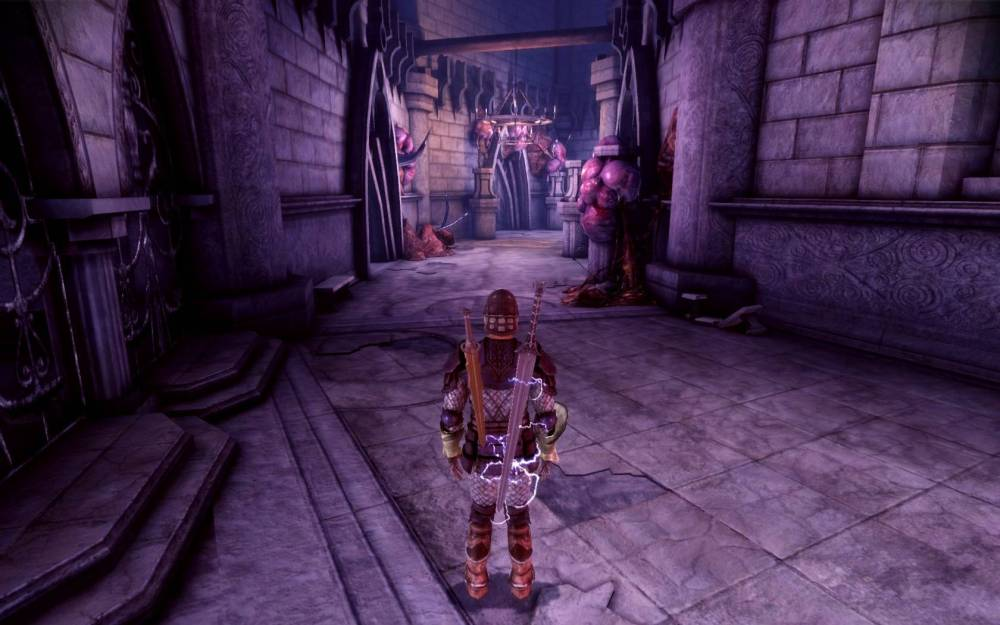
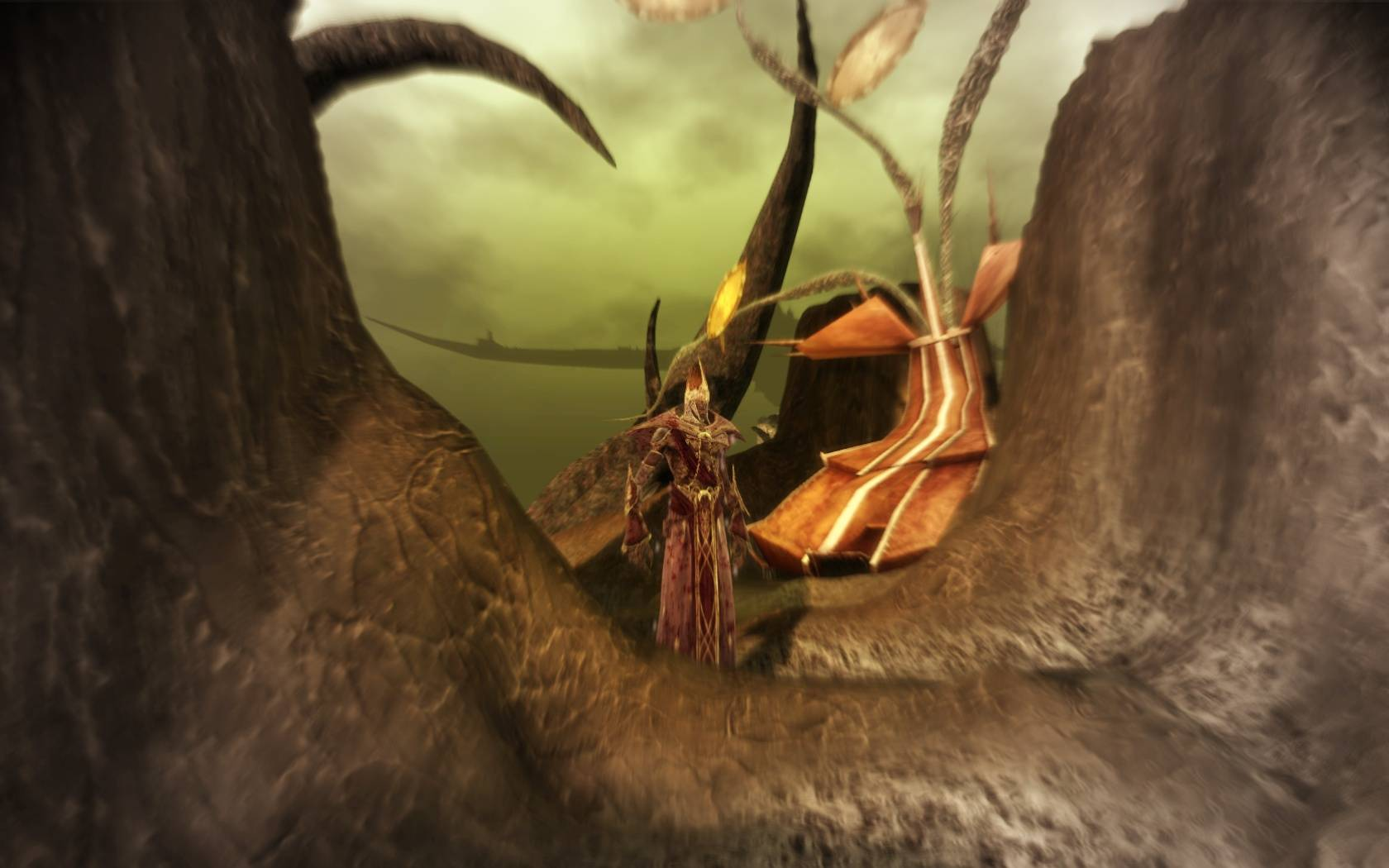
Now, don't get me wrong; the plot itself is interesting too, but it's hard to tread new ground here (Doom threatens the world; a hero arises; things go wrong that the hero must put right), and the writers don't really worry about doing so. They're just trying to tell a cool story. Without spoiling too much, the Mage Tower story in the main plot is particularly fun. The writers leave you a trail of breadcrumbs to figure out what happened, dump you into fantasy land for a few puzzles and a different way of fighting, then top it off with an epic battle, all while maintaining an atmosphere of hopelessness and dread. What's more, all the different portions of the main plot are completely distinct, each with its own moral dilemmas, level layout, look, and back-story.
In addition to countless hours of dialogue, one big way BioWare goes about establishing their game world is through books, scrolls, and notes scattered around the areas you visit. When you click on them, they'll put a page or so of text in your Codex explaining who's who and what's what, so you're not inundated with a flood of made-up, fantasy-world names at any one time. The Codex entries are relevant to whatever task you're currently doing, and vary in form from dictionary-style explanation to diary entries to poems.
So, how about the gameplay? Many RPGs have met their downfall on the weakness of their combat mechanics, or have succeeded in spite of it. (I'll name no names, but one such rhymes with Moblivion.) Like several other BioWare games, you can pause the action and queue up an ability that will fire off when you un-pause. You can also take control of any other party member(s) whenever you please. Group size tops out at four, which allows a fair amount of micromanagement without becoming tedious. For general commands like attacking or movement, you can control multiple party members at once. There's not a lot of movement during combat. Rogues have bit of an incentive to move behind their targets, and mages will occasionally have cause to kite a monster, but most of the running you do will be to get your melee in range to hit something. My only major gripe is that melee classes tend to run out of stamina quickly, so for long battles they spend a lot of time auto-attacking.
Even with just that, it would be a solid combat system, but there are three other major features which allow you customize your level of engagement. First, there are four difficulty settings. Easy will let you basically just point-and-click to win. Normal will require some planning and pausing, and some potion use on the tougher fights. Hard makes you do a lot more micromanagement, use consumables often, and watch out for friendly fire. Nightmare is for people who should probably be medicated. Second, you can set generalized behaviors for each of your party members; this will make them run to seek a fight, run away, ignore it altogether, or a few other options.
Third is your Tactics page. This lets you set up responses to a large variety of actions or game states. For example, you can set a Mage to cast a heal when somebody drops below 50% health. Or, you could have your warrior tank run over to attack whatever monster is beating on your rogue. There are hundreds of trigger conditions neatly laid out in a set of drop-down menus. You can set some some fairly complex behavior if you'd like to, or just automate the basic tasks. When you put this whole system together, you end up being able to tailor the fighting to your personal preference for involvement. You can micromanage as much or as little as you want.
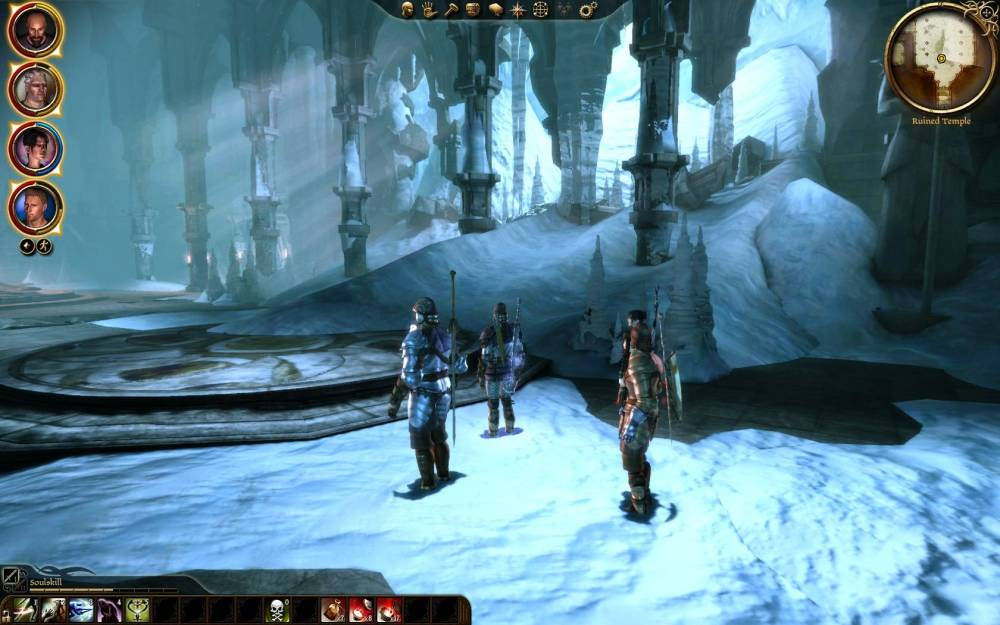
The UI is very streamlined and responsive. The camera is over-the-shoulder, and if you zoom out far enough it pulls back to an almost top-down, "tactical" view. (The console versions are restricted to over-the-shoulder.) For using your abilities, you have a boilerplate action bar, and your group portraits are off to the left for monitoring health and mana. If I were nitpicking, I'd say the health and mana bars should be somewhat thicker; they're a bit small to take in the whole group at a glance. Click-able bars pop up on the bottom of your screen whenever you get quest or codex updates (and a few other things), which makes it very easy to keep track of what's going on with the plot. You can hold down a button to highlight everything on screen that you can interact with (chests, NPCs, monsters, loot-able corpses, quest items, doors), so finding what you're looking for is dead easy.
That streamlining carries over into the gameplay as well. Any of your party members who fall in battle come back to life if the remaining characters win the fight. It's silly from a realism perspective, but at the same time it saves me from spending 30 seconds casting Resurrection every other battle or keeping 500 Phoenix Downs in my bags. (Though, oddly, characters come back to life with injuries — minor stat debuffs — that require an item or a visit to base camp to heal.) Itemization is perhaps a victim of this streamlining. As I leveled up, I naturally picked up better gear, but it never felt like the items made a significant difference. On the other hand, stat gains from leveling were constant, and new talents provided obvious improvements. Quests are sometimes quite simplistic because of the interface as well, but those quests mainly exist to serve the narrative. I expected this to bother me, but it didn't; I just wanted to see where the story was going.
Dragon Age: Origins has a ton of (quality) playtime in it; even more when you consider replayability. I'm sure I could go through the entire game again and have a largely different experience, both in story and in combat. (I tend to stick with a group configuration I like, so one of my potential companions has been sitting on the sidelines the whole time, and I slightly killed another one. Not to mention different talent choices and specializations.) BioWare didn't blaze a new trail within the genre, but they succeeded in their effort to create a game that presents a new, fun take on the familiar with elegance and polish. (And Claudia Black.)
-
Review: Dragon Age: Origins
Since the release of Baldur's Gate in 1998, BioWare has cultivated a strong reputation for quality role-playing games, exploring various aspects of the genre ranging from traditional D&D roles and rules to space marine and Jedi Knights. Dragon Age: Origins is a shift back to traditional swords-and-sorcery standards, unashamedly embracing the archetypes that made RPGs what they are, and using them to tell a complex, interesting story in a familiar yet unexplored world. In addition, BioWare has done yet another iteration of their combat system to make it deeper and allow the player to dictate the level of engagement. The result is that Dragon Age: Origins is one of the best RPGs in recent history. Read on for the rest of my thoughts.- Title: Dragon Age: Origins
- Developer: BioWare
- Publisher: Electronic Arts
- System: Windows (Also: PlayStation 3, Xbox 360)
- Reviewer: Soulskill
- Score: 8/10
Character creation starts you off with a few simple choices that have far-reaching effects. There are three races (Human, Dwarf, Elf), and three classes (Warrior, Mage, Rogue), and they are much as you'd expect if you've ever played a fantasy RPG before. Depending on what you pick, one or two of the 'Origins' stories becomes available. These are short scenarios which detail the introduction of your character to the main plot line. For example, Human Rogues get their beginning as part of a noble house. Dwarf Warriors can choose either the dwarf noble or dwarf commoner starting areas, and both Elven and Human mages share a starter-story due to their class. (The only race restriction is that Dwarves can't be Mages.) These decisions affect how NPCs interact with your character throughout the game.
While only having three classes may seem limiting, your characters will have a high degree of customization as you start leveling up. You have talent trees (well, not so much 'trees' as 'lines') and each level gives you a talent point to spend. The talent lines are divided up into major fighting categories. The categories for Warriors are Dual Weapon, Archery, Weapon and Shield, and Two-Handed. Within each of these categories are sets of activated and passive abilities that grow progressively more powerful as you spend more talent points in that line.
The result of this is that you can easily have multiple Warriors in a group, each performing a different role and having different gameplay. One can swing a massive axe and lay waste to whatever he touches, and another can grab a shield and take on the tank role, utilizing a host of defensive talents. Mages get a similar selection of roles, and are able to play as elemental sorcerers, healers/buffers, or dabblers in the dark arts. On top of all this, each class has a set of four Specializations, which confer certain bonuses and unlock another set of abilities. Rogues can choose to become bards, which grants them songs to buff their party and mesmerize their enemies; they can also choose Assassin, making them better at finding weak spots, or Ranger, which lets them summon forest creatures to their aid. You get to pick a specialization at levels 7 and again at 14, but perhaps the most interesting part is how you acquire them. Some you can purchase, some are trained by various NPCs or party members, and others are unlocked by quests.
The stat system will be instantly familiar to anyone with experience in the genre; strength makes you hit harder, constitution makes you tougher, etc. It's quite simple, and the tooltips explain everything you need to know. Every level gives you three stat points to spend as you will. Various items and talents will have a stat requirement to use or acquire, but it's a fairly smooth progression. You won't typically have to wait very long to use that shiny new sword you picked up. There's no single, monolithic alignment system, but your actions will have an effect on how NPCs treat you. Perhaps more importantly, your actions will have an effect on how your group members feel about you. Each of them has an Approval Rating, which is a measure of how much they like you. Extreme ratings can unlock side plots — friendship and romance for high ratings, mutiny and abandonment for low ratings — and they can have an effect on the characters' stats.
The Approval system is a fun way to learn about each of your companions. There's a surprising amount of story to be told for each of them. Surprising, at least, until you realize how much story there is in the rest of the game. I was impressed by how often I had a meaningful choice in how the plot unfolded. That is, when the dialogue allowed for different options, they didn't feel like window dressing. (e.g. Do you want to kill him? Yes/No Yes. Are you sure? No/I Guess Not Damnit.) I just picked whichever option I felt like picking, and the plot still worked.
The story succeeds, by and large, for two reasons: the writing and the voice acting. BioWare made a lot of noise about getting some big names for Dragon Age: Origins (and they did; Kate Mulgrew, Claudia Black, Tim Curry, Steve Valentine, and Tim Russ, to name a few), but that isn't a guarantee of good voice work. Virtually all of the NPC dialogue in this game is spoken (you can skip through it if you care to; I rarely felt the need to), even when you're asking them about mundane things, so poor voice acting would be hard to tolerate after a while. But this cast turned in a performance that (sadly) I don't tend to expect from video games. What helped a lot in this regard is that the characters are very well written — which is to say they actually seem fleshed-out and believable, with a personality that's consistent from one scene to the next. The details of how the characters react to events and interact with each other are spot on. Your companions will occasionally trade jokes or insults at random times throughout the game, whether you're in the middle of dialogue or just wandering through a city.
Now, don't get me wrong; the plot itself is interesting too, but it's hard to tread new ground here (Doom threatens the world; a hero arises; things go wrong that the hero must put right), and the writers don't really worry about doing so. They're just trying to tell a cool story. Without spoiling too much, the Mage Tower story in the main plot is particularly fun. The writers leave you a trail of breadcrumbs to figure out what happened, dump you into fantasy land for a few puzzles and a different way of fighting, then top it off with an epic battle, all while maintaining an atmosphere of hopelessness and dread. What's more, all the different portions of the main plot are completely distinct, each with its own moral dilemmas, level layout, look, and back-story.
In addition to countless hours of dialogue, one big way BioWare goes about establishing their game world is through books, scrolls, and notes scattered around the areas you visit. When you click on them, they'll put a page or so of text in your Codex explaining who's who and what's what, so you're not inundated with a flood of made-up, fantasy-world names at any one time. The Codex entries are relevant to whatever task you're currently doing, and vary in form from dictionary-style explanation to diary entries to poems.
So, how about the gameplay? Many RPGs have met their downfall on the weakness of their combat mechanics, or have succeeded in spite of it. (I'll name no names, but one such rhymes with Moblivion.) Like several other BioWare games, you can pause the action and queue up an ability that will fire off when you un-pause. You can also take control of any other party member(s) whenever you please. Group size tops out at four, which allows a fair amount of micromanagement without becoming tedious. For general commands like attacking or movement, you can control multiple party members at once. There's not a lot of movement during combat. Rogues have bit of an incentive to move behind their targets, and mages will occasionally have cause to kite a monster, but most of the running you do will be to get your melee in range to hit something. My only major gripe is that melee classes tend to run out of stamina quickly, so for long battles they spend a lot of time auto-attacking.
Even with just that, it would be a solid combat system, but there are three other major features which allow you customize your level of engagement. First, there are four difficulty settings. Easy will let you basically just point-and-click to win. Normal will require some planning and pausing, and some potion use on the tougher fights. Hard makes you do a lot more micromanagement, use consumables often, and watch out for friendly fire. Nightmare is for people who should probably be medicated. Second, you can set generalized behaviors for each of your party members; this will make them run to seek a fight, run away, ignore it altogether, or a few other options.
Third is your Tactics page. This lets you set up responses to a large variety of actions or game states. For example, you can set a Mage to cast a heal when somebody drops below 50% health. Or, you could have your warrior tank run over to attack whatever monster is beating on your rogue. There are hundreds of trigger conditions neatly laid out in a set of drop-down menus. You can set some some fairly complex behavior if you'd like to, or just automate the basic tasks. When you put this whole system together, you end up being able to tailor the fighting to your personal preference for involvement. You can micromanage as much or as little as you want.
The UI is very streamlined and responsive. The camera is over-the-shoulder, and if you zoom out far enough it pulls back to an almost top-down, "tactical" view. (The console versions are restricted to over-the-shoulder.) For using your abilities, you have a boilerplate action bar, and your group portraits are off to the left for monitoring health and mana. If I were nitpicking, I'd say the health and mana bars should be somewhat thicker; they're a bit small to take in the whole group at a glance. Click-able bars pop up on the bottom of your screen whenever you get quest or codex updates (and a few other things), which makes it very easy to keep track of what's going on with the plot. You can hold down a button to highlight everything on screen that you can interact with (chests, NPCs, monsters, loot-able corpses, quest items, doors), so finding what you're looking for is dead easy.
That streamlining carries over into the gameplay as well. Any of your party members who fall in battle come back to life if the remaining characters win the fight. It's silly from a realism perspective, but at the same time it saves me from spending 30 seconds casting Resurrection every other battle or keeping 500 Phoenix Downs in my bags. (Though, oddly, characters come back to life with injuries — minor stat debuffs — that require an item or a visit to base camp to heal.) Itemization is perhaps a victim of this streamlining. As I leveled up, I naturally picked up better gear, but it never felt like the items made a significant difference. On the other hand, stat gains from leveling were constant, and new talents provided obvious improvements. Quests are sometimes quite simplistic because of the interface as well, but those quests mainly exist to serve the narrative. I expected this to bother me, but it didn't; I just wanted to see where the story was going.
Dragon Age: Origins has a ton of (quality) playtime in it; even more when you consider replayability. I'm sure I could go through the entire game again and have a largely different experience, both in story and in combat. (I tend to stick with a group configuration I like, so one of my potential companions has been sitting on the sidelines the whole time, and I slightly killed another one. Not to mention different talent choices and specializations.) BioWare didn't blaze a new trail within the genre, but they succeeded in their effort to create a game that presents a new, fun take on the familiar with elegance and polish. (And Claudia Black.)
-
Review: Dragon Age: Origins
Since the release of Baldur's Gate in 1998, BioWare has cultivated a strong reputation for quality role-playing games, exploring various aspects of the genre ranging from traditional D&D roles and rules to space marine and Jedi Knights. Dragon Age: Origins is a shift back to traditional swords-and-sorcery standards, unashamedly embracing the archetypes that made RPGs what they are, and using them to tell a complex, interesting story in a familiar yet unexplored world. In addition, BioWare has done yet another iteration of their combat system to make it deeper and allow the player to dictate the level of engagement. The result is that Dragon Age: Origins is one of the best RPGs in recent history. Read on for the rest of my thoughts.- Title: Dragon Age: Origins
- Developer: BioWare
- Publisher: Electronic Arts
- System: Windows (Also: PlayStation 3, Xbox 360)
- Reviewer: Soulskill
- Score: 8/10
Character creation starts you off with a few simple choices that have far-reaching effects. There are three races (Human, Dwarf, Elf), and three classes (Warrior, Mage, Rogue), and they are much as you'd expect if you've ever played a fantasy RPG before. Depending on what you pick, one or two of the 'Origins' stories becomes available. These are short scenarios which detail the introduction of your character to the main plot line. For example, Human Rogues get their beginning as part of a noble house. Dwarf Warriors can choose either the dwarf noble or dwarf commoner starting areas, and both Elven and Human mages share a starter-story due to their class. (The only race restriction is that Dwarves can't be Mages.) These decisions affect how NPCs interact with your character throughout the game.
While only having three classes may seem limiting, your characters will have a high degree of customization as you start leveling up. You have talent trees (well, not so much 'trees' as 'lines') and each level gives you a talent point to spend. The talent lines are divided up into major fighting categories. The categories for Warriors are Dual Weapon, Archery, Weapon and Shield, and Two-Handed. Within each of these categories are sets of activated and passive abilities that grow progressively more powerful as you spend more talent points in that line.
The result of this is that you can easily have multiple Warriors in a group, each performing a different role and having different gameplay. One can swing a massive axe and lay waste to whatever he touches, and another can grab a shield and take on the tank role, utilizing a host of defensive talents. Mages get a similar selection of roles, and are able to play as elemental sorcerers, healers/buffers, or dabblers in the dark arts. On top of all this, each class has a set of four Specializations, which confer certain bonuses and unlock another set of abilities. Rogues can choose to become bards, which grants them songs to buff their party and mesmerize their enemies; they can also choose Assassin, making them better at finding weak spots, or Ranger, which lets them summon forest creatures to their aid. You get to pick a specialization at levels 7 and again at 14, but perhaps the most interesting part is how you acquire them. Some you can purchase, some are trained by various NPCs or party members, and others are unlocked by quests.
The stat system will be instantly familiar to anyone with experience in the genre; strength makes you hit harder, constitution makes you tougher, etc. It's quite simple, and the tooltips explain everything you need to know. Every level gives you three stat points to spend as you will. Various items and talents will have a stat requirement to use or acquire, but it's a fairly smooth progression. You won't typically have to wait very long to use that shiny new sword you picked up. There's no single, monolithic alignment system, but your actions will have an effect on how NPCs treat you. Perhaps more importantly, your actions will have an effect on how your group members feel about you. Each of them has an Approval Rating, which is a measure of how much they like you. Extreme ratings can unlock side plots — friendship and romance for high ratings, mutiny and abandonment for low ratings — and they can have an effect on the characters' stats.
The Approval system is a fun way to learn about each of your companions. There's a surprising amount of story to be told for each of them. Surprising, at least, until you realize how much story there is in the rest of the game. I was impressed by how often I had a meaningful choice in how the plot unfolded. That is, when the dialogue allowed for different options, they didn't feel like window dressing. (e.g. Do you want to kill him? Yes/No Yes. Are you sure? No/I Guess Not Damnit.) I just picked whichever option I felt like picking, and the plot still worked.
The story succeeds, by and large, for two reasons: the writing and the voice acting. BioWare made a lot of noise about getting some big names for Dragon Age: Origins (and they did; Kate Mulgrew, Claudia Black, Tim Curry, Steve Valentine, and Tim Russ, to name a few), but that isn't a guarantee of good voice work. Virtually all of the NPC dialogue in this game is spoken (you can skip through it if you care to; I rarely felt the need to), even when you're asking them about mundane things, so poor voice acting would be hard to tolerate after a while. But this cast turned in a performance that (sadly) I don't tend to expect from video games. What helped a lot in this regard is that the characters are very well written — which is to say they actually seem fleshed-out and believable, with a personality that's consistent from one scene to the next. The details of how the characters react to events and interact with each other are spot on. Your companions will occasionally trade jokes or insults at random times throughout the game, whether you're in the middle of dialogue or just wandering through a city.
Now, don't get me wrong; the plot itself is interesting too, but it's hard to tread new ground here (Doom threatens the world; a hero arises; things go wrong that the hero must put right), and the writers don't really worry about doing so. They're just trying to tell a cool story. Without spoiling too much, the Mage Tower story in the main plot is particularly fun. The writers leave you a trail of breadcrumbs to figure out what happened, dump you into fantasy land for a few puzzles and a different way of fighting, then top it off with an epic battle, all while maintaining an atmosphere of hopelessness and dread. What's more, all the different portions of the main plot are completely distinct, each with its own moral dilemmas, level layout, look, and back-story.
In addition to countless hours of dialogue, one big way BioWare goes about establishing their game world is through books, scrolls, and notes scattered around the areas you visit. When you click on them, they'll put a page or so of text in your Codex explaining who's who and what's what, so you're not inundated with a flood of made-up, fantasy-world names at any one time. The Codex entries are relevant to whatever task you're currently doing, and vary in form from dictionary-style explanation to diary entries to poems.
So, how about the gameplay? Many RPGs have met their downfall on the weakness of their combat mechanics, or have succeeded in spite of it. (I'll name no names, but one such rhymes with Moblivion.) Like several other BioWare games, you can pause the action and queue up an ability that will fire off when you un-pause. You can also take control of any other party member(s) whenever you please. Group size tops out at four, which allows a fair amount of micromanagement without becoming tedious. For general commands like attacking or movement, you can control multiple party members at once. There's not a lot of movement during combat. Rogues have bit of an incentive to move behind their targets, and mages will occasionally have cause to kite a monster, but most of the running you do will be to get your melee in range to hit something. My only major gripe is that melee classes tend to run out of stamina quickly, so for long battles they spend a lot of time auto-attacking.
Even with just that, it would be a solid combat system, but there are three other major features which allow you customize your level of engagement. First, there are four difficulty settings. Easy will let you basically just point-and-click to win. Normal will require some planning and pausing, and some potion use on the tougher fights. Hard makes you do a lot more micromanagement, use consumables often, and watch out for friendly fire. Nightmare is for people who should probably be medicated. Second, you can set generalized behaviors for each of your party members; this will make them run to seek a fight, run away, ignore it altogether, or a few other options.
Third is your Tactics page. This lets you set up responses to a large variety of actions or game states. For example, you can set a Mage to cast a heal when somebody drops below 50% health. Or, you could have your warrior tank run over to attack whatever monster is beating on your rogue. There are hundreds of trigger conditions neatly laid out in a set of drop-down menus. You can set some some fairly complex behavior if you'd like to, or just automate the basic tasks. When you put this whole system together, you end up being able to tailor the fighting to your personal preference for involvement. You can micromanage as much or as little as you want.
The UI is very streamlined and responsive. The camera is over-the-shoulder, and if you zoom out far enough it pulls back to an almost top-down, "tactical" view. (The console versions are restricted to over-the-shoulder.) For using your abilities, you have a boilerplate action bar, and your group portraits are off to the left for monitoring health and mana. If I were nitpicking, I'd say the health and mana bars should be somewhat thicker; they're a bit small to take in the whole group at a glance. Click-able bars pop up on the bottom of your screen whenever you get quest or codex updates (and a few other things), which makes it very easy to keep track of what's going on with the plot. You can hold down a button to highlight everything on screen that you can interact with (chests, NPCs, monsters, loot-able corpses, quest items, doors), so finding what you're looking for is dead easy.
That streamlining carries over into the gameplay as well. Any of your party members who fall in battle come back to life if the remaining characters win the fight. It's silly from a realism perspective, but at the same time it saves me from spending 30 seconds casting Resurrection every other battle or keeping 500 Phoenix Downs in my bags. (Though, oddly, characters come back to life with injuries — minor stat debuffs — that require an item or a visit to base camp to heal.) Itemization is perhaps a victim of this streamlining. As I leveled up, I naturally picked up better gear, but it never felt like the items made a significant difference. On the other hand, stat gains from leveling were constant, and new talents provided obvious improvements. Quests are sometimes quite simplistic because of the interface as well, but those quests mainly exist to serve the narrative. I expected this to bother me, but it didn't; I just wanted to see where the story was going.
Dragon Age: Origins has a ton of (quality) playtime in it; even more when you consider replayability. I'm sure I could go through the entire game again and have a largely different experience, both in story and in combat. (I tend to stick with a group configuration I like, so one of my potential companions has been sitting on the sidelines the whole time, and I slightly killed another one. Not to mention different talent choices and specializations.) BioWare didn't blaze a new trail within the genre, but they succeeded in their effort to create a game that presents a new, fun take on the familiar with elegance and polish. (And Claudia Black.)
-
Review: Dragon Age: Origins
Since the release of Baldur's Gate in 1998, BioWare has cultivated a strong reputation for quality role-playing games, exploring various aspects of the genre ranging from traditional D&D roles and rules to space marine and Jedi Knights. Dragon Age: Origins is a shift back to traditional swords-and-sorcery standards, unashamedly embracing the archetypes that made RPGs what they are, and using them to tell a complex, interesting story in a familiar yet unexplored world. In addition, BioWare has done yet another iteration of their combat system to make it deeper and allow the player to dictate the level of engagement. The result is that Dragon Age: Origins is one of the best RPGs in recent history. Read on for the rest of my thoughts.- Title: Dragon Age: Origins
- Developer: BioWare
- Publisher: Electronic Arts
- System: Windows (Also: PlayStation 3, Xbox 360)
- Reviewer: Soulskill
- Score: 8/10
Character creation starts you off with a few simple choices that have far-reaching effects. There are three races (Human, Dwarf, Elf), and three classes (Warrior, Mage, Rogue), and they are much as you'd expect if you've ever played a fantasy RPG before. Depending on what you pick, one or two of the 'Origins' stories becomes available. These are short scenarios which detail the introduction of your character to the main plot line. For example, Human Rogues get their beginning as part of a noble house. Dwarf Warriors can choose either the dwarf noble or dwarf commoner starting areas, and both Elven and Human mages share a starter-story due to their class. (The only race restriction is that Dwarves can't be Mages.) These decisions affect how NPCs interact with your character throughout the game.
While only having three classes may seem limiting, your characters will have a high degree of customization as you start leveling up. You have talent trees (well, not so much 'trees' as 'lines') and each level gives you a talent point to spend. The talent lines are divided up into major fighting categories. The categories for Warriors are Dual Weapon, Archery, Weapon and Shield, and Two-Handed. Within each of these categories are sets of activated and passive abilities that grow progressively more powerful as you spend more talent points in that line.
The result of this is that you can easily have multiple Warriors in a group, each performing a different role and having different gameplay. One can swing a massive axe and lay waste to whatever he touches, and another can grab a shield and take on the tank role, utilizing a host of defensive talents. Mages get a similar selection of roles, and are able to play as elemental sorcerers, healers/buffers, or dabblers in the dark arts. On top of all this, each class has a set of four Specializations, which confer certain bonuses and unlock another set of abilities. Rogues can choose to become bards, which grants them songs to buff their party and mesmerize their enemies; they can also choose Assassin, making them better at finding weak spots, or Ranger, which lets them summon forest creatures to their aid. You get to pick a specialization at levels 7 and again at 14, but perhaps the most interesting part is how you acquire them. Some you can purchase, some are trained by various NPCs or party members, and others are unlocked by quests.
The stat system will be instantly familiar to anyone with experience in the genre; strength makes you hit harder, constitution makes you tougher, etc. It's quite simple, and the tooltips explain everything you need to know. Every level gives you three stat points to spend as you will. Various items and talents will have a stat requirement to use or acquire, but it's a fairly smooth progression. You won't typically have to wait very long to use that shiny new sword you picked up. There's no single, monolithic alignment system, but your actions will have an effect on how NPCs treat you. Perhaps more importantly, your actions will have an effect on how your group members feel about you. Each of them has an Approval Rating, which is a measure of how much they like you. Extreme ratings can unlock side plots — friendship and romance for high ratings, mutiny and abandonment for low ratings — and they can have an effect on the characters' stats.
The Approval system is a fun way to learn about each of your companions. There's a surprising amount of story to be told for each of them. Surprising, at least, until you realize how much story there is in the rest of the game. I was impressed by how often I had a meaningful choice in how the plot unfolded. That is, when the dialogue allowed for different options, they didn't feel like window dressing. (e.g. Do you want to kill him? Yes/No Yes. Are you sure? No/I Guess Not Damnit.) I just picked whichever option I felt like picking, and the plot still worked.
The story succeeds, by and large, for two reasons: the writing and the voice acting. BioWare made a lot of noise about getting some big names for Dragon Age: Origins (and they did; Kate Mulgrew, Claudia Black, Tim Curry, Steve Valentine, and Tim Russ, to name a few), but that isn't a guarantee of good voice work. Virtually all of the NPC dialogue in this game is spoken (you can skip through it if you care to; I rarely felt the need to), even when you're asking them about mundane things, so poor voice acting would be hard to tolerate after a while. But this cast turned in a performance that (sadly) I don't tend to expect from video games. What helped a lot in this regard is that the characters are very well written — which is to say they actually seem fleshed-out and believable, with a personality that's consistent from one scene to the next. The details of how the characters react to events and interact with each other are spot on. Your companions will occasionally trade jokes or insults at random times throughout the game, whether you're in the middle of dialogue or just wandering through a city.
Now, don't get me wrong; the plot itself is interesting too, but it's hard to tread new ground here (Doom threatens the world; a hero arises; things go wrong that the hero must put right), and the writers don't really worry about doing so. They're just trying to tell a cool story. Without spoiling too much, the Mage Tower story in the main plot is particularly fun. The writers leave you a trail of breadcrumbs to figure out what happened, dump you into fantasy land for a few puzzles and a different way of fighting, then top it off with an epic battle, all while maintaining an atmosphere of hopelessness and dread. What's more, all the different portions of the main plot are completely distinct, each with its own moral dilemmas, level layout, look, and back-story.
In addition to countless hours of dialogue, one big way BioWare goes about establishing their game world is through books, scrolls, and notes scattered around the areas you visit. When you click on them, they'll put a page or so of text in your Codex explaining who's who and what's what, so you're not inundated with a flood of made-up, fantasy-world names at any one time. The Codex entries are relevant to whatever task you're currently doing, and vary in form from dictionary-style explanation to diary entries to poems.
So, how about the gameplay? Many RPGs have met their downfall on the weakness of their combat mechanics, or have succeeded in spite of it. (I'll name no names, but one such rhymes with Moblivion.) Like several other BioWare games, you can pause the action and queue up an ability that will fire off when you un-pause. You can also take control of any other party member(s) whenever you please. Group size tops out at four, which allows a fair amount of micromanagement without becoming tedious. For general commands like attacking or movement, you can control multiple party members at once. There's not a lot of movement during combat. Rogues have bit of an incentive to move behind their targets, and mages will occasionally have cause to kite a monster, but most of the running you do will be to get your melee in range to hit something. My only major gripe is that melee classes tend to run out of stamina quickly, so for long battles they spend a lot of time auto-attacking.
Even with just that, it would be a solid combat system, but there are three other major features which allow you customize your level of engagement. First, there are four difficulty settings. Easy will let you basically just point-and-click to win. Normal will require some planning and pausing, and some potion use on the tougher fights. Hard makes you do a lot more micromanagement, use consumables often, and watch out for friendly fire. Nightmare is for people who should probably be medicated. Second, you can set generalized behaviors for each of your party members; this will make them run to seek a fight, run away, ignore it altogether, or a few other options.
Third is your Tactics page. This lets you set up responses to a large variety of actions or game states. For example, you can set a Mage to cast a heal when somebody drops below 50% health. Or, you could have your warrior tank run over to attack whatever monster is beating on your rogue. There are hundreds of trigger conditions neatly laid out in a set of drop-down menus. You can set some some fairly complex behavior if you'd like to, or just automate the basic tasks. When you put this whole system together, you end up being able to tailor the fighting to your personal preference for involvement. You can micromanage as much or as little as you want.
The UI is very streamlined and responsive. The camera is over-the-shoulder, and if you zoom out far enough it pulls back to an almost top-down, "tactical" view. (The console versions are restricted to over-the-shoulder.) For using your abilities, you have a boilerplate action bar, and your group portraits are off to the left for monitoring health and mana. If I were nitpicking, I'd say the health and mana bars should be somewhat thicker; they're a bit small to take in the whole group at a glance. Click-able bars pop up on the bottom of your screen whenever you get quest or codex updates (and a few other things), which makes it very easy to keep track of what's going on with the plot. You can hold down a button to highlight everything on screen that you can interact with (chests, NPCs, monsters, loot-able corpses, quest items, doors), so finding what you're looking for is dead easy.
That streamlining carries over into the gameplay as well. Any of your party members who fall in battle come back to life if the remaining characters win the fight. It's silly from a realism perspective, but at the same time it saves me from spending 30 seconds casting Resurrection every other battle or keeping 500 Phoenix Downs in my bags. (Though, oddly, characters come back to life with injuries — minor stat debuffs — that require an item or a visit to base camp to heal.) Itemization is perhaps a victim of this streamlining. As I leveled up, I naturally picked up better gear, but it never felt like the items made a significant difference. On the other hand, stat gains from leveling were constant, and new talents provided obvious improvements. Quests are sometimes quite simplistic because of the interface as well, but those quests mainly exist to serve the narrative. I expected this to bother me, but it didn't; I just wanted to see where the story was going.
Dragon Age: Origins has a ton of (quality) playtime in it; even more when you consider replayability. I'm sure I could go through the entire game again and have a largely different experience, both in story and in combat. (I tend to stick with a group configuration I like, so one of my potential companions has been sitting on the sidelines the whole time, and I slightly killed another one. Not to mention different talent choices and specializations.) BioWare didn't blaze a new trail within the genre, but they succeeded in their effort to create a game that presents a new, fun take on the familiar with elegance and polish. (And Claudia Black.)
-
Review: Dragon Age: Origins
Since the release of Baldur's Gate in 1998, BioWare has cultivated a strong reputation for quality role-playing games, exploring various aspects of the genre ranging from traditional D&D roles and rules to space marine and Jedi Knights. Dragon Age: Origins is a shift back to traditional swords-and-sorcery standards, unashamedly embracing the archetypes that made RPGs what they are, and using them to tell a complex, interesting story in a familiar yet unexplored world. In addition, BioWare has done yet another iteration of their combat system to make it deeper and allow the player to dictate the level of engagement. The result is that Dragon Age: Origins is one of the best RPGs in recent history. Read on for the rest of my thoughts.- Title: Dragon Age: Origins
- Developer: BioWare
- Publisher: Electronic Arts
- System: Windows (Also: PlayStation 3, Xbox 360)
- Reviewer: Soulskill
- Score: 8/10
Character creation starts you off with a few simple choices that have far-reaching effects. There are three races (Human, Dwarf, Elf), and three classes (Warrior, Mage, Rogue), and they are much as you'd expect if you've ever played a fantasy RPG before. Depending on what you pick, one or two of the 'Origins' stories becomes available. These are short scenarios which detail the introduction of your character to the main plot line. For example, Human Rogues get their beginning as part of a noble house. Dwarf Warriors can choose either the dwarf noble or dwarf commoner starting areas, and both Elven and Human mages share a starter-story due to their class. (The only race restriction is that Dwarves can't be Mages.) These decisions affect how NPCs interact with your character throughout the game.
While only having three classes may seem limiting, your characters will have a high degree of customization as you start leveling up. You have talent trees (well, not so much 'trees' as 'lines') and each level gives you a talent point to spend. The talent lines are divided up into major fighting categories. The categories for Warriors are Dual Weapon, Archery, Weapon and Shield, and Two-Handed. Within each of these categories are sets of activated and passive abilities that grow progressively more powerful as you spend more talent points in that line.
The result of this is that you can easily have multiple Warriors in a group, each performing a different role and having different gameplay. One can swing a massive axe and lay waste to whatever he touches, and another can grab a shield and take on the tank role, utilizing a host of defensive talents. Mages get a similar selection of roles, and are able to play as elemental sorcerers, healers/buffers, or dabblers in the dark arts. On top of all this, each class has a set of four Specializations, which confer certain bonuses and unlock another set of abilities. Rogues can choose to become bards, which grants them songs to buff their party and mesmerize their enemies; they can also choose Assassin, making them better at finding weak spots, or Ranger, which lets them summon forest creatures to their aid. You get to pick a specialization at levels 7 and again at 14, but perhaps the most interesting part is how you acquire them. Some you can purchase, some are trained by various NPCs or party members, and others are unlocked by quests.
The stat system will be instantly familiar to anyone with experience in the genre; strength makes you hit harder, constitution makes you tougher, etc. It's quite simple, and the tooltips explain everything you need to know. Every level gives you three stat points to spend as you will. Various items and talents will have a stat requirement to use or acquire, but it's a fairly smooth progression. You won't typically have to wait very long to use that shiny new sword you picked up. There's no single, monolithic alignment system, but your actions will have an effect on how NPCs treat you. Perhaps more importantly, your actions will have an effect on how your group members feel about you. Each of them has an Approval Rating, which is a measure of how much they like you. Extreme ratings can unlock side plots — friendship and romance for high ratings, mutiny and abandonment for low ratings — and they can have an effect on the characters' stats.
The Approval system is a fun way to learn about each of your companions. There's a surprising amount of story to be told for each of them. Surprising, at least, until you realize how much story there is in the rest of the game. I was impressed by how often I had a meaningful choice in how the plot unfolded. That is, when the dialogue allowed for different options, they didn't feel like window dressing. (e.g. Do you want to kill him? Yes/No Yes. Are you sure? No/I Guess Not Damnit.) I just picked whichever option I felt like picking, and the plot still worked.
The story succeeds, by and large, for two reasons: the writing and the voice acting. BioWare made a lot of noise about getting some big names for Dragon Age: Origins (and they did; Kate Mulgrew, Claudia Black, Tim Curry, Steve Valentine, and Tim Russ, to name a few), but that isn't a guarantee of good voice work. Virtually all of the NPC dialogue in this game is spoken (you can skip through it if you care to; I rarely felt the need to), even when you're asking them about mundane things, so poor voice acting would be hard to tolerate after a while. But this cast turned in a performance that (sadly) I don't tend to expect from video games. What helped a lot in this regard is that the characters are very well written — which is to say they actually seem fleshed-out and believable, with a personality that's consistent from one scene to the next. The details of how the characters react to events and interact with each other are spot on. Your companions will occasionally trade jokes or insults at random times throughout the game, whether you're in the middle of dialogue or just wandering through a city.
Now, don't get me wrong; the plot itself is interesting too, but it's hard to tread new ground here (Doom threatens the world; a hero arises; things go wrong that the hero must put right), and the writers don't really worry about doing so. They're just trying to tell a cool story. Without spoiling too much, the Mage Tower story in the main plot is particularly fun. The writers leave you a trail of breadcrumbs to figure out what happened, dump you into fantasy land for a few puzzles and a different way of fighting, then top it off with an epic battle, all while maintaining an atmosphere of hopelessness and dread. What's more, all the different portions of the main plot are completely distinct, each with its own moral dilemmas, level layout, look, and back-story.
In addition to countless hours of dialogue, one big way BioWare goes about establishing their game world is through books, scrolls, and notes scattered around the areas you visit. When you click on them, they'll put a page or so of text in your Codex explaining who's who and what's what, so you're not inundated with a flood of made-up, fantasy-world names at any one time. The Codex entries are relevant to whatever task you're currently doing, and vary in form from dictionary-style explanation to diary entries to poems.
So, how about the gameplay? Many RPGs have met their downfall on the weakness of their combat mechanics, or have succeeded in spite of it. (I'll name no names, but one such rhymes with Moblivion.) Like several other BioWare games, you can pause the action and queue up an ability that will fire off when you un-pause. You can also take control of any other party member(s) whenever you please. Group size tops out at four, which allows a fair amount of micromanagement without becoming tedious. For general commands like attacking or movement, you can control multiple party members at once. There's not a lot of movement during combat. Rogues have bit of an incentive to move behind their targets, and mages will occasionally have cause to kite a monster, but most of the running you do will be to get your melee in range to hit something. My only major gripe is that melee classes tend to run out of stamina quickly, so for long battles they spend a lot of time auto-attacking.
Even with just that, it would be a solid combat system, but there are three other major features which allow you customize your level of engagement. First, there are four difficulty settings. Easy will let you basically just point-and-click to win. Normal will require some planning and pausing, and some potion use on the tougher fights. Hard makes you do a lot more micromanagement, use consumables often, and watch out for friendly fire. Nightmare is for people who should probably be medicated. Second, you can set generalized behaviors for each of your party members; this will make them run to seek a fight, run away, ignore it altogether, or a few other options.
Third is your Tactics page. This lets you set up responses to a large variety of actions or game states. For example, you can set a Mage to cast a heal when somebody drops below 50% health. Or, you could have your warrior tank run over to attack whatever monster is beating on your rogue. There are hundreds of trigger conditions neatly laid out in a set of drop-down menus. You can set some some fairly complex behavior if you'd like to, or just automate the basic tasks. When you put this whole system together, you end up being able to tailor the fighting to your personal preference for involvement. You can micromanage as much or as little as you want.
The UI is very streamlined and responsive. The camera is over-the-shoulder, and if you zoom out far enough it pulls back to an almost top-down, "tactical" view. (The console versions are restricted to over-the-shoulder.) For using your abilities, you have a boilerplate action bar, and your group portraits are off to the left for monitoring health and mana. If I were nitpicking, I'd say the health and mana bars should be somewhat thicker; they're a bit small to take in the whole group at a glance. Click-able bars pop up on the bottom of your screen whenever you get quest or codex updates (and a few other things), which makes it very easy to keep track of what's going on with the plot. You can hold down a button to highlight everything on screen that you can interact with (chests, NPCs, monsters, loot-able corpses, quest items, doors), so finding what you're looking for is dead easy.
That streamlining carries over into the gameplay as well. Any of your party members who fall in battle come back to life if the remaining characters win the fight. It's silly from a realism perspective, but at the same time it saves me from spending 30 seconds casting Resurrection every other battle or keeping 500 Phoenix Downs in my bags. (Though, oddly, characters come back to life with injuries — minor stat debuffs — that require an item or a visit to base camp to heal.) Itemization is perhaps a victim of this streamlining. As I leveled up, I naturally picked up better gear, but it never felt like the items made a significant difference. On the other hand, stat gains from leveling were constant, and new talents provided obvious improvements. Quests are sometimes quite simplistic because of the interface as well, but those quests mainly exist to serve the narrative. I expected this to bother me, but it didn't; I just wanted to see where the story was going.
Dragon Age: Origins has a ton of (quality) playtime in it; even more when you consider replayability. I'm sure I could go through the entire game again and have a largely different experience, both in story and in combat. (I tend to stick with a group configuration I like, so one of my potential companions has been sitting on the sidelines the whole time, and I slightly killed another one. Not to mention different talent choices and specializations.) BioWare didn't blaze a new trail within the genre, but they succeeded in their effort to create a game that presents a new, fun take on the familiar with elegance and polish. (And Claudia Black.)
-
Review: Champions Online
Champions Online is Cryptic Studios' latest entry into the Superhero MMORPG genre, representing several years of advancement in game design both for Cryptic and for MMOs as a whole. It's no longer a new field, and there are now certain expectations about what an MMO should contain, and how it should play. Two major factors to a new game's success or failure are the standards they embrace and do well, and the ones they reject and do differently. Champions Online succeeds at adapting many established concepts, while still setting themselves apart from the typical swords & sorcery backdrop. Read on for the rest of my thoughts.
- Title: Champions Online
- Developer: Cryptic Studios
- Publisher: Atari
- System: PC
- Reviewer: Soulskill
- Score: 8/10
First, a disclaimer — MMOs are unlike ordinary games because active development never really stops. Bugs and gameplay issues, once identified, are almost always fixed — indeed, one of the traits that distinguishes a good MMO from a bad one is how well and how quickly the development team solves such problems. Thus, this review will not focus on the minor, easily fixable problems other than to identify them and perhaps point out what Cryptic has said about fixing them, where applicable. On to the game itself.
Champions gets off on the right foot with an excellent character creator. The depth and level of detail for all of the customization options exceeds any game I've played, and it's pretty simple to find and select the look that you want. If you're the type who enjoys making your character picture-perfect, you'll love it; matching a costume to whatever vision you have for a character is surprisingly easy. There are enough options that I really don't see any player characters who look alike — or few enough that I don't notice. It also allows the irrepressible creation of characters from other intellectual properties. It's something I've seen less and less as time passes, so I assume Cryptic is clamping down on it (as they should; Marvel already sued them for the same thing in City of Heroes), but it's occasionally hilarious to see Duke Nukem, Dr. McCoy, or a WoW Paladin out killing bad guys.
The customization continues beyond the character creator, too. Throughout the game, you accumulate various powers — these are your skills/spells/abilities, everything from laser beams to giant fiery swords to huge explosions. There are a ton of powers to choose from, and each has its own graphical effect. The nice thing is that you can modify the colors of the effect and the location from which they originate. My character's first ability had him shooting red laser pulses from his fists, which I changed to be blue lasers shooting from his eyes. It's a nice touch that allows even characters with the exact same powers to look different. Beyond that, as you go through the game you can get items that unlock more costume options.
There's a tremendous variety to the powers you can use, to the point where it's almost better to figure out what you want your character to do — drop bombs, sling ice shards, Force-choke — than to look at the abilities and figure out which are the "best." They're divided up amongst 18 different "frameworks," which are collections of similarly-themed powers. For example, the Munitions framework contains powers that involve shooting various guns, dropping mines, throwing grenades, and shooting rockets. The "Unarmed" framework holds different punch and kick attacks, and the "Fire" framework has — you guessed it — fire spells. You're not restricted to a particular framework, which is nice. You can grab all your powers from a single one, or go into a different framework for each power.
It's fun to have so many options, but almost overwhelming if you're trying to min/max your character. My recommendation would be to not worry overmuch about picking the absolute best power. With a few exceptions, they're pretty well balanced — as well as can be expected for a new MMO — and Cryptic is already making refinements. More important is to select powers that have different effects. They're divided up and labeled such that you know which are for close/ranged attacks, area effect attacks, crowd control, healing, summoning, or buffs. In many cases, it's pointless to get two of a particular effect, so you want to diversify. You get a new power every few levels, and they really add to the depth of the combat.
Your character gets stronger in other ways, as well. You get "advantages," which increase the effectiveness of your powers, but you're limited into how much you can strengthen any one ability. It's another level of customization and utility, and they make interesting changes to your powers. You're also heavily dependent on stats. They're somewhat arcane and unintuitive (Strength is obvious enough, but what would you think "Presence" does?), but you'll do fine with the understanding that you should pick two and focus on them almost exclusively, as they'll determine your damage output.
The fighting is done against individual enemies or, more often, small groups. The non-player opponents you typically fight are classified as one of the following, from easiest to hardest: Henchman, Villain, Master Villain, and Super Villain. There are also Cosmic and Legendary Villains, but those are rare, and usually require a team to defeat. A more typical group will have a cluster of Henchmen, or a couple Henchmen and a Villain. The Henchmen die in a matter of seconds, but the Villains take a bit more work. As they get more powerful, you'll have to put some thought into how you want to handle them; there's a lot of content you can solo with some strategy and perseverance. Many of the powers you use complement each other in fun and interesting ways. A lot of them have short recharge periods (cooldowns), which you can fill by using a hold (crowd control) or knocking your opponent back, which delays them for several seconds.
Combat is fairly fast-paced, and it can involve a lot of movement. It feels like a hybrid between an MMO and an action RPG. Most powers can be used while on the move, giving you the opportunity to close with your attacker or maintain range, or perhaps duck out of line-of-sight just after your ability fires. You can also Block attacks. In fact, it's crucial to block some of them. Enemies will sometimes charge up big attacks, advertised by a growing symbol over their heads. When you see this happening, stop what you're doing and block it, or expect to take some serious damage. Blocking adds more depth to the combat, but is slightly hampered by the controls.
Cryptic clearly put a lot of effort into building a good system for game controls and the UI. There are a ton of different options for movement, targeting, and camera styles; you can play it like a typical MMO, or a first-person shooter, or Cryptic's own superhero MMO concoction, and it's well implemented. Unfortunately, there's a fair bit of UI lag. Server lag has been almost non-existent — amazing as that is to say during the launch period of an MMO — but the responsiveness of the controls is probably the game's biggest technical fault right now. It can be frustrating at times to have your abilities not work as you expect because of this. There's enough of a delay after hitting the button that you won't be sure if it actually triggered the ability. Many abilities require a button to be held down, so if you press it again and then the original trigger goes through, you've wasted a cooldown. Pressing Block right after charging up a power will also sometimes clip the end of it, and cause it not to fire. I would attribute the majority of my deaths so far to the UI lag. That said, it's not game-breaking.
Quests in Champions Online are called missions. A lot of it is typical MMO fare, but not all, and the mission system is streamlined and unobtrusive. The game world has several large zones, with quest hubs scattered about them. You'll get your standard "Kill N of X" and "Collect Y of Z" missions. You'll also get quest lines that tell cool stories, if you care to read them. Cryptic has stepped up the convenience factor in a few ways. First, your map is always marked with the area you need to visit to finish the missions. In other words, no more "Head past the Valley of Ambivalence and to the northeast corner of the Forest of Mild Discomfort to slay Ted the Impaler." It's simply displayed on your map (and minimap). Finding new missions is easier, too. You can open the "Crime Computer," which will tell you where various emergencies (i.e. missions) are located, and mark those for you on the map as well.
City of Heroes veterans can rest easy; the missions are a lot better in Champions. Most of them are out in the world. Some are instanced, but there are varying objectives, and I've never been sent into the same building twice, except when it makes sense for the story. Another nice feature is that you'll occasionally stumble across a civilian being accosted by villains out in the street. If you save them, they sometimes give you a mission. You can also find missions just by moving around — as you pass by a bank that's being robbed, you'll be given a quest to stop it, without having to even talk to an NPC. There are several Open Missions in each zone, too. These are missions everybody nearby can participate in, and you get rewarded based on your level of contribution. Cryptic is still working the bugs out in a few of these, but they're fun, and they have an epic feel. You'll see even more impressive missions in dungeons and "crisis zones" — one multi-part mission has you join a team of prison guards attempting to lock down a jailbreak led by a boss with paranormal powers. You fight through levels of the dungeon, struggling to reach him, and it almost feels like playing through a section of F.E.A.R.
The open world zones are few, but large, and they contain content for multiple ranges of levels. They're divided loosely into neighborhoods, which you'll typically explore until you've exhausted all the missions (gaining a couple levels in the process), and move on to a neighborhood in a different zone. The neighborhoods all tend to tell a story, or a few related stories, which tie in to the overarching plot of the game. There are a couple smallish content gaps — early into level 31, I exhausted all available quests and had to grind out the rest of the level — but Cryptic has already acknowledged that they're pinpointing those gaps and working to fill them. My advice would be to take any mission given to you by a random citizen or object; the experience from these adds up quickly, and I probably wouldn't have been stuck if I'd spent a bit more time doing those.
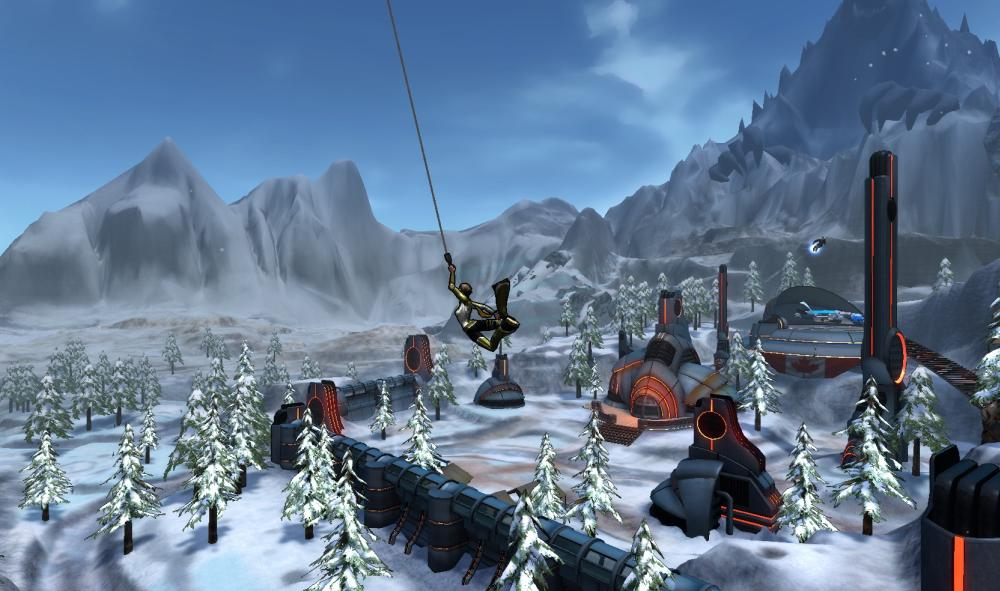
The zones would take a long time to traverse on foot, but early on you're given your choice of travel powers, which make getting from one place to another much faster. The travel powers are actually a lot of fun, in and of themselves. You can get your standard flying power, or ride a sheet of ice, or use rocket boots, but there are more entertaining options as well. You can get Superjump, which lets you literally leap tall buildings in a single bound, or Swing, which lets you shoot a grapple upwards and swing as if from vine to vine. Oftentimes you're just shooting it into the open air, so it doesn't make much sense, but that's more than made up by how fun it is.
One of the really good innovations in Champions is what they call the Powerhouse. This is where you go to buy new powers, increase your stats, and upgrade existing powers — the equivalent of a class trainer in other games. However, the Powerhouse is instanced, and it has a large testing area at the back. You can pick up your new powers, test them, and get rid of them if you don't like them. Changes aren't finalized until you leave the Powerhouse. It's great for trying out new things without worrying that they'll work poorly with your character. The game does have a re-specialization system, appropriately called "retcon," but at current it's ridiculously expensive. Recent power purchases aren't bad to change, but if you want to fix a mistake from early on (when you weren't that familiar with the game), it will likely cost you several times the wealth you've managed to accumulate.
Now, that's definitely a poor decision on Cryptic's part, but it's not as bad as it sounds. First, they've already held a post-launch dev chat, in which they said they're going to revise upward the amount of money you receive from monsters and quests. They also indicated that retcon costs would probably be lowered. What's more, they've already issued one free retcon to all characters, and said they'll likely do that whenever they make significant changes to powers in a patch. One phrase they used was "targeted retcon," which would let players freely change a power that has been modified. While I was initially displeased that I couldn't fix mistakes I made when I didn't know how the game worked, it's good to see that Cryptic is already addressing it, and on multiple fronts. That speaks well toward the long-term health of the game.
An important aspect of the game starts at level 25 when you get to create your Nemesis. This is a super villain whose plans you constantly try to thwart, and who routinely sends his minions to destroy you. It's basically an epic series of missions that happens gradually as you level up. After you tangle with him for the first time, you'll occasionally be ambushed by his henchmen when you're off doing normal missions. Sometimes when you kill the henchmen, they'll drop notes that contain information about your Nemesis' plans, which you go on a mission to disrupt. Other times, the police or NPC superheroes will call on you to stop his latest scheme. It's nicely done, and it really adds to the feel that you're doing heroic deeds and fighting complex battles.
There is less focus on gear in Champions than in most other MMOs. You have nine gear slots, and your typical item will increase your stats and and your defenses. You generally want to focus on the two "Super Stats" you select early in the leveling process, since raising those increases your damage output. There are also items with other effects; some will replace or modify your powers, adding an ancillary effect and perhaps a new graphic. Equip-able items are categorized as Arms, Mysticism, and Science — these are the three professions. Each of them has crafting and gathering aspects. Unlike most MMOs, your profession skill doesn't increase much by making things or harvesting nodes out in the wilderness. Instead, you take items you find and "research" them, breaking them down into their components. This is cool because it gives you a ton of materials to work with, and makes it easy to catch up to where your skill level is supposed to be. You don't have to make two dozen Shoulderpads of the Useless that you immediately vendor. There is virtually no "grind" to the process, which is quite nice, and you can build yourself some basic gear and useful consumables.
There's still work to be done on the game, as with any MMO launch. Pet AI isn't working right, so summoned creatures will frequently run off and attack whatever the heck they want. Several buggy missions have already been fixed, but others are still broken. PvP is dominated by a few annoying abilities; nothing you can't work around with a semi-coordinated team, but a lot of people can't rely on that. There are a few places in the game that look like they're just waiting to be populated with villains and quests; hopefully that'll happen soon to fill out the leveling process. The downside right now is that you'll frequently end up doing quests a couple levels higher than you, which give you rewards you can't use yet. Endgame doesn't have a ton of variety; that's something they'll have to address fairly soon, once a significant number of players reach the level cap.
As it stands, I think Champions Online's success will be determined by where Cryptic takes it from here. The launch is solid, there's a reasonable amount of content, and the combat is a fun break from typical MMOs. When Cryptic actively developed for City of Heroes, they released 10 expansions and City of Villains in a three-and-a-half year period. If they can roll out content on a similar scale for Champions, while staying on top of balance issues and bug fixes, it will certainly find success. As it is, it's piqued my interest. It's no WoW-killer, but it's a fun, distinct game that will carve out a niche for itself.
-
Review: Champions Online
Champions Online is Cryptic Studios' latest entry into the Superhero MMORPG genre, representing several years of advancement in game design both for Cryptic and for MMOs as a whole. It's no longer a new field, and there are now certain expectations about what an MMO should contain, and how it should play. Two major factors to a new game's success or failure are the standards they embrace and do well, and the ones they reject and do differently. Champions Online succeeds at adapting many established concepts, while still setting themselves apart from the typical swords & sorcery backdrop. Read on for the rest of my thoughts.
- Title: Champions Online
- Developer: Cryptic Studios
- Publisher: Atari
- System: PC
- Reviewer: Soulskill
- Score: 8/10
First, a disclaimer — MMOs are unlike ordinary games because active development never really stops. Bugs and gameplay issues, once identified, are almost always fixed — indeed, one of the traits that distinguishes a good MMO from a bad one is how well and how quickly the development team solves such problems. Thus, this review will not focus on the minor, easily fixable problems other than to identify them and perhaps point out what Cryptic has said about fixing them, where applicable. On to the game itself.
Champions gets off on the right foot with an excellent character creator. The depth and level of detail for all of the customization options exceeds any game I've played, and it's pretty simple to find and select the look that you want. If you're the type who enjoys making your character picture-perfect, you'll love it; matching a costume to whatever vision you have for a character is surprisingly easy. There are enough options that I really don't see any player characters who look alike — or few enough that I don't notice. It also allows the irrepressible creation of characters from other intellectual properties. It's something I've seen less and less as time passes, so I assume Cryptic is clamping down on it (as they should; Marvel already sued them for the same thing in City of Heroes), but it's occasionally hilarious to see Duke Nukem, Dr. McCoy, or a WoW Paladin out killing bad guys.
The customization continues beyond the character creator, too. Throughout the game, you accumulate various powers — these are your skills/spells/abilities, everything from laser beams to giant fiery swords to huge explosions. There are a ton of powers to choose from, and each has its own graphical effect. The nice thing is that you can modify the colors of the effect and the location from which they originate. My character's first ability had him shooting red laser pulses from his fists, which I changed to be blue lasers shooting from his eyes. It's a nice touch that allows even characters with the exact same powers to look different. Beyond that, as you go through the game you can get items that unlock more costume options.
There's a tremendous variety to the powers you can use, to the point where it's almost better to figure out what you want your character to do — drop bombs, sling ice shards, Force-choke — than to look at the abilities and figure out which are the "best." They're divided up amongst 18 different "frameworks," which are collections of similarly-themed powers. For example, the Munitions framework contains powers that involve shooting various guns, dropping mines, throwing grenades, and shooting rockets. The "Unarmed" framework holds different punch and kick attacks, and the "Fire" framework has — you guessed it — fire spells. You're not restricted to a particular framework, which is nice. You can grab all your powers from a single one, or go into a different framework for each power.
It's fun to have so many options, but almost overwhelming if you're trying to min/max your character. My recommendation would be to not worry overmuch about picking the absolute best power. With a few exceptions, they're pretty well balanced — as well as can be expected for a new MMO — and Cryptic is already making refinements. More important is to select powers that have different effects. They're divided up and labeled such that you know which are for close/ranged attacks, area effect attacks, crowd control, healing, summoning, or buffs. In many cases, it's pointless to get two of a particular effect, so you want to diversify. You get a new power every few levels, and they really add to the depth of the combat.
Your character gets stronger in other ways, as well. You get "advantages," which increase the effectiveness of your powers, but you're limited into how much you can strengthen any one ability. It's another level of customization and utility, and they make interesting changes to your powers. You're also heavily dependent on stats. They're somewhat arcane and unintuitive (Strength is obvious enough, but what would you think "Presence" does?), but you'll do fine with the understanding that you should pick two and focus on them almost exclusively, as they'll determine your damage output.
The fighting is done against individual enemies or, more often, small groups. The non-player opponents you typically fight are classified as one of the following, from easiest to hardest: Henchman, Villain, Master Villain, and Super Villain. There are also Cosmic and Legendary Villains, but those are rare, and usually require a team to defeat. A more typical group will have a cluster of Henchmen, or a couple Henchmen and a Villain. The Henchmen die in a matter of seconds, but the Villains take a bit more work. As they get more powerful, you'll have to put some thought into how you want to handle them; there's a lot of content you can solo with some strategy and perseverance. Many of the powers you use complement each other in fun and interesting ways. A lot of them have short recharge periods (cooldowns), which you can fill by using a hold (crowd control) or knocking your opponent back, which delays them for several seconds.
Combat is fairly fast-paced, and it can involve a lot of movement. It feels like a hybrid between an MMO and an action RPG. Most powers can be used while on the move, giving you the opportunity to close with your attacker or maintain range, or perhaps duck out of line-of-sight just after your ability fires. You can also Block attacks. In fact, it's crucial to block some of them. Enemies will sometimes charge up big attacks, advertised by a growing symbol over their heads. When you see this happening, stop what you're doing and block it, or expect to take some serious damage. Blocking adds more depth to the combat, but is slightly hampered by the controls.
Cryptic clearly put a lot of effort into building a good system for game controls and the UI. There are a ton of different options for movement, targeting, and camera styles; you can play it like a typical MMO, or a first-person shooter, or Cryptic's own superhero MMO concoction, and it's well implemented. Unfortunately, there's a fair bit of UI lag. Server lag has been almost non-existent — amazing as that is to say during the launch period of an MMO — but the responsiveness of the controls is probably the game's biggest technical fault right now. It can be frustrating at times to have your abilities not work as you expect because of this. There's enough of a delay after hitting the button that you won't be sure if it actually triggered the ability. Many abilities require a button to be held down, so if you press it again and then the original trigger goes through, you've wasted a cooldown. Pressing Block right after charging up a power will also sometimes clip the end of it, and cause it not to fire. I would attribute the majority of my deaths so far to the UI lag. That said, it's not game-breaking.
Quests in Champions Online are called missions. A lot of it is typical MMO fare, but not all, and the mission system is streamlined and unobtrusive. The game world has several large zones, with quest hubs scattered about them. You'll get your standard "Kill N of X" and "Collect Y of Z" missions. You'll also get quest lines that tell cool stories, if you care to read them. Cryptic has stepped up the convenience factor in a few ways. First, your map is always marked with the area you need to visit to finish the missions. In other words, no more "Head past the Valley of Ambivalence and to the northeast corner of the Forest of Mild Discomfort to slay Ted the Impaler." It's simply displayed on your map (and minimap). Finding new missions is easier, too. You can open the "Crime Computer," which will tell you where various emergencies (i.e. missions) are located, and mark those for you on the map as well.
City of Heroes veterans can rest easy; the missions are a lot better in Champions. Most of them are out in the world. Some are instanced, but there are varying objectives, and I've never been sent into the same building twice, except when it makes sense for the story. Another nice feature is that you'll occasionally stumble across a civilian being accosted by villains out in the street. If you save them, they sometimes give you a mission. You can also find missions just by moving around — as you pass by a bank that's being robbed, you'll be given a quest to stop it, without having to even talk to an NPC. There are several Open Missions in each zone, too. These are missions everybody nearby can participate in, and you get rewarded based on your level of contribution. Cryptic is still working the bugs out in a few of these, but they're fun, and they have an epic feel. You'll see even more impressive missions in dungeons and "crisis zones" — one multi-part mission has you join a team of prison guards attempting to lock down a jailbreak led by a boss with paranormal powers. You fight through levels of the dungeon, struggling to reach him, and it almost feels like playing through a section of F.E.A.R.
The open world zones are few, but large, and they contain content for multiple ranges of levels. They're divided loosely into neighborhoods, which you'll typically explore until you've exhausted all the missions (gaining a couple levels in the process), and move on to a neighborhood in a different zone. The neighborhoods all tend to tell a story, or a few related stories, which tie in to the overarching plot of the game. There are a couple smallish content gaps — early into level 31, I exhausted all available quests and had to grind out the rest of the level — but Cryptic has already acknowledged that they're pinpointing those gaps and working to fill them. My advice would be to take any mission given to you by a random citizen or object; the experience from these adds up quickly, and I probably wouldn't have been stuck if I'd spent a bit more time doing those.
The zones would take a long time to traverse on foot, but early on you're given your choice of travel powers, which make getting from one place to another much faster. The travel powers are actually a lot of fun, in and of themselves. You can get your standard flying power, or ride a sheet of ice, or use rocket boots, but there are more entertaining options as well. You can get Superjump, which lets you literally leap tall buildings in a single bound, or Swing, which lets you shoot a grapple upwards and swing as if from vine to vine. Oftentimes you're just shooting it into the open air, so it doesn't make much sense, but that's more than made up by how fun it is.
One of the really good innovations in Champions is what they call the Powerhouse. This is where you go to buy new powers, increase your stats, and upgrade existing powers — the equivalent of a class trainer in other games. However, the Powerhouse is instanced, and it has a large testing area at the back. You can pick up your new powers, test them, and get rid of them if you don't like them. Changes aren't finalized until you leave the Powerhouse. It's great for trying out new things without worrying that they'll work poorly with your character. The game does have a re-specialization system, appropriately called "retcon," but at current it's ridiculously expensive. Recent power purchases aren't bad to change, but if you want to fix a mistake from early on (when you weren't that familiar with the game), it will likely cost you several times the wealth you've managed to accumulate.
Now, that's definitely a poor decision on Cryptic's part, but it's not as bad as it sounds. First, they've already held a post-launch dev chat, in which they said they're going to revise upward the amount of money you receive from monsters and quests. They also indicated that retcon costs would probably be lowered. What's more, they've already issued one free retcon to all characters, and said they'll likely do that whenever they make significant changes to powers in a patch. One phrase they used was "targeted retcon," which would let players freely change a power that has been modified. While I was initially displeased that I couldn't fix mistakes I made when I didn't know how the game worked, it's good to see that Cryptic is already addressing it, and on multiple fronts. That speaks well toward the long-term health of the game.
An important aspect of the game starts at level 25 when you get to create your Nemesis. This is a super villain whose plans you constantly try to thwart, and who routinely sends his minions to destroy you. It's basically an epic series of missions that happens gradually as you level up. After you tangle with him for the first time, you'll occasionally be ambushed by his henchmen when you're off doing normal missions. Sometimes when you kill the henchmen, they'll drop notes that contain information about your Nemesis' plans, which you go on a mission to disrupt. Other times, the police or NPC superheroes will call on you to stop his latest scheme. It's nicely done, and it really adds to the feel that you're doing heroic deeds and fighting complex battles.
There is less focus on gear in Champions than in most other MMOs. You have nine gear slots, and your typical item will increase your stats and and your defenses. You generally want to focus on the two "Super Stats" you select early in the leveling process, since raising those increases your damage output. There are also items with other effects; some will replace or modify your powers, adding an ancillary effect and perhaps a new graphic. Equip-able items are categorized as Arms, Mysticism, and Science — these are the three professions. Each of them has crafting and gathering aspects. Unlike most MMOs, your profession skill doesn't increase much by making things or harvesting nodes out in the wilderness. Instead, you take items you find and "research" them, breaking them down into their components. This is cool because it gives you a ton of materials to work with, and makes it easy to catch up to where your skill level is supposed to be. You don't have to make two dozen Shoulderpads of the Useless that you immediately vendor. There is virtually no "grind" to the process, which is quite nice, and you can build yourself some basic gear and useful consumables.
There's still work to be done on the game, as with any MMO launch. Pet AI isn't working right, so summoned creatures will frequently run off and attack whatever the heck they want. Several buggy missions have already been fixed, but others are still broken. PvP is dominated by a few annoying abilities; nothing you can't work around with a semi-coordinated team, but a lot of people can't rely on that. There are a few places in the game that look like they're just waiting to be populated with villains and quests; hopefully that'll happen soon to fill out the leveling process. The downside right now is that you'll frequently end up doing quests a couple levels higher than you, which give you rewards you can't use yet. Endgame doesn't have a ton of variety; that's something they'll have to address fairly soon, once a significant number of players reach the level cap.
As it stands, I think Champions Online's success will be determined by where Cryptic takes it from here. The launch is solid, there's a reasonable amount of content, and the combat is a fun break from typical MMOs. When Cryptic actively developed for City of Heroes, they released 10 expansions and City of Villains in a three-and-a-half year period. If they can roll out content on a similar scale for Champions, while staying on top of balance issues and bug fixes, it will certainly find success. As it is, it's piqued my interest. It's no WoW-killer, but it's a fun, distinct game that will carve out a niche for itself.
-
Review: Champions Online
Champions Online is Cryptic Studios' latest entry into the Superhero MMORPG genre, representing several years of advancement in game design both for Cryptic and for MMOs as a whole. It's no longer a new field, and there are now certain expectations about what an MMO should contain, and how it should play. Two major factors to a new game's success or failure are the standards they embrace and do well, and the ones they reject and do differently. Champions Online succeeds at adapting many established concepts, while still setting themselves apart from the typical swords & sorcery backdrop. Read on for the rest of my thoughts.
- Title: Champions Online
- Developer: Cryptic Studios
- Publisher: Atari
- System: PC
- Reviewer: Soulskill
- Score: 8/10
First, a disclaimer — MMOs are unlike ordinary games because active development never really stops. Bugs and gameplay issues, once identified, are almost always fixed — indeed, one of the traits that distinguishes a good MMO from a bad one is how well and how quickly the development team solves such problems. Thus, this review will not focus on the minor, easily fixable problems other than to identify them and perhaps point out what Cryptic has said about fixing them, where applicable. On to the game itself.
Champions gets off on the right foot with an excellent character creator. The depth and level of detail for all of the customization options exceeds any game I've played, and it's pretty simple to find and select the look that you want. If you're the type who enjoys making your character picture-perfect, you'll love it; matching a costume to whatever vision you have for a character is surprisingly easy. There are enough options that I really don't see any player characters who look alike — or few enough that I don't notice. It also allows the irrepressible creation of characters from other intellectual properties. It's something I've seen less and less as time passes, so I assume Cryptic is clamping down on it (as they should; Marvel already sued them for the same thing in City of Heroes), but it's occasionally hilarious to see Duke Nukem, Dr. McCoy, or a WoW Paladin out killing bad guys.
The customization continues beyond the character creator, too. Throughout the game, you accumulate various powers — these are your skills/spells/abilities, everything from laser beams to giant fiery swords to huge explosions. There are a ton of powers to choose from, and each has its own graphical effect. The nice thing is that you can modify the colors of the effect and the location from which they originate. My character's first ability had him shooting red laser pulses from his fists, which I changed to be blue lasers shooting from his eyes. It's a nice touch that allows even characters with the exact same powers to look different. Beyond that, as you go through the game you can get items that unlock more costume options.
There's a tremendous variety to the powers you can use, to the point where it's almost better to figure out what you want your character to do — drop bombs, sling ice shards, Force-choke — than to look at the abilities and figure out which are the "best." They're divided up amongst 18 different "frameworks," which are collections of similarly-themed powers. For example, the Munitions framework contains powers that involve shooting various guns, dropping mines, throwing grenades, and shooting rockets. The "Unarmed" framework holds different punch and kick attacks, and the "Fire" framework has — you guessed it — fire spells. You're not restricted to a particular framework, which is nice. You can grab all your powers from a single one, or go into a different framework for each power.
It's fun to have so many options, but almost overwhelming if you're trying to min/max your character. My recommendation would be to not worry overmuch about picking the absolute best power. With a few exceptions, they're pretty well balanced — as well as can be expected for a new MMO — and Cryptic is already making refinements. More important is to select powers that have different effects. They're divided up and labeled such that you know which are for close/ranged attacks, area effect attacks, crowd control, healing, summoning, or buffs. In many cases, it's pointless to get two of a particular effect, so you want to diversify. You get a new power every few levels, and they really add to the depth of the combat.
Your character gets stronger in other ways, as well. You get "advantages," which increase the effectiveness of your powers, but you're limited into how much you can strengthen any one ability. It's another level of customization and utility, and they make interesting changes to your powers. You're also heavily dependent on stats. They're somewhat arcane and unintuitive (Strength is obvious enough, but what would you think "Presence" does?), but you'll do fine with the understanding that you should pick two and focus on them almost exclusively, as they'll determine your damage output.
The fighting is done against individual enemies or, more often, small groups. The non-player opponents you typically fight are classified as one of the following, from easiest to hardest: Henchman, Villain, Master Villain, and Super Villain. There are also Cosmic and Legendary Villains, but those are rare, and usually require a team to defeat. A more typical group will have a cluster of Henchmen, or a couple Henchmen and a Villain. The Henchmen die in a matter of seconds, but the Villains take a bit more work. As they get more powerful, you'll have to put some thought into how you want to handle them; there's a lot of content you can solo with some strategy and perseverance. Many of the powers you use complement each other in fun and interesting ways. A lot of them have short recharge periods (cooldowns), which you can fill by using a hold (crowd control) or knocking your opponent back, which delays them for several seconds.
Combat is fairly fast-paced, and it can involve a lot of movement. It feels like a hybrid between an MMO and an action RPG. Most powers can be used while on the move, giving you the opportunity to close with your attacker or maintain range, or perhaps duck out of line-of-sight just after your ability fires. You can also Block attacks. In fact, it's crucial to block some of them. Enemies will sometimes charge up big attacks, advertised by a growing symbol over their heads. When you see this happening, stop what you're doing and block it, or expect to take some serious damage. Blocking adds more depth to the combat, but is slightly hampered by the controls.
Cryptic clearly put a lot of effort into building a good system for game controls and the UI. There are a ton of different options for movement, targeting, and camera styles; you can play it like a typical MMO, or a first-person shooter, or Cryptic's own superhero MMO concoction, and it's well implemented. Unfortunately, there's a fair bit of UI lag. Server lag has been almost non-existent — amazing as that is to say during the launch period of an MMO — but the responsiveness of the controls is probably the game's biggest technical fault right now. It can be frustrating at times to have your abilities not work as you expect because of this. There's enough of a delay after hitting the button that you won't be sure if it actually triggered the ability. Many abilities require a button to be held down, so if you press it again and then the original trigger goes through, you've wasted a cooldown. Pressing Block right after charging up a power will also sometimes clip the end of it, and cause it not to fire. I would attribute the majority of my deaths so far to the UI lag. That said, it's not game-breaking.
Quests in Champions Online are called missions. A lot of it is typical MMO fare, but not all, and the mission system is streamlined and unobtrusive. The game world has several large zones, with quest hubs scattered about them. You'll get your standard "Kill N of X" and "Collect Y of Z" missions. You'll also get quest lines that tell cool stories, if you care to read them. Cryptic has stepped up the convenience factor in a few ways. First, your map is always marked with the area you need to visit to finish the missions. In other words, no more "Head past the Valley of Ambivalence and to the northeast corner of the Forest of Mild Discomfort to slay Ted the Impaler." It's simply displayed on your map (and minimap). Finding new missions is easier, too. You can open the "Crime Computer," which will tell you where various emergencies (i.e. missions) are located, and mark those for you on the map as well.
City of Heroes veterans can rest easy; the missions are a lot better in Champions. Most of them are out in the world. Some are instanced, but there are varying objectives, and I've never been sent into the same building twice, except when it makes sense for the story. Another nice feature is that you'll occasionally stumble across a civilian being accosted by villains out in the street. If you save them, they sometimes give you a mission. You can also find missions just by moving around — as you pass by a bank that's being robbed, you'll be given a quest to stop it, without having to even talk to an NPC. There are several Open Missions in each zone, too. These are missions everybody nearby can participate in, and you get rewarded based on your level of contribution. Cryptic is still working the bugs out in a few of these, but they're fun, and they have an epic feel. You'll see even more impressive missions in dungeons and "crisis zones" — one multi-part mission has you join a team of prison guards attempting to lock down a jailbreak led by a boss with paranormal powers. You fight through levels of the dungeon, struggling to reach him, and it almost feels like playing through a section of F.E.A.R.
The open world zones are few, but large, and they contain content for multiple ranges of levels. They're divided loosely into neighborhoods, which you'll typically explore until you've exhausted all the missions (gaining a couple levels in the process), and move on to a neighborhood in a different zone. The neighborhoods all tend to tell a story, or a few related stories, which tie in to the overarching plot of the game. There are a couple smallish content gaps — early into level 31, I exhausted all available quests and had to grind out the rest of the level — but Cryptic has already acknowledged that they're pinpointing those gaps and working to fill them. My advice would be to take any mission given to you by a random citizen or object; the experience from these adds up quickly, and I probably wouldn't have been stuck if I'd spent a bit more time doing those.
The zones would take a long time to traverse on foot, but early on you're given your choice of travel powers, which make getting from one place to another much faster. The travel powers are actually a lot of fun, in and of themselves. You can get your standard flying power, or ride a sheet of ice, or use rocket boots, but there are more entertaining options as well. You can get Superjump, which lets you literally leap tall buildings in a single bound, or Swing, which lets you shoot a grapple upwards and swing as if from vine to vine. Oftentimes you're just shooting it into the open air, so it doesn't make much sense, but that's more than made up by how fun it is.
One of the really good innovations in Champions is what they call the Powerhouse. This is where you go to buy new powers, increase your stats, and upgrade existing powers — the equivalent of a class trainer in other games. However, the Powerhouse is instanced, and it has a large testing area at the back. You can pick up your new powers, test them, and get rid of them if you don't like them. Changes aren't finalized until you leave the Powerhouse. It's great for trying out new things without worrying that they'll work poorly with your character. The game does have a re-specialization system, appropriately called "retcon," but at current it's ridiculously expensive. Recent power purchases aren't bad to change, but if you want to fix a mistake from early on (when you weren't that familiar with the game), it will likely cost you several times the wealth you've managed to accumulate.
Now, that's definitely a poor decision on Cryptic's part, but it's not as bad as it sounds. First, they've already held a post-launch dev chat, in which they said they're going to revise upward the amount of money you receive from monsters and quests. They also indicated that retcon costs would probably be lowered. What's more, they've already issued one free retcon to all characters, and said they'll likely do that whenever they make significant changes to powers in a patch. One phrase they used was "targeted retcon," which would let players freely change a power that has been modified. While I was initially displeased that I couldn't fix mistakes I made when I didn't know how the game worked, it's good to see that Cryptic is already addressing it, and on multiple fronts. That speaks well toward the long-term health of the game.
An important aspect of the game starts at level 25 when you get to create your Nemesis. This is a super villain whose plans you constantly try to thwart, and who routinely sends his minions to destroy you. It's basically an epic series of missions that happens gradually as you level up. After you tangle with him for the first time, you'll occasionally be ambushed by his henchmen when you're off doing normal missions. Sometimes when you kill the henchmen, they'll drop notes that contain information about your Nemesis' plans, which you go on a mission to disrupt. Other times, the police or NPC superheroes will call on you to stop his latest scheme. It's nicely done, and it really adds to the feel that you're doing heroic deeds and fighting complex battles.
There is less focus on gear in Champions than in most other MMOs. You have nine gear slots, and your typical item will increase your stats and and your defenses. You generally want to focus on the two "Super Stats" you select early in the leveling process, since raising those increases your damage output. There are also items with other effects; some will replace or modify your powers, adding an ancillary effect and perhaps a new graphic. Equip-able items are categorized as Arms, Mysticism, and Science — these are the three professions. Each of them has crafting and gathering aspects. Unlike most MMOs, your profession skill doesn't increase much by making things or harvesting nodes out in the wilderness. Instead, you take items you find and "research" them, breaking them down into their components. This is cool because it gives you a ton of materials to work with, and makes it easy to catch up to where your skill level is supposed to be. You don't have to make two dozen Shoulderpads of the Useless that you immediately vendor. There is virtually no "grind" to the process, which is quite nice, and you can build yourself some basic gear and useful consumables.
There's still work to be done on the game, as with any MMO launch. Pet AI isn't working right, so summoned creatures will frequently run off and attack whatever the heck they want. Several buggy missions have already been fixed, but others are still broken. PvP is dominated by a few annoying abilities; nothing you can't work around with a semi-coordinated team, but a lot of people can't rely on that. There are a few places in the game that look like they're just waiting to be populated with villains and quests; hopefully that'll happen soon to fill out the leveling process. The downside right now is that you'll frequently end up doing quests a couple levels higher than you, which give you rewards you can't use yet. Endgame doesn't have a ton of variety; that's something they'll have to address fairly soon, once a significant number of players reach the level cap.
As it stands, I think Champions Online's success will be determined by where Cryptic takes it from here. The launch is solid, there's a reasonable amount of content, and the combat is a fun break from typical MMOs. When Cryptic actively developed for City of Heroes, they released 10 expansions and City of Villains in a three-and-a-half year period. If they can roll out content on a similar scale for Champions, while staying on top of balance issues and bug fixes, it will certainly find success. As it is, it's piqued my interest. It's no WoW-killer, but it's a fun, distinct game that will carve out a niche for itself.
-
Review: Champions Online
Champions Online is Cryptic Studios' latest entry into the Superhero MMORPG genre, representing several years of advancement in game design both for Cryptic and for MMOs as a whole. It's no longer a new field, and there are now certain expectations about what an MMO should contain, and how it should play. Two major factors to a new game's success or failure are the standards they embrace and do well, and the ones they reject and do differently. Champions Online succeeds at adapting many established concepts, while still setting themselves apart from the typical swords & sorcery backdrop. Read on for the rest of my thoughts.
- Title: Champions Online
- Developer: Cryptic Studios
- Publisher: Atari
- System: PC
- Reviewer: Soulskill
- Score: 8/10
First, a disclaimer — MMOs are unlike ordinary games because active development never really stops. Bugs and gameplay issues, once identified, are almost always fixed — indeed, one of the traits that distinguishes a good MMO from a bad one is how well and how quickly the development team solves such problems. Thus, this review will not focus on the minor, easily fixable problems other than to identify them and perhaps point out what Cryptic has said about fixing them, where applicable. On to the game itself.
Champions gets off on the right foot with an excellent character creator. The depth and level of detail for all of the customization options exceeds any game I've played, and it's pretty simple to find and select the look that you want. If you're the type who enjoys making your character picture-perfect, you'll love it; matching a costume to whatever vision you have for a character is surprisingly easy. There are enough options that I really don't see any player characters who look alike — or few enough that I don't notice. It also allows the irrepressible creation of characters from other intellectual properties. It's something I've seen less and less as time passes, so I assume Cryptic is clamping down on it (as they should; Marvel already sued them for the same thing in City of Heroes), but it's occasionally hilarious to see Duke Nukem, Dr. McCoy, or a WoW Paladin out killing bad guys.
The customization continues beyond the character creator, too. Throughout the game, you accumulate various powers — these are your skills/spells/abilities, everything from laser beams to giant fiery swords to huge explosions. There are a ton of powers to choose from, and each has its own graphical effect. The nice thing is that you can modify the colors of the effect and the location from which they originate. My character's first ability had him shooting red laser pulses from his fists, which I changed to be blue lasers shooting from his eyes. It's a nice touch that allows even characters with the exact same powers to look different. Beyond that, as you go through the game you can get items that unlock more costume options.
There's a tremendous variety to the powers you can use, to the point where it's almost better to figure out what you want your character to do — drop bombs, sling ice shards, Force-choke — than to look at the abilities and figure out which are the "best." They're divided up amongst 18 different "frameworks," which are collections of similarly-themed powers. For example, the Munitions framework contains powers that involve shooting various guns, dropping mines, throwing grenades, and shooting rockets. The "Unarmed" framework holds different punch and kick attacks, and the "Fire" framework has — you guessed it — fire spells. You're not restricted to a particular framework, which is nice. You can grab all your powers from a single one, or go into a different framework for each power.
It's fun to have so many options, but almost overwhelming if you're trying to min/max your character. My recommendation would be to not worry overmuch about picking the absolute best power. With a few exceptions, they're pretty well balanced — as well as can be expected for a new MMO — and Cryptic is already making refinements. More important is to select powers that have different effects. They're divided up and labeled such that you know which are for close/ranged attacks, area effect attacks, crowd control, healing, summoning, or buffs. In many cases, it's pointless to get two of a particular effect, so you want to diversify. You get a new power every few levels, and they really add to the depth of the combat.
Your character gets stronger in other ways, as well. You get "advantages," which increase the effectiveness of your powers, but you're limited into how much you can strengthen any one ability. It's another level of customization and utility, and they make interesting changes to your powers. You're also heavily dependent on stats. They're somewhat arcane and unintuitive (Strength is obvious enough, but what would you think "Presence" does?), but you'll do fine with the understanding that you should pick two and focus on them almost exclusively, as they'll determine your damage output.
The fighting is done against individual enemies or, more often, small groups. The non-player opponents you typically fight are classified as one of the following, from easiest to hardest: Henchman, Villain, Master Villain, and Super Villain. There are also Cosmic and Legendary Villains, but those are rare, and usually require a team to defeat. A more typical group will have a cluster of Henchmen, or a couple Henchmen and a Villain. The Henchmen die in a matter of seconds, but the Villains take a bit more work. As they get more powerful, you'll have to put some thought into how you want to handle them; there's a lot of content you can solo with some strategy and perseverance. Many of the powers you use complement each other in fun and interesting ways. A lot of them have short recharge periods (cooldowns), which you can fill by using a hold (crowd control) or knocking your opponent back, which delays them for several seconds.
Combat is fairly fast-paced, and it can involve a lot of movement. It feels like a hybrid between an MMO and an action RPG. Most powers can be used while on the move, giving you the opportunity to close with your attacker or maintain range, or perhaps duck out of line-of-sight just after your ability fires. You can also Block attacks. In fact, it's crucial to block some of them. Enemies will sometimes charge up big attacks, advertised by a growing symbol over their heads. When you see this happening, stop what you're doing and block it, or expect to take some serious damage. Blocking adds more depth to the combat, but is slightly hampered by the controls.
Cryptic clearly put a lot of effort into building a good system for game controls and the UI. There are a ton of different options for movement, targeting, and camera styles; you can play it like a typical MMO, or a first-person shooter, or Cryptic's own superhero MMO concoction, and it's well implemented. Unfortunately, there's a fair bit of UI lag. Server lag has been almost non-existent — amazing as that is to say during the launch period of an MMO — but the responsiveness of the controls is probably the game's biggest technical fault right now. It can be frustrating at times to have your abilities not work as you expect because of this. There's enough of a delay after hitting the button that you won't be sure if it actually triggered the ability. Many abilities require a button to be held down, so if you press it again and then the original trigger goes through, you've wasted a cooldown. Pressing Block right after charging up a power will also sometimes clip the end of it, and cause it not to fire. I would attribute the majority of my deaths so far to the UI lag. That said, it's not game-breaking.
Quests in Champions Online are called missions. A lot of it is typical MMO fare, but not all, and the mission system is streamlined and unobtrusive. The game world has several large zones, with quest hubs scattered about them. You'll get your standard "Kill N of X" and "Collect Y of Z" missions. You'll also get quest lines that tell cool stories, if you care to read them. Cryptic has stepped up the convenience factor in a few ways. First, your map is always marked with the area you need to visit to finish the missions. In other words, no more "Head past the Valley of Ambivalence and to the northeast corner of the Forest of Mild Discomfort to slay Ted the Impaler." It's simply displayed on your map (and minimap). Finding new missions is easier, too. You can open the "Crime Computer," which will tell you where various emergencies (i.e. missions) are located, and mark those for you on the map as well.
City of Heroes veterans can rest easy; the missions are a lot better in Champions. Most of them are out in the world. Some are instanced, but there are varying objectives, and I've never been sent into the same building twice, except when it makes sense for the story. Another nice feature is that you'll occasionally stumble across a civilian being accosted by villains out in the street. If you save them, they sometimes give you a mission. You can also find missions just by moving around — as you pass by a bank that's being robbed, you'll be given a quest to stop it, without having to even talk to an NPC. There are several Open Missions in each zone, too. These are missions everybody nearby can participate in, and you get rewarded based on your level of contribution. Cryptic is still working the bugs out in a few of these, but they're fun, and they have an epic feel. You'll see even more impressive missions in dungeons and "crisis zones" — one multi-part mission has you join a team of prison guards attempting to lock down a jailbreak led by a boss with paranormal powers. You fight through levels of the dungeon, struggling to reach him, and it almost feels like playing through a section of F.E.A.R.
The open world zones are few, but large, and they contain content for multiple ranges of levels. They're divided loosely into neighborhoods, which you'll typically explore until you've exhausted all the missions (gaining a couple levels in the process), and move on to a neighborhood in a different zone. The neighborhoods all tend to tell a story, or a few related stories, which tie in to the overarching plot of the game. There are a couple smallish content gaps — early into level 31, I exhausted all available quests and had to grind out the rest of the level — but Cryptic has already acknowledged that they're pinpointing those gaps and working to fill them. My advice would be to take any mission given to you by a random citizen or object; the experience from these adds up quickly, and I probably wouldn't have been stuck if I'd spent a bit more time doing those.
The zones would take a long time to traverse on foot, but early on you're given your choice of travel powers, which make getting from one place to another much faster. The travel powers are actually a lot of fun, in and of themselves. You can get your standard flying power, or ride a sheet of ice, or use rocket boots, but there are more entertaining options as well. You can get Superjump, which lets you literally leap tall buildings in a single bound, or Swing, which lets you shoot a grapple upwards and swing as if from vine to vine. Oftentimes you're just shooting it into the open air, so it doesn't make much sense, but that's more than made up by how fun it is.
One of the really good innovations in Champions is what they call the Powerhouse. This is where you go to buy new powers, increase your stats, and upgrade existing powers — the equivalent of a class trainer in other games. However, the Powerhouse is instanced, and it has a large testing area at the back. You can pick up your new powers, test them, and get rid of them if you don't like them. Changes aren't finalized until you leave the Powerhouse. It's great for trying out new things without worrying that they'll work poorly with your character. The game does have a re-specialization system, appropriately called "retcon," but at current it's ridiculously expensive. Recent power purchases aren't bad to change, but if you want to fix a mistake from early on (when you weren't that familiar with the game), it will likely cost you several times the wealth you've managed to accumulate.
Now, that's definitely a poor decision on Cryptic's part, but it's not as bad as it sounds. First, they've already held a post-launch dev chat, in which they said they're going to revise upward the amount of money you receive from monsters and quests. They also indicated that retcon costs would probably be lowered. What's more, they've already issued one free retcon to all characters, and said they'll likely do that whenever they make significant changes to powers in a patch. One phrase they used was "targeted retcon," which would let players freely change a power that has been modified. While I was initially displeased that I couldn't fix mistakes I made when I didn't know how the game worked, it's good to see that Cryptic is already addressing it, and on multiple fronts. That speaks well toward the long-term health of the game.
An important aspect of the game starts at level 25 when you get to create your Nemesis. This is a super villain whose plans you constantly try to thwart, and who routinely sends his minions to destroy you. It's basically an epic series of missions that happens gradually as you level up. After you tangle with him for the first time, you'll occasionally be ambushed by his henchmen when you're off doing normal missions. Sometimes when you kill the henchmen, they'll drop notes that contain information about your Nemesis' plans, which you go on a mission to disrupt. Other times, the police or NPC superheroes will call on you to stop his latest scheme. It's nicely done, and it really adds to the feel that you're doing heroic deeds and fighting complex battles.
There is less focus on gear in Champions than in most other MMOs. You have nine gear slots, and your typical item will increase your stats and and your defenses. You generally want to focus on the two "Super Stats" you select early in the leveling process, since raising those increases your damage output. There are also items with other effects; some will replace or modify your powers, adding an ancillary effect and perhaps a new graphic. Equip-able items are categorized as Arms, Mysticism, and Science — these are the three professions. Each of them has crafting and gathering aspects. Unlike most MMOs, your profession skill doesn't increase much by making things or harvesting nodes out in the wilderness. Instead, you take items you find and "research" them, breaking them down into their components. This is cool because it gives you a ton of materials to work with, and makes it easy to catch up to where your skill level is supposed to be. You don't have to make two dozen Shoulderpads of the Useless that you immediately vendor. There is virtually no "grind" to the process, which is quite nice, and you can build yourself some basic gear and useful consumables.
There's still work to be done on the game, as with any MMO launch. Pet AI isn't working right, so summoned creatures will frequently run off and attack whatever the heck they want. Several buggy missions have already been fixed, but others are still broken. PvP is dominated by a few annoying abilities; nothing you can't work around with a semi-coordinated team, but a lot of people can't rely on that. There are a few places in the game that look like they're just waiting to be populated with villains and quests; hopefully that'll happen soon to fill out the leveling process. The downside right now is that you'll frequently end up doing quests a couple levels higher than you, which give you rewards you can't use yet. Endgame doesn't have a ton of variety; that's something they'll have to address fairly soon, once a significant number of players reach the level cap.
As it stands, I think Champions Online's success will be determined by where Cryptic takes it from here. The launch is solid, there's a reasonable amount of content, and the combat is a fun break from typical MMOs. When Cryptic actively developed for City of Heroes, they released 10 expansions and City of Villains in a three-and-a-half year period. If they can roll out content on a similar scale for Champions, while staying on top of balance issues and bug fixes, it will certainly find success. As it is, it's piqued my interest. It's no WoW-killer, but it's a fun, distinct game that will carve out a niche for itself.
-
Review: Champions Online
Champions Online is Cryptic Studios' latest entry into the Superhero MMORPG genre, representing several years of advancement in game design both for Cryptic and for MMOs as a whole. It's no longer a new field, and there are now certain expectations about what an MMO should contain, and how it should play. Two major factors to a new game's success or failure are the standards they embrace and do well, and the ones they reject and do differently. Champions Online succeeds at adapting many established concepts, while still setting themselves apart from the typical swords & sorcery backdrop. Read on for the rest of my thoughts.
- Title: Champions Online
- Developer: Cryptic Studios
- Publisher: Atari
- System: PC
- Reviewer: Soulskill
- Score: 8/10
First, a disclaimer — MMOs are unlike ordinary games because active development never really stops. Bugs and gameplay issues, once identified, are almost always fixed — indeed, one of the traits that distinguishes a good MMO from a bad one is how well and how quickly the development team solves such problems. Thus, this review will not focus on the minor, easily fixable problems other than to identify them and perhaps point out what Cryptic has said about fixing them, where applicable. On to the game itself.
Champions gets off on the right foot with an excellent character creator. The depth and level of detail for all of the customization options exceeds any game I've played, and it's pretty simple to find and select the look that you want. If you're the type who enjoys making your character picture-perfect, you'll love it; matching a costume to whatever vision you have for a character is surprisingly easy. There are enough options that I really don't see any player characters who look alike — or few enough that I don't notice. It also allows the irrepressible creation of characters from other intellectual properties. It's something I've seen less and less as time passes, so I assume Cryptic is clamping down on it (as they should; Marvel already sued them for the same thing in City of Heroes), but it's occasionally hilarious to see Duke Nukem, Dr. McCoy, or a WoW Paladin out killing bad guys.
The customization continues beyond the character creator, too. Throughout the game, you accumulate various powers — these are your skills/spells/abilities, everything from laser beams to giant fiery swords to huge explosions. There are a ton of powers to choose from, and each has its own graphical effect. The nice thing is that you can modify the colors of the effect and the location from which they originate. My character's first ability had him shooting red laser pulses from his fists, which I changed to be blue lasers shooting from his eyes. It's a nice touch that allows even characters with the exact same powers to look different. Beyond that, as you go through the game you can get items that unlock more costume options.
There's a tremendous variety to the powers you can use, to the point where it's almost better to figure out what you want your character to do — drop bombs, sling ice shards, Force-choke — than to look at the abilities and figure out which are the "best." They're divided up amongst 18 different "frameworks," which are collections of similarly-themed powers. For example, the Munitions framework contains powers that involve shooting various guns, dropping mines, throwing grenades, and shooting rockets. The "Unarmed" framework holds different punch and kick attacks, and the "Fire" framework has — you guessed it — fire spells. You're not restricted to a particular framework, which is nice. You can grab all your powers from a single one, or go into a different framework for each power.
It's fun to have so many options, but almost overwhelming if you're trying to min/max your character. My recommendation would be to not worry overmuch about picking the absolute best power. With a few exceptions, they're pretty well balanced — as well as can be expected for a new MMO — and Cryptic is already making refinements. More important is to select powers that have different effects. They're divided up and labeled such that you know which are for close/ranged attacks, area effect attacks, crowd control, healing, summoning, or buffs. In many cases, it's pointless to get two of a particular effect, so you want to diversify. You get a new power every few levels, and they really add to the depth of the combat.
Your character gets stronger in other ways, as well. You get "advantages," which increase the effectiveness of your powers, but you're limited into how much you can strengthen any one ability. It's another level of customization and utility, and they make interesting changes to your powers. You're also heavily dependent on stats. They're somewhat arcane and unintuitive (Strength is obvious enough, but what would you think "Presence" does?), but you'll do fine with the understanding that you should pick two and focus on them almost exclusively, as they'll determine your damage output.
The fighting is done against individual enemies or, more often, small groups. The non-player opponents you typically fight are classified as one of the following, from easiest to hardest: Henchman, Villain, Master Villain, and Super Villain. There are also Cosmic and Legendary Villains, but those are rare, and usually require a team to defeat. A more typical group will have a cluster of Henchmen, or a couple Henchmen and a Villain. The Henchmen die in a matter of seconds, but the Villains take a bit more work. As they get more powerful, you'll have to put some thought into how you want to handle them; there's a lot of content you can solo with some strategy and perseverance. Many of the powers you use complement each other in fun and interesting ways. A lot of them have short recharge periods (cooldowns), which you can fill by using a hold (crowd control) or knocking your opponent back, which delays them for several seconds.
Combat is fairly fast-paced, and it can involve a lot of movement. It feels like a hybrid between an MMO and an action RPG. Most powers can be used while on the move, giving you the opportunity to close with your attacker or maintain range, or perhaps duck out of line-of-sight just after your ability fires. You can also Block attacks. In fact, it's crucial to block some of them. Enemies will sometimes charge up big attacks, advertised by a growing symbol over their heads. When you see this happening, stop what you're doing and block it, or expect to take some serious damage. Blocking adds more depth to the combat, but is slightly hampered by the controls.
Cryptic clearly put a lot of effort into building a good system for game controls and the UI. There are a ton of different options for movement, targeting, and camera styles; you can play it like a typical MMO, or a first-person shooter, or Cryptic's own superhero MMO concoction, and it's well implemented. Unfortunately, there's a fair bit of UI lag. Server lag has been almost non-existent — amazing as that is to say during the launch period of an MMO — but the responsiveness of the controls is probably the game's biggest technical fault right now. It can be frustrating at times to have your abilities not work as you expect because of this. There's enough of a delay after hitting the button that you won't be sure if it actually triggered the ability. Many abilities require a button to be held down, so if you press it again and then the original trigger goes through, you've wasted a cooldown. Pressing Block right after charging up a power will also sometimes clip the end of it, and cause it not to fire. I would attribute the majority of my deaths so far to the UI lag. That said, it's not game-breaking.
Quests in Champions Online are called missions. A lot of it is typical MMO fare, but not all, and the mission system is streamlined and unobtrusive. The game world has several large zones, with quest hubs scattered about them. You'll get your standard "Kill N of X" and "Collect Y of Z" missions. You'll also get quest lines that tell cool stories, if you care to read them. Cryptic has stepped up the convenience factor in a few ways. First, your map is always marked with the area you need to visit to finish the missions. In other words, no more "Head past the Valley of Ambivalence and to the northeast corner of the Forest of Mild Discomfort to slay Ted the Impaler." It's simply displayed on your map (and minimap). Finding new missions is easier, too. You can open the "Crime Computer," which will tell you where various emergencies (i.e. missions) are located, and mark those for you on the map as well.
City of Heroes veterans can rest easy; the missions are a lot better in Champions. Most of them are out in the world. Some are instanced, but there are varying objectives, and I've never been sent into the same building twice, except when it makes sense for the story. Another nice feature is that you'll occasionally stumble across a civilian being accosted by villains out in the street. If you save them, they sometimes give you a mission. You can also find missions just by moving around — as you pass by a bank that's being robbed, you'll be given a quest to stop it, without having to even talk to an NPC. There are several Open Missions in each zone, too. These are missions everybody nearby can participate in, and you get rewarded based on your level of contribution. Cryptic is still working the bugs out in a few of these, but they're fun, and they have an epic feel. You'll see even more impressive missions in dungeons and "crisis zones" — one multi-part mission has you join a team of prison guards attempting to lock down a jailbreak led by a boss with paranormal powers. You fight through levels of the dungeon, struggling to reach him, and it almost feels like playing through a section of F.E.A.R.
The open world zones are few, but large, and they contain content for multiple ranges of levels. They're divided loosely into neighborhoods, which you'll typically explore until you've exhausted all the missions (gaining a couple levels in the process), and move on to a neighborhood in a different zone. The neighborhoods all tend to tell a story, or a few related stories, which tie in to the overarching plot of the game. There are a couple smallish content gaps — early into level 31, I exhausted all available quests and had to grind out the rest of the level — but Cryptic has already acknowledged that they're pinpointing those gaps and working to fill them. My advice would be to take any mission given to you by a random citizen or object; the experience from these adds up quickly, and I probably wouldn't have been stuck if I'd spent a bit more time doing those.
The zones would take a long time to traverse on foot, but early on you're given your choice of travel powers, which make getting from one place to another much faster. The travel powers are actually a lot of fun, in and of themselves. You can get your standard flying power, or ride a sheet of ice, or use rocket boots, but there are more entertaining options as well. You can get Superjump, which lets you literally leap tall buildings in a single bound, or Swing, which lets you shoot a grapple upwards and swing as if from vine to vine. Oftentimes you're just shooting it into the open air, so it doesn't make much sense, but that's more than made up by how fun it is.
One of the really good innovations in Champions is what they call the Powerhouse. This is where you go to buy new powers, increase your stats, and upgrade existing powers — the equivalent of a class trainer in other games. However, the Powerhouse is instanced, and it has a large testing area at the back. You can pick up your new powers, test them, and get rid of them if you don't like them. Changes aren't finalized until you leave the Powerhouse. It's great for trying out new things without worrying that they'll work poorly with your character. The game does have a re-specialization system, appropriately called "retcon," but at current it's ridiculously expensive. Recent power purchases aren't bad to change, but if you want to fix a mistake from early on (when you weren't that familiar with the game), it will likely cost you several times the wealth you've managed to accumulate.
Now, that's definitely a poor decision on Cryptic's part, but it's not as bad as it sounds. First, they've already held a post-launch dev chat, in which they said they're going to revise upward the amount of money you receive from monsters and quests. They also indicated that retcon costs would probably be lowered. What's more, they've already issued one free retcon to all characters, and said they'll likely do that whenever they make significant changes to powers in a patch. One phrase they used was "targeted retcon," which would let players freely change a power that has been modified. While I was initially displeased that I couldn't fix mistakes I made when I didn't know how the game worked, it's good to see that Cryptic is already addressing it, and on multiple fronts. That speaks well toward the long-term health of the game.
An important aspect of the game starts at level 25 when you get to create your Nemesis. This is a super villain whose plans you constantly try to thwart, and who routinely sends his minions to destroy you. It's basically an epic series of missions that happens gradually as you level up. After you tangle with him for the first time, you'll occasionally be ambushed by his henchmen when you're off doing normal missions. Sometimes when you kill the henchmen, they'll drop notes that contain information about your Nemesis' plans, which you go on a mission to disrupt. Other times, the police or NPC superheroes will call on you to stop his latest scheme. It's nicely done, and it really adds to the feel that you're doing heroic deeds and fighting complex battles.
There is less focus on gear in Champions than in most other MMOs. You have nine gear slots, and your typical item will increase your stats and and your defenses. You generally want to focus on the two "Super Stats" you select early in the leveling process, since raising those increases your damage output. There are also items with other effects; some will replace or modify your powers, adding an ancillary effect and perhaps a new graphic. Equip-able items are categorized as Arms, Mysticism, and Science — these are the three professions. Each of them has crafting and gathering aspects. Unlike most MMOs, your profession skill doesn't increase much by making things or harvesting nodes out in the wilderness. Instead, you take items you find and "research" them, breaking them down into their components. This is cool because it gives you a ton of materials to work with, and makes it easy to catch up to where your skill level is supposed to be. You don't have to make two dozen Shoulderpads of the Useless that you immediately vendor. There is virtually no "grind" to the process, which is quite nice, and you can build yourself some basic gear and useful consumables.
There's still work to be done on the game, as with any MMO launch. Pet AI isn't working right, so summoned creatures will frequently run off and attack whatever the heck they want. Several buggy missions have already been fixed, but others are still broken. PvP is dominated by a few annoying abilities; nothing you can't work around with a semi-coordinated team, but a lot of people can't rely on that. There are a few places in the game that look like they're just waiting to be populated with villains and quests; hopefully that'll happen soon to fill out the leveling process. The downside right now is that you'll frequently end up doing quests a couple levels higher than you, which give you rewards you can't use yet. Endgame doesn't have a ton of variety; that's something they'll have to address fairly soon, once a significant number of players reach the level cap.
As it stands, I think Champions Online's success will be determined by where Cryptic takes it from here. The launch is solid, there's a reasonable amount of content, and the combat is a fun break from typical MMOs. When Cryptic actively developed for City of Heroes, they released 10 expansions and City of Villains in a three-and-a-half year period. If they can roll out content on a similar scale for Champions, while staying on top of balance issues and bug fixes, it will certainly find success. As it is, it's piqued my interest. It's no WoW-killer, but it's a fun, distinct game that will carve out a niche for itself.
-
Review: Champions Online
Champions Online is Cryptic Studios' latest entry into the Superhero MMORPG genre, representing several years of advancement in game design both for Cryptic and for MMOs as a whole. It's no longer a new field, and there are now certain expectations about what an MMO should contain, and how it should play. Two major factors to a new game's success or failure are the standards they embrace and do well, and the ones they reject and do differently. Champions Online succeeds at adapting many established concepts, while still setting themselves apart from the typical swords & sorcery backdrop. Read on for the rest of my thoughts.
- Title: Champions Online
- Developer: Cryptic Studios
- Publisher: Atari
- System: PC
- Reviewer: Soulskill
- Score: 8/10
First, a disclaimer — MMOs are unlike ordinary games because active development never really stops. Bugs and gameplay issues, once identified, are almost always fixed — indeed, one of the traits that distinguishes a good MMO from a bad one is how well and how quickly the development team solves such problems. Thus, this review will not focus on the minor, easily fixable problems other than to identify them and perhaps point out what Cryptic has said about fixing them, where applicable. On to the game itself.
Champions gets off on the right foot with an excellent character creator. The depth and level of detail for all of the customization options exceeds any game I've played, and it's pretty simple to find and select the look that you want. If you're the type who enjoys making your character picture-perfect, you'll love it; matching a costume to whatever vision you have for a character is surprisingly easy. There are enough options that I really don't see any player characters who look alike — or few enough that I don't notice. It also allows the irrepressible creation of characters from other intellectual properties. It's something I've seen less and less as time passes, so I assume Cryptic is clamping down on it (as they should; Marvel already sued them for the same thing in City of Heroes), but it's occasionally hilarious to see Duke Nukem, Dr. McCoy, or a WoW Paladin out killing bad guys.
The customization continues beyond the character creator, too. Throughout the game, you accumulate various powers — these are your skills/spells/abilities, everything from laser beams to giant fiery swords to huge explosions. There are a ton of powers to choose from, and each has its own graphical effect. The nice thing is that you can modify the colors of the effect and the location from which they originate. My character's first ability had him shooting red laser pulses from his fists, which I changed to be blue lasers shooting from his eyes. It's a nice touch that allows even characters with the exact same powers to look different. Beyond that, as you go through the game you can get items that unlock more costume options.
There's a tremendous variety to the powers you can use, to the point where it's almost better to figure out what you want your character to do — drop bombs, sling ice shards, Force-choke — than to look at the abilities and figure out which are the "best." They're divided up amongst 18 different "frameworks," which are collections of similarly-themed powers. For example, the Munitions framework contains powers that involve shooting various guns, dropping mines, throwing grenades, and shooting rockets. The "Unarmed" framework holds different punch and kick attacks, and the "Fire" framework has — you guessed it — fire spells. You're not restricted to a particular framework, which is nice. You can grab all your powers from a single one, or go into a different framework for each power.
It's fun to have so many options, but almost overwhelming if you're trying to min/max your character. My recommendation would be to not worry overmuch about picking the absolute best power. With a few exceptions, they're pretty well balanced — as well as can be expected for a new MMO — and Cryptic is already making refinements. More important is to select powers that have different effects. They're divided up and labeled such that you know which are for close/ranged attacks, area effect attacks, crowd control, healing, summoning, or buffs. In many cases, it's pointless to get two of a particular effect, so you want to diversify. You get a new power every few levels, and they really add to the depth of the combat.
Your character gets stronger in other ways, as well. You get "advantages," which increase the effectiveness of your powers, but you're limited into how much you can strengthen any one ability. It's another level of customization and utility, and they make interesting changes to your powers. You're also heavily dependent on stats. They're somewhat arcane and unintuitive (Strength is obvious enough, but what would you think "Presence" does?), but you'll do fine with the understanding that you should pick two and focus on them almost exclusively, as they'll determine your damage output.
The fighting is done against individual enemies or, more often, small groups. The non-player opponents you typically fight are classified as one of the following, from easiest to hardest: Henchman, Villain, Master Villain, and Super Villain. There are also Cosmic and Legendary Villains, but those are rare, and usually require a team to defeat. A more typical group will have a cluster of Henchmen, or a couple Henchmen and a Villain. The Henchmen die in a matter of seconds, but the Villains take a bit more work. As they get more powerful, you'll have to put some thought into how you want to handle them; there's a lot of content you can solo with some strategy and perseverance. Many of the powers you use complement each other in fun and interesting ways. A lot of them have short recharge periods (cooldowns), which you can fill by using a hold (crowd control) or knocking your opponent back, which delays them for several seconds.
Combat is fairly fast-paced, and it can involve a lot of movement. It feels like a hybrid between an MMO and an action RPG. Most powers can be used while on the move, giving you the opportunity to close with your attacker or maintain range, or perhaps duck out of line-of-sight just after your ability fires. You can also Block attacks. In fact, it's crucial to block some of them. Enemies will sometimes charge up big attacks, advertised by a growing symbol over their heads. When you see this happening, stop what you're doing and block it, or expect to take some serious damage. Blocking adds more depth to the combat, but is slightly hampered by the controls.
Cryptic clearly put a lot of effort into building a good system for game controls and the UI. There are a ton of different options for movement, targeting, and camera styles; you can play it like a typical MMO, or a first-person shooter, or Cryptic's own superhero MMO concoction, and it's well implemented. Unfortunately, there's a fair bit of UI lag. Server lag has been almost non-existent — amazing as that is to say during the launch period of an MMO — but the responsiveness of the controls is probably the game's biggest technical fault right now. It can be frustrating at times to have your abilities not work as you expect because of this. There's enough of a delay after hitting the button that you won't be sure if it actually triggered the ability. Many abilities require a button to be held down, so if you press it again and then the original trigger goes through, you've wasted a cooldown. Pressing Block right after charging up a power will also sometimes clip the end of it, and cause it not to fire. I would attribute the majority of my deaths so far to the UI lag. That said, it's not game-breaking.
Quests in Champions Online are called missions. A lot of it is typical MMO fare, but not all, and the mission system is streamlined and unobtrusive. The game world has several large zones, with quest hubs scattered about them. You'll get your standard "Kill N of X" and "Collect Y of Z" missions. You'll also get quest lines that tell cool stories, if you care to read them. Cryptic has stepped up the convenience factor in a few ways. First, your map is always marked with the area you need to visit to finish the missions. In other words, no more "Head past the Valley of Ambivalence and to the northeast corner of the Forest of Mild Discomfort to slay Ted the Impaler." It's simply displayed on your map (and minimap). Finding new missions is easier, too. You can open the "Crime Computer," which will tell you where various emergencies (i.e. missions) are located, and mark those for you on the map as well.
City of Heroes veterans can rest easy; the missions are a lot better in Champions. Most of them are out in the world. Some are instanced, but there are varying objectives, and I've never been sent into the same building twice, except when it makes sense for the story. Another nice feature is that you'll occasionally stumble across a civilian being accosted by villains out in the street. If you save them, they sometimes give you a mission. You can also find missions just by moving around — as you pass by a bank that's being robbed, you'll be given a quest to stop it, without having to even talk to an NPC. There are several Open Missions in each zone, too. These are missions everybody nearby can participate in, and you get rewarded based on your level of contribution. Cryptic is still working the bugs out in a few of these, but they're fun, and they have an epic feel. You'll see even more impressive missions in dungeons and "crisis zones" — one multi-part mission has you join a team of prison guards attempting to lock down a jailbreak led by a boss with paranormal powers. You fight through levels of the dungeon, struggling to reach him, and it almost feels like playing through a section of F.E.A.R.
The open world zones are few, but large, and they contain content for multiple ranges of levels. They're divided loosely into neighborhoods, which you'll typically explore until you've exhausted all the missions (gaining a couple levels in the process), and move on to a neighborhood in a different zone. The neighborhoods all tend to tell a story, or a few related stories, which tie in to the overarching plot of the game. There are a couple smallish content gaps — early into level 31, I exhausted all available quests and had to grind out the rest of the level — but Cryptic has already acknowledged that they're pinpointing those gaps and working to fill them. My advice would be to take any mission given to you by a random citizen or object; the experience from these adds up quickly, and I probably wouldn't have been stuck if I'd spent a bit more time doing those.
The zones would take a long time to traverse on foot, but early on you're given your choice of travel powers, which make getting from one place to another much faster. The travel powers are actually a lot of fun, in and of themselves. You can get your standard flying power, or ride a sheet of ice, or use rocket boots, but there are more entertaining options as well. You can get Superjump, which lets you literally leap tall buildings in a single bound, or Swing, which lets you shoot a grapple upwards and swing as if from vine to vine. Oftentimes you're just shooting it into the open air, so it doesn't make much sense, but that's more than made up by how fun it is.
One of the really good innovations in Champions is what they call the Powerhouse. This is where you go to buy new powers, increase your stats, and upgrade existing powers — the equivalent of a class trainer in other games. However, the Powerhouse is instanced, and it has a large testing area at the back. You can pick up your new powers, test them, and get rid of them if you don't like them. Changes aren't finalized until you leave the Powerhouse. It's great for trying out new things without worrying that they'll work poorly with your character. The game does have a re-specialization system, appropriately called "retcon," but at current it's ridiculously expensive. Recent power purchases aren't bad to change, but if you want to fix a mistake from early on (when you weren't that familiar with the game), it will likely cost you several times the wealth you've managed to accumulate.
Now, that's definitely a poor decision on Cryptic's part, but it's not as bad as it sounds. First, they've already held a post-launch dev chat, in which they said they're going to revise upward the amount of money you receive from monsters and quests. They also indicated that retcon costs would probably be lowered. What's more, they've already issued one free retcon to all characters, and said they'll likely do that whenever they make significant changes to powers in a patch. One phrase they used was "targeted retcon," which would let players freely change a power that has been modified. While I was initially displeased that I couldn't fix mistakes I made when I didn't know how the game worked, it's good to see that Cryptic is already addressing it, and on multiple fronts. That speaks well toward the long-term health of the game.
An important aspect of the game starts at level 25 when you get to create your Nemesis. This is a super villain whose plans you constantly try to thwart, and who routinely sends his minions to destroy you. It's basically an epic series of missions that happens gradually as you level up. After you tangle with him for the first time, you'll occasionally be ambushed by his henchmen when you're off doing normal missions. Sometimes when you kill the henchmen, they'll drop notes that contain information about your Nemesis' plans, which you go on a mission to disrupt. Other times, the police or NPC superheroes will call on you to stop his latest scheme. It's nicely done, and it really adds to the feel that you're doing heroic deeds and fighting complex battles.
There is less focus on gear in Champions than in most other MMOs. You have nine gear slots, and your typical item will increase your stats and and your defenses. You generally want to focus on the two "Super Stats" you select early in the leveling process, since raising those increases your damage output. There are also items with other effects; some will replace or modify your powers, adding an ancillary effect and perhaps a new graphic. Equip-able items are categorized as Arms, Mysticism, and Science — these are the three professions. Each of them has crafting and gathering aspects. Unlike most MMOs, your profession skill doesn't increase much by making things or harvesting nodes out in the wilderness. Instead, you take items you find and "research" them, breaking them down into their components. This is cool because it gives you a ton of materials to work with, and makes it easy to catch up to where your skill level is supposed to be. You don't have to make two dozen Shoulderpads of the Useless that you immediately vendor. There is virtually no "grind" to the process, which is quite nice, and you can build yourself some basic gear and useful consumables.
There's still work to be done on the game, as with any MMO launch. Pet AI isn't working right, so summoned creatures will frequently run off and attack whatever the heck they want. Several buggy missions have already been fixed, but others are still broken. PvP is dominated by a few annoying abilities; nothing you can't work around with a semi-coordinated team, but a lot of people can't rely on that. There are a few places in the game that look like they're just waiting to be populated with villains and quests; hopefully that'll happen soon to fill out the leveling process. The downside right now is that you'll frequently end up doing quests a couple levels higher than you, which give you rewards you can't use yet. Endgame doesn't have a ton of variety; that's something they'll have to address fairly soon, once a significant number of players reach the level cap.
As it stands, I think Champions Online's success will be determined by where Cryptic takes it from here. The launch is solid, there's a reasonable amount of content, and the combat is a fun break from typical MMOs. When Cryptic actively developed for City of Heroes, they released 10 expansions and City of Villains in a three-and-a-half year period. If they can roll out content on a similar scale for Champions, while staying on top of balance issues and bug fixes, it will certainly find success. As it is, it's piqued my interest. It's no WoW-killer, but it's a fun, distinct game that will carve out a niche for itself.
-
Blizzcon 2009 Wrap-Up
Last year's Blizzcon was tremendously popular. So much so that their servers were unable to handle the strain of fans competing for 15,000 available tickets. This year, Blizzard was more prepared; they made an additional 5,000 tickets available and set up a queue so that the transaction servers weren't overwhelmed. CEO Mike Morhaime said during the keynote address that if you weren't able to get into the queue within 30 seconds of its opening, the tickets were sold out before your turn came. Tens of thousands more chose to order the pay-per-view coverage, demonstrating the extraordinary enthusiasm felt for Blizzard's games. Their presentations didn't disappoint. Read on for details on the status of StarCraft II, Diablo III, World of Warcraft: Cataclysm, and the new Battle.net. It's divided into sections by game in case you're only interested in one or two of them.
StarCraft II / Battle.netThe big StarCraft II news this year wasn't so much about the first installment, Wings of Liberty, as it was about two of the major features shipping with the game: the editor and Battle.net. Both look to be extremely powerful, and they're being given the same level of care and polish you'd expect from the game proper. Still, the devs spoke a little bit about their philosophy and vision for the game. One of the major themes is making sure the player has options. When selecting missions in the single-player campaign, players can choose from several different paths to advance the main plot. There are also optional missions; you can choose to skip them if you want, or you can finish them to open up new units that you wouldn't have access to otherwise.
Even within missions themselves, Blizzard wants to give you different ways to get the job done. One example they gave was an escort mission where you're shown the path some escaping civilians will be taken, so you can plan out how you want to prepare for attacks and decide how many resources to commit at a particular time. Another mission features high terrain surrounded by low terrain. Zerg attack frequently, and every so often, lava rises out of nearby crevasses and floods the low terrain. The goal of the mission is to build up a certain amount of money, which puts a new spin on resource planning. Spending a lot of money to fight off the Zerg goes contrary to the mission objective, but spending too little has its own risks. You can also decide to be as aggressive or as cautious as you want when playing chicken with the lava. Harvesting those extra few minerals can make a huge difference if you time it well enough.
This leads into another major theme: keeping all the missions unique and interesting. Even with the brief look at the single-player campaign that we've already seen, there are several cool new mechanics that make the game more than "build up an army and smash the other army" thirty times in a row. It'll do great things for replayability, and I think it will make the single-player portion of the game stand on its own more than in the original StarCraft. Solo-play in RTS games is often referred to as "training" for multi-player, but Blizzard doesn't look at it this way; the missions are far too unlike PvP to be useful in that regard. Instead, they've added what they call "Challenges," which do train you for common PvP scenarios. There will be mini-missions for things like maximizing your economy, learning how to counter particular units, or using micro-management skills to take out a superior force. You'll be able to keep trying, improve your scores, and track your performance — thanks to the new Battle.net.
Battle.net is shaping up to be a really impressive addition. Match-making is at the heart of it, but calling it simply a match-making system doesn't really do it justice. Communication, stat-tracking, and mod-sharing are also central to the new platform. Players will be able to create friends lists that span the different games, allowing somebody in World of Warcraft to talk with somebody playing Wings of Liberty. They're rolling out what is essentially an integrated IM client with all the features you'd expect for keeping track of people and conversations — multiple frames, online/offline notices, setting an alias for somebody, etc. I think it'll be an incredible boon for multi-player when people are able to look for groups in one game while playing another. Blizzard also made sure to mention that they were aware of the privacy concerns involved in such a system, and they'll be implementing controls to let you limit the amount of information you share.
The new system also supports looking at your performance in myriad ways. When reviewing a game, you'll be able to see how the players' economies developed, what their build orders were, unit production, battle details, and more. What's more, you'll get a much more useful replay system, allowing you to fast-forward, rewind, jump to particular points in the game, view from different places, and look at stats as they're being accumulated. In addition to this is a full achievement system with a ton of things to unlock and show off. One of the coolest parts is the ability to unlock and choose artistic decals which will then be rendered on your units in-game.
But, of course, the matchmaking system itself can't be overshadowed. Their goal when designing it was to give a competitive experience to as many people as possible, and it looks like they've found a way. As you play against other people and start to accumulate wins and losses, you are put in a League with players of a similar skill level. There are seven Leagues: Pro, Platinum, Gold, Silver, Bronze, Copper, Practice. The Leagues are broken down further into Divisions, which include opponents even closer to your skill level. Divisions are limited to 100 people. Players will be ranked against others in their Division, and there will be seasons of play. Tournaments held at the end of the season will determine Division winners, who can complete for the League championship. The idea is that everyone should be paired against people of their own skill level as much as possible, and everyone should have a reasonable chance of winning their division — even the most hopeless of casuals. Speaking of which — for the truly new (or truly terrible), there will be a few maps designed specifically to be "anti-rush" so that they can learn the basics without fear of being immediately crushed.
Another significant fact to keep in mind is that these ratings will be tied to Battle.net accounts, which will require the purchase of a Blizzard game to use. This allows for two great new controls: first, people will be much less likely to try cheating, since they can't just register a new account for free. Second, your game rating is tied to your account, so the problem of "smurfing" — when highly-skilled players make a new account for the sole purpose of being matched against (and then demolishing) newer players — is neatly eliminated. Providing meaningful, interesting matches to every player will go a long way toward a thriving, sustainable PvP community. Also, the rating system will apply to co-op match-making as well. Each team of players has its own rating, so you don't have to worry about dropping in the standings if you want to goof off with your friends in 3v3. Speaking of co-op, the match-making and game creation system has been streamlined in that regard as well. It's simple to, for example, join up with one friend and then drop into a 3v3 or 4v4 game as a group of two. You also don't have to jump through hoops to get your friends in a game and select settings before letting random people in to fill the extra slots.
The last major feature of the new Battle.net is the support for custom maps and mods. They're making it very easy to browse custom games and download maps without having to repeatedly get booted from a server or visit a third-party site. The Blizzard developers were extremely enthusiastic about what they called the StarCraft II Marketplace — essentially an App-Store-like interface for browsing and getting maps and mods. You could feel the wariness from the Blizzcon audience when this was announced; people were wondering if they would be required to pay for custom maps. But, for the most part, this won't be the case. The capacity for premium mods does exist, but the devs said that even a massively-popular mod like DotA would probably be too simple to expect people to pay for. The ability to charge was put into place so development teams that were interested could plan for a budget, in order to build extremely detailed or complex maps and mods. You can expect free access to all the great fan-made maps and mods that are typical of Blizzard games.
This naturally leads to questions about the editor that will be coming with StarCraft II. From what we've seen so far, the Blizzard devs are going out of their way to include a ridiculous amount of flexibility in the tools they are providing. They seem to have a tremendous respect for what fans have done with their previous games; fully one-third of their design staff has come out of the mod community, and they have every intention of contacting people who make incredible creations for StarCraft II. Put simply, everything in the single-player campaign can be done with their editor. Many things not in the single-player campaign can be done with the editor. They gave a few simple examples: nothing in StarCraft II makes use of an inventory, but the code is there to support it. One of the powerful Zerg units, an Ultralisk, was modified with spiny grafts on its back that rapidly shot back and forth to destroy smaller units. When the Ultralisk was surrounded, it gave off a huge circular flame wave, destroying what was, literally, a screen full of enemies.
Most impressive, though, were the two complicated examples. Using just the editor, they were able to transform the game into a third-person shooter. You took control of a unit (a Ghost, of course), and ran around the map (even underground) shooting Zerg, complete with a shooter UI, keyboard movement controls and mouse-look. They were also able to turn the game into a top-down scrolling space shooter. Take a look. And they're still adding features. They're looking for ways to create libraries that can be passed around — they want to give mod-makers the ability to work on different tasks at the same time. They're also very aware of the possibility that people might grab somebody else's custom map, make one minor change, and re-submit it as their own — Blizzard is making it very difficult to do this, and they're already working on a report and review system for objectionable content. The editor will be available during the beta, but probably not right away.
With all of this in development, it's easy to see why Blizzard is so focused on getting people to use Battle.net. The oft-repeated suggestion that it's just DRM to fight piracy isn't the case. Hearing them talk about it and finally seeing what Battle.net has to offer makes it plain that they really do think the gaming experience will be better for it. That said, the door to LAN play doesn't seem to be closed. Rob Pardo acknowledged that there are a number of fringe cases where access to the internet isn't available or networking concerns prevent decent gameplay, and they're still looking into ways to give people what they want. They're also continuing to look into ways to optimize for situations where people are playing with each other from the same location.
Diablo III
The big reveal for Diablo III this year was the new Monk class. It's the game's second melee character, after the Barbarian, but manages to have a completely distinct style and feel. The inspiration for the Monk came from rather disparate sources; pen-and-paper RPGs and arcade-style fighting games (think Street Fighter). Since a Monk is holy by nature, Blizzard felt he should have access to a bit of holy magic to enhance his martial-arts style of fighting. Interestingly, they drew on a more Eastern European background, rather than the archetypical Southeast Asian variety, and the departure works well; the character seems to have the discipline and focus expected of a devoted adherent while concealing a craziness that would make him try to kill a bear with his teeth. And win.
When designing the Monk, they wanted a fragile fighting class with more depth than just running up and smashing something. They looked at World of Warcraft's Rogue and Diablo II's Assassin, but decided each was ultimately unsatisfying for a game like Diablo III. They wanted something with a limited amount of skills but many ways to have those skills work together. Thus was born the combo system. Many of the Monk's major attacks have three different stages. Clicking on an enemy once gives you the first stage, clicking again (within a short period of time) gives you the second stage, and another click for the third stage. For example: Exploding Palm. The first stage hits for 35% of your weapon damage. Second stage hits for 50%. Third stage puts a damage-over-time bleed effect on the enemy, exacerbated by movement. If the enemy dies from the bleed effect, it explodes, causing a huge amount of damage to nearby enemies. This happens quite often, and it's a very powerful area-of-effect attack. Another example: Way of the Hundred Fists. The first attack is a quick dash, striking one enemy. The second stage is a rapid series of low-damage attacks. The third stage is a powerful area-of-effect damage and knock-back effect around the player.
Now, the most interesting part about these combos is that you can mix and match. You can take the first stage from one ability, second stage from another, and the third stage from still another. This lets you tailor the way you attack to fit whatever situation you're in. These combine with more typical single-stage abilities, although some of the abilities themselves are anything but typical. An attack called Seven Sided Strike makes the Monk zip around part of the screen, teleporting between enemies to attack them. It's great fun to use, and very reminiscent of combo attacks in arcade fighting games. It's not something you'd expect in a Diablo game, but it fits perfectly. Everything feels like an impact.
There were hands-on gaming areas set up throughout the convention, so we got to sit down and play through a level using the brand-new Monks, and it was probably the most entertaining time I spent there. Figuring out interesting ways to weave the abilities together is fun. Plus, one of the coolest things I noticed was how well two players could complement each other, even playing the same class. As I got comfortable with the Monk's skills and began to watch what my partner (also a Monk) was doing, I found that if I planned my attacks to play into his, we could tackle much stronger groups of monsters than we could otherwise. I could use my knock-back to bump a few monsters in to his area-attack or to give him a little space when he was vulnerable. We could layer our disorient spell so that monsters had less time to hit us. It gave me great hope for group synergy.
Blizzard had some neat tidbits on display within the level itself, too. Several boss monsters, and even some regular ones, required strategic movement and ability use — not just blindly running in the opposite direction waiting for our heath bars to fill up, as was often the case in Diablo II. By playing smart, we could avoid a lot of the damage, which is how it should be. There was also an interesting side-dungeon; upon zoning in, we were warned that the place was collapsing, and a timer began ticking down. As we moved further inside, the ceiling would periodically drop rocks on us, forcing us to dodge quickly or take damage. But here's the rub: the further you go into the dungeon the more and better loot you get from chests. So it becomes a race — a challenge. How far can you go before you can't get back? When the timer expires, everything collapses, and you die.
Several quests were available in the demo level as well. They all operate in a very smooth and story-driven manner. Several lessons have obviously been taken from World of Warcraft in that regard, but not in a way that undermines the Diablo style. They succeeded in showing a very dark thematic tone in a visually bright level. The developers spent some time talking about their design process and philosophy, and showed some examples of what they had in the works. They're trying to do interesting things with the monsters without making an individual monster too complex. Difficulty and complexity is achieved through combining different types of monsters. They have a variety of archetypes, such as swarmers, ranged attackers, enemies that weaken you in some way, monsters that alter or constrict your movement through area-effect spells, and many others. Knowing how to prioritize your targets will be a valuable skill.
Diablo III is a game that's already impressive, but very much still in development. Blizzard isn't ready to talk about many things; major decisions for the PvP system haven't been made yet, Battle.net integration is something for the future (though they will have cross-game communication, like the others), and the much-anticipated rune system for customizing skills is on hold until they finalize the skills themselves. Even things like the Barbarian's resource system and graphical effects are still going through new iterations, and they're trying to smooth out the bumps in monster design. They mentioned a sand-shark which would become much more powerful in the open desert (think Tremors), making the sand feel less safe to stand on than nearby rocks. Unfortunately, in playtesting, they found that it was hard to balance and confusing for the players, so they're tinkering with the design. I wouldn't expect this game before 2011.
A few more random snippets: the stash will be "gigantic," and there will still be endgame loot runs, but they will most likely be "diversified" such that you'd actively want to kill multiple bosses rather than the same one over and over. There will be some method for transferring items between your characters, and they're working on ways to prevent item duping/hacking. They want Diablo III to have a more meaningful economy than Diablo II. They don't feel like modding or map-making provides any substantial benefit for the game, and they don't plan to support it. They like the idea of using the Horadric Cube to craft items, but wouldn't be satisfied duplicating the way it was implemented.
World of Warcraft: Cataclysm
The unveiling of World of Warcraft's third expansion was perhaps the biggest hit of the conference. It was clear since the launch of The Burning Crusade that Blizzard has gotten much better at quest and zone design since the original two continents were created. Wrath of the Lich King only emphasized that point; comparing the landscape of Howling Fjord to that of Desolace made you wonder that they were part of the same game. Players had been asking for a better leveling experience for years, and their demands did not go unnoticed. Cataclysm is easily the biggest expansion, and is sure to further solidify the game's place at the top of the MMO food chain.
So, what do we know about Cataclysm? Well, it'll affect every zone on Kalimdor and the Eastern Kingdoms, some to greater extent than others. Northrend will be affected too, though not as much. The Outland, being separate from the world of Azeroth, won't undergo significant physical change, but quests and dialogues will be updated to reflect such a major event. In addition to the remodeling of the two major continents, several entirely new areas will be available to players as well, including an underwater zone. The phasing technology introduced in Wrath is being upgraded to affect terrain, and players will be able to use their flying mounts in Azeroth.
That's a lot to digest, but the WoW developers just kept piling on more information throughout the convention. There are five new high-level zones for taking players from level 80 to 85. Two of them, Mount Hyjal and the Sunken City of Vashj'ir, are starter zones. Vashj'ir is the underwater zone. The devs promised to "make sure it won't be annoying." From what they described, most of the combat will be done on the bottom of the ocean, with characters able to move around and fight much like normal. They'll also be able to detach themselves from the bottom and swim through the water above them. Underwater mounts will be introduced that move as quickly as flying mounts, and there may even be some areas at the bottom of the sea that will be enclosed, containing air. They showed some concept art that was very bright and colorful, what you might expect from a documentary on a lively reef on the Discovery channel. Hyjal will be under siege by an old enemy — Ragnaros. He's not too happy about what happened to him the last time around, and he's trying to take out his anger on the World Tree.
Deepholm was termed the "hub" of the new 80-85 areas; it will facilitate quick transport to any of them. A temple in the center of the zone is where the expansion's villain, Deathwing, broke through and caused the cataclysm. It's designed to feel like an enclosed space, and the art we've seen makes it look like a giant cavern, which will definitely give it a different feel from any zone we've seen before. Uldum is a long-awaited addition to Azeroth. As it turns out, it was always "there," but Titan-created machines prevented anyone from seeing it. The cataclysm broke those machines, so it's open season on this Egypt-inspired zone. Twilight Highlands is home to the Twilight's Hammer cult, the ones who helped to free Deathwing. It'll have Grim Batol, one of the new raids, as well as new port towns for both the Horde and the Alliance.
The cataclysm will have political ramifications as well, resulting in two new playable races. The Goblins will be forced from their neutrality into partnership with the Horde, and a break in the Greymane Wall puts the Worgen squarely on the side of the Alliance. They each get their own starting zone (levels 1-15), and both will have fairly powerful racial abilities; Worgen get a sprint ability, slightly increased damage, and a bonus to skinning — which they don't require a knife to do. Goblins get price discounts regardless of reputation, engineering abilities (one launches them at their target, another fires rockets, but they share a cooldown), and a bonus to their alchemy skill, which includes increased effects from potions. You don't need to worry that these are more powerful than the old races — all of them will be updated to a similar level of usefulness when Cataclysm launches. Oh, and race changes will become available at some point as well.
More big news: rated battlegrounds will be arriving with Cataclysm. They will function differently from arenas in that you won't have particular teams, and your rating will never go down — only up. Every week a particular battleground can be used for rated matches. If you win, you gain rating determined by your current rating and the quality of your opponents. If you lose, your rating stays the same. Winning also awards you a number of arena points per game. Arenas will be shifting to this system as well. Your rating will determine the maximum number of points you can earn in a week. You won't have rated teams for battlegrounds, but you will need to queue as a group. A variety of new bonuses and awards are being introduced, including epic ground mounts and the return of honor titles, like Grand Marshal.
Also on the PvP front, a new world-PvP zone will be opening: an island called Tol Barad. The intent is to combine the battles in Wintergrasp with the daily quest hub of the Isle of Quel'Danas. When the battle isn't active, players from both factions can do daily quests and choose whether or not they want to rumble on their own terms. When the fight is underway, daily quests shut down until there is a victor. The winner gets access to an instance and a few more daily quests. The action will be spread out over a larger area in order to avoid some of the crippling lag that plagued Wintergrasp on some servers, and different areas will have different types of combat. There will be a new battleground too, the Battle of Gilneas, which will have players trying to capture districts of a city. There will probably be new arena maps as well.
Perhaps as significant as the physical changes to World of Warcraft are the changes to itemization that are in the works. Mana per 5 is being rolled into Spirit. Attack Power will be abandoned for Strength and Agility. Spell Power will be rolled into Intellect. Defense and Armor Penetration are going away (almost) entirely. Block value is gone too; blocks now absorb a flat percentage of the damage, making it a useful stat against bosses. The intent is to streamline gear so that players don't need giant spreadsheets to figure out whether something is an upgrade. Most of these stats will be replaced by a new stat called "Mastery," which "makes you better at what you do best." The talent trees are being revised to remove talents that give a passive bonus to your character, since that's kind of boring. Instead, simply spending points in a particular talent tree will give you appropriate passive bonuses. The further you go, the better the bonuses are. It will allow for more meaningful choices in how the characters is played. The system will be smart enough to know what weapon specialization you use, and if you go all the way down to the bottom of a tree, you'll see some really interesting bonuses. One they showed for Paladins granted a percentage reduction in cooldown duration.
Some big class changes are underway too; Hunters will no longer use mana, but instead adopt the Focus system used by their pets. This lets them ignore Intellect gear and reduces the need for cooldowns on their abilities, since that can be handled by their resource system. Warlocks are seeing a substantial change in the way Soul Shards work. No longer will they have to carry around a few dozen in their bags; instead, they'll acquire a max of three, held in a UI system similar to Death Knight Runes. They won't be easily recharged during combat, but grant substantial boosts to spell effects. For example, one might be used to make a long summoning spell or their biggest, slowest damage spell instant-cast instead.
It wouldn't be an expansion without a new profession, and once again Blizzard is doing it in a way they haven't done before; Archaeology is a new secondary profession, so everyone can get it without taking up one of their primary profession slots. It's also the key to a new max-level character progression system called "Paths of the Titans." This will be a way to gradually improve your character once you've hit the level cap. Progress will be limited; they don't want people to feel obligated to grind it out, so it'll become available slowly. There are 10 ranks to each Path, and you get bonuses to your character at every rank. The bonuses are not class specific, so it's feasible for a warrior and a priest to pick the same one; it just depends on what abilities you'd like. The examples they gave included a passive damage reduction to your character and an activated ability that reduced damage to nearby allies. It uses the glyph system, but the glyphs come from Archaeology rather than Inscription. Another way to customize will be an ability called Reforging. It will let you exchange part of one stat on an item for another. For example, a ring with 10 Intellect could be changed to a ring with 5 Intellect and 5 Spirit.
That's not all with regard to customization, however. Cataclysm will be introducing a Guild leveling system. Almost everything you do — boss kills, level-ups, skill-ups, PvP, etc. — contributes toward your guild gaining levels, to a maximum of 20. Guilds will have their own talent trees, which only apply to its members. Blizzard showed a few of the possible talents; one reduced repair costs, and another granted a mass resurrection spell. They also talked about talents for removing reagent costs and having extra gold drop from monsters. There will also be Guild Achievements and Guild Heirlooms. Heirloom recipes can be purchased, allowing anyone of that profession within the guild to craft the item. If a person with one of those items leaves the guild, the item is put back in the guild bank.
It was an eventful two days for the WoW team. They mentioned a variety of other news, too. They're doing away with spell ranks; they all just scale with level now. Incidentally, this opens the door to a mentoring system, which they may decide to implement at some point. They're making "big changes" to fishing so it will be "more fun." Players with two gathering professions will be able to track both simultaneously. The terrain phasing system will let you see entire coastlines change as the cataclysm progresses. There will be a guild news feed, not to mention cross-faction, cross-realm, and cross-game communication through Battle.net. Cross-server instance groups (aimed at PUGs) are planned for the next major patch. The revamped leveling zones will lead to each other in a more contiguous manner, so expect some high level zones to become low-level zones, and vice versa.
All in all, it looks like the WoW devs have been busy cramming every cool feature they could manage into this expansion, while simultaneously addressing some of the game's biggest weaknesses. It's getting hard to see how new MMOs will ever be able to compete against something like this. Blizzard wants new players to have this experience, so it's likely they'll integrate Cataclysm into the base game. It'll be interesting to see whether the development cycle takes longer than the previous expansions, since it seems like Cataclysm will require a lot more work. I'm sure we'll have a better idea after the next Blizzcon!
-
Blizzcon 2009 Wrap-Up
Last year's Blizzcon was tremendously popular. So much so that their servers were unable to handle the strain of fans competing for 15,000 available tickets. This year, Blizzard was more prepared; they made an additional 5,000 tickets available and set up a queue so that the transaction servers weren't overwhelmed. CEO Mike Morhaime said during the keynote address that if you weren't able to get into the queue within 30 seconds of its opening, the tickets were sold out before your turn came. Tens of thousands more chose to order the pay-per-view coverage, demonstrating the extraordinary enthusiasm felt for Blizzard's games. Their presentations didn't disappoint. Read on for details on the status of StarCraft II, Diablo III, World of Warcraft: Cataclysm, and the new Battle.net. It's divided into sections by game in case you're only interested in one or two of them.
StarCraft II / Battle.netThe big StarCraft II news this year wasn't so much about the first installment, Wings of Liberty, as it was about two of the major features shipping with the game: the editor and Battle.net. Both look to be extremely powerful, and they're being given the same level of care and polish you'd expect from the game proper. Still, the devs spoke a little bit about their philosophy and vision for the game. One of the major themes is making sure the player has options. When selecting missions in the single-player campaign, players can choose from several different paths to advance the main plot. There are also optional missions; you can choose to skip them if you want, or you can finish them to open up new units that you wouldn't have access to otherwise.
Even within missions themselves, Blizzard wants to give you different ways to get the job done. One example they gave was an escort mission where you're shown the path some escaping civilians will be taken, so you can plan out how you want to prepare for attacks and decide how many resources to commit at a particular time. Another mission features high terrain surrounded by low terrain. Zerg attack frequently, and every so often, lava rises out of nearby crevasses and floods the low terrain. The goal of the mission is to build up a certain amount of money, which puts a new spin on resource planning. Spending a lot of money to fight off the Zerg goes contrary to the mission objective, but spending too little has its own risks. You can also decide to be as aggressive or as cautious as you want when playing chicken with the lava. Harvesting those extra few minerals can make a huge difference if you time it well enough.
This leads into another major theme: keeping all the missions unique and interesting. Even with the brief look at the single-player campaign that we've already seen, there are several cool new mechanics that make the game more than "build up an army and smash the other army" thirty times in a row. It'll do great things for replayability, and I think it will make the single-player portion of the game stand on its own more than in the original StarCraft. Solo-play in RTS games is often referred to as "training" for multi-player, but Blizzard doesn't look at it this way; the missions are far too unlike PvP to be useful in that regard. Instead, they've added what they call "Challenges," which do train you for common PvP scenarios. There will be mini-missions for things like maximizing your economy, learning how to counter particular units, or using micro-management skills to take out a superior force. You'll be able to keep trying, improve your scores, and track your performance — thanks to the new Battle.net.
Battle.net is shaping up to be a really impressive addition. Match-making is at the heart of it, but calling it simply a match-making system doesn't really do it justice. Communication, stat-tracking, and mod-sharing are also central to the new platform. Players will be able to create friends lists that span the different games, allowing somebody in World of Warcraft to talk with somebody playing Wings of Liberty. They're rolling out what is essentially an integrated IM client with all the features you'd expect for keeping track of people and conversations — multiple frames, online/offline notices, setting an alias for somebody, etc. I think it'll be an incredible boon for multi-player when people are able to look for groups in one game while playing another. Blizzard also made sure to mention that they were aware of the privacy concerns involved in such a system, and they'll be implementing controls to let you limit the amount of information you share.
The new system also supports looking at your performance in myriad ways. When reviewing a game, you'll be able to see how the players' economies developed, what their build orders were, unit production, battle details, and more. What's more, you'll get a much more useful replay system, allowing you to fast-forward, rewind, jump to particular points in the game, view from different places, and look at stats as they're being accumulated. In addition to this is a full achievement system with a ton of things to unlock and show off. One of the coolest parts is the ability to unlock and choose artistic decals which will then be rendered on your units in-game.
But, of course, the matchmaking system itself can't be overshadowed. Their goal when designing it was to give a competitive experience to as many people as possible, and it looks like they've found a way. As you play against other people and start to accumulate wins and losses, you are put in a League with players of a similar skill level. There are seven Leagues: Pro, Platinum, Gold, Silver, Bronze, Copper, Practice. The Leagues are broken down further into Divisions, which include opponents even closer to your skill level. Divisions are limited to 100 people. Players will be ranked against others in their Division, and there will be seasons of play. Tournaments held at the end of the season will determine Division winners, who can complete for the League championship. The idea is that everyone should be paired against people of their own skill level as much as possible, and everyone should have a reasonable chance of winning their division — even the most hopeless of casuals. Speaking of which — for the truly new (or truly terrible), there will be a few maps designed specifically to be "anti-rush" so that they can learn the basics without fear of being immediately crushed.
Another significant fact to keep in mind is that these ratings will be tied to Battle.net accounts, which will require the purchase of a Blizzard game to use. This allows for two great new controls: first, people will be much less likely to try cheating, since they can't just register a new account for free. Second, your game rating is tied to your account, so the problem of "smurfing" — when highly-skilled players make a new account for the sole purpose of being matched against (and then demolishing) newer players — is neatly eliminated. Providing meaningful, interesting matches to every player will go a long way toward a thriving, sustainable PvP community. Also, the rating system will apply to co-op match-making as well. Each team of players has its own rating, so you don't have to worry about dropping in the standings if you want to goof off with your friends in 3v3. Speaking of co-op, the match-making and game creation system has been streamlined in that regard as well. It's simple to, for example, join up with one friend and then drop into a 3v3 or 4v4 game as a group of two. You also don't have to jump through hoops to get your friends in a game and select settings before letting random people in to fill the extra slots.
The last major feature of the new Battle.net is the support for custom maps and mods. They're making it very easy to browse custom games and download maps without having to repeatedly get booted from a server or visit a third-party site. The Blizzard developers were extremely enthusiastic about what they called the StarCraft II Marketplace — essentially an App-Store-like interface for browsing and getting maps and mods. You could feel the wariness from the Blizzcon audience when this was announced; people were wondering if they would be required to pay for custom maps. But, for the most part, this won't be the case. The capacity for premium mods does exist, but the devs said that even a massively-popular mod like DotA would probably be too simple to expect people to pay for. The ability to charge was put into place so development teams that were interested could plan for a budget, in order to build extremely detailed or complex maps and mods. You can expect free access to all the great fan-made maps and mods that are typical of Blizzard games.
This naturally leads to questions about the editor that will be coming with StarCraft II. From what we've seen so far, the Blizzard devs are going out of their way to include a ridiculous amount of flexibility in the tools they are providing. They seem to have a tremendous respect for what fans have done with their previous games; fully one-third of their design staff has come out of the mod community, and they have every intention of contacting people who make incredible creations for StarCraft II. Put simply, everything in the single-player campaign can be done with their editor. Many things not in the single-player campaign can be done with the editor. They gave a few simple examples: nothing in StarCraft II makes use of an inventory, but the code is there to support it. One of the powerful Zerg units, an Ultralisk, was modified with spiny grafts on its back that rapidly shot back and forth to destroy smaller units. When the Ultralisk was surrounded, it gave off a huge circular flame wave, destroying what was, literally, a screen full of enemies.
Most impressive, though, were the two complicated examples. Using just the editor, they were able to transform the game into a third-person shooter. You took control of a unit (a Ghost, of course), and ran around the map (even underground) shooting Zerg, complete with a shooter UI, keyboard movement controls and mouse-look. They were also able to turn the game into a top-down scrolling space shooter. Take a look. And they're still adding features. They're looking for ways to create libraries that can be passed around — they want to give mod-makers the ability to work on different tasks at the same time. They're also very aware of the possibility that people might grab somebody else's custom map, make one minor change, and re-submit it as their own — Blizzard is making it very difficult to do this, and they're already working on a report and review system for objectionable content. The editor will be available during the beta, but probably not right away.
With all of this in development, it's easy to see why Blizzard is so focused on getting people to use Battle.net. The oft-repeated suggestion that it's just DRM to fight piracy isn't the case. Hearing them talk about it and finally seeing what Battle.net has to offer makes it plain that they really do think the gaming experience will be better for it. That said, the door to LAN play doesn't seem to be closed. Rob Pardo acknowledged that there are a number of fringe cases where access to the internet isn't available or networking concerns prevent decent gameplay, and they're still looking into ways to give people what they want. They're also continuing to look into ways to optimize for situations where people are playing with each other from the same location.
Diablo III
The big reveal for Diablo III this year was the new Monk class. It's the game's second melee character, after the Barbarian, but manages to have a completely distinct style and feel. The inspiration for the Monk came from rather disparate sources; pen-and-paper RPGs and arcade-style fighting games (think Street Fighter). Since a Monk is holy by nature, Blizzard felt he should have access to a bit of holy magic to enhance his martial-arts style of fighting. Interestingly, they drew on a more Eastern European background, rather than the archetypical Southeast Asian variety, and the departure works well; the character seems to have the discipline and focus expected of a devoted adherent while concealing a craziness that would make him try to kill a bear with his teeth. And win.
When designing the Monk, they wanted a fragile fighting class with more depth than just running up and smashing something. They looked at World of Warcraft's Rogue and Diablo II's Assassin, but decided each was ultimately unsatisfying for a game like Diablo III. They wanted something with a limited amount of skills but many ways to have those skills work together. Thus was born the combo system. Many of the Monk's major attacks have three different stages. Clicking on an enemy once gives you the first stage, clicking again (within a short period of time) gives you the second stage, and another click for the third stage. For example: Exploding Palm. The first stage hits for 35% of your weapon damage. Second stage hits for 50%. Third stage puts a damage-over-time bleed effect on the enemy, exacerbated by movement. If the enemy dies from the bleed effect, it explodes, causing a huge amount of damage to nearby enemies. This happens quite often, and it's a very powerful area-of-effect attack. Another example: Way of the Hundred Fists. The first attack is a quick dash, striking one enemy. The second stage is a rapid series of low-damage attacks. The third stage is a powerful area-of-effect damage and knock-back effect around the player.
Now, the most interesting part about these combos is that you can mix and match. You can take the first stage from one ability, second stage from another, and the third stage from still another. This lets you tailor the way you attack to fit whatever situation you're in. These combine with more typical single-stage abilities, although some of the abilities themselves are anything but typical. An attack called Seven Sided Strike makes the Monk zip around part of the screen, teleporting between enemies to attack them. It's great fun to use, and very reminiscent of combo attacks in arcade fighting games. It's not something you'd expect in a Diablo game, but it fits perfectly. Everything feels like an impact.
There were hands-on gaming areas set up throughout the convention, so we got to sit down and play through a level using the brand-new Monks, and it was probably the most entertaining time I spent there. Figuring out interesting ways to weave the abilities together is fun. Plus, one of the coolest things I noticed was how well two players could complement each other, even playing the same class. As I got comfortable with the Monk's skills and began to watch what my partner (also a Monk) was doing, I found that if I planned my attacks to play into his, we could tackle much stronger groups of monsters than we could otherwise. I could use my knock-back to bump a few monsters in to his area-attack or to give him a little space when he was vulnerable. We could layer our disorient spell so that monsters had less time to hit us. It gave me great hope for group synergy.
Blizzard had some neat tidbits on display within the level itself, too. Several boss monsters, and even some regular ones, required strategic movement and ability use — not just blindly running in the opposite direction waiting for our heath bars to fill up, as was often the case in Diablo II. By playing smart, we could avoid a lot of the damage, which is how it should be. There was also an interesting side-dungeon; upon zoning in, we were warned that the place was collapsing, and a timer began ticking down. As we moved further inside, the ceiling would periodically drop rocks on us, forcing us to dodge quickly or take damage. But here's the rub: the further you go into the dungeon the more and better loot you get from chests. So it becomes a race — a challenge. How far can you go before you can't get back? When the timer expires, everything collapses, and you die.
Several quests were available in the demo level as well. They all operate in a very smooth and story-driven manner. Several lessons have obviously been taken from World of Warcraft in that regard, but not in a way that undermines the Diablo style. They succeeded in showing a very dark thematic tone in a visually bright level. The developers spent some time talking about their design process and philosophy, and showed some examples of what they had in the works. They're trying to do interesting things with the monsters without making an individual monster too complex. Difficulty and complexity is achieved through combining different types of monsters. They have a variety of archetypes, such as swarmers, ranged attackers, enemies that weaken you in some way, monsters that alter or constrict your movement through area-effect spells, and many others. Knowing how to prioritize your targets will be a valuable skill.
Diablo III is a game that's already impressive, but very much still in development. Blizzard isn't ready to talk about many things; major decisions for the PvP system haven't been made yet, Battle.net integration is something for the future (though they will have cross-game communication, like the others), and the much-anticipated rune system for customizing skills is on hold until they finalize the skills themselves. Even things like the Barbarian's resource system and graphical effects are still going through new iterations, and they're trying to smooth out the bumps in monster design. They mentioned a sand-shark which would become much more powerful in the open desert (think Tremors), making the sand feel less safe to stand on than nearby rocks. Unfortunately, in playtesting, they found that it was hard to balance and confusing for the players, so they're tinkering with the design. I wouldn't expect this game before 2011.
A few more random snippets: the stash will be "gigantic," and there will still be endgame loot runs, but they will most likely be "diversified" such that you'd actively want to kill multiple bosses rather than the same one over and over. There will be some method for transferring items between your characters, and they're working on ways to prevent item duping/hacking. They want Diablo III to have a more meaningful economy than Diablo II. They don't feel like modding or map-making provides any substantial benefit for the game, and they don't plan to support it. They like the idea of using the Horadric Cube to craft items, but wouldn't be satisfied duplicating the way it was implemented.
World of Warcraft: Cataclysm
The unveiling of World of Warcraft's third expansion was perhaps the biggest hit of the conference. It was clear since the launch of The Burning Crusade that Blizzard has gotten much better at quest and zone design since the original two continents were created. Wrath of the Lich King only emphasized that point; comparing the landscape of Howling Fjord to that of Desolace made you wonder that they were part of the same game. Players had been asking for a better leveling experience for years, and their demands did not go unnoticed. Cataclysm is easily the biggest expansion, and is sure to further solidify the game's place at the top of the MMO food chain.
So, what do we know about Cataclysm? Well, it'll affect every zone on Kalimdor and the Eastern Kingdoms, some to greater extent than others. Northrend will be affected too, though not as much. The Outland, being separate from the world of Azeroth, won't undergo significant physical change, but quests and dialogues will be updated to reflect such a major event. In addition to the remodeling of the two major continents, several entirely new areas will be available to players as well, including an underwater zone. The phasing technology introduced in Wrath is being upgraded to affect terrain, and players will be able to use their flying mounts in Azeroth.
That's a lot to digest, but the WoW developers just kept piling on more information throughout the convention. There are five new high-level zones for taking players from level 80 to 85. Two of them, Mount Hyjal and the Sunken City of Vashj'ir, are starter zones. Vashj'ir is the underwater zone. The devs promised to "make sure it won't be annoying." From what they described, most of the combat will be done on the bottom of the ocean, with characters able to move around and fight much like normal. They'll also be able to detach themselves from the bottom and swim through the water above them. Underwater mounts will be introduced that move as quickly as flying mounts, and there may even be some areas at the bottom of the sea that will be enclosed, containing air. They showed some concept art that was very bright and colorful, what you might expect from a documentary on a lively reef on the Discovery channel. Hyjal will be under siege by an old enemy — Ragnaros. He's not too happy about what happened to him the last time around, and he's trying to take out his anger on the World Tree.
Deepholm was termed the "hub" of the new 80-85 areas; it will facilitate quick transport to any of them. A temple in the center of the zone is where the expansion's villain, Deathwing, broke through and caused the cataclysm. It's designed to feel like an enclosed space, and the art we've seen makes it look like a giant cavern, which will definitely give it a different feel from any zone we've seen before. Uldum is a long-awaited addition to Azeroth. As it turns out, it was always "there," but Titan-created machines prevented anyone from seeing it. The cataclysm broke those machines, so it's open season on this Egypt-inspired zone. Twilight Highlands is home to the Twilight's Hammer cult, the ones who helped to free Deathwing. It'll have Grim Batol, one of the new raids, as well as new port towns for both the Horde and the Alliance.
The cataclysm will have political ramifications as well, resulting in two new playable races. The Goblins will be forced from their neutrality into partnership with the Horde, and a break in the Greymane Wall puts the Worgen squarely on the side of the Alliance. They each get their own starting zone (levels 1-15), and both will have fairly powerful racial abilities; Worgen get a sprint ability, slightly increased damage, and a bonus to skinning — which they don't require a knife to do. Goblins get price discounts regardless of reputation, engineering abilities (one launches them at their target, another fires rockets, but they share a cooldown), and a bonus to their alchemy skill, which includes increased effects from potions. You don't need to worry that these are more powerful than the old races — all of them will be updated to a similar level of usefulness when Cataclysm launches. Oh, and race changes will become available at some point as well.
More big news: rated battlegrounds will be arriving with Cataclysm. They will function differently from arenas in that you won't have particular teams, and your rating will never go down — only up. Every week a particular battleground can be used for rated matches. If you win, you gain rating determined by your current rating and the quality of your opponents. If you lose, your rating stays the same. Winning also awards you a number of arena points per game. Arenas will be shifting to this system as well. Your rating will determine the maximum number of points you can earn in a week. You won't have rated teams for battlegrounds, but you will need to queue as a group. A variety of new bonuses and awards are being introduced, including epic ground mounts and the return of honor titles, like Grand Marshal.
Also on the PvP front, a new world-PvP zone will be opening: an island called Tol Barad. The intent is to combine the battles in Wintergrasp with the daily quest hub of the Isle of Quel'Danas. When the battle isn't active, players from both factions can do daily quests and choose whether or not they want to rumble on their own terms. When the fight is underway, daily quests shut down until there is a victor. The winner gets access to an instance and a few more daily quests. The action will be spread out over a larger area in order to avoid some of the crippling lag that plagued Wintergrasp on some servers, and different areas will have different types of combat. There will be a new battleground too, the Battle of Gilneas, which will have players trying to capture districts of a city. There will probably be new arena maps as well.
Perhaps as significant as the physical changes to World of Warcraft are the changes to itemization that are in the works. Mana per 5 is being rolled into Spirit. Attack Power will be abandoned for Strength and Agility. Spell Power will be rolled into Intellect. Defense and Armor Penetration are going away (almost) entirely. Block value is gone too; blocks now absorb a flat percentage of the damage, making it a useful stat against bosses. The intent is to streamline gear so that players don't need giant spreadsheets to figure out whether something is an upgrade. Most of these stats will be replaced by a new stat called "Mastery," which "makes you better at what you do best." The talent trees are being revised to remove talents that give a passive bonus to your character, since that's kind of boring. Instead, simply spending points in a particular talent tree will give you appropriate passive bonuses. The further you go, the better the bonuses are. It will allow for more meaningful choices in how the characters is played. The system will be smart enough to know what weapon specialization you use, and if you go all the way down to the bottom of a tree, you'll see some really interesting bonuses. One they showed for Paladins granted a percentage reduction in cooldown duration.
Some big class changes are underway too; Hunters will no longer use mana, but instead adopt the Focus system used by their pets. This lets them ignore Intellect gear and reduces the need for cooldowns on their abilities, since that can be handled by their resource system. Warlocks are seeing a substantial change in the way Soul Shards work. No longer will they have to carry around a few dozen in their bags; instead, they'll acquire a max of three, held in a UI system similar to Death Knight Runes. They won't be easily recharged during combat, but grant substantial boosts to spell effects. For example, one might be used to make a long summoning spell or their biggest, slowest damage spell instant-cast instead.
It wouldn't be an expansion without a new profession, and once again Blizzard is doing it in a way they haven't done before; Archaeology is a new secondary profession, so everyone can get it without taking up one of their primary profession slots. It's also the key to a new max-level character progression system called "Paths of the Titans." This will be a way to gradually improve your character once you've hit the level cap. Progress will be limited; they don't want people to feel obligated to grind it out, so it'll become available slowly. There are 10 ranks to each Path, and you get bonuses to your character at every rank. The bonuses are not class specific, so it's feasible for a warrior and a priest to pick the same one; it just depends on what abilities you'd like. The examples they gave included a passive damage reduction to your character and an activated ability that reduced damage to nearby allies. It uses the glyph system, but the glyphs come from Archaeology rather than Inscription. Another way to customize will be an ability called Reforging. It will let you exchange part of one stat on an item for another. For example, a ring with 10 Intellect could be changed to a ring with 5 Intellect and 5 Spirit.
That's not all with regard to customization, however. Cataclysm will be introducing a Guild leveling system. Almost everything you do — boss kills, level-ups, skill-ups, PvP, etc. — contributes toward your guild gaining levels, to a maximum of 20. Guilds will have their own talent trees, which only apply to its members. Blizzard showed a few of the possible talents; one reduced repair costs, and another granted a mass resurrection spell. They also talked about talents for removing reagent costs and having extra gold drop from monsters. There will also be Guild Achievements and Guild Heirlooms. Heirloom recipes can be purchased, allowing anyone of that profession within the guild to craft the item. If a person with one of those items leaves the guild, the item is put back in the guild bank.
It was an eventful two days for the WoW team. They mentioned a variety of other news, too. They're doing away with spell ranks; they all just scale with level now. Incidentally, this opens the door to a mentoring system, which they may decide to implement at some point. They're making "big changes" to fishing so it will be "more fun." Players with two gathering professions will be able to track both simultaneously. The terrain phasing system will let you see entire coastlines change as the cataclysm progresses. There will be a guild news feed, not to mention cross-faction, cross-realm, and cross-game communication through Battle.net. Cross-server instance groups (aimed at PUGs) are planned for the next major patch. The revamped leveling zones will lead to each other in a more contiguous manner, so expect some high level zones to become low-level zones, and vice versa.
All in all, it looks like the WoW devs have been busy cramming every cool feature they could manage into this expansion, while simultaneously addressing some of the game's biggest weaknesses. It's getting hard to see how new MMOs will ever be able to compete against something like this. Blizzard wants new players to have this experience, so it's likely they'll integrate Cataclysm into the base game. It'll be interesting to see whether the development cycle takes longer than the previous expansions, since it seems like Cataclysm will require a lot more work. I'm sure we'll have a better idea after the next Blizzcon!
-
Blizzcon 2009 Wrap-Up
Last year's Blizzcon was tremendously popular. So much so that their servers were unable to handle the strain of fans competing for 15,000 available tickets. This year, Blizzard was more prepared; they made an additional 5,000 tickets available and set up a queue so that the transaction servers weren't overwhelmed. CEO Mike Morhaime said during the keynote address that if you weren't able to get into the queue within 30 seconds of its opening, the tickets were sold out before your turn came. Tens of thousands more chose to order the pay-per-view coverage, demonstrating the extraordinary enthusiasm felt for Blizzard's games. Their presentations didn't disappoint. Read on for details on the status of StarCraft II, Diablo III, World of Warcraft: Cataclysm, and the new Battle.net. It's divided into sections by game in case you're only interested in one or two of them.
StarCraft II / Battle.netThe big StarCraft II news this year wasn't so much about the first installment, Wings of Liberty, as it was about two of the major features shipping with the game: the editor and Battle.net. Both look to be extremely powerful, and they're being given the same level of care and polish you'd expect from the game proper. Still, the devs spoke a little bit about their philosophy and vision for the game. One of the major themes is making sure the player has options. When selecting missions in the single-player campaign, players can choose from several different paths to advance the main plot. There are also optional missions; you can choose to skip them if you want, or you can finish them to open up new units that you wouldn't have access to otherwise.
Even within missions themselves, Blizzard wants to give you different ways to get the job done. One example they gave was an escort mission where you're shown the path some escaping civilians will be taken, so you can plan out how you want to prepare for attacks and decide how many resources to commit at a particular time. Another mission features high terrain surrounded by low terrain. Zerg attack frequently, and every so often, lava rises out of nearby crevasses and floods the low terrain. The goal of the mission is to build up a certain amount of money, which puts a new spin on resource planning. Spending a lot of money to fight off the Zerg goes contrary to the mission objective, but spending too little has its own risks. You can also decide to be as aggressive or as cautious as you want when playing chicken with the lava. Harvesting those extra few minerals can make a huge difference if you time it well enough.
This leads into another major theme: keeping all the missions unique and interesting. Even with the brief look at the single-player campaign that we've already seen, there are several cool new mechanics that make the game more than "build up an army and smash the other army" thirty times in a row. It'll do great things for replayability, and I think it will make the single-player portion of the game stand on its own more than in the original StarCraft. Solo-play in RTS games is often referred to as "training" for multi-player, but Blizzard doesn't look at it this way; the missions are far too unlike PvP to be useful in that regard. Instead, they've added what they call "Challenges," which do train you for common PvP scenarios. There will be mini-missions for things like maximizing your economy, learning how to counter particular units, or using micro-management skills to take out a superior force. You'll be able to keep trying, improve your scores, and track your performance — thanks to the new Battle.net.
Battle.net is shaping up to be a really impressive addition. Match-making is at the heart of it, but calling it simply a match-making system doesn't really do it justice. Communication, stat-tracking, and mod-sharing are also central to the new platform. Players will be able to create friends lists that span the different games, allowing somebody in World of Warcraft to talk with somebody playing Wings of Liberty. They're rolling out what is essentially an integrated IM client with all the features you'd expect for keeping track of people and conversations — multiple frames, online/offline notices, setting an alias for somebody, etc. I think it'll be an incredible boon for multi-player when people are able to look for groups in one game while playing another. Blizzard also made sure to mention that they were aware of the privacy concerns involved in such a system, and they'll be implementing controls to let you limit the amount of information you share.
The new system also supports looking at your performance in myriad ways. When reviewing a game, you'll be able to see how the players' economies developed, what their build orders were, unit production, battle details, and more. What's more, you'll get a much more useful replay system, allowing you to fast-forward, rewind, jump to particular points in the game, view from different places, and look at stats as they're being accumulated. In addition to this is a full achievement system with a ton of things to unlock and show off. One of the coolest parts is the ability to unlock and choose artistic decals which will then be rendered on your units in-game.
But, of course, the matchmaking system itself can't be overshadowed. Their goal when designing it was to give a competitive experience to as many people as possible, and it looks like they've found a way. As you play against other people and start to accumulate wins and losses, you are put in a League with players of a similar skill level. There are seven Leagues: Pro, Platinum, Gold, Silver, Bronze, Copper, Practice. The Leagues are broken down further into Divisions, which include opponents even closer to your skill level. Divisions are limited to 100 people. Players will be ranked against others in their Division, and there will be seasons of play. Tournaments held at the end of the season will determine Division winners, who can complete for the League championship. The idea is that everyone should be paired against people of their own skill level as much as possible, and everyone should have a reasonable chance of winning their division — even the most hopeless of casuals. Speaking of which — for the truly new (or truly terrible), there will be a few maps designed specifically to be "anti-rush" so that they can learn the basics without fear of being immediately crushed.
Another significant fact to keep in mind is that these ratings will be tied to Battle.net accounts, which will require the purchase of a Blizzard game to use. This allows for two great new controls: first, people will be much less likely to try cheating, since they can't just register a new account for free. Second, your game rating is tied to your account, so the problem of "smurfing" — when highly-skilled players make a new account for the sole purpose of being matched against (and then demolishing) newer players — is neatly eliminated. Providing meaningful, interesting matches to every player will go a long way toward a thriving, sustainable PvP community. Also, the rating system will apply to co-op match-making as well. Each team of players has its own rating, so you don't have to worry about dropping in the standings if you want to goof off with your friends in 3v3. Speaking of co-op, the match-making and game creation system has been streamlined in that regard as well. It's simple to, for example, join up with one friend and then drop into a 3v3 or 4v4 game as a group of two. You also don't have to jump through hoops to get your friends in a game and select settings before letting random people in to fill the extra slots.
The last major feature of the new Battle.net is the support for custom maps and mods. They're making it very easy to browse custom games and download maps without having to repeatedly get booted from a server or visit a third-party site. The Blizzard developers were extremely enthusiastic about what they called the StarCraft II Marketplace — essentially an App-Store-like interface for browsing and getting maps and mods. You could feel the wariness from the Blizzcon audience when this was announced; people were wondering if they would be required to pay for custom maps. But, for the most part, this won't be the case. The capacity for premium mods does exist, but the devs said that even a massively-popular mod like DotA would probably be too simple to expect people to pay for. The ability to charge was put into place so development teams that were interested could plan for a budget, in order to build extremely detailed or complex maps and mods. You can expect free access to all the great fan-made maps and mods that are typical of Blizzard games.
This naturally leads to questions about the editor that will be coming with StarCraft II. From what we've seen so far, the Blizzard devs are going out of their way to include a ridiculous amount of flexibility in the tools they are providing. They seem to have a tremendous respect for what fans have done with their previous games; fully one-third of their design staff has come out of the mod community, and they have every intention of contacting people who make incredible creations for StarCraft II. Put simply, everything in the single-player campaign can be done with their editor. Many things not in the single-player campaign can be done with the editor. They gave a few simple examples: nothing in StarCraft II makes use of an inventory, but the code is there to support it. One of the powerful Zerg units, an Ultralisk, was modified with spiny grafts on its back that rapidly shot back and forth to destroy smaller units. When the Ultralisk was surrounded, it gave off a huge circular flame wave, destroying what was, literally, a screen full of enemies.
Most impressive, though, were the two complicated examples. Using just the editor, they were able to transform the game into a third-person shooter. You took control of a unit (a Ghost, of course), and ran around the map (even underground) shooting Zerg, complete with a shooter UI, keyboard movement controls and mouse-look. They were also able to turn the game into a top-down scrolling space shooter. Take a look. And they're still adding features. They're looking for ways to create libraries that can be passed around — they want to give mod-makers the ability to work on different tasks at the same time. They're also very aware of the possibility that people might grab somebody else's custom map, make one minor change, and re-submit it as their own — Blizzard is making it very difficult to do this, and they're already working on a report and review system for objectionable content. The editor will be available during the beta, but probably not right away.
With all of this in development, it's easy to see why Blizzard is so focused on getting people to use Battle.net. The oft-repeated suggestion that it's just DRM to fight piracy isn't the case. Hearing them talk about it and finally seeing what Battle.net has to offer makes it plain that they really do think the gaming experience will be better for it. That said, the door to LAN play doesn't seem to be closed. Rob Pardo acknowledged that there are a number of fringe cases where access to the internet isn't available or networking concerns prevent decent gameplay, and they're still looking into ways to give people what they want. They're also continuing to look into ways to optimize for situations where people are playing with each other from the same location.
Diablo III
The big reveal for Diablo III this year was the new Monk class. It's the game's second melee character, after the Barbarian, but manages to have a completely distinct style and feel. The inspiration for the Monk came from rather disparate sources; pen-and-paper RPGs and arcade-style fighting games (think Street Fighter). Since a Monk is holy by nature, Blizzard felt he should have access to a bit of holy magic to enhance his martial-arts style of fighting. Interestingly, they drew on a more Eastern European background, rather than the archetypical Southeast Asian variety, and the departure works well; the character seems to have the discipline and focus expected of a devoted adherent while concealing a craziness that would make him try to kill a bear with his teeth. And win.
When designing the Monk, they wanted a fragile fighting class with more depth than just running up and smashing something. They looked at World of Warcraft's Rogue and Diablo II's Assassin, but decided each was ultimately unsatisfying for a game like Diablo III. They wanted something with a limited amount of skills but many ways to have those skills work together. Thus was born the combo system. Many of the Monk's major attacks have three different stages. Clicking on an enemy once gives you the first stage, clicking again (within a short period of time) gives you the second stage, and another click for the third stage. For example: Exploding Palm. The first stage hits for 35% of your weapon damage. Second stage hits for 50%. Third stage puts a damage-over-time bleed effect on the enemy, exacerbated by movement. If the enemy dies from the bleed effect, it explodes, causing a huge amount of damage to nearby enemies. This happens quite often, and it's a very powerful area-of-effect attack. Another example: Way of the Hundred Fists. The first attack is a quick dash, striking one enemy. The second stage is a rapid series of low-damage attacks. The third stage is a powerful area-of-effect damage and knock-back effect around the player.
Now, the most interesting part about these combos is that you can mix and match. You can take the first stage from one ability, second stage from another, and the third stage from still another. This lets you tailor the way you attack to fit whatever situation you're in. These combine with more typical single-stage abilities, although some of the abilities themselves are anything but typical. An attack called Seven Sided Strike makes the Monk zip around part of the screen, teleporting between enemies to attack them. It's great fun to use, and very reminiscent of combo attacks in arcade fighting games. It's not something you'd expect in a Diablo game, but it fits perfectly. Everything feels like an impact.
There were hands-on gaming areas set up throughout the convention, so we got to sit down and play through a level using the brand-new Monks, and it was probably the most entertaining time I spent there. Figuring out interesting ways to weave the abilities together is fun. Plus, one of the coolest things I noticed was how well two players could complement each other, even playing the same class. As I got comfortable with the Monk's skills and began to watch what my partner (also a Monk) was doing, I found that if I planned my attacks to play into his, we could tackle much stronger groups of monsters than we could otherwise. I could use my knock-back to bump a few monsters in to his area-attack or to give him a little space when he was vulnerable. We could layer our disorient spell so that monsters had less time to hit us. It gave me great hope for group synergy.
Blizzard had some neat tidbits on display within the level itself, too. Several boss monsters, and even some regular ones, required strategic movement and ability use — not just blindly running in the opposite direction waiting for our heath bars to fill up, as was often the case in Diablo II. By playing smart, we could avoid a lot of the damage, which is how it should be. There was also an interesting side-dungeon; upon zoning in, we were warned that the place was collapsing, and a timer began ticking down. As we moved further inside, the ceiling would periodically drop rocks on us, forcing us to dodge quickly or take damage. But here's the rub: the further you go into the dungeon the more and better loot you get from chests. So it becomes a race — a challenge. How far can you go before you can't get back? When the timer expires, everything collapses, and you die.
Several quests were available in the demo level as well. They all operate in a very smooth and story-driven manner. Several lessons have obviously been taken from World of Warcraft in that regard, but not in a way that undermines the Diablo style. They succeeded in showing a very dark thematic tone in a visually bright level. The developers spent some time talking about their design process and philosophy, and showed some examples of what they had in the works. They're trying to do interesting things with the monsters without making an individual monster too complex. Difficulty and complexity is achieved through combining different types of monsters. They have a variety of archetypes, such as swarmers, ranged attackers, enemies that weaken you in some way, monsters that alter or constrict your movement through area-effect spells, and many others. Knowing how to prioritize your targets will be a valuable skill.
Diablo III is a game that's already impressive, but very much still in development. Blizzard isn't ready to talk about many things; major decisions for the PvP system haven't been made yet, Battle.net integration is something for the future (though they will have cross-game communication, like the others), and the much-anticipated rune system for customizing skills is on hold until they finalize the skills themselves. Even things like the Barbarian's resource system and graphical effects are still going through new iterations, and they're trying to smooth out the bumps in monster design. They mentioned a sand-shark which would become much more powerful in the open desert (think Tremors), making the sand feel less safe to stand on than nearby rocks. Unfortunately, in playtesting, they found that it was hard to balance and confusing for the players, so they're tinkering with the design. I wouldn't expect this game before 2011.
A few more random snippets: the stash will be "gigantic," and there will still be endgame loot runs, but they will most likely be "diversified" such that you'd actively want to kill multiple bosses rather than the same one over and over. There will be some method for transferring items between your characters, and they're working on ways to prevent item duping/hacking. They want Diablo III to have a more meaningful economy than Diablo II. They don't feel like modding or map-making provides any substantial benefit for the game, and they don't plan to support it. They like the idea of using the Horadric Cube to craft items, but wouldn't be satisfied duplicating the way it was implemented.
World of Warcraft: Cataclysm
The unveiling of World of Warcraft's third expansion was perhaps the biggest hit of the conference. It was clear since the launch of The Burning Crusade that Blizzard has gotten much better at quest and zone design since the original two continents were created. Wrath of the Lich King only emphasized that point; comparing the landscape of Howling Fjord to that of Desolace made you wonder that they were part of the same game. Players had been asking for a better leveling experience for years, and their demands did not go unnoticed. Cataclysm is easily the biggest expansion, and is sure to further solidify the game's place at the top of the MMO food chain.
So, what do we know about Cataclysm? Well, it'll affect every zone on Kalimdor and the Eastern Kingdoms, some to greater extent than others. Northrend will be affected too, though not as much. The Outland, being separate from the world of Azeroth, won't undergo significant physical change, but quests and dialogues will be updated to reflect such a major event. In addition to the remodeling of the two major continents, several entirely new areas will be available to players as well, including an underwater zone. The phasing technology introduced in Wrath is being upgraded to affect terrain, and players will be able to use their flying mounts in Azeroth.
That's a lot to digest, but the WoW developers just kept piling on more information throughout the convention. There are five new high-level zones for taking players from level 80 to 85. Two of them, Mount Hyjal and the Sunken City of Vashj'ir, are starter zones. Vashj'ir is the underwater zone. The devs promised to "make sure it won't be annoying." From what they described, most of the combat will be done on the bottom of the ocean, with characters able to move around and fight much like normal. They'll also be able to detach themselves from the bottom and swim through the water above them. Underwater mounts will be introduced that move as quickly as flying mounts, and there may even be some areas at the bottom of the sea that will be enclosed, containing air. They showed some concept art that was very bright and colorful, what you might expect from a documentary on a lively reef on the Discovery channel. Hyjal will be under siege by an old enemy — Ragnaros. He's not too happy about what happened to him the last time around, and he's trying to take out his anger on the World Tree.
Deepholm was termed the "hub" of the new 80-85 areas; it will facilitate quick transport to any of them. A temple in the center of the zone is where the expansion's villain, Deathwing, broke through and caused the cataclysm. It's designed to feel like an enclosed space, and the art we've seen makes it look like a giant cavern, which will definitely give it a different feel from any zone we've seen before. Uldum is a long-awaited addition to Azeroth. As it turns out, it was always "there," but Titan-created machines prevented anyone from seeing it. The cataclysm broke those machines, so it's open season on this Egypt-inspired zone. Twilight Highlands is home to the Twilight's Hammer cult, the ones who helped to free Deathwing. It'll have Grim Batol, one of the new raids, as well as new port towns for both the Horde and the Alliance.
The cataclysm will have political ramifications as well, resulting in two new playable races. The Goblins will be forced from their neutrality into partnership with the Horde, and a break in the Greymane Wall puts the Worgen squarely on the side of the Alliance. They each get their own starting zone (levels 1-15), and both will have fairly powerful racial abilities; Worgen get a sprint ability, slightly increased damage, and a bonus to skinning — which they don't require a knife to do. Goblins get price discounts regardless of reputation, engineering abilities (one launches them at their target, another fires rockets, but they share a cooldown), and a bonus to their alchemy skill, which includes increased effects from potions. You don't need to worry that these are more powerful than the old races — all of them will be updated to a similar level of usefulness when Cataclysm launches. Oh, and race changes will become available at some point as well.
More big news: rated battlegrounds will be arriving with Cataclysm. They will function differently from arenas in that you won't have particular teams, and your rating will never go down — only up. Every week a particular battleground can be used for rated matches. If you win, you gain rating determined by your current rating and the quality of your opponents. If you lose, your rating stays the same. Winning also awards you a number of arena points per game. Arenas will be shifting to this system as well. Your rating will determine the maximum number of points you can earn in a week. You won't have rated teams for battlegrounds, but you will need to queue as a group. A variety of new bonuses and awards are being introduced, including epic ground mounts and the return of honor titles, like Grand Marshal.
Also on the PvP front, a new world-PvP zone will be opening: an island called Tol Barad. The intent is to combine the battles in Wintergrasp with the daily quest hub of the Isle of Quel'Danas. When the battle isn't active, players from both factions can do daily quests and choose whether or not they want to rumble on their own terms. When the fight is underway, daily quests shut down until there is a victor. The winner gets access to an instance and a few more daily quests. The action will be spread out over a larger area in order to avoid some of the crippling lag that plagued Wintergrasp on some servers, and different areas will have different types of combat. There will be a new battleground too, the Battle of Gilneas, which will have players trying to capture districts of a city. There will probably be new arena maps as well.
Perhaps as significant as the physical changes to World of Warcraft are the changes to itemization that are in the works. Mana per 5 is being rolled into Spirit. Attack Power will be abandoned for Strength and Agility. Spell Power will be rolled into Intellect. Defense and Armor Penetration are going away (almost) entirely. Block value is gone too; blocks now absorb a flat percentage of the damage, making it a useful stat against bosses. The intent is to streamline gear so that players don't need giant spreadsheets to figure out whether something is an upgrade. Most of these stats will be replaced by a new stat called "Mastery," which "makes you better at what you do best." The talent trees are being revised to remove talents that give a passive bonus to your character, since that's kind of boring. Instead, simply spending points in a particular talent tree will give you appropriate passive bonuses. The further you go, the better the bonuses are. It will allow for more meaningful choices in how the characters is played. The system will be smart enough to know what weapon specialization you use, and if you go all the way down to the bottom of a tree, you'll see some really interesting bonuses. One they showed for Paladins granted a percentage reduction in cooldown duration.
Some big class changes are underway too; Hunters will no longer use mana, but instead adopt the Focus system used by their pets. This lets them ignore Intellect gear and reduces the need for cooldowns on their abilities, since that can be handled by their resource system. Warlocks are seeing a substantial change in the way Soul Shards work. No longer will they have to carry around a few dozen in their bags; instead, they'll acquire a max of three, held in a UI system similar to Death Knight Runes. They won't be easily recharged during combat, but grant substantial boosts to spell effects. For example, one might be used to make a long summoning spell or their biggest, slowest damage spell instant-cast instead.
It wouldn't be an expansion without a new profession, and once again Blizzard is doing it in a way they haven't done before; Archaeology is a new secondary profession, so everyone can get it without taking up one of their primary profession slots. It's also the key to a new max-level character progression system called "Paths of the Titans." This will be a way to gradually improve your character once you've hit the level cap. Progress will be limited; they don't want people to feel obligated to grind it out, so it'll become available slowly. There are 10 ranks to each Path, and you get bonuses to your character at every rank. The bonuses are not class specific, so it's feasible for a warrior and a priest to pick the same one; it just depends on what abilities you'd like. The examples they gave included a passive damage reduction to your character and an activated ability that reduced damage to nearby allies. It uses the glyph system, but the glyphs come from Archaeology rather than Inscription. Another way to customize will be an ability called Reforging. It will let you exchange part of one stat on an item for another. For example, a ring with 10 Intellect could be changed to a ring with 5 Intellect and 5 Spirit.
That's not all with regard to customization, however. Cataclysm will be introducing a Guild leveling system. Almost everything you do — boss kills, level-ups, skill-ups, PvP, etc. — contributes toward your guild gaining levels, to a maximum of 20. Guilds will have their own talent trees, which only apply to its members. Blizzard showed a few of the possible talents; one reduced repair costs, and another granted a mass resurrection spell. They also talked about talents for removing reagent costs and having extra gold drop from monsters. There will also be Guild Achievements and Guild Heirlooms. Heirloom recipes can be purchased, allowing anyone of that profession within the guild to craft the item. If a person with one of those items leaves the guild, the item is put back in the guild bank.
It was an eventful two days for the WoW team. They mentioned a variety of other news, too. They're doing away with spell ranks; they all just scale with level now. Incidentally, this opens the door to a mentoring system, which they may decide to implement at some point. They're making "big changes" to fishing so it will be "more fun." Players with two gathering professions will be able to track both simultaneously. The terrain phasing system will let you see entire coastlines change as the cataclysm progresses. There will be a guild news feed, not to mention cross-faction, cross-realm, and cross-game communication through Battle.net. Cross-server instance groups (aimed at PUGs) are planned for the next major patch. The revamped leveling zones will lead to each other in a more contiguous manner, so expect some high level zones to become low-level zones, and vice versa.
All in all, it looks like the WoW devs have been busy cramming every cool feature they could manage into this expansion, while simultaneously addressing some of the game's biggest weaknesses. It's getting hard to see how new MMOs will ever be able to compete against something like this. Blizzard wants new players to have this experience, so it's likely they'll integrate Cataclysm into the base game. It'll be interesting to see whether the development cycle takes longer than the previous expansions, since it seems like Cataclysm will require a lot more work. I'm sure we'll have a better idea after the next Blizzcon!
-
Blizzcon 2009 Wrap-Up
Last year's Blizzcon was tremendously popular. So much so that their servers were unable to handle the strain of fans competing for 15,000 available tickets. This year, Blizzard was more prepared; they made an additional 5,000 tickets available and set up a queue so that the transaction servers weren't overwhelmed. CEO Mike Morhaime said during the keynote address that if you weren't able to get into the queue within 30 seconds of its opening, the tickets were sold out before your turn came. Tens of thousands more chose to order the pay-per-view coverage, demonstrating the extraordinary enthusiasm felt for Blizzard's games. Their presentations didn't disappoint. Read on for details on the status of StarCraft II, Diablo III, World of Warcraft: Cataclysm, and the new Battle.net. It's divided into sections by game in case you're only interested in one or two of them.
StarCraft II / Battle.netThe big StarCraft II news this year wasn't so much about the first installment, Wings of Liberty, as it was about two of the major features shipping with the game: the editor and Battle.net. Both look to be extremely powerful, and they're being given the same level of care and polish you'd expect from the game proper. Still, the devs spoke a little bit about their philosophy and vision for the game. One of the major themes is making sure the player has options. When selecting missions in the single-player campaign, players can choose from several different paths to advance the main plot. There are also optional missions; you can choose to skip them if you want, or you can finish them to open up new units that you wouldn't have access to otherwise.
Even within missions themselves, Blizzard wants to give you different ways to get the job done. One example they gave was an escort mission where you're shown the path some escaping civilians will be taken, so you can plan out how you want to prepare for attacks and decide how many resources to commit at a particular time. Another mission features high terrain surrounded by low terrain. Zerg attack frequently, and every so often, lava rises out of nearby crevasses and floods the low terrain. The goal of the mission is to build up a certain amount of money, which puts a new spin on resource planning. Spending a lot of money to fight off the Zerg goes contrary to the mission objective, but spending too little has its own risks. You can also decide to be as aggressive or as cautious as you want when playing chicken with the lava. Harvesting those extra few minerals can make a huge difference if you time it well enough.
This leads into another major theme: keeping all the missions unique and interesting. Even with the brief look at the single-player campaign that we've already seen, there are several cool new mechanics that make the game more than "build up an army and smash the other army" thirty times in a row. It'll do great things for replayability, and I think it will make the single-player portion of the game stand on its own more than in the original StarCraft. Solo-play in RTS games is often referred to as "training" for multi-player, but Blizzard doesn't look at it this way; the missions are far too unlike PvP to be useful in that regard. Instead, they've added what they call "Challenges," which do train you for common PvP scenarios. There will be mini-missions for things like maximizing your economy, learning how to counter particular units, or using micro-management skills to take out a superior force. You'll be able to keep trying, improve your scores, and track your performance — thanks to the new Battle.net.
Battle.net is shaping up to be a really impressive addition. Match-making is at the heart of it, but calling it simply a match-making system doesn't really do it justice. Communication, stat-tracking, and mod-sharing are also central to the new platform. Players will be able to create friends lists that span the different games, allowing somebody in World of Warcraft to talk with somebody playing Wings of Liberty. They're rolling out what is essentially an integrated IM client with all the features you'd expect for keeping track of people and conversations — multiple frames, online/offline notices, setting an alias for somebody, etc. I think it'll be an incredible boon for multi-player when people are able to look for groups in one game while playing another. Blizzard also made sure to mention that they were aware of the privacy concerns involved in such a system, and they'll be implementing controls to let you limit the amount of information you share.
The new system also supports looking at your performance in myriad ways. When reviewing a game, you'll be able to see how the players' economies developed, what their build orders were, unit production, battle details, and more. What's more, you'll get a much more useful replay system, allowing you to fast-forward, rewind, jump to particular points in the game, view from different places, and look at stats as they're being accumulated. In addition to this is a full achievement system with a ton of things to unlock and show off. One of the coolest parts is the ability to unlock and choose artistic decals which will then be rendered on your units in-game.
But, of course, the matchmaking system itself can't be overshadowed. Their goal when designing it was to give a competitive experience to as many people as possible, and it looks like they've found a way. As you play against other people and start to accumulate wins and losses, you are put in a League with players of a similar skill level. There are seven Leagues: Pro, Platinum, Gold, Silver, Bronze, Copper, Practice. The Leagues are broken down further into Divisions, which include opponents even closer to your skill level. Divisions are limited to 100 people. Players will be ranked against others in their Division, and there will be seasons of play. Tournaments held at the end of the season will determine Division winners, who can complete for the League championship. The idea is that everyone should be paired against people of their own skill level as much as possible, and everyone should have a reasonable chance of winning their division — even the most hopeless of casuals. Speaking of which — for the truly new (or truly terrible), there will be a few maps designed specifically to be "anti-rush" so that they can learn the basics without fear of being immediately crushed.
Another significant fact to keep in mind is that these ratings will be tied to Battle.net accounts, which will require the purchase of a Blizzard game to use. This allows for two great new controls: first, people will be much less likely to try cheating, since they can't just register a new account for free. Second, your game rating is tied to your account, so the problem of "smurfing" — when highly-skilled players make a new account for the sole purpose of being matched against (and then demolishing) newer players — is neatly eliminated. Providing meaningful, interesting matches to every player will go a long way toward a thriving, sustainable PvP community. Also, the rating system will apply to co-op match-making as well. Each team of players has its own rating, so you don't have to worry about dropping in the standings if you want to goof off with your friends in 3v3. Speaking of co-op, the match-making and game creation system has been streamlined in that regard as well. It's simple to, for example, join up with one friend and then drop into a 3v3 or 4v4 game as a group of two. You also don't have to jump through hoops to get your friends in a game and select settings before letting random people in to fill the extra slots.
The last major feature of the new Battle.net is the support for custom maps and mods. They're making it very easy to browse custom games and download maps without having to repeatedly get booted from a server or visit a third-party site. The Blizzard developers were extremely enthusiastic about what they called the StarCraft II Marketplace — essentially an App-Store-like interface for browsing and getting maps and mods. You could feel the wariness from the Blizzcon audience when this was announced; people were wondering if they would be required to pay for custom maps. But, for the most part, this won't be the case. The capacity for premium mods does exist, but the devs said that even a massively-popular mod like DotA would probably be too simple to expect people to pay for. The ability to charge was put into place so development teams that were interested could plan for a budget, in order to build extremely detailed or complex maps and mods. You can expect free access to all the great fan-made maps and mods that are typical of Blizzard games.
This naturally leads to questions about the editor that will be coming with StarCraft II. From what we've seen so far, the Blizzard devs are going out of their way to include a ridiculous amount of flexibility in the tools they are providing. They seem to have a tremendous respect for what fans have done with their previous games; fully one-third of their design staff has come out of the mod community, and they have every intention of contacting people who make incredible creations for StarCraft II. Put simply, everything in the single-player campaign can be done with their editor. Many things not in the single-player campaign can be done with the editor. They gave a few simple examples: nothing in StarCraft II makes use of an inventory, but the code is there to support it. One of the powerful Zerg units, an Ultralisk, was modified with spiny grafts on its back that rapidly shot back and forth to destroy smaller units. When the Ultralisk was surrounded, it gave off a huge circular flame wave, destroying what was, literally, a screen full of enemies.
Most impressive, though, were the two complicated examples. Using just the editor, they were able to transform the game into a third-person shooter. You took control of a unit (a Ghost, of course), and ran around the map (even underground) shooting Zerg, complete with a shooter UI, keyboard movement controls and mouse-look. They were also able to turn the game into a top-down scrolling space shooter. Take a look. And they're still adding features. They're looking for ways to create libraries that can be passed around — they want to give mod-makers the ability to work on different tasks at the same time. They're also very aware of the possibility that people might grab somebody else's custom map, make one minor change, and re-submit it as their own — Blizzard is making it very difficult to do this, and they're already working on a report and review system for objectionable content. The editor will be available during the beta, but probably not right away.
With all of this in development, it's easy to see why Blizzard is so focused on getting people to use Battle.net. The oft-repeated suggestion that it's just DRM to fight piracy isn't the case. Hearing them talk about it and finally seeing what Battle.net has to offer makes it plain that they really do think the gaming experience will be better for it. That said, the door to LAN play doesn't seem to be closed. Rob Pardo acknowledged that there are a number of fringe cases where access to the internet isn't available or networking concerns prevent decent gameplay, and they're still looking into ways to give people what they want. They're also continuing to look into ways to optimize for situations where people are playing with each other from the same location.
Diablo III
The big reveal for Diablo III this year was the new Monk class. It's the game's second melee character, after the Barbarian, but manages to have a completely distinct style and feel. The inspiration for the Monk came from rather disparate sources; pen-and-paper RPGs and arcade-style fighting games (think Street Fighter). Since a Monk is holy by nature, Blizzard felt he should have access to a bit of holy magic to enhance his martial-arts style of fighting. Interestingly, they drew on a more Eastern European background, rather than the archetypical Southeast Asian variety, and the departure works well; the character seems to have the discipline and focus expected of a devoted adherent while concealing a craziness that would make him try to kill a bear with his teeth. And win.
When designing the Monk, they wanted a fragile fighting class with more depth than just running up and smashing something. They looked at World of Warcraft's Rogue and Diablo II's Assassin, but decided each was ultimately unsatisfying for a game like Diablo III. They wanted something with a limited amount of skills but many ways to have those skills work together. Thus was born the combo system. Many of the Monk's major attacks have three different stages. Clicking on an enemy once gives you the first stage, clicking again (within a short period of time) gives you the second stage, and another click for the third stage. For example: Exploding Palm. The first stage hits for 35% of your weapon damage. Second stage hits for 50%. Third stage puts a damage-over-time bleed effect on the enemy, exacerbated by movement. If the enemy dies from the bleed effect, it explodes, causing a huge amount of damage to nearby enemies. This happens quite often, and it's a very powerful area-of-effect attack. Another example: Way of the Hundred Fists. The first attack is a quick dash, striking one enemy. The second stage is a rapid series of low-damage attacks. The third stage is a powerful area-of-effect damage and knock-back effect around the player.
Now, the most interesting part about these combos is that you can mix and match. You can take the first stage from one ability, second stage from another, and the third stage from still another. This lets you tailor the way you attack to fit whatever situation you're in. These combine with more typical single-stage abilities, although some of the abilities themselves are anything but typical. An attack called Seven Sided Strike makes the Monk zip around part of the screen, teleporting between enemies to attack them. It's great fun to use, and very reminiscent of combo attacks in arcade fighting games. It's not something you'd expect in a Diablo game, but it fits perfectly. Everything feels like an impact.
There were hands-on gaming areas set up throughout the convention, so we got to sit down and play through a level using the brand-new Monks, and it was probably the most entertaining time I spent there. Figuring out interesting ways to weave the abilities together is fun. Plus, one of the coolest things I noticed was how well two players could complement each other, even playing the same class. As I got comfortable with the Monk's skills and began to watch what my partner (also a Monk) was doing, I found that if I planned my attacks to play into his, we could tackle much stronger groups of monsters than we could otherwise. I could use my knock-back to bump a few monsters in to his area-attack or to give him a little space when he was vulnerable. We could layer our disorient spell so that monsters had less time to hit us. It gave me great hope for group synergy.
Blizzard had some neat tidbits on display within the level itself, too. Several boss monsters, and even some regular ones, required strategic movement and ability use — not just blindly running in the opposite direction waiting for our heath bars to fill up, as was often the case in Diablo II. By playing smart, we could avoid a lot of the damage, which is how it should be. There was also an interesting side-dungeon; upon zoning in, we were warned that the place was collapsing, and a timer began ticking down. As we moved further inside, the ceiling would periodically drop rocks on us, forcing us to dodge quickly or take damage. But here's the rub: the further you go into the dungeon the more and better loot you get from chests. So it becomes a race — a challenge. How far can you go before you can't get back? When the timer expires, everything collapses, and you die.
Several quests were available in the demo level as well. They all operate in a very smooth and story-driven manner. Several lessons have obviously been taken from World of Warcraft in that regard, but not in a way that undermines the Diablo style. They succeeded in showing a very dark thematic tone in a visually bright level. The developers spent some time talking about their design process and philosophy, and showed some examples of what they had in the works. They're trying to do interesting things with the monsters without making an individual monster too complex. Difficulty and complexity is achieved through combining different types of monsters. They have a variety of archetypes, such as swarmers, ranged attackers, enemies that weaken you in some way, monsters that alter or constrict your movement through area-effect spells, and many others. Knowing how to prioritize your targets will be a valuable skill.
Diablo III is a game that's already impressive, but very much still in development. Blizzard isn't ready to talk about many things; major decisions for the PvP system haven't been made yet, Battle.net integration is something for the future (though they will have cross-game communication, like the others), and the much-anticipated rune system for customizing skills is on hold until they finalize the skills themselves. Even things like the Barbarian's resource system and graphical effects are still going through new iterations, and they're trying to smooth out the bumps in monster design. They mentioned a sand-shark which would become much more powerful in the open desert (think Tremors), making the sand feel less safe to stand on than nearby rocks. Unfortunately, in playtesting, they found that it was hard to balance and confusing for the players, so they're tinkering with the design. I wouldn't expect this game before 2011.
A few more random snippets: the stash will be "gigantic," and there will still be endgame loot runs, but they will most likely be "diversified" such that you'd actively want to kill multiple bosses rather than the same one over and over. There will be some method for transferring items between your characters, and they're working on ways to prevent item duping/hacking. They want Diablo III to have a more meaningful economy than Diablo II. They don't feel like modding or map-making provides any substantial benefit for the game, and they don't plan to support it. They like the idea of using the Horadric Cube to craft items, but wouldn't be satisfied duplicating the way it was implemented.
World of Warcraft: Cataclysm
The unveiling of World of Warcraft's third expansion was perhaps the biggest hit of the conference. It was clear since the launch of The Burning Crusade that Blizzard has gotten much better at quest and zone design since the original two continents were created. Wrath of the Lich King only emphasized that point; comparing the landscape of Howling Fjord to that of Desolace made you wonder that they were part of the same game. Players had been asking for a better leveling experience for years, and their demands did not go unnoticed. Cataclysm is easily the biggest expansion, and is sure to further solidify the game's place at the top of the MMO food chain.
So, what do we know about Cataclysm? Well, it'll affect every zone on Kalimdor and the Eastern Kingdoms, some to greater extent than others. Northrend will be affected too, though not as much. The Outland, being separate from the world of Azeroth, won't undergo significant physical change, but quests and dialogues will be updated to reflect such a major event. In addition to the remodeling of the two major continents, several entirely new areas will be available to players as well, including an underwater zone. The phasing technology introduced in Wrath is being upgraded to affect terrain, and players will be able to use their flying mounts in Azeroth.
That's a lot to digest, but the WoW developers just kept piling on more information throughout the convention. There are five new high-level zones for taking players from level 80 to 85. Two of them, Mount Hyjal and the Sunken City of Vashj'ir, are starter zones. Vashj'ir is the underwater zone. The devs promised to "make sure it won't be annoying." From what they described, most of the combat will be done on the bottom of the ocean, with characters able to move around and fight much like normal. They'll also be able to detach themselves from the bottom and swim through the water above them. Underwater mounts will be introduced that move as quickly as flying mounts, and there may even be some areas at the bottom of the sea that will be enclosed, containing air. They showed some concept art that was very bright and colorful, what you might expect from a documentary on a lively reef on the Discovery channel. Hyjal will be under siege by an old enemy — Ragnaros. He's not too happy about what happened to him the last time around, and he's trying to take out his anger on the World Tree.
Deepholm was termed the "hub" of the new 80-85 areas; it will facilitate quick transport to any of them. A temple in the center of the zone is where the expansion's villain, Deathwing, broke through and caused the cataclysm. It's designed to feel like an enclosed space, and the art we've seen makes it look like a giant cavern, which will definitely give it a different feel from any zone we've seen before. Uldum is a long-awaited addition to Azeroth. As it turns out, it was always "there," but Titan-created machines prevented anyone from seeing it. The cataclysm broke those machines, so it's open season on this Egypt-inspired zone. Twilight Highlands is home to the Twilight's Hammer cult, the ones who helped to free Deathwing. It'll have Grim Batol, one of the new raids, as well as new port towns for both the Horde and the Alliance.
The cataclysm will have political ramifications as well, resulting in two new playable races. The Goblins will be forced from their neutrality into partnership with the Horde, and a break in the Greymane Wall puts the Worgen squarely on the side of the Alliance. They each get their own starting zone (levels 1-15), and both will have fairly powerful racial abilities; Worgen get a sprint ability, slightly increased damage, and a bonus to skinning — which they don't require a knife to do. Goblins get price discounts regardless of reputation, engineering abilities (one launches them at their target, another fires rockets, but they share a cooldown), and a bonus to their alchemy skill, which includes increased effects from potions. You don't need to worry that these are more powerful than the old races — all of them will be updated to a similar level of usefulness when Cataclysm launches. Oh, and race changes will become available at some point as well.
More big news: rated battlegrounds will be arriving with Cataclysm. They will function differently from arenas in that you won't have particular teams, and your rating will never go down — only up. Every week a particular battleground can be used for rated matches. If you win, you gain rating determined by your current rating and the quality of your opponents. If you lose, your rating stays the same. Winning also awards you a number of arena points per game. Arenas will be shifting to this system as well. Your rating will determine the maximum number of points you can earn in a week. You won't have rated teams for battlegrounds, but you will need to queue as a group. A variety of new bonuses and awards are being introduced, including epic ground mounts and the return of honor titles, like Grand Marshal.
Also on the PvP front, a new world-PvP zone will be opening: an island called Tol Barad. The intent is to combine the battles in Wintergrasp with the daily quest hub of the Isle of Quel'Danas. When the battle isn't active, players from both factions can do daily quests and choose whether or not they want to rumble on their own terms. When the fight is underway, daily quests shut down until there is a victor. The winner gets access to an instance and a few more daily quests. The action will be spread out over a larger area in order to avoid some of the crippling lag that plagued Wintergrasp on some servers, and different areas will have different types of combat. There will be a new battleground too, the Battle of Gilneas, which will have players trying to capture districts of a city. There will probably be new arena maps as well.
Perhaps as significant as the physical changes to World of Warcraft are the changes to itemization that are in the works. Mana per 5 is being rolled into Spirit. Attack Power will be abandoned for Strength and Agility. Spell Power will be rolled into Intellect. Defense and Armor Penetration are going away (almost) entirely. Block value is gone too; blocks now absorb a flat percentage of the damage, making it a useful stat against bosses. The intent is to streamline gear so that players don't need giant spreadsheets to figure out whether something is an upgrade. Most of these stats will be replaced by a new stat called "Mastery," which "makes you better at what you do best." The talent trees are being revised to remove talents that give a passive bonus to your character, since that's kind of boring. Instead, simply spending points in a particular talent tree will give you appropriate passive bonuses. The further you go, the better the bonuses are. It will allow for more meaningful choices in how the characters is played. The system will be smart enough to know what weapon specialization you use, and if you go all the way down to the bottom of a tree, you'll see some really interesting bonuses. One they showed for Paladins granted a percentage reduction in cooldown duration.
Some big class changes are underway too; Hunters will no longer use mana, but instead adopt the Focus system used by their pets. This lets them ignore Intellect gear and reduces the need for cooldowns on their abilities, since that can be handled by their resource system. Warlocks are seeing a substantial change in the way Soul Shards work. No longer will they have to carry around a few dozen in their bags; instead, they'll acquire a max of three, held in a UI system similar to Death Knight Runes. They won't be easily recharged during combat, but grant substantial boosts to spell effects. For example, one might be used to make a long summoning spell or their biggest, slowest damage spell instant-cast instead.
It wouldn't be an expansion without a new profession, and once again Blizzard is doing it in a way they haven't done before; Archaeology is a new secondary profession, so everyone can get it without taking up one of their primary profession slots. It's also the key to a new max-level character progression system called "Paths of the Titans." This will be a way to gradually improve your character once you've hit the level cap. Progress will be limited; they don't want people to feel obligated to grind it out, so it'll become available slowly. There are 10 ranks to each Path, and you get bonuses to your character at every rank. The bonuses are not class specific, so it's feasible for a warrior and a priest to pick the same one; it just depends on what abilities you'd like. The examples they gave included a passive damage reduction to your character and an activated ability that reduced damage to nearby allies. It uses the glyph system, but the glyphs come from Archaeology rather than Inscription. Another way to customize will be an ability called Reforging. It will let you exchange part of one stat on an item for another. For example, a ring with 10 Intellect could be changed to a ring with 5 Intellect and 5 Spirit.
That's not all with regard to customization, however. Cataclysm will be introducing a Guild leveling system. Almost everything you do — boss kills, level-ups, skill-ups, PvP, etc. — contributes toward your guild gaining levels, to a maximum of 20. Guilds will have their own talent trees, which only apply to its members. Blizzard showed a few of the possible talents; one reduced repair costs, and another granted a mass resurrection spell. They also talked about talents for removing reagent costs and having extra gold drop from monsters. There will also be Guild Achievements and Guild Heirlooms. Heirloom recipes can be purchased, allowing anyone of that profession within the guild to craft the item. If a person with one of those items leaves the guild, the item is put back in the guild bank.
It was an eventful two days for the WoW team. They mentioned a variety of other news, too. They're doing away with spell ranks; they all just scale with level now. Incidentally, this opens the door to a mentoring system, which they may decide to implement at some point. They're making "big changes" to fishing so it will be "more fun." Players with two gathering professions will be able to track both simultaneously. The terrain phasing system will let you see entire coastlines change as the cataclysm progresses. There will be a guild news feed, not to mention cross-faction, cross-realm, and cross-game communication through Battle.net. Cross-server instance groups (aimed at PUGs) are planned for the next major patch. The revamped leveling zones will lead to each other in a more contiguous manner, so expect some high level zones to become low-level zones, and vice versa.
All in all, it looks like the WoW devs have been busy cramming every cool feature they could manage into this expansion, while simultaneously addressing some of the game's biggest weaknesses. It's getting hard to see how new MMOs will ever be able to compete against something like this. Blizzard wants new players to have this experience, so it's likely they'll integrate Cataclysm into the base game. It'll be interesting to see whether the development cycle takes longer than the previous expansions, since it seems like Cataclysm will require a lot more work. I'm sure we'll have a better idea after the next Blizzcon!
-
Blizzcon 2009 Wrap-Up
Last year's Blizzcon was tremendously popular. So much so that their servers were unable to handle the strain of fans competing for 15,000 available tickets. This year, Blizzard was more prepared; they made an additional 5,000 tickets available and set up a queue so that the transaction servers weren't overwhelmed. CEO Mike Morhaime said during the keynote address that if you weren't able to get into the queue within 30 seconds of its opening, the tickets were sold out before your turn came. Tens of thousands more chose to order the pay-per-view coverage, demonstrating the extraordinary enthusiasm felt for Blizzard's games. Their presentations didn't disappoint. Read on for details on the status of StarCraft II, Diablo III, World of Warcraft: Cataclysm, and the new Battle.net. It's divided into sections by game in case you're only interested in one or two of them.
StarCraft II / Battle.netThe big StarCraft II news this year wasn't so much about the first installment, Wings of Liberty, as it was about two of the major features shipping with the game: the editor and Battle.net. Both look to be extremely powerful, and they're being given the same level of care and polish you'd expect from the game proper. Still, the devs spoke a little bit about their philosophy and vision for the game. One of the major themes is making sure the player has options. When selecting missions in the single-player campaign, players can choose from several different paths to advance the main plot. There are also optional missions; you can choose to skip them if you want, or you can finish them to open up new units that you wouldn't have access to otherwise.
Even within missions themselves, Blizzard wants to give you different ways to get the job done. One example they gave was an escort mission where you're shown the path some escaping civilians will be taken, so you can plan out how you want to prepare for attacks and decide how many resources to commit at a particular time. Another mission features high terrain surrounded by low terrain. Zerg attack frequently, and every so often, lava rises out of nearby crevasses and floods the low terrain. The goal of the mission is to build up a certain amount of money, which puts a new spin on resource planning. Spending a lot of money to fight off the Zerg goes contrary to the mission objective, but spending too little has its own risks. You can also decide to be as aggressive or as cautious as you want when playing chicken with the lava. Harvesting those extra few minerals can make a huge difference if you time it well enough.
This leads into another major theme: keeping all the missions unique and interesting. Even with the brief look at the single-player campaign that we've already seen, there are several cool new mechanics that make the game more than "build up an army and smash the other army" thirty times in a row. It'll do great things for replayability, and I think it will make the single-player portion of the game stand on its own more than in the original StarCraft. Solo-play in RTS games is often referred to as "training" for multi-player, but Blizzard doesn't look at it this way; the missions are far too unlike PvP to be useful in that regard. Instead, they've added what they call "Challenges," which do train you for common PvP scenarios. There will be mini-missions for things like maximizing your economy, learning how to counter particular units, or using micro-management skills to take out a superior force. You'll be able to keep trying, improve your scores, and track your performance — thanks to the new Battle.net.
Battle.net is shaping up to be a really impressive addition. Match-making is at the heart of it, but calling it simply a match-making system doesn't really do it justice. Communication, stat-tracking, and mod-sharing are also central to the new platform. Players will be able to create friends lists that span the different games, allowing somebody in World of Warcraft to talk with somebody playing Wings of Liberty. They're rolling out what is essentially an integrated IM client with all the features you'd expect for keeping track of people and conversations — multiple frames, online/offline notices, setting an alias for somebody, etc. I think it'll be an incredible boon for multi-player when people are able to look for groups in one game while playing another. Blizzard also made sure to mention that they were aware of the privacy concerns involved in such a system, and they'll be implementing controls to let you limit the amount of information you share.
The new system also supports looking at your performance in myriad ways. When reviewing a game, you'll be able to see how the players' economies developed, what their build orders were, unit production, battle details, and more. What's more, you'll get a much more useful replay system, allowing you to fast-forward, rewind, jump to particular points in the game, view from different places, and look at stats as they're being accumulated. In addition to this is a full achievement system with a ton of things to unlock and show off. One of the coolest parts is the ability to unlock and choose artistic decals which will then be rendered on your units in-game.
But, of course, the matchmaking system itself can't be overshadowed. Their goal when designing it was to give a competitive experience to as many people as possible, and it looks like they've found a way. As you play against other people and start to accumulate wins and losses, you are put in a League with players of a similar skill level. There are seven Leagues: Pro, Platinum, Gold, Silver, Bronze, Copper, Practice. The Leagues are broken down further into Divisions, which include opponents even closer to your skill level. Divisions are limited to 100 people. Players will be ranked against others in their Division, and there will be seasons of play. Tournaments held at the end of the season will determine Division winners, who can complete for the League championship. The idea is that everyone should be paired against people of their own skill level as much as possible, and everyone should have a reasonable chance of winning their division — even the most hopeless of casuals. Speaking of which — for the truly new (or truly terrible), there will be a few maps designed specifically to be "anti-rush" so that they can learn the basics without fear of being immediately crushed.
Another significant fact to keep in mind is that these ratings will be tied to Battle.net accounts, which will require the purchase of a Blizzard game to use. This allows for two great new controls: first, people will be much less likely to try cheating, since they can't just register a new account for free. Second, your game rating is tied to your account, so the problem of "smurfing" — when highly-skilled players make a new account for the sole purpose of being matched against (and then demolishing) newer players — is neatly eliminated. Providing meaningful, interesting matches to every player will go a long way toward a thriving, sustainable PvP community. Also, the rating system will apply to co-op match-making as well. Each team of players has its own rating, so you don't have to worry about dropping in the standings if you want to goof off with your friends in 3v3. Speaking of co-op, the match-making and game creation system has been streamlined in that regard as well. It's simple to, for example, join up with one friend and then drop into a 3v3 or 4v4 game as a group of two. You also don't have to jump through hoops to get your friends in a game and select settings before letting random people in to fill the extra slots.
The last major feature of the new Battle.net is the support for custom maps and mods. They're making it very easy to browse custom games and download maps without having to repeatedly get booted from a server or visit a third-party site. The Blizzard developers were extremely enthusiastic about what they called the StarCraft II Marketplace — essentially an App-Store-like interface for browsing and getting maps and mods. You could feel the wariness from the Blizzcon audience when this was announced; people were wondering if they would be required to pay for custom maps. But, for the most part, this won't be the case. The capacity for premium mods does exist, but the devs said that even a massively-popular mod like DotA would probably be too simple to expect people to pay for. The ability to charge was put into place so development teams that were interested could plan for a budget, in order to build extremely detailed or complex maps and mods. You can expect free access to all the great fan-made maps and mods that are typical of Blizzard games.
This naturally leads to questions about the editor that will be coming with StarCraft II. From what we've seen so far, the Blizzard devs are going out of their way to include a ridiculous amount of flexibility in the tools they are providing. They seem to have a tremendous respect for what fans have done with their previous games; fully one-third of their design staff has come out of the mod community, and they have every intention of contacting people who make incredible creations for StarCraft II. Put simply, everything in the single-player campaign can be done with their editor. Many things not in the single-player campaign can be done with the editor. They gave a few simple examples: nothing in StarCraft II makes use of an inventory, but the code is there to support it. One of the powerful Zerg units, an Ultralisk, was modified with spiny grafts on its back that rapidly shot back and forth to destroy smaller units. When the Ultralisk was surrounded, it gave off a huge circular flame wave, destroying what was, literally, a screen full of enemies.
Most impressive, though, were the two complicated examples. Using just the editor, they were able to transform the game into a third-person shooter. You took control of a unit (a Ghost, of course), and ran around the map (even underground) shooting Zerg, complete with a shooter UI, keyboard movement controls and mouse-look. They were also able to turn the game into a top-down scrolling space shooter. Take a look. And they're still adding features. They're looking for ways to create libraries that can be passed around — they want to give mod-makers the ability to work on different tasks at the same time. They're also very aware of the possibility that people might grab somebody else's custom map, make one minor change, and re-submit it as their own — Blizzard is making it very difficult to do this, and they're already working on a report and review system for objectionable content. The editor will be available during the beta, but probably not right away.
With all of this in development, it's easy to see why Blizzard is so focused on getting people to use Battle.net. The oft-repeated suggestion that it's just DRM to fight piracy isn't the case. Hearing them talk about it and finally seeing what Battle.net has to offer makes it plain that they really do think the gaming experience will be better for it. That said, the door to LAN play doesn't seem to be closed. Rob Pardo acknowledged that there are a number of fringe cases where access to the internet isn't available or networking concerns prevent decent gameplay, and they're still looking into ways to give people what they want. They're also continuing to look into ways to optimize for situations where people are playing with each other from the same location.
Diablo III
The big reveal for Diablo III this year was the new Monk class. It's the game's second melee character, after the Barbarian, but manages to have a completely distinct style and feel. The inspiration for the Monk came from rather disparate sources; pen-and-paper RPGs and arcade-style fighting games (think Street Fighter). Since a Monk is holy by nature, Blizzard felt he should have access to a bit of holy magic to enhance his martial-arts style of fighting. Interestingly, they drew on a more Eastern European background, rather than the archetypical Southeast Asian variety, and the departure works well; the character seems to have the discipline and focus expected of a devoted adherent while concealing a craziness that would make him try to kill a bear with his teeth. And win.
When designing the Monk, they wanted a fragile fighting class with more depth than just running up and smashing something. They looked at World of Warcraft's Rogue and Diablo II's Assassin, but decided each was ultimately unsatisfying for a game like Diablo III. They wanted something with a limited amount of skills but many ways to have those skills work together. Thus was born the combo system. Many of the Monk's major attacks have three different stages. Clicking on an enemy once gives you the first stage, clicking again (within a short period of time) gives you the second stage, and another click for the third stage. For example: Exploding Palm. The first stage hits for 35% of your weapon damage. Second stage hits for 50%. Third stage puts a damage-over-time bleed effect on the enemy, exacerbated by movement. If the enemy dies from the bleed effect, it explodes, causing a huge amount of damage to nearby enemies. This happens quite often, and it's a very powerful area-of-effect attack. Another example: Way of the Hundred Fists. The first attack is a quick dash, striking one enemy. The second stage is a rapid series of low-damage attacks. The third stage is a powerful area-of-effect damage and knock-back effect around the player.
Now, the most interesting part about these combos is that you can mix and match. You can take the first stage from one ability, second stage from another, and the third stage from still another. This lets you tailor the way you attack to fit whatever situation you're in. These combine with more typical single-stage abilities, although some of the abilities themselves are anything but typical. An attack called Seven Sided Strike makes the Monk zip around part of the screen, teleporting between enemies to attack them. It's great fun to use, and very reminiscent of combo attacks in arcade fighting games. It's not something you'd expect in a Diablo game, but it fits perfectly. Everything feels like an impact.
There were hands-on gaming areas set up throughout the convention, so we got to sit down and play through a level using the brand-new Monks, and it was probably the most entertaining time I spent there. Figuring out interesting ways to weave the abilities together is fun. Plus, one of the coolest things I noticed was how well two players could complement each other, even playing the same class. As I got comfortable with the Monk's skills and began to watch what my partner (also a Monk) was doing, I found that if I planned my attacks to play into his, we could tackle much stronger groups of monsters than we could otherwise. I could use my knock-back to bump a few monsters in to his area-attack or to give him a little space when he was vulnerable. We could layer our disorient spell so that monsters had less time to hit us. It gave me great hope for group synergy.
Blizzard had some neat tidbits on display within the level itself, too. Several boss monsters, and even some regular ones, required strategic movement and ability use — not just blindly running in the opposite direction waiting for our heath bars to fill up, as was often the case in Diablo II. By playing smart, we could avoid a lot of the damage, which is how it should be. There was also an interesting side-dungeon; upon zoning in, we were warned that the place was collapsing, and a timer began ticking down. As we moved further inside, the ceiling would periodically drop rocks on us, forcing us to dodge quickly or take damage. But here's the rub: the further you go into the dungeon the more and better loot you get from chests. So it becomes a race — a challenge. How far can you go before you can't get back? When the timer expires, everything collapses, and you die.
Several quests were available in the demo level as well. They all operate in a very smooth and story-driven manner. Several lessons have obviously been taken from World of Warcraft in that regard, but not in a way that undermines the Diablo style. They succeeded in showing a very dark thematic tone in a visually bright level. The developers spent some time talking about their design process and philosophy, and showed some examples of what they had in the works. They're trying to do interesting things with the monsters without making an individual monster too complex. Difficulty and complexity is achieved through combining different types of monsters. They have a variety of archetypes, such as swarmers, ranged attackers, enemies that weaken you in some way, monsters that alter or constrict your movement through area-effect spells, and many others. Knowing how to prioritize your targets will be a valuable skill.
Diablo III is a game that's already impressive, but very much still in development. Blizzard isn't ready to talk about many things; major decisions for the PvP system haven't been made yet, Battle.net integration is something for the future (though they will have cross-game communication, like the others), and the much-anticipated rune system for customizing skills is on hold until they finalize the skills themselves. Even things like the Barbarian's resource system and graphical effects are still going through new iterations, and they're trying to smooth out the bumps in monster design. They mentioned a sand-shark which would become much more powerful in the open desert (think Tremors), making the sand feel less safe to stand on than nearby rocks. Unfortunately, in playtesting, they found that it was hard to balance and confusing for the players, so they're tinkering with the design. I wouldn't expect this game before 2011.
A few more random snippets: the stash will be "gigantic," and there will still be endgame loot runs, but they will most likely be "diversified" such that you'd actively want to kill multiple bosses rather than the same one over and over. There will be some method for transferring items between your characters, and they're working on ways to prevent item duping/hacking. They want Diablo III to have a more meaningful economy than Diablo II. They don't feel like modding or map-making provides any substantial benefit for the game, and they don't plan to support it. They like the idea of using the Horadric Cube to craft items, but wouldn't be satisfied duplicating the way it was implemented.
World of Warcraft: Cataclysm
The unveiling of World of Warcraft's third expansion was perhaps the biggest hit of the conference. It was clear since the launch of The Burning Crusade that Blizzard has gotten much better at quest and zone design since the original two continents were created. Wrath of the Lich King only emphasized that point; comparing the landscape of Howling Fjord to that of Desolace made you wonder that they were part of the same game. Players had been asking for a better leveling experience for years, and their demands did not go unnoticed. Cataclysm is easily the biggest expansion, and is sure to further solidify the game's place at the top of the MMO food chain.
So, what do we know about Cataclysm? Well, it'll affect every zone on Kalimdor and the Eastern Kingdoms, some to greater extent than others. Northrend will be affected too, though not as much. The Outland, being separate from the world of Azeroth, won't undergo significant physical change, but quests and dialogues will be updated to reflect such a major event. In addition to the remodeling of the two major continents, several entirely new areas will be available to players as well, including an underwater zone. The phasing technology introduced in Wrath is being upgraded to affect terrain, and players will be able to use their flying mounts in Azeroth.
That's a lot to digest, but the WoW developers just kept piling on more information throughout the convention. There are five new high-level zones for taking players from level 80 to 85. Two of them, Mount Hyjal and the Sunken City of Vashj'ir, are starter zones. Vashj'ir is the underwater zone. The devs promised to "make sure it won't be annoying." From what they described, most of the combat will be done on the bottom of the ocean, with characters able to move around and fight much like normal. They'll also be able to detach themselves from the bottom and swim through the water above them. Underwater mounts will be introduced that move as quickly as flying mounts, and there may even be some areas at the bottom of the sea that will be enclosed, containing air. They showed some concept art that was very bright and colorful, what you might expect from a documentary on a lively reef on the Discovery channel. Hyjal will be under siege by an old enemy — Ragnaros. He's not too happy about what happened to him the last time around, and he's trying to take out his anger on the World Tree.
Deepholm was termed the "hub" of the new 80-85 areas; it will facilitate quick transport to any of them. A temple in the center of the zone is where the expansion's villain, Deathwing, broke through and caused the cataclysm. It's designed to feel like an enclosed space, and the art we've seen makes it look like a giant cavern, which will definitely give it a different feel from any zone we've seen before. Uldum is a long-awaited addition to Azeroth. As it turns out, it was always "there," but Titan-created machines prevented anyone from seeing it. The cataclysm broke those machines, so it's open season on this Egypt-inspired zone. Twilight Highlands is home to the Twilight's Hammer cult, the ones who helped to free Deathwing. It'll have Grim Batol, one of the new raids, as well as new port towns for both the Horde and the Alliance.
The cataclysm will have political ramifications as well, resulting in two new playable races. The Goblins will be forced from their neutrality into partnership with the Horde, and a break in the Greymane Wall puts the Worgen squarely on the side of the Alliance. They each get their own starting zone (levels 1-15), and both will have fairly powerful racial abilities; Worgen get a sprint ability, slightly increased damage, and a bonus to skinning — which they don't require a knife to do. Goblins get price discounts regardless of reputation, engineering abilities (one launches them at their target, another fires rockets, but they share a cooldown), and a bonus to their alchemy skill, which includes increased effects from potions. You don't need to worry that these are more powerful than the old races — all of them will be updated to a similar level of usefulness when Cataclysm launches. Oh, and race changes will become available at some point as well.
More big news: rated battlegrounds will be arriving with Cataclysm. They will function differently from arenas in that you won't have particular teams, and your rating will never go down — only up. Every week a particular battleground can be used for rated matches. If you win, you gain rating determined by your current rating and the quality of your opponents. If you lose, your rating stays the same. Winning also awards you a number of arena points per game. Arenas will be shifting to this system as well. Your rating will determine the maximum number of points you can earn in a week. You won't have rated teams for battlegrounds, but you will need to queue as a group. A variety of new bonuses and awards are being introduced, including epic ground mounts and the return of honor titles, like Grand Marshal.
Also on the PvP front, a new world-PvP zone will be opening: an island called Tol Barad. The intent is to combine the battles in Wintergrasp with the daily quest hub of the Isle of Quel'Danas. When the battle isn't active, players from both factions can do daily quests and choose whether or not they want to rumble on their own terms. When the fight is underway, daily quests shut down until there is a victor. The winner gets access to an instance and a few more daily quests. The action will be spread out over a larger area in order to avoid some of the crippling lag that plagued Wintergrasp on some servers, and different areas will have different types of combat. There will be a new battleground too, the Battle of Gilneas, which will have players trying to capture districts of a city. There will probably be new arena maps as well.
Perhaps as significant as the physical changes to World of Warcraft are the changes to itemization that are in the works. Mana per 5 is being rolled into Spirit. Attack Power will be abandoned for Strength and Agility. Spell Power will be rolled into Intellect. Defense and Armor Penetration are going away (almost) entirely. Block value is gone too; blocks now absorb a flat percentage of the damage, making it a useful stat against bosses. The intent is to streamline gear so that players don't need giant spreadsheets to figure out whether something is an upgrade. Most of these stats will be replaced by a new stat called "Mastery," which "makes you better at what you do best." The talent trees are being revised to remove talents that give a passive bonus to your character, since that's kind of boring. Instead, simply spending points in a particular talent tree will give you appropriate passive bonuses. The further you go, the better the bonuses are. It will allow for more meaningful choices in how the characters is played. The system will be smart enough to know what weapon specialization you use, and if you go all the way down to the bottom of a tree, you'll see some really interesting bonuses. One they showed for Paladins granted a percentage reduction in cooldown duration.
Some big class changes are underway too; Hunters will no longer use mana, but instead adopt the Focus system used by their pets. This lets them ignore Intellect gear and reduces the need for cooldowns on their abilities, since that can be handled by their resource system. Warlocks are seeing a substantial change in the way Soul Shards work. No longer will they have to carry around a few dozen in their bags; instead, they'll acquire a max of three, held in a UI system similar to Death Knight Runes. They won't be easily recharged during combat, but grant substantial boosts to spell effects. For example, one might be used to make a long summoning spell or their biggest, slowest damage spell instant-cast instead.
It wouldn't be an expansion without a new profession, and once again Blizzard is doing it in a way they haven't done before; Archaeology is a new secondary profession, so everyone can get it without taking up one of their primary profession slots. It's also the key to a new max-level character progression system called "Paths of the Titans." This will be a way to gradually improve your character once you've hit the level cap. Progress will be limited; they don't want people to feel obligated to grind it out, so it'll become available slowly. There are 10 ranks to each Path, and you get bonuses to your character at every rank. The bonuses are not class specific, so it's feasible for a warrior and a priest to pick the same one; it just depends on what abilities you'd like. The examples they gave included a passive damage reduction to your character and an activated ability that reduced damage to nearby allies. It uses the glyph system, but the glyphs come from Archaeology rather than Inscription. Another way to customize will be an ability called Reforging. It will let you exchange part of one stat on an item for another. For example, a ring with 10 Intellect could be changed to a ring with 5 Intellect and 5 Spirit.
That's not all with regard to customization, however. Cataclysm will be introducing a Guild leveling system. Almost everything you do — boss kills, level-ups, skill-ups, PvP, etc. — contributes toward your guild gaining levels, to a maximum of 20. Guilds will have their own talent trees, which only apply to its members. Blizzard showed a few of the possible talents; one reduced repair costs, and another granted a mass resurrection spell. They also talked about talents for removing reagent costs and having extra gold drop from monsters. There will also be Guild Achievements and Guild Heirlooms. Heirloom recipes can be purchased, allowing anyone of that profession within the guild to craft the item. If a person with one of those items leaves the guild, the item is put back in the guild bank.
It was an eventful two days for the WoW team. They mentioned a variety of other news, too. They're doing away with spell ranks; they all just scale with level now. Incidentally, this opens the door to a mentoring system, which they may decide to implement at some point. They're making "big changes" to fishing so it will be "more fun." Players with two gathering professions will be able to track both simultaneously. The terrain phasing system will let you see entire coastlines change as the cataclysm progresses. There will be a guild news feed, not to mention cross-faction, cross-realm, and cross-game communication through Battle.net. Cross-server instance groups (aimed at PUGs) are planned for the next major patch. The revamped leveling zones will lead to each other in a more contiguous manner, so expect some high level zones to become low-level zones, and vice versa.
All in all, it looks like the WoW devs have been busy cramming every cool feature they could manage into this expansion, while simultaneously addressing some of the game's biggest weaknesses. It's getting hard to see how new MMOs will ever be able to compete against something like this. Blizzard wants new players to have this experience, so it's likely they'll integrate Cataclysm into the base game. It'll be interesting to see whether the development cycle takes longer than the previous expansions, since it seems like Cataclysm will require a lot more work. I'm sure we'll have a better idea after the next Blizzcon!