Slashdot Mirror
Domain: gatesnotes.com
Stories and comments across the archive that link to gatesnotes.com.
Stories · 16
-
Bill and Melinda Gates: Textbooks Are Becoming Obsolete
Reader theodp writes: Thanks to software, Bill and Melinda Gates report in their 2019 Annual Letter, textbooks are becoming obsolete. Bill writes: "I read more than my share of textbooks. But it's a pretty limited way to learn something. Even the best text can't figure out which concepts you understand and which ones you need more help with. It certainly can't tell your teacher how well you grasped last night's assigned reading. But now, thanks to software, the standalone textbook is becoming a thing of the past" (if so, it'll be a 60-year overnight success!). The Gates are putting their money where their mouths are -- their education investments include look-Ma-no-textbooks Khan Academy and Code.org. Code.org, whose AP Computer Science Principles course for high schools "does not require or follow a textbook", boasted in its just-released Annual Report that 38% of all AP CS exam takers in 2018 came from "Code.org Computer Science Principles classrooms," adding that it had spent $24.2 million of its donors' money on curriculum and its Code Studio learning platform (30,300 hours of coursework), another $46.7 million to prepare 87,000 new K-12 CS teachers, $12.4 million on Marketing, and $6.9 million on Government Affairs. So, do we still need textbooks? -
As China Option Fades, Bill Gates Urges US To Take the Lead in Nuclear Power, For the Good of the Planet (geekwire.com)
In his year-end letter, Microsoft co-founder Bill Gates says his to-do list for 2019 includes persuading U.S. leaders to regain America's leading role in nuclear energy research and embrace advanced nuclear technologies such as the concept being advanced by his own TerraPower venture. From a report: "The world needs to be working on lots of solutions to stop climate change," Gates wrote in the wide-ranging letter, released Saturday night. "Advanced nuclear is one, and I hope to persuade U.S. leaders to get into the game." Gates acknowledged that tighter U.S. export restrictions, put in place by the Trump administration, have virtually ruled out TerraPower's grand plan to test its traveling-wave nuclear technology in China. "We had hoped to build a pilot project in China, but recent policy changes here in the U.S. have made that unlikely," Gates wrote. He said "we may be able to build it in the United States" if regulations are updated and the investment climate for nuclear power improves. -
Bill Gates Argues 'Supply and Demand' Doesn't Apply To Software (gatesnotes.com)
"Not enough people are paying attention to this economic trend," writes Bill Gates, challenging the widespread use of forecasts and policies based on a "supply and demand" economic model. An anonymous reader quotes the Gates Notes blog: Software doesn't work like this. Microsoft might spend a lot of money to develop the first unit of a new program, but every unit after that is virtually free to produce. Unlike the goods that powered our economy in the past, software is an intangible asset. And software isn't the only example: data, insurance, e-books, even movies work in similar ways.
The portion of the world's economy that doesn't fit the old model just keeps getting larger. That has major implications for everything from tax law to economic policy to which cities thrive and which cities fall behind, but in general, the rules that govern the economy haven't kept up. This is one of the biggest trends in the global economy that isn't getting enough attention. If you want to understand why this matters, the brilliant new book Capitalism Without Capital by Jonathan Haskel and Stian Westlake is about as good an explanation as I've seen.... They don't act like there's something evil about the trend or prescribe hard policy solutions. Instead they take the time to convince you why this transition is important and offer broad ideas about what countries can do to keep up in a world where the "Ec 10" supply and demand chart is increasingly irrelevant.
"What the book reinforced for me is that lawmakers need to adjust their economic policymaking to reflect these new realities," Gates writes, adding "a lot has changed since the 1980s. It's time the way we think about the economy does, too." -
A Book Recommendation for Bill Gates: The Story of PLATO
Long-time Slashdot reader theodp writes: This holiday season, many Slashdot readers are likely to find gifts under the tree because of Bill Gates' book picks. Not that there's anything wrong with that, but it seems that turnabout is fair play -- what book recommendations do you have for Bill?
At the top of my pick list for personalized learning advocate Gates would be Brian Dear's remarkable The Friendly Orange Glow: The Untold Story of the PLATO System and the Dawn of Cyberculture, with its tale of how a group of visionary engineers and designers -- some of them only high school students -- created a shockingly little-known computer system called PLATO in the late 1960s and 1970s that was decades ahead of its time in experimenting with how people could learn, engage, communicate, and play through connected terminals and computers. After all, "we can't move forward," as Audrey Watters argued in The Hidden History of Ed-Tech, "til we reconcile where we've been before." -
Laurene Jobs Awards $10M To Pet Charter School Network of Zuckerberg, Gates
theodp writes: The XQ Institute -- a nonprofit backed by Laurene Powell Jobs (Steve's widow) -- announced the winners of its $100 million competition (Warning: may be paywalled) to rethink the American high school this week. Among the 10 lucky schools winning a $10M grant was Summit Elevate ("a new high school planning to open in Fall 2018"), part of the Bill Gates and Mark Zuckerberg-supported Summit Charter Schools network (HP CEO Meg Whitman is on Summit's Board). In announcing the grant, XQ praised Basecamp, Summit's personalized learning software platform that was developed by Facebook engineers, which Bill Gates has spent $1+ million on to get schools to adopt it (the NY Times characterized the Facebook-Summit partnership as "more of a ground-up effort to create a national demand for student-driven learning in schools"). U.S. education, it seems, is becoming The Game of Billionaires -- at last May's NewSchools Venture Summit, former U.S. Secretary of Education Arne Duncan (now working for Jobs) was interviewed by former U.S. Deputy Secretary of Education and Gates Foundation Program Director Jim Shelton (now working for Zuckerberg and wife Priscilla Chan). -
Bill Gates' Donation of Thousands of Chickens Rejected by Bolivia (theverge.com)
HughPickens.com shares an article from The Verge: Bill Gates' philanthropic efforts are usually greeted with near-universal praise, but a recent attempt by the US billionaire to donate 100,000 chickens ruffled some feathers. The leftist government of Bolivia...has refused the donation, describing Gates' gift as "offensive." "He does not know Bolivia's reality to think we are living 500 years ago, in the middle of the jungle not knowing how to produce," said Cesar Cocarico [Bolivia's minister of land and rural development]... "Respectfully, he should stop talking about Bolivia, and once he knows more, apologize to us."
Gates' "Coop Dreams" initiative partnered with Heifer International, a group which fights poverty by delivering livestock and agricultural training, to deliver 100,000 chickens around the world, mostly to sub-Saharan Africa, as a way to improve the lives of people making $2 a day. In a blog post Gates noted that chickens are cheap and easy to take care, while selling flocks of chickens can be a profitable business, and raising chickens offers other benefits to children and families. "Our foundation is betting on chickens..." Gates writes, adding "if I were in their shoes, that's what I would do -- I would raise chickens." -
Ask Slashdot: What Books Should An Aspiring Coder Read?
Earlier this month Bill Gates released his summer reading list, which included Seveneves, by Neal Stephenson and mathematician Jordan Ellenberg's book How Not to be Wrong. Now an anonymous Slashdot reader asks for your book recommendations. I've been trying to learn more about coding, but I need a break sometimes from technical documentation and O'Reilly books. Are there any good books that can provide some good general context and maybe teach me about our place in the history of technology or the state of the programming profession today?
In the U.S., Memorial Day is considered the "unofficial" first weekend of summer -- so what should be on this geek's summer reading list? Cracking the Coding Interview? Godel, Escher, Bach? This year's Nebula award winners? George Takei's The Internet Strikes Back? Leave your suggestions in the comments. What books should an aspiring coder be reading? -
Ask Slashdot: What Books Should An Aspiring Coder Read?
Earlier this month Bill Gates released his summer reading list, which included Seveneves, by Neal Stephenson and mathematician Jordan Ellenberg's book How Not to be Wrong. Now an anonymous Slashdot reader asks for your book recommendations. I've been trying to learn more about coding, but I need a break sometimes from technical documentation and O'Reilly books. Are there any good books that can provide some good general context and maybe teach me about our place in the history of technology or the state of the programming profession today?
In the U.S., Memorial Day is considered the "unofficial" first weekend of summer -- so what should be on this geek's summer reading list? Cracking the Coding Interview? Godel, Escher, Bach? This year's Nebula award winners? George Takei's The Internet Strikes Back? Leave your suggestions in the comments. What books should an aspiring coder be reading? -
Google Diversity Report Straight Out of 'How To Lie With Statistics' Playbook
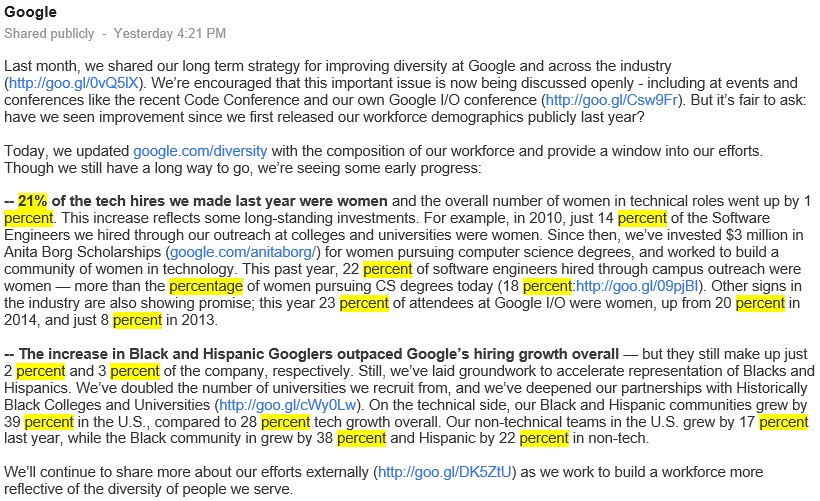
theodp writes: Among the books recommended by Bill Gates for beach reading this summer is How to Lie With Statistics, the published-in-1954-but-timely-as-ever introduction to the (mis)use of statistics. So, how can one lie with statistics? "Sometimes it is percentages that are given and raw figures that are missing," explains the book, "and this can be deceptive too." So, does this explain Google's just-released Diversity Report and the accompanying chock-full-o-percentages narrative (find-all-%-image), which boasts "the Black community in grew [sic] by 38 percent", while the less-impressive raw figures — e.g., the number of Google employees increased by 5,928, but the ranks of Black females only increased by 35 (less than 0.6% of the net increase) — are relegated to a PDF of its EEO-1 Report that's linked to in the fine-print footnotes? To be fair to Google, Microsoft, Twitter, Apple and Amazon didn't want people to see their EEO-1 numbers, either. -
Bill Gates On Educating the World
theodp writes During February, Bill Gates is playing Perry White at The Verge, expounding on the big bets the Gates Foundation is making to improve the world over the next 15 years. One of those bets is that online classrooms can help the world catch up. Gates' vision of universal online education extends to those who struggle with basic literacy and currently lack online access, far beyond the reach of MOOCs like Coursera, EdX, and Udacity, which have enjoyed their greatest success with higher-level courses aimed at the middle class. "Gates' vision — a wave of smartphones that can act as ubiquitous, cheap computers — is central to solving this problem," explains The Verge's Adi Robertson. "And unfortunately, we're not there yet." But eventually, Gates is betting that a world-class education will only be a few taps away for anyone in the world. And that's when things get really interesting. "Before a child even starts primary school," Bill and Melinda Gates wrote in their Foundation's 2015 letter, "she will be able to use her mom's smartphone to learn her numbers and letters, giving her a big head start. Software will be able to see when she's having trouble with the material and adjust for her pace. She will collaborate with teachers and other students in a much richer way. If she is learning a language, she'll be able to speak out loud and the software will give her feedback on her pronunciation." -
Bill Gates On Educating the World
theodp writes During February, Bill Gates is playing Perry White at The Verge, expounding on the big bets the Gates Foundation is making to improve the world over the next 15 years. One of those bets is that online classrooms can help the world catch up. Gates' vision of universal online education extends to those who struggle with basic literacy and currently lack online access, far beyond the reach of MOOCs like Coursera, EdX, and Udacity, which have enjoyed their greatest success with higher-level courses aimed at the middle class. "Gates' vision — a wave of smartphones that can act as ubiquitous, cheap computers — is central to solving this problem," explains The Verge's Adi Robertson. "And unfortunately, we're not there yet." But eventually, Gates is betting that a world-class education will only be a few taps away for anyone in the world. And that's when things get really interesting. "Before a child even starts primary school," Bill and Melinda Gates wrote in their Foundation's 2015 letter, "she will be able to use her mom's smartphone to learn her numbers and letters, giving her a big head start. Software will be able to see when she's having trouble with the material and adjust for her pace. She will collaborate with teachers and other students in a much richer way. If she is learning a language, she'll be able to speak out loud and the software will give her feedback on her pronunciation." -
Brought To You By the Letter R: Microsoft Acquiring Revolution Analytics
theodp writes Maybe Bill Gates' Summer Reading this year will include The Art of R Programming. Pushing further into Big Data, Microsoft on Friday announced it's buying Revolution Analytics, the top commercial provider of software and services for the open-source R programming language for statistical computing and predictive analytics. "By leveraging Revolution Analytics technology and services," blogged Microsoft's Joseph Sirosh, "we will empower enterprises, R developers and data scientists to more easily and cost effectively build applications and analytics solutions at scale." Revolution Analytics' David Smith added, "Now, Microsoft might seem like a strange bedfellow for an open-source company [RedHat:Linux as Revolution Analytics:R], but the company continues to make great strides in the open-source arena recently." Now that it has Microsoft's blessing, is it finally time for AP Statistics to switch its computational vehicle to R? -
Bill Gates Endorses Water From Human Waste
theodp writes: GeekWire reports that Bill gates is certainly leading by example, appearing in a video in which he sips "a glass of delicious drinking water" produced from human waste processed by Janicki Bioenergy's OmniProcessor, which can take sewer sludge and turn it into clean drinking water, electricity and clean ash. So how was it? "The water tasted as good as any I've had out of a bottle," said Bill. "And having studied the engineering behind it, I would happily drink it every day. It's that safe." -
Interviews: Ask the Hampton Creek Team About the Science and Future of Food
samzenpus writes Hampton Creek is a food technology company that makes food healthier by utilizing a specially made egg substitute in food products. The company was selected by Bill Gates to be featured on his website in a story called, The Future of Food, and has raised $30 million in funding. Hampton Creek's latest product is called, Just Cookies, which is an eggless chocolate chip cookie dough, but it is their eggless mayo that has been in the news lately. Unilever, which manufactures Hellmann's and Best Foods mayonnaise, is suing Hampton Creek claiming that the name Just Mayo is misleading to consumers. Named one of Entrepreneur Magazine's 100 Brilliant Companies and one of CNBC's Top 50 Disruptors, Hampton Creek has picked up some impressive talent including the former lead data scientist at Google Maps, Dan Zigmond. With Thanksgiving just around the corner, Dan and the Hampton Creek team have agreed to answer any questions you may have. As usual, ask as many as you'd like, but please, one per post. -
Bill Gates: Piketty's Attack on Income Inequality Is Right
New submitter rvw sends word that Bill Gates has posted a review of Capital in the Twenty-First Century, an acclaimed book by economist Thomas Piketty about how income equality is a necessary result of unchecked capitalism. Gates, one of the most successful capitalists of our time, agrees with Piketty's most important conclusions. That said, he also finds parts of the book to be flawed and incomplete, but says Piketty has started vital debate on these issues. Gates writes, Yes, some level of inequality is built in to capitalism. As Piketty argues, it is inherent to the system. The question is, what level of inequality is acceptable? And when does inequality start doing more harm than good? That's something we should have a public discussion about, and it's great that Piketty helped advance that discussion in such a serious way. ... I agree that taxation should shift away from taxing labor. It doesn't make any sense that labor in the United States is taxed so heavily relative to capital. It will make even less sense in the coming years, as robots and other forms of automation come to perform more and more of the skills that human laborers do today. But rather than move to a progressive tax on capital, as Piketty would like, I think we'd be best off with a progressive tax on consumption. -
Scientists Race To Develop Livestock That Can Survive Climate Change
Hugh Pickens DOT Com (2995471) writes "Evan Halper writes in the LA Times that with efforts to reduce carbon emissions lagging, researchers, backed by millions of dollars from the federal government, are looking for ways to protect key industries from the impact of climate change by racing to develop new breeds of farm animals that can stand up to the hazards of global warming. ""We are dealing with the challenge of difficult weather conditions at the same time we have to massively increase food production" to accommodate larger populations and a growing demand for meat, says Agriculture Secretary Tom Vilsack. For example a team of researchers is trying to map the genetic code of bizarre-looking African naked-neck chickens to see if their ability to withstand heat can be bred into flocks of US broilers. "The game is changing since the climate is changing," says Carl Schmidt. "We have to start now to anticipate what changes we have to make in order to feed 9 billion people," citing global-population estimates for 2050." (More below.) "Warmer temperatures can create huge problems for animals farmed for food. Turkeys are vulnerable to a condition that makes their breast meat mushy and unappetizing. Disease rips through chicken coops. Brutal weather can claim entire cattle herds. Some climate experts, however, question the federal government's emphasis on keeping pace with a projected growing global appetite for meat. Because raising animals demands so many resources, the only viable way to hit global targets for greenhouse gas reduction may be to encourage people to eat less meat and point to an approach backed by Microsoft founder Bill Gates that takes animals out the process altogether. "There's no way to produce enough meat for 9 billion people," says Bill Gates. "Yet we can't ask everyone to become vegetarians. We need more options for producing meat without depleting our resources.""