Slashdot Mirror
Domain: gcrio.org
Stories and comments across the archive that link to gcrio.org.
Comments · 16
-
Re:Simpler?So you're a "wacko" if you disagree with the poor "science" presented in that article? The author says:
Let's start with CO2. Activists tell us that man-caused CO2 is creating global warming. However, only 3 percent of CO2 comes from people. The rest comes from oceans, animals and Ryan Seacrest.
OK, true enough. However, the conclusion (it's only 3%, obviously that's not enough to do anything) is not only wrong, it has no scientific basis. Since when is it scientific to just say "oh that's a small number, can't be significant?" Seems to me a good starting point for "significant" would be "exceeds the ability of the ecosystem to absorb the increased emissions."
As a result of this natural balance, carbon dioxide levels in the atmosphere would have changed little if human activities had not added an amount every year. This addition, presently about 3% of annual natural emissions, is sufficient to exceed the balancing effect of sinks. As a result, carbon dioxide has gradually accumulated in the atmosphere, until at present, its concentration is 30% above pre- industrial levels.
-- http://www.gcrio.org/ipcc/qa/05.htmlFeel free to dance around your Kool-Aid jug if it makes you feel better.
-
Ok. I will not jump to conclusions.
Hard science, hard fact.
The clouds are caused by space flight, and high flying research planes. We do know, from Paul Newman'ss research, that they seem to appear following shuttle launches, and passing thunderhead clouds. They glow because they are so high in the sky, that the ice crystals are reflecting sunlight, and they are the subject of current research. We also know that they travel to the poles ( about 7k miles from the equator ), in less than 48 hours (Newman), and that they are a component of the catylisys of ozone destruction. (Schindell, Newman, GEOS letters ), but just to be clear about the answer to your question:
"Maybe the cloud is part of a positive feedback cycle that keeps the Earth's climate in acceptable ranges." It is possible that an ELE ( Extinction Level Event ) or ELP ( Extinction Level Process ) will occur, from this reducing Earth's global human population, but the current theory, that Schindell and Newman are proposing, ( they now have 16 years of data ), is that it will lead to a catostrophic loss of ozone for the next 120 years. Their conclusion, not mine, and paid by taxpayer's money.
I mean, after a few hundred million die from carcinoma* (Abarca), we will clearly see, we did the science (with taxpayer funded researchers), we had the proof, and didn't believe it. Tanzania is taking this threat very seriously, and so is Finland.
*Do the math: @Punta Aranus, 177/100,000 die. Nothern Hemisphere expected exposure to ultraviolet B, about 2.6 billion. Will we have the equivlent death rate, or a slightly higher death rate?
Do your self a favor, and hunt down the refrences.
Here are a few links:
http://www.npr.org/templates/story/story.php?storyId=15662891
http://www.sellingcr.com/content/view/54/1/
"Water is a tremendous greenhouse gas. It can condense and form all these clouds. Clouds can reflect radiation. Clouds can actually insulate the surface, if you got a cloud layer overhead the surface stays a little bit warmer. So water is really crucial to the whole process," Newman says.
But, the govenment is not really interested in:
"AEAP: Atmospheric Effects of Aviation Project
The AEAP Project has ended. "
But from other refrences:
http://www.gcrio.org/ocp96/p38box.html
"Water vapor and sulfur oxide concentrations are expected to increase significantly, perhaps as much as 40%, in the stratosphere." ( 1996, again we seem of have lost interest in all this.) -
Odd definition of "most"
This statement is meant for no other reason than to give weight to the claims, not discuss the issues intelligently.
This statement often comes after all attempts to discuss the issues intelligently fall on deaf ears. Is there a particular issue you would like to discuss? I'd recommend starting with an FAQ. There are a lot out there.Even if true, "most scientists" once thought we would see an ice age within 50 years of the 1970's.
Only if by "most" you mean "very few". There were about as many climate scientists who "thought we would see an ice age within 50 years of the 1970's" as there are climate scientists now who think it is possible (> 5% probability) that humans are not primarily responsible for global warming. -
Re:-1 : Habitual liar.
No, "the problem" is people like yourself, you try to paint yourself as a critical thinker and a skeptic. You are neither, you lie and look for the answer that you want.
I'm sorry you see me as a heretic. I am not trying to destroy your religion or deny you the ability to practice it.
That being said, I need to point out that I am not saying these things, I am repeating them and others have said them. But it does bring up a critical point which might make me a critical thinker, Why is there such an effort to suppress any dissent? I think the answer is because either people have become brainwashed or are pushing the issue for reasons of gain. But I will address your accusations and sight some articles from this year. I'm sure you will do the same and cite articles from 3 years ago or maybe even 10 years ago that refute this information that was made available this year like normal. Cause thats what the "good book says" right?Lie #1 - "Realclimate is untrustworthy".
Reality: RC is run by climatologists, many have contributed or peer-reviewed the IPCC reports, the founder is M.Mann (the hockey stick guy).Yes, one of the most interesting one. The mann guy if hockey stick fame who's hockey stick has been shown inaccurate and refuted. I guess if you need you ten minutes of fame, your do anything. But back to the basics, It was started by some guy who became famous because of a graph of data that was prove to be inaccurate and who's work is being used by the UN IPCC who openly and freely admits their only job is to prove man is the problem.
A real stand-up sight. And If you look at this site, Pay attention to the articles. They address somethings that look like a real good job of explaining the irrelevance of new theories into global warming. I noticed that with situations like the sun, they reference articles that are 10 years old or better to discredit articles of today. This would be good if we knew for sure that the problem was 2+2=4. But we don't know this and the new theories specifically state these older beliefs are wrong. Now this is real science I guess, if we stop considering anything new in order to reject anything that disagrees with the agenda.Lie #2 - "NASA doubts the findings of the IPCC".
Reality: James Hansen, is a world renowned climatologist and also the guy in charge of putting up the "unreliable sattelites", he has warned we may only have 10yrs to turn things around.Yes, it would seem this is true, Hansen does say we only have ten year and he is in charge of them. And according to the source data the suns activity has been declining since 2003 when it went live. But more importantly, the Total Irradiance Monitor (TIM) which is part of the NASA material says that the temp increase caused by the sun is
The IPCC and real climate isn't interested in any -
Re:He's not a climatologist :/
Stability of the Sun's thermal output
The only way to reliably test the so-called "solar constant," whose value at the mean Sun-Earth distance is a little over 1 1/3 kilowatts per square meter of surface, is from outer space. Atmosphere and other factors are going to vary any measurement too much.
Here is a web site that talks about changes in this Solar Constant, measured since 1979. The greatest has been about
http://www.gcrio.org/CONSEQUENCES/winter96/article 3-fig2.html
Why is the Sun stable?
1) if the Sun's output weren't stable, temperatures would fluctuate so fast life on Earth wouldn't be in its present form.
2) We are here -- hence things must have been stable.
3) Follow the following physics I dug up about Hydrostatic Equilibrium:
http://www.astronomynotes.com/starsun/s3.htm
Solar Luminosity---huge energy output!
The first basic question about the Sun is how bright is it? It puts out A LOT of energy every second. How much? The answer from our measurements is 4 × 1026 watts. Such a large number is beyond most of our comprehension, so let's put the Sun's total energy output (ie., its luminosity) in more familiar units. It is equal to 8 × 10¹⁶ of the largest power plants (nuclear or hydroelectric) on the Earth. Our largest power plants now can produce around 5,000 Megawatts of power. Another way to look at this is that the sun puts out every second the same amount of energy as 2.5 × 10⁹ of those large power plants would put out every year---that's over two billion!
Hydrostatic Equilibrium Controls the Reaction Rates
Hydrostatic equilibrium is the balance between the thermal pressures from the heat source pushing outwards and gravity trying to make the star collapse to the very center. I will discuss hydrostatic equilibrium in more depth (no pun intended) in a later section. The nuclear fusion rate is very sensitive to temperature. It increases as roughly temperature4 for the proton-proton chain and even more sharply (temperature15) for the Carbon-Nitrogen-Oxygen chain. So a slight increase in the temperature causes the fusion rate to increase by a large amount and a slight decrease in the temperature causes a large decrease in the fusion rate.
Now suppose the nuclear fusion rate speeds up for some reason. Then the following sequence of events would happen: 1) the thermal pressure would increase causing the star to expand; 2) the star would expand to a new point where gravity would balance the thermal pressure; 3) but the expansion would lower the temperature in the core---the nuclear fusion rate would slow down; 4) the thermal pressure would then drop and the star would shrink; 5) the temperature would rise again and the nuclear fusion rate would increase. Stability would be re-established between the nuclear reation rates and the gravity compression.
Personally, I think there are fluctuations --from minute to minute. Kind of like the waves on the ocean can make the water level change dramatically at small samples. But the Level of the ocean as an average is very, very stable. So I think that the thermal output of the Sun is very, very stable -- sunspot activity on 11 year cycles or not. There are a lot of dynamic forces that very constantly and very quickly in the 4-stage fusion process of the sun, but they all average out. Any drastic change over time would be huge. Since it has been here 4 Billion years -- the Net process has to be stable. Right? In our Stratosphere, Ozone atmosphere convert much of the Ulraviolet light into Infrared light -- heat. Out magnetosphere is created by our earth's metal core. This creates a giant electrical generator that keeps producing lightning (interaction between magnetic field and charged particles from sun) so a more energetic Sun would produce more lighting and more Ozone co -
Public planning based on hype is ill-founded>> global warming is very real, however we simply don't have good enough models yet
You are right on both counts. I am a scientist and an engineer, and I work enough with climate modelling to understand the problems and limitations in this area. And from this background, I judge that the esteemed economist is paying more attention to hype than fact.
Global warming is very real. Without natural global warming, this planet would be about 33 C colder than it currently is, so it's an extremely important effect that keeps this planet liveable. The most important greenhouse gas that creates 95% of the greenhouse effect is water vapour (not CO2), and we have no control over the water vapour whatsoever, but we're damn glad it's there.
What's more, there has been a gradual (though erratic) increase of temperature throughout the current interglacial period (18,000 years), which cannot be attributed to "advanced" civilization emissions, and this should be viewed against the backdrop of the longer current glaciation cycle (100,000 years) --- ie. we're at a perfectly normal peak in temperature, and it's not even a high one within the current interglacial.
That's the background. Now let's see where current observations put us.
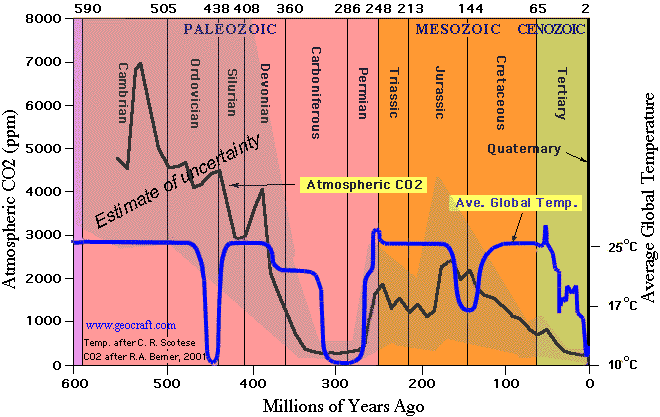
Man's huge outpouring of CO2 has very significantly increased the CO2 ppm in the atmosphere, to levels unprecedented in recent glacial periods. While CO2 is not a primary controller of global temperature (the long-term paleoclimate record shows almost no correlation whatsoever, the record through the last several glaciations shows a strong correlation between the two.
Of course, graphing CO2 and temperature from the fossil record doesn't tell us which is cause and which is effect, and we are not currently able to model the very complex biosphere nor the chaotic cloud formation processes well enough to make any sound judgements about this. However, that doesn't mean that we can ignore it.
Two things we do know with total certainty:- Man-made CO2 *does* cause a tiny initial rise in the greenhouse effect (that's just simple physics), even if it turns out that its final effect is not the obvious one expected.
- The climate is in the process of abrupt change, as noted from the extremely rapid melting of Greenland ice flows and polar ice cover, and the very dramatic observed slowdown in the Atlantic overturning that drives the Gulf Stream. And these processes are unstoppable, period, no matter what we do.
Firstly, this is what we DON'T do: we don't conclude that the temperature is going to go through the roof. Not only is there no significant temperature excess in the record (the +0.6 C of recent times would be regarded as entirely within natural climate variation if it weren't for the hype), but more importantly, the trend cannot be stopped in the ways suggested because CO2 has a very long lifetime, and all the industrial age CO2 will continue having its effect for a good 800+ years.
Secondly, this is what we DO do: we accept that the North Atlantic and polar melting cannot be stopped and that therefore the sea level will rise enormously in coming decades and centuries. This will have a collosal effect on Man, and we should plan for it, basically through gradual retreat from the shorelines.
That would be economic planning based on scientific facts, rather than hype.
Of course, reducing CO2 while we're at it is a great idea --- we should not polute the planet, FULL STOP, as it's the only one we've got, currently. But to believe that this is going to solve climate change is a complete fiction. - Man-made CO2 *does* cause a tiny initial rise in the greenhouse effect (that's just simple physics), even if it turns out that its final effect is not the obvious one expected.
-
Public planning based on hype is ill-founded>> global warming is very real, however we simply don't have good enough models yet
You are right on both counts. I am a scientist and an engineer, and I work enough with climate modelling to understand the problems and limitations in this area. And from this background, I judge that the esteemed economist is paying more attention to hype than fact.
Global warming is very real. Without natural global warming, this planet would be about 33 C colder than it currently is, so it's an extremely important effect that keeps this planet liveable. The most important greenhouse gas that creates 95% of the greenhouse effect is water vapour (not CO2), and we have no control over the water vapour whatsoever, but we're damn glad it's there.
What's more, there has been a gradual (though erratic) increase of temperature throughout the current interglacial period (18,000 years), which cannot be attributed to "advanced" civilization emissions, and this should be viewed against the backdrop of the longer current glaciation cycle (100,000 years) --- ie. we're at a perfectly normal peak in temperature, and it's not even a high one within the current interglacial.
That's the background. Now let's see where current observations put us.
Man's huge outpouring of CO2 has very significantly increased the CO2 ppm in the atmosphere, to levels unprecedented in recent glacial periods. While CO2 is not a primary controller of global temperature (the long-term paleoclimate record shows almost no correlation whatsoever, the record through the last several glaciations shows a strong correlation between the two.
Of course, graphing CO2 and temperature from the fossil record doesn't tell us which is cause and which is effect, and we are not currently able to model the very complex biosphere nor the chaotic cloud formation processes well enough to make any sound judgements about this. However, that doesn't mean that we can ignore it.
Two things we do know with total certainty:- Man-made CO2 *does* cause a tiny initial rise in the greenhouse effect (that's just simple physics), even if it turns out that its final effect is not the obvious one expected.
- The climate is in the process of abrupt change, as noted from the extremely rapid melting of Greenland ice flows and polar ice cover, and the very dramatic observed slowdown in the Atlantic overturning that drives the Gulf Stream. And these processes are unstoppable, period, no matter what we do.
Firstly, this is what we DON'T do: we don't conclude that the temperature is going to go through the roof. Not only is there no significant temperature excess in the record (the +0.6 C of recent times would be regarded as entirely within natural climate variation if it weren't for the hype), but more importantly, the trend cannot be stopped in the ways suggested because CO2 has a very long lifetime, and all the industrial age CO2 will continue having its effect for a good 800+ years.
Secondly, this is what we DO do: we accept that the North Atlantic and polar melting cannot be stopped and that therefore the sea level will rise enormously in coming decades and centuries. This will have a collosal effect on Man, and we should plan for it, basically through gradual retreat from the shorelines.
That would be economic planning based on scientific facts, rather than hype.
Of course, reducing CO2 while we're at it is a great idea --- we should not polute the planet, FULL STOP, as it's the only one we've got, currently. But to believe that this is going to solve climate change is a complete fiction. - Man-made CO2 *does* cause a tiny initial rise in the greenhouse effect (that's just simple physics), even if it turns out that its final effect is not the obvious one expected.
-
Re:Its nice to know someone has ballsIf you Google about for him, you get some interesting stuff:
DR. WATSON: A question for Pieter Tans. What if we don't want carbon dioxide to increase to more than one thousand parts per million? For example, what if we want to keep CO2 from exceeding 450, what is the implication for burning all the fossil fuels?
And another interesting thing here:
DR. TANS: It would be Draconian. I showed the real long term effect of it. If we want to keep CO2 below 450 ppm permanently, I guess we would have to stop just about today, almost.What do we see? At least during '92 and '93, there is tremendous uptake of CO2 at mid-latitudes in the Northern Hemisphere by plants. The uptake is about half as large as the total combustion of fossil fuels. So this is fortunate, this is good news. People in the oil and coal industry might love it. But like I said, we don't know if this is going to last. Biologists are generally very skeptical that this will keep happening for decades. In fact, we know that in 1994, terrestrial uptake at the mid-latitudes in the Northern Hemisphere was much smaller than during '92 and '93. So we know that it varies a lot from year to year. It just so happened that when we got our isotopic analysis on line, there were two big years of terrestrial uptake.
Just reading through what he's said, he seems like a straight-shooter. Sometimes he says things that the oil industry might hate, some things they might love. Ah, science! -
Re:Its nice to know someone has ballsIf you Google about for him, you get some interesting stuff:
DR. WATSON: A question for Pieter Tans. What if we don't want carbon dioxide to increase to more than one thousand parts per million? For example, what if we want to keep CO2 from exceeding 450, what is the implication for burning all the fossil fuels?
And another interesting thing here:
DR. TANS: It would be Draconian. I showed the real long term effect of it. If we want to keep CO2 below 450 ppm permanently, I guess we would have to stop just about today, almost.What do we see? At least during '92 and '93, there is tremendous uptake of CO2 at mid-latitudes in the Northern Hemisphere by plants. The uptake is about half as large as the total combustion of fossil fuels. So this is fortunate, this is good news. People in the oil and coal industry might love it. But like I said, we don't know if this is going to last. Biologists are generally very skeptical that this will keep happening for decades. In fact, we know that in 1994, terrestrial uptake at the mid-latitudes in the Northern Hemisphere was much smaller than during '92 and '93. So we know that it varies a lot from year to year. It just so happened that when we got our isotopic analysis on line, there were two big years of terrestrial uptake.
Just reading through what he's said, he seems like a straight-shooter. Sometimes he says things that the oil industry might hate, some things they might love. Ah, science! -
Re:Critique of RealClimate.org's critiqueLet me try.
I don't think it was absolute. His statement was, "increasingly," not "entirely" or "all."
No. Crichton's statement (specifically the bit that was italicised for emphasis by RealClimate.org) was:
"No longer are models judged by how well they reproduce data from the real world"
The 'increasingly' you have latched onto is in the subordinate clause that follows on from this, where Crichton rows back from the bold rhetorical claim that he wants his audience to remember. RealClimate.org's critique focuses on the main claim, not the weasel words Crichton puts in as a get out of jail card. So they turned to the IPCC Report that Crichton cited in the bibliography to his novel (and thus can be assumed to have read), which gives a good overview of current research and point to ~150 pages in that report that go into how climatoligists take computer climate models and assess them against RW data.
How does this square with Crichton's subsequent claim in this article that such models are no longer being checked against the real world?
[on comparing two different kinds of predictions]
A weather prediction. I expect you to want to reply, "But see! That's not weather, that's climate!"
No, it is not a weather prediction, yes - it is a climate prediction. Woe is me, I have fallen into your cunning trap...
Which is a good time to point out a question that you've chosen to ignore: If what you say is true, then why did RealClimate.org define things the way they did (specifically, weather == "what you observe", climate == "what you expect")? This is not a rhetorical question. Answer it!
and upthread you wrote...
If "climate," by RealClimate.org's own admission is "what you expect," then that definition is functionally equivalent to a weather prediction
By which I think you're saying that RealClimate's definition ('what you expect') applies to any forecast/prediction, right? Because a prediction or a forecast is what you are expecting to happen?
Sadly you have misread the RealClimate writer's intent. If you had bothered to follow the three definitional links that they included in the subsequent sentence you would have found that actually they (or rather, climatologists) define 'climate' as the statistical average of various meterological metrics over a wide area and time, whereas 'weather' is an instance of those self-same metrics for a specific time and location.
Thus the 'what you expect' part of the tag refers to the statistical nature of what climate is rather than any predictive attributes it might have, whilst the 'what you get' part of the tag refers to the specificity of what weather is (or will be).
So the guy on the news who tells me that tomorrow there's going to be bright sunshine and 70+ temperatures isn't telling me 'what I expect' (in February, in London) but it might well be 'what I get' (not this week it seems however, brrrr!).
Hope that helps.
Regards
Luke -
-5, Patently Misinformed
What's worse: the brunt of the pollution stems from North American and European industrialization.
In 1998, Australia was the worlds worst polluter, and they're not even in the Northern hemisphere. According to the UN, the third world produces almost three times as much greenhouse gases than the US, Europe, and developed asian countries (Japan, S Korea, Taiwan, et al) combined. While the 'westernized' world consumes more resources, they also do it more efficiently and emit fewer harmful emissions than countries like China (who is responsible singly for 29% of all CO2 from coal, while the US is only responsible for 19%).
As to your rhetorical question about reversing the trend? Aggressive investment in nuclear fusion for energy production, hydrogen as a storage medium for energy, and efficient transmission methods for electrical power. The problem is the 50 years of draconian environment legislation lead by scientifically ignorant environmental groups like Greenpeace. -
Re:More on sinks
wow, anecdotal evidence and blatant misinformation gets modded insightful, nice...
Thermometers around the world, satellite data, and much soft evidence like receding glaciers and retreating sea ice points quite clearly to global warming being real.
I find that in particular hard to believe. I don't know what kind of thermometer you have, but the last few years where I live (Pennsylvania, USA) have been much colder than usual.
A couple links from a google of "average global temperature":
one
two
Both of which quite clearly show that temperatures are in fact increasing and proving, once again, that anecdotal evidence means shit.
Second, the theory is quite sound. CO2 pushes the energy budget of Earth up. Less energy out means Earth has to heat up.
IANAS, but doesn't less energy mean that the Earth will cool down?
um....no, seriously, why would you even think that? If you are taking in the same amount of energy, but are losing less energy, you will have a net gain, simple. -
Re:InsignificantIt really makes me laugh when people talk about how bad mankind is to the environment, when eruptions like Mt. St. Helens released more carbon dioxide into the atmospehere in a day or two than humans have created since we started making fire. Not to mention all the nasty sulfur and nitrogen based compounds that went with it. And that was just ONE volcanic eruption. Think about Krakatoa in 1883 or even the constant eruptions that go on all over the world.
No that's incorrect. According to the UN, the US pumped 5.8 billion tons of CO2 into the atmosphere in 2000. Volcanism is a huge contribution to CO2 production, but the human race produces more. The US in the above report increased its CO2 production rate by roughly 15% from 1990 to 2000. Alternate sources peg the CO2 release in the same neighborhood (estimates 5.5 billion tons of the carbon portion of CO2 released into the atmosphere - that's roughly 20 billion tons of CO2 released globally per year. In comparison, natural volcanic activity releases around 130-230 million tons of CO2 per year on average.
-
Re:Older, more effective foam was replaced
It's already been proven that there is NO global warming,
In what universe? Seriously, you may have issues with the political implications of global warming, you may have issues with the implementation of damage-control policies before a true consensus of the scientific community has been reached, but that statement is just plain wrong.
I don't have any doubt that it is repeated ad nauseum in hysterical screeds by the likes of Rush et al, but you would do yourself some good by attempting to understand the opinions of people who actually know what they are talking about.
Here are some starters:
The US Global Change Research Information Office
The American Geophysical Union
The Union of Concerned Scientsts
The Hadley Center for Climate Prediction and Research
UCS Debunking of the 'Skeptical Environmentalist'
globalwarming.org's constantly updated list of scientific references
I could go on but I won't. There's still lots of debate, and this is as it should be, but global warming has not been "disproved" except in the minds of politically motivated ideologues.
-
Re:The temp won't rise for a while either.
I might as well take a crack at this too (and I got a "C" in high school chemistry because I insisted on lighting up th acetylene ballons we used in the Gas Density lab...)
To focus on water's phase changes as a heat sink is to miss the point. Surface water is not a major component of Earth's mass, so its ability to smooth out temperature variations as a 'thermal capacitor' would on the face of it be not very significant when compared to the mass of Earth as a whole.
Another fallacy is that the Earth is a closed system. It's not: Earth not only takes in energy from the Sun but it also radiates energy back into space. I should mention that solar radiation isn't the only heat source either: radioactive decay also heats the Earth's core.
Once you understand this, then you appreciate the very reason greenhouse gases are called such: they trap this radiation like the walls of a greenhouse.
The size of the polar ice caps is a reflection of the average Earth temperature, not the other way around. Its effect on mean sea level is an indicator of mean temperature, but it certainly isn't the only one (how about the mean temperature itself?)
More interesting to me is the potential effect of increased water vapor in the air, itself a greenhouse gas. Would it have a positive reinforcing effect on a temperature rise, whether it be due to increased CO2, solar radiation, or cow flatuence? On first glance this phenomenon seems to be not well understood.
Another idea I don't see tossed about much is biological equilibria having influence on CO2 levels. It seems quite reasonable that increased CO2 levels and temperatures would increase the biomass (especially in plankton) and thus the drawdown of CO2 out of the atmosphere.
Global climate is a complicated thing. Unfortuantely it is complicated further by global politics....
- dvd_tude -
Re:Voluntarily? HAH!What have I gotten myself into?
Refuting global warming
You provide evidence that global tropospheric temperatures are decreasing. However, these measurements are actually further evidence of global warming. If the greenhouse effect is trapping heat in the lower atmosphere, less heat makes it back into the upper atmosphere as measured by satellites. Check out this article from the NOAA, especially paragraph 3 (although the whole thing is pretty interesting). Also note the results of a NAS study that examines the data you referenced. They conclude that global surface warming is definitely real and that the satellite data does not invalidate these measurements.Refuting importance of CO2 compared to H2O in global warming
Your source states that water vapor is a greenhouse gas and that it exists in much greater concentrations than CO2 in the atmosphere. Therefore, global warming should be closely related to an increase in atmospheric water vapor, with the effect of CO2 being negligible. However, if we grant that global surface temperatures are increasing, were are left wondering why atmospheric water vapor is increasing. This document from the WMO explains how CO2 emissions affect the climate by increasing the amount of water vapor in the air. Basically, the CO2 traps a bit of heat near the surface. The warmer air holds more water, and this additional water in turn leads to more warming. The "push" from the CO2 basically changes the planet's water distribution, with more water in the air and less elsewhere. You can consider the CO2 an indirect cause, but it definitely leads to warming. On a related note, here's an interesting article from NASA which suggests that an increasingly moist atmosphere may harm the ozone layer as well. Note the quote in paragraph 7.Refuting rising sea levels
This article was by far the most entertaining source you provided. I love the part in paragraph 10 where Lord Bumpershoot (or whatever his name was) complains about convicts vandalizing his test equipment. According to your source, the sea level measurements in this area seem to be decreasing. However, consider the observations from the TOPEX/POSEIDON satellite, which uses a radar altimeter to map global sea levels. There appears to be a clear upward trend of about 3 mm/year. Judging from the data, it's apparent that the global mean sea level is increasing.On a final note, I noticed from your previous posts that you seem to be a Bush supporter. It looks like the Bush administration has reversed its position on the existence of global warming. I'm totally shocked. Are you?