Slashdot Mirror
Domain: github.com
Stories and comments across the archive that link to github.com.
Comments · 4,419
-
Re: write it yourself
I had written it myself. Had the same problem This program does all that and more with a graphic interface. It uses md5 hashes to deduplicate files from a source folder to a destination folder. https://github.com/evandrojr/F... It is open source works for windows and should work for linux with minor changes. It uses mono with c# Hope it helps. Worked for me pretty well.
-
Re: General case
This program does all that and more with a graphic interface https://github.com/evandrojr/F... It is open source works for windows and should work for linux with minor changes. It uses mono with c# Hope it helps
-
Re:My solution
I'm replying to you because one of my two solutions has the same name
https://github.com/caluml/find...I have another solution, written in Python. It is pretty efficient but very limited. It walks two folders, sorting files into bins according to size. If any bins match between the two folders, it does a hash once on each file in each bin and then compares them. That way, the files are not read repeatedly and hashes are only done if necessary. It could be sped up further by only doing partial file matches, but it worked fine for me. Reply if you want it.
-
Bug in oogle Glass for porn?
Fail: doesn't work when I take her from behind. She likes to bury her head in the pillows. Bug. Issue #22. See http://github.com/rabidfukker/theotherview/issues/22
-
noVNC
Classicly I have used SSH to tunnel both RDP and VNC though it can be cumbersome on the client side as you need a VNC viewer and SSH software. Not a big deal if its your personal tablet or laptop as you can easily run ConnectBot on Android or similar on iOS and then use a VNC client. On a laptop use Putty on windows or on OSX, ssh is included by default. But if its a PC out of your control so to speak your options are limited. There is a java applet version of tightvnc which runs inside a browser, though java applets can be cumbersome and you need a web server.
But alas, there is this: https://github.com/kanaka/noVNC, a pure javascript VNC client. NoVNC also includes ssl encryption as well so you can safely connect to your VNC server through an SSL tunnel; https://github.com/kanaka/websockify/wiki/Encrypted-Connections (The link is also on the noVNC page toward the bottom).
-
noVNC
Classicly I have used SSH to tunnel both RDP and VNC though it can be cumbersome on the client side as you need a VNC viewer and SSH software. Not a big deal if its your personal tablet or laptop as you can easily run ConnectBot on Android or similar on iOS and then use a VNC client. On a laptop use Putty on windows or on OSX, ssh is included by default. But if its a PC out of your control so to speak your options are limited. There is a java applet version of tightvnc which runs inside a browser, though java applets can be cumbersome and you need a web server.
But alas, there is this: https://github.com/kanaka/noVNC, a pure javascript VNC client. NoVNC also includes ssl encryption as well so you can safely connect to your VNC server through an SSL tunnel; https://github.com/kanaka/websockify/wiki/Encrypted-Connections (The link is also on the noVNC page toward the bottom).
-
Quietnet
Quietnet: Simple chat program using near ultrasonic frequencies.
"Simple chat program using near ultrasonic frequencies. Works without Wifi or Bluetooth and won't show up in a pcap.
Note: If you can clearly hear the send script working then your speakers may not be high quality enough to produce sounds in the near ultrasonic range.
Usagerun python send.py in one terminal window and python listen.py in another. Text you input into the send.py window should appear (after a delay) in the listen.py window.
Warning: May annoy some animals and humans."[1]
https://github.com/Katee/quietnet
[1] https://kate.io/
via: http://boingboing.net/2014/01/11/quietnet-near-ultrasonic-mess.html -
These Guys Are Creating a Brain Scanner
These Guys Are Creating a Brain Scanner You Can Print Out at Home
- http://www.wired.com/wiredenterprise/2014/01/openbci/
-- http://www.openbci.com/
-- https://github.com/OpenBCI"Bootstrapped with a little funding help from DARPA â" the research arm of the Department of Defense â" the device is known as OpenBCI. It includes sensors and a mini-computer that plugs into sensors on a black skull-grabbing piece of plastic called the âoeSpider Claw 3000,â which you print out on a 3-D printer. Put it all together, and it operates as a low-cost electroencephalography (EEG) brainwave scanner that connects to your PC."
Archived: http://web.archive.org/web/20140113131516/http://www.wired.com/wiredenterprise/2014/01/openbci/
-
now go and get some snatch!
These Guys Are Creating a Brain Scanner You Can Print Out at Home
- http://www.wired.com/wiredenterprise/2014/01/openbci/
-- http://www.openbci.com/
-- https://github.com/OpenBCI"Bootstrapped with a little funding help from DARPA â" the research arm of the Department of Defense â" the device is known as OpenBCI. It includes sensors and a mini-computer that plugs into sensors on a black skull-grabbing piece of plastic called the âoeSpider Claw 3000,â which you print out on a 3-D printer. Put it all together, and it operates as a low-cost electroencephalography (EEG) brainwave scanner that connects to your PC."
Archived: http://web.archive.org/web/20140113131516/http://www.wired.com/wiredenterprise/2014/01/openbci/
-
Obligatory
https://github.com/jashkenas/coffee-script/wiki/List-of-languages-that-compile-to-JS
Why Ceylon in particular?
-
Mozilla Servo
While the old GTK vs QT and C vs C++ debate continues, the interesting stuff is really happening in the Web space with projects like Mozilla Servo where the UI is parallelised as much as possible. Servo might be rendering HTML at first but it could just as easily render another XML dialect designed for apps like XUL. Actually, it would be nice if they could move away from XML and move to JSON but I digress.
-
Re:Question
I read TFA, and you didn't miss much. The reporter dumbed the idea too far down or didn't understand it himself. https://github.com/bramcohen/DissidentX [github.com] has a little more explanation especially if you want to read the code.
Anyway, you can't tell how many messages are encoded, in fact you shouldn't be able to see if a single message is encoded at all, hence the purpose of the tool and stenography in general. Though, if you have the undoctered original file and you know that this tool is the only thing that might have messed with the file, then you can tell that at least one message has been encoded.
However, you can tell how many messages could be encoded and therefore keep water-boarding until you get that many messages, but likely no one put that many messages into the file in the first place so your just doing the extra torture for fun.
-
Encoding cleverly uses spaces, Oxford commas
This is really clever. It includes encoders that use tabs spaces at the ends of lines, and even Oxford commas. That is ridiculously cool. Nice work, Bram & co.!
-
Encoding cleverly uses spaces, Oxford commas
This is really clever. It includes encoders that use tabs spaces at the ends of lines, and even Oxford commas. That is ridiculously cool. Nice work, Bram & co.!
-
Encoding cleverly uses spaces, Oxford commas
This is really clever. It includes encoders that use tabs spaces at the ends of lines, and even Oxford commas. That is ridiculously cool. Nice work, Bram & co.!
-
Re:tool?
Q. Your code is horribly inefficient and can be optimized in all kinds of ways.
A. That's why it's called 'reference' code.
-
Actual Link
Come on guys! At least post a link to the project.
-
Re:MiniDLNA
Looks like Fuppes is now on GitHub. Last commit was 3 days ago, I guess it's still alive.
-
Quietnet - chat program using near ultrasonic freq
Quietnet: Simple chat program using near ultrasonic frequencies.
"Simple chat program using near ultrasonic frequencies. Works without Wifi or Bluetooth and won't show up in a pcap.
Note: If you can clearly hear the send script working then your speakers may not be high quality enough to produce sounds in the near ultrasonic range.
Usagerun python send.py in one terminal window and python listen.py in another. Text you input into the send.py window should appear (after a delay) in the listen.py window.
Warning: May annoy some animals and humans."[1]
https://github.com/Katee/quietnet
[1] https://kate.io/
via: http://boingboing.net/2014/01/11/quietnet-near-ultrasonic-mess.html -
Quietnet
Quietnet: Simple chat program using near ultrasonic frequencies.
"Simple chat program using near ultrasonic frequencies. Works without Wifi or Bluetooth and won't show up in a pcap.
Note: If you can clearly hear the send script working then your speakers may not be high quality enough to produce sounds in the near ultrasonic range.
Usagerun python send.py in one terminal window and python listen.py in another. Text you input into the send.py window should appear (after a delay) in the listen.py window.
Warning: May annoy some animals and humans."[1]
-
Re:Why not in English?
I have started to translate the paper so that English speakers can explore it. I've only had time for the abstract, introduction, and main result statement, but that already gives an important part of the picture. Any further contributions are welcome. https://github.com/myw/navier_stokes_translate
-
Re:Wrong question
Let's say I have something in python that was developed on python 2.5 and is in maintenance now. The correct question is why would I demand python 2.7 suddenly?
Actually, I just recently started a new project and I'm coding it in Python 2.7 despite the fact that I much prefer Python 3 (byte/str makes sense in Python3, str/unicode in Python2 was and is a mess). The reason is that Python 3 does not have a decent MySQL connector. I hear complaints about thrid-party developers (mysqlf included) not supporting Python 3, but core Python language bindings that we depend upon don't yet even support Python 3. Here, let me quote to you directly from my project's FAQ:
Why no Python3 support?
There is no MySQL connector for Python3 yet.According to `git blame` I added that entry on 2013-12-04, just about a month ago.
Here is the project for those interested in a database explorer with a focus on breadth, not depth:
https://github.com/dotancohen/squeal -
Re:People don't upgrade
But, why aim for the least, when you *can* do the most? Environment-modules allow you to install multiple versions of software side-by-side, including multiple versions of Python. Furthermore, it is next to trivial to install few 2.x and 3.x versions by using EasyBuild, see for examples at: https://github.com/hpcugent/easybuild-easyconfigs/tree/master/easybuild/easyconfigs/p/Python EasyBuild itself is written in Python and will run in any Python 2.x for x>=4. Last but not least, EasyBuild may prove to be the more sane way to install Python packages in a cross-platform way; anyone here having a better *cross-platform* offer?
-
Re:Network Transparency ... solved
sorry this reply is so late. I think this is what you're looking for.
-
Re: Blind ants, now need to search more branches
Fair enough... the propagation delays would suck, yes... but we're talking about general purpose computing here, not picosecond timing. The main goal is throughput, and if you can get most of the transistors in the thing doing computation, instead of waiting for the 100 picoseconds they are actually needed, you've solved the "dark transistor" problem.
The gain is from being able to process all parts of a given problem in parallel, so you get at least 1 result per clock.... imagine being able to do 1024 bin FFTs at 1 Ghz, or faster.
You have to route signal, but at least in the bitgrid, that's flexible, and not he huge constraint on things that existing FPGAs force you to work around. You should be able to get 90% usage... I'm writing a simulator to try to figure that out, in Delphi for Windows, it's on GitHub.
-
"[U]se [RC4] as a last resort."
Unfortunately — in Firefox, at least — ciphers can only be toggled, not given a priority. Control over cipher selection (and other HTTPS parameters, such as key length, key exchange, hash (MD5/SHA)., etc.) lies with the server operator. In my own testing, the arbitrated HTTPS parameters are most frequently prioritized in some order without regard to strength, or prioritized from weakest-to-strongest (or perhaps least-to-most expensive to execute).
In order to retain manageable security, I have only TLS 1.0-1.2 enabled, MD5 disabled, all RC4-employing combos disabled, with the last being switchable via a check box provided by "CipherFox." (Additional features of use to "CipherFox" users are provided by "Calomel SSL Validation."; I recommend both.)
-
Re:Ends of Moore's Law in software ?
You should use puts or better: write, but modern versions of GCC will automatically replace printf("literal without directives terminated by\n"); with puts("literal without directives terminated by"); automatically with -O.
Also 8k is fucking huge. I wrote a hello world for Linux in 118 bytes using FASM. And that's not even the smallest Hello World. It's also noticably faster than one written in C, particularly a dynamically linked one.
-
Meh.
Real Programmers(tm) wouldn't use this for debugging. You should be using Fuckit.js to really work out the bugs in your code.
-
Re:Perhaps it's just that I'm ignorant...
here is the code in question.
-
Re:Security?
Its not that bad: modern cryptography provides some great tools than make better approach possible. Look into the algorithm I used. You can have (as public or non public record) a list of allowed voters, and who got ballots signed (via Blind signatures) and what the ballots are. There is no need to have anyone but the voter know which ballot was theirs. You can still verify that your exact ballot (containing the unique ID you randomly select) is counted it the public list of ballots, as well as verify that the number of ballots is less than or equal to the number of voters who submitted ballots to be signed. Assuming all voters actually verify their votes are included, the selection can is robust, even against attacks by the folks running it adding ballots, changing votes, or not counting them all.
So you can have your absolute anonymity (even more so than mail in or in person!), increased verifiability and robustness (much harder for fraud, including done by government.) and the ease of voting online. Its still a tradeoff (it might be easier to sell/buy votes), but as as the list of approved voters is correct (thats another seperate issue) its quite robust.
-
Re:Security?
The only way this would ever be even remotely secure is if users of the system had to get a unique key in person or have a key mailed to them that can only be used once. Even then, it obviously could be guessed what the key is or snail mail could be intercepted. Then you'd have the issue of people claiming someone stole their vote when their party member didn't win. Why are we taking this seriously? Because someone in a University is doing it instead of a for profit company?
If you can't mail someone something unique, how does vote by mail work? Well, it doesn't always work, but we use it. Thats why we are trying to make better systems. if your key is as attackable as a mailed ballot, but unlike in a mail in system, you can prove your vote was counted in the final tally, prove fraud (to the media, auditors, whatever) if its not, and have much stronger guarantees about the robustness of the secret ballot its still an improvement. Perfect? No, nothing involving people is, but its better in many ways (and worse in some, but I'd argue the benefits outweigh the issues).
Since I see no code or algorithm description yet for the implementation (plan?) in the article, you can look at my example election software. Check out the readme for an outline of how the design compares to existing mail in systems. Thats just a personal little project of mine. I've also had a little involvement with another election software project that is based on somewhat on my design.
Is their code public? How about the algorithms? If not, then I'll claim to have contributed more, even with just my minimal unfinished efforts. My code is documented (somewhat), public and freely licencesed (MIT). Use it, fix it, fork it. Really though, I could build a decent system from scratch by myself in a quarter. Its less work than some project classes I took. 10 years seems a little excessive to work on this. Sure all the clients for different platforms and auditing and such takes a while, but its not that horrible.
-
Re:Security?
The only way this would ever be even remotely secure is if users of the system had to get a unique key in person or have a key mailed to them that can only be used once. Even then, it obviously could be guessed what the key is or snail mail could be intercepted. Then you'd have the issue of people claiming someone stole their vote when their party member didn't win. Why are we taking this seriously? Because someone in a University is doing it instead of a for profit company?
If you can't mail someone something unique, how does vote by mail work? Well, it doesn't always work, but we use it. Thats why we are trying to make better systems. if your key is as attackable as a mailed ballot, but unlike in a mail in system, you can prove your vote was counted in the final tally, prove fraud (to the media, auditors, whatever) if its not, and have much stronger guarantees about the robustness of the secret ballot its still an improvement. Perfect? No, nothing involving people is, but its better in many ways (and worse in some, but I'd argue the benefits outweigh the issues).
Since I see no code or algorithm description yet for the implementation (plan?) in the article, you can look at my example election software. Check out the readme for an outline of how the design compares to existing mail in systems. Thats just a personal little project of mine. I've also had a little involvement with another election software project that is based on somewhat on my design.
Is their code public? How about the algorithms? If not, then I'll claim to have contributed more, even with just my minimal unfinished efforts. My code is documented (somewhat), public and freely licencesed (MIT). Use it, fix it, fork it. Really though, I could build a decent system from scratch by myself in a quarter. Its less work than some project classes I took. 10 years seems a little excessive to work on this. Sure all the clients for different platforms and auditing and such takes a while, but its not that horrible.
-
Re:The Wave Story
Just heard about this: https://github.com/WeTheInternet/collide - thought you might be interested.
-
Traitors, the lot of them
I found the shill! You're also a jackboot licking, spineless, and wretched excuse for a human being.
You didn't read TFA or TFS or even The Fucking Headline. How is a publicly posted (on Github) proof-of-concept with accompanying explanation in detail (in TFA) "in the hands of the NSA only"? If you're actually concerned about foreign governments or terrorists, this sort of behavior is the most egregious possible: it makes ALL of us less safe. You think that China doesn't have cryptographers at least as good as this guy I've never heard of before? That which is in the power of one fool to do is also in the power of another. The bottom line is that those supposed to protect us shirked their duty. They are traitors. By paying money to promote an algorithm with a known backdoor as secure, for the use of the very citizens they protect, they actively aided the enemy. Hang them all.
aris@kalix86:~/dualec$
s at start of generate:
E9B8FBCFCDC7BCB091D14A41A95AD68966AC18879ECC27519403B34231916485
[omitted: many output from openssl]
y coordinate at end of mul:
0663BC78276A258D2F422BE407F881AA51B8D2D82ECE31481DB69DFBC6C4D010
r in generate is:
96E8EBC0D507C39F3B5ED8C96E789CC3E6861E1DDFB9D4170D3D5FF68E242437
Random bits written:
000000000000000000000000000000000000000000000000000000000000
y coordinate at end of mul:
5F49D75753F59EA996774DD75E17D730051F93F6C4EB65951DED75A8FCD5D429
s in generate:
C64EAF10729061418EB280CCB288AD9D14707E005655FDD2277FC76EC173125E
[omitted: many output from openssl]
PRNG output: ebc0d507c39f3b5ed8c96e789cc3e6861e1ddfb9d4170d3d5ff68e242437449e
Found a match !
A_x: 96e8ebc0d507c39f3b5ed8c96e789cc3e6861e1ddfb9d4170d3d5ff68e242437
A_y: 0663bc78276a258d2f422be407f881aa51b8d2d82ece31481db69dfbc6c4d010
prediction: a3cbc223507c197ec2598e6cff61cab0d75f89a68ccffcb7097c09d3
Reviewed 65502 valid points (candidates for A)
PRNG output: a3cbc223507c197ec2598e6cff61cab0d75f89a68ccffcb7097c09d3 -
Re:no engineering
thygate, we are a team of 3 developers, who converts a draft idea to first batch in about 1,5 years. Reason of developing was easy - we did not find appropriate solution. Here's short video http://www.youtube.com/watch?v=38Uc1ttnmOQ, where I'm explain main idea. Please mention it is OLD video (Jan 2013), but main idea of a project still the same. Here we are at github: https://github.com/virt2real In Russia we try to make crowdfund and obtained about 50% of needed sum. We add our own money to make first batch of 1000 pcs. And we are fully broken our heads while trying to port all to modern kernel 3.9 now. We no need advertisement or money. I just contacted Rick Lehrbaum to ask for help - we are just enthusiasts and now we have not enougt power to finalize linux part of a project.
-
cat /dev/urandom /dev/audacity would be nice
Great question.
Bitcoin: https://github.com/spesmilo/sx , GoxCLI
Calandar; 'cal'
wget, curl with cut, grep & awk
mplayer... with acsii output, transcode,
irc bots such as malware command and control interfaces - are there benign examples?There are very few financial command line tools. It's strange but there doesn't seem to be a way to buy or sell securities, forex or futures.
Can anyone tell me why you can't |pipe| GUI programs....? Why can't you pipe audio live from
-
A command-line audio recording and production tool
Nama's command prompt has been used to produce the prog rock compositions of Julien Claassen. It is a small overlay (<20kloc) on the well-regarded Ecasound audio engine. Nama is written in perl, so can build under any Unix brethren, and Ecasound as well. With some upcoming changes, it will also manage audio mixing and routing for live shows. It does have a optional hard-disk recorder styled GUI, and can pop up other utilities for viewing and editing waveforms. Best is to build from github.
--The Nama Animator (say that three times fast)
-
KDE Kolab
I'm currently in the process of setting up something like this.
Kolab is a FOSS groupware server that can synchronize emails, to do lists, calenders, notes, etc. across multiple devices. You can access it from the included web interface (roundcube), the recommended client (Kontact), or via Outlook with the connector installed. Android support is available via ActiveSync, and I believe Kontact Touch will be ported to Android now that Qt 5 supports it.)If you're not interested in running your own server, there're also sites like this which sell accounts.
Here are some notes on my experiences setting it up, for anyone interested:
- Make sure you read the documentation first, because Kolab is too complex to just jump right in and hit the ground running. In particular, make sure you have a FQDN
- Kolab pulls in a bunch of different daemons, including apache2, cyrus, mysql, postfix, slapd, clamav. It's a fairly heavy-weight solution, since it was developed with enterprise users in mind.
- Multiple users can use a single installation. Users can be added/removed from a web interface.
- By default, nothing uses SSL. This is undesirable if you're planning on connecting to it over the internet. The LDAP server uses a different SSL stack to the rest of the daemons (NSS), and you'll definitely want to run it over SSL because it sends passwords in plaintext. The easiest solution I found was to create a CA cert with certutil, use that to create the certificate for use with LDAP, then export that certificate to PEM format and use it for everything else. LDAP needs to be configured online, but all the other daemons just have configuration files with entries for the path to the certificates.
- On some distros, Kontact may not be compiled with Kolab support. (e.g. Sabayon)
- RSS syncing is currently the only feature in Kontact that doesn't sync with Kolab (AFAIK), although you can embed tt-rss in the web interface.
-
org-mode in emacs
I have tried several solutions and find org-mode to be the most useful one. I have it set up in essentially a GTD structure, with TODO items in one big list, a separate list of active projects, and a third list of potential future projects.
org-mode is extremely configurable, which is a definite plus for software you intend to organize your life. I recommend the following add-ons as well:
- org-caldav to synchronize appointments and scheduled TODO tasks with Google calendar. (two-way sync that is!)
- MobileOrg for Android, which will let your Nexus 7 work with your org-files.
Now you just take text notes in emacs and org-mode does the rest. I happen to write LaTeX and some code, and org-mode also supports literal programming. This is an extremely useful feature since I can write rich outlines of all my projects in org-mode and have the TODO items be placed naturally where they would have gone in my hand-written notes.
For a simple example of how this might work, suppose I'm drafting a research paper and don't remember some detail I don't care about currently. I might write, "Smith first published this theory in the 80s * TODO Look up the year for Smith". org-mode will find these todo items and tell me about them when I look at my todo list. Then when I find the appropriate date and want to insert it, it will take me directly to where I put the TODO item so I can insert it into the draft with minimal effort. In this way, outlines naturally progress toward finished projects, just as GTD wants them to.
-
org-mode in emacs
I have tried several solutions and find org-mode to be the most useful one. I have it set up in essentially a GTD structure, with TODO items in one big list, a separate list of active projects, and a third list of potential future projects.
org-mode is extremely configurable, which is a definite plus for software you intend to organize your life. I recommend the following add-ons as well:
- org-caldav to synchronize appointments and scheduled TODO tasks with Google calendar. (two-way sync that is!)
- MobileOrg for Android, which will let your Nexus 7 work with your org-files.
Now you just take text notes in emacs and org-mode does the rest. I happen to write LaTeX and some code, and org-mode also supports literal programming. This is an extremely useful feature since I can write rich outlines of all my projects in org-mode and have the TODO items be placed naturally where they would have gone in my hand-written notes.
For a simple example of how this might work, suppose I'm drafting a research paper and don't remember some detail I don't care about currently. I might write, "Smith first published this theory in the 80s * TODO Look up the year for Smith". org-mode will find these todo items and tell me about them when I look at my todo list. Then when I find the appropriate date and want to insert it, it will take me directly to where I put the TODO item so I can insert it into the draft with minimal effort. In this way, outlines naturally progress toward finished projects, just as GTD wants them to.
-
Re:Betteridge's law of headlines
Chrome OS is indeed a version of Linux. You can install Crouton on a Chromebook; that gives you an Ubuntu userspace as an alternative to the normal Chrome UI (but does not replace the Linux kernel used by Chrome OS) and you can switch back and forth.
-
Re:not dead
Sorry, didn't mean to announce a premature demise, I must admit that I was hoping that wave in a box would be a little more mature by now. (although I have no right to complain, not having contributed any code myself!). As a side note, I guess this is the best spot to try out the code: https://github.com/apache/wave
-
Re: "Slashmirrored"
> Btw: Why is KDBUS code full with 'goto' calls ?
checking https://github.com/gregkh/kdbus/blob/master/bus.c
because it makes more sense than a huge nested if/else structure. if it was oop you'd also do "if(bla) throw ex1; if(b) throw ex2; -
Re:How many don't use the chrome part?
I use both, thanks to crouton.
It is the best of both worlds. Chrome OS works great with netflix and google web apps. I can use crouton for everything else. I have a dedicated Ubuntu server, so ssh -x is really my only client side requirement. -
Re:Really?
and despite Rizzoma claiming to be Open-Source, their code is nowhere to be found!
Funny, I found it in 5 seconds here after simply doing a search for "Rizzoma source code".
I think the correct repository is:
https://gitorious.org/kune
-
Too much navel gazingToo much navel gazing about change. Here is the reason behind kdbus. Primarily it's for application sandboxing and making sure that a bad actor does not do something bad to something else. As GNU/Linux gets more popular, we want to be able to make sure that we can contain bad actors as much as possible. It's also a step in the direction to have a universal app spec instead of having to have each distro package the same damn app. I miean, how much duplicate work do you want to do? It makes it easier for people who write apps to have GNU/Linux as a target instead of having to pick the most popular distro at that point of time.
http://lwn.net/Articles/551969/
Linus is okay with it. Have to worry about Al Viro.
Here is an updated talk by Greg K-H that he gave on KDbus, he posted this about 3 days ago. https://github.com/gregkh/presentation-kdbus
Let's stop all the FUD, and educate yourself on the reasons behind on this.
-
The Wave Story
Here's what happened in excruciating detail:
1) Google Releases Wave, claims it will be open source. Promises/Tells a Fibonacci.
2) Google doesn't release Wave as open source for various reasons eg: protocol buffers toolchain underneath deemed too valuable. (Please don't argue this, the protocol buffers stuff that's been released is only a tiny part of the story.)
3) Google builds a terrible open source replacement pretty much from scratch. It BARELY works for one commit nearly 3 years after they claim Wave will be open sourced. It never has been. Entire affair is swept under carpet.I know because I had an ehealth startup that died partially as a result of this. In the end, after we realized we had been hoodwinked (this post excludes private conversations we had with Google) we wrote a Wave-like thing around part of our technology in record time and it surprisingly turned out really well, but unfortunately it was too late, and company died. That was sad. Startups are fragile things.
Anyhow, try sharejs it's written by a former Wave team member and it's better. You can easily wrap gwt around that if you need to. Or, I'm highly skeptical but you can try JBoss Errai, they have written an OT framework into their weird everything framework. OT is a pretty complicated bit of code, and they just stuck it in a directory errai-otec like it was any other feature (eg. a Base64 encoder). I would rate the chance their OT impl has major issues as very high. I don't really understand corporate open source like this, so I'd love to see an Errai person explain the project. I'm guessing the thesis is somehow based around upselling a service of some sort.
tl;dr You want this.
Support A Free Internet
-
Re:why?
I don't understand why these systems are set up like this, operationally it's not much different from EZ-Pass which works fine with an account based system, putting the value tracking on the cards is just asking for an upgrade treadmill even if it's well designed now, 10 years from now it will be easilly cracked. compare CPU vs GPU/FPGA/ASIC hashing advances
Because its expensive to run a lot of data over GSM links in every bus/tram in the city.
We use same system in Poland and recently a group of people (over 900!) got charged with fraud. They werent the ones selling cards, they were the users, and only stupid ones.
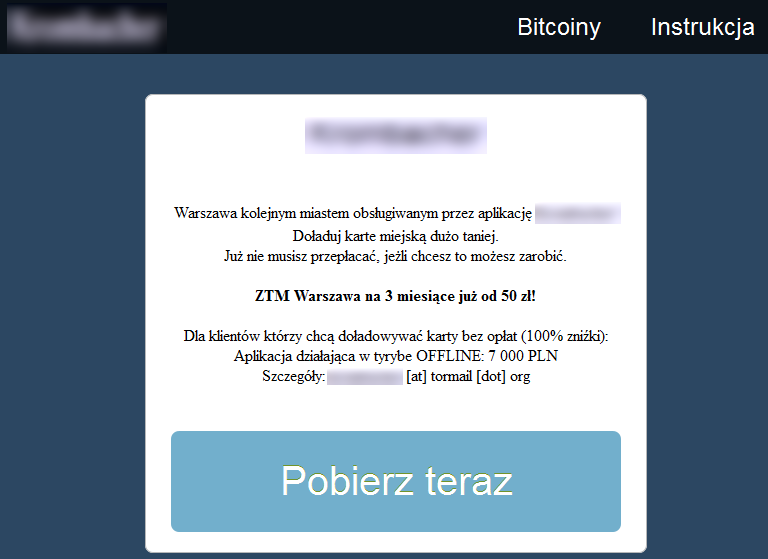
in polish http://niebezpiecznik.pl/post/900-wlascicieli-falszywych-warszawskich-kart-miejskich-bedzie-przesluchanych/Someone also offers Android app that charges cards using phone buildin NFC. You pay with BTC (yes, bitcoins). Its only available over TOR
http://zaufanatrzeciastrona.pl/wp-content/uploads/2013/03/screen01.png
City has NO technical way of discovering fake cards on the meters, they only stumbled on those cards because City was upgrading older VERY broken Classic cards to never less but still broken model, they did it by offering free exchange program. Some retards tried to turn in FAKE cardsevul sourcecode for clonning
https://github.com/ikarus23/MifareClassicTool -
Really?
and despite Rizzoma claiming to be Open-Source, their code is nowhere to be found!
Funny, I found it in 5 seconds here after simply doing a search for "Rizzoma source code".
-
Javascript [sic] Mess is non-commercial
Ahh, gotta love non-free software... https://github.com/jsmess/jsmess/blob/no_cothreads/mess/docs/license.txt