Slashdot Mirror
Domain: globalaircraft.org
Stories and comments across the archive that link to globalaircraft.org.
Comments · 19
-
Re:The Concorde failed too
Concorde flew higher and faster than an F16, carrying 100 passengers in their normal clothes - no face mask or pressure suit. And they could drink champagne while looking out of their window into space.
By your measure the Apollo space program was a failure.
-
Re:No, no, no!
Lockheed-Georgia C-5 Galaxy. Maximum Cargo Weight: 270,000 pounds. Cost: $179 million. http://www.globalaircraft.org/planes/c-5_galaxy.pl
-
Re:No, no, no!
Lockheed-Georgia C-5 Galaxy. Maximum Cargo Weight: 270,000 pounds. Cost: $179 million. http://www.globalaircraft.org/planes/c-5_galaxy.pl
-
Re:"Heavy cargo...increases risk"
You might like to consider, vis-a-vis aviation, that we looked at supersonic passenger aircraft and then walked away from them because they were stupidly expensive (and actually unsafe.) We did much better with aircraft designed to work, as it were, with the atmosphere rather than against it. Jeremy Clarkson, no less, suggested that supersonic aircraft went away because of mobile phones and the Internet. In the same way, within the limits of our current technical capability, the need for manned spacecraft (if it ever existed, which I doubt) went away once we could put a little robot on Mars and have it wander around for years looking at things.
That sounds nice, but isn't even close to the truth. Concorde operated at a tremendous profit for British Airways: "BA's profits have been reported to be up to 50 million in the most profitable year, with a total revenue of 1.75 billion, before costs of 1 billion." - found here, and in a documentary I recently saw. What hurt them was the single crash, and the fact that 9/11 killed a lot of their best customers. And as far as safety goes, the type had ONE hull loss. You can't conclude that it's worse than any plane which has had at least one, and that's all but the very newest types. With what they learned in the accident investigation, they made it even safer, but in the post 9/11 world it was no longer economically viable. But there's nothing wrong with the concept. -
More like Northrop's plane
From the crappy pic at AviationLeak, it looks like it may be an outgrowth of the X-45 development bird.
It looks more like the Navy's X-47B, which is also a tailless flying wing. The Navy and NG have been very open about the program, so perhaps that's another reason why USAF felt they didn't have to hide the Sentinel anymore.
-
More like Northrop's plane
From the crappy pic at AviationLeak, it looks like it may be an outgrowth of the X-45 development bird.
It looks more like the Navy's X-47B, which is also a tailless flying wing. The Navy and NG have been very open about the program, so perhaps that's another reason why USAF felt they didn't have to hide the Sentinel anymore.
-
X-45 outgrowth?
-
X-45 outgrowth?
-
Re:I'm not surprised
I've often been amazed how bad the aerodynamics of Science Fiction are. The X wing is a pretty good example, with those huge laser weapons on the ends of the wings that guarantee flutter problems in the wings.
What, you mean kinda like this?
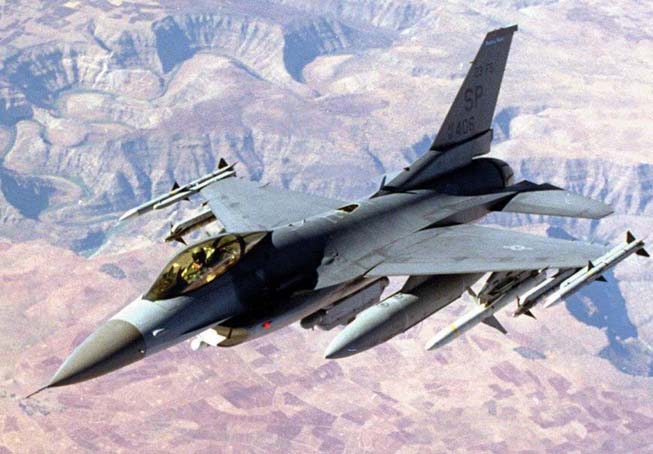
Having huge weapons hanging anywhere off the wing doesn't "guarantee" any problem with aerodynamics. (Before you argue that the other missiles and fuel pods somehow dampen the vibration, the F-16 can fly with sidewinders alone. In fact, you can mount a heavier AIM-120 AMRAAM to the wing edge mounts if you want, like this).
The only real problem I can see with the X-Wing's laser weapons from an aerodynamic standpoint is the reflectors on the tip - and it wouldn't really be a big deal to just stow those somehow when flying through an atmosphere (though I don't remember if that was ever modeled in any of the Star Wars movies. I doubt it).
The overall wing design is a bigger problem, though it's more the overall profile than the leading edge that's the issue. An X-Wing's wings themselves seem to be flat, and peppered with all sorts of bumps and indentations; there's nothing to generate lift, and plenty to generate drag. I guess this is compensated a bit by the fact that the thing is supposed to be powered by rocket engines, not jets - I'm not convinced it's even supposed to be able to "fly" in the traditional sense. It might just sort of push itself through the air at high speeds when flying atmospherically, with the "wings" providing some amount of support and stability in flight but not actually generating much (or any) lift.
I'm not really a Star Wars geek so I don't know how the X-Wing is really supposed to fly, but I just wanted to point out that there's nothing necessarily about either of the two issues you raised that would preclude it. -
Sacrilege!!!Who dared to give to a fictional plane the same name as the most beautiful and most fantastic airplane ever made?
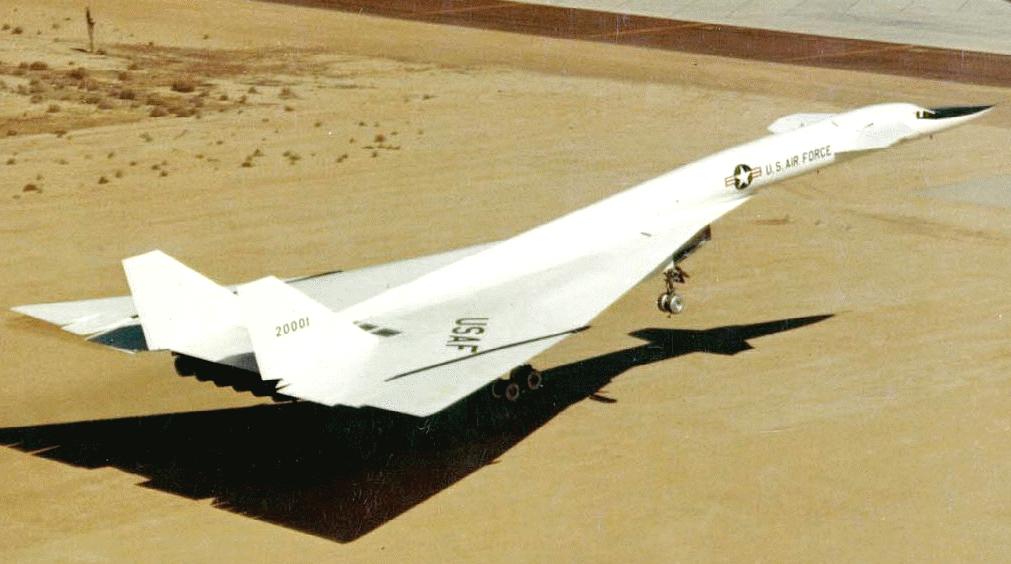
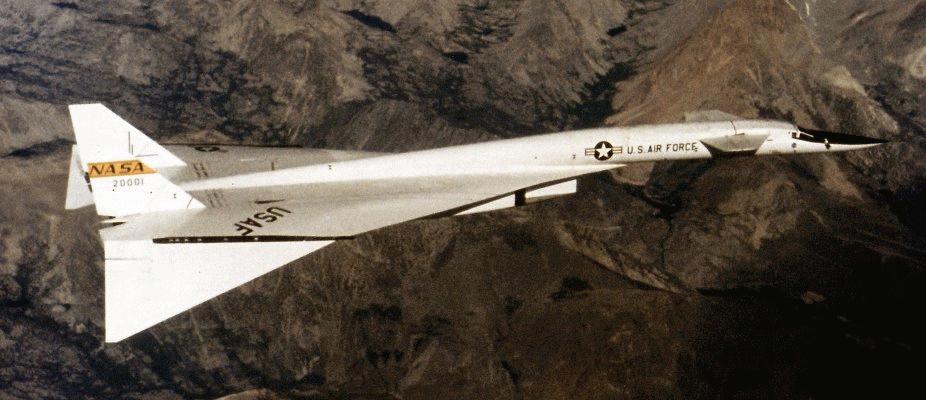
Compare the fictional Valkyrie specifications with the real one. The XB-70 could take off with a gross weight of 250 tons, and had a range of 8000 kilometers at Mach 3. It had variable geometry too. At subsonic speeds the wings were flat. At supersonic speeds wing tips folded down, to keep the lift constant at all speeds.
Isn't it funny how reality is better than fiction? -
Re:Prediction: JSF will not be purchased in bulk
"by cheap I mean you can fire ten missiles at a target (rest assured one will hit it) for the cost of one manned sortie."
During Desert Storm, Iraqi forces shot tons of anti-aircraft missiles in the air in order to shoot down incoming F-117 Nighthawk stealth planes, but none of them were scratched -- all jets returned safely after striking their respective targets.
Although I'll agree that the air force is putting more emphasis on unmanned drones, I would't call fighter jets obsolete, by any stretch of the imagination. If there was a target that had to be destroyed in a time-critical fashion (say an enemy early-defense radar station), I'd rather prefer to have a stealth fighter take it out, instead of a drone swarm.
Bottom line: Fighter jets are good for mission-critical objectives, Drones are good for suppression. -
Re:They have more in common than you may think...
So you're saying it's Mach 2.5, not Mach 3?
Or, roughly F-15 Eagle, not XB-70 Valkyrie ! -
Re:Sour Grapes?Oh, I didn't mean to say that they could have built something like the A380 40 years ago. I also wouldn't say they couldn't, they were very capable back then (just look at the B-52 that is still in service today, from the 1950's). What I meant is that they have had 40 years of experience and major achievements since then. The 777 that came out a decade ago for example. Even now, the A380's engines put out what the engines of the 777 put out a decade ago. In 2002 the 777's engines were updated GE. So in short I have to wonder what is so exciting about the A380. All of this to surpass a 40 year old aircraft (the 747) and as configured it only carries 139 more people... yawn. See how stuff works for a side by side comparison. If you look at the comparison I hope you see what I mean. Sure looks like it isn't as efficient as it should be. In fact I think I'd prefer the 747-400, it looks like a better deal.
I'm wondering if you really do know what you are talking about with the airports. Your the first one I have heard that says there is nothing that has to be done. Political gateway dot com seems to disagree with you. Here is one about the investment at Heathrow (London for those of us that don't know about Heathrow across the pond) airport business At Dulles Airport in Virginia, I understand that some construction going on over there is for the A380 to handle the 2nd deck. So do they have it wrong or do you? I can't seem to find anything that says nothing has to be modified at 747 airports. I dare say, you seem to be the one that is uninformed, or do those experts have it all wrong? I'm taking them for their word.
Comparing the fuel efficiency of the A380 to a 40 year old plane seems a bit odd to me. Update the 747 with the 777 engines and see what happens. Do you compare new cars efficiency to 40 year old cars too? Your comparison also assumes that the plane is fully loaded. The modern 747-400 seems to do better on fuel than the A380.
I'm still bothered that you think that every part of my argument is wrong. You don't think the SST was a white elephant? They would still be flying it if it was cost effective, especially after updating it after the takeoff crash. There was a conversion problem between the C-5 Galaxy and the A380 (darn metric). The two aircraft are very similar but the A380 is designed to take off with more weight. They are so similar (after I converted correctly) I wonder if they started with the C-5's plans and updated them (maybe they started with the 747's plans). By the way, if you take off in a fully loaded A380, one that weighs in at the max of 560 tonnes, the max landing weight is 386 tonnes. So you have to get rid of 174 tonnes to land if something goes wrong after takeoff. Seems that a C-5 could take more than 800 people, especially with 2 decks. There again, the C-5 has been around for decades. If there was a need, it would have already been put into service as a passenger plane. You would also have to update terminals to handle the C-5 as well. Top aircraft in the world - http://www.globalaircraft.org/50_largest.htm. The an-225 is still bigger than the A380. The spruce goose is larger, a prop plane that Howard Hughes built (a nearly 60 year old sea plane).
Well maybe I should be glad that someone is happy that Airbus with their big government subsidy has a new plane. Hurray for Airbus and the EU. I hope the US doesn't build something bigger.
-
Re:When will India/China/Brazil/Russia enter the r
Air Foyle HeavyLift does charter that single flying AN-225 that is considered "the world's largest aircraft". (specifications)
-
Re:How did I get here?It was actually a different aircraft that I believe was based on the An-124 design, called An-225.
/Mikael
-
Re:Just got back from MojaveWe got some good spots as near to the takeoff and landing as possible
Where was that? I was right on the taxiway as close as possible to the hangar. The northern-most corner. I think that was the best spot (except for the VIP area...)At about 6:40 the low altitude chase plane took off, it was a bright red little single engine plane
An Extra (German-manufactured airobatics plane).Next (I think) came the medium altitude chase plane, which was this really cool and modern looking craft with propellers in the back and a little wing on the nose.
The StarShip, a canard plane (the canard is the little wing at the front), a design which was made popular by Rutan.It taxied along the tarmac that ran past the crowd did a U turn then sped up and soared off of the runway to a cheering crowd.
Standard thing: taxi on the taxiway towards the end, then turn on the runway (parallel to the taxiway.)
As everybody watched the ship gain altitude, the high altitude chase taxied and lifted off. This jet was pretty interesting, It sort of looked like a fighter jet
If I remember right, it was an Alpha Jet.After that, the low altitude chase plane made a flyby
And that even though they said at the start that this is not an airshow... -
Re:Speaking of technology transfer.
While I don't know if there's a "story" to the similarities between the two aircraft, there were not too many ways to build a supersonic swing-wing bomber in the 70's - 80's.
One might speculate that the TU-160 was inspired by the B1-A (which had its first flight in 1974, the year before the TU-160 started development), and that the B1-B was inspired by the flight of the TU-160 (the B1-B project started in 1981, the same year the TU-160 first flew). Of course the US and the USSR often looked at each others programs for "inspiration"
Here's a couple of links to the TU-160 from the manufacturer and from some Internet site. The B1-B from the manufacturer and from wikipedia. -
Re:Speaking of technology transfer.
While I don't know if there's a "story" to the similarities between the two aircraft, there were not too many ways to build a supersonic swing-wing bomber in the 70's - 80's.
One might speculate that the TU-160 was inspired by the B1-A (which had its first flight in 1974, the year before the TU-160 started development), and that the B1-B was inspired by the flight of the TU-160 (the B1-B project started in 1981, the same year the TU-160 first flew). Of course the US and the USSR often looked at each others programs for "inspiration"
Here's a couple of links to the TU-160 from the manufacturer and from some Internet site. The B1-B from the manufacturer and from wikipedia. -
Re:Assumption is the mother of all f**k-ups...
in fact Argentina put Skyhawks up against the Sea Harriers in the Falklands war and they're not supersonic.
Here are the Skyhawk Tech Specs - top speed 675 mph - and to jog you memory the Speed of Sound is 761 mph (1,223 km/h).
Here is a link to Skyhawks in Argentina and in the Argentine Forces during the Falklands war.
They did field four Super Etendard Fighters which are supersonic - but not against the Sea Harriers. The Sea Harriers were lost mainly through accidents, SAMs and small arms fire! British Aircraft Lost.
Here's a breakdown of Argentine Aircraft Lost - you'll see they were shot down mainly by missiles - some from ships others by Sea Harriers. The Sea Harrier can thus be seen as a platform for missiles - and can not really be lauded as a performance aircraft - though the VTOL ability is amazing.
I'm no war or fighter nut - these links above were found on Google over a 10 minute period - it's called research - something I don't think you actually did
Just the facts Man!