Slashdot Mirror
Domain: gnu.org
Stories and comments across the archive that link to gnu.org.
Comments · 13,360
-
Re:oh please
You completely misunderstand the GPL. GPL'ed software is NOT into the public domain. It is still under copyright, either to the original author or to the FSF. Public domain is not the same as copyleft.
The GPL is a software license that gives you rights but along with restrictions. Public domain is necessarily without restrictions of any kind.
You can release material under the public domain, you simply have to state so instead of a copyright notice.
You can also release something copyrighted. This protection is automatic even in the absence of a copyright notice, at least nowadays. You can at a later time then annul your own copyright and release your work into the public domain. Such a release is automatic after the copyright expires (which appears will never occur again in the US the way it's going, and considering how many countries including my own align themselves with the US on those matters it might never happen at all).
I suggest you read the GNU documentation on the subject. -
Re:Free Ads / Free Betas
If they didn't release a product until 2008, the market (mostly linux) would have time to catch-up.
Catch up? Because Linux doesn't have any command shells...
Seriously, it seems to me that Windows is less and less about operating systems. WinFS was the major new OS feature, and it's been shelved. Looks like we're waiting all these years for adequate security, a new window manager and a bunch of wizards. That's right, and a new command shell. Forgive for not getting too excited.
-
Re:Don't hate it
Though the Unisys patents concerning the GIF format have expired, there is still the IBM patent and there might be other patents elsewhere. The Free Software Foundation still has no GIF images on their site as of June 21, 2004 and they seem to consider the IBM patent (which expires on August 11, 2006) to be an issue. Also, the FSF says that they have only checked for patents in the USA, Canada, Japan, and the European Union as of June 21, 2004.
The GIF format will likely be remembered as a format which unexpectedly became encumbered to the inconvenience of many.
-
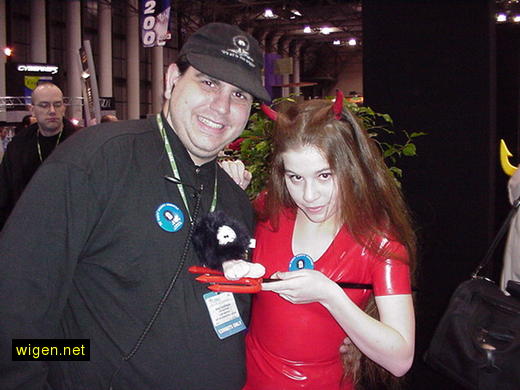
Ceren wins beautiful geek chick prize...
IMPORTANT UPDATE: Please show your support for Ceren in this poll of Geek Babes!
Is it any wonder people think Linux users are a bunch of flaming homosexuals when its fronted by obviously gay losers like these?! BSD has a mascot who leaves us in no doubt that this is the OS for real men! If Linux had more hot chicks and gorgeous babes then maybe it would be able to compete with BSD! Hell this girl should be a model!
Linux is a joke as long as it continues to lack sexy girls like her! I mean just look at this girl! Doesn't she excite you? I know this little hottie puts me in need of a cold shower! This guy looks like he is about to cream his pants standing next to such a fox. As you can see, no man can resist this sexy little minx. Don't you wish the guy in this pic was you? Are you telling me you wouldn't like to get your hands on this ass?! Wouldn't this just make your Christmas?! Yes doctor, this uber babe definitely gets my pulse racing! Oh how I envy the lucky girl in this shot! Linux has nothing that can possibly compete. Come on, you must admit she is better than an overweight penguin or a gay looking goat! Wouldn't this be more liklely to influence your choice of OS?
With sexy chicks like the lovely Ceren you could have people queuing up to buy open source products. Could you really refuse to buy a copy of BSD if she told you to? Personally I know I would give my right arm to get this close to such a divine beauty!
Don't be a fag! Join the campaign for more cute open source babes today!
$Id: ceren.html,v 9.0 2004/08/01 16:01:34 ceren_rocks Exp $ -
Re:It's actually worse than that - auto-save does
I gave up and started keeping my notes in an emacs buffer (which has infinite undo, and can stay up for days with no trouble - go figure).
Emacs keeps auto-save files, too.
IIRC, it's setup by default to be something like 300 keystrokes before autosaving.
Many, many years ago with NFS over a flaky network and fast typing I could detect a noticeable pause in Emacs when it did its autosave thing.
-
Re:The Free Software Problem: Possible Solution
This is not the way free/open source software should be approached, IMO. Nobody is going to make much money by trying to sell something that users can get for free. You can sell a service based on the software but that's about it.
I don't think you intended to imply that Free Software or Open Source software is always free of charge. I'll make the point anyhow, just in case someone misreads it. I am sure there is somebody who wants to read About Free Software.
While it is often true that its usually easy for users to get Free Software for no charge, it doesn't have to be like that.
A hypothetical example:
I might write a peace of software, that I chose to distribute for a fee, but distributing it under the GNU General Public License. Now, while you might get it for free, it might be hard. My customers might not wanna give it away something they paid for in full for no fee, or maybe you don't even know who to ask.Eventually my customers might be selling the software cheaper than I am, and I'll have to compete, maybe adjusting my price down, selling support and the like to the end-users, but if I already sold enough software to pay for my work when this happens, why be sad? A lot of users will be using my software and will learn that my software is good quality, which again will make it easier to sell them my next product, ensuring me butter for my bread.
If you want to read more about selling Free Software, you might want to read the article Selling Free Software, it has even been translated to several languages.
-
Re:The Free Software Problem: Possible Solution
This is not the way free/open source software should be approached, IMO. Nobody is going to make much money by trying to sell something that users can get for free. You can sell a service based on the software but that's about it.
I don't think you intended to imply that Free Software or Open Source software is always free of charge. I'll make the point anyhow, just in case someone misreads it. I am sure there is somebody who wants to read About Free Software.
While it is often true that its usually easy for users to get Free Software for no charge, it doesn't have to be like that.
A hypothetical example:
I might write a peace of software, that I chose to distribute for a fee, but distributing it under the GNU General Public License. Now, while you might get it for free, it might be hard. My customers might not wanna give it away something they paid for in full for no fee, or maybe you don't even know who to ask.Eventually my customers might be selling the software cheaper than I am, and I'll have to compete, maybe adjusting my price down, selling support and the like to the end-users, but if I already sold enough software to pay for my work when this happens, why be sad? A lot of users will be using my software and will learn that my software is good quality, which again will make it easier to sell them my next product, ensuring me butter for my bread.
If you want to read more about selling Free Software, you might want to read the article Selling Free Software, it has even been translated to several languages.
-
Re:The Free Software Problem: Possible Solution
This is not the way free/open source software should be approached, IMO. Nobody is going to make much money by trying to sell something that users can get for free. You can sell a service based on the software but that's about it.
I don't think you intended to imply that Free Software or Open Source software is always free of charge. I'll make the point anyhow, just in case someone misreads it. I am sure there is somebody who wants to read About Free Software.
While it is often true that its usually easy for users to get Free Software for no charge, it doesn't have to be like that.
A hypothetical example:
I might write a peace of software, that I chose to distribute for a fee, but distributing it under the GNU General Public License. Now, while you might get it for free, it might be hard. My customers might not wanna give it away something they paid for in full for no fee, or maybe you don't even know who to ask.Eventually my customers might be selling the software cheaper than I am, and I'll have to compete, maybe adjusting my price down, selling support and the like to the end-users, but if I already sold enough software to pay for my work when this happens, why be sad? A lot of users will be using my software and will learn that my software is good quality, which again will make it easier to sell them my next product, ensuring me butter for my bread.
If you want to read more about selling Free Software, you might want to read the article Selling Free Software, it has even been translated to several languages.
-
Re:The Free Software Problem: Possible Solution
This is not the way free/open source software should be approached, IMO. Nobody is going to make much money by trying to sell something that users can get for free. You can sell a service based on the software but that's about it.
I don't think you intended to imply that Free Software or Open Source software is always free of charge. I'll make the point anyhow, just in case someone misreads it. I am sure there is somebody who wants to read About Free Software.
While it is often true that its usually easy for users to get Free Software for no charge, it doesn't have to be like that.
A hypothetical example:
I might write a peace of software, that I chose to distribute for a fee, but distributing it under the GNU General Public License. Now, while you might get it for free, it might be hard. My customers might not wanna give it away something they paid for in full for no fee, or maybe you don't even know who to ask.Eventually my customers might be selling the software cheaper than I am, and I'll have to compete, maybe adjusting my price down, selling support and the like to the end-users, but if I already sold enough software to pay for my work when this happens, why be sad? A lot of users will be using my software and will learn that my software is good quality, which again will make it easier to sell them my next product, ensuring me butter for my bread.
If you want to read more about selling Free Software, you might want to read the article Selling Free Software, it has even been translated to several languages.
-
Re:The Free Software Problem: Possible Solution
This is not the way free/open source software should be approached, IMO. Nobody is going to make much money by trying to sell something that users can get for free. You can sell a service based on the software but that's about it.
I don't think you intended to imply that Free Software or Open Source software is always free of charge. I'll make the point anyhow, just in case someone misreads it. I am sure there is somebody who wants to read About Free Software.
While it is often true that its usually easy for users to get Free Software for no charge, it doesn't have to be like that.
A hypothetical example:
I might write a peace of software, that I chose to distribute for a fee, but distributing it under the GNU General Public License. Now, while you might get it for free, it might be hard. My customers might not wanna give it away something they paid for in full for no fee, or maybe you don't even know who to ask.Eventually my customers might be selling the software cheaper than I am, and I'll have to compete, maybe adjusting my price down, selling support and the like to the end-users, but if I already sold enough software to pay for my work when this happens, why be sad? A lot of users will be using my software and will learn that my software is good quality, which again will make it easier to sell them my next product, ensuring me butter for my bread.
If you want to read more about selling Free Software, you might want to read the article Selling Free Software, it has even been translated to several languages.
-
Re:The Free Software Problem: Possible Solution
This is not the way free/open source software should be approached, IMO. Nobody is going to make much money by trying to sell something that users can get for free. You can sell a service based on the software but that's about it.
I don't think you intended to imply that Free Software or Open Source software is always free of charge. I'll make the point anyhow, just in case someone misreads it. I am sure there is somebody who wants to read About Free Software.
While it is often true that its usually easy for users to get Free Software for no charge, it doesn't have to be like that.
A hypothetical example:
I might write a peace of software, that I chose to distribute for a fee, but distributing it under the GNU General Public License. Now, while you might get it for free, it might be hard. My customers might not wanna give it away something they paid for in full for no fee, or maybe you don't even know who to ask.Eventually my customers might be selling the software cheaper than I am, and I'll have to compete, maybe adjusting my price down, selling support and the like to the end-users, but if I already sold enough software to pay for my work when this happens, why be sad? A lot of users will be using my software and will learn that my software is good quality, which again will make it easier to sell them my next product, ensuring me butter for my bread.
If you want to read more about selling Free Software, you might want to read the article Selling Free Software, it has even been translated to several languages.
-
Re:The Free Software Problem: Possible Solution
This is not the way free/open source software should be approached, IMO. Nobody is going to make much money by trying to sell something that users can get for free. You can sell a service based on the software but that's about it.
I don't think you intended to imply that Free Software or Open Source software is always free of charge. I'll make the point anyhow, just in case someone misreads it. I am sure there is somebody who wants to read About Free Software.
While it is often true that its usually easy for users to get Free Software for no charge, it doesn't have to be like that.
A hypothetical example:
I might write a peace of software, that I chose to distribute for a fee, but distributing it under the GNU General Public License. Now, while you might get it for free, it might be hard. My customers might not wanna give it away something they paid for in full for no fee, or maybe you don't even know who to ask.Eventually my customers might be selling the software cheaper than I am, and I'll have to compete, maybe adjusting my price down, selling support and the like to the end-users, but if I already sold enough software to pay for my work when this happens, why be sad? A lot of users will be using my software and will learn that my software is good quality, which again will make it easier to sell them my next product, ensuring me butter for my bread.
If you want to read more about selling Free Software, you might want to read the article Selling Free Software, it has even been translated to several languages.
-
Examining hot geek babes...
IMPORTANT UPDATE: Please show your support for Ceren in this poll of Geek Babes!
Is it any wonder people think Linux users are a bunch of flaming homosexuals when its fronted by obviously gay losers like these?! BSD has a mascot who leaves us in no doubt that this is the OS for real men! If Linux had more hot chicks and gorgeous babes then maybe it would be able to compete with BSD! Hell this girl should be a model!
Linux is a joke as long as it continues to lack sexy girls like her! I mean just look at this girl! Doesn't she excite you? I know this little hottie puts me in need of a cold shower! This guy looks like he is about to cream his pants standing next to such a fox. As you can see, no man can resist this sexy little minx. Don't you wish the guy in this pic was you? Are you telling me you wouldn't like to get your hands on this ass?! Wouldn't this just make your Christmas?! Yes doctor, this uber babe definitely gets my pulse racing! Oh how I envy the lucky girl in this shot! Linux has nothing that can possibly compete. Come on, you must admit she is better than an overweight penguin or a gay looking goat! Wouldn't this be more liklely to influence your choice of OS?
With sexy chicks like the lovely Ceren you could have people queuing up to buy open source products. Could you really refuse to buy a copy of BSD if she told you to? Personally I know I would give my right arm to get this close to such a divine beauty!
Don't be a fag! Join the campaign for more cute open source babes today!
$Id: ceren.html,v 9.0 2004/08/01 16:01:34 ceren_rocks Exp $ -
Should have picked Ceren...
IMPORTANT UPDATE: Please show your support for Ceren in this poll of Geek Babes!
Is it any wonder people think Linux users are a bunch of flaming homosexuals when its fronted by obviously gay losers like these?! BSD has a mascot who leaves us in no doubt that this is the OS for real men! If Linux had more hot chicks and gorgeous babes then maybe it would be able to compete with BSD! Hell this girl should be a model!
Linux is a joke as long as it continues to lack sexy girls like her! I mean just look at this girl! Doesn't she excite you? I know this little hottie puts me in need of a cold shower! This guy looks like he is about to cream his pants standing next to such a fox. As you can see, no man can resist this sexy little minx. Don't you wish the guy in this pic was you? Are you telling me you wouldn't like to get your hands on this ass?! Wouldn't this just make your Christmas?! Yes doctor, this uber babe definitely gets my pulse racing! Oh how I envy the lucky girl in this shot! Linux has nothing that can possibly compete. Come on, you must admit she is better than an overweight penguin or a gay looking goat! Wouldn't this be more liklely to influence your choice of OS?
With sexy chicks like the lovely Ceren you could have people queuing up to buy open source products. Could you really refuse to buy a copy of BSD if she told you to? Personally I know I would give my right arm to get this close to such a divine beauty!
Don't be a fag! Join the campaign for more cute open source babes today!
$Id: ceren.html,v 9.0 2004/08/01 16:01:34 ceren_rocks Exp $ -
Fighting back means not helping those who harm us.
This is one of those moments where you have to reflect on how freedoms work and then recognize that we cannot afford to support those who would take other freedoms away.
Software proprietors like the new BSD license (among others) because it allows them to build on the program and not share their improvements in a form which allows others to excercise their software freedom to inspect, share, and modify the software. As you have pointed out, Microsoft has done this.
We don't gain or retain software freedom by trying to grant all possible freedoms to all people and all organizations. Extending such power to those who would build on our commons and then take our commons away from us with their superior advertising or patent acquisition power is unwise. Their proprietary variant of the program could become the de facto standard. Then we would either end up working for them by continuing to make gifts of code to them (thus treating a business like a charity and competing against a derivative of our own code) or we would be defeated in our struggle to maintain a software commons. If their new algorithms are patented, we lose the opportunity to outcompete until the patent expires, no matter how skilled a programmer we are. Waiting for patents to expire means our software will be less competitive, possibly obsolete.
It is not our job in society to look out for businesses. However, time has shown that businesses are willing to share and modify code as equals under a strong copylefted license like the GPL. This kind of cooperation is beneficial in more important ways than adding hackers to a project. I'm not anti-business, I'm against giving business the power to step on my software freedom. I'm all for giving people choices in licensing, but I want more people to realize the ramifications of that power, not select a license because of some enclosure-movement-friendly misinterpretation of freedom and power.
-
Re:Progress
You can force it to use backing store by starting the X server with the +bs -wm options. According to Alan Cox this is better and feels snappier on most setups but will kill a tiny machine.
-
I love mixed metaphors.
-
Re:I'm sorry, were you expecting better?
I find it really annoying when people like to play semantics with words.
Me too. Plus Linux is technically an O.S. The kernel is really a bare bones OS - much like MS DOS (D_isc O_perating S_ystem) is also an OS. ALthough I have to admit, certain terms are very annoying. Intellectual Property for exmaple - a lawyers term. It refers to the blob that is copyrights, and trademarks etc. but makes no sense on its own really. I look here for spiritual guidance. -
Re:Everybody sing along now!
It was intended to be sung to the tune of Sadi Moma (a Bulgarian dance tune).
The Free software song on the GNU website.
The sheet music.
[Un]fortunately you can also actually listen to RMS singing it. You can find that on the web page I've linked. -
Re:Everybody sing along now!
It was intended to be sung to the tune of Sadi Moma (a Bulgarian dance tune).
The Free software song on the GNU website.
The sheet music.
[Un]fortunately you can also actually listen to RMS singing it. You can find that on the web page I've linked. -
Re:Your Arguement?
Your numbered statements:
1) Many people put their time and effort into creating 'intangibles', just the same as many other put their time and effor into building tangible objects.
I'd need to be convinced more that physical exertion is the same thing as thinking / speaking, at least for an argument about the morality of copyright.
2) The intangible creations are of similar value to tangible creations.
Value to who? Having to pay for ideas only exists because *currently* there is copyright that creates false scarcity *forcing* people to pay.
Creating something in reality and forcing other people not to think or witness an idea / expression do not appear to be the same thing unless you have an argument otherwise.
3) We have a social contract in this country
The social contract states that people give up some of their freedom in subordination to government so government can be the arbiter of force to protect each individual from one another. What this has to do with copyright was not revealed in the rest of your sentence.
4) Basically, we have a social contract to compensate someone for their efforts done in good faith.
The social contract only exists voluntarily, and in such cases as government is abusing its power (like say throwing people in jail for trying to broaden their minds by being exposed to others' ideas [with our without the content creator's permission]) then it is incumbent upon the population to remove said government from power.
5) Sound good?
No. I will not sit back and watch society degenerate into one in which *every* *EVERY* single idea or expression must be paid for, where reading is metered out like gasoline and you pay by the word.
-
Yep the very concept of "fair use"...
... itself is under assault. Just whittle it away, one step at at time until it's gone forever, just like many more of our rights. This is just another example of the concept known as the "slippery slope". It's happening at an ever-accelerating rate too. We're boiling the frogs in a pot of water, and only a few of them are starting to get jumpy but most are still too fat, happy and complacent... enjoying the warmth and oblivious that anything is going wrong. Now we have the Registrar of Copyrights indicating by overturning the "Betamax Decision" that she'd actually like to see us heading down the road of "pay per view" of *LITERALLY EVERYTHING* that's copyrighted, even though that wasn't explicitly said, that's how I read it. Looks like RMS is more of a visionary than even I've given him credit for.
-
Re:RTFA, SVP.
"I request that any word documents sent to me via email are reformatted as plain text, RTF, or PDF, with my preference being plain text."
Richard Stallman did an article on this.
Although I agree with the sentiment, I took issue with the tone of the arguments and the suggested messages for people with the audacity to send the GNU/Linux user an unholy Word document. I may not want Word in emails - for me, that's an attachment size issue, not a file format one - but I don't want to call my clients stupid because they use Word and I don't want imply they are a pawn of Microsoft's evil empire, either.
It completely destroyed any sympathy I may have had for Stallman's cause. Way to go for free software!
As far as the original article is concerned - close Word, find normal.dot, delete normal.dot, restart Word so normal.dot is recreated. If that fails, try the MS Knowledge bank.
The article has no real merit - he found some bugs in Word, so he advocates scrapping it because he says it's unfixable. What a load of bollocks.
Don't let this guy look at the Linux kernel, or Linus will be called on to start again! (For our American cousins and the more zealous Linux users - TWAJS. Any software has bugs, I used the kernel as an example of Dvorak's approach to bug-fixing.) -
Java is NOT slow!
One of the reasons that some consider Java uncool, is because of the myth that Java is slow. I call it a myth, and I will try to explain why it is a myth. (Actually, in theory, Java will outperform C++ soon).
Just to take a swing at another myth, while we're at it: When it comes to size of the stack, how you want the garbage collector to use memory etc., you CAN in fact give the JVM parameters to control this stuff.
Java isn't slow anymore. It may be true, that (small) Java applications generally takes a little longer to start up, if you didn't use an AOT compiler (like for instance the "free as in freedom" compiler GCJ or the more mature but proprietary Excelsior JET). Its true that early versions of Java were slow, but 1.4.x isn't generally slower than C++, in fact, I wouldn't be surprised if it outperformed C++ on general terms one of these days.
One of the things that makes Java "not slow", is actually the way memory is allocated. Its rather cheap to allocate memory in Java, compared to other languages, and its even cheaper to "free" memory, since you don't do it, you have the cost of the garbage collector instead. The garbage collector in Java is very fast, compared to older garbage collectors.
(For the interested, IBM has an article on "garbage collection in the HotSpot JVM", and another article that explains various garbage collection techniques, and finally they have an article that covers performance concerning garbage collection. They have a lot of other interesting articles, but I don't want to list all I know, if you like to check it out, here is the search I used to "refind" these articles.)
I make the claim that Java isn't slow, but don't just take my worth for it. (Not that I think you would). Go search on google or whatever. A word of warning though
(On purpose, I didn't go for SUN benchmarks, as they might be (considered) biased, but sun does have a word to say about "Java Performance".)
Here is a couple of quotes from an article that considers performance of Java vs. C++, analysing some benchmarks of Java, C++ and other languages. While the article was updated this year, I was still unable to find a link to a benchmark diagram of the current 1.4.x JVM. It seems though, that the 1.3.x wasn't too slow, even without latest optimised GC-subsystem, which is one of the key factors that makes 1.4.2 faster.
Here are the quotes:
"Five composite benchmarks listed below show that modern Java has acceptable performance, being nearly equal to (and in many cases faster than) C/C++ across a number of benchmarks."
"Java is now nearly equal to (or faster than) C++ on low-level and numeric benchmarks. This should not be surprising: Java is a compiled language (albeit JIT compiled)."
-
Java is NOT slow!
One of the reasons that some consider Java uncool, is because of the myth that Java is slow. I call it a myth, and I will try to explain why it is a myth. (Actually, in theory, Java will outperform C++ soon).
Just to take a swing at another myth, while we're at it: When it comes to size of the stack, how you want the garbage collector to use memory etc., you CAN in fact give the JVM parameters to control this stuff.
Java isn't slow anymore. It may be true, that (small) Java applications generally takes a little longer to start up, if you didn't use an AOT compiler (like for instance the "free as in freedom" compiler GCJ or the more mature but proprietary Excelsior JET). Its true that early versions of Java were slow, but 1.4.x isn't generally slower than C++, in fact, I wouldn't be surprised if it outperformed C++ on general terms one of these days.
One of the things that makes Java "not slow", is actually the way memory is allocated. Its rather cheap to allocate memory in Java, compared to other languages, and its even cheaper to "free" memory, since you don't do it, you have the cost of the garbage collector instead. The garbage collector in Java is very fast, compared to older garbage collectors.
(For the interested, IBM has an article on "garbage collection in the HotSpot JVM", and another article that explains various garbage collection techniques, and finally they have an article that covers performance concerning garbage collection. They have a lot of other interesting articles, but I don't want to list all I know, if you like to check it out, here is the search I used to "refind" these articles.)
I make the claim that Java isn't slow, but don't just take my worth for it. (Not that I think you would). Go search on google or whatever. A word of warning though
(On purpose, I didn't go for SUN benchmarks, as they might be (considered) biased, but sun does have a word to say about "Java Performance".)
Here is a couple of quotes from an article that considers performance of Java vs. C++, analysing some benchmarks of Java, C++ and other languages. While the article was updated this year, I was still unable to find a link to a benchmark diagram of the current 1.4.x JVM. It seems though, that the 1.3.x wasn't too slow, even without latest optimised GC-subsystem, which is one of the key factors that makes 1.4.2 faster.
Here are the quotes:
"Five composite benchmarks listed below show that modern Java has acceptable performance, being nearly equal to (and in many cases faster than) C/C++ across a number of benchmarks."
"Java is now nearly equal to (or faster than) C++ on low-level and numeric benchmarks. This should not be surprising: Java is a compiled language (albeit JIT compiled)."
-
Re:Microsoft is indeed quite dangerous.
Keeping defaults is what most users do, so that doesn't bother me. But since you see a problem here, you should leverage your freedom to improve the Mozilla programs and then share your improvements with us. If you're not a programmer, perhaps you would be willing to hire one or get one of your programmer friends to supply said improvement.
You're quick to portray open source as a democracy, and Microsoft (along with other large corporations) as a despotism.
No, I did not mention anything about "open source". I wrote about granting the freedom to share and modify computer software to everyone -- users included -- and as the late 1998 trade show example toward the end of this essay shows, the open source message of improving programs for faster and better development doesn't always include users. The latter point is obvious of the corporate structure which is designed to be an undemocratic tyranny.
While I'm not familiar with the Mozilla developers, I can say that most open source projects are effectively an oligarchy. [...] While everyone is given the right to modify open source software, few people actually have the means to do so.
I've recently addressed this misunderstanding, so I'll point to that response rather than repeat myself here.
-
Re:Go write me a distributed n-tier web site in c
I responded to your grandparent post as well, but here we go correcting you again. Check up on things first
"GCJ is a portable, optimizing, ahead-of-time compiler for the Java Programming Language. It can compile:
* Java source code directly to native machine code,
* Java source code to Java bytecode (class files),
* and Java bytecode to native machine code."
Just give up hating java, it is truly an amazing language.
Regards,
Steve -
Re:Hot Keys
I save, compile, and view LaTeX with this beautiful command...
What's really sad is you're not using the wonderful AucTeX package. You save as usual (C-x C-s), but all the LaTeX commands are the same: C-c C-c [return]. AucTeX just figures out what it is that you want to do (LaTeX, View, BibTeX, you name it).C-x C-s C-c C-f C-c C-v
What's sad is I didn't know what keys to press; I had to go into emacs and try it once to be able to write it down.
-
Re:Hot Keys
Yeah, because I want my computer terminal to work like a freakin' Wurlitzer! When I'm ready to code, I want to throw a lever and have this huge contraption the size of a VW rise out of the floor, complete with Phantom of the Opera music playing in the background! And I'll be dressed like Tuxedo Kamen to do it!
Bah. Real men use ed! -
Re:Microsoft needs to truly contribute to Open Sou
They started by creating the CPL, getting it certified, and have now been hiring prominent open source developers to work on CPL.
The CPL was not created by Microsoft - as mentioned here, it was created by IBM, and is essentially an updated and generalized version of IBM's original Open Source license, the IBM Public License.
When someone incorporates CPL code, there's no way to prove that they modified it themselves, and so CPL compliance is based entirely on the goodwill of corporations, and we've seen how generous that goodwill is...
Irrelevant - there's no way to prove that someone has incorporated GPL code into a closed source product, short of obvious indicators like embedded strings, etc. GPL compliance is also "based entirely on the goodwill of corporations". The long and the short of the matter is that a company that's willing to knowingly violate the CPL will probably also be willing to knowingly violate the GPL.
The CPL is designed so that companies can take advantage of the work of open source developers without having to compensate them in any way... traditionally, with Open Source, the developers receive the source for their project, and any derivative works.
As is the GPL. Neither the CPL nor the GPL are concerned with the origin of software, they're concerned with the distribution of software. They're both designed to ensure that the recipient of a piece of software has access to the source code. That's it. Nothing in either license about compensating the original developers, or having to give back source code to the original developers. Even you recognize this - while it's "traditional" to contribute back changes to an GPL'd project, it's not required. In fact, the FSF considers this kind of requirement onerous enough that they explicitly classify licenses that have this requirement (for example, the Open Public License) as non-free.
Now, the reason why I bring this all up is that, as mentioned above, Microsoft has been hiring prominent open source developers, having them release their source under the CPL.
...which is bad, why? We're talking about Microsoft's own code, here - it's their choice as to what license they want to release their code under. The CPL is recognized by the OSI. It's acknowledged as a free software license by the FSF, albeit one incompatible with the current GPL because it addresses patent issues that the GPL does not.
In fact, at this point, if there's anyone that's getting a "free ride" off of Microsoft's actions, it's everyone except Microsoft, who now has access to - and can use - Microsoft's CPL software, as is, without any obligation.
Overall, I think this is a positive event. It appears there are OSS advocates (not juse Josh!) within Microsoft who seem to be trying to convince the corporate culture there that OSS is not neccesarily a threat to Microsoft, and they're going about it in a very reasonable way. They selected an existing OSS license instead of coming up with Yet Another License. They released code for a couple of trial projects under this license, and have been following the OSS philosophy of "release early, release often". They've apparently met with enough success with these projects that they feel they have a good reason to actively encourage the release other projects under OSS licenses, and they're asking the community for input on what else to consider releasing
-
Re:Microsoft needs to truly contribute to Open Sou
They started by creating the CPL, getting it certified, and have now been hiring prominent open source developers to work on CPL.
The CPL was not created by Microsoft - as mentioned here, it was created by IBM, and is essentially an updated and generalized version of IBM's original Open Source license, the IBM Public License.
When someone incorporates CPL code, there's no way to prove that they modified it themselves, and so CPL compliance is based entirely on the goodwill of corporations, and we've seen how generous that goodwill is...
Irrelevant - there's no way to prove that someone has incorporated GPL code into a closed source product, short of obvious indicators like embedded strings, etc. GPL compliance is also "based entirely on the goodwill of corporations". The long and the short of the matter is that a company that's willing to knowingly violate the CPL will probably also be willing to knowingly violate the GPL.
The CPL is designed so that companies can take advantage of the work of open source developers without having to compensate them in any way... traditionally, with Open Source, the developers receive the source for their project, and any derivative works.
As is the GPL. Neither the CPL nor the GPL are concerned with the origin of software, they're concerned with the distribution of software. They're both designed to ensure that the recipient of a piece of software has access to the source code. That's it. Nothing in either license about compensating the original developers, or having to give back source code to the original developers. Even you recognize this - while it's "traditional" to contribute back changes to an GPL'd project, it's not required. In fact, the FSF considers this kind of requirement onerous enough that they explicitly classify licenses that have this requirement (for example, the Open Public License) as non-free.
Now, the reason why I bring this all up is that, as mentioned above, Microsoft has been hiring prominent open source developers, having them release their source under the CPL.
...which is bad, why? We're talking about Microsoft's own code, here - it's their choice as to what license they want to release their code under. The CPL is recognized by the OSI. It's acknowledged as a free software license by the FSF, albeit one incompatible with the current GPL because it addresses patent issues that the GPL does not.
In fact, at this point, if there's anyone that's getting a "free ride" off of Microsoft's actions, it's everyone except Microsoft, who now has access to - and can use - Microsoft's CPL software, as is, without any obligation.
Overall, I think this is a positive event. It appears there are OSS advocates (not juse Josh!) within Microsoft who seem to be trying to convince the corporate culture there that OSS is not neccesarily a threat to Microsoft, and they're going about it in a very reasonable way. They selected an existing OSS license instead of coming up with Yet Another License. They released code for a couple of trial projects under this license, and have been following the OSS philosophy of "release early, release often". They've apparently met with enough success with these projects that they feel they have a good reason to actively encourage the release other projects under OSS licenses, and they're asking the community for input on what else to consider releasing
-
LISP IDE
-
Re:ext3 to reiser4 ?
Unless it is a perfect hash, of course.
-
Re:I got a better idea!
Obj-C++ is going into non-Apple GCC, and will probably be in the 3.5 release. See this GCC mailing list post.
-
Original or revised BSD?
I'm a bit confused as to whether you are refering to the original (see the UCB/LBL section) or the revised BSD license.
Under the revised BSD license (which is very similar to the X11 license and is what I am assuming is what you are refering to as the "MIT license") you need only mention copyrights in documentation.
Under the original BSD license you HAVE to mention the copyrights and contributors when the program is used or when the program is advertised. -
Re:Simple BSD allows rape
Under GPL corporate america loses.
The ability to make a profit off of someone else's work for free, perhaps.Corporations, just like everyone else, are free to use GPL software in anyway they wish. However, if they decide to distribute their own program which includes code taken from a program covered by the GPL, they must release their program under the GPL. The Corporation is still free to charge for it, but it must permit anyone who comes along and uses their program to do what it did: Modify the source code or modify their current program with part of the program, make a better program, and distribute it under the GPL (although that person could still charge for their program).
The BSD (or the MIT license, or any number of other licenses), on the other hand, gives the corporation the right to prevent others from coming along and doing what they did: profit from the labor of others without paying.
-
License switch by new version (GPL version 3.0?)
Since in the standard preamble of the GPL (as found in Linux) http://www.gnu.org/copyleft/gpl.html, the following is stated:
"This program is free software; you can redistribute it and/or modify it under the terms of the GNU General Public License as published by the Free Software Foundation; either version 2 of the License, OR (at your option) ANY LATER VERSION"
Couldn't the license switch be done by simply having a new version of the GPL?
I am not saying it is a good idea, but I'm curious if this is possible? -
Re:Less incentive to developWhat's most important, freedom for developers or freedom for users? The GPL is all about freedom for users, while the BSD-style licenses give much more freedom developers/corporations to do whatever they want with the code.
Personally, I'm going for freedom for users. I want the software I use to be open source. I want to have the ability to bugfix and extend the programs I use. I don't want closed source programs to hijack my data!
More people should read the GPL and some of the background info on why it is the way it is. Then maybe we would have fewer of the BSD-is-more-free-than-GPL trolls (I'm not necessarily implying that the parent poster is one of them...)
-
Not FreeYep. The people do not understand IP. I have had every significant piece of original code or graphic that I wrote ripped off, as in my name removed and someone else' inserted ranging from goberment to small business users. For me it is no problem as long as I get credit but that is a story for another day...What really bites is that Mom and Dad still think it is okay to ripp-off without paying despite my discord?
It is Free!
-
Re:The correct pricing structure for most software
If all software was free, why would anyone bother developing it?
Gee, I can't think of anyone who would develop software without getting paid for it...
But seriously, there are several reasons people would write software whose price is 0:
- People want better software to do $WHATEVER (for values of $WHATEVER that make money, which is most of them), so they write it
- People want to get a job as a programmer so they write a software package to prove they aren't total code monkeys
- People like fame; they like being admired and appreciated
- An industry consortium decides they need an open, standard, free way to do $WHATEVER
- Some people have a political motivation to undermine proprietary software (we may not have that same motivation; but it is a real driving force for some people)
- Some people like to help others (ditto)
- Your company might want to make your product universally (or nearly so) used in order to be able to charge money for training, certification, etc.
- I mentioned 15 high-profile products that are competitive with best-of-breed and are available for $0 (and not all of it is Free as in speech). All of them were written because one of the above bullet points (or one I forgot) applied.
There are lots of motivations for people's actions besides money.
-
Text MMOG for console freaksThey used to be called MUDs...
Check out Aardwolf if you want something to keep on one of your windows in Screen. Its also free.
A nifty MUD client to make your play sharper: TinyFugue
In case you were wondering, an aardwolf is an African hyena that eats termites. Why they called the game that, I'll never know...
-
Bad argument
"When they started trying to charge people $699 for using code they've been distributing themselves under the GPL for years, you don't think that was maybe a breach of some kind?"
Not a good argument. From the GPL preamble:When we speak of free software, we are referring to freedom, not price. Our General Public Licenses are designed to make sure that you have the freedom to distribute copies of free software (and charge for this service if you wish)...
For more information read Does the GPL allow me to sell copies of the program for money? -
How times change...
Many Java developers are frustrated by the not-so-open process to improve/correct/augment the Java core libraries. Unless you work for Sun or belong to a JSR expert group, there is very little you can do to influence the future of the Java platform.
What about MS? I think that they also wanted to "embrace and extend" Java as well at some point.
My point is, that sometimes I feel like people think free software should always get its way as a matter of principle. The truth is, that you are free to write an alternative classpath. and distribute it with your own VM as it is. Quit moaning and join in with the guys at GNU Classpath. Sun doesn't mind. It's focusing on its own. That's what MS did.
-
An alternative ...
As an alternative to trying to contribute to the Sun java and javax libraries, people could contribute to the Classpath libraries. Getting these complete means effort could then be expended on useful extensions and perhaps some optional improvements to the standard libraries. If Classpath could get some serious impetus (from IBM for instance), then Sun may have to open the development of their reference implementation or risk being left behind.
-
Assumptions worth examining.
If I wanted to take some GPL'd libraries and framework to create a program for Open Gaming, I'd be unable to--as the GPL is likely incompatable with the OGL (see www.opengamingfoundation.org) despite being very compatable in intent and even outlook & purpose. And so, I wind up just using the OGL (or my own license, or someone else's) and when you want to use my code and RMS's code to make something new, you can't.
What's interesting here is that the onus of responsibility falls on the GPL to allow these derivatives rather than taking the authors of the OGL to task for writing a GPL-incompatible license (despite the GPL's clear popularity when the OGL was written). What is particularly ironic about this incompability is that the Open Gaming Foundation claims to be "based on the Free Software GNU General Public License ". But even if you're not willing to do that, all is not lost -- what happened when you asked the copyright holders of the two works for permission to make this derivative? Copyrighted works can be licensed any number of ways to any number of other parties. Perhaps they would grant you special permission to make your work. Also, why is it any GPL licensor's duty to let you create such a derivative by default?
Before Linux, MS actually sold a flavor of UNIX. Had "Free Software" not ran so contrary to their basic business model, we'd probably have MS Office for UNIX now. Rather that throwing the baby out with the bathwater, the collaborative features that MS Office has had for years might actually work with the Free Software OS RMS and LT happily put together.
Linux is a kernel, not an operating system. GNU predates the release of the Linux kernel. The existence of GNU and/or the Linux kernel does not prevent Microsoft from continuing the development of their UNIX-like system nor does it prevent them from writing MS Office for any OS they wish (including any free software OS). It seems to me that Microsoft's decision to can a program you appear to want is best addressed by talking to them, not chastising RMS. It appears that the Free Software Foundation is not interested in throwing aside their goals for mere popularity:
People justify adding non-free software in the name of the "popularity of Linux"--in effect, valuing popularity above freedom. Sometimes this is openly admitted. For instance, Wired Magazine says Robert McMillan, editor of Linux Magazine, "feels that the move toward open source software should be fueled by technical, rather than political, decisions." And Caldera's CEO openly urged users to drop the goal of freedom and work instead for the "popularity of Linux".
Adding non-free software to the GNU/Linux system may increase the popularity, if by popularity we mean the number of people using some of GNU/Linux in combination with non-free software. But at the same time, it implicitly encourages the community to accept non-free software as a good thing, and forget the goal of freedom. It is no use driving faster if you can't stay on the road.
-
Re:What this is
I whole heartedly agree with your all of your observations. To date most GPS processing software is either closed source or comes with an NDA--even software from universities.
I believe that there are a number of projects that would complement the GPSTk. GnuRadio is the first. Sharc, which performs receiver communication and control, is another. Finally, OpenSourceGPS might also benefit from the GPSTk. -
Re:We're off to a bad start here, unfortunately
My Anonymous Friend... The salutations are appreciated. It has been a challenge for our team to develop and to share the GPSTk. I hope you discover its benefits, and I hope they outweigh the distastefulness of Perforce and Jam.
Please allow me to briefly explain why Jam was deliberately chosen over the GNU autoconf toolchain as the build process for GPSTk.
Jam addresses a larger set of users than GNU autoconf. Does configure work using the Borland free compiler? With MS
Jam is not just a "hack" as one reply claims but a serious contender for the replacement for the make/configure/autoconf toolchain. If autoconf/make is such the obvious choice for all projects--then why are there so many alternatives? Other make variations or replacements include ant, cmake, qmake, and confix.
However I will be the first to admit Jam has flaws. Poor documentation is perhaps the greatest. Lack of familiarity is a runner up IMHO. Despite its flaws, Jam was chosen for its simplicity.
Perhaps the above sounds too defensive. I don't want to make the impression that the GPS Toolkit team would not consider switching to, say, CMake or autoconf. We have chosen the Open Source route for this project. The "many eyes" principle is founded upon challenge--we should accept this challenge to our build process. And we know we are asking for challenge by not following the autoconf convention. But the effort to switch build processes would only be considered if (1) the new build process broadened the user base or (2) it addressed technical inability in the current build process. Otherwise, the choice of build tool is arbitrary and if so, our choice is Jam. -
Re:GPL and Commerical Licenses Impossible?
There are other reasons to release the code under the GPL than to get code contributions. And unless there has been a significant mind shift in the company again, I doubt that getting contributions from a GPL based community is the main reason in this case. See the NuSphere fiasko for what I mean with the last mind shift.
One possible reason I can think of is free ALPHA and BETA testers.
Another reason could be to become the most popular Open Source Database, known by the students today who will be the decision makers of tomorrow.
Whatever it really is, the fact is that all code today is Copyright MySQL AB. Probably they only suggested that and all people who made little code donations agreed that would be a good idea.
Jan -
Commercial != Proprietary
When MySQL AB speaks "Commercial" they really mean proprietary.
This confusion is being laid down on MySQL AB themselves for not following wise advice from the FSF.
So put aside MySQL AB's stubborn remarks and read this:
Of course you can make a Commercial program linked with the GNU GPL. You can make Free Software and charge for 1st sale copies. What you can't is turn a GPL'ed software into a non-GPL'ed program.
But you can still make lots of businesses with it!
Come to think of it, many don't follow FSF's advices and call them fanatics or worse things. The funny thing is, they never force nothing upon you, they simply advise you, give you an example, and criticize you when you go "yay proprietary".
Maybe you should read more of what's on their site instead of relying on what your friend or idol says. -
Email the FSF
Maybe you should email the FSF. They're the gurus on all legalese GPL.