Slashdot Mirror
Domain: gnu.org
Stories and comments across the archive that link to gnu.org.
Comments · 13,360
-
RMS's viewpointI wonder what RMS would say on this one? Anybody want to ask him?
RMS's position on copyrighting software (and data) is that even though the GPL depends on software copyrights to function, he would much prefer a world without software copyrights, where there would be no need for the GPL.
I remember once reading a quotation on the GNU web site that asserted the above directly, but I can't find it any more. I did, however, find the following quotes, which together amply illustrate the FSF position:
No matter what sort of published information is being shared, we urge people to reject the assumption that some person or company has a natural right to prohibit sharing and dictate exactly how the public can use it. ( source)
The idea of copyleft is that we should fight fire with fire--that we should use copyright to make sure our code stays free. (source)
Since proprietary software developers use copyright to stop us from sharing, we cooperators can use copyright to give other cooperators an advantage. (source)
-
RMS's viewpointI wonder what RMS would say on this one? Anybody want to ask him?
RMS's position on copyrighting software (and data) is that even though the GPL depends on software copyrights to function, he would much prefer a world without software copyrights, where there would be no need for the GPL.
I remember once reading a quotation on the GNU web site that asserted the above directly, but I can't find it any more. I did, however, find the following quotes, which together amply illustrate the FSF position:
No matter what sort of published information is being shared, we urge people to reject the assumption that some person or company has a natural right to prohibit sharing and dictate exactly how the public can use it. ( source)
The idea of copyleft is that we should fight fire with fire--that we should use copyright to make sure our code stays free. (source)
Since proprietary software developers use copyright to stop us from sharing, we cooperators can use copyright to give other cooperators an advantage. (source)
-
RMS's viewpointI wonder what RMS would say on this one? Anybody want to ask him?
RMS's position on copyrighting software (and data) is that even though the GPL depends on software copyrights to function, he would much prefer a world without software copyrights, where there would be no need for the GPL.
I remember once reading a quotation on the GNU web site that asserted the above directly, but I can't find it any more. I did, however, find the following quotes, which together amply illustrate the FSF position:
No matter what sort of published information is being shared, we urge people to reject the assumption that some person or company has a natural right to prohibit sharing and dictate exactly how the public can use it. ( source)
The idea of copyleft is that we should fight fire with fire--that we should use copyright to make sure our code stays free. (source)
Since proprietary software developers use copyright to stop us from sharing, we cooperators can use copyright to give other cooperators an advantage. (source)
-
Bull
The purpose of the GPL is to eliminate any chance that a programmer might use the code in a way which would provide him with a financial reward for his hard work. This is, again, blatant discrimination.
Nonsense. The purpose of the GPL is to keep software licensed under it Free. It's obviously more difficult to make money selling software when that software is Free, but it is far from impossible. See Selling Free Software. In fact, the FSF considers the ability to sell the software for a fee an essential component of Free Software - the Yast license, for one, is classified as non-free because it forbids this.
Even Richard Stallman, the author of the GPL, says that "Free Software [note the caps; Stallman considers this to mean "GPLed software"
Whoah, slow down there troll-boy. Free Software is most definately NOT the same thing as GPL'd software. See this list of licenses on the GNU site - particularly the ones listed under headings "GPL-Compatible Free Software Licenses" and "GPL-Incompatible, Free Software Licenses."
15 licenses are listed as GPL compatible, and an additional 21 are listed as not GPL compatible but still Free Software!
"That old saw about the early bird just goes to show that the worm should have stayed in bed." -
Bull
The purpose of the GPL is to eliminate any chance that a programmer might use the code in a way which would provide him with a financial reward for his hard work. This is, again, blatant discrimination.
Nonsense. The purpose of the GPL is to keep software licensed under it Free. It's obviously more difficult to make money selling software when that software is Free, but it is far from impossible. See Selling Free Software. In fact, the FSF considers the ability to sell the software for a fee an essential component of Free Software - the Yast license, for one, is classified as non-free because it forbids this.
Even Richard Stallman, the author of the GPL, says that "Free Software [note the caps; Stallman considers this to mean "GPLed software"
Whoah, slow down there troll-boy. Free Software is most definately NOT the same thing as GPL'd software. See this list of licenses on the GNU site - particularly the ones listed under headings "GPL-Compatible Free Software Licenses" and "GPL-Incompatible, Free Software Licenses."
15 licenses are listed as GPL compatible, and an additional 21 are listed as not GPL compatible but still Free Software!
"That old saw about the early bird just goes to show that the worm should have stayed in bed." -
Re:"Commercial" vs. "Proprietary"
GPLed software cannot be licensed for money and hence cannot be commercial. The disk it's on can be sold for money, and so can support, but the code itself cannot according to the terms of the GPL. It therefore is not commercial.
WRONG!From:
http://www.gnu.org/philosophy/selling.html
Selling a copy of a free program is legitimate, and we encourage it.
-
Re:newbie question
So your saying i can take gcc, modify it a little and then only give this modified version to people who pay?
That's 100% correct. You may make modifications and keep them to yourself, or only distribute them to people who pay. However anyone you give your modified version to has the right to demand the source code to your modified version and you must provide it for no more than the cost of doing so (i.e. cost of media, copying, and shipping).
Hello did you see the earlier posts about the Objc compiler fool.
The Objective C modifications were an example of a company trying to make extensions to GCC and then only distributing the binaries; they weren't allowed to do so and had to give purchasers a copy of the source. The practical result was that the FSF was able to get a copy- since it only took one person who had paid NeXT for the code to give it to them for them to have it to distribute- but NeXT was under no obligation to give it to them for the asking.
When you read the GPL and the statements of Richard Stallman, try to actually comprehend it.
Before you claim to know what Mr. Stallman has to say about selling GPLed software, perhaps you should read his comments about it. Just in case you're too lazy to follow the link, the crucial comments are [emphasis is theirs]:
Actually we encourage people who redistribute free software to charge as much as they wish or can. If this seems surprising to you, please read on.
Since free software is not a matter of price, a low price isn't more free, or closer to free. So if you are redistributing copies of free software, you might as well charge a substantial fee and make some money. Redistributing free software is a good and legitimate activity; if you do it, you might as well make a profit from it.
Distributing free software is an opportunity to raise funds for development. Don't waste it!
Sounds pretty much as though the FSF says that you're free to distribute GPLed software only to those people who are willing to pay what you want to charge.
-
Those license terms are outrageous!
As of yesterday, Gracenote has posted a *free* (FREE, NO COST) license to freeware developers.
There's a difference between freeware and free software. The terms of the non-commercial license conflict with those of a certain popular free software license.
Check this out:
The Licensed Application will only be distributed for non-commercial use on General Purpose Personal Computers. "General Purpose Personal Computers" or "PCs" are general purpose personal computers consisting of a desktop or laptop model, a display monitor, keyboard and mouse. PCs do not include any attachments or peripherals except an external CD drive, DVD drive, hard drive, printer, scanner and/or analog Audio Equipment such as speakers. An external device that reads TOC and also displays text or graphics is NOT a PC.
Note that this definition excludes computers with common peripherals such as (/me scans the back of my computer) trackballs, touchpads, drawing tablets, joysticks, floppy disk drives, Zip drives, tape drives, network cards, modems, video capture hardware, etc. (This license is useless, as floppy drives are included with most PCs, and use of a network card or modem is required to access the Gracenote CDDB® database.)The real GPL compatibility killer: "You agree not to modify or disable any Gracenote CDDB Client functions or to otherwise interfere with the operation of the Gracenote CDDB Client." Also, "The Client ID must be embedded in binary form in your Licensed Application, and must not be easily extractable by End-Users or other developers."
Or this:
You will use the Gracenote CDDB Client and the Gracenote CDDB Database as the exclusive source for CD identification and Data when your Licensed Application accesses such information by reading a CD's TOC or disc identification number and retrieves Data or related data via the Internet.
Translation: "You will not modify, or allow to be modified, the hostname or IP number accessed by the software." Not compatible.Of course, there are a couple patents on using a TOC hash as a database key that keep you from just using FreeDB instead.
All your hallucinogen are belong to us. -
Those license terms are outrageous!
As of yesterday, Gracenote has posted a *free* (FREE, NO COST) license to freeware developers.
There's a difference between freeware and free software. The terms of the non-commercial license conflict with those of a certain popular free software license.
Check this out:
The Licensed Application will only be distributed for non-commercial use on General Purpose Personal Computers. "General Purpose Personal Computers" or "PCs" are general purpose personal computers consisting of a desktop or laptop model, a display monitor, keyboard and mouse. PCs do not include any attachments or peripherals except an external CD drive, DVD drive, hard drive, printer, scanner and/or analog Audio Equipment such as speakers. An external device that reads TOC and also displays text or graphics is NOT a PC.
Note that this definition excludes computers with common peripherals such as (/me scans the back of my computer) trackballs, touchpads, drawing tablets, joysticks, floppy disk drives, Zip drives, tape drives, network cards, modems, video capture hardware, etc. (This license is useless, as floppy drives are included with most PCs, and use of a network card or modem is required to access the Gracenote CDDB® database.)The real GPL compatibility killer: "You agree not to modify or disable any Gracenote CDDB Client functions or to otherwise interfere with the operation of the Gracenote CDDB Client." Also, "The Client ID must be embedded in binary form in your Licensed Application, and must not be easily extractable by End-Users or other developers."
Or this:
You will use the Gracenote CDDB Client and the Gracenote CDDB Database as the exclusive source for CD identification and Data when your Licensed Application accesses such information by reading a CD's TOC or disc identification number and retrieves Data or related data via the Internet.
Translation: "You will not modify, or allow to be modified, the hostname or IP number accessed by the software." Not compatible.Of course, there are a couple patents on using a TOC hash as a database key that keep you from just using FreeDB instead.
All your hallucinogen are belong to us. -
"Freeware" != "Free software"
Okay, I didn't realize it'd require a port. However, I take offense to your "hostile to free software" comment. Windows has an extensive freeward community
I assume "freeward" is a misspelling for "freeware." In that case, I know about all royalty-free binaries, but most of them are not free software. There's a difference.
OSS software does not need to run on an OSSOS.
But copylefted free software can never be written in Visual Basic, as that would require providing the source code of the MS Visual Basic runtime and releasing it under a compatible license. Tough luck getting Microsoft to comply there. (Or is the VB runtime covered by the operating system exception to the common licenses?)
And there isn't that large of a library of GPL'd Windows software to infect Windows programs with GPL either.
All your hallucinogen are belong to us. -
"Freeware" != "Free software"
Okay, I didn't realize it'd require a port. However, I take offense to your "hostile to free software" comment. Windows has an extensive freeward community
I assume "freeward" is a misspelling for "freeware." In that case, I know about all royalty-free binaries, but most of them are not free software. There's a difference.
OSS software does not need to run on an OSSOS.
But copylefted free software can never be written in Visual Basic, as that would require providing the source code of the MS Visual Basic runtime and releasing it under a compatible license. Tough luck getting Microsoft to comply there. (Or is the VB runtime covered by the operating system exception to the common licenses?)
And there isn't that large of a library of GPL'd Windows software to infect Windows programs with GPL either.
All your hallucinogen are belong to us. -
Fair use can be contracted away
Under standard copyright law, something like benchmarks is considered fair use, and is thus not subject to asinine click through agreements. If something is not covered by copyright law, it cannot reasonably be covered by click through
Click-through is like any other contract. Once you agree to it, you are bound by it. The agreements already waive your first sale rights. If you waive fair use, you waive fair use; such are the terms of the agreement. If you don't like it, tough beans. Use free software instead.
All your hallucinogen are belong to us. -
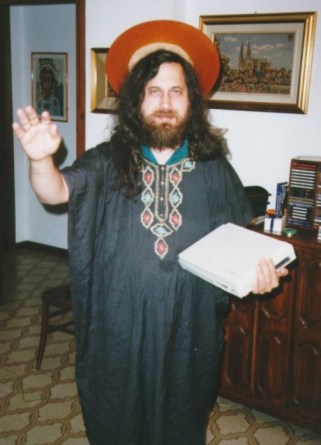
Re:How about "GNU"There's already a Church of Emacs which of course operates all over the world. It has a song sung by its leader, Saint IGNUcius. "I bless you, my computer, my child!"
And remember... Lensmen eat Jedi for breakfast.
-
Re:How about "GNU"There's already a Church of Emacs which of course operates all over the world. It has a song sung by its leader, Saint IGNUcius. "I bless you, my computer, my child!"
And remember... Lensmen eat Jedi for breakfast.
-
Andd now for the good news...
This could put some SERIOUS teeth into the GPL in Australia. (it just gets really hard to discuss it.)
-- -
Re:Better System Configs
If they could base a boot manager similar to GRUB off LinuxBIOS, then we'd instantly have a booter capable of reading a huge slew of partition types and filesystems. Currently GRUB only supports 4 filesystems IIRC.
-----
"People who bite the hand that feeds them usually lick the boot that kicks them" -
European TVs; piracy third
It's basically same as the DVD regions, except only 3 - one for each of Japan, America, and Europe
This is for a good reason. Console software is optimized for a particular television hardware standard. European games are optimized for 50 fps PAL, while North American and Japanese games run on 60 fps NTSC (that is, until 2006 when the USian FCC kills NTSC). Games that don't conform to the television will fall out of sync and produce a scrambled picture. For example, take NES games. The NES is easy to mod-chip (simply cut the power line) but the more timing-sensitive games (especially Rare games such as Rad Racer that use Pole Position-style raster scrolling) crash when played on a different style of television.
This also has the side effect of making it possible to play burned copies of games.
Which may or may not be illegal, depending on the license the game is released under. Backup first, free software second, piracy last.
All your hallucinogen are belong to us. -
Re:The GPL is also an "embrace and extend" strateg
No it isn't. It's much closer to a "If you're not for us, your against us" tactic.
That too. Of course, the GPL even punishes kindred spirits. (Witness the number of open-source licenses that are incompatible with the GPL.)
It says, "you can use our stuff, and make more stuff out of our stuff, but only if you lisence any resulting stuff the same".
The GPL is very much of a "my way or the highway" approach to "cooperation". Microsoft isn't much different either. You can use Microsoft's stuff, and make more stuff out of their stuff, but only if you use Microsoft's platform. How is this so different?
Embrace and extend is like "we'll get our stuff to support your features and play nice with your system, but then well add more features to ours that you can't use", thus meaning that if you want to use the fancy new stuff you gotta use the extended and the extended ain't shared with the original authors.
Are you trying to deny that GPL'd software tries to do exactly this? Try reading the GNU web page, Why you shouldn't use the Library GPL for your next library: "However, when a library provides a significant unique capability, like GNU Readline, that's a horse of a different color. The Readline library implements input editing and history for interactive programs, and that's a facility not generally available elsewhere. Releasing it under the GPL and limiting its use to free programs gives our community a real boost. At least one application program is free software today specifically because that was necessary for using Readline."
How is that different? "You can use our fancy new features -- but only if you play the game our way." The same statement could be used about the GPL (our way == use the GPL for your code), or for Microsoft API's (our way == use a Microsoft platform for your code).
So like I said, it's quite different.
It's not at all different. You're hung up on the fact the one side wants to share with you and the other side doesn't. Both sides want to force you into a path of doing things their way, because that furthers their objectives. Sure, the objectives differ, but the approach doesn't. -
license warsAccording to Gnu, the license for PHP Version 4 is not GPL-compatible because it includes a BSD-like advertising clause. For this reason, GNU recommends that free software developers write for PHP version 3 instead, because it is also licensed under the GPL .
Apparently, PHP-GTK gets by with linking to version 4 because GTK is released under the LGPL.
I'm surprised Richard Stallman hasn't released a blistering condemnation of the project yet.
-
license warsAccording to Gnu, the license for PHP Version 4 is not GPL-compatible because it includes a BSD-like advertising clause. For this reason, GNU recommends that free software developers write for PHP version 3 instead, because it is also licensed under the GPL .
Apparently, PHP-GTK gets by with linking to version 4 because GTK is released under the LGPL.
I'm surprised Richard Stallman hasn't released a blistering condemnation of the project yet.
-
license warsAccording to Gnu, the license for PHP Version 4 is not GPL-compatible because it includes a BSD-like advertising clause. For this reason, GNU recommends that free software developers write for PHP version 3 instead, because it is also licensed under the GPL .
Apparently, PHP-GTK gets by with linking to version 4 because GTK is released under the LGPL.
I'm surprised Richard Stallman hasn't released a blistering condemnation of the project yet.
-
license warsAccording to Gnu, the license for PHP Version 4 is not GPL-compatible because it includes a BSD-like advertising clause. For this reason, GNU recommends that free software developers write for PHP version 3 instead, because it is also licensed under the GPL .
Apparently, PHP-GTK gets by with linking to version 4 because GTK is released under the LGPL.
I'm surprised Richard Stallman hasn't released a blistering condemnation of the project yet.
-
license warsAccording to Gnu, the license for PHP Version 4 is not GPL-compatible because it includes a BSD-like advertising clause. For this reason, GNU recommends that free software developers write for PHP version 3 instead, because it is also licensed under the GPL .
Apparently, PHP-GTK gets by with linking to version 4 because GTK is released under the LGPL.
I'm surprised Richard Stallman hasn't released a blistering condemnation of the project yet.
-
Microsoft DID inspire "open source"
To an extent, Microsoft (the first major closed-source provider) did inspire the so-called "Open Source" movement. But the movement for free software explicitly for freedom's sake has been around since the early 1980s when Microsoft's influence on the industry was already great.
All your hallucinogen are belong to us. -
Microsoft DID inspire "open source"
To an extent, Microsoft (the first major closed-source provider) did inspire the so-called "Open Source" movement. But the movement for free software explicitly for freedom's sake has been around since the early 1980s when Microsoft's influence on the industry was already great.
All your hallucinogen are belong to us. -
Microsoft DID inspire "open source"
To an extent, Microsoft (the first major closed-source provider) did inspire the so-called "Open Source" movement. But the movement for free software explicitly for freedom's sake has been around since the early 1980s when Microsoft's influence on the industry was already great.
All your hallucinogen are belong to us. -
Re:Yet another first for KDEUnfortunately, my A tag was screwed up in my other post. I haven't written HTML in a long time and made a stupid mistake. (Imagine that) Here's the link: http://gcc.gnu.org/java/
--
-
Replying to everyone at once..
Why would you add Qt/KDE bindings to Java? Doesn't that just limit the crossplatformness of Java?
(a) Some people see merit in Java beyond its crossplatformness. Some people think it is a nice language, easy to develop in, easy to write maintainable code in. (b) Objectively, the existence of bindings for any language is a good thing for any toolkit. The absence of such bindings is a bad thing. Hence this is good.
can you say sludge? I would imagine the speed of these apps running on anything less than a Wonderbox would be like watching snails.
You are aware that Java code can be compiled to a native executable, using a compiler such as gcj? You are also aware that much of the blame for slow Java applications has been placed upon the Swing toolkit, which you wouldn't be using if you were using QT?
Why not just stick with C++ or something?
Perhaps because you are a Java programmer who is not experienced with C++ (or who doesn't like C++), and yet still wish to develop for KDE
this is all we need, kde apps that need to start a jvm to run.
Not if they're compiled to native executables..
What was the KDE developement team thinking..
Maybe that.. oops! nearly replied to a qpt troll!
KDE has had problems in the past with licensing issues..
oops! nearly replied to an Ananova troll!
Disclaimer: I'm not a Java programmer, or a KDE developer. I actually get paid for writing VB (OK, feel free to moderate me -1, "Spawn of Satan")
-
Re:Mandrake 8.0 beta is best for the homeGrovelling thru the assembly listing of the code generated by egcs-2.91.66 running on Slackware 7.1 w/2.2.16 kernel, I think I have discovered why 10 = 9.
The difference between the two expressions is that one is a constant expression and can be evaluated at compile-time (as is done by cc1), while the other is a variable expression and must be done at run-time. The compiler expanded the second expression in assembly code and got (at run-time) the result $9 (due to rounding error) in the %eax register, which was then pushed onto the stack. Then it evaluated the constant expression (at compile time) and got the constant result $10, which was pushed directly onto the stack. Then the string, then the call to printf.
The discrepancy is apparently due to the floating-point code in cc1 not having the same round-off errors as the code it generates. Maybe someone over at GCC HQ should take a look.
-
Re:RMS quoteIt will probably be too much to hope for, that some of the "RMS will only accept GPL" people will take note.
Indeed it will, given that he has played this game of bait-and-switch before, when he started trying to deprecate LGPL. For Stallman, any other form of licence is just a tactical compromise on the way to finagling everyone into using his beloved GPL. He wants to try to promote Ogg to become the de facto standard, and then start including features in it with GPL code, so that anyone who wants to stay up with the development path has to join his merry band of intellectual property guerrillas. Of course, when Microsoft do this, it's called "embrace and extend", but Open Source's favourite sweaty hippie would never do anything so bad, would he?
-
Re:Why should GPL software about UCITA?
Did you even bother to read this before sitting down at your keyboard and wasting all our time?
-
Where is the gov distributing their program?According to my understanding of the GPL, you only need to distribute your code modifications if you distribute the binary. If the government agency is just using this software internally, then their GPL code (and GPL infected code) will only need to be available internally, also. Of course, the question is whether the U.S. government a single entity, or would they have to distribute the source code between branches or just between federal, state, and local government agencies?
I'm basing this primarily on section 2b of the GPL.
-
This is a subject that I have looked at a little..
Mandatory Disclaimer: I am not a lawyer, nor do I pretend to be one--anything I tell you should not be construed as advice but the ramblings of a mad man.
Full GPL License There are a few ways that GPL'ed code can remain open but the greater project can be closed... think about DLL's or helper executables to handle the work that is required here. Helper executables would slow down the processing a bit, but linked DLL's should still work. IF it was "mandatory" to fix this "mistake" it might be plausible to place the GPLed code in a linked DLL and use that to work in the "gpl'ed" code... with the greater Executable being closed source.
Of course there is the option to redo all the work, but I doubt that this is even possible... but if the higher ups do not think a staticly linked DLL containing the open source code is possible (EG they dont want the open source for even that code any longer) -- well... redo all the work, or send a coded message involving the acronym "RTFGPL" (Read the 'friggin' GPL) to your higher ups. -
Re:Doesn't look GPL compatibleYou are correct; see GNU's Licence List.
"The License of Python 1.6b1 and later versions.
This is a free software license but is incompatible with the GNU GPL. The primary incompatibility is that this Python license is governed by the laws of the 'State' of Virginia in the USA, and the GPL does not permit this. "
-
Why should they?
Consider your history. Why are there now two desktop environments for Linux? Well, we have reached this state because of liscensing issues. The Gnome project formed purely because people were unhappy with the KDE qt liscense.
The origin of the projects is no longer important. So if MIT suddenly is given the source code for all the printer drivers in use on their campus, should RMS give up the Free Software Foundation? (click here if that didn't make sense to you)
Why continue to divide out labor on two projects which both hope to achieve the same thing?
Because they plan to do this in completely different ways, also once they are mature the differences willbeself evident.
Imagine how much more polished the Linux desktop environment would be if all effort were focused on just one. Twice as much effort would be expended on it every day.
Anyone who has read Frederick Brooke's Mythical Man Month knows that your statements are a big misconception. Doubling the number of developers on a project does not double the amount of time taken to finish the project because new developers have to be brought up to speed and the layers of communication increase which leads to more errorsoccuring due to miscommunication. Basically there is a certain level of complexity where throwing more developers at a product produces little net gain. KDE and GNOME are at that level of complexity.
KDE is mainly C++, GNOME is mainly C (if you do not realize there is a fundamental difference in these languages then go to comp.lang.c or comp.lang.c++ and state this and see the responses you'll get). GNOME uses all sorts of CORBA stuff while KDE does not. GNOME uses OrBit while the few KDE developers who know CORBA used Mico. Both projects are extremely undocumented and very few, if any, have a complete grasp of the entire system in either case.
Quite frankly,if KDE and GNOME merged the efforts involved in adjusting to the merger would slow down development a lot more than any perceived current lack of developers does. In addition, some functionality that was a part of one or the other system would be lost (because stuff always gets trimmed in a merger).
A better suggestion is for KDE and GNOME to start actively pursing interoperability. Unfortunately this is one place were Open Source may fail. It is unlikely that GNOME interoperability is high on the list of any KDE developer's list of itches he/she wants scratched and vice versa. Thus since they are all simply volunteers they can't be made to do it like would happen in a professional development environment, where a manager can just assign a bunch of coders this task.
Finagle's First Law -
A Good Cross-Platform FrameworkIf a company wants to develop software that will run on both Windows and Linux (and Mac OS and BeOS too), one application framework they can use is the ZooLib cross-platform application framework.
There's still some work it needs for complete Linux support as you can read here but it's a lot less than developing your own framework.
ZooLib requires very little in the way of system graphics support so it wouldn't be too hard to port it to the framebuffer if you prefer doing that to running your game under X.
Because ZooLib uses the MIT License (also known as the X11 License) it is appropriate for use in both proprietary and Free Software programs.
If ZooLib doesn't suit your needs, have a look at the GUI Toolkit, Framework page.
-
Re:different definitions for "free" software...RMS is using the FSF definition of Free.
Check it out here
-
Interesting that you should say that.
I have been thinking about starting a movement to do this. I even mentally mapped the areas of code I would being rewriting first. But when I pondered the matter further, I realized that all of the improvements and changes that I would make are things that HURD project pretty much has covered. I won't stop using GNU/Linux, but when the HURD is ready I would recommend checking it out.
-
Re:Sigh
With all due respect to the FSF, who cares what they think is "free software".
People who think that the FSF have thought through many of the issues of free software carefully, and given arguments as to why it is a good thing. Since the FSF (and RMS in particular) have thought about these issues extensively, that makes it interesting (to me) to hear what they have to say. Even when I don't agree with them.
They set up conditions for a definition of "free" and insist till the end of time that software is not "free" unless it follows the GPL (or some very close and related liscense)
FUD. Look at their website (here comes the link again) and see that there are many other licenses they class as free, that are quite different from the GPL.
Say all you want, its BETTER that not having the source at all. Apple should be given credit for it.
Hear, hear. I don't think anyone (least of all RMS) would disagree with the above statement
[offtopic remark about trolls] What you wrote certainly isn't a troll. A troll is when an author deliberately makes comments that he doesn't even personally believe to be true, just to incite an argument. You believe what you said, that's not a troll. (Moderators take note, please)
Jules
-
Re:Who cares?
The Free Software Foundation will only accept one license -- the one that gives them control, the GPL. It does not matter what anyone else attempt to do, unless you give all software over to their dogmatic cause, then you are the enemy. I don't think Apple should pay them a bit of attention. The FSF's dogma has always been "My way or the highway."
Well, the FSF think they're right. Of course. Most people who take a philosophical or moral stance think they've taken the right one
Also, I don't think GPL'ing software gives the FSF any particular control. It's still your copyright, you just happen to have chosen a license their lawyers drafted.
The fact that I can't make a direct system call (and bypassing the LGPL'ed glibc) in Linux without GPL'ing my software is nauseating. The fact that I can't use the GNU regular expression library without GPLing my software is even more frustrating. What is the point of a library you can't use because of licensing issues? How is that free?
It's a device to ensure that software stays free. I'm sure you understand this. (I'm not asking you to agree with it, you don't have to). It's a device to protect the author's work, in a different way to a conventional copyright. A conventional copyright protects the author's work by forbidding copying it at all without a fee (and, in general, source code is not available). The GPL protects the author's work by ensuring that derived works must also be GPL'ed (which almost, but not quite, means that their source must be released). The X11 license (also a free software license) simply doesn't protect the author's rights at all.
Oh, and incidentally, a program which syscalls directly is still (probably) not a derived work of the Linux kernel, and so wouldn't need to be GPL'ed. Exactly what a derived work is, is a subjective, not technical, issue.
I don't think that it's important. It's just an attempt to get the zealots stirred up in an attempt to force Apple to accept things on the FSF's terms. I say ignore them.
I think it's simply RMS saying "It seems Apple wishes this to be free software" (and it does seem that; that does appear to be Apple's intention), and "in my opinion, it still isn't, for this reason". No one is claiming RMS is the only voice that counts, but (for me, at least) his views are interesting, because he has taken a long time to think about the issues involved
Jules
-
"mere aggregation" is ok
Well, what about a Linux distro that contains GPL stuff and.. say.. Netscape Communicator?
Look at the text of the GPL, end of section 2:
In addition, mere aggregation of another work not based on the Program with the Program (or with a work based on the Program) on a volume of a storage or distribution medium does not bring the other work under the scope of this License.
-
securely wiping drives
The definition of wiping drives properly, like other security related matters, depends on what adversary you are trying to protect the data from. If your adversary is a coworker, shred ( gnu fileutils (older) or gnu fileutils (newer) ), wipe , or norton utilities wipeinfo (see Norton System Works , you might have to get the professional edition to get wipeinfo) might work. For adversaries that have more funding and/or time, purchasing sanitizer is advisable as its "D" version meets DOD requirements for electronically disposing of classified and sensitive data on a hard drive. It can apparently defeat electron microscopes with spin control, when properly utilized. Note that if you're going to this extent you probably want to TEMPEST shield (and here and there ) your life, and start using crypto sytems that keep the key material in FIPS 140 compliant crypto devices like these.
-
securely wiping drives
The definition of wiping drives properly, like other security related matters, depends on what adversary you are trying to protect the data from. If your adversary is a coworker, shred ( gnu fileutils (older) or gnu fileutils (newer) ), wipe , or norton utilities wipeinfo (see Norton System Works , you might have to get the professional edition to get wipeinfo) might work. For adversaries that have more funding and/or time, purchasing sanitizer is advisable as its "D" version meets DOD requirements for electronically disposing of classified and sensitive data on a hard drive. It can apparently defeat electron microscopes with spin control, when properly utilized. Note that if you're going to this extent you probably want to TEMPEST shield (and here and there ) your life, and start using crypto sytems that keep the key material in FIPS 140 compliant crypto devices like these.
-
More helpful tips for youWhile I was out for a while I thought of a few more things to post that should have been included in the above.
While I don't think either of them were really overtly trying to mentor me, I owe a lot of credit for what I know and what I can do to a couple of brilliant programmers that I've had the privilege to work with. Both of these fellows are very kind, pleasant people and went out of their way to help me. They also both go out of their way to write correct code, as opposed to, say, just screwing around with it until it sort of works.
I met Haim Zamir at Live Picture (now MGI Software) in 1997 where I really began my C++ effort in a serious way (I tried it in 1990 to write test tools at Apple but didn't really enjoy the experience). Have a look at Haim's Resume, particularly under "Skills" where he lists:
Well grounded in disciplines of software engineering for correctness, robustness, performance, and longevity
Haim can write the most difficult code, and it doesn't just work right, it is unquestionable.Another brilliant programmer is my friend Andrew Green. Andy spares no amount of effort to get his code just right - he devoted nine years to developing the ZooLib cross-platform application framework before releasing under the MIT License. (Not five years as I say on the page.)
If you think being correct, as opposed to merely working ok isn't important, imagine trying to get platform-independent reference counted smart pointers to work in a multithreaded application framework. Andy did.
For an archive of anecdotes of interesting, funny and sometimes tragic technology quality problems, please read:
-
The Forum on Risks to the Public in Computers and Related Systems,
with such anecdotes as:
- The Sinking of the USS Gitarro (because of either poor training, poor UI, or both)
- The scary MSWord residue feature - exchange Word documents during legal negotiations?
- Also see the book Computer Related Risks by Risks moderator Peter Neumann
If you write software, another good investment (more important than your hardware investment), is buying and reading good books. As a software consultant I keep the canceled checks and receipts for my technical book purchases; in 1999 I deducted about $750 worth of technical books from my taxes and about $250 in 1998.
But there are a lot of bad software books out there; much as there was a gold rush due to the Internet, there was a smaller-scale gold rush for technical book authors over the last couple years. A really good source of straight-talking book reviews by people who have good reason to know what they're talking about is maintainted by the Association of C and C++ Users at:
The ACCU is interested in more than just C and C++ these days, if you program in those languages, Java or (dare I say it) C-sharp you should join. The mailing lists is pretty low traffic and has some of the best signal-to-noise ratio of any list I've seen (except Risks). The ACCU's technical journals, with articles written by the members, are a valuable source of information on such things as how to write exception-safe code.(Note to CowboyNeal - writing C-sharp with the pound sign set off the lameness filter, driving me damn near out of my skull. How about adding something to the preview to let us know which characters are lame, exactly?).
And good news for those of you across the pond (but bad news for me), it's a British organization and holds regular technical conferences. I believe they also send observers to the ISO standards bodies.
If you program in C++ you should read these two books by Scott Meyers and put them to practice in your code. Read each item one at a time and then go through your code from beginning to end to see how you can apply it:
- Effective C++ - ACCU Review - be sure to get the 2nd Edition
- More Effective C++ - ACCU Review
-Weffc++ (C++ only)
Importantly, in any language, make sure your code compiles cleanly without warnings with all the warnings enabled in the compiler - use the -pedantic option in gcc.Warn about violations of various style guidelines from Scott Meyers' Effective C++ books. If you use this option, you should be aware that the standard library headers do not obey all of these guidelines; you can use `grep -v' to filter out those warnings.
C++ is not the problem language it's often said to be if you follow Meyers' advice, but if you prefer C you certainly can have problems there too - and note that the preferred language for Gnome is C (while KDE is an extended C++), for C programmers you should read:
People who write in any programming language, from assembler on through C and way out to prolog, really should go back to our roots and read the early book: Sadly, this book is out of print, but see the "E" Titles Section at ACCU for other Elements of Style books.Back to the topic of compiler warnings, remember reading about lint in Kernighan and Ritchey's The C Programming Language? When I started out in my first real programming job, doing Sun system administration and writing image processing software back in the late '80's, I learned to write "lint" targets in my Makefiles, and I'd type "make lint" after editing but before compiling to actual machine code. This made my code much easier to debug and quicker to develop.
Much of lint's function is now available in the warnings of GCC (but I don't think all of it), but there are some proprietary products that will do extremely rigorous statis analysis of your source code. I haven't yet used either (although I plan to) but the two I know about are:
Looks like I missed one when I spoke about Bounded Pointers for GCC, Spotlight, etc. in my previous post. Parasoft offers: But note that these products use patented algorithms - number 5,581,696 and 5,860,011.You can search by patent number here.
And speaking of web programming, many Slashdot readers write web applications (Linux being a "server OS" as they say). How many of you validate the HTML that's generated by the web applications you write?
Your HTML should work well in any browser and it should be well designed for easy usability. I don't mean attractive graphics. I mean it shouldn't suck. Two links on design:
Finally, to make sure your HTML is valid, test it with the W3C HTML validation service. You have two choices of how to get your documents processed:- By uploading static files from your browser - most convenient during hand composition
- By entering its URL in a form - best for dynamic pages and final tuning of static pages
-
The Forum on Risks to the Public in Computers and Related Systems,
with such anecdotes as:
-
My own efforts to help other programmersFirst, my effort to improve the quality of free software can be found at the Linux Quality Database. While the database hasn't started being written yet, I have started writing articles on the top of quality assurance and writing better free software. The first such article actually to be posted is Using Test Suites to Validate the Linux Kernel.
For quite some time before that I have been writing GoingWare's Bag of Programming Tricks, a collection of articles on the business and practice of programming. Of most interest in learning how to program well would be:
- Study Fundamentals Not Tools APIs or OSes
- Properly managing memory returned by transcode() in the Xerces library (while about an obscure problem, it illustrates more general principles in a useful way)
- Secrets of the Debug Meisters: MacsBug Tips and Tricks (MacsBug is a Mac OS assembly debugger)
- Pointers, References and Values - Passing Parameters, Returning Results and Storing Member Variables, with Musings on Good C++ Style
- Bounded Pointers for GCC
- Spotlight for Mac OS PowerPC
- BoundsChecker for Windows
- Purify for Windows and Unix (but I think it doesn't support Linux)
-
shred (of the GNU fileutils) works wellSource is here: fileutils-4.0.41.
For the theory behind it, see "Secure Deletion of Data from Magnetic and Solid-State Memory".
On-line documentation (if you have the package installed already):
$ info 'file util' basic shred
-
But they are FSF donors!
How can this be when they are FSF donors?!
Just take a look at Thank GNUs page the the FSF homepage, and search for Microsoft on the page. Microsoft Corporation is listed there...
-
But they are FSF donors!
How can this be when they are FSF donors?!
Just take a look at Thank GNUs page the the FSF homepage, and search for Microsoft on the page. Microsoft Corporation is listed there...
-
Re:Restrictions
Why not tailor the GPL or BSD style licenses to you (sic) personal tastes and check out their legality with your local friendly law student or lawyer?
Because, from: http://www.gnu.org/copyleft/gpl.html:Everyone is permitted to copy and distribute verbatim copies of this license document, but changing it is not allowed.
-
Re:Is ESR Relevant?
Accomplishments from the fetchmail project aside,
Hey, don't forget the broken version of ncurses he released (3.something). Fortunately, more able people have since released a better version.
does anyone think that ESR still has a credible voice in the community? For me, he stopped having credibility shortly after the flurry of Linux-related IPOs.
You mean when he wrote self-promoting crap like his "Newfound Wealth" bitching-cause-i'm-rich or the "Take my Job please" bitching-cause-i'm-famous bit?
I, along with a lot of other people, interpreted his statements as arrogant, thinly-guised, and frankly insulting bragging (the exact stuff we love Linus for *not* doing).
You're hardly the only one.
In any event, it seems to me that his role as a community mouthpiece has been largely taken over
It's about time.
I know this is marginally off-topic, but I need to know if I'm alone amongst the serious
Not hardly. If a tree fell on ESR in a forest filled with Linux users, would anyone notice? The guy is, and always has been, all talk. Say what you will about RMS (a communist), Larry Wall (a pseudo-scientist babbler), or Theo deRaadt (a sociopathic cult leader), but they produce working code. Until ESR does more than a simple mail downloader (is he capable of it?), he is simply not needed.
(I already know what the trolls think),
Heh.
or am I just being too hard on a guy who still has something worthwhile to say despite letting the dollar-signs go to his head at one point?
One word: no.
-- Floyd