Slashdot Mirror
Domain: gnu.org
Stories and comments across the archive that link to gnu.org.
Comments · 13,360
-
Re:Prevents TivoizationYou may want to read up on the GPL version 3. From http://www.gnu.org/licenses/quick-guide-gplv3.html
Protecting Your Right to Tinker
Tivoization is a dangerous attempt to curtail users' freedom: the right to modify your software will become meaningless if none of your computers let you do it. GPLv3 stops tivoization by requiring the distributor to provide you with whatever information or data is necessary to install modified software on the device. This may be as simple as a set of instructions, or it may include special data such as cryptographic keys or information about how to bypass an integrity check in the hardware. It will depend on how the hardware was designed—but no matter what information you need, you must be able to get it.
This requirement is limited in scope. Distributors are still allowed to use cryptographic keys for any purpose, and they'll only be required to disclose a key if you need it to modify GPLed software on the device they gave you. The GNU Project itself uses GnuPG to prove the integrity of all the software on its FTP site, and measures like that are beneficial to users. GPLv3 does not stop people from using cryptography; we wouldn't want it to. It only stops people from taking away the rights that the license provides you—whether through patent law, technology, or any other means.If Apple allowed GPL 3 software on the iPhone, then they would have to make it possible for me to change that software on my actual iPhone without any additional conditions. A payment is one such additional condition. You can charge for GPL 3 software, but you can't first deliver it and then require a charge to live up to the requirements of the GPL 3. If the SDK was free and freely redistributable then maybe there wouldn't be an issue, but clearly Apple don't want that since then competitors could set up competing app stores for the iPhone.
-
My first question.Will they resolve the question of std::list::size() function's speed? It is constant O(1) in Visual C++ implementation. In gcc people are arguing over fine distinctions between "shall" and "will" or something equally esoteric. As it stands in Linux it is Order(N). I am not kidding. My code was scaling fine in Visual C++ going form 10 elements to 10 million elements in a nice predictable N*Log(N) curve. It was frustrating to debug the scaling loss in Linux and to finally realize, the root cause of the trouble was the break conditional evaluation in the for loop. And everyone is refusing to fix the damn thing for six years. We were paying maintenance to RedHat. And they were also giving us the lawyer talk instead a fix.
-
Re:It's a linux distro.
One of 8 approved GNU/Linux distributions. None of which matter in the real world.
Outside of servers and as a basis for other systems (like TiVo and Android) and appliances, one could similarly claim that no Linux distro matters 'in the real world'. Although I don't share the FSF's moral stance on software, I do think it's good for them to put out lists like this and endorse software that meets their ideals.
Apparently, in order to be an approved FREE software OS, you need to prevent users from using non-free software. FREE from choice. The ultimate FREEdom.
That's not true. They require the distros to not include non-free software (including not having official 'non-free' repositories), but the user can be allowed to install non-free software. In fact, I'm pretty sure that if a distro had the ability to prevent users from installing non-free software, it would logically have to be a non-free system and thus not allowed in the FSF's list.
The FSF has always supported peoples' right to choose non-free software. They have simply been consistent in doing everything they can to discourage it, but never disallowing it.
-
Re:It's a linux distro.
One of 8 approved GNU/Linux distributions. None of which matter in the real world.
Outside of servers and as a basis for other systems (like TiVo and Android) and appliances, one could similarly claim that no Linux distro matters 'in the real world'. Although I don't share the FSF's moral stance on software, I do think it's good for them to put out lists like this and endorse software that meets their ideals.
Apparently, in order to be an approved FREE software OS, you need to prevent users from using non-free software. FREE from choice. The ultimate FREEdom.
That's not true. They require the distros to not include non-free software (including not having official 'non-free' repositories), but the user can be allowed to install non-free software. In fact, I'm pretty sure that if a distro had the ability to prevent users from installing non-free software, it would logically have to be a non-free system and thus not allowed in the FSF's list.
The FSF has always supported peoples' right to choose non-free software. They have simply been consistent in doing everything they can to discourage it, but never disallowing it.
-
Re:It's a linux distro.
http://www.gnu.org/distros/common-distros.html
Ubuntu offers the option to install only free packages, which means it also offers the option to install nonfree packages too.
Thank you, Captain Obvious... -.-
-
Re:Gonna be totally honest here...
The only word in the summary that I recognise is "Release", but I can guess what "Libre" means. I don't know why you can't just use "free."?
In the open source community (and most of the larger computer nerd metacommunity) the term free software has a very specific meaning. Unfortunately, the english word free has two different meanings: free as in freedom, and free as in beer, as it's usually put. To anyone not in the know, free software is just software that can be obtained at no cost.
Using the words libre and gratis clarifies what you're talking about, and though it may not be a particularly useful distinction on slashdot, it's often used elsewhere. Most people can guess what they mean even if they've never heard them used in this context, because gratis is often used to say "this costs nothing", while libre sounds a lot like liberty.
-
Re:It's a linux distro.
One of 8 approved GNU/Linux distributions. None of which matter in the real world.
Apparently, in order to be an approved FREE software OS, you need to prevent users from using non-free software. FREE from choice. The ultimate FREEdom.
-
Re:It's a linux distro.
One of 8 approved GNU/Linux distributions. None of which matter in the real world.
Apparently, in order to be an approved FREE software OS, you need to prevent users from using non-free software. FREE from choice. The ultimate FREEdom.
-
Apple is just another proprietor sometimes.
Then you shouldn't have any problem listing these things in detail. I doubt what you're saying is true. I think it's far more likely Eben Moglen's description is the case: (paraphrased) announce GPLv4 and people will love GPLv3 like a brother. This is what happened with GPLv2: when it was announced work began on GPLv3, suddenly GPLv2 was loved.
Some of what Apple does reveals Apple to be just another proprietor who built their fortunes on free software: they know they can't go far without software freedom, and they want to treat the free software community as a market, but they don't want to behave as a member of the free software community.
As for being "quite happy to contribute to GCC", that simply is not true. NeXT committed copyright infringement and GCC's copyright holder (FSF) compelled them to comply with GCC's license (GPLv2). Bradley Kuhn describes it succinctly, "Apple lawyers have a pathological hatred of GPL, which he believes comes directly down from Steve Jobs, who began his dislike of GPL when he tried, while at NeXT, to distribute a proprietary front-end for GCC for Objective-C." and Richard Stallman talks of this in the essay Copyleft: Pragmatic Idealism explaining why GCC can compile Objective-C:
NeXT initially wanted to make this front end proprietary; they proposed to release it as
NeXT was lucky they were dealing with a copyright holder who (then as now) seeks compliance with the license above monetary compensation and court appearances. NeXT was also lucky that, at the time, they were able to correct their illegality outside the spotlight of publicity. Apple owns NeXT now and we're talking about the same person in charge at both companies. Apple would go on to commit copyright infringement against the FSF again in May 2010 distributing GNU Go in violation of the GPL (by adding additional restrictions on top of GPLv2 which that license disallows) but that time chose to cease distributing GNU Go.
-
Re:GPL is the problem
That's not the case at all. They are fully comptable, and the conjoined work becomes GPLv3.
FALSE. If you did the research, and read the licenses, or at least the FAQ, you would learn something:
Q: Is GPLv3 compatible with GPLv2?
A: No. Some of the requirements in GPLv3, such as the requirement to provide Installation Information, do not exist in GPLv2. As a result, the licenses are not compatible: if you tried to combine code released under both these licenses, you would violate section 6 of GPLv2.The ONLY exception is if the author included a statement in the source code that allows you to distribute their code under any future version of the GPL (which they sometimes do), but that would not be because the licenses were compatible -- that would be because the author gave the FSF a blank check to offer new licenses that may be used with the code.
-
Re:GPL is the problem
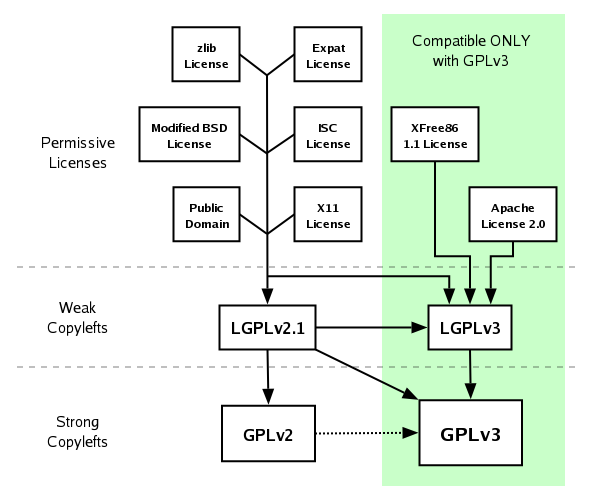
That's not the case at all. They are fully comptable, and the conjoined work becomes GPLv3. The GPLv3 is actually more compatible with other licenses than the GPLv2.
http://www.gnu.org/licenses/quick-guide-gplv3-compatibility.png
-
Lesser GPL vs. Ordinary GPL
There are two GPL licenses and they are both copyleft licenses. There is the ordinary and there is the lesser. The lesser GPL (LGPL from here on in) is used on software you want to allow people to recompile/include in their own closed source works they can then resell without the consent of the copyright holder.
On the other hand, the ordinary GPL states that you cannot include the work in closed source works, only other open source works. With both, if you attempt to branch the work, the new work will still be covered by the license used to create the original work.
So to sum it up:
LGPL -> can be used in new closed source products and resold. For example AForge, an imaging framework, uses a LGPL.
GPL -> can only be used in other GPL style licensed products. For example Quake3 source. You cannot use (compile) this in a closed source project.
The FSF wants you to use the GPL to force more people to write open source software. I'm all for that.
From gnu.org:
http://www.gnu.org/licenses/gpl-faq.html#WhySomeGPLAndNotLGPL:
IMHO Apple is an enemy to open source software. They will drink from the open source font, but when it comes to opening their own software forget it. They hijack FreeBSD and turn it into an abomination of closed source commercialism, flying in the face of everything the copyleft license stands for. That's why instead of just switching their whole operation to open source ordinary GPL they scurry away and remove ordinary GPL software and scour the internet for other LGPL suckers they can suck the life out of to pad their own pockets.
Apple, stop it with the free ride, it took millions of man hours that you didn't pay for to build the software you so arrogantly call OSX. I love the prorogation of FOSS but I hate the way Apple treats everyone. Customers, fans, foes, they are all scum to Apple, to be used and discarded when they become a liability, Samba in this case, but there are many more. If Apple were any friend of open source they would not just use open source, they would be open source and license their software using the GPL. -
Re:The fundamental GPLv3 flaw...
The issue Apple has is additional enforcement of the 4 freedoms of free software. The GPL2 had a pair of loopholes which GPL3 closed.
1. anti-tivoization - You must be able to take the source provided (under freedom 1), modify it, compile it, and run it on the device (freedom 0). iOS does not allow this due to the requirement that all code must be signed by Apple before it will run. They would be in full compliance if they provided an option to allow unsigned code or allowed users to add their own certificates, but they don't.
2. Patents - If your GPL3 code is covered by a patent, you are required to license that patent to anyone who you give/sell your software too, along with anyone they give/sell the software too, and so on down the chain, otherwise they could sue someone distributing the software (freedom 2) or their modifications of such (freedom 3). They can still sue anyone infringing on that patent while not using their code, though it would make proving the infringement more difficult.
-
Re:GPL is the problem
The GPL(3) is functioning just as it was designed, to limit commercial use of code.
Nope, that wasn't why it was designed. You can learn about the GPL here: http://www.gnu.org/licenses/quick-guide-gplv3.html
-
Re:Prevents TivoizationExcept that the anti-tivoization clause only applies to "User Products" and is more about where you'd actually be prevented from using modified copies (vs. having to install it in a different way). From the GPL FAQ:
I use public key cryptography to sign my code to assure its authenticity. Is it true that GPLv3 forces me to release my private signing keys?
No. The only time you would be required to release signing keys is if you conveyed GPLed software inside a User Product, and its hardware checked the software for a valid cryptographic signature before it would function. In that specific case, you would be required to provide anyone who owned the device, on demand, with the key to sign and install modified software on his device so that it will run. If each instance of the device uses a different key, then you need only give each purchaser the key for his instance.
My impression is that the problematic part of the GPLv3 is the "patent retaliation" clause.
-
Re:GPL is the problem
Sorry, I screwed up the link, here: http://www.gnu.org/philosophy/open-source-misses-the-point.html
-
Re:GPL is the problem
If a developer in the forest offers to distribute 3rd party GPLv3 code, and no-one is there to see this, has a GPLv3 violation occured?
Good question. Let's wait and see what RMS' lawyers have to say. Or just use a different license that is shorter and simple enough for everyone to understand clearly and doesn't inherently cause a barrage of inter-license incompatibilities. A simple, down-to-earth license is joy.
-
Re:GPL is the problem
You're either for software freedom or your not. GPL restricts what you can, therefor is not free.
This kind of "either you see it my way our you're wrong" statement is NOT a good argument.
There are real reasons why the GPL versions (and other licenses) are problematic for various folks, and this kind of assertion acknowledges none of them.
You can learn the factual basis for arguments against or in favor of various open source or free software licenses at the OSI site and at the FSF site.
-
Here, let me Google that for you.
-
Re:Sparc
Not the most widely used software maybe, but SBCL is taking its time porting to ARM, Clozure CL doesn't have a port I'm aware of, nor does CLISP. The only Common Lisp implemantation I know of that works on ARM is ECL.
-
Re:Jesus Flipping Christ...
emacs http://www.gnu.org/software/emacs/ is on version 23.3 as of now (March 2011), and it is perfectly ok.
-
Different types of economic transactions
* Subsistence (taking from the environment)
* Pollution (putting back to the land in a harmful way)
* Gift giving (to individuals or a group, like free software and personal blogging, or the environment at an improvement)
* Theft (compelling as an individual)
* Planning authority (compels action by force or reasonable persuasion usually from above to some purportedly good social end)
* Exchange (non-compelled interchange)The balance of all these changes depending on the technology and culture. We are seeing the balance change as the internet makes possible stigmergic cooperation on a huge scale (like Wikipedia and GNU/Linux).
Using a paywall and copyright laws backed ultimately by state violence to create "artificial scarcity" to force an exchange for otherwise easily copied goods is just a more and more problematical business model in an age more and more dominated by subsistence, gift giving, and planning. This is especially problematical when copyrights have been extended to be effectively infinite, when in the age of the pony express and sailing ships they were about twenty years, since if anything, they should be shorter now by the logic of faster times to recoup investments in fast moving media. So, the old social bargain for copyright feels like it has been broken by the publishers (see Richard Stallman for more on the social bargain issue).
http://www.gnu.org/philosophy/misinterpreting-copyright.htmlIf we had twenty year copyright (or much less) so much would be in the public domain we would have a much freer society and creators would have a lot more in the public domain to draw from. One way to get there would be to put an annual tax on all copyrights as some small percentage of what owners say they are worth (where anyone could buy the copyright into the public domain for that full amount).
-
the Right to Read
Human are naturally unwilling to express their creativity which is why we need to restrict the right to read so they have financial incentive to do stuff, right?
You have no right to be lazy, educating yourself and being productive out of enjoyment. To aim for an Ancient Greek society with technology as a replacement for slavery is insane. Your only right is the right to be worked^W^Wwork. Everyone who doesn't enjoy this right is just lazy - remember to be divided and conquered and engage your bitterness to turn against your fellow man even while he wants a better life for you. Then turn your brain into a tradable commodity. Hemos pasado!
-
Re:What about C++ headers with template functions
It's right that while LGPL works for C code to make its header files non viral, C++ header files may contain non trivial template code that turns them into source files, license wise. They have to contain an explicit permission to be used without an viral effect.
For example the Gnu's libstdc++ header files are under GPL with the following addition:
which refers to: http://gcc.gnu.org/onlinedocs/libstdc++/manual/license.html
The purpose of this Exception is to allow compilation of non-GPL (including proprietary) programs to use, in this way, the header files and runtime libraries covered by this Exception.
I think of it as LGPL for C++ code, but it doesn't have its own name.
-
Re:All works are derivative
who create
You used a non-word: http://www.gnu.org/philosophy/words-to-avoid.html
-
Re:I'm not that technically knowledgeable*...
Unfortunately, this doesn't mean that the manufacturers of mainstream Anroid devices can't lock them down so the people that buy them can't put on their own versions of self-baked Android. It's not Android's fault, but it damn well is Android's problem
I'm pretty sure that parts of the LGPL (which a parts of Android are undoubtedly licensed under) makes it clear that the user must be able to:
0) Convey the Minimal Corresponding Source under the terms of this License, and the Corresponding Application Code in a form suitable for, and under terms that permit, the user to recombine or relink the Application with a modified version of the Linked Version to produce a modified Combined Work, in the manner specified by section 6 of the GNU GPL for conveying Corresponding Source.
1) Use a suitable shared library mechanism for linking with the Library. A suitable mechanism is one that (a) uses at run time a copy of the Library already present on the user's computer system, and (b) will operate properly with a modified version of the Library that is interface-compatible with the Linked Version.(From http://www.gnu.org/copyleft/lesser.html)
I'd argue that a locked bootloader prevents me doing just that, since I can't update the firmware image with my replacement library and expect it to boot.
-
not so fast
The following excerpt appears near the beginning of the GPL v2 license that covers Linux (emphasis added):
1. You may copy and distribute verbatim copies of the Program's source code as you receive it, in any medium, provided that you conspicuously and appropriately publish on each copy an appropriate copyright notice and disclaimer of warranty; keep intact all the notices that refer to this License and to the absence of any warranty; and give any other recipients of the Program a copy of this License along with the Program.
You may charge a fee for the physical act of transferring a copy, and you may at your option offer warranty protection in exchange for a fee.
2. You may modify your copy or copies of the Program or any portion of it, thus forming a work based on the Program, and copy and distribute such modifications or work under the terms of Section 1 above, provided that you also meet all of these conditions:
a) You must cause the modified files to carry prominent notices stating that you changed the files and the date of any change.
b) You must cause any work that you distribute or publish, that in whole or in part contains or is derived from the Program or any part thereof, to be licensed as a whole at no charge to all third parties under the terms of this License.
c) If the modified program normally reads commands interactively when run, you must cause it, when started running for such interactive use in the most ordinary way, to print or display an announcement including an appropriate copyright notice and a notice that there is no warranty (or else, saying that you provide a warranty) and that users may redistribute the program under these conditions, and telling the user how to view a copy of this License. (Exception: if the Program itself is interactive but does not normally print such an announcement, your work based on the Program is not required to print an announcement.) -
Re:Please stop spreading FUD ...
Guys, can't you see a bogus claim whenerver you see it? Using header files for developing userland software IS allowed by GPL without being necessary to license the application code as GPL. EXPLICITLY!!!!
Can you point out where the GPL explicitly says anything about header files or userland software? Here is the text of the license, for the sake of convenience.
(There is a copyright notice distributed with the Linux kernel, but it's an extra on top of GPL, and is kernel specific.)
-
The term "intellectual property"
There is a reason there is a legal term "intellectual property": because it's different to physical property and has different laws and different offences against those laws.
"Intellectual property" didn't become a legal term until the formation of WIPO, as I understand it. Richard Stallman has explained how "intellectual property" confuses several issues, and I've written my own thoughts on the term. The term carries several hidden assumptions, at least some of which I believe are contrary to fact:
- Copyrights, patents, trademarks, and trade secrets are more similar than different in purpose.
- These exclusive rights are more similar than different in scope.
- These exclusive rights are more similar to exclusive rights in land than different from it. (You recognize that this is untrue, but some "IP" proponents have not.)
- The best way to promote the creation of works of authorship and inventions is by creating a state-sponsored entitlement to exclusive rights.
- Especially when the term is abbreviated as "IP", strained analogies among these exclusive rights and between them and rights in land should be taken for granted.
If you mean copyright, say copyright. Otherwise, I agree with the points you make
-
Re:What the heck?
Whoops, here's the link I was trying to make to the libstdc++ faq.
-
Here we go again ...
The usual "Ragging on Flash" roundup rolling in.
Let's look at the facts:
1) Flash is by far the most ubiquitous end-user plattform in existance.
2) For a little more than a decade competitors have tried to dethrone Flash. And even the most promising of those failed miserably due to pure and utter incompetence in delivering what people want and rich client developers need. (Java Media Framework and JavaFX anyone?)
3) Compared to it's penetration and availability, Flash actually is one of the safest plattforms out there. Which is why it's so popular. Duh. Or are you telling me that Firefox would have less security problems if it had a 97.5% worldwide installbase?
So all of you know-all Flash bashers STFU and come up with a viable FOSS alternative. And no, this isn't an alternative. It's a joke, emphasising that the GNU frontline fighters for freedom are good at building compilers, maintaining ancient editors and doing evagelism, but totally suck at delivering anything usable that tend to computing with a mouse and a GUI.
Bottom line:
How about you guys stop living in your dreamworld and start thinking about what makes Flash so popular and what it would actually take to build a competitor that doesn't fall flat on it's face. Then you'd probably notice that there actually still is quite a bit of work to be done in the field before FOSS can catch up. -
RMS supports free, not open source, software.
I don't know if he's ever slipped up and accidentally said open source, but he's pretty adamant that he supports free software and *not* open source software.
http://www.gnu.org/philosophy/open-source-misses-the-point.htmlThe definitions are almost the same, but they're philosophically different. Free software is about freedom; open source software only suggests that it is a practically better model. That's what Stallman says, anyway.
He also addresses the idea of free microwaves or microwave dinners (tables actually).
http://www.youtube.com/watch?v=SNBMdDaYhZA
Supposedly, you can modify a table or a dinner without their blue prints, but it's less feasible with programs. I can see a couple holes in that argument, but they're not gaping. Trying to modify a compiled program isn't impossible, but it's somewhat insane. On the other hand, I modifying a microwave would be easier with the schematics. -
Re:You always need a
RMS is seen as crying wolf, but many of his weirdest predictions have come true.
Viz. The Right to Read
And we're already there with Amazon's action's regarding remote Kindle book manipulation.
Cell phones? Remember the article on government snooping while the phone's turned off? The fact that cell phones can and do track you is blindingly true, but for some reason, people don't even want to hear it.
Yup, it isn't just government agencies. It could be douchey co-workers as well.
Do you assholes hear me? I'm NOT bringing the potato salad to the pot luck on Thursday!!
-
Re:Open source vs proprietary
Well, let's see. His most recent code commit to emacs was in November 2009, looks like: http://git.savannah.gnu.org/cgit/emacs.git/log/?qt=author&q=stallman
So at least that recent, even assuming he's not worked on anything else.
-
Re:Drop the GNU.
It looks like what they're doing is using SIP Witch as a basis. As far as I can tell, SIP Witch just connects endpoints to each other, allowing those endpoints to negotiate a protocol for what they're streaming to each other independently. I think the new thing here is that it'll be able to route through a P2P/mesh type arrangement, for privacy and independence from a single central service provider -- but everything else is existing code.
That's what I gleaned from TFA and its comments. I could have misunderstood large parts of it. Feel free to correct me.
-
Re:Some developers have families to feed
Maybe I'm not informed well enough about what free software really is.
That seems to be the case, yes.
http://www.gnu.org/philosophy/selling.html
I don't mean to be rude (really!) but it's probably worth being familiar with the FSF's stance, before weighing into the debate.
-
Re:Some developers have families to feed
There's often great confusion in what free means when discussing free software. When Richard Stallman uses the term free software, he doesn't mean that it necessarily comes free of cost.
From the free software definition: “Free software” is a matter of liberty, not price. To understand the concept, you should think of “free” as in “free speech,” not as in “free beer.” http://www.gnu.org/philosophy/free-sw.html
For instance, the Mozilla Corporation is for-profit (unlike the Mozilla Foundation, which is non-profit), but their software falls under the definition of free because anyone can analyze it, modify it, etc. Similarly, you can analyze, take apart and rebuild your toaster. You might break it in the process, but when you buy it, there is nothing preventing you from taking a screwdriver to it.
-
You always need a
RMS is seen as crying wolf, but many of his weirdest predictions have come true.
Viz. The Right to Read
And we're already there with Amazon's action's regarding remote Kindle book manipulation.
Cell phones? Remember the article on government snooping while the phone's turned off? The fact that cell phones can and do track you is blindingly true, but for some reason, people don't even want to hear it.
-
Re:What about Xcode?
Can you get the source via the App Store? If not, it's a violation of the GPL.
They have to offer you the source via exactly the same means as the binaries.
100% WRONG!!
http://www.gnu.org/licenses/old-licenses/gpl-2.0.html
3. You may copy and distribute the Program (or a work based on it, under Section 2) in object code or executable form under the terms of Sections 1 and 2 above provided that you also do one of the following:
- a} Accompany it with the complete corresponding machine-readable source code, which must be distributed under the terms of Sections 1 and 2 above on a medium customarily used for software interchange; or,
- b) Accompany it with a written offer, valid for at least three years, to give any third party, for a charge no more than your cost of physically performing source distribution, a complete machine-readable copy of the corresponding source code, to be distributed under the terms of Sections 1 and 2 above on a medium customarily used for software interchange; or,
- c) Accompany it with the information you received as to the offer to distribute corresponding source code. (This alternative is allowed only for noncommercial distribution and only if you received the program in object code or executable form with such an offer, in accord with Subsection b above.)
-
Re:Not incompatible
I believe a simple link is not a valid "written offer". Nonetheless, according to FSF itself, rather than putting the source "in the same place" as binary, you can provide a link there to a source hosted elsewhere (per GPLv2 FAQ). But there is a catch - the obligation to redistribute is still on Apple, so if they use the link that app submitter has provided, and he later takes it down (or it permanently goes down for any other reason), Apple is now not complying with GPL (and therefore infringing on up until the moment they become aware of it and take the app down). Even more subtle, if the linked file changes such that it no longer corresponds to exact source used to compile the binaries, then Apple is again infringing.
Alternatively they could download the source and then host it on their own servers. But then they need the infrastructure for that, and they also need to verify that source exactly corresponds to binary during app approving. It's all definitely possible, but it's a hassle for them, and they probably think that it's not worth the benefit.
-
Re:BSD would make more sense ...
I understand that your code has to be public domain, but you can mix public domain code with GPL. The FEF's lawyers seem to think you should have no problem:
-
Re:Why is Anyone Surprised?
They replied that the drivers are proprietary, and source will not be released. Seems pretty clearly a GPL violation to me
I don't get it. How should that be a GPL violation?
It's derived code which makes no sense absent the API of the kernel. The GPL FAQ says it needs to be under a license compatible with the GPL. Furthermore, the GPL FAQ covers exactly this scenario of proprietary libraries linked with GPL code.
-
Re:Why is Anyone Surprised?
They replied that the drivers are proprietary, and source will not be released. Seems pretty clearly a GPL violation to me
I don't get it. How should that be a GPL violation?
It's derived code which makes no sense absent the API of the kernel. The GPL FAQ says it needs to be under a license compatible with the GPL. Furthermore, the GPL FAQ covers exactly this scenario of proprietary libraries linked with GPL code.
-
Re:Nokia has amazing hardware, but not software
Stick with a cross-platform text editor. Both vi and emacs are avaiable for Windows.
-
Re:Stupid humans, why do we still need this crap?With GNU coreutils:
date -d '33 weeks'
-
Re:As always...
Not distribute, provide access to...
No, distribute. From the GPLv2:
3. You may copy and distribute the Program (or a work based on it, under Section 2) in object code or executable form under the terms of Sections 1 and 2 above provided that you also do one of the following:
a) Accompany it with the complete corresponding machine-readable source code, which must be distributed under the terms of Sections 1 and 2 above on a medium customarily used for software interchange; or,
b) Accompany it with a written offer, valid for at least three years, to give any third party, for a charge no more than your cost of physically performing source distribution, a complete machine-readable copy of the corresponding source code, to be distributed under the terms of Sections 1 and 2 above on a medium customarily used for software interchange; or,
c) Accompany it with the information you received as to the offer to distribute corresponding source code. (This alternative is allowed only for noncommercial distribution and only if you received the program in object code or executable form with such an offer, in accord with Subsection b above.)
Ie: if Microsoft distributes the binary, they must also distribute the source code (either with it or on request).
(Note that (c) is not applicable as the app store is "commercial distribution".)
Also potentially problematic is:
4. You may not copy, modify, sublicense, or distribute the Program except as expressly provided under this License. [...]
I expect the app store has its own licensing restrictions that would classify as "sublicensing" a GPLed work. From memory, this is the one Apple cited when they nixed some GPLed software from their app store.
-
Re:"So either SSDs are really hard to erase, or...
So does running the Linux command shred completely obliterate data stored on an SSD, or not?
-
Re:Good.
Deleted, should mean deleted.
That's what the Linux command shred is for...
-
Indie stuff
I looked up "runaway1956" on IMDB, but only got this. Have you produced anything I might be familiar with, or was it all indie stuff?
The tendency to look down on "indie stuff" solely because it hasn't been reviewed by the mainstream media is characteristic of someone who accepts or even benefits from a divide between those who create works and those who "just consume". It is in the mainstream media's interest to downplay prosumption because it competes with products of entertainment conglomerates that own the mainstream news media.
-
obRMS