Slashdot Mirror
Domain: guim.co.uk
Stories and comments across the archive that link to guim.co.uk.
Comments · 75
-
A photo of the REAL Monkeyhttp://static.guim.co.uk/sys-images/Guardian/Pix/pictures/2012/12/10/1355137476555/Ikea-monkey-in-Toronto-st-008.jpg
Fresh from purchasing a Klappar Cirkus
-
Re:A store cannot look like a store?
I'm not familiar with (UK?) stores, but a quick Google shows that Apple stores are distinctively different than Debenahms (I don't see any video screens, and it's much more cluttered), or HMV (I don't see any tables or wall mounted video displays).
Apple stores do have a distinctive look, and I can't fault them for wanting to keep that unique. I don't think they're trying at all to claim the individual features, but the overall architecture created by a combination of features. -
Re:Silly FUD Summary
How much is being stuck in a building for 6 months affecting Julian psychologically?
-
Re:Microsoft never ceases to amaze me
-
Tech journalists: Stop hyping unproven security...
Tech journalists: Stop hyping unproven security tools
Monday, July 30, 2012 | Christopher Soghoian
http://paranoia.dubfire.net/2012/07/tech-journalists-stop-hyping-unproven.htmlhttp://static.guim.co.uk/sys-images/Media/Pix/pictures/2010/3/25/1269523445370/Austin-Heap-001.jpg
"Preface: Although this essay compares the media's similar hyping of Haystack and Cryptocat, the tools are, at a technical level, in no way similar. Haystack was at best, snake oil, peddled by a charlatan. Cryptocat is an interesting, open-source tool created by a guy who means well, and usually listens to feedback.
In 2009, media outlets around the world discovered, and soon began to shower praise upon Haystack, a software tool designed to allow Iranians to evade their government's Internet filtering. Haystack was the brainchild of Austin Heap, a San Francisco software developer, who the Guardian described as a "tech wunderkind" with the "know-how to topple governments."
The New York Times wrote that Haystack "makes it near impossible for censors to detect what Internet users are doing." The newspaper also quoted one of the members of the Haystack team saying that "It's encrypted at such a level it would take thousands of years to figure out what youâ(TM)re saying."
Newsweek stated that Heap had "found the perfect disguise for dissidents in their cyberwar against the worldâ(TM)s dictators." The magazine revealed that the tool, which Heap and a friend had in "less than a month and many all-nighters" of coding, was equipped with "a sophisticated mathematical formula that conceals someoneâ(TM)s real online destinations inside a stream of innocuous traffic."
Heap was not content to merely help millions of oppressed Iranians. Newsweek quoted the 20-something developer revealing his long term goal: "We will systematically take on each repressive country that censors its people. We have a list. Donâ(TM)t piss off hackers who will have their way with you.
The Guardian even selected Heap as its Innovator of the Year. The chair of the award panel praised Heap's "vision and unique approach to tackling a huge problem" as well as "his inventiveness and bravery."
This was a feel-good tech story that no news editor could ignore. A software developer from San Francisco taking on a despotic regime in Tehran.
There was just one problem: The tool hadn't been evaluated by actual security experts. Eventually, Jacob Appelbaum obtained a copy of and analyze the software. The results were not pretty -- he described it as "the worst piece of software I have ever had the displeasure of ripping apart."
Soon after, Daniel Colascione, the lead developer of Haystack resigned from the project, saying the program was an example of "hype trumping security." Heap ultimately shuttered Haystack.
After the proverbial shit hit the fan, the Berkman Center's Jillian York wrote:
I certainly blame Heap and his partnersâ"for making outlandish claims about their product without it ever being subjected to an independent security review, and for all of the media whoring theyâ(TM)ve done over the past year.
But I also firmly place blame on the media, which elevated the status of a person who, at best was just trying to help, and a tool which very well could have been a great thing, to the level of a kid genius and his silver bullet, without so much as a call to circumvention experts.
http://blogs-images.forbes.com/jonmatonis/files/2012/07/web_chat.png
Cryptocat: The press is still hypin'
In 2011, Nadim Kobeissi, then a 20 year old college student in Canada started to develop Cryptocat, a web-based secure chat servi
-
Re:How you integrate also counts as innovation
An example is the iPod. The click wheel and master/slave method of managing music was, in the terminology of biology, an overwhelmingly successful adaptation.
Obviously you've never heard of WinAmp or the Diamond Rio MP3 player, both of which debuted about half a decade before the first iPod. Apple didn't innovate shit, they copied other people's designs then told you, 'hey, look at this awesome new thing we came up with!' and you got down on your knees like a good little sucker.
I think it's obvious that the grandparent was referring to hardware, portable mp3 players. Winamp is utterly irrelevant in this context. And he's not saying that Apple invented the mp3 player--just that they innovated within that (fairly small) market and then with those innovations, practically dominated it. Other mp3 players still existed and continued to be created, but interface-wise, they were poor in comparison.
I'm not sure what he means by master/slave music management. Maybe he means a separate app to manage music irrespective of files. Not knowing the history of iTunes, I'm not sure if it always abstracted files and folders away in favor of songs and albums, but that's also a feature that consumers have generally favored.
The Diamond Rio doesn't have a click-wheel. It has something closer to the older scroll-wheel. The click-wheel (using Apple's terminology for a capacitive scrolling wheel which also had 5 buttons built into the wheel) didn't show up until 2004. I can't find anything that comes very close to it in other portable mp3 players.
The click-wheel was really a turning point for usability, but it probably helped that the iPod had a screen capable of showing multiple menu options/songs. I mean, on that Rio you linked to, how much text even fits on that LCD?
The MP3 player market effectively ceased to exist.
I'm not even going to dignify that ignorant bullshit with a response (beyond calling it out as ignorant bullshit, of course).
Yeah, it was quite an exaggeration. There are still non-Apple mp3 players sold. But they don't get any press to speak of and I can find no indication that they sell particularly well. I've owned several (a Sansa being my favorite) but I tend to fall back to using my iPhone because I always have it with me anyway.
-
Re:How you integrate also counts as innovation
An example is the iPod. The click wheel and master/slave method of managing music was, in the terminology of biology, an overwhelmingly successful adaptation.
Obviously you've never heard of WinAmp or the Diamond Rio MP3 player, both of which debuted about half a decade before the first iPod. Apple didn't innovate shit, they copied other people's designs then told you, 'hey, look at this awesome new thing we came up with!' and you got down on your knees like a good little sucker.
The MP3 player market effectively ceased to exist.
I'm not even going to dignify that ignorant bullshit with a response (beyond calling it out as ignorant bullshit, of course).
-
Re:Tory party is a collection of special interests
Also Alex Salmond is a fat megalomaniacal idiot.
I saw him giving a speech and he was leaning over reading his notes so all you could see was the starting-to-go-bawdy heid and the neckroll. He looked like Prescot.
Then again, when I see this I expect him to come out with something like "Eeee, my mother in law, she's a right bastard. What do you do if you see a sassenach drowning? Throw him a paki!".
-
Racially Biased Decision
Obviously the Arkansas Supreme Court is packed with crackers who let Erickson (probably related to Leif) off because he was white.
-
Re:That's right, Apple has a monopoly on smart
So, not Acer: http://blog.dialaphone.co.uk/wp-content/uploads/2010/11/acer-tablet1.jpg
or Motorola: http://static.guim.co.uk/sys-images/Technology/Pix/pictures/2011/4/27/1303887422785/Motorola-Xoom-tablet-005.jpg
or the HP Touchpad: http://ecx.images-amazon.com/images/I/41I6VtL6D%2BL._SL500_AA300_.jpg
or the Advent Vega: http://en.wikipedia.org/wiki/Advent_Vega
or the Sony Tablet S: http://upload.wikimedia.org/wikipedia/commons/thumb/f/fa/Sony_Tablet_S.jpg/300px-Sony_Tablet_S.jpg
or the Viewsonic G: http://upload.wikimedia.org/wikipedia/commons/thumb/4/49/ViewSonic_G_Tablet.JPG/220px-ViewSonic_G_Tablet.JPGno, none of these look remotely like an iPad. Except the Xoom, cause Apple have tried to sue Motorola for them. The rest haven't been sued because they're not black, with rounded edges and a single button with a rectangular screen.
-
Re:Have done the same as a developer, sort of
But then again, if it's good enough for Picard, it is probably good enough for me.
Picard used an iPad, Kirk used a Windows slate.
-
Google ice cream
You know what would be cool? If Google actually produced real sandwich ice cream with the Android shape: http://static.guim.co.uk/sys-images/Guardian/Pix/pictures/2011/05/10/icecreamsandwich.jpg
Hey, you've heard it first time from me! Google I just want 10% on this. -
Re:Hardly secret or surprising
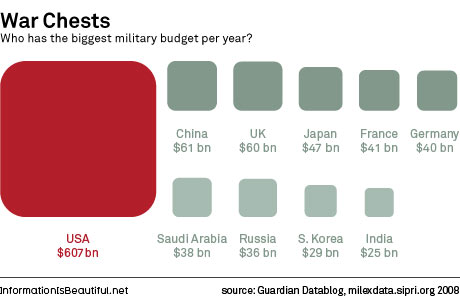
The visualisation I find most enlightening isn't this one
but this one
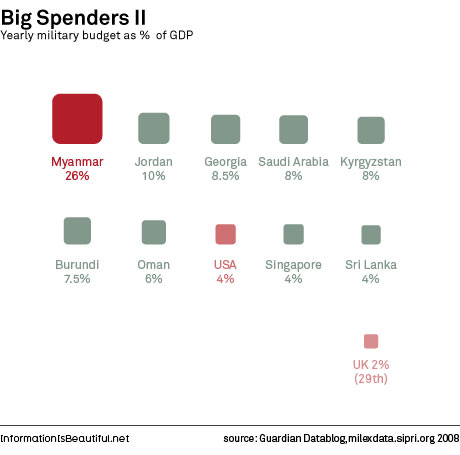
Compared to the GDP yearly of the US, our defense budget is just 4%, that isn't very much. Another enlightening set of graphs are
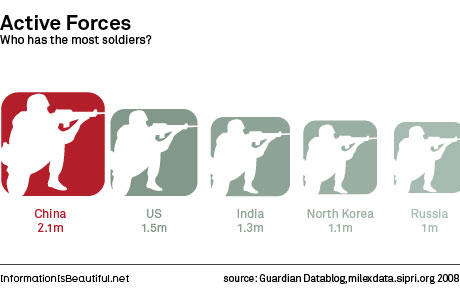
Raw Number of Soldiers
http://static.guim.co.uk/sys-images/Guardian/Pix/pictures/2010/3/31/1270054077524/Info-is-beautiful-defence-001.jpg
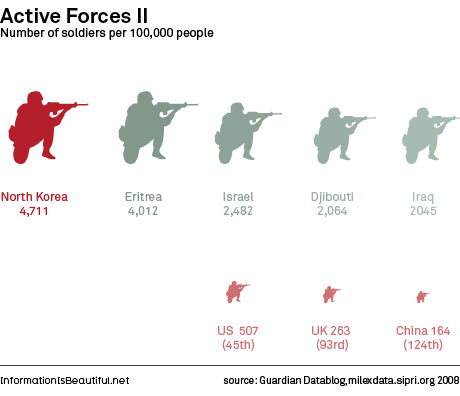
Number per 100k population
http://static.guim.co.uk/sys-images/Guardian/Pix/pictures/2010/3/31/1270054153378/Info-is-beautiful-defence-001.jpgWhen put in this context, our defense budget isn't so bad.
-
Re:Hardly secret or surprising
The visualisation I find most enlightening isn't this one
but this one
Compared to the GDP yearly of the US, our defense budget is just 4%, that isn't very much. Another enlightening set of graphs are
Raw Number of Soldiers
http://static.guim.co.uk/sys-images/Guardian/Pix/pictures/2010/3/31/1270054077524/Info-is-beautiful-defence-001.jpg
Number per 100k population
http://static.guim.co.uk/sys-images/Guardian/Pix/pictures/2010/3/31/1270054153378/Info-is-beautiful-defence-001.jpgWhen put in this context, our defense budget isn't so bad.
-
Re:Hardly secret or surprising
The visualisation I find most enlightening isn't this one
but this one
Compared to the GDP yearly of the US, our defense budget is just 4%, that isn't very much. Another enlightening set of graphs are
Raw Number of Soldiers
http://static.guim.co.uk/sys-images/Guardian/Pix/pictures/2010/3/31/1270054077524/Info-is-beautiful-defence-001.jpg
Number per 100k population
http://static.guim.co.uk/sys-images/Guardian/Pix/pictures/2010/3/31/1270054153378/Info-is-beautiful-defence-001.jpgWhen put in this context, our defense budget isn't so bad.
-
Re:Hardly secret or surprising
The visualisation I find most enlightening isn't this one
but this one
Compared to the GDP yearly of the US, our defense budget is just 4%, that isn't very much. Another enlightening set of graphs are
Raw Number of Soldiers
http://static.guim.co.uk/sys-images/Guardian/Pix/pictures/2010/3/31/1270054077524/Info-is-beautiful-defence-001.jpg
Number per 100k population
http://static.guim.co.uk/sys-images/Guardian/Pix/pictures/2010/3/31/1270054153378/Info-is-beautiful-defence-001.jpgWhen put in this context, our defense budget isn't so bad.
-
Re:Lawsuit Untanglement
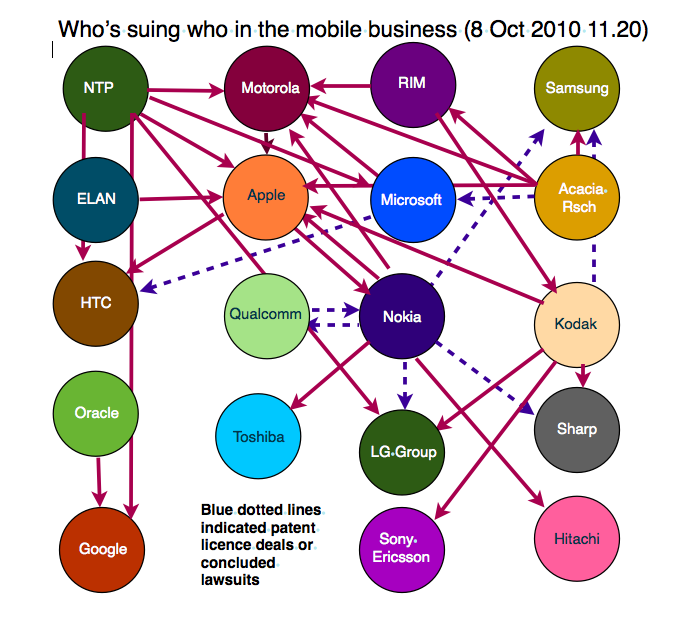
Visualisation to the rescue! The Guardian has a map of the lawsuits. It's missing this one, so the Microsoft to Motorola arrow should have an arrow at the other end too.
-
No matter who loses, the lawyers win
A diagram in the Guardian from last week nicely illustrates the insanity that is the mobile phone litigation business. With the vortex of lawsuits surrounding both hardware and software, it's amazing that anybody is able to innovate at all.
-
Re:It's easy to feel good about Apple's policies..
-
Re:That's all fine and good
You are confused. Here are a couple of images to prove my point:
Capitan Kirk uses a TOS PADD
Uhura uses a TOS PADDTrue, these pads utilized a stylus, but Kay's Dynabook used a dedicated keypad area, so was less like an iPad and more like a Timex Sinclair:
-
Re:Tablets are dead
And, still, it hasn't. iTard.
-
Re:Lies, damned lies, and statistics.
How often do you see the net total adjusted for the current economic situation? Are the book markets actually loosing money?
On a related topic Charles Arthur tried to go through various numbers and statistic as related to music piracy in this article on The Guardian's site.
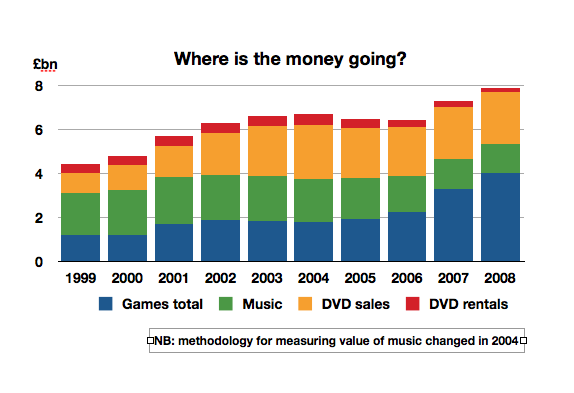
The first clue of where all those downloaders are really spending their money came in searching for games statistics: year after year ELSPA had hailed "a record year". In fact if you look at the graph above, you'll see that games spend has risen dramatically - from £1.18bn in 1999 to £4.03bn in 2008.
Meanwhile music spending (allowing for that * of adjustment in 2004 onwards) has gone from £1.94bn to £1.31bn.
DVD sales and rentals, meanwhile, have nearly doubled, from a total of £1.286bn in 1999 to £2.56bn in 2008.
If we assume that there's roughly the same amount of discretionary spending available (which, even allowing for the credit bubble, should be roughly true; most of the credit went into houses), then it's clear who the culprit is: the games industry. By 2009, the amount spent in games and music is almost exactly the same as 1999 (though note that the music industry changed its methods from 2004). -
Re:The thing about P2P and bandwidth distribution
You are going further back than me on the internet issue. The first connections I remember ran about $30/month for dial-up and I was still in high school at that point.
You are a bit off on the bandwidth prices though:
In Q2 2008 the average price per mb on a gigE port in the US and Europe was between $10-14.
That would make a 7mb home connection $70 - $98 for dedicated bandwidth wholesale. There are other costs at play and that home connection for $30 SHOULD probably end up being around 2mb/s if all the bandwidth games were stopped. But that 2mb would be 2mb/2mb not 2mb/256k or some other such nonsense, in fact it would be 2mb full-duplex so in practice that would give a potential 4mb/s if using maxing out your up/down connection. That is 10368gb/month of potential transfer EACH WAY.
Of course that means more infrastructure to support those connections and buying more connections. That in turn means higher volume of those large infrastructure components which would lower their cost per unit and drop that cost per mb further.
This starts a cycle that would eventually get us back up to the advertised speeds of today, but they would be real speeds without bandwidth games and consumers could host their own content, voice servers for games, game servers, etc, etc.
And that, would drive a concern for IPv6 to the end user but that's a discussion for another day.
-
heh they should jam all the religious nuts
-
Re:In other words...
Sure he has experience, but he doesn't seem to have any decent experience in succeeding.
yeah, but he's got a beard; maybe he can succeed by getting re-hired by Microsoft to star in their television commercials.