Slashdot Mirror
Domain: haveland.com
Stories and comments across the archive that link to haveland.com.
Comments · 15
-
Re:The Arctic is NOT doomed
multi decade cycle my ass: http://haveland.com/share/arct...
-
Re:Empirical curve fitting suggests sooner.
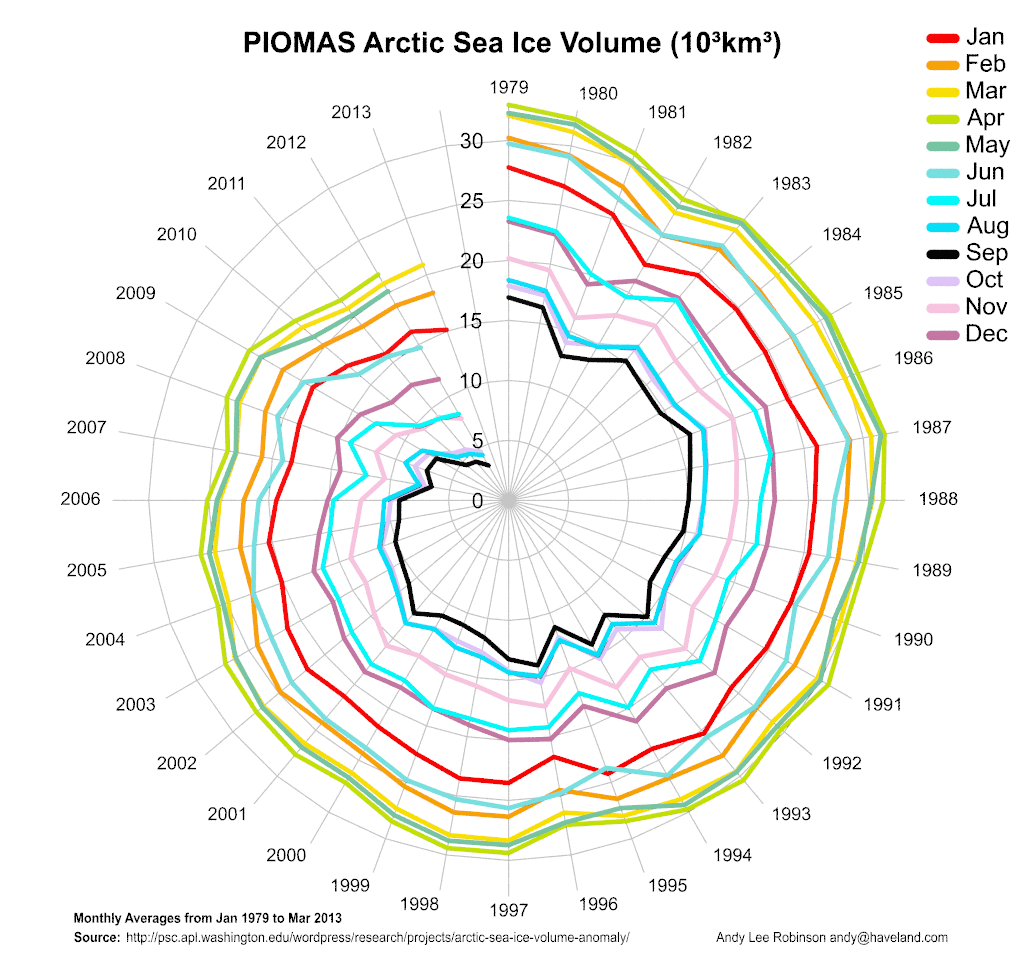
There are a couple of good "Arctic Death Spiral" plots out there, none of them look very encouraging.
https://sites.google.com/site/pettitclimategraphs/sea-ice-volume#asivds http://haveland.com/share/arctic-death-spiral-1979-201303.png https://sites.google.com/site/arcticseaicegraphs/ -
Re:strange
Yeah, someone throw the POV-Ray benchmark at it and post results at the povray benchmark website
-
Re:Software selection
Having twice the general purpose registers will typically improve performance 10-20% just by recompiling everything into 64 bit mode.
Data please? this thread mentions povray, well this povray benchmark site clearly shows that the $259 amd64 chip is slower than the $200 Intel offering.
this site has some benchmarks. Note that they use gcc for the pentium machines, which is not a very good optimizing compiler. For floating point apps, I typically see 2x speedup when using the Intel compiler (like oggenc, povray, etc). I cannot say which is faster, but being that there is no good (free) compiler for the amd64 you will just have to take the numbers for what they are (meaningless).
The grandparent is smoking some major crack.
Damn, I've gotta be more discreet. -
Re:10 years of boring uniformity
Your link appears to be dead, but I did find this. Heh, an M68040 comes in at last place. Wonder how my TI-92+ would do?
-
Re:10 years of boring uniformity
The povray benchmarks have a good spread of CPU's and weird configurations
-
Re:Using POV-Ray on cluster systems
if you're interested in this check out povbench
in college in 2000 we used mpi-povray and mpich(mpicc) to benchmark our beowulf cluster. we got skyvase.pov from a render time of 2:45 on our master server to 7 seconds with I think 7 athalons of various speeds.
here is part of our report that deals with this
For our benchmarking, we decided to use a raytracing suite called POVRay. The source obtained from the official POVRay website is not ready for parallel use. To use POVRay over MPI, a patch must be applied to the original POVRay source. For our installation, we were using POVRay 3.1. The following steps outline our installation:
1. Unpack the POVRay source for the distribution you have downloaded.
2. Obtain the MPI-POVRay patch.
3. Apply the patch: gzip -dc mpi-povray*.patch.gz | patch -p1
4. cd povray31/source/mpi-unix Monkey with the Makefile to get the right options for your platform and MPI implementation. (MPICH provides mpicc which makes life easier.)
5. Build a binary: make newxwin
it's not much but it might help -
Re:Why linux on a PS2?http://www.haveland.com/index.htm?povbench/index.
h tmNote the original outrageously great result the Emotion Engine got proved to be erroneous. The new figure (to save you the 470K download and them the slashdotting) is 616.67 POVmark, on Linux 2.2.2, at CPU speed of 294 Mhz (comparing to 1000Mhz PCs at that level). The score of $ divided by POVmark is 0.48. The only other results anywhere near that are AMD PC systems and a PowerMac G4, all of which do outperform the PS2 board, but the nearest price-performace is one of the AMD systems at 0.88. The other AMD systems are at 0.92 and 0.95 price/performance. The G4 is at 1.05 and is running OSX- very likely running just Darwin, with no GUI layer present.
It looks like if you're into POV, a PS2 can probably render faster than your PC for almost any value of PC. It takes particularly good gigahertz Athlon systems to beat it, or a stripped-down G4 running Darwin to beat it- or a quad Intel system to get anywhere near it
-
Re:Ray Tracing BenchmarkHere are the benchmarks. (Warning - Java & Frames)
The PSX Emotion engine does well, this is also a testament to the quality of the Linux port and dev kit.
Also fun to check out the various cluster's performance.
-
Re:Linux is already on the PS2!
Take a look at the povray benchmarks!
PSx2 bety board running Linux 2.2.2
5 seconds (96 PIII cluster runs in 2 seconds)
www.haveland.com/povbench -
Re:rendering clusters?You know, what makes me think that the boundary between interactive and "off-line" rendering hardware is getting blurred is stuff like the PS2 rendering engine doing stuff like povbench
As always on the internet, this has to be taken with a bit of caution, I don't even know if this is for real or not... but you get the idea.
Isn't there anything on a 3D accelerator that could be used to accelerate pov and the like?
---
-
Re:Prove Linux > NT !If you go to the povbench website and look at the single processor results:
You will see that the fastest system listed running NT is an Athlon 600mhz which took 47 seconds to complete the scene. A 600mhz athlon running RedHat 6.0 was reported as finishing the same scene in 37 seconds, which is roughly a 21-22% speed increase. Granted, I don't trust the povbench page, as many of the entries seem questionable. Regardless, most of the entries at the top seem to be running linux.
Nite_Hawk
-
Re:spooge!
They mentioned Linux, will these things run some sort of linux...
----
I noticed an interesting entry in the the POV-Ray benchmarks, recently:
http://www.haveland.com/cgi-b in/getpovb.pl?search=psx -
Real-time rendering?
POVBENCH measures how long it takes to parse and render a specific POV-Ray scene (skyvase.pov) with specific settings and write the resulting image to the disk in chunks of 1000KB. The method in use is ray tracing using floating point math. This method is not the same medhod used to render Toy Story. The resulting image contains 640 * 480 pixels. For each pixel 1 to 9 rays are traced. In addition to those reflected rays are traced, too. 3 seconds is awesome. You can download POV and try for yourself.
-
Could it be off the shelf?Perhaps Redhat (and Barnes and Noble) has an amazing distribution model, but this chart says they were running Linux 2.2.2. I don't think a 2.2.2 kernel could have been pulled off of the shelf so soon after becoming available.
bnf