Slashdot Mirror
Domain: hawaii.edu
Stories and comments across the archive that link to hawaii.edu.
Stories · 39
-
First Extrasolar Object Observed Racing Through Our Solar System (space.com)
Enigma2175 writes: For the first time, scientists have observed an object they believe came from outside our solar system. The object is in a hyperbolic orbit that will send it back into interstellar space. From Space.com: "The object, known as A/2017 U1, was detected last week by researchers using the Pan-STARRS 1 telescope in Hawaii. 'It's long been theorized that such objects exist -- asteroids or comets moving around between the stars and occasionally passing through our solar system -- but this is the first such detection,' Chodas added. 'So far, everything indicates this is likely an interstellar object, but more data would help to confirm it.' It's unclear what exactly this thing is. When A/2017 U1 was first spotted, it was thought to be a comet (and was therefore given the moniker C/2017 U1). But further observations have revealed no evidence of a coma -- the fuzzy cloud of gas and dust surrounding a comet's core -- so the object's name was amended to its current asteroidal designation." -
Small Asteroid Discovered Orbiting Earth (cnn.com)
Frosty Piss writes from a report via CNN: A small asteroid has been found circling Earth. Scientists say it looks like the asteroid, named 2016 HO3, has been out there for about 50 years. Calculations indicate 2016 HO3 has been a stable quasi-satellite of Earth for almost a century, and it will continue to follow this pattern as Earth's companion for centuries to come. Scientists think the asteroid is between 120 and 300 feet (37 to 91 meters) in diameter, and NASA says it never gets closer than 9 million miles (14 million kilometers) from Earth. It was found on April 27, 2016 by the Pan-STARRS 1 asteroid survey telescope in Haleakala, Hawaii. So how do we miss a 300 foot object that has been orbiting the Earth for around 50 years? Probably the same way we've missed all the flying saucers! -
The Most Detailed Images of Uranus' Atmosphere Ever
New submitter monkeyhybrid writes "The Planetary Society's Emily Lakdawalla reports on the most detailed images of Uranus ever taken. The infrared sensitivity of the ground based Keck II telescope's NIRC2 instrument enabled astronomers to see below the high level methane based atmosphere that has hampered previous observations, and with unprecedented clarity. If you ever thought Uranus was a dull blue looking sphere then look again; you could easily mistake these images for being of Jupiter!" -
Microbots Made of Bubbles Are Controlled By Lasers
An anonymous reader writes "Researchers at the University of Hawaii have turned bubbles of gas into non-mechanical 'microbots' that they propel and steer with a laser. The laser heats up specific areas of the fluid that the bubble are in, and temperature gradients push the fluid towards the hot area, moving the bubble along. By using an array of lasers, the researchers can control the speed and direction of multiple bubble bots independently; this capability is not possible with other types of microbots, such as those controlled by a magnetic field, which affects all robots simultaneously. The University of Hawaii researchers hope their non-mechanical microbots can be used to assemble and manipulate microscopic structures, including live cells. In one experiment, they used the bubble bots to position 100-m-diameter glass beads to form the letters 'UH.'" -
Fifty Meter Asteroid Might Hit Earth In 2098
eldavojohn writes "The Bad Astronomer brings word of an asteroid discovered with a tiny chance of hitting Earth. While it's only 50 meters wide, it could have the impact of a 20 megaton bomb. It's still twenty million miles away so if it hits us, it won't happen until 2098. The real story here is how a remarkable telescope, dubbed Panoramic Survey Telescope & Rapid Response System, that went operational in May found its first potential target in our growing impact alert system for Earth." -
Astronomers Discover the Coolest Known Sub-Stellar Body
Hugh Pickens writes "Science Daily reports that using the United Kingdom Infrared Telescope (UKIRT) in Hawaii, astronomers have discovered what may be the coolest sub-stellar body ever found outside our own solar system. Too small to be stars and with insufficient mass to maintain hydrogen-burning nuclear fusion reactions in their cores, 'brown dwarfs' have masses smaller than stars but larger than gas giant planets like Jupiter, with an upper limit in between 75 and 80 Jupiter masses. 'This looks like the fourth time in three years that the UKIRT has made a record breaking discovery of the coolest known brown dwarf, with an estimated temperature not far above 200 degrees Celsius,' says Dr. Philip Lucas at the University of Hertfordshire. Due to their low temperature these objects are very faint in visible light, and are detected by their glow at infrared wavelengths. The object known as SDSS1416+13B is in a wide orbit around a somewhat brighter and warmer brown dwarf, SDSS1416+13A, and the pair is located between 15 and 50 light years from the solar system, which is quite close in astronomical terms." -
Most Distant Object Yet Detected, Bagged By Galileo Scope
An anonymous reader writes "It's fitting, in this 400th anniversary of the astronomical telescope, that the Telescopio Nationale Galileo (TNG) in the Canary Islands would be used to uncover the most distant object ever seen by mankind. The gamma-ray burst from April 23, a powerful explosion from a dying star, was detected by the Swift satellite using on-board gamma-ray and X-ray instruments. A flurry of activity led to the remarkable discovery that the event occurred roughly 630 million years after the Big Bang. This makes GRB 090423 the most distant known event!" -
Ultra-Sensitive Camera To Measure Exoplanet Sizes
Roland Piquepaille writes "US astronomers and engineers have built a new camera to precisely measure the size of planets moving around distant stars. This camera has been dubbed OPTIC — short for 'Orthogonal Parallel Transfer Imaging Camera.' According to the research team, it is 'so sensitive that it could detect the passage of a moth in front of a lit window from a distance of 1,000 miles.' I'm not sure if this analogy is right, but the team said it was able to precisely define the size of a planet called WASP-10b which is orbiting around the star WASP-10, about 300 light-years from Earth." -
1.4 Billion Pixel Camera To Watch For Asteroids
SpaceSlug writes "The world's largest digital camera is to be used to keep an eye out for asteroids heading towards Earth. The Panoramic Survey Telescope and Rapid Response System (Pan-STARRS) has been built by researchers at MIT's Lincoln Lab. At its heart is a 1.4 billion pixel (or 1400 megapixel) camera that will scan the night sky looking for rogue near-Earth objects from atop Mount Haleakala in Maui Island, Hawaii. The system uses something called an orthogonal transfer CCD to remove atmospheric blur from images." -
Reversing Magnetic Poles Observed in Another Star
Babu 'God' Hoover tips us to news out of the University of Hawaii Institute for Astronomy that for the first time, a magnetic pole reversal has been observed in a star other than our own. Tau Bootis, while similar to the Sun, also has a planet more than six times larger than Jupiter orbiting at only a twentieth of the distance between Earth and the Sun. Scientists hope to use this discovery to learn more about the magnetic dynamics in the Sun, which can affect our telecommunications, among other things. -
EU Craft Successfully Hits The Moon
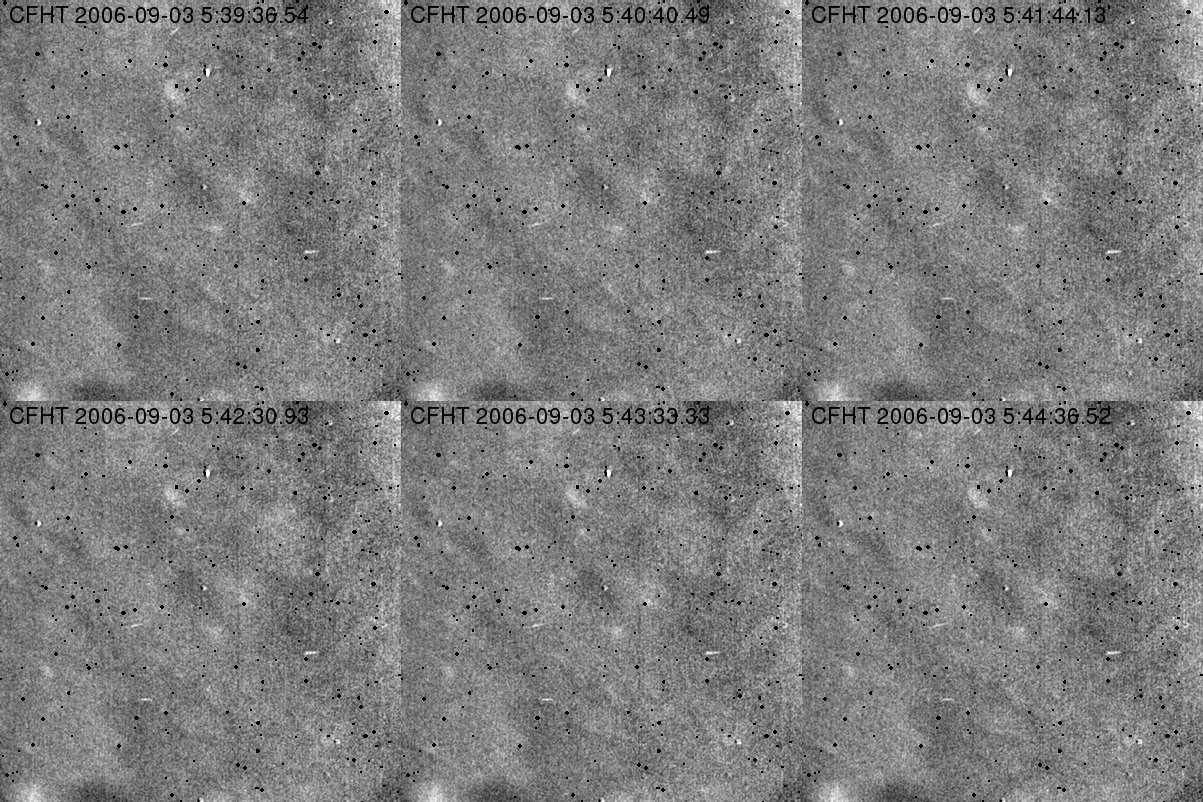
An anonymous reader writes "SMART-1 has hit the Moon , just as planned and — even better — the impact threw out a bright infrared that was seen by the Canada-France-Hawaii Telescope in Hawaii. There's an animation of the images grabbed by the telescope. Scientists now hope to analyse the chemistry of the rock ejected by the crash. If only you could dump old cars in such a useful way." -
EU Craft Successfully Hits The Moon
An anonymous reader writes "SMART-1 has hit the Moon , just as planned and — even better — the impact threw out a bright infrared that was seen by the Canada-France-Hawaii Telescope in Hawaii. There's an animation of the images grabbed by the telescope. Scientists now hope to analyse the chemistry of the rock ejected by the crash. If only you could dump old cars in such a useful way." -
Errors in Spreadsheets are Pandemic
G Roper writes "Studies show that most spreadsheets have critical errors in one percent of their cells, well beyond a permissible level. Here are some news stories about spreadsheet errors. Spreadsheets won't protect a firm from liability when they are audited and spreadsheet errors found: spreadsheets are not secure, provide no audit trail and won't pass HIPAA or Sarbanes-Oxley auditing. How are Slashdotters coping with the proliferation of spreadsheets in the face of greater legal accountability and auditing?" -
Planet Discovered Using Telephoto Camera Lenses
[rvr] writes "The Space Telescope Science Institute (STScI) reports the discovery of an extra-solar planet called XO-1b, which orbits a dim star in Corona Borealis every 4 days. To find it, the brightness of several thousand stars were regularly scanned using two mini-telescopes in Hawaii. This equipment was built using commercial hardware: two digital cameras, attached to telephoto camera lenses on a robotic equatorial mount. A team of amateur astronomers helped with their own equipment to discard or confirm dozens of suspected transits." -
Einstein's Biggest Blunder That Wasn't
jose parinas writes "The genius of Albert Einstein, who added a "cosmological constant" to his equation for the expansion of the universe but later retracted it, may be vindicated by new research. The enigmatic "dark energy" that drives the acceleration of the Universe behaves just like Einstein's famed cosmological constant, according to the Supernova Legacy Survey (SNLS). Their observations reveal that the dark energy behaves like Einstein's cosmological constant to a precision of 10%." -
Einstein's Biggest Blunder That Wasn't
jose parinas writes "The genius of Albert Einstein, who added a "cosmological constant" to his equation for the expansion of the universe but later retracted it, may be vindicated by new research. The enigmatic "dark energy" that drives the acceleration of the Universe behaves just like Einstein's famed cosmological constant, according to the Supernova Legacy Survey (SNLS). Their observations reveal that the dark energy behaves like Einstein's cosmological constant to a precision of 10%." -
Saturn Has a Warm Pole
Artifex writes "Astronomers using infrared imaging capabilities at Keck Observatory in Hawaii have discovered that Saturn's "south" pole is warm - the first warm pole detected in the solar system. " -
New Infrared Camera Gets Amazing Orion Images
The BBC is reporting, as is the Register, about the new Wide-Field Camera (WFCAM) on the UK Infrared Telescope (UKIRT) in Hawaii. WFCAM is the world's most powerful astronomical infrared camera. It's 5.4 meters long and weighs 1500 kilograms. As part of its commissioning, it produced some stunning images of interstellar clouds in Orion. -
New Infrared Camera Gets Amazing Orion Images
The BBC is reporting, as is the Register, about the new Wide-Field Camera (WFCAM) on the UK Infrared Telescope (UKIRT) in Hawaii. WFCAM is the world's most powerful astronomical infrared camera. It's 5.4 meters long and weighs 1500 kilograms. As part of its commissioning, it produced some stunning images of interstellar clouds in Orion. -
New Infrared Camera Gets Amazing Orion Images
The BBC is reporting, as is the Register, about the new Wide-Field Camera (WFCAM) on the UK Infrared Telescope (UKIRT) in Hawaii. WFCAM is the world's most powerful astronomical infrared camera. It's 5.4 meters long and weighs 1500 kilograms. As part of its commissioning, it produced some stunning images of interstellar clouds in Orion. -
Binary Star EF Eridanus Baffles Astronomers
baldinux writes "Reuters is reporting the finding of a new stellar object in the Eridanus constellation that may require the astronomical community to create a new category of stellar entities -- that is, dead ones. In the binary system, one of the stars 'gave too much' (Reuters) of its own resources to its partner white dwarf star, resulting in a breakdown of nuclear fusion, thus producing this 'dead' entity. Researchers at Gemini North (click here for images) and Keck II observatories at Mauna Kea, Hawaii, have been analyzing this unique system." -
The Dirt On Mars, In Words And Pictures
An anonymous reader writes "The Spirit rover's first soil analysis reveals some puzzling features about Gusev crater. The region seems to contain the greenish silicate mineral, olivine, which usually is considered water-reactive and thus volcanic in origin. For olivine to be found in the soil may point to rock formation during a drier period in martian history, even with strong evidence for sampling in an ancient lakebed. A second puzzle is why the soil seems so crusty. After the rover arm pressed soil down, the top layer of dust hardly moved, a finding that suggests something may be binding the dust like some type of salt or thin cement." For even more and better Mars pictures, read on below.mlyle writes "I've spent a few hours hacking together some software to deal with the Mars Exploration Rover imagery at JPL. The software puts together a webpage and RDF feed of new raw imagery as it is posted to the JPL site, along with technical information decoded about how the picture was taken. It also produces stereo anaglyphs and color images that NASA has not seen fit to convert and make publically available. Be sure to also check out the ultra high resolution image of the lander as viewed from Spirit."
-
DriveLock on Compaq/HP Laptops?
whois asks: "I just purchased a new Compaq laptop and noticed a feature in the BIOS called 'DriveLock'. It locks the drive so a password has to be entered on startup. If you take the drive out and put it in a system without a drivelock BIOS, the system can't boot from the drive. There is very little information on the web about this feature. Most people talk about what happens if you lose your password (buy a new drive) and what happens if you want to reuse the drive in other machines (you can't). What I want to know is the tech specs on this. Is it security through obscurity, and just sets a password in the drive BIOS, or is it doing encryption in hardware? My guess is it's the former, but I'm submitting to find out if anyone knows the real story. Here is an HP doc that mentions it in passing." According to information provided by the included links, this "feature" isn't something you can disable, either. Are we likely to see more manufacturers tie hardware together like this, in the future? -
Intelligent Agents And Robotic Telescopes
dpp writes "Astronomers working on the eSTAR Project have used software "Intelligent Agents" to control the United Kingdom Infrared Telescope and observe a dwarf nova. One of the astronomers says "The Agents can detect and respond to the rapidly changing universe faster than any human... [they] can be used to assist human observers, instead of replacing them entirely - augmenting their abilities to do science quicker, faster, and more reliably." Next up: getting results sent automatically to your 2.5G/3G mobile phone (with images!), and deploying on more telescopes including the Liverpool Telescope and the Faulkes Telescopes. The full story is at the Joint Astronomy Centre." -
Intelligent Agents And Robotic Telescopes
dpp writes "Astronomers working on the eSTAR Project have used software "Intelligent Agents" to control the United Kingdom Infrared Telescope and observe a dwarf nova. One of the astronomers says "The Agents can detect and respond to the rapidly changing universe faster than any human... [they] can be used to assist human observers, instead of replacing them entirely - augmenting their abilities to do science quicker, faster, and more reliably." Next up: getting results sent automatically to your 2.5G/3G mobile phone (with images!), and deploying on more telescopes including the Liverpool Telescope and the Faulkes Telescopes. The full story is at the Joint Astronomy Centre." -
Good Guys 2, Spammers 0
JoeJob writes "A couple of victories in the legal war against spammers. First, a Washington resident has been awarded a $250,000 decision against a spammer that sent him 58,000 copies of a spam. Second, looks like the spammers who are trying to sue Spamhaus, SPEWS, and other spam blacklists have decided to tuck their tails and run. Let's hope this trend continues." If you care to celebrate this, one food springs to mind. -
Close Mars Means Close-Up Pictures
Guttata writes " space.com has posted 1 of 2 images taken by Hubble last night, dubbed the best Mars globe photo ever taken. The second image will be posted at 4 p.m. ET. Cool!" aderuwe points to a report on the Hubble site itself. Finally, dpp writes "Space.com is reporting how astronomers using the UK Infrared Telescope (UKIRT) here at the Joint Astronomy Centre have made what are thought to be the sharpest ground-based images of Mars to date. They'll be studying the spectra of the infrared light to look for the signatures of minerals that would indicate the past presence of liquid water, which could have hosted life." -
43 More Moons Discovered Orbiting Jupiter
linuxwrangler writes "Scott S. Sheppard, a graduate student at the University of Hawaii, has discovered 43 more moons orbiting Jupiter more than doubling the number of known Jovian moons. The small moons, which follow wildly irregular orbits, are thought to be the result of ancient collisions of larger moons. Sheppard used a 2.2 and a 3.6 meter telescope at the Mauna Kea observatory to catalog the moons." -
CFH Telescope Gets New Wide-field Digital Camera
Pixie writes "The Canada-France-Hawaii Telescope, located on Mauna Kea in Hawaii, has begun using a new 350 MegaPixel, wide-field camera called MegaPrime. This new camera, designed collaboratively by NRC-HIA in Canada, CEA and Observatoire de Paris in France, and CFHT in the US, will provide astronomers with extrodinary wide-field views of the heavens. Official press releases available at CFHT, NRC-HIA and CEA." -
CFH Telescope Gets New Wide-field Digital Camera
Pixie writes "The Canada-France-Hawaii Telescope, located on Mauna Kea in Hawaii, has begun using a new 350 MegaPixel, wide-field camera called MegaPrime. This new camera, designed collaboratively by NRC-HIA in Canada, CEA and Observatoire de Paris in France, and CFHT in the US, will provide astronomers with extrodinary wide-field views of the heavens. Official press releases available at CFHT, NRC-HIA and CEA." -
CFH Telescope Gets New Wide-field Digital Camera
Pixie writes "The Canada-France-Hawaii Telescope, located on Mauna Kea in Hawaii, has begun using a new 350 MegaPixel, wide-field camera called MegaPrime. This new camera, designed collaboratively by NRC-HIA in Canada, CEA and Observatoire de Paris in France, and CFHT in the US, will provide astronomers with extrodinary wide-field views of the heavens. Official press releases available at CFHT, NRC-HIA and CEA." -
CFH Telescope Gets New Wide-field Digital Camera
Pixie writes "The Canada-France-Hawaii Telescope, located on Mauna Kea in Hawaii, has begun using a new 350 MegaPixel, wide-field camera called MegaPrime. This new camera, designed collaboratively by NRC-HIA in Canada, CEA and Observatoire de Paris in France, and CFHT in the US, will provide astronomers with extrodinary wide-field views of the heavens. Official press releases available at CFHT, NRC-HIA and CEA." -
New Satellites of Jupiter Discovered
dss902 writes "The discovery of 18 new satellites of Jupiter, bringing the total of known Jupiter satellites to 58 were made using the world's two largest digital cameras at the Subaru (8.3 meter diameter) and Canada-France-Hawaii (3.6 meter diameter) telescopes atop Mauna Kea in Hawaii. Recoveries were performed at the University of Hawaii 2.2 meter with help from Yanga Fernandez and Henry Hsieh also from the University of Hawaii. Brian Marsden of the Harvard-Smithsonian Center for Astrophysics performed the orbit fitting for the new satellites. More info here." We ran a story on the first eight, but now... eighteen. -
You Gonna Eat That? It Could Become Plastic
Kaz Riprock writes "Jian Yu and associates at the Hawaii Natural Energy Institute have been working on a system to convert food waste into plastic polymers. There is a CNN article that gives an overview of the process. More information on the anaerobic acidogenesis and aerobic synthesis at Dr. Yu's page at HNEI. This could be a really good step in the right direction, assuming it provides a cheaper source of plastic than current methods (to be accepted and highly regarded by the plastic industry)." -
You Gonna Eat That? It Could Become Plastic
Kaz Riprock writes "Jian Yu and associates at the Hawaii Natural Energy Institute have been working on a system to convert food waste into plastic polymers. There is a CNN article that gives an overview of the process. More information on the anaerobic acidogenesis and aerobic synthesis at Dr. Yu's page at HNEI. This could be a really good step in the right direction, assuming it provides a cheaper source of plastic than current methods (to be accepted and highly regarded by the plastic industry)." -
Huge Volcanic Eruption Observed on Io
minesweeper writes "Astronomers at the Keck Observatory in Hawaii recently monitored the largest volcanic eruption ever observed on Jupiter's moon Io. The eruption took place in February 2001, though image analysis was only recently completed by a team of University of California, Berkeley, astronomers. More info is available from the Berkeley press release, and an image is available here." -
First Image Of Planet-Like Body Orbiting A Star
deglr6328 writes "The Gemini North Telescope has, for the first time, directly imaged a planet like body orbiting a star. The object is a brown dwarf, 55 to 78 times the mass of planet Jupiter and 14 AU distant from its parent star 15 Sge. It was imaged using adaptive optics(see also here) that correct for the blurring effect of the atmosphere using deformable mirrors. Cool!" -
101 Giant Galaxy Clusters Discovered
Porfiry says: "Astronomers behind the Massive Cluster Survey (MACS) have uncovered 101 giant galaxy clusters, many of them so distant and thus forming so early in the history of time that they challenge our current understanding of how quickly the Universe evolved into its current hierarchical structure of stars, galaxies and clusters. Galaxy clusters are the largest gravitationally bound structures in the Universe, typically containing a few hundred to thousands of galaxies, each of which in turn contains many billions of stars." -
The Mini-Quickies That Fell To Earth
johnathan spectre wrote in to tell us about these really cool plasma shoelaces. plasticPaddy wrote in to tell us about SkyBird, a nifty remote-control ornithopter. Fire up the flux capacitor, because feebeling wrote in about this WWW guide, circa 1993. seizer told us about some crazy guy TCP/IP tunneling through E-mail: now that's dedication. Speaking of crazy people, Green Monkey scared me with his submission, a Web site devoted to Pokémon butts. From the self-referential bucket, the Webby Awards have nominated Slashdot in the 'Community' and 'Print and Zines' categories. Go Vote and we get some trophy or something. _damnit_ wrote in with a nice little piece on the Ides of March. In case you're in the greater Boston area, Rob 'CmdrTaco' Malda will be speaking at the Geek Pride Festival at the end of the month.