Slashdot Mirror
Domain: history-computer.com
Stories and comments across the archive that link to history-computer.com.
Comments · 11
-
Re:Let me see here
The wealth and education part was actually irrelevant to his success (aside from enabling him to stay in business until the IBM deal came up). He didn't make MS-DOS. He learned from his mom that IBM was looking for an OS, and he knew he didn't have the skill nor time to write it himself. So he bought it from a competitor. He could've known nothing about computers (like Steve Jobs) and still pulled off the deal.
So it was (1) his mom knowing the chairman at IBM in charge of the PC project, and (2) him knowing someone in the industry that had what IBM wanted. Even (1) is a string of coincidences - both she and chairman Opel were on the board for the United Way, which is how she learned of IBM's PC project and she tipped them off to talk to Microsoft for an OS. Contacts are everything. A friend of mine who transferred to Harvard said the education there was pretty much the same quality as at her previous college, but the contacts she was getting through her professors and other students were invaluable.
This is why you try as hard as you can not to burn bridges when quitting a job - something most people don't seem to care about. They'd rather get to spend a few minutes to openly express their righteous indignation at being treated badly at work, than be diplomatic and keep those contacts in their back pocket for life. -
Re:Laser printers? We don't need no laser printers
You're wrong on everything. As usual.
Not according to the source that I cited in my comment.
Xerox failed to connect the dots and realize that the profit wasn't in the printer but in the toner and the paper. As a result, the company was beaten to market by Hewlett-Packard, which introduced the first personal laser printer in 1980.
-
Laser printers? We don't need no laser printers?
Xerox is well-known for missing the significance of what they had at PARC back in the day, and letting Steve Jobs ransack the place to develop the Mac. One of the lesser known stories, mentioned in "Dealers of Lightning: Xerox PARC and the Dawn of the Computer Age" by Michael A. Hiltzik, was how Xerox dismissed the laser printer as they didn't want to cannibalize their copier sales. A delimma that most technology companies encounter when they have a cash cow product and a newer product that would replace it. HP came out with the first personal laser printer in 1980 and turned toner cartridges into a cash cow.
-
That's how it works
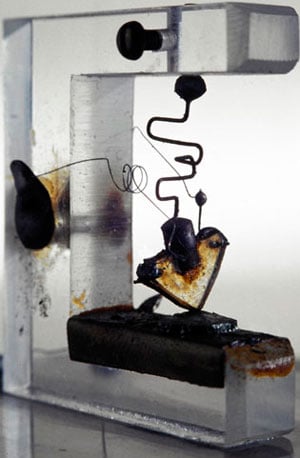
This guy seemed to be "Well, we figured out how it works, but I'm done now, somebody else has to figure out how to make more than the 2 prototypes I spent 4 years making in the lab."
Just to give you something to consider, here is a picture of the very first transistor.
-
Vinton Cerf, you're under arrest.
We're with The Government and you're under arrest. You and Robert Kahn are credited with "inventing" TCP/IP which is a key technology now used by internet villians. Unfortunately we can't arrest Chris Sholes, the developer of QWERTY, but we've already locked up Federico Faggin, Ted Hoff and the gang of Intel thugs who claim to have developed the first microprocessor. We're headed to Redmond after we're done with you.
-
Re:It's the day innovation died at Apple
He doesn't even get credit for bringing the GUI to Apple - Jef Raskin did that.
It seems they both influenced it (for good or bad). Quote:
http://history-computer.com/Mo...
"The [Mac project] caught the attention of Steve Jobs, co-founder of Apple. Realizing that the Macintosh was more marketable than the Lisa, he began to focus his attention on the project. Raskin finally left the Macintosh project in 1981 over a personality conflict with Jobs, and the final Macintosh design is said to be closer to Jobs' ideas than Raskin's."
-
Re: Who is Kurzweil? Why should I care?
Neural networks ARE machine learning.
No argument against that from me!
OCR IS Neural networks.
Now that is debatable. Or, you know, it actually isn't - there's no identity between the two. It's not even a case of one being a proper subset of the other, they merely intersect.
-
Re: Who is Kurzweil? Why should I care?
Technically, not inventor of the concept but one of those who improved it over the years.
-
Re:5 years too late
Alan Kay did this in 1972.
-
Re:aah yes the terminal!
Incredibly,PLATO had gas-plasma flat-panel bitmapped touch-screen display terminals in 1972, which was still back in the days of paper tape and punch cards!
-
Re:Benchmark?
I found some more information about the PDP-1, and it looks like it could complete 200K operations/second (100K multiplies).
It cost $120K in 1960, or around $900K in today's dollars.
I still don't know how fast the emulator is, but I bet it's faster than the original.