Slashdot Mirror
Domain: hpmuseum.org
Stories and comments across the archive that link to hpmuseum.org.
Comments · 124
-
Re:Sounds like a profit model to me...
It was 1975. The HP25. There are images and links to a simulator if you feel nostalgic. The lunar landing game is there too. (Correction to my post: it has 49 lines for programs, 8 registers for variables.)
-
If you have a Pocket PC
Check out the HP 41 emulator
There is a lot of software available here as well.
There are more HP calculator emulators for different platforms here. -
If you have a Pocket PC
Check out the HP 41 emulator
There is a lot of software available here as well.
There are more HP calculator emulators for different platforms here. -
Why not just use the real thing?
I have been a HP calculator fan for many years. I've had HP33E through the HP48GX, the latter being my latest. I've always beleived if you want a "real" calculator you have to go with HP.
hpmuseum -
Re:The book is already dated
Also, expect prices of vintage Curtas calculators to go up because of their mention in the book...
-
Re:RPN
-
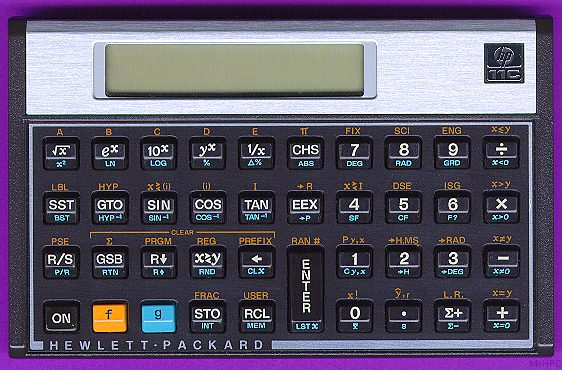
HP-11C
I love my 1985 HP-11C as well... I wish they still made them, as I'd buy a few more for members of my extended family who are turning 12. What a great way to learn how to write simple programs; registers, stacks, etc.
-
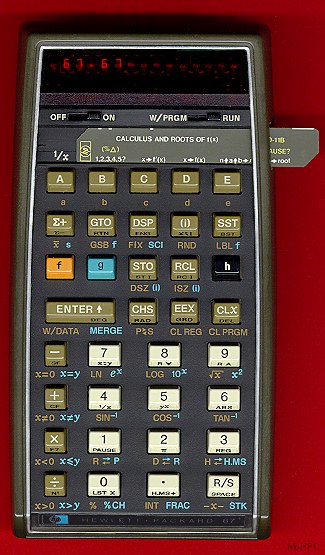
Calculator games? Old hat for HP.My dad used an HP67 for years and years and years. He must have bought it pretty close to when they first came out (1976), and he used it well into the 90's before it finally gave up the ghost. It had a magnetic card reader on which you could save programs.
And yes, it had at least one game I remember!! A simple lunar lander game, where the display alternately shows your height above the lunar surface and your velocity, and you have to make fuel burns at the appropriate time and of the correct duration in order to set the lander down gently on the moon's surface.
-
Re:In the 80s it was HP calculatorsYeah, but was yours an RPN model?
He said it was a 15C.
Anyways, I use my thumbs for my 11C too...
-
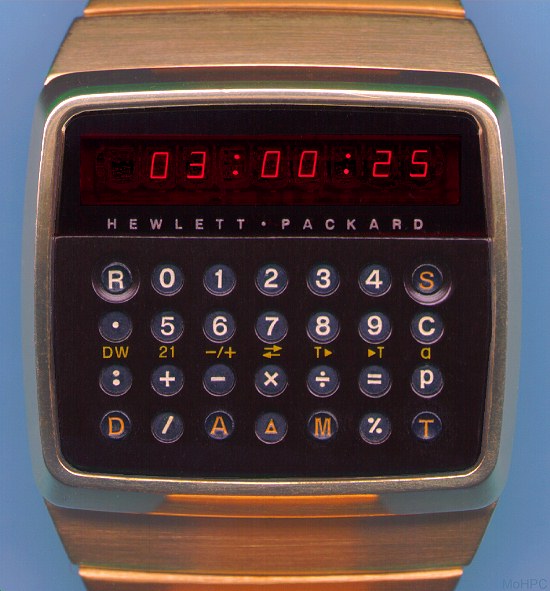
Only one choice: the HP-01There's only one choice IMHO: The HP-01. It is, without a doubt, the ultimate geek watch, and has been for the past quarter- century.
See this picture and this list of features.
-
Only one choice: the HP-01There's only one choice IMHO: The HP-01. It is, without a doubt, the ultimate geek watch, and has been for the past quarter- century.
See this picture and this list of features.
-
Only one choice: the HP-01There's only one choice IMHO: The HP-01. It is, without a doubt, the ultimate geek watch, and has been for the past quarter- century.
See this picture and this list of features.
-
Re:Dark days indeed...
Hey, It's all about the stack...
  RPN stands for Reverse Polish Notation. The short history:
  In the 1920's Polish mathematician (and philosopher) Jan Lukasiewicz developed "Polish Notation" where the operators preceded the arguments. This was in the interest of simplifying symbolic algebra. Later in the 1960's HP found this to be an efficient method of performing calculations and implemented it, but instead had the operators entered after the arguments - hence REVERSE Polish Notation. This allowed intermediate calculation results to be kept on the stack and evaluated later WITHOUT ROUNDOFF ERROR that resulted from copying down the displayed results and entering them later. So not only was this more efficient, it also became a more accurate methodology! Due to the technological limitations of the time, it also allowed full algebraic calculations to be performed.
  You can read a lil more at the following sites: http://www.calculator.org/rpn.html http://www.hpmuseum.org/rpn.htm http://www-stone.ch.cam.ac.uk/documentation/rrf/rp n.html
  Best of luck going back to school. May you never stop learning! -
HP-35 -- The Original
The HP-35 was the original hand-held scientific calculator. I worked all summer carrying garbage to buy one for $495 back when $495 was worth something, men were men, women were women and they didn't joke about it.
-
Re:Why learn lisp -- deeper reasons needed
Nice troll. Unfortunately, you are wrong.
Reverse Polish notation, also called "postfix notation", has the arguments first, followed by the operator. For example, "3 2 +". Lisp programs are typically written directly in the language's abstract syntax, using the prefix notation and parens with which many are familiar. For example, "(+ 3 2)".
Common Lisp's reader (aka parser) is, however, fully under program control. Through CL's readtables, one can extend the basic prefix notation, e.g. CL's sharpsign-S macro to read in structure objects is "#S(typename
Unlike static languages like C or Java, almost everything about the Common Lisp run-time environment is under program control. Even the object system can be modified (through something called the Meta Object Protocol). And idiomatic Common Lisp code is often times within a factor of two of idiomatic C code in terms of performance.
-
A calculator parallelWhen I was a young 2685 (USAF code for mathematician) working as a ballistics engineer we got hold of some of the first TI-59 calculators with the nifty little magnetic card readers for inputting and storing programs. I had been playing with ballistic missile codes (both for live missiles and for a program called STRIKE (Strategic Targeting Resource Integrator and Kill Evaluator)) and suggested to the powers that be that it might be possible to get a pretty good fuel usage estimate for use in retargeting the Minuteman III (3 warhead system). Given the go-ahead, I pressed on.
The first problem was the development and testing cycle times. I was used to the IBM 360 turnaround times for punch decks of 2-4 hours (often overnight because of the classification of the programs (Secret, Top Secret, SCI)). The TI-59 was slow, so I developed a sort of emulator on the HP9825 desktop "Calculator" so I could get faster turnarounds. In those days computers belonged to "Data Automation" (AD), so we only got the HP9825 because the case said "Calculator". The system had a tape drive, card reader, plotter, printer, full keyboard, 32-character display and 4K of memory with its own programming language, but hey, the box said "Calculator" so, by the book, it wasn't a computer. By emulating the TI59 on the HP9825 I was able to do real-time run/debug/correct style programming that was really fun compared with the batch style programming we were using on the IBM 360.
By using some really tight code I was able to simulate the flight and deployment of the booster and the three reentry vehicles, computing the cross range and downrange perturbations and the resulting fuel costs, and estimate the total fuel used to deliver the RVs to the three targets as input by the user. This all had to fit in the 960-step/100 memory register of the TI59. Considering that amongst other things I had to invert a 3x3 matrix, space was pretty tight.
Using data from the actual targeting programs used in the Minuteman III, I built some curve fitting functions for fuel usage, used simple spherical trig range and azimuth calculations and managed to get within 5% of the actual fuel usage (the program's estimate was always close to the projection from the mainframe, and was usually in the
The final program was to be carried on the ABCP (KC-135 "Looking Glass") to permit quick evaluation of proposed retargeting of MMIII missiles. -
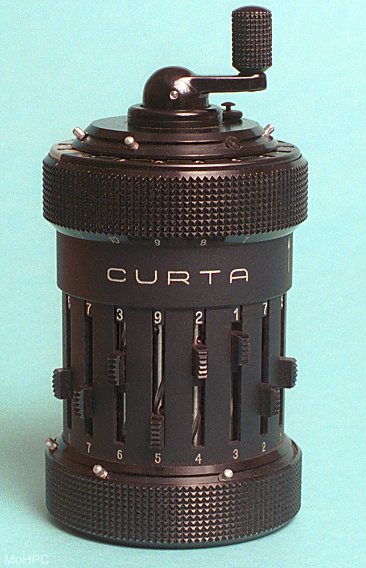
Curta anyone ?My mother was an accountant. She used a Curta (mecanical Handheld calculator).
I still have it, functional, of course. It is an amazing machine.
History of the curta, and a picture of the : model I
Cheers,
--fred
-
Curta anyone ?My mother was an accountant. She used a Curta (mecanical Handheld calculator).
I still have it, functional, of course. It is an amazing machine.
History of the curta, and a picture of the : model I
Cheers,
--fred
-
Re:HP48 supports BOTH rpn and infix notation !
Most excellent observation! Way back around 1974 I drooled over the HP calculator ads I saw in my high school's library's Scientific American magazines. Oh how cool that "gold" key looked. When they became available - pretty expensive - my grandmother, God rest her soul, gave me one for a birthday present. It was too awesome!
I fondly remembering looking down my nose at other kids using those inferior TI calculators.
I went through a few HP models over the years. I currently use an HP-10C. Maybe it's an 11C, I really don't remember, and here's why. Years ago it slipped out of my coat pocket one day while I was getting out of my car in the driveway. There were several inches of fresh snow on the ground and I didn't notice it had fallen out. The next day I was looking for it and couldn't find it and was sure that I had lost it for good. I went outside to get in the car and saw the case sticking out of the snow. It had been in the snow for a good 24 hours and had clearly been run over by the car at least once. The LCD display, however, wasn't cracked and while the metal plate at the top was dented in several spots and the name plate had come off the damn thing still worked. I never found the name plate but the thing still works fine to this day and I love my RPN calculator still. I still think of my grandmother every once in a while when I press that "gold" key. The "blue" key is like an extra bonus from the earlier models. Some of my most vivid memories of high school are of reading those HP ads in Scientific American and learning all I could about Reverse Polish Notation months before I actually held one in my hands. How's that for a nerdy kind of story?
I still get a kick out of people who borrow it and stare blankly at it for a while and then hand it back. Here's a nice link to the Museum of HP Calculators . Mine's and 11C - thanks Mr. Hewlett for all your great contributions. Rest In Peace. -
Re:Thanks, Bill. We'll Miss You.HP products do run forever.
The first calculator I ever used my my dad's HP-21, which he bought when he was in college. The calcualator is older than I am and still works fine, I have it sitting on my desk right now.
Of course since I learned RPN first I can't stand to use a brain dead 'normal' calcuator.
-
Re:I'm not really an expert...
but it's 4 bit internally
-
Mechanical ComputersI did some research in the field of mechanical computers a while back. (Right after I built my own : ) It's an interesting field. Anyway, I thought someone might want to see these related sites on the history of mechanical computers.
-
Re:Physics is interesting however it has problems> Calculus is OK, if it's taught well, but dx/dy on it's own won't have the same meaning
> as "the rate at which something changes", and integrating is something people just don't
> tend to do, on a day-to-day basis.When I was 14, during lunch break, I asked my math teacher "What is Calculus exactly?".
He took his pen, drew a y=f(x) function graph, and said, "This is a function".
He then shaded the area between the x axis and the function plot. "And the area here is the integral of the function".
He then drew tick-marks on the function line, and said "and when you're differentiating, you just calculate the slope between two close points".There. I learned the idea behind calculus in less than 5 minutes, during lunch hour. Within the end of the day, I had written a program to integrate functions on my HP-25 calculator (during the english class)...
But I was kicked-out of school before the curricula touched Calculus...
-- ----------------------------------------------
Vive le logiciel... Libre!!! -
Re:What's PN ?
It was invented by Jan Lukasiewicz, a Polish mathematician and philosopher. A short description can be found here.