Slashdot Mirror
Domain: ieee.org
Stories and comments across the archive that link to ieee.org.
Stories · 649
-
Details of Chinese Spacecraft's Asteroid Encounter
the_newsbeagle writes "Chinese aerospace engineers have revealed, for the first time, details about their Chang'e-2 spacecraft's encounter with the asteroid Toutatis last month. They have plenty to boast: The asteroid flyby wasn't part of the original flight plan, but engineers adapted the mission and navigated the satellite through deep space (PDF). Exactly how close Chang'e-2 came to Toutatis is still unclear. The article states that the first reports 'placed the flyby range at 3.2 km, which was astonishingly—even recklessly—tight. Passing within a few kilometers of an asteroid only 2 to 3 km in diameter at a speed of 10,730 meters per second could be described as either superb shooting or a near disaster.' If the Chinese spacecraft did pass that near, it could provide a "scientific bonanza" with data about the asteroid's mass and composition." -
CES: Another Chording Keyboard Hits the Market (Video)
Wayne Rasanen's Decatxt chording keyboard may be new and exciting to him, and he says has a patent on it so apparently the USPTO found it novel and original, but it's not the first chording keyboard by many long shots. The idea has been around (at least) since 1968. And let's not forget Braille chording keyboards, as described in a 1992 IEEE paper. And if you have an iPhone and want to experiment with a virtual Braille chording keyboard, there's an app for that. Maybe we're just jaded. Or maybe we've known a lot of blind people who used one-handed Braille chording keyboards to type as fast with one hand as a sighted person using a QWERTY keyboard and two hands. So it's hard for us to get excited about a chording keyboard. Be that as it may, we wish Wayne Rasanen all the luck in the world as he brings his invention to market. -
LEGO Announces GNU/LInux-Powered Mindstorms EV3 Platform
First time accepted submitter Barryke writes "Today LEGO announces the new mohawk (NASA's turf) sporting MINDSTORMS EV3 platform (press release). And with details on its features and innards (in Dutch) which in short comes down to: 'Its intelligent brick sports an ARM9-soc running Linux on 64MB RAM and 16MB storage memory, and supports SD cards. There are also four ports, which allow four other 'Bricks' can be connected. The intelligent brick can be reached by WiFi, USB and Bluetooth, and supports control via Android and iOS devices. It comes with 3 servo's, two touch sensors and an IR sensor to track other robots at upto six meters. It also includes 17 build plans, shown in 3D using Adobe Inventor Publisher.'" -
How Google Glass Is Evolving As It Heads For Release To Developers
hypnosec writes "Babak Parviz, the founder and head of Project Glass at Google, has revealed that the feature set of Google Glass and state of apps is still in flux and that there is a lot of testing going on at the moment. In an interview with IEEE Spectrum, Parviz provided insights into Project Glass, the reasons behind having such a gadget and what's there for the project in near future. Parviz said that they are trying out new ideas and ways in which the platform can be used while also trying to make the platform more robust. There is no specific feature set that Google has been talking about and 'It is still in flux.'" My favorite question / answer pair: "IEEE Spectrum: What kind of business model is associated with Google Glass? Babak Parviz: This is still being worked on, but we are quite interested in providing the hardware." -
New Theory About the Source of Pioneer Space Probe Deceleration
First time accepted submitter deathcow writes "After forty years, a fresh perspective on old Pioneer data leads to new conclusions as to why the Pioneer probes are decelerating. Many theories to the slowing probes have persisted over the years — was it gravity? some type of unforeseen radiation? dark matter? Thanks to the data backup preservation efforts of a NASA Ames Research engineer, mountains of old telemetry data were still available for studying this curious anomaly." -
"Self-Healing" NAND Flash Memory That Can Survive Over 100 Million Cycles
another random user writes with an interesting use of 800C heating elements to keep flash working longer. It's long been known that heating NAND to temperatures around 250C can restore life, but doing so was practically impossible. From the article: "Engineers at Macronix have a solution that moves flash memory over to a new life. ... They redesigned a flash memory chip to include onboard heaters to anneal small groups of memory cells. Applying a brief jolt of heat to a very restricted area within the chip (800 degrees C) returns the cell to a 'good' state. ... According to project member HangTing Lue, the annealing can be done infrequently and on one sector at a time while the device is inactive but still connected to the power source. It would not drain a cellphone battery, he added." It's still a long way from commercialization, but if it works on a small scale... -
One Step Toward a Babel Fish: Real-Time Voice Translation For Phones
the_newsbeagle writes "Douglas Adams's fictional Babel fish, which lived in the brain and could translate any language in the universe, was so incredibly useful that it simultaneously proved and disproved the existence of God. This real-time translation app for mobile phones, offered by the Japanese telecom company NTT DoCoMo, isn't going to freak out theologians any time soon. The company admits it has lots of work to do to improve translation accuracy, and it can currently only translate between Japanese and three languages: English, Korean, and Mandarin. But by allowing phone calls to pierce the language barrier, we just might have taken a step toward the universe that Adams envisioned: one where open communication between people of different cultures leads to an onslaught of terrible bloody warfare." -
Evidence for Unconscious Math, Language Processing Abilities
the_newsbeagle writes "It's hard to determine what the unconscious brain is doing since, after all, we're not aware of it. But in a neat set of experiments, researchers from the Hebrew University of Jerusalem's consciousness lab found evidence that the unconscious brain can parse language and perform simple arithmetic. The researchers flashed colorful patterns at test subjects that took up all their attention and allowed for the subliminal presentation of sentences or equations. In the language processing experiment, researchers found that subjects became consciously aware of a sentence sooner if it was jarring and nonsensical (like, for example, the sentence 'I ironed coffee')." -
Neuromorphic Algorithms Allow MAVs To Avoid Obstacles With Single Camera
First time accepted submitter aurtherdent2000 writes "IEEE Spectrum magazine says that Cornell University has developed neuromorphic algorithms that enable MAVs to avoid obstacles using just a single camera. This is especially relevant for small and cheap robots, because all you need is a single camera, minimal processing power, and even more minimal battery power. Now, will we see more of the drones and aerial vehicles flying all around us?" -
IEEE Standards For Voting Machines
kgeiger writes "Voting machine designs and data formats are a free-for-all. The result is poor validation and hence opportunity for fraud. An IEEE standards group wants all election computer systems to speak the same language. From the article: 'IEEE Standards Project 1622 is working on electronic data interchange for voting systems. The plan is to create a common format, based on the Election Markup Language (EML) already recommended for use in Europe. This is a subset of the popular XML (eXtensible Markup Language) that specifies particular fields and data structures for use in voting.'" -
How To Hug a Chicken Via the Internet
the_newsbeagle writes "Adrian Cheok, a professor of electrical engineering in Japan, wants to invent a "multisensory Internet" that will transmit not just information, but also experiences. To usher in this new age, he started by building a haptic system that enabled him to send a hug to a chicken via the Internet. Next came the 'huggy pajama' project, which allowed distant parents to send their kid a goodnight squeeze. Lately he's begun working on sending a taste over the internet with his 'digital lollypop' project." -
Fukushima Fish Still Radioactive
the_newsbeagle writes "Bottom-dwelling fish that live near the wrecked Fukushima Dai-ichi nuclear power plant still show elevated radiation levels 19 months after the accident — and those radiation levels are not declining. Researcher Ken Buesseler says this indicates the seafloor sediments are contaminated (abstract), and will remain so for decades. He said, 'I was struck by how [the radiation levels] really haven’t changed over the last year. Since cesium doesn't bioaccumulate to a significant degree, and in fact is lost when fish move to a less contaminated area, this implies that the cesium source is still there'" -
National Ignition Facility Fails To Ignite Support In Congress
Hugh Pickens writes "For more than 50 years, physicists have been eager to achieve controlled fusion, an elusive goal that could potentially offer a boundless and inexpensive source of energy. Now Bill Sweet writes in IEEE Spectrum that the National Ignition Facility (NIF), now five billion dollars over its original budget and years behind schedule, deserves to be recognized as perhaps the biggest and fattest white elephant of all time. With the total tab for NIF now running to an estimated $7 billion, the laboratory has been pulling out all the stops to claim success is just around the corner. 'We didn't achieve the goal,' said Donald L. Cook, an official at the National Nuclear Security Administration who oversees the laser project but rather than predicting when it might succeed, he added in an interview, 'we're going to settle into a serious investigation' of what caused the unforeseen snags. On one hand, the laser's defenders point out, hard science is by definition risky, and no serious progress is possible without occasional failures. On the other, federal science initiatives seldom disappoint on such a gargantuan scale, and the setback comes in an era of tough fiscal choices and skepticism about science among some lawmakers. 'If the main goal is to achieve a power source that could replace fossil fuels, we suspect the money would be better spent on renewable sources of energy that are likely to be cheaper and quicker to put into wide use,' editorializes the NY Times. 'Congress will need to look hard at whether these "stockpile stewardship" and long-term energy goals can be pursued on a smaller budget.'" -
How Cosmological Supercomputers Evolve the Universe All Over Again
the_newsbeagle writes "To study the mysterious phenomena of dark matter and dark energy, astronomers are turning to supercomputers that can simulate the entire evolution of the universe. One such simulation, the Bolshoi projection, recently did a complete run-through. It started with the state the universe was in around 13.7 billion years ago (not long after the Big Bang) and modeled the evolution of dark matter and energy up to the present day. The run used 14,000 CPUs on NASA's fastest supercomputer." -
Towards a 50% Efficient Solar Cell
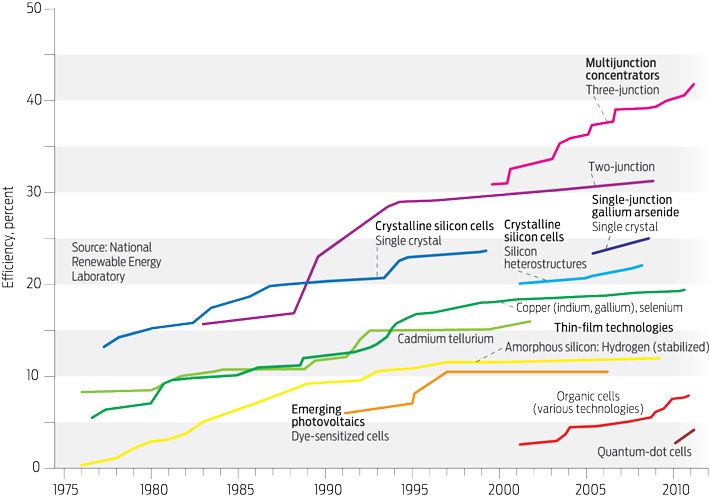
necro81 writes "IEEE Spectrum magazine has a feature article describing DARPA-funded work towards developing a solar cell that's 50% efficient, for a finished module that's 40% efficient — suitable for charging a soldier's gadgets in the field. Conventional silicon and thin-film PV tech can hit cell efficiencies of upwards of 20%, with finished modules hovering in the teens. Triple-junction cells can top 40%, but are expensive to produce and not practical in most applications. Current work by the Very High Efficiency Solar Cell program uses optics (dichroic films) to concentrate incoming sunlight by 20-200x, and split it into constituent spectra, which fall on many small solar cells of different chemistries, each tuned to maximize the conversion of different wavelengths." -
Towards a 50% Efficient Solar Cell
necro81 writes "IEEE Spectrum magazine has a feature article describing DARPA-funded work towards developing a solar cell that's 50% efficient, for a finished module that's 40% efficient — suitable for charging a soldier's gadgets in the field. Conventional silicon and thin-film PV tech can hit cell efficiencies of upwards of 20%, with finished modules hovering in the teens. Triple-junction cells can top 40%, but are expensive to produce and not practical in most applications. Current work by the Very High Efficiency Solar Cell program uses optics (dichroic films) to concentrate incoming sunlight by 20-200x, and split it into constituent spectra, which fall on many small solar cells of different chemistries, each tuned to maximize the conversion of different wavelengths." -
How Viable Is Large Scale Wind Energy?
New submitter notscientific writes "Renewable sources of energy are obviously a hit but they have as yet failed to live up to the hype. A new study in Nature Climate Change shows however that there is more than enough power to be harnessed from the wind to sustain Earth's entire population... x200! To generate energy from the wind, we may however need to set up wind farms at altitudes of 200-20,000 metres. To be fair, the study is purely theoretical and does not look at the feasibility of such potential wind farms. Regardless, the paper does provide a major boost to backers of wind-generated energy. Science has confirmed that the sky's the limit." -
Weebots: Driveable Robots For Babies Who Need Them
toygeek writes "Babies, as you may have noticed if you own one, like to get into all sorts of mischief, and studies show that exploring and interacting with the world is important for cognitive development. Babies who can't move around as well may not develop at the same rate as babies who can, which is why researchers from Ithaca College in New York are working on a way to fuse babies with robots to give mobility to all babies, even those with conditions that may delay independent mobility, like Down syndrome, spina bifida, or cerebral palsy." -
Meet the Very First Rover To Land On Mars
toygeek writes "Before Curiosity, before Opportunity, before Spirit, and before Sojourner, the very first robot to land on Mars was this little guy, way back in December of 1971. Called PrOP-M, the rover was part of the Soviet Union's Mars-3 mission, which had the potential to deploy the first ever mobile scientific instruments onto the Martian surface. Article also contains Russian video on early rovers." -
App Can Prevent Users From Texting While Driving
Hugh Pickens writes writes "Scientific American reports that while laws prohibit texting while driving in many states, many people still find it impossible to resist. Now researchers at Pacific Northwest National Laboratory are studying how software on a cell phone could analyze keystrokes to determine when that phone's user is distracted while composing and sending text messages and combined with GPS and other data, determine when a texter is behind the wheel and shut off texting functions automatically. Such a feature could take the form of a mobile app for any phone—independent of the manufacturer, operating system and wireless service provider. The researchers programmed a cell phone to log keystroke dynamics using a common operating system as a means of determining if an individual was texting while driving, in particular, 'keystroke entropy.' (PDF) when keys are struck at irregular intervals, as an indicator that the test subjects' attention is divided between texting and driving. 'The things that we are measuring, the data never needs to leave the person's phone,' says Mike Watkins, developer of the algorithm. 'But as a parent, you could require your child to have something like this on their cellphone as a way to protect them. Employers could use it as a way to mitigate their liability for accidents on work time. Even insurance companies could use it.'" -
Satellite Uplinks For the Masses
kgeiger writes "Intellectual Ventures has spun out Kymeta to develop and mass-produce their mTenna product line. mTennas are based on metamaterials like the invisibility cloaks discussed on Slashdot and elsewhere. Metamaterials enable beam-steering that ensures an mTenna remains in contact with satellites even during motion. Kymeta will use 'established lithographic techniques' to make them. IMHO, these antennas may be as big a leap for mobile computing and remote communications as the invention of fractal antennas was for mobile phones." -
Meet DARPA's New Militarized Earthworm
derekmead writes "Meshworm is a toughened, robotic earthworm that can crawl virtually silently at a speed of about 5 millimeters per second. DARPA wants to send it into battle. Believe it or not, the Pentagon's been working on building a robotic earthworm for a while. They tried putting one together with gears. They tried with air-powered and pneumatic pumps, but the results were bulky and untenable. Then, researchers at Harvard, MIT and Seoul National University in Korea put their heads together and designed an 'artificial muscle.' It's essentially a polymer mesh that's wrapped with nickel and titanium wire designed to stretch and contract with heat. When an electric current is applied, the mesh mimics the circular muscle system of an earthworm to scoot forward." -
MS-DOS Not Stolen, New Forensic Analysis Concludes
theodp writes "Challenging earlier assertions that Bill Gates got the rewards due Gary Kildall, a forensic analysis conducted for the latest issue of IEEE Spectrum concludes that the landmark MS-DOS operating system which Bill Gates and Microsoft licensed to IBM was an original piece of work, not stolen goods. Using his company's CodeSuite forensic software, Bob Zeidman said he found no evidence that QDOS or MS-DOS was copied from or was a derivative of Gary Kildall's CP/M. So, what do you think of Microsoft expert witness (pdf) Zeidman's "if-the-codebase-doesn't-fit-you-must-acquit" arguments?" -
Time Machines, Computer Memory, and Brute Force Attacks Against Smartcards
An anonymous reader writes "IEEE Spectrum reports on a method that exploits the decaying contents of unpowered computer memory to create an hourglass-like 'time machine' that rate limits brute force attacks against contactless smartcards and RFIDs. The paper takes an odd twist on the 'cold boot' attack reported four years ago at USENIX Security. Not quite as cool as a hot tub time machine though. " Full paper (PDF). -
Curiosity Lands On Mars
The Mars Science Laboratory, a.k.a. Curiosity, is now less than an hour from touchdown on Mars. It's scheduled to land at 1:31 AM EDT (0531 UTC). The landing will be monitored by the Odyssey orbiter, which will be the data relay between Curiosity and Earth. The Mars Reconnaissance Orbiter will be listening to Curiosity as well (yes — two of our probes orbiting another world will be watching a third). While Odyssey will be giving us close to real-time updates (as close as possible, given the 14-minute time delay), MRO's data will take a bit longer to be processed and evaluated. NASA is broadcasting from the JPL mission room right now. If you'd like to watch a pretty awesome graphical visualization of the mission, check out eyes.nasa.gov. If you'd like to play around with a Java app showing Mars-local times and seasons, check out Mars24. If you'd like to watch unofficial coverage, Bad Astronomer Phil Plait and a bunch of other astronomers are hosting a public Google Hangout. If you'd like to read a detailed explanation of the landing, checkout NASA's press kit (PDF), and there's also a post about what to expect when the rover starts sending pictures back to Earth, which will be about two hours after the rover lands. Good luck to everyone involved! We'll update this post when we get word on the landing.
Update: 08/06 05:33 GMT by S : Curiosity is on the ground! Everything looks nominal, and everybody at JPL is cheering. Congratulations, folks. They're continuing to receive telemetry from Odyssey, and the connection is strong. They've now received the first images back from Mars of Curiosity on the ground. A press briefing is scheduled in a little bit (2:15AM EDT, 0615 UTC), and several more throughout the day as more data comes back. -
MSL Landing Timeline: What To Expect Tonight
An anonymous reader writes "When the Curiosity rover lands on Mars later tonight, it'll be executing a complex series of maneuvers. JPL will be relying on the Mars Odyssey orbiter to relay telemetry back to Earth in time-delayed real-time, and if all goes well, we'll be getting confirmation on the success (or failure) of each entry, descent, and landing phase, outlined in detail here." -
XRL Hexapod Robot Gets a Tail, Learns To Use It
New submitter toygeek writes "In an effort to give various robots more control during free-fall and navigation of severe obstacles, researchers have studied how agama lizards use their tails to retain or correct orientation during leaps and jumps. They've applied the research to both hexapod and wheeled robots, and the results are both astounding, and outstanding!" -
Champions Declared In AI Poker Tournament
the_newsbeagle writes "The annual computer poker competition has just wrapped up, in which artificial intelligences battled each other over the (virtual) Texas Hold 'Em table. A researcher who worked on one of the top programs, the University of Alberta's "Hyperborean" program, has blogged about this year's competition and entrants for IEEE Spectrum. His first post explains the rules of the game and why it's tougher for a computer to win at poker than at chess; his second post describes Hyperborean's strategies, and the third gives the results and takes stock of Hyperborean's performance." -
Champions Declared In AI Poker Tournament
the_newsbeagle writes "The annual computer poker competition has just wrapped up, in which artificial intelligences battled each other over the (virtual) Texas Hold 'Em table. A researcher who worked on one of the top programs, the University of Alberta's "Hyperborean" program, has blogged about this year's competition and entrants for IEEE Spectrum. His first post explains the rules of the game and why it's tougher for a computer to win at poker than at chess; his second post describes Hyperborean's strategies, and the third gives the results and takes stock of Hyperborean's performance." -
Champions Declared In AI Poker Tournament
the_newsbeagle writes "The annual computer poker competition has just wrapped up, in which artificial intelligences battled each other over the (virtual) Texas Hold 'Em table. A researcher who worked on one of the top programs, the University of Alberta's "Hyperborean" program, has blogged about this year's competition and entrants for IEEE Spectrum. His first post explains the rules of the game and why it's tougher for a computer to win at poker than at chess; his second post describes Hyperborean's strategies, and the third gives the results and takes stock of Hyperborean's performance." -
Would You Trust an 80-Year-Old Nuclear Reactor?
the_newsbeagle writes "The worst nuclear near-disaster that you've never heard of came to light in 2002, when inspectors at Ohio's Davis-Besse nuclear power station discovered that a slow leak had been corroding a spot on the reactor vessel's lid for years (PDF). When they found the cavity, only 1 cm of metal was left to protect the nuclear core. That kind of slow and steady degradation is a major concern as the US's 104 reactors get older and grayer, says nuclear researcher Leonard Bond. U.S. reactors were originally licensed for 40 years of operation, but the majority have already received extensions to keep them going until the age of 60. Industry researchers like Bond are now determining whether it would be safe and economically feasible to keep them active until the age of 80. Bond describes the monitoring techniques that could be used to watch over aging reactors, and argues that despite the risks, the U.S. needs these aging atomic behemoths." Meanwhile, some very, very rich individuals have taken an interest in the future of nuclear power. -
Would You Trust an 80-Year-Old Nuclear Reactor?
the_newsbeagle writes "The worst nuclear near-disaster that you've never heard of came to light in 2002, when inspectors at Ohio's Davis-Besse nuclear power station discovered that a slow leak had been corroding a spot on the reactor vessel's lid for years (PDF). When they found the cavity, only 1 cm of metal was left to protect the nuclear core. That kind of slow and steady degradation is a major concern as the US's 104 reactors get older and grayer, says nuclear researcher Leonard Bond. U.S. reactors were originally licensed for 40 years of operation, but the majority have already received extensions to keep them going until the age of 60. Industry researchers like Bond are now determining whether it would be safe and economically feasible to keep them active until the age of 80. Bond describes the monitoring techniques that could be used to watch over aging reactors, and argues that despite the risks, the U.S. needs these aging atomic behemoths." Meanwhile, some very, very rich individuals have taken an interest in the future of nuclear power. -
Nanoparticle Completely Eradicates Hepatitis C Virus
Diggester writes "While Americans worry every year about getting a flu shot or preventing HIV/AIDS, the deadlier silent killer is actually Hepatitis C, killing over 15,000 people yearly in the U.S. since 2007 — and the numbers continue to increase as the carriers increase in age. While there is no vaccine, there is hope in nanoparticle technology. The breakthrough came from a group of researchers at the University of Florida, creating a 'nanozyme' that eliminates the Hep C 100% of the time; before now, the six-month treatment would only work about half the time. The particles are coated with two biological agents, the identifier and the destroyer; the identifier recognizes the virus and sends the destroyer off to eliminate the mRNA which allows Hep C to replicate." Reader Joiseybill adds a link to coverage in the IEEE Spectrum, and points out that the 100 percent success rate, while encouraging, is so far only in the lab. -
FCC Tariff Changes Mean No More Free Conference Calls
kgeiger writes "The FCC is changing the call termination tariffs that subsidized rural wireline service and coincidentally free conference calls. Free conference call services had located their dial-in centers in rural areas to scoop up FCC tariffs from its Universal Service Fund. USF monies will go to broadband deployment instead. Be prepared to put more nickels in the box." On the other hand, maybe ad-driven Internet services (whether free or "freemium") will step in to the free-conference gap with some good-enough options, as they have for many other services, like email and faxing. -
Robot Hand Beats You At Rock, Paper, Scissors 100% of the Time
wasimkadak writes "This robot hand will play a game of rock, paper, scissors with you. Sounds like fun, right? Not so much, because this particular robot wins every. Single. Time. It only takes a single millisecond for the robot to recognize what shape your hand is in, and just a few more for it to make the shape that beats you, but it all happens so fast that it's more or less impossible to tell that the robot is waiting until you commit yourself before it makes its move, allowing it to win 100% of the time." -
Why Bad Jobs (or No Jobs) Happen To Good Workers
sean_nestor writes "Back in October, an article appeared in The Wall Street Journal with the headline 'Why Companies Aren't Getting the Employees They Need.' It noted that even with millions of highly educated and highly trained workers sidelined by the worst economic downturn in three generations, companies were reporting shortages of skilled workers. Companies typically blame schools, for not providing the right training; the government, for not letting in enough skilled immigrants; and workers themselves, who all too often turn down good jobs at good wages. The author of the article, an expert on employment and management issues, concluded that although employers are in almost complete agreement about the skills gap, there was no actual evidence of it. Instead, he said, 'The real culprits are the employers themselves.'" The linked article is an interview with Peter Cappelli, author of the WSJ piece, who has recently published a book on the alleged skills gap. -
Display Makers To Use Quantum Dots For Efficiency and Color Depth
ArmageddonLord writes with this news from the IEEE Spectrum, reporting on display industry gathering Display Week: "Liquid crystal displays dominate today's big, bright world of color TVs. But they're inefficient and don't produce the vibrant, richly hued images of organic light-emitting diode (OLED) screens, which are expensive to make in large sizes. Now, a handful of start-up companies aim to improve the LCD by adding quantum dots, the light-emitting semiconductor nanocrystals that shine pure colors when excited by electric current or light. When integrated into the back of LCD panels, the quantum dots promise to cut power consumption in half while generating 50 percent more colors. Quantum-dot developer Nanosys says an LCD film it developed with 3M is now being tested, and a 17-inch notebook incorporating the technology should be on shelves by year's end." -
Famous 'Uncanny Valley' Essay Translated, Published In Full
An anonymous reader writes "IEEE has published an English translation of the 1970 essay in which Japanese roboticist Masahiro Mori introduced the now-famous concept of the Uncanny Valley. The original essay was in Japanese, and IEEE says this is the first publication of a translation authorized and reviewed by Mori. They also have an interview with Mori, who still thinks that robot designers should not attempt to 'cross' the Uncanny Valley." -
Famous 'Uncanny Valley' Essay Translated, Published In Full
An anonymous reader writes "IEEE has published an English translation of the 1970 essay in which Japanese roboticist Masahiro Mori introduced the now-famous concept of the Uncanny Valley. The original essay was in Japanese, and IEEE says this is the first publication of a translation authorized and reviewed by Mori. They also have an interview with Mori, who still thinks that robot designers should not attempt to 'cross' the Uncanny Valley." -
Fighting Counterfeiters With Quantum Money
the_newsbeagle writes "This article discusses a proposal to create cash that can't be counterfeited by embedding quantum particles in banknotes. A counterfeiter trying to copy a real bill would have to precisely measure all the attributes of the embedded quantum particles — which is impossible under the tricky laws of quantum mechanics (PDF). MIT computer scientist Scott Aaronson, who famously offered a prize for anyone who could prove quantum computers are impossible, said, 'This is science fiction, but it’s science fiction that doesn’t violate any of the known laws of physics.'" -
IEEE Spectrum Digs Into the Future of Money
New submitter ArmageddonLord writes "Small, out-of-pocket cash exchanges are still the stuff of everyday life. In 2010, cash transactions in the United States totaled $1.2 trillion (not including extralegal ones, of course). There will come a day, however, when you'll be able to transfer funds just by holding your cellphone next to someone else's and hitting a few keys — and this is just one of the ways we'll wean ourselves off cash. In 'The Last Days of Cash,' a special report on the future of money, we describe the various ways that technology is transforming how we pay for stuff; how it's boosting security by linking our biometric selves with our accounts; and how it's helping us achieve, at least in theory, an ancient ideal — money that cannot be counterfeited." -
Microbots Made of Bubbles Are Controlled By Lasers
An anonymous reader writes "Researchers at the University of Hawaii have turned bubbles of gas into non-mechanical 'microbots' that they propel and steer with a laser. The laser heats up specific areas of the fluid that the bubble are in, and temperature gradients push the fluid towards the hot area, moving the bubble along. By using an array of lasers, the researchers can control the speed and direction of multiple bubble bots independently; this capability is not possible with other types of microbots, such as those controlled by a magnetic field, which affects all robots simultaneously. The University of Hawaii researchers hope their non-mechanical microbots can be used to assemble and manipulate microscopic structures, including live cells. In one experiment, they used the bubble bots to position 100-m-diameter glass beads to form the letters 'UH.'" -
MIT Unveils Robotic Manipulator Filled With Coffee Grounds
An anonymous reader writes "MIT researchers have developed a highly articulated robotic manipulator based on soft materials that can harden to reposition the device. The technique is known as jamming, and it relies on pouches filled with granular material like coffee grounds; when air is removed from the pouches, they become rigid. The researchers combined jamming actuators with cables to build a manipulator resembling an elephant trunk. They say the device is low-cost, capable of grasping a variety of objects, and can remain in a hardened state for extended periods of time using little energy." -
IEEE Approves Revision of Wireless LAN Standard
An anonymous reader writes "IEEE announced the publication of IEEE 802.11-2012, which defines the technology for the world's premier wireless LAN products. The new IEEE 802.11-2012 revision has been expanded significantly by supporting devices and networks that are faster and more secure, while offering improved Quality of Service and improved cellular network hand-off. The standard's relevance continues to expand with the emergence of new applications, such as the smart grid, which augments the facility for electricity generation, distribution, delivery and consumption with a two-way, end-to-end network for communications and control." -
MA Hackerspace Building Rideable Hexapod
New submitter schlesingerj writes in with news about a six legged robot "The Artisans Asylum hackerspace in Somerville, MA is building a monster rideable hexapod named 'Stompy', with fully articulated legs (18 hydraulics actuators in total), powered by a humongous propane forklift engine. This is being built as a class, lead by a team of expert roboticists with an impressive background, including DEKA, Boston Dynamics and Barret Technologies and is expected to be finished by the end of the summer. I for one welcome our new robot overlords." -
How the Sinking of the Titanic Sparked a Century of Radio Improvements
joshuarrrr writes "When the RMS Titanic scraped an iceberg on the night of 14 April 1912, its wireless operators began sending distress calls on one of the world's most advanced radios: a 5-kilowatt rotary spark transmitter that on a clear night could send signals from the middle of the Atlantic to New York City or London. What the radio operators lacked, however, were international protocols for wireless communications at sea. At the time, US law only required ships to have one operator on board, and he was usually employed by the wireless companies, not the ship itself. On the 100th anniversary of the Titanic, IEEE Spectrum looks at how the tragedy accelerated the improvement of communications at sea." -
Official Details For the DARPA Robotics Challenge
An anonymous reader writes "The DARPA Robotics Challenge is offering tens of million of dollars in funding to teams from anywhere in the world to build robots capable of performing complex mobility and manipulation tasks such as walking over rubble and operating power tools. It all will culminate in an audacious competition with robots driving trucks, breaking through walls, and attempting to perform repairs in a simulated industrial-disaster setting. The winner takes all: a $2 million cash prize." -
Arrays of "Topological Insulators": a Step Towards Exotic Electronics
LilaG writes with a paragraph from Chemical & Engineering news: "Chemists in China have precisely grown arrays of ultrathin flakes of bismuth selenide and bismuth telluride on a surface. The bismuth compounds belong to a recently discovered – and weird — class of materials called topological insulators, which conduct electrons only along their surfaces, not through their insides. Researchers think topological insulators promise a new realm of fast, energy-efficient electronic and spintronic devices. Making well-defined nanoparticle arrays such as the new study's flakes is a key step towards such devices." -
11-lb Robot Can Jump 30 Feet Into the Air
Ruvim writes "Boston Dynamics has developed a 'Sand Flea' 11-lb robot that drives like an RC car, but when it needs to, it can jump 30 feet into the air. An onboard stabilization system keeps it oriented during flight to improve the view from the video uplink and to control landings." -
Nanowire Forests Use Sunlight To Split Water
An anonymous reader sends this excerpt from IEEE Spectrum's Nanoclast blog: "One of the fundamental problems with fuel cells has been the cost of producing hydrogen. While hydrogen is, of course, the most abundant element, it attaches itself to other elements like nitrogen or fluorine, and perhaps most ubiquitously to oxygen to create the water molecule. ... Now researchers at University of California, San Diego have developed a quite different approach to mimicking photosynthesis for splitting water molecules by using a 3D branched nanowire array that looks like a forest of trees. ... The nanowire forest [uses] the process of photoelectrochemical water-splitting to produce hydrogen gas. The method used by the researchers, which was published in the journal Nanoscale (abstract), found that the forest structure of the nanowires, which has a massive amount of surface area, not only captured more light than flat planar designs, but also produced more hydrogen gas."