Slashdot Mirror
Domain: inetnebr.com
Stories and comments across the archive that link to inetnebr.com.
Comments · 13
-
Re:Memory exists to be used
...Don't think any of the SSD based netbooks use swap at all and they get along just fine...
What is the best way to configure Linux on a sub 512MB RAM box, sub notebook, etc..., so that no matter how much you load (application wise) it will not die, although it might run slower should swapping occur? (The system seems to stop swapping as well when Free Memory falls below 10MB and really poorly when it falls below 5 MB. Ideally I would like to maintain 10 - 15 MB of Free RAM Memory available at all times.)
I know Linux can be configured to run in 128MB of RAM and love that...actually have a PC that I would like to configure and use with that low of RAM. (Intuitively I understand that if I can run with less RAM, when I purchase newer boxes with more RAM I should be able to run, much, much faster...the idea that a system for a normal Power user would ever get sluggish with over 1 GB of RAM is ridiculous in my opinion. If I purchase more RAM, I want my apps to benefit from that, not be required to have it just to function, but than my first work computer was an IBM mainframe with 32KB of RAM, an IBM 360.
My first desktop was the Radio Shack Model III, (4K RAM, Floppy drives, 12 inch B/W Monitor, keyboard, BASIC in ROM, TRS-DOS on disk, between $700 - $2,500 depending on config)my first IBM PC had either 16kB of RAM, 4.77 MHz Intel 8088, Floppy Disk Drive (credited with its business success per the wiki, aah the power of the floppy), 5 Bus slots (w/Expander in 1 of 5 - 8 more Bus Slots, slots used by Monitor, Hard Disk (if you had one, my first did not), I/O adapters, 3278/3279 Adapter - for moving up to 2 MB files to/from mainframe.), No hard disk for around $3,000. My first lug gable the IBM P70, OS/2 1.2 Extended Edition, MSDOS, Windows 3.1, Microsoft Word, Intel 9600 EX Modem, Hyper Access software, Token Ring Built in, slot for Ethernet, external monitor port (dual monitor mode), 8512 Color Monitor, floppy drive and hard disk (120 MB I believe) cost over $5,000. Made well over $15,000 working out of a hotel room on a consulting contract in a few weeks with that sexy heavy beast which was state of the art at the time. so was well worth the purchase.
A Intel Celeron M running at 900 MHz sub notebook, 512MB of RAM, 4GB SSD drive, 10/100 & WiFi built in; Web Cam, Audio and Mic ports, 3 USB ports, MMC.SD slot, external monitor port for $300 - $400 is something else... warning...slow loading flash; wiki page.
I could probably fit 9+ sub Notebooks the size of the Asus Eee PC in the IBM P70 leather carrying case, lol.
Thanks to the many great posts here I am learning this is a bit art as it is science and I do not mind experimenting with different configurations...
Read on if you need specifics about my configurations and PCs to help me...honestly looking for the right answers. I too would love to be able to set a MIN and MAX memory point (as another poster mentioned above) to begin swapping IN/OUT only allowing the swap if it is honestly required. Sounds like that is NOT possible at this time, though I sneakingly expect there might be a way...one day as I learn more...might be time to pick up programming in C again.
On my Asus EeePC I have noticed that my free memory continues to shrink, down to around 4 - 6KB free, at which point my performance suffers greatly. If an app fails or my Network Adapter hic ups when it is this low it can cause a lockup situation for me. I thought about swap space, but based on reading about hard disk performance issues, that does not sound like a good solution. ( Or is it?)
Now I do this to myself, I will often have
-
Right...If this doesn't make you think they will slap the winning code into such a 'bot, nothing will.
DARPA, and the DOD would *love* to have semi to full autonomous "kill bots" - in a way, today, they already have them for some tasks - they are called "cruise missles", which can be launched, told to stay on "hold" above possible targets, then commanded to strike on located targets. I would assume "located" likely means some form of lat/lon coordinates or painted with a laser (either by troops or from the air).
The exact same thing could be done with a kill bot: send it to a predetermined position, and tell it to "hold fire" unless acted upon agressively, or if non-friendly comes into position (at which point it could bark a series of commands in different languages to the offender - think of it as an active landmine with intelligence that can move on command), which if not heeded, shoots a warning, then if continued, shoots to kill. Friendlies are identified by RFID or similar tags. Equip them with the ability to identify each other, as well as to flock or coordinate efforts with one another. Other commands could be something like "fire on ident", where they could be set up, then when a target is painted with a laser (perhaps from a troop's rifle), it fires on that target.
You better bet that the DOD and DARPA would be all over such a system if it was proven field safe (to our troops) and easy/quick to use, and rugged. They are half way there with the TALON robots already, they just lack the rest of the package, which the Grand Challenge is dealing with...
Of course, one can also easily see the potential of scaled up versions - robotic Humvees and M1A tanks, as well as robotic quads, and perhaps legged versions...
BTW - this last was actually funded by DARPA back in the 1980's, which culminated in the Odetics, Inc. (now known as Iteris, Inc. - based in Anaheim, California - interesting the strange things going on at this company, whatwith name changes, etc - plus, they are developers of an "electronic highway" concept - I am sure there is no relation to the Grand Challenge - wink, wink) ODEX-1 legged walker - a very unique leg design that proved to be fairly robust and strong, while keeping outboard weight (on the legs) to an absolute minimum by moving all the electric motors inward toward the torso of the machine.
Think about it - if you could, in addition to GPS coordinates, vision systems, etc - also bury in the ground or nearby some form of active or passive "locator" beacons, such as what Odetics - oops, I mean Iteris - is developing - wouldn't the problem become just a little bit simpler...?
Nah - DARPA hasn't been thinking about this, not at all, not at all...
-
Re:Wonder if Joss Whedon watches anime
Also in that genre is a '70s tokusatsu (Japanese live-action) show called Kaiketsu Zubat. No, it has nothing to do with Pokemon--Kaiketsu Zubat is an awesome superhero show from 1977 set in a "modern western"-type setting. It takes place in modern Japan, but the characters dress and act as if it were a western. It's not really sci-fi, but it does combine a western motif with a modern setting.
There's a site dedicated to Kaiketsu Zubat, and it has an entry on the IMDB. Oh, and I'll also add that my favourite actor of all time (Hiroshi Miyauchi) plays the main character. -
Prior art ;-]
Anyone else think of the Quasar robot? -
Re:Why not?
Well, here's one that was made in the 80s:
Odex 1
Large and strong, this dude could pick up the end of a pickup truck and move it around.
-
I'd hope so
The IT100 is powered by a 60 watt external PSU and is smaller than a PS2.
For something that bills itself as a "mini-server," I'd hope that it's smaller than a PS/2...wouldn't make much sense if it was larger.
-
Re:News Flash
Sure, alot of ISP's still survive. Internet Nebraska in Nebraska has survived for nearly 10 years and provided service across nearly the entire state including DSL and in the face of stiff competition (Alltell, Road Runner, Cox Cable). As a matter of fact they are even rolling out Wireless in some parts of the state.
Of course, they have a different attitude than most ISP's - they don't have the latest and greatest in tech. As a matter of fact the tech desk machines are old Sparc stations (30mhz I believe) and most of their equipment is bought off E-bay. Doesn't make a difference; their uptimes and such are excellent, and they are the largest ISP in Nebraska - and no I don't work for them.
The problem with most of the ISP's you listed is that they expanded too fast, and spent too much buying the latest and greatest equipment with no thought of if they where going to be able to recoup the costs. -
Re:Rediscovered a 20-year-old Technique
There was no audio (hell, there was barely video) on that machine, and the original data storage medium was cassette tapes. Stored at about 300 baud, or so. The output of the cassette port was about the same +5v / 0v range, and people used the same approach to store data on the tape (I think it's called Frequency Shift Keying, but I'm not sure).
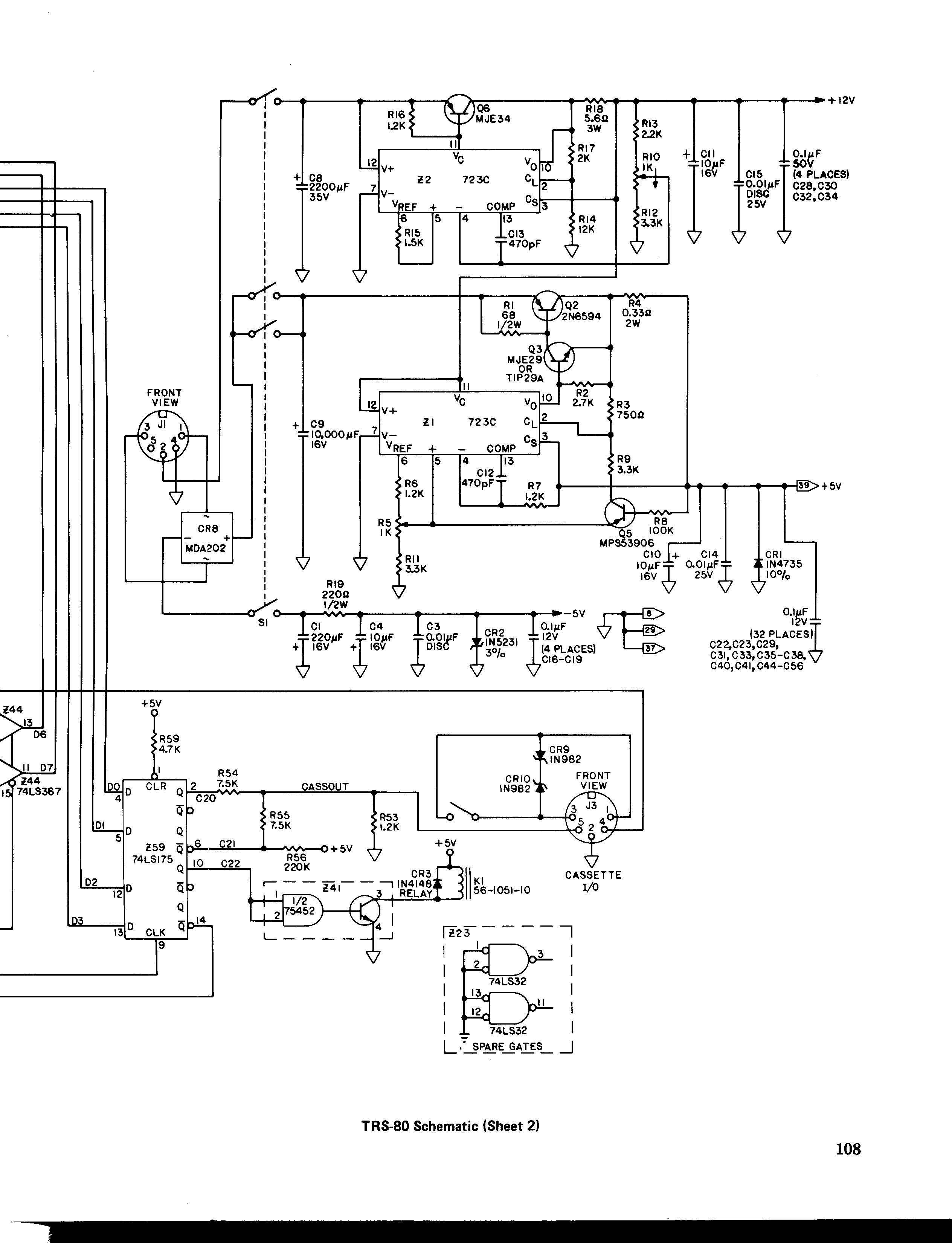
The TRS-80 cassette schematics can be seen here. Unlike the PC speaker output which is a simple square wave (bilevel), the TRS-80 cassette output was trilevel - default was 1V, with 0V and 2V pulses individually generated.
Data output to the cassette was generated as a series of positive and negative pulses approximating a sinewave; from memory, there was a clocking pulse-pair followed by another pulse-pair for "1" or nothing for "0". (I may have misremembered this; there were several utilities that increased the data density on the cassette, and I may be remembering one of these instead.)
Audio sound was generated by manually generating the cassette pulses at given frequencies. Some bright sparks also figured out that you could generate two-voice music by using positive pulses for one voice, and negative pulses for the other. Very neat!
See also the TRS-80 Documentation Preservation Page - very handy since these computers last a lot longer than their manuals... -
Re:Stylish wearables..
Actually, major progress is being made recently in just this sort of thing. It's not a commercial solution, but Matt Carlson (of the wear-hard mailing list) created a pretty sweet hack of the M1 personal display into a covert glasses mount display. Several others on the wear-hard list have done similar things, and I will be soon as well, as soon as I can gather the 500 or so dollars I need to get a display to hack open
-
Why I won't use my IBM PS/2 for DVDs [link]
I doubt I'll be using my IBM Model 80 PS/2 for DVDs.
For starters, it's a 386.
For seconds, it doesn't even have a CD-ROM let alone a DVD drive (the prospect of adding more weight to this beast is... unwelcome).
And finally, the thought of having to move this hulk out of my study, downstairs to the lounge, frankly fills me (and my back) with dread. Anything with a bright yellow sticker saying "CAUTION! DO NOT ATTEMPT TO LIFT THIS GREAT BIG FSKING HUMP OF METAL ON YOUR OWN, MATEY, YOU'LL REGRET IT REAL SOON" (anyone remember the exact words?) is something that, like cast iron cooking ranges, should be put in place FIRST and the building constructed around it AFTERWARDS.
More and more on the great beasts.
(mind you, it plays Doom like a bastard so I can see how people could confuse it with a console)
--
-
First Computer - RCA CDP1802An IBM OS/360 mainframe when I was twelve. It had BASIC and PL/I in interactive mode, IIRC, and FORTRAN and COBOL for batch use.
The first one I owned was a COSMAC ELF built from the plans in the August 1976 in Popular Electronics (yeah, I'm an old bastard. Sue me.) It ate up the money saved from a whole summer's worth of part-time employment. At that, I couldn't afford the two digit hex display, and had to make do with 8 LEDs tied directly to the data bus. The 1802 was actually quite a nice chip for the time.... 16 bit registers (vs. 8 bit for competitors such as the 6502 and 8080), CMOS technology, and it came in a nice rad-hardened ceramic package. I understand that RCA sold a buttload of these to the military for satellite applications, but it never really caught on in the PC world. A cursory examination of parts suppliers indicates that most of the parts from the above schematic are still available. Might make a nice retrocomputing project....hmmm.
--
WordSocket Voice BBS Software -
ISP monitoring
I just think all the stuff about ISP monitoring and strict regulations on DSL is crazy! I use a local ISP for my DSL service here in Lincoln, Nebraska, (Internet Nebraska), and they don't have any regulations on what you do with the service. The only potential issue is data transfer, with a limit of 1 gig up and 1 gig down each month (and a very modest fee if you go over). Running servers? Heck, I'm on a static IP plan and they'll do DNS entries for me the same day! They don't care what you do! And, talk about customer service! When I was having difficulty setting up my Linux box initially, I posted a question on a newsgroup, and one of their guys who happened to be reading the post called me at home to help! Just like the old mom-n-pop stores of yesteryear, only in the information world! If we could get more like them.....
-
Python script implementing Single Image StorageI have written a quick version of SIS in Python.
See http://incolor.inetnebr.com/jeple r/sis-1.0.tar.gz
Jeff
jepler@inetnebr.com
too lazy to figure out why his login doesn't work