Slashdot Mirror
Domain: infotoday.com
Stories and comments across the archive that link to infotoday.com.
Comments · 23
-
UCITA 2.0 all over again
A number of years back the computer industry tried pulling this stunt with UCITA. It provided a uniform license for software that in theory greatly simplified licensing.
http://newsbreaks.infotoday.co...
It sounded great in the soundbites the tech giants put out at the time. However, once you got into the details it quickly became apparent that the law that was completely tilted in their favor. For example it made it legal to remotely shut off users software in the event of a contract dispute.
This is effectively UCITA 2.0 and must be opposed just as strongly as UCITA was. Don't allow the tech giants sell out your privacy rights. UCITA was defeated, this too can be defeated.
-
Boycott the USA next time?
Maybe I'm becoming jaded, but I don't think the United States is a good place to hold a security conference. I know, this year the TrustyCon organizers have to accommodate previous arrangements, but next time they should hold the conference in a place less likely to arrest security researchers and harass pioneers whose work is featured in every computer on every desk and in every smartphone.
-
Re:that settles it
I guess they won't be going through Heathrow.
The US is hardly a safe haven.. I believe a place like Iceland would be the safest for these kinds of gatherings..
I understand there's also a nice hotel in the "flight side" of Moscow airport
-
Re:that settles it
I guess they won't be going through Heathrow.
The US is hardly a safe haven.. I believe a place like Iceland would be the safest for these kinds of gatherings..
-
Re:Amazon Response
Wrong, see this article -- US Government information maybe protected by copyright -- by Bonnie Klein, a copyright specialist with the DTIC.
-
seems reasonable
It's becoming increasingly anachronistic that a for-profit company should: 1) get their main product (the papers, in this case) produced for free by third parties who are not given any cut of the revenues; 2) have much of the intellectual work of reviewing and editing the papers also done for free by third parties; and then 3) lock up the result behind a paywall to maximize revenues, which go to people who had comparatively minor roles in actually producing the product being sold.
Perhaps if more academics did this sort of thing things would change.
-
Re:Just cos he does it - doesnt make it right
Read this.
-
Re:Piracy?But to spite copyright holders, you ignore 200 years of the term's legal history. Read the article Here which contains interesting tidbits such as:
The practice of piracy originally had a positive (even proud) reputation. During the 10th and 9th centuries B.C. in Greece, small groups routinely engaged in the organized use of force; this was an activity seen merely as part of citizens' struggle for survival rather than anything immoral or illegal. Those who engaged in piracy seized essential goods, but the practice was not limited to necessities, since pirates also seized goods merely for gain. Whether for need or sport, piracy served as a wholly legitimate alternative to Greece's main gift-exchange economic transfer system. In this way, piracy was an original underground economy.
Then later moves on to the more IP-related piracy claims, such as:
Henry Campbell Black wrote in 1898, the term "piracy" "is also applied to the illicit reprinting or reproduction of a copyrighted book or print or to unlawful plagiarism from it." This definition is consistent with the 1798 case Beckford v. Hood, one of American law's first case citations that invoked "piracy" as a proxy for unauthorized copying. In Beckford, the court characterized the case's primary issue (an unauthorized commercial republication of a book) as "an action upon the case for piracy of copyright."
Refusing to use the term in a proper context is not the answer. Re-establishing the weight of the context will be a much more successful approach.
-
Re:Oh Apple, let the Apps through already!
no. I like to use search engines, not decision engines with their own controversy and positive articles about microsoft (aka propaganda machines). Also nice to know how they have no opt out from tracking, no guarantee of anonymity data (as pitiful as that is in the first place), etc.
Brought to you by the same company that first tried to forcibly obtain yahoo, and instead got the ceo kicked out and replaced them with a microsoft individual. How's that "yahoo"?
Yeah. Bing. I'll pass.
-
Re:AdBlock Plus
I see the day coming when this will no longer be funny.
It's already here: http://newsbreaks.infotoday.com/nbreader.asp?ArticleID=15986 -
Wasn't Me, But Here Are More Details!
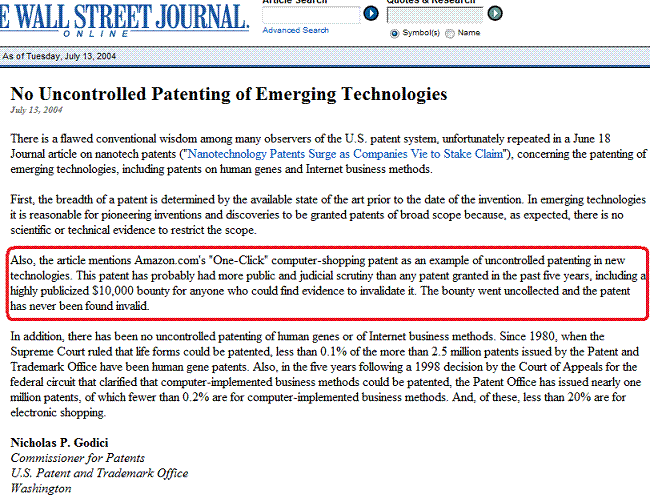
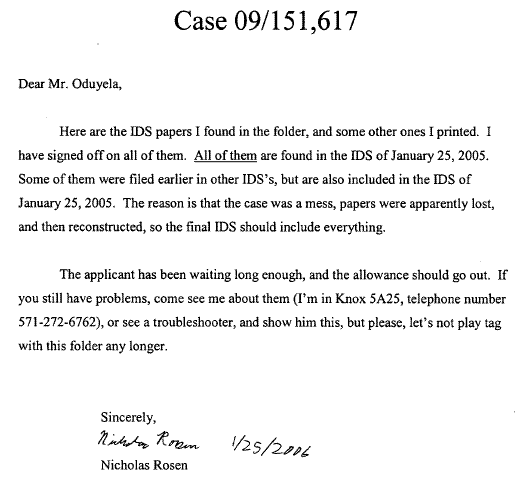
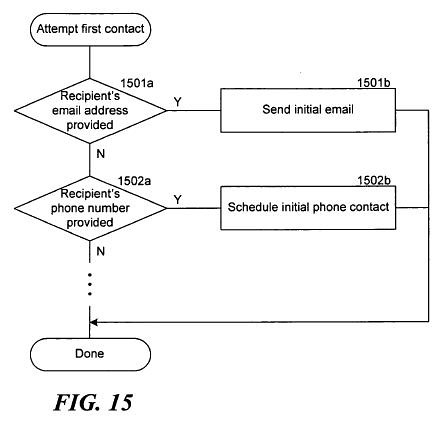
Congress didn't buy Amazon's argument that the failure of a defunct Jeff Bezos-funded company to award a $10,000 bounty offered by Tim O'Reilly for prior art that could bust Bezos' 1-Click patent was proof of 1-Click's novelty. The Commissioner for Patents, on the other hand, was duly impressed. As was one of his patent Examiners, who broke ranks from a less-impressed fellow Examiner and re-Examiner, to push through last week's issuance of U.S. patent no. 7,222,087, a 'continuation' of 1-Click which adds innovative claims like contacting the recipient of an order via e-mail or a phone call to obtain additional info.
-
Sounds like the RIAA has been an inspiration....
From the website at http://www.infotoday.com/linkup/lud090106-goldsbo
r ough.shtml
""" The group, EmbroideryOrganizationInformation (http://groups.yahoo.com/group/EmbroideryOrganizat ionInformation), is a Yahoo! Groups discussion group that was set up in response to piracy and copyright infringement charges made by ESPC against those who share embroidery designs obtained from embroidery software and from embroidery design companies.
Many of the participants have elected to participate in the discussion group on an anonymous basis. In response to this, ESPC obtained a subpoena to force Yahoo! to reveal the identities of these people in addition to filing defamation claims against individual members for what they wrote.
The Electronic Frontier Foundation (EFF), in turn, filed a motion to block this subpoena, which it described as "brazen" and "heavy-handed." """ -
Re:Outsource parts of LOC to Google or Amazon?
You mean like this?
-
CC License Welcome But Unnecessary to Self-ArchiveThis has come up before on Slashdot:
http://science.slashdot.org/comments.pl?sid=82084& cid=7217869On the Deep Disanalogy
A CC License is always desirable and welcome, but it is unnecessary for the self-archiving of authors' own peer-reviewed journal articles. With 93% of journals having already given their authors the green light to self-archive
Between Text and Software and
Between Text and Data
Insofar as Free/Open Access is Concerned
http://romeo.eprints.org/stats.php
what is needed is that authors should now go ahead and self-archive -- not waste yet another decade
http://www.infotoday.com/IT/oct04/poynder.shtml
-- this time needlessly trying to negotiate a CC license with their publishers!
See also:
"Apercus of WOS Meeting: Making Ends Meet in the Creative Commons"
http://www.ecs.soton.ac.uk/~harnad/Hypermail/Amsci Stevan Harnad
Moderator,
AMERICAN SCIENTIST OPEN ACCESS FORUM:
A complete Hypermail archive of the ongoing discussion of providing open access to the peer-reviewed research literature online (1998-2004) is available at:
http://www.cogsci.soton.ac.uk/~harnad/Hypermail/Am sci/index.html To join or leave the Forum or change your subscription address:
http://amsci-forum.amsci.org/archives/American-Sci entist-Open-Access-Forum.html
Post discussion to: american-scientist-open-access-forum@amsci.org -
Re:Perfect Name for a Ripoff Artist
They did support the Mozilla development environment for a good many years for like 0 profit
Actually did far more than that...
They donated $2 million to the Mozilla Foundation to get them going and willingly donated the mozilla.org domain name, the Mozilla-related trademarks, and related equipment such as the mozilla.org servers, to Mozilla Foundation. They was obliged to do none of this, just having purchased Netscape and got all this along with them.
See also this story. -
Re:How long...
Apparently, this took place over a long time... I didn't realise just how long it takes to shut down a government website... (or how quickly it goes from necessary and useful to redundant...)
October 1999 http://www.pnl.gov/energyscience/11-99/art2.htm - PubScience opened.
http://arl.cni.org/info/frn/gov/pubscience02.html
2001 http://www.infotoday.com/newsbreaks/nb010709-1.htm - they decide to cut funding, suggesting that the system be shut down.
http://www.nature.com/nature/debates/e-access/Arti cles/butler.html
2002 http://www.infotoday.com/newsbreaks/nb020819-2.htm - decision to close... Comments invited...
2004 http://www.washingtonpost.com/ac2/wp-dyn?pagename= article&contentId=A17568-2002Nov20¬Found=tr ue - it's closed... -
Re:How long...
Apparently, this took place over a long time... I didn't realise just how long it takes to shut down a government website... (or how quickly it goes from necessary and useful to redundant...)
October 1999 http://www.pnl.gov/energyscience/11-99/art2.htm - PubScience opened.
http://arl.cni.org/info/frn/gov/pubscience02.html
2001 http://www.infotoday.com/newsbreaks/nb010709-1.htm - they decide to cut funding, suggesting that the system be shut down.
http://www.nature.com/nature/debates/e-access/Arti cles/butler.html
2002 http://www.infotoday.com/newsbreaks/nb020819-2.htm - decision to close... Comments invited...
2004 http://www.washingtonpost.com/ac2/wp-dyn?pagename= article&contentId=A17568-2002Nov20¬Found=tr ue - it's closed... -
Morgan Wilson's response to articleWhile cruising through other law blogs, I came across Morgan Wilson's explodedlibrary.info (of the Hamline Law Library) response to Melissa Bar's article:
In my biased opinion, this article has one major flaw, which is that it seems to totally ignore the role of law libraries - particularly academic law libraries and court libraries. I can only speak for the academic law library where I work. Although we mainly exist to serve our students, faculty and alumni, we never turn anyone from the public away who needs help with legal research. We are trained to help people find what they want or need without crossing over into the area of unauthorized practice of law. At the risk of blowing the profession's own horn too much, I say that the the assistance of a good law librarian - who is armed with a standard collection of printed materials and the resources available on the "free web", including the Legal Information Institute, West's FindLaw and LexisOne - will usually do a much better job for the pro se patron than free access to LexisNexis or Westlaw. The printed sources aren't all bad. They are very strong with the older materials, which Ms. Barr uses as an example, and they make it more difficult to full into the full-text infoglut trap - where the few pearls are hidden in a tonne of garbage.
Law libraries should do a better job of communicating all this to public libraries. I know that some of the professional associations, including the Minnesota Association of Law Libraries are already doing some work in this area.
None of this is to say that I don't have my issues with LexisNexis or Westlaw - or think that they're perfect, altruistic companies. But now there are more free electronic alternatives (or cheap ones, like VersusLaw) available for legal research. They don't have the all the fancy bells & whistles of Westlaw or Lexis, but they still offer the public access to primary legal materials that would have seemed unthinkable 15 years ago. -
Re:Ummm...[??]
I guess I was dating myself. My information was old, and it appears that West did lose in their efforts to copyright page numbers back in 1999.
-
Re:West v. Mead was settled out of courtThe Internet is a beautiful thing. You cite exactly the case that caused West to lose its copyright claim on page numbers
I bow to your superior Kung Fu. Who knew?
-
Barr's name misspelled...
Not to nitpick, but her last name is Barr, not Bar. As in barr.htm.
-
Re:Here's a quote I've been saving
The Internet is supposed to be...
- TO EMPOWER K-12 LEARNERS
- the promise of our future
- to save the American medical system
- a global, multipurpose, multimedia communications network
- to strengthen Hispanic families and communities
- to open the door for competition
- for English as a Second Language
- for freedom from sysadmin
- to transfer the power of the high-speed network effectively to society at large
- to compete successfully with Fortune 500 companies
- To center learning around the student instead of the classroom
- to regain the tails of the normal distribution
- to test the founding vision of the framers of the Constitution
- to propel the economy forward
- a truly democratic means of communication.
- to increase mail usage and expand paper consumption
- TO EMPOWER K-12 LEARNERS
-
Re:Recall?Rofl. Like that's gonna happen. That would be like some asshole patenting hyperlinks, then forcing the entire web to shut down due to unauthorized use.