Slashdot Mirror
Domain: ipcc.ch
Stories and comments across the archive that link to ipcc.ch.
Comments · 821
-
Re:The Collapse of Reason
Catching scientists in a misrepresentation
There you go again. Which scientists were caught in a "misrepresentation"?
The melting Himalayan glaciers was in the WG II report (Working Group II: Impacts, Adaption and Vulnerability), not the WG I report. It wasn't written by scientists.
Glaciers in the Himalaya are receding faster than in any other part of the world (see Table 10.9) and, if the present rate continues, the likelihood of them disappearing by the year 2035 and perhaps sooner is very high if the Earth keeps warming at the current rate. Its total area will likely shrink from the present 500,000 to 100,000 km2 by the year 2035 (WWF, 2005).
http://www.ipcc.ch/publications_and_data/ar4/wg2/en/ch10s10-6-2.html
-
Re:Science vs. Government
The IPCC doesn't do research. It "reviews and assesses" the science in order to "provide the world with a clear scientific view on the current state of climate change and its potential environmental and socio-economic consequences".
http://www.ipcc.ch/organization/organization.htm -
Re:2 big problems in that report
Working group 2 of the IPCC seems to have made some embarrassing mistakes. Upon seeing the letter in Science, I wondered why I'd never noticed these ludicrous statements before. Then I realized that the mistakes weren't in working group 1 report, which is all I'd ever bothered to read. Here's what each working group does:
The IPCC Working Group I (WG I) assesses the physical scientific aspects of the climate system and climate change.
The main topics assessed by WG I include: changes in greenhouse gases and aerosols in the atmosphere; observed changes in air, land and ocean temperatures, rainfall, glaciers and ice sheets, oceans and sea level; historical and paleoclimatic perspective on climate change; biogeochemistry, carbon cycle, gases and aerosols; satellite data and other data; climate models; climate projections, causes and attribution of climate change.
The IPCC Working Group II (WG II) assesses the vulnerability of socio-economic and natural systems to climate change, negative and positive consequences of climate change, and options for adapting to it.
It also takes into consideration the inter-relationship between vulnerability, adaptation and sustainable development. The assessed information is considered by sectors (water resources; ecosystems; food & forests; coastal systems; industry; human health) and regions (Africa; Asia; Australia & New Zealand; Europe; Latin America; North America; Polar Regions; Small Islands).
The wild claim that "glaciers in the Himalaya are receding faster than in any other part of the world", the 2350/2035 typo, confusion of Himalayan glacier area with the worldwide total, and reliance on non-peer-reviewed source material all occurred in a single paragraph(!) in the WG2 report (section 10.6.2, paragraph 2).
Statements in the WG1 report regarding glaciers, on the other hand, accurately reflect conclusions in the peer-reviewed literature.
Due to my obsession with the physical sciences, I'd never even realized that other working group reports existed. Perhaps other scientists reacted in a similar fashion, which might be why such an absurd cluster of errors went undetected for so long...
-
Re:Premature
Found another error in the WG1 report! To: IPCC-Sec@wmo.int, Feb 20, 2010 at 2:35 PM subject: Duplicated figure? To Whom It May Concern, First, thank you for your very helpful report. I'm writing because I recently tried to direct someone to the AR4 WG1 chapter 2, figure 2.3 (CO2 isotope ratios plot). But the relevant link is this. However, that's actually a copy of figure 2.4. Something similar happened with 2.5 and 2.6. Sincerely, Dumb Scientist
-
Re:Premature
Found another error in the WG1 report! To: IPCC-Sec@wmo.int, Feb 20, 2010 at 2:35 PM subject: Duplicated figure? To Whom It May Concern, First, thank you for your very helpful report. I'm writing because I recently tried to direct someone to the AR4 WG1 chapter 2, figure 2.3 (CO2 isotope ratios plot). But the relevant link is this. However, that's actually a copy of figure 2.4. Something similar happened with 2.5 and 2.6. Sincerely, Dumb Scientist
-
Re:I Don't Think This Was Well Thought Out
Have you found any peer reviewed articles?
Well, for example in Chapter 8: Climate Models and their EvaluationYou'll find the references.
Abramopoulos, F., C. Rosenzweig, and B. Choudhury, 1988: Improved ground hydrology calculations for global climate models (GCMs): Soil water movement and evapotranspiration. J. Clim., 1, 921-941.
Achatz, U., and J.D. Opsteegh, 2003: Primitive-equation-based low-order models with seasonal cycle, Part II: Application to complexity and nonlinearity of large-scale atmospheric dynamics. J. Atmos. Sci., 60, 478-490.
AchutaRao, K., and K.R. Sperber, 2002: Simulation of the El Niño Southern Oscillation: Results from the coupled model intercomparison project. Clim. Dyn., 19, 191-209.
AchutaRao, K., and K.R. Sperber, 2006: ENSO simulation in coupled ocean-atmosphere models: Are the current models better? Clim. Dyn., 27, 1-15.
AchutaRao, K., et al., 2004: An Appraisal of Coupled Climate Model Simulations. UCRL-TR-202550, Lawrence Livermore National Laboratory, Livermore, CA, 197 pp.
Alexander, M.A., et al., 2004: The atmospheric response to realistic Arctic sea ice anomalies in an AGCM during winter. J. Clim., 17, 890-905.
Alexeev, V.A., 2003: Sensitivity to CO2 doubling of an atmospheric GCM coupled to an oceanic mixed layer: a linear analysis. Clim. Dyn., 20, 775-787.
Alexeev, V.A., P.L. Langen, and J.R. Bates, 2005: Polar amplification of surface warming on an aquaplanet in "ghost forcing" experiments without sea ice feedbacks. Clim. Dyn., 24, 655-666.
Alexeev, V.A., et al., 1998: Modelling of the present-day climate by the INM RAS atmospheric model "DNM GCM". Institute of Numerical Mathematics, Moscow, Russia, 200 pp.
Allan, R.P., and A. Slingo, 2002: Can current climate forcings explain the spatial and temporal signatures of decadal OLR variations? Geophys. Res. Lett., 29(7), 1141, doi:10.1029/2001GL014620.
Allan, R.P., V. Ramaswamy, and A. Slingo, 2002: A diagnostic analysis of atmospheric moisture and clear-sky radiative feedback in the Hadley Centre and Geophysical Fluid Dynamics Laboratory (GFDL) climate models. J. Geophys. Res., 107(D17), 4329, doi:10.1029/2001JD001131.
Allan, R.P., M.A. Ringer, and A. Slingo, 2003: Evaluation of moisture in the Hadley Centre Climate Model using simulations of HIRS water vapour channel radiances. Q. J. R. Meteorol. Soc., 129, 3371-3389.
Allan, R.P., M.A. Ringer, J.A. Pamment, and A. Slingo, 2004: Simulation of the Earth's radiation budget by the European Centre for Medium Range Weather Forecasts 40-year Reanalysis (ERA40). J. Geophys. Res., 109, D18107, doi:10.1029/2004JD004816.
Allen, M.R., and W.J. Ingram, 2002: Constraints on future changes in climate and the hydrologic cycle. Nature, 419, 224-231.
Alley, R.B., et al., 2002: Abrupt Climate Changes: Inevitable Surprises. National Research Council, National Academy Press, Washington, DC, 221 pp.
Alves, O., M.A. Balmaseda, D. Anderson, and T. Stockdale, 2004: Sensitivity of dynamical seasonal forecast to ocean initial conditions. Q. J. R. Meteorol. Soc., 130, 647-667.
Amundrud, T.L., H. Mailing, and R.G. Ingram, 2004: Geometrical constraints on the evolution of ridged sea ice. J. Geophys. Res., 109, C06005, doi:10.1029/2003JC002251.
Annamalai, H., K. Hamilton, and K.R. Sperber, 2007: South Asian summer monsoon and its relationship with ENSO in the IPCC AR4 simulations. J. Clim., 20, 1071-1083.
Annan, J.D., J.C. Hargreaves, N.R. Edwards, and R. Marsh, 2005a: Parameter estimation in an intermediate complexity Earth System Model using an ensemble Kalman filter. Ocean Modelling, 8, 135-154.
Annan, J.D., et al., 2005b: Efficiently constraining climate sensitivity with palaeoclimate observations. Scientific Online Letters on the Atmosphere, 1, 181-184.
Arakaw
-
Re:I Don't Think This Was Well Thought Out
Have you found any peer reviewed articles?
Well, for example in Chapter 8: Climate Models and their EvaluationYou'll find the references.
Abramopoulos, F., C. Rosenzweig, and B. Choudhury, 1988: Improved ground hydrology calculations for global climate models (GCMs): Soil water movement and evapotranspiration. J. Clim., 1, 921-941.
Achatz, U., and J.D. Opsteegh, 2003: Primitive-equation-based low-order models with seasonal cycle, Part II: Application to complexity and nonlinearity of large-scale atmospheric dynamics. J. Atmos. Sci., 60, 478-490.
AchutaRao, K., and K.R. Sperber, 2002: Simulation of the El Niño Southern Oscillation: Results from the coupled model intercomparison project. Clim. Dyn., 19, 191-209.
AchutaRao, K., and K.R. Sperber, 2006: ENSO simulation in coupled ocean-atmosphere models: Are the current models better? Clim. Dyn., 27, 1-15.
AchutaRao, K., et al., 2004: An Appraisal of Coupled Climate Model Simulations. UCRL-TR-202550, Lawrence Livermore National Laboratory, Livermore, CA, 197 pp.
Alexander, M.A., et al., 2004: The atmospheric response to realistic Arctic sea ice anomalies in an AGCM during winter. J. Clim., 17, 890-905.
Alexeev, V.A., 2003: Sensitivity to CO2 doubling of an atmospheric GCM coupled to an oceanic mixed layer: a linear analysis. Clim. Dyn., 20, 775-787.
Alexeev, V.A., P.L. Langen, and J.R. Bates, 2005: Polar amplification of surface warming on an aquaplanet in "ghost forcing" experiments without sea ice feedbacks. Clim. Dyn., 24, 655-666.
Alexeev, V.A., et al., 1998: Modelling of the present-day climate by the INM RAS atmospheric model "DNM GCM". Institute of Numerical Mathematics, Moscow, Russia, 200 pp.
Allan, R.P., and A. Slingo, 2002: Can current climate forcings explain the spatial and temporal signatures of decadal OLR variations? Geophys. Res. Lett., 29(7), 1141, doi:10.1029/2001GL014620.
Allan, R.P., V. Ramaswamy, and A. Slingo, 2002: A diagnostic analysis of atmospheric moisture and clear-sky radiative feedback in the Hadley Centre and Geophysical Fluid Dynamics Laboratory (GFDL) climate models. J. Geophys. Res., 107(D17), 4329, doi:10.1029/2001JD001131.
Allan, R.P., M.A. Ringer, and A. Slingo, 2003: Evaluation of moisture in the Hadley Centre Climate Model using simulations of HIRS water vapour channel radiances. Q. J. R. Meteorol. Soc., 129, 3371-3389.
Allan, R.P., M.A. Ringer, J.A. Pamment, and A. Slingo, 2004: Simulation of the Earth's radiation budget by the European Centre for Medium Range Weather Forecasts 40-year Reanalysis (ERA40). J. Geophys. Res., 109, D18107, doi:10.1029/2004JD004816.
Allen, M.R., and W.J. Ingram, 2002: Constraints on future changes in climate and the hydrologic cycle. Nature, 419, 224-231.
Alley, R.B., et al., 2002: Abrupt Climate Changes: Inevitable Surprises. National Research Council, National Academy Press, Washington, DC, 221 pp.
Alves, O., M.A. Balmaseda, D. Anderson, and T. Stockdale, 2004: Sensitivity of dynamical seasonal forecast to ocean initial conditions. Q. J. R. Meteorol. Soc., 130, 647-667.
Amundrud, T.L., H. Mailing, and R.G. Ingram, 2004: Geometrical constraints on the evolution of ridged sea ice. J. Geophys. Res., 109, C06005, doi:10.1029/2003JC002251.
Annamalai, H., K. Hamilton, and K.R. Sperber, 2007: South Asian summer monsoon and its relationship with ENSO in the IPCC AR4 simulations. J. Clim., 20, 1071-1083.
Annan, J.D., J.C. Hargreaves, N.R. Edwards, and R. Marsh, 2005a: Parameter estimation in an intermediate complexity Earth System Model using an ensemble Kalman filter. Ocean Modelling, 8, 135-154.
Annan, J.D., et al., 2005b: Efficiently constraining climate sensitivity with palaeoclimate observations. Scientific Online Letters on the Atmosphere, 1, 181-184.
Arakaw
-
Re:Premature
They you say that the ozone is important because it blocks UV (and mention sunburns). But elsewhere you say that it has little effect on surface temperature (which logically would imply that UV strong enough to cause sunburns would have little effect on surface temperature).
Stratospheric ozone blocks UV, which is important for animals and plants. Its radiative forcing (i.e. global warming effects) are small, though. That's because sunlight has less UV than visible light. Ozone's absorption of UV can warm the stratosphere, but only because of its low heat capacity.
Again, ozone's radiative forcing at the surface is much, much smaller than CO2. In fact, notice that the error bars on stratospheric ozone actually lie on both the positive and negative sides of the forcings chart, implying that modern science can't distinguish its effect from "zero".
... the sole point I have been trying to make is that none of the mainstream models account for the phenomena observed here, whether that be ozone recovery or just the temperature trend.
The prediction of ozone recovery isn't the province of GCMs. As I said, that's a forcing, not a part of the model. And it's believed to be happening because of the ban on CFCs.
Strangely enough, I've been agreeing with your "sole point" about the temperature trends for weeks:
"In contrast, stratospheric temperature trends aren't as well understood."
"Yet again, I'm saying that stratospheric trends aren't as well understood as surface trends
And in this post I agreed with that claim.
But, as I said at the end of this comment, I must have gotten the wrong impression about your sole point from previous comments. Like I said at the end of that post, my bad. I'm sorry. I didn't mean to misinterpret your position as though you were trying to use this paper to demonstrate that GCMs are fundamentally flawed. That's completely my mistake, and I'd like to apologize once more.
And I object in the strongest terms to the use of the word "fraudulent". That is going much too far. I don't care a whit if you disagree with me, but if you have any evidence of fraud on my part, I challenge you to present it right now. I don't know who the hell you think you are, but you won't get away with that kind of garbage.
I didn't mean that you were engaging in fraud. I meant that your description of this "bristlecone pine" situation clearly implies that you think scientists are either ridiculously incompetent or literally faking their data (i.e. fraudulent). Isn't that what you were saying?
This statement is just yet another of your many disingenuous remarks. I have already explained to which papers I refer, and if you cannot make some small logical inferences about exactly which papers I mean, then I question your ability to do it about anything else.
If by "ignore" you mean that I've asked you to show me the faulty papers in question, yeah. Please note that I'm not telepathic, so I don't know what paper you're talking about. Yes, this means I'm too stupid to do research. I understand that you think I'm an idiot or a conspirator, so there's not much point in repeating that stateme
-
Re:I love to be the first to say this...
Solar radiation is remarkably invariant, as Warmers point out every time Denialists mention it. Now suddenly it's an important variable?
A good reference regarding solar variability is section 2.7.1 on pages 188-193 of chapter 2 in the IPCC AR4 WG1 report. "Remarkably invariant" wouldn't be my first choice of words. Solar output varies cyclically, mainly at an 11 year cycle. But the satellite network hasn't detected a long term trend in solar output over the past ~40 years to match the surface temperature trend over that timespan.
Also, isn't it curious that there's no evidence of warming in the past 15 years but we keep on hearing about how Arctic ice is melting at record rates. What do you suppose is driving that? If global temperatures have not increased, yet Arctic melting is not only going on but going on at a rate far faster than anyone predicted (which is what I always see reported) what is driving it? Clearly not anything to do with the Earth's overall heat budget, which you have just admited has been very nearly neutral in the past 15 years.
Again, it's better to think about the heat content of the ocean+troposphere system. That eliminates the spurious ENSO heat redistributions which seem to confuse so many nonscientists. Plus, the internal energy of the Earth certainly includes the heat of fusion of melting glaciers and sea ice, so I don't agree that the Earth's heat budget has been neutral over the past 15 years.
That's because you need more than 15 years to get statistically significant figures.
You do realize you're just making that up?
Wow! In that case, why do climatologists bother to take initial condition ensembles, if climate models have the accuracy you're claiming they do? Is it because they enjoy increasing the run time on expensive supercomputers by an order of magnitude?
GCMs with better skill than those available to modern science will eventually be able to make predictions that require less temporal averaging. But right now I'd say his figure is on the low side; climate is only meaningful when discussing averages over ~20 years.
-
Re:I Don't Think This Was Well Thought Out
No report of that size is going to be perfect; there are going to be minor typos and flaws. So far only two legitimate errors have been found. (The other involves bad data on the Netherlands, which was provided by...wait for it...the government of the Netherlands.)
You know, if you link to realclimate.org, you're not going to get an accurate picture of the situation. You will get a defense of the situation, and in this case, that defense is inaccurate. I'm guessing you haven't read much of the report, you've only looked at what people are saying about it.
The fact is, the IPCC report volume 2 is riddled with references to WWF reports, which isn't in any way a reliable scientific source. To verify this, visit http://www.ipcc.ch/ and click on the WGII volume. Do a search for WWF in any of the chapters. This is stuff anyone can do.
An example of another error is in WGII chapter 13, p 596:Up to 40% of the Amazonian forests could react drastically to even a slight reduction in precipitation; this means that the tropical vegetation, hydrology and climate system in South America could change very rapidly to another steady state, not necessarily producing gradual changes between the current and the future situation
If you follow the reference chain, you will find it leads to a WWF report, which mischaracterized a quote from Nature (which was referring to logging practices, and in any case at most can be interpreted to be referring to 10% of the rainforest). This is a complete distortion or misreading of the original report.
The problem is, no one actually read the IPCC report because they assumed it was authoritative. It is clear now that WGII does a horrible job choosing good sources of information, although I personally feel that WGI does better (I haven't found any references to WWF articles in WGI).Maybe we can all agree that the IPCC report is 99.999% correct. Then we can get something done.
Can we all agree to go back to original sources, only use the IPCC report as a convenient reference (which it is, I strongly suggest reading WGI), and when we do read anything, to read it critically and not blindly?
-
It's really about living sustainably
"What? So because there have been changes in the climate in the past, then dumping half the carbon ever stored in oil and coal over millions of years back into the air in the space of a couple of hundred won't change it? Some people are so determined to believe something, that there will never ever be enough evidence to convince them otherwise. I wonder if you're one of them? Ever seen a credible peer-reviewed paper that disproves CO2-driven climate change to weigh up against the hundreds that support it? All during this thread the "Skeptics" drag their tired little objections in, probably gleaned from some right wing radio show. How many skeptics actually have taken the time to tead the IPCC report? http://www.ipcc.ch/publications_and_data/publications_and_data_reports.htm The tempature is going up, the ppm of CO2 is going up, the sea level is going up. As it is patently true, temperature changes occur based on forcings, the nibbling arguments don't change the main point. They're characteristic of a political movement that has no defense, only offense. My own feeling is that they feel that their wasteful lifestyles based on cheap, high density energy fuel are threatened and this is a knee-jerk survival response, trying to prove that it isn't happening when, in truth, it is. With a collection of vague positions on the subject they attempt to refute the scientific facts with hearsay, typos, 'conspiracy' theories, mistakes, and phony 'news' reports that in the end only serve to tarnish the reputation of those who persist in the folly. Some scientists have models that suggest that even if we were able to limit our CO2 to 350 ppm, the delays in the system and the effects of climate change cannot be stopped. Who do you choose as your expert on Climate? Rush Limberger or The American Geophysical Union? What will you say to your great grandchildren who ask.. "you mean, the scientists TOLD you it was going to happen and you doubted them?"
-
Re:Premature
Oops. Replace "Compare the surface forcing due to ozone at any reasonable concentration to that of CO2 at today's concentration, and then re-examine your use of the word "significant"." with:
Compare the surface forcing due to stratospheric ozone at any reasonable concentration to that of CO2 at today's concentration, and then re-examine your use of the word "significant".
Then open the IPCC AR4 WG1, Chapter 2, page 149...
"...Global [stratospheric] ozone amounts decreased between the late 1970s and early 1990s, with the lowest values occurring during 1992 to 1993 (roughly 6% below the 1964 to 1980 average), and slightly increasing values thereafter. Global ozone for the period 2000 to 2003 was approximately 4% below the 1964 to 1980 average values. Whether or not recently observed changes in ozone trends (Newchurch et al., 2003; Weatherhead and Andersen, 2006) are already indicative of recovery of the global ozone layer is not yet clear and requires more detailed attribution of the drivers of the changes (Steinbrecht et al., 2004a (see also comment and reply: Cunnold et al., 2004 and Steinbrecht et al., 2004b); Hadjinicolaou et al., 2005; Krizan and Lastovicka, 2005; Weatherhead and Andersen, 2006).
... and re-examine your use of the phrase "completely unknown".
-
Re:Premature
Oops. Replace "Compare the surface forcing due to ozone at any reasonable concentration to that of CO2 at today's concentration, and then re-examine your use of the word "significant"." with:
Compare the surface forcing due to stratospheric ozone at any reasonable concentration to that of CO2 at today's concentration, and then re-examine your use of the word "significant".
Then open the IPCC AR4 WG1, Chapter 2, page 149...
"...Global [stratospheric] ozone amounts decreased between the late 1970s and early 1990s, with the lowest values occurring during 1992 to 1993 (roughly 6% below the 1964 to 1980 average), and slightly increasing values thereafter. Global ozone for the period 2000 to 2003 was approximately 4% below the 1964 to 1980 average values. Whether or not recently observed changes in ozone trends (Newchurch et al., 2003; Weatherhead and Andersen, 2006) are already indicative of recovery of the global ozone layer is not yet clear and requires more detailed attribution of the drivers of the changes (Steinbrecht et al., 2004a (see also comment and reply: Cunnold et al., 2004 and Steinbrecht et al., 2004b); Hadjinicolaou et al., 2005; Krizan and Lastovicka, 2005; Weatherhead and Andersen, 2006).
... and re-examine your use of the phrase "completely unknown".
-
Re:This is not science.
... they did discuss the MM papers
Of course, chapters 9 and 11 each mention McIntyre 3 times. Each time, their claim is briefly but not extensively discussed because their conclusions on page 117 include: "The instrumentally measured warming of about 0.6C during the 20th century is also reflected in borehole temperature measurements, the retreat of glaciers, and other observational evidence, and can be simulated with climate models."
As far as I can tell, the largest caveats to emerge from the NAS report are concerns about the uncertainty estimates (especially prior to 1600 CE) and this point on page 115: Even less confidence can be placed in the original conclusions by Mann et al. (1999) that "the 1990s are likely the warmest decade, and 1998 the warmest year, in at least a millennium" because the uncertainties inherent in temperature reconstructions for individual years and decades are larger than those for longer time periods, and because not all of the available proxies record temperature information on such short timescales.
Second, the two papers you mention (Rutherford 2005 and Wahl and Ammann 2007) are based on CRU data, the Rutherford paper even has Jones and Mann as coauthors.
My point is that those papers can't be affected by the claimed MM PCA "mistake" because they use different methodologies.
There was ample opportunity to cook (deliberately or via unintentional observer bias) the CRU estimates to restore the hockey stick by 2005.
I've already linked the results of independent temperature reconstructions. And last year I said: Each time series in the graph I previously linked is referenced in chapter 6 here. Turn to page 469 and examine Table 6.1 (later, if you get bored, consider checking out column 2 of page 466 which reviews the claims of MM03 and MM05.) Every time series is referenced well enough to be found on google scholar-- for example here's one of them. As you've seen from the graph, they all support the abrupt temperature increase in Mann's graph. (I freely admit that all these authors could be drooling morons, sheeple incapable of independent thought, or evil conspirators... any of these scenarios or a linear combination of them would completely discredit my position.)
Notice how all these reconstructions are consistent. Most interesting is PS2004, which reconstructs past temperatures using a borehole. By measuring the temperature of the ground at various depths, past temperatures can be reconstructed using heat conduction equations.
This isn't based on CRU data at all, yet is consistent with it. That's not too surprising, because there's no evidence that the CRU data has been "cooked" as you imply.
-
Re:This is not science.
... they did discuss the MM papers
Of course, chapters 9 and 11 each mention McIntyre 3 times. Each time, their claim is briefly but not extensively discussed because their conclusions on page 117 include: "The instrumentally measured warming of about 0.6C during the 20th century is also reflected in borehole temperature measurements, the retreat of glaciers, and other observational evidence, and can be simulated with climate models."
As far as I can tell, the largest caveats to emerge from the NAS report are concerns about the uncertainty estimates (especially prior to 1600 CE) and this point on page 115: Even less confidence can be placed in the original conclusions by Mann et al. (1999) that "the 1990s are likely the warmest decade, and 1998 the warmest year, in at least a millennium" because the uncertainties inherent in temperature reconstructions for individual years and decades are larger than those for longer time periods, and because not all of the available proxies record temperature information on such short timescales.
Second, the two papers you mention (Rutherford 2005 and Wahl and Ammann 2007) are based on CRU data, the Rutherford paper even has Jones and Mann as coauthors.
My point is that those papers can't be affected by the claimed MM PCA "mistake" because they use different methodologies.
There was ample opportunity to cook (deliberately or via unintentional observer bias) the CRU estimates to restore the hockey stick by 2005.
I've already linked the results of independent temperature reconstructions. And last year I said: Each time series in the graph I previously linked is referenced in chapter 6 here. Turn to page 469 and examine Table 6.1 (later, if you get bored, consider checking out column 2 of page 466 which reviews the claims of MM03 and MM05.) Every time series is referenced well enough to be found on google scholar-- for example here's one of them. As you've seen from the graph, they all support the abrupt temperature increase in Mann's graph. (I freely admit that all these authors could be drooling morons, sheeple incapable of independent thought, or evil conspirators... any of these scenarios or a linear combination of them would completely discredit my position.)
Notice how all these reconstructions are consistent. Most interesting is PS2004, which reconstructs past temperatures using a borehole. By measuring the temperature of the ground at various depths, past temperatures can be reconstructed using heat conduction equations.
This isn't based on CRU data at all, yet is consistent with it. That's not too surprising, because there's no evidence that the CRU data has been "cooked" as you imply.
-
Re:This is not science.
It's still criticism (and he has been other than "probably false and/or misleading" at times in the past, remember the "hockey stick" complaint?).
The NAS report found no significant problems with Mann's 1998 reconstruction, and it's been confirmed repeatedly by independent teams.
-
Re:Biased Reports?
"When the big names on one side of the debate turn out to be engaged in avoiding freedom-of-information requests, carrying on back-channel actions like squeezing people out of journals, and making ridiculous claims about Himalayan glaciers, it weakens their case. That doesn't mean global warming isn't happening; it's just the story of the boy who cried wolf."
The fact that climate scientists who are part of the IPCC pointed out the doggy Himalayan paragraph and the IPCC prominently acknowledged the error on thier main report page strengthens their claims of scientific rigour. The rest just feeds the never ending appetite humans have for witch burning and gossip. It doesn't help that we no longer get news and opinion, we get the two rolled together into a multi-channel, multi-media, web-enabled, 24x7 display of ignorance and hubris. -
Re:Sounds like a coal industry shill
Have you noticed that all of the complaints are from IPCC WGII and WGIII? Not like you know the difference, so let me explain. WGI is about the science of climate change. WGII is about impacts, while WGIII is about how to avert it.
In all of its reports, the IPCC is explicitly not limited to peer-reviewed materials. They can use, and I quote:
"Peer reviewed and internationally available scientific technical and socio-economic literature, manuscripts made available for IPCC review and selected non peer-reviewed literature produced by other relevant institutions including industry".
(I bolded the last part because you'll never see the deniers complaining about that, so I thought it deserved particular emphasis!). They can quote peer-reviewed material, governmental material, NGO material, and industry studies. The reason for this is because not everything on the planet is peer-reviewed. Peer-review is for science.
WG1 is almost entirely peer-reviewed. It's about science, so that's what you do. WGII is mostly about "news". While a good chunk of what it mentions is peer reviewed, it does include a number of non-peer-reviewed reports. The same goes with WGIII (which has more of a focus on policy and industry).
Most of the IPCC review effort, likewise, goes into WG1. WGII and WGIII review is much less emphasized. But the real key is that if you find something wrong with WGII or WGIII, you're not attacking the science of climate change, because those reports aren't about science. The science is in WGI. And if you find a non-peer-reviewed report anywhere in the IPCC, it is *not* violating its guidelines. WG1 just avoids them.
Sadly, some of the people who know better (Watts, I'm looking at you) love to spread misconceptions about all of this.
-
Re:For our sake
I have located an even more recent paper, written by a scientist working for NOAA (a reputable scientific body), using NASA's own data, that shows that the lower stratosphere is not in fact cooling as the greenhouse models call for. Rather, it is warming. Which in turn means the greenhouse warming models are fundamentally flawed...
Interesting paper. Of course, it doesn't say (or even imply) that "greenhouse warming models are fundamentally flawed." The stratosphere cools as CO2 increases because the "emitting layer" moves higher into the troposphere, so it emits less long wave radiation because temperature decreases with altitude in the troposphere. Because that radiation normally warms the stratosphere, the stratosphere cools. But other factors can warm the stratosphere, like anthropogenic methane and water vapor. Also, increased ozone warms the stratosphere, which is why the paper you cited actually suggests that "the reversing trend may relate to a possible recovery of stratospheric ozone concentration."
In reality, global circulation models (GCMs) are validated in a more robust fashion than examining a single variable in a single paper. After running an initial condition ensemble to average away the weather, and a multi-model ensemble to average away non-systematic errors, GCM output is compared to paleoclimate reconstructions and instrumental records (though the mean climate can't be independently verified because of model "tuning"). The GCM response to forcing events such as volcanic eruptions can be compared to reality. The CO2 sensitivity implied by the GCM can be compared to independent estimates from the last deglaciation. Chapter 8 here is a good source for background information concerning climate models and their evaluation.
I could go on about this for hours, pointing out reams of data and studies that do not support the idea of man-caused global warming... but I have already made my point: the plain FACT is, nowhere near "all" our evidence points to man-caused global warming. There is a great deal of counter-evidence, and much of the evidence on the "pro" side is now under suspicion because of some questionable practices used.
Maybe you understand the physics behind these arguments better than I do, but the overwhelming majority of the evidence I've seen says that abrupt climate change is happening because of anthropogenic greenhouse gases like CO2. Considering that this conclusion has been subjected to extensive independent verification, I also don't see any reason to be concerned about any questionable practices that have been floating around the tabloids. The few stories that weren't complete nonsense simply showed that scientists are human-- that countering the never-ending deluge of misinformation from nonscientists is stressful enough that they need to vent to each other privately via email.
I can sympathize. If every one of these climate skeptics put as much energy into getting a graduate physics education as they do into reading crackpot blogs and hurling insults at me online, maybe I'd have more time to work on my actual research...
-
Re:Shhhh!
"it's almost like you are abandoning a walk-on part in the war for a lead role in the cage or something."
Ouch!
Having dug deeper into the issue and reading the IPCC statement on the subject, I agree that the paragraph in question was not properly referenced. The fact that the 2035 date was lifted from a WWF report does not in itself imply the WWF report was not properly referenced but it does show that in this case the IPCC failed to follow their own procedures and used a third hand source.
It is by far the sloppiest bit of work to come out of the IPCC in 20yrs (that I am aware of), and I was too quick to write it off as a simple typo. However it does not change my opinion that the reports are "one of the most robust surveys of peer-reviewed work ever undertaken on a single question". Addressing the error in the manner that they have will assist in making the reports more robust but nothing they do can ever bridge the gap between usefull and perfect. -
Re:In the same report
1. Can you point to the page where the IPCC claims an observed correlation?
I'm sure you could find more, but five seconds on Google was helpful. That would be Page 5 of this (pdf) document:
Given the urgency and scale of the adaptation challenge it is imperative to learn from long experience in managing-- and reducing--the risk of extreme climate events, such as floods, droughts, storms and extreme temperatures. The IPCC Fourth Assessment Report recognises the opportunity to advance adaptation through the use of such policies and tools. In particular, it states: "Reducing vulnerability to current climatic variability can effectively reduce vulnerability to increased hazard risk associated with climate change."
To be fair, this is a separate document but fortunately there are footnotes:
1 IPCC, Climate Change 2007: Impacts, Adaptation and Vulnerability, Chapter 20.5 pg 821. 2 IPCC, Climate Change 2007: Impacts, Adaptation and Vulnerability, Chapter 20.9 pg 837. 3 IPCC, Climate Change 2007: Impacts, Adaptation and Vulnerability, Chapter 20.5 pg 820
From the first reference not only do they find correlation, they have a proposed action response:
The International Decade for Natural Disaster Reduction (1990 to 1999) led to a fundamental shift in the way disasters are viewed: away from the notion that disasters were temporary disruptions to be managed by humanitarian responses and technical interventions and towards a recognition that disasters are a function of both natural and human drivers (ISDR, 2004; UNDP, 2004). The concept of disaster risk management has evolved; it is defined as the systematic management of administrative decisions, organisations, operational skills and abilities to implement policies, strategies and coping capacities of society or individuals to lessen the impacts of natural and related environmental and technological hazards (ISDR, 2004). This includes measures to provide not only emergency relief and recovery, but also disaster risk reduction (ISDR, 2004); i.e., the development and application of policies, strategies and practices designed to minimise vulnerabilities and the impacts of disasters through a combination of technical measures to reduce physical hazards and to enhance social and economic capacity to adapt. Disaster risk reduction is conceived as taking place within the broad context of sustainable development (ISDR, 2004).
2. The wiki page does not exist. Paleontologists have known about these thermal cycles since long before there was a "climate science", and astronomers have some interesting explanations for some of them. It's the only reasonable explanation for why glaicial morain should lie on top of a limestone bed that caps a coal bed that contains fossils of ferns.
3. What you said - it's what I said. Did you have an argument or are you going to stick with the "OMG AGWs are melting our arctic icecap!" when it's clearly not true? That's not very sciency.
-
Re:In the same report
1. Can you point to the page where the IPCC claims an observed correlation?
I'm sure you could find more, but five seconds on Google was helpful. That would be Page 5 of this (pdf) document:
Given the urgency and scale of the adaptation challenge it is imperative to learn from long experience in managing-- and reducing--the risk of extreme climate events, such as floods, droughts, storms and extreme temperatures. The IPCC Fourth Assessment Report recognises the opportunity to advance adaptation through the use of such policies and tools. In particular, it states: "Reducing vulnerability to current climatic variability can effectively reduce vulnerability to increased hazard risk associated with climate change."
To be fair, this is a separate document but fortunately there are footnotes:
1 IPCC, Climate Change 2007: Impacts, Adaptation and Vulnerability, Chapter 20.5 pg 821. 2 IPCC, Climate Change 2007: Impacts, Adaptation and Vulnerability, Chapter 20.9 pg 837. 3 IPCC, Climate Change 2007: Impacts, Adaptation and Vulnerability, Chapter 20.5 pg 820
From the first reference not only do they find correlation, they have a proposed action response:
The International Decade for Natural Disaster Reduction (1990 to 1999) led to a fundamental shift in the way disasters are viewed: away from the notion that disasters were temporary disruptions to be managed by humanitarian responses and technical interventions and towards a recognition that disasters are a function of both natural and human drivers (ISDR, 2004; UNDP, 2004). The concept of disaster risk management has evolved; it is defined as the systematic management of administrative decisions, organisations, operational skills and abilities to implement policies, strategies and coping capacities of society or individuals to lessen the impacts of natural and related environmental and technological hazards (ISDR, 2004). This includes measures to provide not only emergency relief and recovery, but also disaster risk reduction (ISDR, 2004); i.e., the development and application of policies, strategies and practices designed to minimise vulnerabilities and the impacts of disasters through a combination of technical measures to reduce physical hazards and to enhance social and economic capacity to adapt. Disaster risk reduction is conceived as taking place within the broad context of sustainable development (ISDR, 2004).
2. The wiki page does not exist. Paleontologists have known about these thermal cycles since long before there was a "climate science", and astronomers have some interesting explanations for some of them. It's the only reasonable explanation for why glaicial morain should lie on top of a limestone bed that caps a coal bed that contains fossils of ferns.
3. What you said - it's what I said. Did you have an argument or are you going to stick with the "OMG AGWs are melting our arctic icecap!" when it's clearly not true? That's not very sciency.
-
Re:Shhhh!
"Someone want to remind me why I should trust the IPCC (or climate "science") again?"
Because they not only acknowledge their errors but prominently link to the acknowledgement on their main reports page.
Can you tell me why you trust Khandekar who hails from the Fraser Institute. The Fraser institute is famous for providing Phillip Morris with "scientists" to convince you that smoking is harmless. Can you point to where they have acknowleged thier "error" on the effects of smoking?
To paraphrase the late George Carlin - They call it Pajamas media, because you have to be asleep to believe it. -
Re:Shhhh!
"Someone want to remind me why I should trust the IPCC (or climate "science") again?"
Because they not only acknowledge their errors but prominently link to the acknowledgement on their main reports page.
Can you tell me why you trust Khandekar who hails from the Fraser Institute. The Fraser institute is famous for providing Phillip Morris with "scientists" to convince you that smoking is harmless. Can you point to where they have acknowleged thier "error" on the effects of smoking?
To paraphrase the late George Carlin - They call it Pajamas media, because you have to be asleep to believe it. -
Re:Shhhh!
Yes, this is an embarrassing mistake on the part of working group 2 of the IPCC. When news of this story broke, I wondered why I'd never noticed these ludicrous statements before. Then I realized that the mistake wasn't in the report from working group 1, which is all I'd ever bothered to read. Here's what each working group does:
The IPCC Working Group I (WG I) assesses the physical scientific aspects of the climate system and climate change.
The main topics assessed by WG I include: changes in greenhouse gases and aerosols in the atmosphere; observed changes in air, land and ocean temperatures, rainfall, glaciers and ice sheets, oceans and sea level; historical and paleoclimatic perspective on climate change; biogeochemistry, carbon cycle, gases and aerosols; satellite data and other data; climate models; climate projections, causes and attribution of climate change.
The IPCC Working Group II (WG II) assesses the vulnerability of socio-economic and natural systems to climate change, negative and positive consequences of climate change, and options for adapting to it.
It also takes into consideration the inter-relationship between vulnerability, adaptation and sustainable development. The assessed information is considered by sectors (water resources; ecosystems; food & forests; coastal systems; industry; human health) and regions (Africa; Asia; Australia & New Zealand; Europe; Latin America; North America; Polar Regions; Small Islands).
The wild claim that "glaciers in the Himalaya are receding faster than in any other part of the world", the 2350/2035 mistake, confusion of Himalayan glacier area with the worldwide total, and reliance on non-peer-reviewed source material all occurred in a single paragraph(!) in the WG2 report (section 10.6.2, paragraph 2). Statements in the WG1 report, on the other hand, accurately reflect conclusions in the peer-reviewed literature.
Due to my obsession with the physical science, I'd never even realized that other working group reports existed. Perhaps other scientists reacted in a similar fashion, which might be why such an absurd cluster of errors went undetected for so long...
-
Re:Selling the lie
The NAS isn't a climate researching organization. Here is a statement they made on global warming. Notice two things: they rely heavily on the IPCC report for their information. Second, they make no prediction of global catastrophe. No one serious does.
But if you're really serious about learning about this issue, the IPCC report is a good place to start. The NAS does it. Why not you? -
Re:Selling the lie
No one is predicting a complete melting of Greenland as a result of CO2 being added to the atmosphere. The IPCC report puts the estimate at under a meter. There has been some controversy since then, but none of the predictions are drastic. If you have heard predictions of New York being under water, or all of Greenland melting, this is from some propaganda source, not from a scientific source.
-
Re:Climate change is a security threat
I thought they quantified uncertainty in a very nuanced, open manner.
The scale of the damages is, as you say, still up for debate. It may well be comparable to a global dustbowl, which by itself would be worse than the 1930s version that was specific to north America. But it could also be worse if we've underestimated the positive feedback effects at the timescale from now until 2100 in the same way we're underestimating the longer-period positive feedback effects of the Milankovitch glaciation cycles.
And you're right, the human race is good at adapting. I think the evidence available is sufficient that we need to start adapting by spurring a new industrial revolution (probably nuclear-based) to help wean ourselves from a (limited) fuel that props up oppressive foreign regimes.
-
Re:Climate change is a security threat
Exactly. "We can't explain it any other way." This is about the weakest line of logic ever.
Huh? I just showed you how the greenhouse warming model explains the current observations, has been validated in multiple independent ways, and has no serious competition. That's exactly the same thing I say about evolution, but I gave up trying to explain that to creationists. Perhaps I should give up here for similar reasons?
I'm going to say, your writing style makes me feel like you spend a lot of your time on realclimate.org. I strongly suggest instead that you look at the ipcc report [www.ipcc.ch] (the actual report, not just the summary which a lot of people don't feel represents the report). realclimate.org has a kind of propaganda-ish feel, and the IPCC report covers tons and tons of ground. If you are an information junkie, that is where you should go. It's the good stuff.
Holy crap! You're telling me to look at the source which- in that very article- I've referenced over and over and over and over? Are you serious? Most of the graphs in the article that you were just talking about are from the AR4 report. I've only deviated from it with respect to sea level increase, because their information is out of date and too conservative based on data collected since 2007.
Had it ever occurred to you that maybe I spend most of my time studying the climate as a professional physicist, and that I'm not just regurgitating bullshit I read on the internet?
You've probably already seen the argument I made to the other guy, but I feel I should make it here, too: look at this graph. There is a calculation difference of nearly a degree in those climate models, whereas the temperature itself has varied significantly less than that. Do these models really inspire you to trust them? They are not very convincing to me at all.
How ironic. Maybe you should stop looking at a single realclimate.org graph and consider the AR4 scenarios from the IPCC report. (Yeah, the same ones I linked in my article months ago.) Notice that the uncertainty for each scenario is wide, but the error bars for different emissions scenarios don't overlap. The scenarios are referenced in the second column of page 755 of chapter 10 of the AR4 report.
These uncertainties are estimated using procedures described on pages 805-809, in section 8.5.4: "Sampling Uncertainty and Estimating Probabilities". Those pages describe the role of multi-model ensembles and perturbed physics (i.e. perturbed parameters) ensembles in evaluating the uncertainty of climate projections.
And, yes, I'm impressed by the careful job they've done. The methods they're using to validate the models are ingenious. The error bars don't have to be infinitesimal; just smaller than the difference between emissions scenarios. And they are.
-
Re:Climate change is a security threat
Exactly. "We can't explain it any other way." This is about the weakest line of logic ever.
Huh? I just showed you how the greenhouse warming model explains the current observations, has been validated in multiple independent ways, and has no serious competition. That's exactly the same thing I say about evolution, but I gave up trying to explain that to creationists. Perhaps I should give up here for similar reasons?
I'm going to say, your writing style makes me feel like you spend a lot of your time on realclimate.org. I strongly suggest instead that you look at the ipcc report [www.ipcc.ch] (the actual report, not just the summary which a lot of people don't feel represents the report). realclimate.org has a kind of propaganda-ish feel, and the IPCC report covers tons and tons of ground. If you are an information junkie, that is where you should go. It's the good stuff.
Holy crap! You're telling me to look at the source which- in that very article- I've referenced over and over and over and over? Are you serious? Most of the graphs in the article that you were just talking about are from the AR4 report. I've only deviated from it with respect to sea level increase, because their information is out of date and too conservative based on data collected since 2007.
Had it ever occurred to you that maybe I spend most of my time studying the climate as a professional physicist, and that I'm not just regurgitating bullshit I read on the internet?
You've probably already seen the argument I made to the other guy, but I feel I should make it here, too: look at this graph. There is a calculation difference of nearly a degree in those climate models, whereas the temperature itself has varied significantly less than that. Do these models really inspire you to trust them? They are not very convincing to me at all.
How ironic. Maybe you should stop looking at a single realclimate.org graph and consider the AR4 scenarios from the IPCC report. (Yeah, the same ones I linked in my article months ago.) Notice that the uncertainty for each scenario is wide, but the error bars for different emissions scenarios don't overlap. The scenarios are referenced in the second column of page 755 of chapter 10 of the AR4 report.
These uncertainties are estimated using procedures described on pages 805-809, in section 8.5.4: "Sampling Uncertainty and Estimating Probabilities". Those pages describe the role of multi-model ensembles and perturbed physics (i.e. perturbed parameters) ensembles in evaluating the uncertainty of climate projections.
And, yes, I'm impressed by the careful job they've done. The methods they're using to validate the models are ingenious. The error bars don't have to be infinitesimal; just smaller than the difference between emissions scenarios. And they are.
-
Re:Climate change is a security threat
How about actually linking to something real? Come on, discover magazine? Get serious. You have failed.
-
Re:Climate change is a security threat
You summarized one of my points as "The earth's temperature is warmer than it has been in the past" but in fact what worries scientists is the rate of the warming, which is probably higher than at any point in the last 1000 years. Scientists are concerned about the abrupt nature of these changes, not the absolute temperature.
OK. If you look at the top and middle graphs the actual rate of warming doesn't seem any different than the rates of change in the past. I haven't investigated the climate temperatures enough to really comment on them, but we are talking about a difference of a degree, which is a change small enough that I am usually willing to accept it as reasonable: it's not likely to be wildly inaccurate so in my opinion not worth much time arguing about.
Onward:It's based on the fact that global circulation models account for temperatures after 1970, which can't be explained by any other process like increasing solar illumination, magnetic effects, etc.
Exactly. "We can't explain it any other way." This is about the weakest line of logic ever. Sometimes it works, but all it takes is one missed piece of evidence to topple your logical castle. One problem and you're screwed. If I were staking my career on this point, I would definitely want more research done and stronger evidence.
by correctly predicting climate response to volcanic eruptions,
This isn't impressive, though, because it isn't hard. We have lots of test eruptions to go on from the past, and you could probably do the calculations by hand on paper to make some good estimates of the change in temperature if you knew the output from the volcano.
You've probably already seen the argument I made to the other guy, but I feel I should make it here, too: look at this graph. There is a calculation difference of nearly a degree in those climate models, whereas the temperature itself has varied significantly less than that. Do these models really inspire you to trust them? They are not very convincing to me at all.
I'm going to say, your writing style makes me feel like you spend a lot of your time on realclimate.org. I strongly suggest instead that you look at the ipcc report (the actual report, not just the summary which a lot of people don't feel represents the report). realclimate.org has a kind of propaganda-ish feel, and the IPCC report covers tons and tons of ground. If you are an information junkie, that is where you should go. It's the good stuff. -
Re:Climate change is a security threat
You summarized one of my points as "The earth's temperature is warmer than it has been in the past" but in fact what worries scientists is the rate of the warming, which is probably higher than at any point in the last 1000 years. Scientists are concerned about the abrupt nature of these changes, not the absolute temperature.
OK. If you look at the top and middle graphs the actual rate of warming doesn't seem any different than the rates of change in the past. I haven't investigated the climate temperatures enough to really comment on them, but we are talking about a difference of a degree, which is a change small enough that I am usually willing to accept it as reasonable: it's not likely to be wildly inaccurate so in my opinion not worth much time arguing about.
Onward:It's based on the fact that global circulation models account for temperatures after 1970, which can't be explained by any other process like increasing solar illumination, magnetic effects, etc.
Exactly. "We can't explain it any other way." This is about the weakest line of logic ever. Sometimes it works, but all it takes is one missed piece of evidence to topple your logical castle. One problem and you're screwed. If I were staking my career on this point, I would definitely want more research done and stronger evidence.
by correctly predicting climate response to volcanic eruptions,
This isn't impressive, though, because it isn't hard. We have lots of test eruptions to go on from the past, and you could probably do the calculations by hand on paper to make some good estimates of the change in temperature if you knew the output from the volcano.
You've probably already seen the argument I made to the other guy, but I feel I should make it here, too: look at this graph. There is a calculation difference of nearly a degree in those climate models, whereas the temperature itself has varied significantly less than that. Do these models really inspire you to trust them? They are not very convincing to me at all.
I'm going to say, your writing style makes me feel like you spend a lot of your time on realclimate.org. I strongly suggest instead that you look at the ipcc report (the actual report, not just the summary which a lot of people don't feel represents the report). realclimate.org has a kind of propaganda-ish feel, and the IPCC report covers tons and tons of ground. If you are an information junkie, that is where you should go. It's the good stuff. -
Re:Education
I'll make it easy for you. I'll point you to one technical paper: http://www.ipcc.ch/publications_and_data/publications_and_data_technical_papers_climate_change_and_water.htm
Go read it. Now go read every single paper that it references. Then go read the references that are referenced in the references. I think you'll be up to about a hundred by then. If that's not enough, feel free to read every paper published by the authors of that paper.And that's just what you get by starting with a single technical paper.
Simple, isn't it? I'll be here waiting.
-
Re:Climate change is a security threat
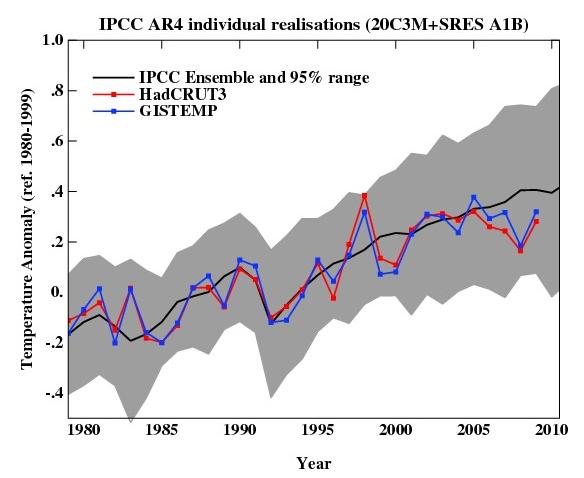
He was just trying to help you understand how climate models work. I'll repeat: global circulation models allow for short-term variability due to weather. That's the whole point of taking an ensemble (see chapter 8) with varying initial conditions and parameterizations. For example, here are individual realizations of a climate model. Notice that the short-term fluctuations are severe and unpredictable, but the long term trend is robust and predictable.
-
Re:Or you can edit your data....
The "sceptic" arguments are nothing but a parade of cherry picking with little attempt at genuine investigation.
Only if you don't actually look around. Richard Lindzen is a climate researcher at MIT, and has investigated it well (he was one of the authors of the IPCC report). His argument is that there is no strong evidence linking anthropogenic CO2 and a global crisis.
And he is right. Check out the evidence for yourself. Look at it critically, and try to see if they can establish a link. They can't. -
Re:So let me get this straight
To accept the basis of the theory of anthropogenic climate change (that is 1-3), but then conclude that the current warming is caused by some as yet unknown phenomena is a leap of faith well beyond most of us.
It is hard for you to believe? It shouldn't be, because it is such a complex system that we know so little about. The number of unknowns are massive. The only way you could conclude otherwise is if you have not actually studied what is going on. I suggest starting here.
You may assume that 1-3 imply 4 since you have been told that so many times it automatically makes sense to you. However, assumption is not science, evidence is science. Correlation is not causation, as I'm sure you know. -
Re:Global Warming Clusterfuck
Yeah. That's how it always is with any field that matters. If Bush had studied the data for himself instead of listening to Rumsfeld and others, maybe we wouldn't have invaded Iraq.
Fortunately climate science isn't extremely inaccessible. You can start here, with the IPCC report. Some people consider the conclusions questionable, but fortunately they do a good job explaining the reasons for their conclusions, so you can decide for yourself if the conclusions seem reasonable based on the evidence they give. If you are going to read it, I would suggest trying to answer four main questions.
Question 1: Are humans increasing atmospheric CO2 levels? (the answer is almost undoubtably yes)
Question 2: Does CO2 increase the global temperature? (the answer is almost undoubtably yes, although each additional unit of CO2 has a cumulatively smaller effect)
Question 3: Is the earth getting warmer (the temperature record seems to indicate a warming trend over the last few decades)
Question 4: How much of that warming trend is due to human-produced CO2, and how much is natural variation?
The IPCC report says the answer to question 4 is most of the warming trend is due to human-produced CO2, and they give some reasons why they believe this. Personally I don't find the reasons convincing at all, but I strongly suggest you read them and decide for yourself. -
Expert and Government Review
I am a bit confused as to the "Expert and Government Review" as shown by the IPCC here:
http://www.ipcc.ch/publications_and_data/publications_and_data.htm
Can anybody please explain what the government has to do with this? Is this a valid peer review process?
-
Re:Peer review is not everything
They are all good reading. If I were to provide a link, I would have linked here. That said, obviously WGI is the most relevant in establishing the truth of global warming.
-
IPCC [Re:like trying to offer proof to a Birther]
have you actually ever read the report? Assessment report: The physical science basis
I have actually.
Really? Ok, you're you're ahead of 99 of the people making comments. I will memorize your user name and put you on my mental "people who actually know what they're talking about" list.
The IPCC "physical basis" report is, indeed, non-technical, but i's probably as good an overview of the science at a non-technical level as you're likely to find-- you can start chasing down the references if you want the details.
-
Re:Peer review is not everything
"Every self respecting geek" my ass. Is it really that hard to provide a proper link to the document you're advocating as good background material? Or did I get it wrong, because really, it's just a guess that that's the one you're referring to. There's several dozen available on the IPCC web site for the last session alone. I'm not in the mood to dig through them all, only to discover that the one you're talking about was from two, maybe three sessions back.
Did I guess correctly? -
Re:Peer review is not everything
Yes, every self-respecting geek should. Because you can never trust another "self-respecting geek" lurking Slashdot to tell the truth.
Exactly. If everyone would get their info from the IPCC instead of sites like realclimate or climate-skeptic, the quality of discussion around here would go up dramatically. Don't believe it just because I say it, go to the source.
However, let's be scientific about it, shall we? Analyze it for yourself and see if their logic makes sense. For example, let's talk about this famous quote you mentioned from page 39 of the synthesis report [warning: big PDF]:"Most of the observed increase in global average temperatures since the mid-20th century is very likely due to the observed increase in anthropogenic GHG concentrations. This is an advance since the TAR's conclusion that 'most of the observed warming over the last 50 years is likely to have been due to the increase in GHG concentrations'
This is an example of a conclusion that was drawn independently by the IPCC. That is ok, they are trying to make conclusions, but we should try to figure out why they conclude what they do.
The first thing to note is the disclaimer footnote that says, " Consideration of remaining uncertainty is based on current methodologies." So, they've left themselves some wiggle room, in case they are wrong. Alright. No one ever mentions that in any press conference, but scientific reporting is never any good.
What we want to know is how they came to this conclusion. They direct us to WGI 9.4, where we read the main justification for that conclusion is that they can't find any other way to explain the current warming other than anthropogenic causes. They are basically laying their claim on the idea that we have understood every significant global process enough to eliminate every other cause. Furthermore, they explain that the computer models agree with them.
Now, maybe you think that is enough evidence. For me it is not. But I encourage you to read the document. Go to the science and decide for yourself; don't believe just because I, or anyone else, tells you. -
hmm
I have. It's not very convincing. In fact, based on your dogmatic certainty, I suspect it is YOU who has not read the research carefully.
so, you've read the research and came to the conclusion that there's adequate information to analyze a chaotic system with enough certainty to put 2/3 of the world's population on the brink of starvation. The consequences of the knee jerk reaction to AGW are worse then ignoring it.
-
Re:like trying to offer proof to a Birther
Because it's a waste of time, that's why. Offering evidence to a denialist ostrich
Not every climate skeptic is a denialist ostrich. Many of us can be converted with patience, lucidity and openness.
Frankly, not that I've noticed.
Here's a question: have you actually ever read the IPCC report on the physical basis for climate change? I don't mean, have you read the critiques of it written by other people who are telling you not to bother reading it. I don't even mean, have you read the summary for policy makers. I mean, have you actually read the report?
Assessment report: The physical science basis, for what it's worth.
-
Re:like trying to offer proof to a Birther
I have. It's not very convincing. In fact, based on your dogmatic certainty, I suspect it is YOU who has not read the research carefully.
When you get done, you will realize: everyone knows that CO2 makes the earth warmer because of the greenhouse effect. Not everyone acknowledges that there will be catastrophic effects if we don't limit CO2 output. In fact, depending on how we limit CO2 output, it is not even certain that the effects of the limitation won't be worse than doing nothing at all. Certainly the opportunity cost is worth taking into consideration. -
Peer review is not everythingThere are tons of examples of peer review not working. Even ignoring papers that are outright fraud but still manage to get through, scientific journals are places for debate, they don't establish truth. Any particular paper (that is good) will be looking at certain evidence, and possibly be considering its implications, it doesn't establish the final word on the matter.
Now, you can choose to rely on the opinions of scientists to form your opinions, and often that is enough, but if you really want to be sure of any particular topic, you should investigate it yourself. It might take a lot of work, but you will be rewarded with knowledge.
That said, global warming isn't all that inaccessible. If you have a basic background in math and physics, you can get close to the cutting edge just by reading the IPCC report since its such a great summary of the field. I guarantee you will quadruple your understanding of the topic just by reading that alone, and it will give you a good launching point to dig deeper, because everything it talks about is directly referenced to real peer reviewed papers.
Some interesting things I found reading the IPCC report:- It isn't entirely certain that the net effect of human pollution is warming, it could also be cooling (see chapter 2).
- Despite some sensationalistic propaganda floating around, sea level rises are happening slower than geological processes (plate tectonics etc) on any given coast (see chapter 5).
- There is no reliable knowledge of how much CO2 has affected the current warming trend. The report says 'most of it' based on the logic that they can't think of another explanation.(see chapter 9)
- The writers of the IPCC report aren't very confident of their main conclusion, which is that it is very likely that most of the recent warming is human caused. In the report, they are very careful to qualify that statement; although they are not so careful in press conferences (see the synthesis report).
Every self-respecting geek who is willing to opine on the subject of global warming should read that report. Otherwise they are leaving themselves uninformed.
-
Re:Didn't start it, just makes it worse
Page 34 of this document. It is where it says "Most of the observed increase in global average tempera- tures since the mid-20th century is very likely due to the observed increase in anthropogenic GHG concentrations." They base this mainly on computer models, if you look at the citation.
The weasel footnote says this: " Consideration of remaining uncertainty is based on current methodologies." Of course this is a true statement in any scientific endeavor, by why did they feel the need to say it right there and right there only? -
Re:Didn't start it, just makes it worse
but sometimes you've got to recognize that someone who studied climatology for X years might actually know a thing or two that you can't pick up from reading a blog.
Fortunately climate science is a lot more accessible than something like, say, micro-biology. If you have reasonable understanding of physics and geology you can probably read the IPCC report with no problem, and understand the reasoning behind global warming. And I encourage you to do so, because you will find things sound very different in the actual report than they do when you hear about it in the news and on blogs.
For example, many people have mentioned that the most important contributing factor to the recent warming trend is greenhouse gasses. But if you read the report where it says that, you will find a footnote there that absolves the writer of any commitment to that actual position. This is what is known on Wikipedia as 'weasel words'.
Chapter two of the report goes deeply into the science of radiative forcing, which of course, is the heart of the greenhouse gas theory. This is where physics and math knowledge comes in handy. It is a great chapter. However, one thing you never see reported in the news or anywhere, is that it isn't entirely clear that the net effect of human pollution on the global climate system has been positive. That is, it is entirely possible that human pollution has been cooling the earth, not warming it. Think about the implications of that.
Or another thing you hear about in sensationalistic terms is rising sea levels. If you actually read the report, you will see that ocean levels are changing around 3.1 millimeters a year, and roughly projected to continue at that pace. Think about it: on any given coast, geological factors (ie. plate tectonics) are making significantly larger changes than that.
One other important surprising thing you will find, is that no one knows how much greenhouse gasses are contributing to the current trends in global temperature. The report says that it is very likely that most of it is human caused (again, with that qualifying footnote) based on the idea that computer simulations couldn't find any other explanation. How much do you trust this kind of logic?
In other words, if you really want to know the truth about global warming, I strongly suggest you read the IPCC report and draw your own conclusions. Don't rely on what you've heard from scientists when they talk to news reporters, or on 'informational' websites. Read what they say when they are talking scientifically. -
Re:Politics
And please stop cherry-picking data to suit your predetermined conclusions, it insults both of our intelligences.
Fair enough. But let's also be clear that this: "is widely regarded by scientists as one of the most robust reviews of any scientific question in the history of mankind" means nothing. All the matters is the data.
Anyway I've been reading through the IPCC report. It is dense, but enlightening. So a few things:
It is true that over 2,500 people helped with the report, but that doesn't mean they all agreed with the conclusion. All it means is that they wrote a paragraph in there somewhere. The number who worked on deriving conclusions from that report are much smaller.
The major points everyone seems to agree on is that the world has gotten warmer recently (ie, that the measured temperature is accurate) and that adding CO2 to the atmosphere will have a net warming effect. It is not 100% certain that human pollution is warming the earth. It could be cooling it (figure 2.20 from WG1). The major difference from the last report is that we are more certain than ever that human pollution will have a net warming effect.
It is not clear how much effect CO2 is affecting the global temperature. Is most of the recent warming because of natural variation, or is it because of anthropogenic greenhouse gasses? Page 39 of the link you provided says it is very likely that most of it is due to greenhouse gasses (but they have a qualifying footnote, what the hell is that?). What is this very likely conclusion based on? If you look at WGI 9.4[warning: big PDF], they base it mainly on computer simulations. They basically say they can think of no other way to account for the warming other than anthropogenic greenhouse gasses. How much do you trust these climate modeling computers? Apparently the writers of the IPCC summary don't trust it, since they added a footnote. One thing you will never see is a graph that confidently shows how much of the earth's warming is caused by anthropogenic gasses, and how much is from other causes, because this information is not known with any degree of accuracy.
Let's move on to the next point, global disasters. At times you hear that global warming will destroy the earth. Once again, there is no scientific consensus about that. Where I live, the temperature changes as much as 20 degrees in a single day. What difference will a single degree make?
Or let's take a look at another point, rising sea levels. According to WGI chapter 5[warning: another big PDF], we are looking at an ocean rise of 3.1 millimeters or so. Is that really so bad? Even if we ignore the fact that tides vary hundreds of times that much within a single day, and waves often vary 300 times that much in a single second, it's worth remembering that the ocean level on any given coast already varies more than that based on geological processes, like plate tectonics. We have been able to handle plate tectonics so far, we should be able to handle the little added variability that may come with global warming.
Finally, I maintain that almost no one thinks the cap and trade bill in the US congress right now is a good idea. Except New York bankers (read this article, I don't know whether it should make me laugh or cry).