Slashdot Mirror
Domain: iupac.org
Stories and comments across the archive that link to iupac.org.
Comments · 15
-
Re:The names are......
https://iupac.org/iupac-is-nam...
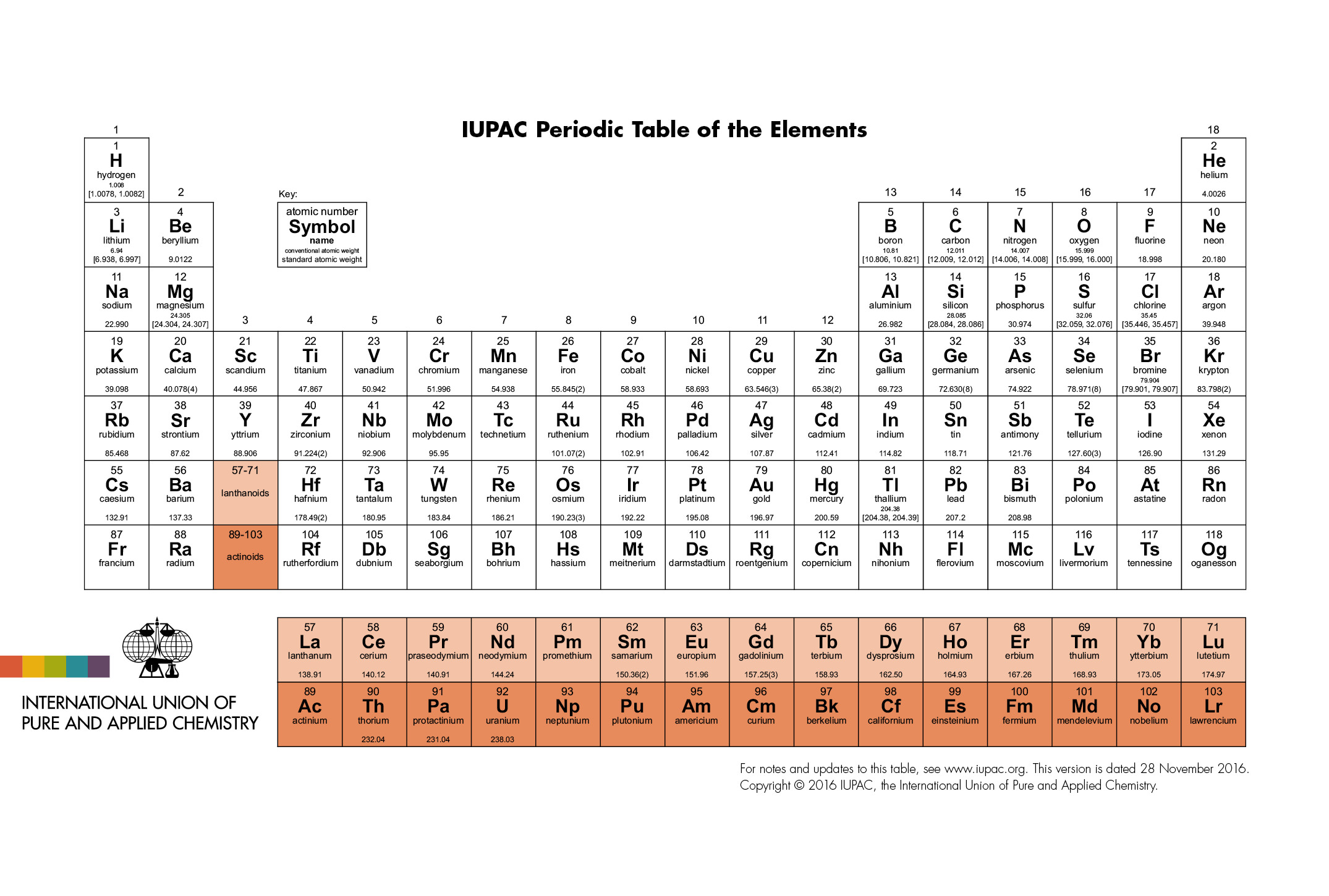
"IUPAC is naming the four new elements Nihonium, Moscovium, Tennessine, and Oganesson"
-
Re:The names are......
The summary has the names (or it does now, anyway) but not the numbers or the symbols, which would have been nice to include. Would've been good to include some etymology as well.
Google is your friend... In any case, here is a better link with the numbers, symbols, and etymology...
http://www.sciencealert.com/it...
and... here is a link to a large image for printing out, you know... for wall art... (grin)
-
Here is the Actual IUPAC Announcement
-
Re:They shall call it...
No, actually, Japan shall not call it that. That's what IUPAC's temporary systematic name for it is, as discovering the transuranics is often hotly contested. IUPAC has a Greek and Latin-based naming scheme that generates names for the undiscovered elements. So even though we've never seen a g-block element, and probably won't for at least a decade or two, IUPAC already has temporary names for them. . . well, names beyond eka-plutonium or whatever floats your Russian bigamist boat. Once the existence of an element has been confirmed "beyond a reasonable doubt," then IUPAC decides what to call it officially, based in part on the recommendations of the discover (but they don't always follow the suggestion).
Some authors and publishers include the temporary names and symbols on periodic tables after someone (or multiple someones) announces they've discovered an element and before IUPAC has fully accepted the existence of the element, but this is technically incorrect.
-
Actual Link to Document
Link to actual article is:
link -
Re:They suck at math too
IUPAC would disagree with you.
Aluminium is the correct spelling, and Aluminum is an acceptable alternative.
-
Only one possible redefinition
They want to have the standards bureau to define the kilogram this way. This is is only one possible redefinition. From what I have read, there is another strong contender which is based on electromagnetic force.
The new paper proposes that the next General Conference on Weights and Measures adopt either one of two definitions for the kilogram to effectively fix its value by selecting a specific value for either the Planck constant or the Avogadro constant. Two types of experiments are leading the effort to realize either of these definitions. The first one measures a kilogram against the amount of magnetic force required to balance a 1-kilogram mass against the pull of Earth's gravity. The experimental apparatus used to make the measurement is called a watt balance. A kilogram mass is placed on a balance plate that is surrounded by a coil of copper wire, which in turn is surrounded by a coil of superconducting wire. Magnetic fields produced by sending electricity through the coils push on the balance plate to offset the artifact's weight. The amount of electric current and its voltage then is used in defining a kilogram. Electrical power can be related to the Planck constant, defined as the ratio between the frequency of an electromagnetic particle such as a photon of light and its energy. This experimental method of defining the kilogram relies on selecting a fixed value for the Planck constant, which is currently determined experimentally based on the fixed value of the kilogram artifact.
This comes from here. Here is another article that talks about the same thing. TFA also links to an article that talks of this (I assume), but that article requires a subscription.
These articles also talk about why it is good to redefine the standard -- basically, by doing so, a bunch of other measurements/definitions immediately have less uncertainty.
-
Re:And now the fun begins
Ha, ha
-
Re:Aluminium? Caesium?
Aluminium and Caesium are the correct IUPAC spellings of those elements for historical reasons.
Caesium comes straight from the Latin caesius for the color sky blue, which is the most prominent line in the element's emission spectrum. Aluminium was so named because many elements at the time had -ium suffixes, and is the official spelling endorsed by the International Union of Pure and Applied Chemistry. The American Chemical Society, however, uses "Aluminum". -
Re:Not as English as you think....The IUPAC seems to think that "aluminum" is just fine. As is "cesium."
Finally, for American readers, it is noted that alternate English language spellings for the names of aluminum and cesium are used in the USA and do not constitute erroneous spellings. -- linky
P.S. Al was named "aluminum" back around 1807 by Sir Humphry Davy. He later decided to go with "aluminium" to match the "-ium" suffix of other elements. I have no idea whether "aluminum" is a marketing tradename or not, but it's definitely not the origin of the "-um" spelling.
-
Re:Bloody Yanks...
it's "sulfur" now, the International Union of Pure and Applied Chemistry says so.
-
You have you facts confused
However the name hydrogen hydroxide is incorrect since that would indicate that the OH part of HOH (H2O ) is an ion and that the extra hydrogen is ionically bonded to it. This is not the case, in H2O both hydrogens are covalently bonded to the central oxygen atom.
Actually the OH- pair is considered to be ionicly bonded to the H+ ion (or really to an H3O+). Where do yo think we get pH from? pH is defined as the inverse exponent of H3O+ concentration. example: Pure water has a concentration of 1x10(-7) (sorry cant do superscripts) and thus has a pH of 7, NaOH 4% has a concentration of 1x10(-13) and so a pH of 13 and HCl 4% aqueus a concentration of 1x10(-0) thus a pH of 0.
You really should check your electronegativies before saying bonds are covalent. This is pretty basic chemistry and explains amongst other things why water is liquid at livable temperatures for we humans and many other phenomenon.
You can find more about naming of chemical structures via IUPAC the International Union of Pure and Applied Chemists -
Re:U.S. spelling has the original formsIf you had actually checked your facts before spouting off, you'd know that the second name Humphrey Davy gave Al was "Aluminum", that IUPAC didn't define any spelling of Al until 1990, and that "Aluminum" is currently considered an acceptable variant spelling for that element by IUPAC. Yes, that spelling has always been used by IUPAC... for the last 13 years.
Oh, and common use in the late 1800s/early 1900s USA was "Aluminum", which was the real reason for the official change by US the chemists, not "contrariness", though it is true that the US was quite unhappy with Europe in this period.
(you know, sodium, potassium, etc. - gee, there doesn't seem to be any others that end in -num)
You mean like Platinum or Molybdenum or Lanthanum? (Or Stannum, though for IUPAC that's an alternate name for Tin, not the preferred name.) There are more -nium endings than -num, but -num is certainly far from unprecedented.The real fault for the confusion lies with Davy. If he'd chosen a spelling and stuck to it, whatever it was would have been used by everyone. For example, Lanthanum was named in 1839, but the discoverer chose a single spelling and stuck with it- so everyone agrees on that spelling.
-
Re:Francium? Freedomium
Today, the National Institute for Standards and Technology, the civilian agency of the US Government responsible for researching and making available data concerning the physical properties of substances including chemical elements, annouces the discontinued use of francium as the name of the 87th chemical element.
Actually, the International Union of Pure and Applied Chemistry is the governing body on element names.. -
Re:Today is a Prime Day
1 would be prime unless they made the special provision so that by definition it isn't.
I think "they" have (who does make these sort of decisions for maths? - it's IUPAC for chemistry...)
I read "somewhere" that 1 isn't defined as a prime partly for this reason: that each integer is said to have a unique prime factorisation, ie 12 = 3 x 2 x 2 and 13 = 13.
If 1 is a prime, then 12 = 3 x 2 x 2 x 1^n and 13 = 13 x 1^n where n is anything you like - hence there goes the unique prime factorisation.
It's a bit like the definition 0! = 1 - that one make combinatorics easier.