Slashdot Mirror
Domain: jstor.org
Stories and comments across the archive that link to jstor.org.
Stories · 16
-
Slashdot Asks: What's Your View On Speed Reading?
Wouldn't it be great if you could read a novel in an hour or two? Certainly, many people do that. The phenomenon of speed reading is nothing new with plenty of people claiming that they have grown habituated -- or taught themselves into -- reading things in an accelerated fashion. Not everyone -- including yours truly -- is a fan of this. There are several studies that suggest that 'speed reading' result in people missing out on lots of tidbits. A New York Times article, published Friday, also suggests the same. Jeffrey M. Zacks, and Rebecca Treiman, in an op-ed, citing a recent article in Psychological Science in the Public Interest, claim that "it's extremely unlikely you can greatly improve your reading speed without missing out on a lot of meaning." They write: Certainly, readers are capable of rapidly scanning a text to find a specific word or piece of information, or to pick up a general idea of what the text is about. But this is skimming, not reading. We can definitely skim, and it may be that speed-reading systems help people skim better.Which brings us to the question: What's your view on speed reading? -
Education Chief Should Know About PLATO and the History of Online CS Education
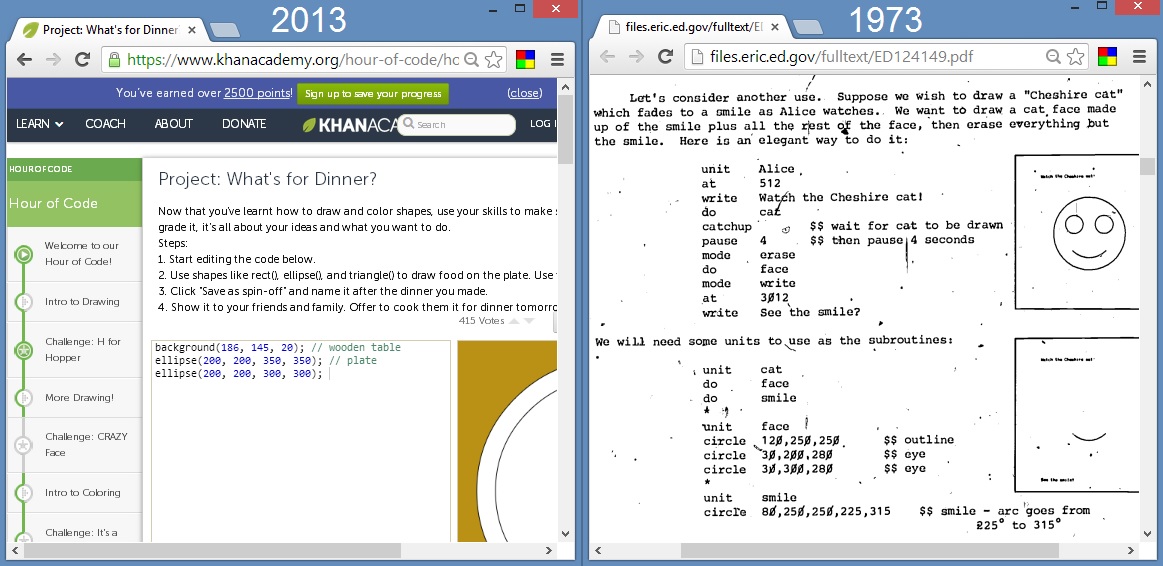
theodp writes Writing in Vanity Fair, U.S. Secretary of Education Arne Duncan marvels that his kids can learn to code online at their own pace thanks to "free" lessons from Khan Academy, which Duncan credits for "changing the way my kids learn" (Duncan calls out his kids' grade school for not offering coding). The 50-year-old Duncan, who complained last December that he "didn't have the opportunity to learn computer skills" while growing up attending the Univ. of Chicago Lab Schools and Yale, may be surprised to learn that the University of Illinois was teaching kids how to program online in the '70s with its PLATO system, and it didn't look all that different from what Khan Academy came up with for his kids 40 years later (Roger Ebert remarked in his 2011 TED Talk that seeing Khan Academy gave him a flashback to the PLATO system he reported on in the '60s). So, does it matter if the nation's education chief — who presides over a budget that includes $69 billion in discretionary spending — is clueless about The Hidden History of Ed-Tech? Some think so. "We can't move forward," Hack Education's Audrey Watters writes, "til we reconcile where we've been before." So, if Duncan doesn't want to shell out $200 to read a 40-year-old academic paper on the subject (that's a different problem!) to bring himself up to speed, he presumably can check out the free offerings at Ed.gov. A 1975 paper on Interactive Systems for Education, for instance, notes that 650 students were learning programming on PLATO during the Spring '75 semester, not bad considering that Khan Academy is boasting that it "helped over 2000 girls learn to code" in 2014 (after luring their teachers with funding from a $1,000,000 Google Award). Even young techies might be impressed by the extent of PLATO's circa-1975 online CS offerings, from lessons on data structures and numerical analysis to compilers, including BASIC, PL/I, SNOBOL, APL, and even good-old COBOL. -
Americans Rejoice At Lower Gas Prices
HughPickens.com writes Drivers across America are rejoicing at falling gasoline prices as pumps across the country dip below $3 a gallon. According to Sharon E. Burke while it's nice to get the break at the gas pump and the economic benefits of an energy boom at home, the national security price of oil remains high and the United States should be doing everything it can to diversify global energy suppliers. Ultimately, the only way to solve our long term energy problem is to make a sustained, long-term investment in the alternatives to petroleum. But October saw a 52 percent jump in Jeep SUV sales and a 36 percent rise in Ram trucks while some hybrid and electric vehicle sales fell at the same time. "This is like putting a Big Mac in front of people who need to diet or watch their cholesterol," says Anthony Perl. "Some people might have the willpower to stick with their program, and some people will wait until their first heart attack before committing to a diet—but if we do that at a planetary scale it will be pretty traumatic."
Nicholas St. Fleur writes at The Atlantic that low oil prices may also undermine the message from the UN's climate panel. The price drop comes after the UN declared earlier this week that fossil fuel emissions must drop to zero by the end of the century in order to keep global temperatures in check. "I don't think people will see the urgency of dealing with fossil fuels today," says Perl. Falling oil prices may also deter businesses from switching to energy-saving technology, as a 2006 study in the Energy Journal suggested. Saving several pennies at the pump, Perl says, may tempt Americans away from actions that can lead to a sustainable, post-carbon future. -
The Power of the Hoodie-Wearing C.E.O.
New submitter silverjacket writes "New research (JSTOR sub required / paywalled) shows that we see nonconformity as a sign of both status and competence — under the right conditions. From the article: 'Next, the researchers asked students at American universities to imagine a professor who is clean-shaven and wears a tie, or one who is bearded and wears T-shirts. Students were slightly more inclined to judge the dapper professor as a better teacher and researcher. But some students were given another piece of information: that the professor works at a top-tier school, where the dress code is presumably more formal. For them, the slouchy scholar earned more points. Deviance can signal status, but only when there are clear norms from which to deviate.'" -
'Energy Beet' Power Is Coming To America
Hugh Pickens writes writes "Gosia Wonzniacka reports that farmers in Fresno County, California, supported by university experts and a $5 million state grant, are set to start construction of the nation's first commercial-scale bio-refinery to turn beets into biofuel with farmers saying the so-called 'energy beets' can deliver ethanol yields more than twice those of corn per acre because beets have a higher sugar content per ton than corn. 'We're trying to reduce greenhouse gas emissions and to shift our transportation fuels to a lower carbon content,' says Robert Weisenmiller. 'The beets have the potential to provide that.' Europe already has more than a dozen such plants, so the bio-refinery would resurrect a crop that has nearly vanished. The birthplace of the sugar beet industry, California once grew over 330,000 acres of the gnarly root vegetable (PDF), with 11 sugar mills processing the beets but as sugar prices collapsed, the mills shut down. So what's the difference between sugar beets and energy beets? To produce table sugar, producers are looking for sucrose, sucrose and more sucrose. Energy beets, on the other hand, contain multiple sugars, meaning sucrose as well as glucose, fructose and other minor sugars, called invert sugars. To create energy beet hybrids, plant breeders select for traits such as high sugar yield, not just sucrose production. America's first commercial energy beet bio-refinery will be capable of producing 40 million gallons of ethanol annually but the bio-refinery will also bring jobs and investment, putting about 80 beet growers and 35,000 acres back into production." -
Nature Vs. Nurture: Waging War Over the Soul of Science
derekmead writes "Wherever determinism appears, controversy attends, raising specters of days when colonialists, eugenicists, public health officials, and political idealists believed they could cure the human condition through manipulation and force. Understanding those fears helps shed light on the controversy surrounding a recent paper (PDF) published in the American Economic Review, entitled, 'The "Out of Africa" Hypothesis, Human Genetic Diversity, and Comparative Economic Development.' In it, economists Quamrul Ashraf and Oded Galor argue that the economic development of broad human populations correlate with their levels of genetic diversity—which is, in turn, pinned to the distance its inhabitants migrated from Africa thousands of years ago. Reaction has been swift and vehement. An article signed by 18 academics in Current Anthropology accuses the researchers of 'bad science' — 'something false and undesirable' based on 'weak data and methods' that 'can become a justification for reactionary policy.' The paper attacks everything from its sources of population data to its methods for measuring genetic diversity, but the economists are standing by their methods. The quality of Ashraf and Galor's research notwithstanding, the debate illustrates just how tricky it's become to assert anything which says something about human development was in any way inevitable." -
MIT Warned of a JSTOR Death Sentence Due To Swartz
theodp writes "The NY Times takes a look at how MIT ensnared Aaron Swartz, but doesn't shed much light on how the incident became a Federal case with Secret Service involvement. Still, the article is interesting with its report that 'E-mails among M.I.T. officials that Tuesday in January 2011 highlight the pressures university officials felt' from JSTOR, which is generally viewed as a good guy in the incident. From the story: 'Ann J. Wolpert, the director of libraries, wrote to Ellen Finnie Duranceau, the official who was receiving JSTOR's complaints: "Has there ever been a situation similar to this when we brought in campus police? The magnitude, systematic and careful nature of the abuses could be construed as approaching criminal action. Certainly, that's how JSTOR views it."' Less than a week later, a Google search reveals, Duranceau notified the MIT community that immediate changes to JSTOR access had to be made lest the University be subjected to a JSTOR 'death sentence.' 'Because JSTOR has recently reported excessive, systematic downloading of articles at MIT,' the post warned, 'we need to add a new layer of access control. This is the only way to prevent recurrence of the abuse and therefore the only way to ensure ongoing access to this valuable resource for the MIT Community.' The post concludes, 'The incidents that prompted this change involved the use of a robot, which is prohibited by JSTOR's Terms and Conditions of Use. ...Continued access to JSTOR and other resources is dependent on the MIT Community complying with these policies.' Hope you enjoyed that freewheeling culture while it lasted, kids — now Everything is a Crime." theodp continues " MIT's Wolpert, who was recently named to an advisory board for JSTOR parent Ithaka, also chairs the Management Board of the MIT Press, where her reports from 2008-2010 included JSTOR Managing Director Laura Brown and MIT's Hal Abelson, adding another twist to Abelson's analysis of MIT's involvement in the Swartz tragedy." -
MIT Warned of a JSTOR Death Sentence Due To Swartz
theodp writes "The NY Times takes a look at how MIT ensnared Aaron Swartz, but doesn't shed much light on how the incident became a Federal case with Secret Service involvement. Still, the article is interesting with its report that 'E-mails among M.I.T. officials that Tuesday in January 2011 highlight the pressures university officials felt' from JSTOR, which is generally viewed as a good guy in the incident. From the story: 'Ann J. Wolpert, the director of libraries, wrote to Ellen Finnie Duranceau, the official who was receiving JSTOR's complaints: "Has there ever been a situation similar to this when we brought in campus police? The magnitude, systematic and careful nature of the abuses could be construed as approaching criminal action. Certainly, that's how JSTOR views it."' Less than a week later, a Google search reveals, Duranceau notified the MIT community that immediate changes to JSTOR access had to be made lest the University be subjected to a JSTOR 'death sentence.' 'Because JSTOR has recently reported excessive, systematic downloading of articles at MIT,' the post warned, 'we need to add a new layer of access control. This is the only way to prevent recurrence of the abuse and therefore the only way to ensure ongoing access to this valuable resource for the MIT Community.' The post concludes, 'The incidents that prompted this change involved the use of a robot, which is prohibited by JSTOR's Terms and Conditions of Use. ...Continued access to JSTOR and other resources is dependent on the MIT Community complying with these policies.' Hope you enjoyed that freewheeling culture while it lasted, kids — now Everything is a Crime." theodp continues " MIT's Wolpert, who was recently named to an advisory board for JSTOR parent Ithaka, also chairs the Management Board of the MIT Press, where her reports from 2008-2010 included JSTOR Managing Director Laura Brown and MIT's Hal Abelson, adding another twist to Abelson's analysis of MIT's involvement in the Swartz tragedy." -
JSTOR an Entitlement For US DoJ's Ortiz & Holder
theodp writes "If Aaron Swartz downloaded JSTOR documents without paying for them, it would presumably be considered a crime by the USDOJ. But if U.S. Attorney Carmen Ortiz or U.S. Attorney General Eric Holder did the same? Rather than a crime, it would be considered their entitlement, a perk of an elite education that's paid for by their alma maters. Ironically and sadly, that's the kind of inequity Aaron railed against with the Guerilla Open Access Manifesto, a document the DOJ cited as evidence (pdf) that Swartz was a menace to society. On Thursday, Ortiz insisted Swartz — who she now characterizes as 'mentally ill' — received fair and reasonable treatment from the DOJ. But that wasn't good enough for Senator John Cornyn, who on Friday asked Eric Holder to explain the DOJ prosecution of Aaron Swartz." Federal prosecutors have come under heavy criticism for their handling of the Swartz case. Legal scholar Orin Kerr provides counterpoint with two detailed, well-reasoned posts about the case. Kerr says that, as the law stands, the charges against Swartz were "pretty much legit," and that the law itself should be the target of the internet community's angst, rather than the prosecutors. "...blame the system and aim to reform the system; don’t think that this was just two or three prosecutors that were doing something unusual. It wasn’t." James Boyle, co-founder of the Center for the Study of the Public Domain, disagrees with Kerr (partly), arguing that Swartz's renown is simply drawing people together to collectively shine a light on poor legislation and poor prosecutorial practices. -
US Attorney Chided Swartz On Day of Suicide
theodp writes "The e-mail that Defendant Swartz's supplemental memorandum (pdf) cites as paramount to his fifth motion to suppress [evidence against him] is relevant, but not nearly as important as he tries to make it out to be,' quipped United States Attorney Carmen M. Ortiz (pdf) in a court filing made on the same day Aaron Swartz committed suicide. In the 1-7-2011 e-mail Ortiz refers to, which was not produced for Swartz until Dec. 14th — almost two years after his 1-6-2011 arrest — a Secret Service agent reported to the Assistant U.S. Attorney that he was 'prepared to take custody anytime' of Swartz's laptop, although no one had yet sought a warrant to search the computer. In Prosecutor as Bully, Larry Lessig laments, 'They [JSTOR] declined to pursue their own action against Aaron, and they asked the government to drop its. MIT, to its great shame, was not as clear, and so the prosecutor had the excuse he needed to continue his war against the "criminal" who we who loved him knew as Aaron.' Swartz's family also had harsh words for MIT and prosecutors: 'Decisions made by officials in the Massachusetts U.S. Attorney's office and at MIT contributed to his death. The US Attorney's office pursued an exceptionally harsh array of charges, carrying potentially over 30 years in prison, to punish an alleged crime that had no victims. Meanwhile, unlike JSTOR, MIT refused to stand up for Aaron.' With MIT President Emeritus Charles M. Vest currently serving as a Trustee of JSTOR parent Ithaka as well as a Trustee of The MIT Corporation, one might have expected MIT to issue a statement similar to the let's-put-this-behind-us one JSTOR made on the Swartz case back in 2011." -
How Technology Promotes World Peace
Hugh Pickens writes "Ayesha & Parag Khanna write in the Atlantic that there are many important differences between the U.S.-China relationship of today and the U.S.-Soviet relationship before the outbreak of the Cold War. One is that the U.S. and China are deeply intertwined through geo-economic interdependence, and the rapid and global diffusion of technology is accelerating these changes. 'As the global economy has become more integrated, states have greater interest in cooperating and less interest in conflict, which can lead to a kind of mutually assured economic destruction,' write the Khanna. 'If military power is inherently competitive — the stronger your army and the weaker your neighbor's, the more powerful you become — then economic power is more cooperative. After all, much of America's power today is economic, but that power would decrease if China's economy collapses.' This economic inter-dependence, the theory goes, promotes peace, but technological power is also cooperative in this way, perhaps even more so. For example, medical research crosses borders, as do the pharmaceuticals or treatments that research can produce. China can increase its power by developing better solar panels — perhaps in part by building on foreign technologies — then turn around and sell them to other high-energy-consuming states, making us all better off. Like economics, technology doesn't just increase cooperation, it is the cooperation. 'The increasingly integrated global system is shaping the states within it, much as individual powers shape the system. The question is thus not who controls technology, but the way in which we develop, guide, and control it collectively.'" -
Aaron Swartz Indicted in Attempted Piracy of Four Million Documents
An anonymous reader writes "New York Times has reported that Internet activist Aaron Swartz has been indicted for stealing more than 4 million documents from JSTOR." The indictment contains an exciting tale featuring trespassing, MAC address forgery, a Python script or two, and even computers hidden under a cardboard box. El Reg has a decent summary. Demand Progress has released an official response claiming the charges are trumped up nonsense. -
HP Patents Bignum Implementation From 1912
I Don't Believe in Imaginary Property writes "The authors of GMP (the GNU Multiple Precision Arithmetic Library) were invited to join Peer-to-Patent to review HP's recent patent on a very old technique for implementing bignums because their software might infringe. Basically, HP's patent claims choosing an exponent based on processor word size. If you choose a 4-bit word size and a binary number, you end up working in hexadecimal. Or for a computer with a 16-bit word and a base-10 number, you use base 10,000 so that each digit of the base-10,000 number would fit into a single 16-bit word. The obvious problem with that is that there's plenty of prior art here. Someone who spent a few minutes Googling found that Knuth describing the idea in TAOCP Vol. 2 and other citations go back to 1912 (which implemented the same algorithm using strips of cardboard and a calculating machine). None of this can be found in the 'references cited' section. Even though the patent examiner did add a couple of references, they appear to have cited some old patents. The patent issued a few months ago was filed back in October of 2004, and collected dust at the USPTO for some 834 days." -
Dealing w/ Copying of Online Articles via Open Proxies?
Creosote asks: "Concerns about piracy are no longer just for the big commercial media outfits. JSTOR, one of the major repositories and distributors of online versions of scholarly journals, has been hit by crackers taking advantage of open proxy servers to download about 51,000 articles from 11 JSTOR journals. Even nonprofit academic publishers rely on income from publications to exist, so the spectre of large-scale unauthorized copying is legitimately scary to them. In a letter to librarians and publishers, the president of JSTOR notes that while the "threat of open proxies has been recognized for some time in the web community...it does not appear that network administrators, librarians, or content providers are aware that organized efforts are being employed to gain unauthorized access to restricted campus resources" through them. I work for a nonprofit publisher (a university press) that will soon be making peer-reviewed digital projects available online, and they can't all be given away for free, so this hits close to home. Are there better solutions than turning into an attack dog, ala the RIAA and the MPAA?" -
Dealing w/ Copying of Online Articles via Open Proxies?
Creosote asks: "Concerns about piracy are no longer just for the big commercial media outfits. JSTOR, one of the major repositories and distributors of online versions of scholarly journals, has been hit by crackers taking advantage of open proxy servers to download about 51,000 articles from 11 JSTOR journals. Even nonprofit academic publishers rely on income from publications to exist, so the spectre of large-scale unauthorized copying is legitimately scary to them. In a letter to librarians and publishers, the president of JSTOR notes that while the "threat of open proxies has been recognized for some time in the web community...it does not appear that network administrators, librarians, or content providers are aware that organized efforts are being employed to gain unauthorized access to restricted campus resources" through them. I work for a nonprofit publisher (a university press) that will soon be making peer-reviewed digital projects available online, and they can't all be given away for free, so this hits close to home. Are there better solutions than turning into an attack dog, ala the RIAA and the MPAA?" -
Dealing w/ Copying of Online Articles via Open Proxies?
Creosote asks: "Concerns about piracy are no longer just for the big commercial media outfits. JSTOR, one of the major repositories and distributors of online versions of scholarly journals, has been hit by crackers taking advantage of open proxy servers to download about 51,000 articles from 11 JSTOR journals. Even nonprofit academic publishers rely on income from publications to exist, so the spectre of large-scale unauthorized copying is legitimately scary to them. In a letter to librarians and publishers, the president of JSTOR notes that while the "threat of open proxies has been recognized for some time in the web community...it does not appear that network administrators, librarians, or content providers are aware that organized efforts are being employed to gain unauthorized access to restricted campus resources" through them. I work for a nonprofit publisher (a university press) that will soon be making peer-reviewed digital projects available online, and they can't all be given away for free, so this hits close to home. Are there better solutions than turning into an attack dog, ala the RIAA and the MPAA?"