Slashdot Mirror
Domain: kenrockwell.com
Stories and comments across the archive that link to kenrockwell.com.
Comments · 112
-
Re:Going by Mr. Musk's other fancy projects....
Well that's the first time I hear it was done forty years ago. Was it some short-lived experiment?
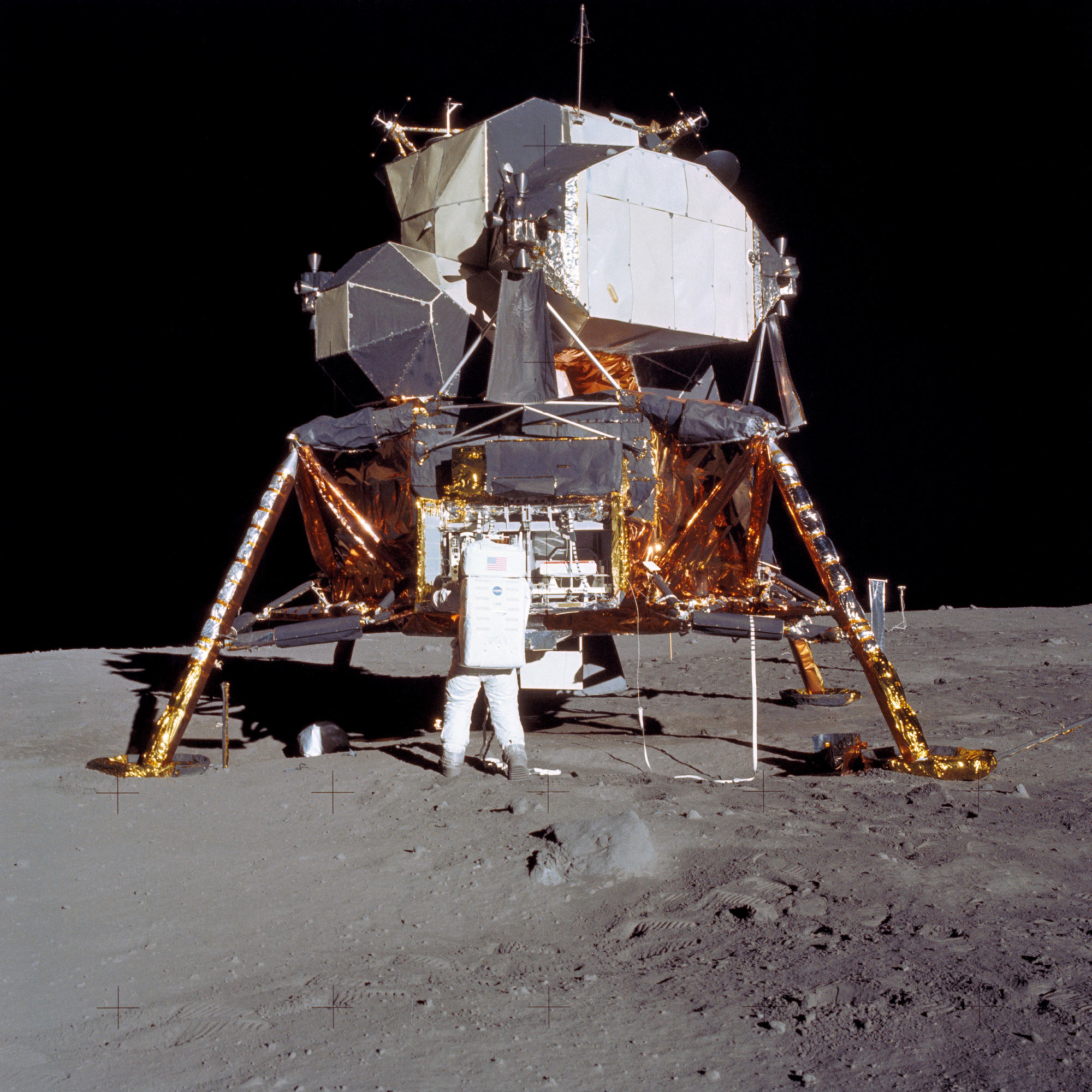
NASA landed multiple rockets vertically on the moon. And they had a 100% success rate unlike space ex shit rocket that has the worst reliability in the entire history of rocketry.
-
Re:Blinders Much
I want 35mm film-quality stills from the lenses and bodies currently residing in my basement
Depending on how old your gear is, buy a DSLR of the same make and use your lenses. Back in the day the camera body was just there to hold the film and the lens, you won't be able to reuse that.
My Nikon DSLR can happily use lenses I had on my film SLR. Not all lenses will work. Heck, some models should cover lenses going back to 1959. I assume other companies have done similar.
I ought to be able to get a 35mm "consumer" version for a few hundred bucks. As long as it had 1080p resolution or better
I think a Nikon D3200 is currently under around $400
The main thing you need to remember is the focal length changes
You may find you can still get a camera body which has all the modern features, but still works with your lenses that you spent a small fortune on.
In fact, depending on the specific brand and lenses, there's a really good chance of it.
-
Re:Tidal?
Well, that's why I threw in the "most" qualifier.
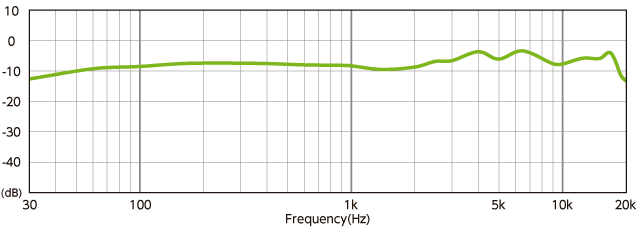
That unit uses the same mic as the H4N, btw, whose frequency specs are listed here. It definitely goes above 20kHz (and unfortunately cuts off there), but you can see by the curve it starts dropping off fairly rapidly just before that. So, some microphones definitely go beyond, but just lose their flat characteristics. I'm curious what the curve looks like beyond 20kHz, and what the maximum range is.
-
Re:The actual appeal
Call me when I can buy a DSLR back with 100 megapixel resolution for less than an insane price. Until then, I'll stick with [a Rollei medium format camera].
People who berated digital as being convenience-over-quality compared to their 35mm cameras a few years back (back when digital wasn't as good as it is now) seemed to forget- or didn't realise- that 35mm film itself was always a convenience-and-cost compromise over quality compared to medium and large film formats.
Images shot properly on larger format film have always been able to knock spots off their 35mm counterparts purely because they're starting with a massive technical advantage. Unfortunately, though one can buy a film-based medium or large format camera for a very affordable price, their digital equivalents- or more specifically the sensors that can deliver comparable resolution and performance to those formats- are, as you imply, prohibitively expensive.
That aside, as the other reply said, it's unlikely that the students in question are using 4 x 5 cameras and the like, and more probable that they're using bog-standard 35mm film cameras, so this is ultimately a red herring... -
Re:It IS FLAC
-
Re:Which one?
Uh... no. I'm not saying no one uses those terms the way you define it, but "dynamic range" is pretty much the only term I've seen used for what you call exposure range.
For example, if I Google "dynamic range photo" (and in the interest of fully disclosing my methods, that's the first search term I tried), the first five results are:
"Overall, the dynamic range of a digital camera can therefore be described as the ratio of maximum light intensity measurable (at pixel saturation), to minimum light intensity measurable (above read-out noise)."
http://www.cambridgeincolour.c..."In photography, dynamic range is the difference between the lightest light and darkest dark which can be seen in a photo."
http://www.kenrockwell.com/tec..."The dynamic range of a sensor is defined by the largest possible signal divided by the smallest possible signal it can generate." This one is closer to your definition of dynamic range.
http://www.dpreview.com/glossa...The wikipedia hit I get goes right to the HDR articles, which says "In photography, dynamic range is measured in EV differences (known as stops) between the brightest and darkest parts of the image that show detail." If you follow the link to the dynamic range article, you get "Photographers use "dynamic range" for the luminance range of a scene being photographed, or the limits of luminance range that a given digital camera or film can capture, or the opacity range of developed film images, or the reflectance range of images on photographic papers." (emphasis mine)
http://en.wikipedia.org/wiki/H...
http://en.wikipedia.org/wiki/D...The fifth link, http://www.stuckincustoms.com/..., doesn't have any definition of dynamic range, and is basically an ad site.
So if I'm generous and count dpreview for you (and then count the fifth link as neutral), that's 1 out of 4 links that agree with you and 3 out of 4 that use "dynamic range" to mean what you call "exposure range".
-
Re:I dont see the point, yet
Good that you brought up cameras, because we already have media that is being under represented on our computer monitors: Consumer point and shoot camera resolutions... Our 800p and 1080p screens are ill-fit for 16Megapixel cameras. 2816 x 1584 is about 4 Megapixels at 16x9, and 4000 x 2248 is 9.0 MP. Still, we have to downconvert and produce jaggies.
There's a bunch of info on the confusion about how much is enough but I find that even a 21" desktop monitor is way underutilized to display my shots:
The biggest print you can make without losing sharpness as seen through a magnifier from a 4MP camera is 6 x 8" (15x20cm). From a sixteen MP camera likewise you could go to 12 x 16" (30x45cm), and still look at the print through a magnifier.
The OS has to scale down our images, resulting in jaggies even when I just use lower resolutions at 12MP. I wish the standard windows wallpaper system offered an anti-alias option.
-
Re:Storing locally will cost you more, not less...
That said, if you're doing 64 GB in a couple of hours, a little more practice with shot discipline will help you both in storage and in workflow time. That's too many pictures.
Then the DELETE key is your friend. Especially if you're doing that many shots. They can't ALL win the Pulitzer Price.
This.
To quote Ken Rockwell: http://www.kenrockwell.com/tech/howto.htm
Only show your very strongest images.
Throw away most of what you shoot. I do. Most of my photos are awful!
Go through the few photos you save out of a roll, and then throw away all but the one strongest image.
Next time, go through the few you've saved from a few rolls, and throw more away.
This isn't painting. In photography it is a requirement to throw away most of what you do.
You'll see that if you only save or show your strongest images that your body of work will seem to improve. Guess what: as you show only the better images, your body of work as seen by others has improved!
Do you think I shoot a roll of film and get a roll loaded with the images you see in my galleries? Of course not. Most of what I shoot is crap. I'm just good enough to throw most of it away and only show the good stuff.
Ansel Adams said that if you can produce one strong image in a year that you are doing very well. Don't expect to turn out miracles every roll, or even every month. Ansel didn't, I don't, and I don't think anyone does.
-
Everyday is a vacation...
when you follow the two hour rule.
http://www.kenrockwell.com/business/two-hour-rule.htm -
Read Ken Rockwell; get an X100 or a low-end DSLR
A couple of things -
MILCs aren't mature, they're overpriced, and it only takes a short amount of time using any sort of electronic viewfinder to learn that they *all* are incredibly frustrating when compared to actually seeing your subject via photons bouncing off and coming into your eye. You can do that with an SLR or a viewfinder camera.
Ken Rockwell has lots of haters but he tends to provide reasonably good info. Read the whole page, but start here: http://www.kenrockwell.com/tech/recommended-cameras.htm#people
-
What type of photography?
If your starting photography, I would try a good P&S that has control of aperture,. shutter and manual. It's easier to carry. Most DSLR kit lenses won't give you significant better quality pictures than a P&S camera. I would read various photography web sites.
The following are my favorite sites:
photo.net anything there is great reading.lensrental.com: the owner has gone the gamut of different purchase, DSLR with cheap lenses, expensive zooms, expensive primes.
Lenses Don't Collect the Whole SetAnd as another note, I would ask what type of pictures are you taking. Because there isn't one universal solution.
Option 1: I was very happy for years with a high end point and shoot like the Canon Powershot models. And really like the ones that use AA batteries. The upper end models have full control over aperture and shutter. And I was able to experiment with try different type of pictures. At the top, the G12 has one of the best lenses for a P&S. I usually went with lower priced models like the SX130/SX150. The SX130/SX150 use AA batteries. I kept spare rechargeable and spare alkaline AA batteries so I rarely had problems of batteries. Limitations: No interchangeable lens. Dust and water can easily damage camera.Option 2: Waterproof/Shockproof/Dustproof camera. I would pick one of these for travel. They should be able to handle beaches, storms, etc.
Option 3: Indoor photography. I started to take indoor photography where flash is prohibited or the subject was too far away. So I needed something with a fast lens. This option eliminates almost all Point and Shoot cameras. I bought a DSLR with a 50 mm (f1.8) lens just to get the feel of this photography. And was able to take indoor pictures that were impossible with a P&S camera. I added a 100mm f2.0 lens to take indoor gymnasium sports photos. Limitations: larger, not as convenient to carry.
Other options: scaba diving, outdoor sports, race cars, museums, portraits, travel etc.
I haven't used the smaller 4:3 frame cameras. I do like the smaller size. But I like the versatility of the DSLR or the compactness of a P&S.
WhatMeWorry!
-
Re:Photogs?
There's a lot of good information and good perspective in this post, although I do believe that it is heavily skewed towards wedding photography and to a lesser extent photo journalism. (Which makes sense, consider the poster's admitted background of being a photo lab technician).
Time was, if you saw a wedding photographer with a 35mm camera, you knew they were amateur. The real wedding photographers all shot 645 or 6x6 on 220. This was still the case in 2000. The photo journalists were the first to make a serious switch to digital. This makes sense, since they were the first to switch to 35mm to begin with. In their line of work, being able to haul less gear and take more pictures is all win and they don't mind poor quality.
Fast forward to 2011. DSLR's can now seriously compete with 35mm for quality. Medium format equipment is basically worthless, since the people that used it (wedding photographers) have all switched to digital. Small format (35mm) color photography has effectively been replaced by digital.
This leaves 3 remaining classes of photographer that still seriously shoot film:
1) Landscape photographers. Landscape photographers still use large format view cameras. The difference in effective resolution between a 15mp digital camera and an 8x10 negative is so large that there isn't even an argument. When people sit down to argue "which is better", film or digital, they are always talking about 35mm. Digital can't even come close to competing with the quality of medium format yet, so I think that these folks will be taking their photographs on film for a long time to come.
2) Black & White photographers. Black and white film developing and printing is easy to do at home with minimal equipment. Real black & white printed optically looks gorgeous. We still can't easily reproduce that with digital.. (Full disclosure, my connection to Kodak is that I still buy Tri-X, Dektol, XTOL & Kodak indicator stop bath on a regular basis). Ken Rockwell has a good article on this subject: http://www.kenrockwell.com/tech/modern-bw.htm
3) "Lomographers". These photographers revel in lo-fi. It's kind of the opposite of the "measurebator" 'photogs'. Although I don't agree with the astonishing prices for some of these garbage cameras ($100 for a diana?!?) I applaud the emphasis on technique rather than chasing the fastest & sharpest lenses. -
Read this first
"A $150 Camera vs. a $5,000 Camera" http://www.kenrockwell.com/tech/150-vs-5000-dollar-camera.htm
-
It is not your camera
Ken Rockwell says it best:
Your Camera Doesn't Matter
Search the rest of his website for other info on the subject as well as more practical info for who is starting into taking pictures.On a more practical side I got myself a Canon S90 (should be S95 nowadays). I would never carry a DSLR around with me and this one has a good (almost DSLR) manual mode. The auto mode works quite well as well. It is small enough that I carry it with me whenever I expect/want to take some pictures.
-
Read Ken Rockwell
Rockwell attracts lots of haters due to the fact that he's opinionated, blunt, and it's always possible to come to a different conclusion given the same set of facts.
However, he's never too far wrong and he's easy to understand.
Go to his "recommended cameras" page. Read the intro for useful general guidelines. Read the other sections for other target audiences. But the section you want is http://www.kenrockwell.com/tech/recommended-cameras.htm#pocket
-
Your Camera Doesn't Matter
So says Ken Rockwell:
Your Camera Doesn't Matter
http://www.kenrockwell.com/tech/notcamera.htmI'd have to agree with him. Many beginners get too caught up with gear. I'm not a "pro" by definition, though I have won photo contests and my work has been published dozens of times. All of my work was done using "cheap", "inferior" cameras.
-
$$$ does not mean
you have skill with a camera. This guy has some good points about the cost of a camera. http://www.kenrockwell.com/tech/150-vs-5000-dollar-camera.htm
-
This guy has some good info
http://www.kenrockwell.com/tech/recommended-cameras.htm Scroll down a bit for the section for Casual Photography.
-
Re:I have seen the Blu-ray releases
Just FYI, while I broadly agree with you (35mm and 70mm are high resolution sources), Ken's site is not particularly reliable. He freely admits to making crap up and writes more for fun than as an unbiased, factual source of information. I wouldn't link to him for facts.
-
Re:I have seen the Blu-ray releases
really? on blu ray? without digitally enhancing them?
My cellphone produces better quality video than the cameras they used in the 70's to film the original movies. If they were to keep the original image quality I wouldn't be surprised if they fit the entire first trilogy on a single dvd
http://www.kenrockwell.com/tech/film-resolution.htm So you are saying your cell phones camera is 175 megapixles at 24 frames a second or better? I would be very interested as to what brand of phone you own.
-
Resolution is just resolution...
These images look nice, interesting angles. They probably look slick because they've been post resized sharpened, the smaller versions on Gizmodo have been gently sharpened to make them pop a bit, it's a common photographic trick.
Even if you have a sharp 12-24 megapixel image, it can always use some sharpening when it's downsized for the web. If you don't sharpen after downsizing, photographs still look great but not as crisp as they could.
(And yes, if you sharpen the full size image and then downsize, the downsizing obliterates the sharpening done at full size.) -
Re:Already Done Before
Well, that's somewhat true. A typical sensor will accurately capture all but about one F-stop higher and lower than human vision. That means that overblown super-HDR type movie poster or similar shots and the like aren't something that you should expect in any camera. Why it behaves like a HDR camera is because it doesn't hit 255 and just simply put solid white in the image when it gets over-exposed. A typical Bayer sensor will do this and there's nothing to be done about it - you hit that wall and you're done. There's nothing to recover at that point - the data just simply vanished.
The Fuji has two methods by which it does this. The first was the Super CCD SR with actually had dual sensors and took two shots at once at different f-stops and then blended them. The EXR version that they currently sell does pixel binning, which while it does create a slightly better dynamic range, it suffers from more interpolation issues (as one would expect) than a typical sensor. It works, but it's less than optimal in terms of color fidelity.
http://www.kenrockwell.com/fuji/s5/dynamic-range.htm
This is an older article, and he's a bit of a tool (has a hard-on for Nikon and hates anything but landscapes), but 2/3 the way down you can see a great example of this in action. Also, the color charts at the bottom show how it (and also Foveon/Sigma) sensor deals with bad contrast. Red goes to pink, then to white as you'd expect. At least in a far more gradual manner, with very little yellow. This means that the parts of the image that normally would require HDR or benefit from them have proper color balance/truer colors.The Sigma doesn't have better dynamic range than a typical camera, but it does the same trick that our eyes do, which is that when the cones in our eyes get saturated, they do it in a gradual manner. This results in pictures that look overexposed like film - a nice soft shoulder at the extremes that can be recovered or dealt with in software. Is the Foveon/Sigma HDR? Well, sort of and sort of not. How it deals with colors is truer and resolutions are identical for each color. So it operates more like HDR for chroma and less for luminance. This is easiest to see in a Bayer sensor where purples and reds look fake and grainy when next to strong blue or green sources. Typically, unless you shoot very low light or black and white, better color fidelity is always the better choice.
And these are not some prototype sensors or custom application technologies, either. They sold millions of these units over the years. 2003 for the Fuji Super CCD technology and around the same time for the Foveon as well. That they've done precious little with it in the last (almost) decade is really unfortunate.
-
Re:Too small....
As a actual photographer and a seller of camera gear you are so wrong. F1.8 needs high res to even be seen on the display without zooming all over. And yes AMAZINGLY I can easily see each pixel. And yes It makes a big difference. I'm talking about The 320x240 vs 640 by 480 (230 000vs 900 000) currently offered.
And I'm talking about much smaller pixels. You are talking pure shit. I have a camera with each resolution of display that you mention (QVGA and VGA, we call them here in tech-land) and therefore I know that this is not the difference we are talking about.
I use a 2x optical scope for fine focus on narrow depth of field for this lens http://www.kenrockwell.com/canon/lenses/85mm-f12.htm with cameras that have no live view (like film cameras).
Yes, that's what I said, idiot. I specifically said that pro photographers are already using an SLR or a separate viewfinder; a scope counts.
Why people with no experience feel the need to comment is beyond me.
Why people who can't read feel the need to respond to my comments is beyond me.
Plus the histogram and EV (exposure values) are not related to screen resolution at all.
I never said they did, but we've already established that you can't read.
But glad to see you know what you are talking about and got modded up by someone equally illuminated. It's
You're full of shit, and you're babbling incoherently.
-
Re:Obligatory XKCD
True, both about the comic and the corresponding forum thread. When it comes to imaging (video/photo), most geeks fall in the "Equipment Measurbator" and "Online Expert" categories, as defined in The Seven Levels of Photographers.
-
Re:A piece of history
Well I'm one of those 'still clinging onto that idea'.
I'll take your example - can you show me an artistic photograph that uses this photo-stacking technique? As a keen photographer myself, I do not see the point of it - it would require using a tripod in order that the images are perfectly aligned, if that is the case, then a long shutter speed combined with a small aperture would achieve the same, and without any artefacts due to the slight changes in focal length seen in many lenses when refocused.
I think the public perception of film is stunted by the cheap ways film used to be dealt with in your local processing lab - processed in a non-dust free environment, and scanned by poor quality machines with poor quality operators. In actual fact 'flim' itself has a tremendous capacity to capture information, and if one is willing to take a small amount of effort to maximise information obtained from the film, one would find very high resolution (35mm captures around the equivalent of a 24mp dslr - see link below), excellent dynamic range, which has a curved shoulder allow colours to fade smoothly into white when overexposued, tonality (see the 7D versus fuji velvia - it's not just the resolution, but also the colour accuracy and colour resolution).
http://photo.net/film-and-processing-forum/00WErk?start=200
This article looks more at the non-resolution aspects of film:
http://www.twinlenslife.com/2009/05/digital-vs-film-real-deal-nikon-d300-vs.html
And Ken Rockwell, as much as he says things clearly thinking it through, has an excellent article with many more valid points here:
http://www.kenrockwell.com/tech/why-we-love-film.htm
Now please do not reply with one of the comparisons which confirmed in a large number of peoples minds that digital was superior, without 1st quoting what scanner was used to do the comparison, and if it isn't a drum scanner, you are already standing on shaky ground.
Duncan.
P.S. Of course buying a Nikon D3X is more convenient and probably cheaper than using a 35mm film camera and sending your photos off for drum scanning, but that is not what we're discussing. I have no problem with people stating that digital is cheaper and more convenient with quality nearly up there with film.
-
Size doesn't matter
I have to go with Ken Rockwell on this one: Megapixels don't matter. Unless you're blowing your 35mm shots up to poster size, pixel density over about 8 megapixels is useless overkill.
-
Re:Rockwell's an expert
A lot of people do shoot pictures of things that don't move. I do know how to operate a view camera, and you'll doubtlessly be shocked to learn that I first tried it out as a rank amateur (and long before KenRockwell.com hit the Webs).
It sounds like you're the type of person he's talking about in the quote I put in my post. You seem very hung up on your own conception of what constitutes photography, and you're upset when someone talks about it in a different way.
As I said before, the point of the article is to encourage people to think of serious photography more broadly than just DSLRs. That message doesn't seem to resonate with you, but there's no reason to get angry about it. I don't use a view camera these days; I use a DSLR mostly, or a waterproof point and shoot. But I recognize their limitations in the greater scope of photography--I know I'm trading off lower image quality for greater convenience. And if you read other articles on the site, you'll see that Ken does too. The post that first mentioned him linked to a humorous article about it:
-
Re:So, *will* it be missed?
I worked professionally with film photography for years. It was terribly difficult to get good color, you have to use color-correcting filters or gels on lights to get accurate color. The color balance on film was very finicky. Shots would have to be perfectly exposed.
And Ken Rockwell hasn't worked for years with film?
Falcon
-
Re:So, *will* it be missed?
A low end DSLR can beat 35mm film today. high end dslr's utterly kicks the crud out of 35mm in resolution.
The getting old Canon 5d Mark II is 21.5 megapixels which is 1.5 megapixels greater than the absolute best 35mm film+best camera+best lens can do. Honestly 90% of all 35mm film shots are less than 12megapixel in resolution due to low end glass and cameras as well as being processed less than perfect. And that's just the mid level stuff from Canon. high end digitals that reach the 60 megapixel mark utterly destroy 35mm film even when used with the best of everything.
That just goes to show how much you know, Canon's highest res pro camera is the 21.1 MP EOS-1Ds Mark III. Even Nikon's D3x only has a 24.5 MP sensor. If you want bigger ones you have to step up to medium format cameras such as Hasselblad or Mamiya.
Meanwhile in pro photographer Ken Rockwell's article Why We Love Film he writes:
"You want dynamic range? I got your dynamic range right here in this little canister. It's called film; a write-once, read-many (WORM) medium."
"I made this shot on a Contax G2 with a 21mm Zeiss lens at f/8 on Fuji Velvia 50, which was processed and scanned at the same time at NCPS. The dynamic range is so great that the hellacious sunbursts you see are just what's naturally coming off the diaphragm blade at f/8, as if 1,000 suns were shining in the lens in the two-minute exposure."
"Not only that, but the film I shot in a Canon EOS Rebel G film camera, worth about $20 today, was sharper as scanned at NCPS than the file I made with the same lens on a Canon 5D, which is sharper still than anything on earth from Nikon digital."
"How about that? A $20 camera with a $5 roll of film and $20 to process and scan the entire roll is sharper than a $5,000 camera. (The Contax cost more, but still loads less than anything in full-frame digital.)"
Falcon
-
Re:So, *will* it be missed?
The best 35mm film stocks don't come close to top-end DSLRs, in either resolution, color reproduction or dynamic range.
Can you give any citations? There are pro photographers, those who make their living as photographers, who disagree with that. Here's wiki's article on digital vs film. And here's Photo.net's discussion. Ken Rockwell, quoted in the wiki article, has the article Why We Love Film. For instance regarding dynamic range he says:
"You want dynamic range? I got your dynamic range right here in this little canister. It's called film; a write-once, read-many (WORM) medium."
"I made this shot on a Contax G2 with a 21mm Zeiss lens at f/8 on Fuji Velvia 50, which was processed and scanned at the same time at NCPS. The dynamic range is so great that the hellacious sunbursts you see are just what's naturally coming off the diaphragm blade at f/8, as if 1,000 suns were shining in the lens in the two-minute exposure."
He further states "A frame of 35mm film, scanned cheaply at a good photo lab to a CD, is about equal to the resolution of a 25MP DSLR."
Falcon
-
Re:So, *will* it be missed?
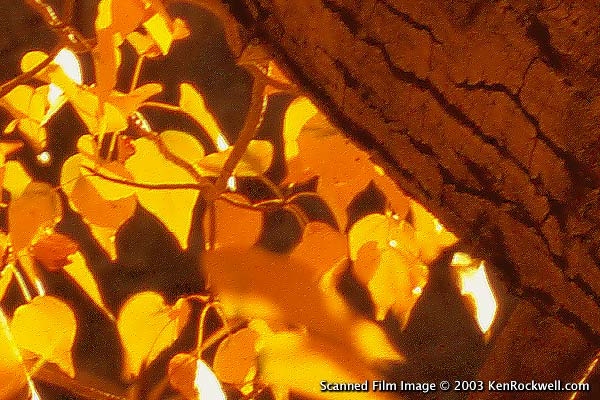
Ken Rockwells scanned film vs digital camera images:
http://www.kenrockwell.com/tech/filmdig.htmFilm:
http://www.kenrockwell.com/tech/images/filmdig/4990scan.jpg
Digital camera:
http://www.kenrockwell.com/tech/images/filmdig/digital.jpg"If you do fret the pixel counts, I find that it takes about 25 megapixels to simulate 35mm film's practical resolution"
Camera was a $700 Tachihara 4x5". lens SChneider Symmar 150 mm f/5.6, film Fuji Velvia, scanner a cheap Epson 4990.
2003, $1500 Microtek 1800f scanner:
http://www.kenrockwell.com/tech/images/filmdig/1800fscan.jpg
2005, $500 Epson 4990 scanner:
http://www.kenrockwell.com/tech/images/filmdig/4990scan.jpgI don't know what digital camera he compared to.
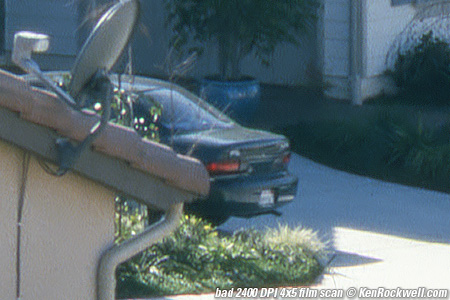
film @ 2400 dpi: http://www.kenrockwell.com/nikon/d200/images/film/2400dpi.jpg
Nikon D200: http://www.kenrockwell.com/nikon/d200/images/film/KEN_5127-nn.jpghttp://www.kenrockwell.com/nikon/d200/d200-vs-4x5.htm
Nice shots. -
Re:So, *will* it be missed?
Ken Rockwells scanned film vs digital camera images:
http://www.kenrockwell.com/tech/filmdig.htmFilm:
http://www.kenrockwell.com/tech/images/filmdig/4990scan.jpg
Digital camera:
http://www.kenrockwell.com/tech/images/filmdig/digital.jpg"If you do fret the pixel counts, I find that it takes about 25 megapixels to simulate 35mm film's practical resolution"
Camera was a $700 Tachihara 4x5". lens SChneider Symmar 150 mm f/5.6, film Fuji Velvia, scanner a cheap Epson 4990.
2003, $1500 Microtek 1800f scanner:
http://www.kenrockwell.com/tech/images/filmdig/1800fscan.jpg
2005, $500 Epson 4990 scanner:
http://www.kenrockwell.com/tech/images/filmdig/4990scan.jpgI don't know what digital camera he compared to.
film @ 2400 dpi: http://www.kenrockwell.com/nikon/d200/images/film/2400dpi.jpg
Nikon D200: http://www.kenrockwell.com/nikon/d200/images/film/KEN_5127-nn.jpghttp://www.kenrockwell.com/nikon/d200/d200-vs-4x5.htm
Nice shots. -
Re:So, *will* it be missed?
Ken Rockwells scanned film vs digital camera images:
http://www.kenrockwell.com/tech/filmdig.htmFilm:
http://www.kenrockwell.com/tech/images/filmdig/4990scan.jpg
Digital camera:
http://www.kenrockwell.com/tech/images/filmdig/digital.jpg"If you do fret the pixel counts, I find that it takes about 25 megapixels to simulate 35mm film's practical resolution"
Camera was a $700 Tachihara 4x5". lens SChneider Symmar 150 mm f/5.6, film Fuji Velvia, scanner a cheap Epson 4990.
2003, $1500 Microtek 1800f scanner:
http://www.kenrockwell.com/tech/images/filmdig/1800fscan.jpg
2005, $500 Epson 4990 scanner:
http://www.kenrockwell.com/tech/images/filmdig/4990scan.jpgI don't know what digital camera he compared to.
film @ 2400 dpi: http://www.kenrockwell.com/nikon/d200/images/film/2400dpi.jpg
Nikon D200: http://www.kenrockwell.com/nikon/d200/images/film/KEN_5127-nn.jpghttp://www.kenrockwell.com/nikon/d200/d200-vs-4x5.htm
Nice shots. -
Re:So, *will* it be missed?
Ken Rockwells scanned film vs digital camera images:
http://www.kenrockwell.com/tech/filmdig.htmFilm:
http://www.kenrockwell.com/tech/images/filmdig/4990scan.jpg
Digital camera:
http://www.kenrockwell.com/tech/images/filmdig/digital.jpg"If you do fret the pixel counts, I find that it takes about 25 megapixels to simulate 35mm film's practical resolution"
Camera was a $700 Tachihara 4x5". lens SChneider Symmar 150 mm f/5.6, film Fuji Velvia, scanner a cheap Epson 4990.
2003, $1500 Microtek 1800f scanner:
http://www.kenrockwell.com/tech/images/filmdig/1800fscan.jpg
2005, $500 Epson 4990 scanner:
http://www.kenrockwell.com/tech/images/filmdig/4990scan.jpgI don't know what digital camera he compared to.
film @ 2400 dpi: http://www.kenrockwell.com/nikon/d200/images/film/2400dpi.jpg
Nikon D200: http://www.kenrockwell.com/nikon/d200/images/film/KEN_5127-nn.jpghttp://www.kenrockwell.com/nikon/d200/d200-vs-4x5.htm
Nice shots. -
Re:So, *will* it be missed?
Ken Rockwells scanned film vs digital camera images:
http://www.kenrockwell.com/tech/filmdig.htmFilm:
http://www.kenrockwell.com/tech/images/filmdig/4990scan.jpg
Digital camera:
http://www.kenrockwell.com/tech/images/filmdig/digital.jpg"If you do fret the pixel counts, I find that it takes about 25 megapixels to simulate 35mm film's practical resolution"
Camera was a $700 Tachihara 4x5". lens SChneider Symmar 150 mm f/5.6, film Fuji Velvia, scanner a cheap Epson 4990.
2003, $1500 Microtek 1800f scanner:
http://www.kenrockwell.com/tech/images/filmdig/1800fscan.jpg
2005, $500 Epson 4990 scanner:
http://www.kenrockwell.com/tech/images/filmdig/4990scan.jpgI don't know what digital camera he compared to.
film @ 2400 dpi: http://www.kenrockwell.com/nikon/d200/images/film/2400dpi.jpg
Nikon D200: http://www.kenrockwell.com/nikon/d200/images/film/KEN_5127-nn.jpghttp://www.kenrockwell.com/nikon/d200/d200-vs-4x5.htm
Nice shots. -
Re:So, *will* it be missed?
Ken Rockwells scanned film vs digital camera images:
http://www.kenrockwell.com/tech/filmdig.htmFilm:
http://www.kenrockwell.com/tech/images/filmdig/4990scan.jpg
Digital camera:
http://www.kenrockwell.com/tech/images/filmdig/digital.jpg"If you do fret the pixel counts, I find that it takes about 25 megapixels to simulate 35mm film's practical resolution"
Camera was a $700 Tachihara 4x5". lens SChneider Symmar 150 mm f/5.6, film Fuji Velvia, scanner a cheap Epson 4990.
2003, $1500 Microtek 1800f scanner:
http://www.kenrockwell.com/tech/images/filmdig/1800fscan.jpg
2005, $500 Epson 4990 scanner:
http://www.kenrockwell.com/tech/images/filmdig/4990scan.jpgI don't know what digital camera he compared to.
film @ 2400 dpi: http://www.kenrockwell.com/nikon/d200/images/film/2400dpi.jpg
Nikon D200: http://www.kenrockwell.com/nikon/d200/images/film/KEN_5127-nn.jpghttp://www.kenrockwell.com/nikon/d200/d200-vs-4x5.htm
Nice shots. -
Re:So, *will* it be missed?
Ken Rockwells scanned film vs digital camera images:
http://www.kenrockwell.com/tech/filmdig.htmFilm:
http://www.kenrockwell.com/tech/images/filmdig/4990scan.jpg
Digital camera:
http://www.kenrockwell.com/tech/images/filmdig/digital.jpg"If you do fret the pixel counts, I find that it takes about 25 megapixels to simulate 35mm film's practical resolution"
Camera was a $700 Tachihara 4x5". lens SChneider Symmar 150 mm f/5.6, film Fuji Velvia, scanner a cheap Epson 4990.
2003, $1500 Microtek 1800f scanner:
http://www.kenrockwell.com/tech/images/filmdig/1800fscan.jpg
2005, $500 Epson 4990 scanner:
http://www.kenrockwell.com/tech/images/filmdig/4990scan.jpgI don't know what digital camera he compared to.
film @ 2400 dpi: http://www.kenrockwell.com/nikon/d200/images/film/2400dpi.jpg
Nikon D200: http://www.kenrockwell.com/nikon/d200/images/film/KEN_5127-nn.jpghttp://www.kenrockwell.com/nikon/d200/d200-vs-4x5.htm
Nice shots. -
Re:So, *will* it be missed?
Ken Rockwells scanned film vs digital camera images:
http://www.kenrockwell.com/tech/filmdig.htmFilm:
http://www.kenrockwell.com/tech/images/filmdig/4990scan.jpg
Digital camera:
http://www.kenrockwell.com/tech/images/filmdig/digital.jpg"If you do fret the pixel counts, I find that it takes about 25 megapixels to simulate 35mm film's practical resolution"
Camera was a $700 Tachihara 4x5". lens SChneider Symmar 150 mm f/5.6, film Fuji Velvia, scanner a cheap Epson 4990.
2003, $1500 Microtek 1800f scanner:
http://www.kenrockwell.com/tech/images/filmdig/1800fscan.jpg
2005, $500 Epson 4990 scanner:
http://www.kenrockwell.com/tech/images/filmdig/4990scan.jpgI don't know what digital camera he compared to.
film @ 2400 dpi: http://www.kenrockwell.com/nikon/d200/images/film/2400dpi.jpg
Nikon D200: http://www.kenrockwell.com/nikon/d200/images/film/KEN_5127-nn.jpghttp://www.kenrockwell.com/nikon/d200/d200-vs-4x5.htm
Nice shots. -
Re:Well...
Indeed. For most people, this simply means "I could make a buck or two", from something which most probably won't ever have any chance to be monetised.
For real photogs (and I mean, those who are already established professionally), there's a good chance their professional material never made it to Flickr anyhow. I allow myself to paraphrase Ken Rockwell by saying "If you want to take awesome pictures, around the world, and be allowed to take creative pictures in whichever you want, wherever and whenever you wish? Then remain an amateur, and never go professional!".
If this stuff pays for your yearly Flickr Pro subscription, you should be very grateful. I doubt anything else will ever come of it. -
Re:Don't care about more pixels
I'm assuming you're french, and therefore used "objective" instead of lens. There are a lot of photogs that indeed will throw huge amounts of money at their hardware, but to be honest it's usually a useless investment.
Also, why you'd be talking about glass in a thread that is specifically aimed at sensors beats me. You don't need 700mm at f/1. Plus, any body that you use with some Canon L is necessarily going to be full-frame, meaning you don't need to be at ISO 50. With full-frame, you can without any problem go up to ISO 400 and not notice any noise -- especially with fast lenses.
To be honest, you sound more like the arrogant paps who don't understand a whole lot about photography than a decent photog. Maybe you too tape up your lens' controls, and just know that you need to be at x meters from your target to be in focus?
You say you want more portable glass. However, you're still asking for a 700mm lens. You do realise, that in order to have 700mm lens at f/1, you need an entrance pupil with 700/1 = 700mm worth of diameter? Yup, that's right, 70cm of diameter in order to achieve f/1. Not sure that's ever going to be portable, mate.
Didn't think anyone would call your bluff out here, eh? -
Re:"Not for ________ use"
The guy Parent was arguing with was probably thinking of this link, scroll down to "See through clothing"
http://www.kenrockwell.com/tech/ir.htm
The link specifically states what the camera sees through is cotton, at the time this camera was released I believe swimsuits got all the attention.
-
Re:People aren't robots
That reminds me of once when I worked on a day that the rest of the office was completely empty. I don't think I was able to keep myself there past 7 hours total.
Of course when I spend the day in some coffee shop working on my own projects, I find myself to be much more focused and productive. Probably because it feels a lot more like "getting something done" and less like "putting in my hours against a charge number."
I also find the Two-Hour Rule to be an interesting (and probably valid) observation.
-
Re:If something does what it's designed to do...
I second mgblst! Megapixles Don't Matter!
I think the most important aspect of a digital camera is its micro controller. How quickly can it take photos? How long is the delay from when you push the button to when the photo is taken? "Ok ready? 1... 2... 3... Cheese!.. err. hold on. I think the flash is charging. Keep smiling. Fla Fla Fla Fla Fla Flash!'
Most annoying thing in the universe since Yellow Punch Buggy No Return! -
Your camera doesn't matter.
Read this and weep: http://www.kenrockwell.com/tech/notcamera.htm
Only a poor workman blames his tools.
-
Re:Any recommendations for a digital point-n-shoot
Can anyone recommend a digital point and shoot with RAW support for about $200-300?
I don't know what they're retailing for where you live, but the Nikon D40 is a great entry-level DSLR. It's small and lightweight, which might appeal to your girlfriend, it comes with a decent 18-50 mm kit lens and shoots RAW, although I generally set mine to shoot Fine quality jpeg.
I would also suggest checking out Ken Rockwell's site. He has great reviews and how-to articles that may be helpful before and after your purchase. I'm not connected to his site in any way, but consult it frequently.
-
Re:What about an XRay camera
I realize you're joking, but longer wavelength infrared cameras can partially see through some fabrics. I don't recall the model, but there was a consumer infrared camera taken off the market when this was discovered.
-
False
The megapixel war is very very very very very far from being anywhere even near over.
This confuses most people because they don't understand the that the CCD (the part of the camera that is replacing the film) isn't the same size in every camera.
There is the "digital" size (nikon calls it dx). This is low-end consumer level stuff. I know a nature photographer that shots on a d300 and loves it, but if you're really doing anything serious you want something called a "full-frame image sensor" (thats is: its just a little tiny bit smaller than a piece of 35mm film, unlike dx, which is much, much smaller. check out this Link for an idea of how hard you are being screwed on DX).
A "full frame" is bigger than "dx". (these are nikon's terms I know, but I shoot nikon and don't know as much about canon, sorry).
Full frame sensors are what you're going to find in "prosumer" and professional cameras (in nikon, the D700, the D3 and the D3x). These can shoot at higher isos (without TOO much noise).But that isn't where it ends...
There are also "medium format" digital cameras that are made by companies like PhaseOne and Hasselblad. These are NOT cameras that you are going to find at best buy, and probably not at your local camera shop either. These $30,000+ cameras shoot in the 100mp and up range...these are the cameras taking the photos you'll see on billboards, in magazines, or on the sides of buildings (and semi-trucks).
Consumer level stuff can stop at about 10mp, pro-level stuff cannot. There are people that even STILL insist on shooting film just simply for the resolution.
BTW, all of this is good for smart-prosumers...you can pick up the legendary hasselblad 500cm for ~$1200 now.
The point is: megapixel war was over for you nikon coolpix years and years ago...for pros it still rages on.
-
Re:Hi
I'm here at my desk, if anyone has questions
Do you get paid just to sit at your desk and post to Slashdot?
Or have you already worked your two hours today?
-
Re:photoshop all the easier...
The reign of Photoshop started years ago. It's no harder to manipulate a scanned negative or print than a digital original. Ken Rockwell is always touting how great his 175MP film scans look compared to anything digital has to offer, including the amazing 21MP shots from the EOS 5D mk II. His reviews wreak of flip-flopping bias both ways, but the numbers don't lie.
-
Re:Camera phones
I didn't ask for 22 megapixels just 3 or 4 http://www.slrtoday.com/articles/47/1/Photokina-Hasselblads-22-Megapixel-H3D-dSLR/Page1.html
if your argument is that standard 35mm cameras don't have good enough optics, there is someone with a 'cheap' 100 megapixel camera http://www.kenrockwell.com/tech/100mp.htm based on a 35mm film camera and a high resolution negative scanner.
i don't think a plastic protected optic enclosure requires not using decent quality optics allowing decent megapixels. the thin form factor of phones might put some restriction, as i recall even fixed lens 35mm cameras were pretty deep. but that gives you at least 100 megapixels, i was asking for 3-4.