Slashdot Mirror
Domain: kit.edu
Stories and comments across the archive that link to kit.edu.
Comments · 8
-
Re:Unrealistically limited view
Automatic translation of human language is solved long ago. (And again, this has nothing to do with AI, perhaps in the remotest sense only)
E.g. when Bill Gates announced at the university of Karlsruhe (http://www.kit.edu) that his next big goal is providing automatic translatiors for human speech, the audience laughed.
For some reason Mr. Gates was not aware that his speech was translated in real time by Prof. Waibels teams english to german translator. Prof. Waibel is working at the CMU and KIT http://isl.anthropomatik.kit.e...They use japanese as base language, and they have translators for plenty of languages from and to japanese.
Why no one is willing to buy that technology but insists to either develop their own mediocre versions of speech recognition and/or automatic translation is beyond me.
Needless to say that M$ and Gates never really started an automatic translating project.
-
Re:isn't this pretty straightforward?
Being a scientiest is what the course of the study is called.
So if the univeristy calls it 'computer sciense' I'm obviously a computer scientist.My papers and thesises are published at http://www.kit.edu/ and http://www.fzi.de/
-
Re:Pollution standards good, but untennable
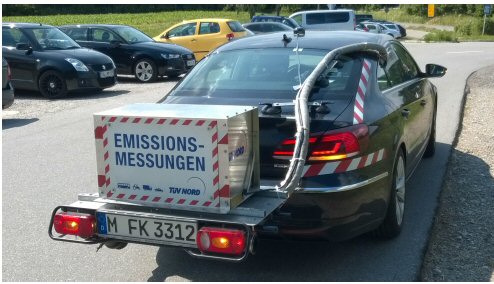
You have never seen one of these Portable Emissions Measurement Systems, have you? I doubt most car owners would be happy to be randomly selected to have their car fitted with such a system for an extended period.
-
Re:Dictionary Definition of Autopilot
Name one autopilot & vehicle that totally the vehicle's operator of all responsibility and need to be attentive.
You won't be able to, because none exist
They exist since decades. They just have not approval yet.BMW, Mercedes, Audi and Toyota all have 100% autonomous cars. I'm pretty sure there are more companies.
However we call them "autonomous driving" and not "autopilot".
A few populations, not about the state of the art though, but videos included
http://www.fzi.de/en/research/...
http://www.fzi.de/en/research/...
http://www.kit.edu/kit/english...
http://www.eetimes.com/documen...Question is when they will be market ready
-
Re:I'm sure weather will have no effect at all
The important facts are missing from both the summary and the English article. The german original has more info:
http://www.kit.edu/visit/pi_2013_12950.php
Basically, the important news is that they build new send/receive integrated chips that can be feed directly a optical link, transmit over radio waves and on the other side feed directly back to optical (fibre).
Formerly, you either have to:
* transcode from optical to radio link, and back on the other side, which is expensive (extra components), draws more power and is bulkier.
* OR use a laser, which is optical, and thus skips the transcoding, but fares bad in wether conditions like rain and fog
The new system combines the advantage of having an small 84x1.5mm) integrated chip system, which uses less power and can thus be cheaper with the advantage of a radio link over a laser link.
Of course it won't be unaffected by weather like a fibre laying in the ground - but it is still better (smaller, more robust, and still as simple as) than the existing laser links. And it is meant to be used where you can't just lay a cable, anyway.
-
Re:Hahahahahahahaha Muahaha
IIRC, to this day, EDU and GOV are only open for US based registrants, and are in no way "generic".
polytechnique.edu
solvay.edu
nist.edu (an unexpected one, with no relation whatsoever to nist.gov...)
kit.edu
au.edu -
Re:Wi-Fi? Seriously?
Looks like www.gcdc.net has been Slashdotted, here are a few links that might be interesting: (they actually use 5.9 GHz communications, 802.11p specifically for use in intelligent transportation systems) Movie from the preparations to the challenge, lots of nerds and tech: http://youtu.be/lmRifLzw8iA Winning team technical paper: http://www.mrt.kit.edu/annieway/downloads/gcdc11_team_description.pdf Runner up technical paper: http://www.hh.se/download/18.7a4c72f812fdb65798d80003243/IDE1120KLTechReportTeamPaper.pdf
-
Re:I wasn't buying it ...
Here is the link: http://www.kit.edu/english/pi_2010_767.php
It's right there in the article
OTOH, off course we've been able to reduce the size and cabling of many inventions, but for others, it's impossible. Basically, when the technique itself involves cabling
What I mean is: Sure, we've been able to reduce electrocardiograms from huge mechanical machines with shitloads of cables to small devices connected to a computer and only 5 cables, but it still involves connecting cables into your chest, and It most probably always will.
This technique:
a) Has nothing at all to do with cellphones. It's just one possible application.
b) Involves and will always involve cables. Off course, we might develop OTHER techniques in the future that don't involve reading electrical signals on the body, but that'll be a whole different technology, maybe involving a camera and feature detectionThe fact that we can probably emulate something like this in OpenCV and maybe port it to the iphone is not the same as saying that this technique equals being able to use your cellphone without actually emitting sounds.